+


Students perception of a blended learning program of
teacher education in an adult education center (Belgium,
Flanders)
Elearn Montreal 9 – 12 october 2012

Yves Blieck, Agnes Toison, Karen De Baere, Lut Lippeveld
+
    Content

       Some facts and figures


       Practice Based Research


       Blended program in teacher education


           The program

           Coaching and assessement in the program
Blended learning in a teacher
         education program

+                -
         Facts and figures
+
    Program and students


    Teacher education program
    (CVO De Oranjerie)


        60 ECTS – 45 blend + 15 internship
      Duration 1 – 2 y
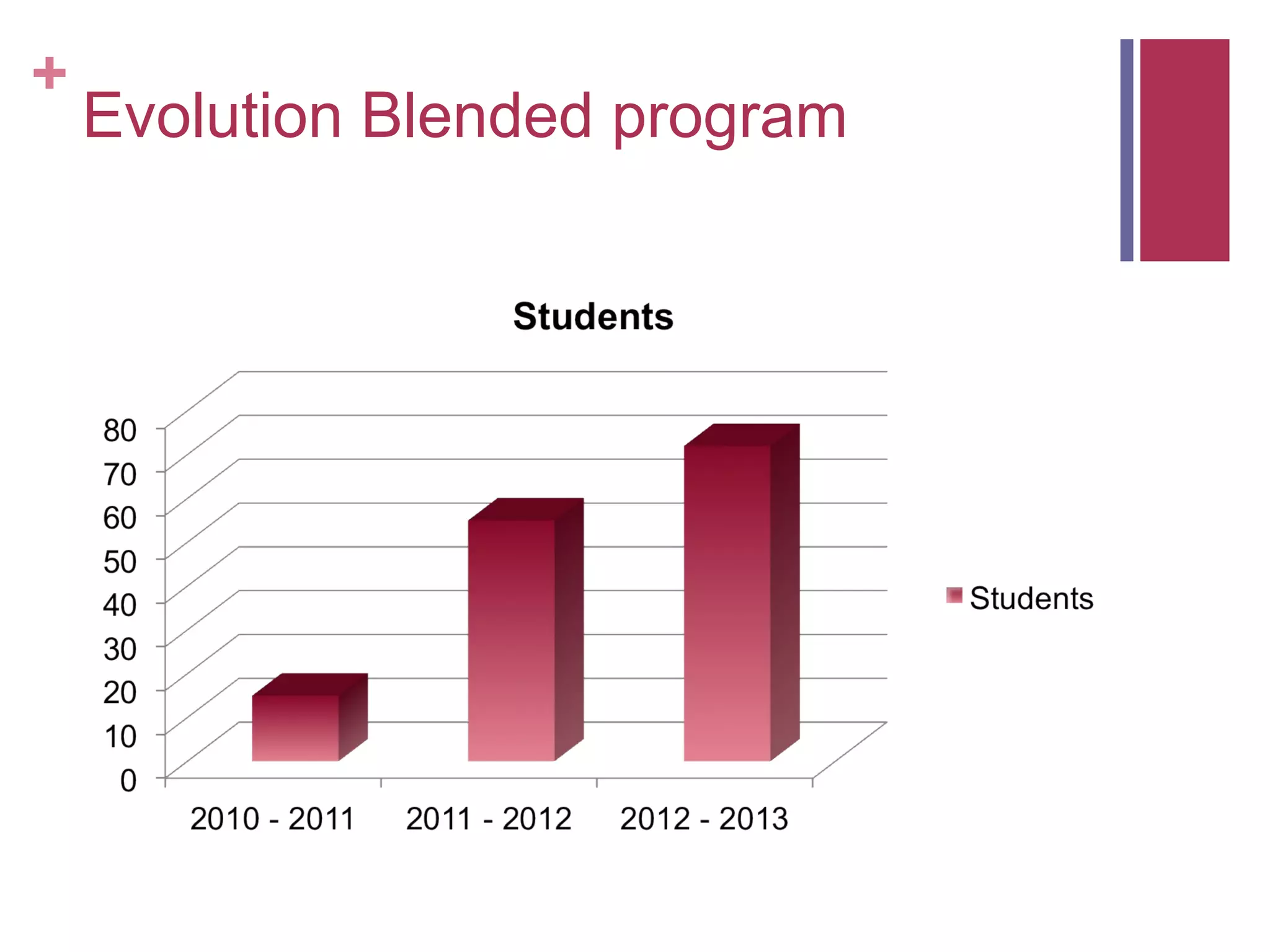
      # students a year = +/- 500
      Career switchers
      +/- 200 graduate each year
+
    Evolution Blended program
+
    Practice Based Research
+
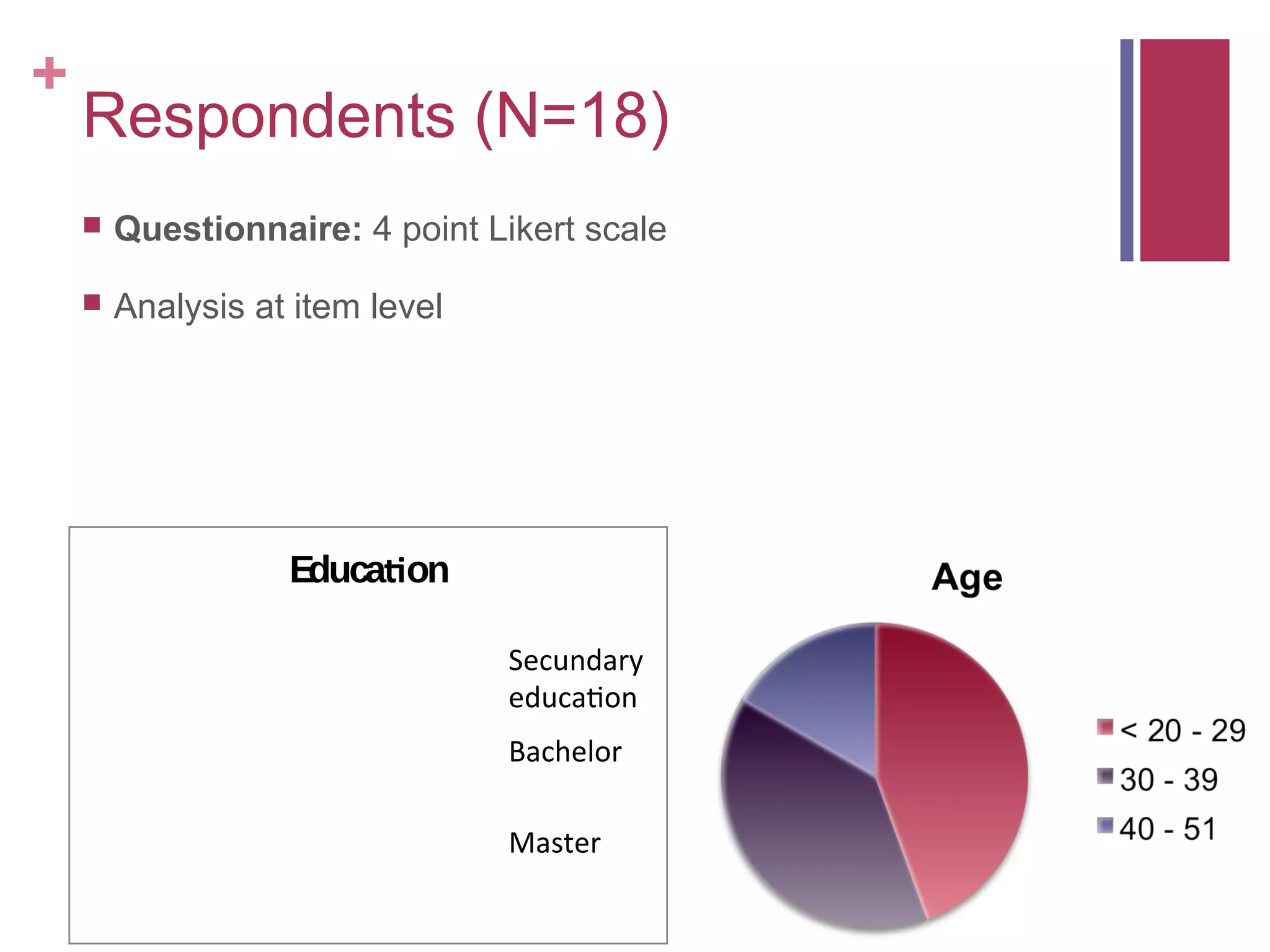
    Respondents (N=18)
       Questionnaire: 4 point Likert scale

       Analysis at item level


                   Educa on

                                 Secundary
                                 educa on
                                 Bachelor

                                 Master
+
    Questions

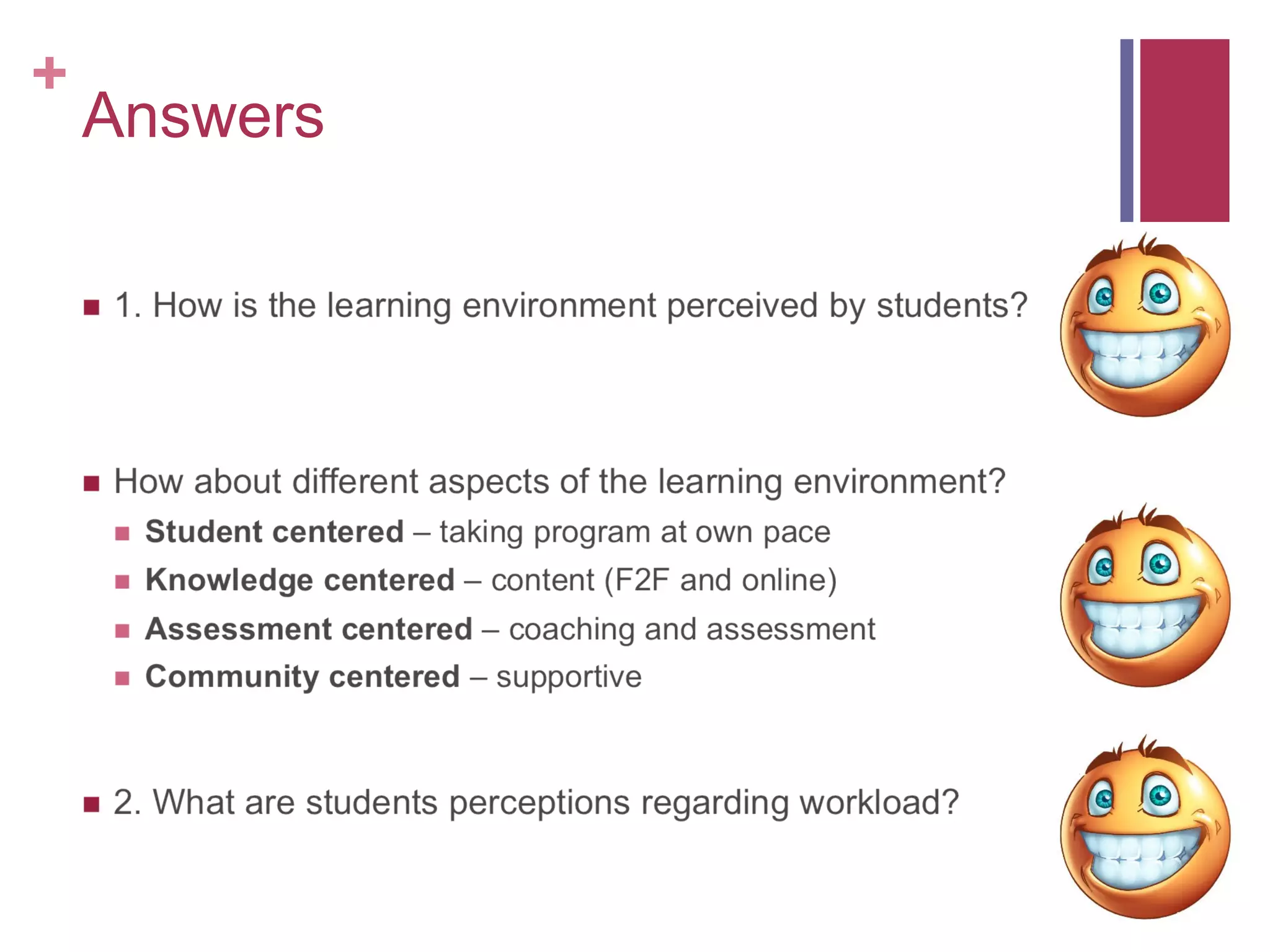
       1. How is the learning environment perceived by students?


       2. What are students perceptions about workload?
+


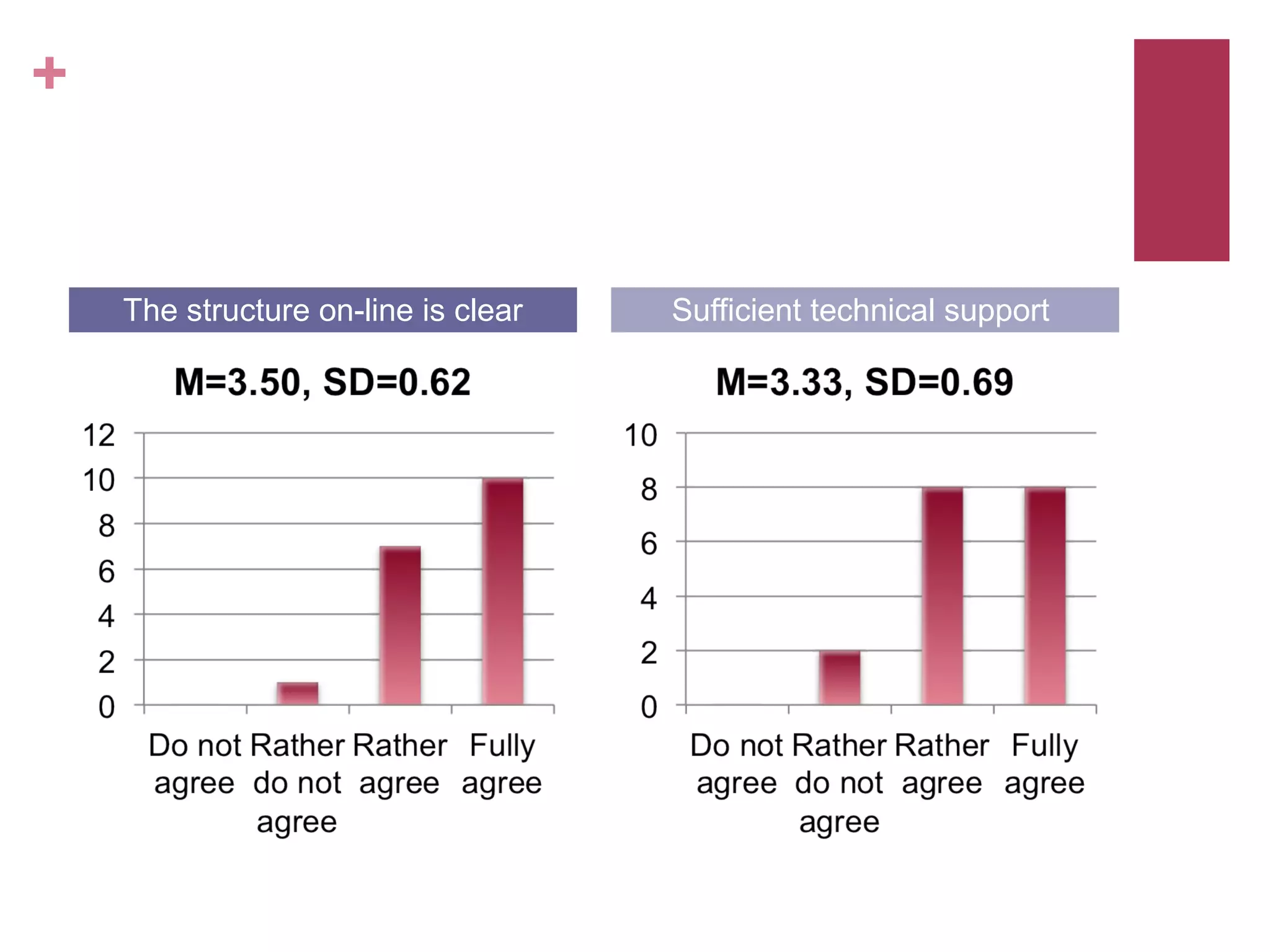
    The structure on-line is clear   Sufficient technical support
+


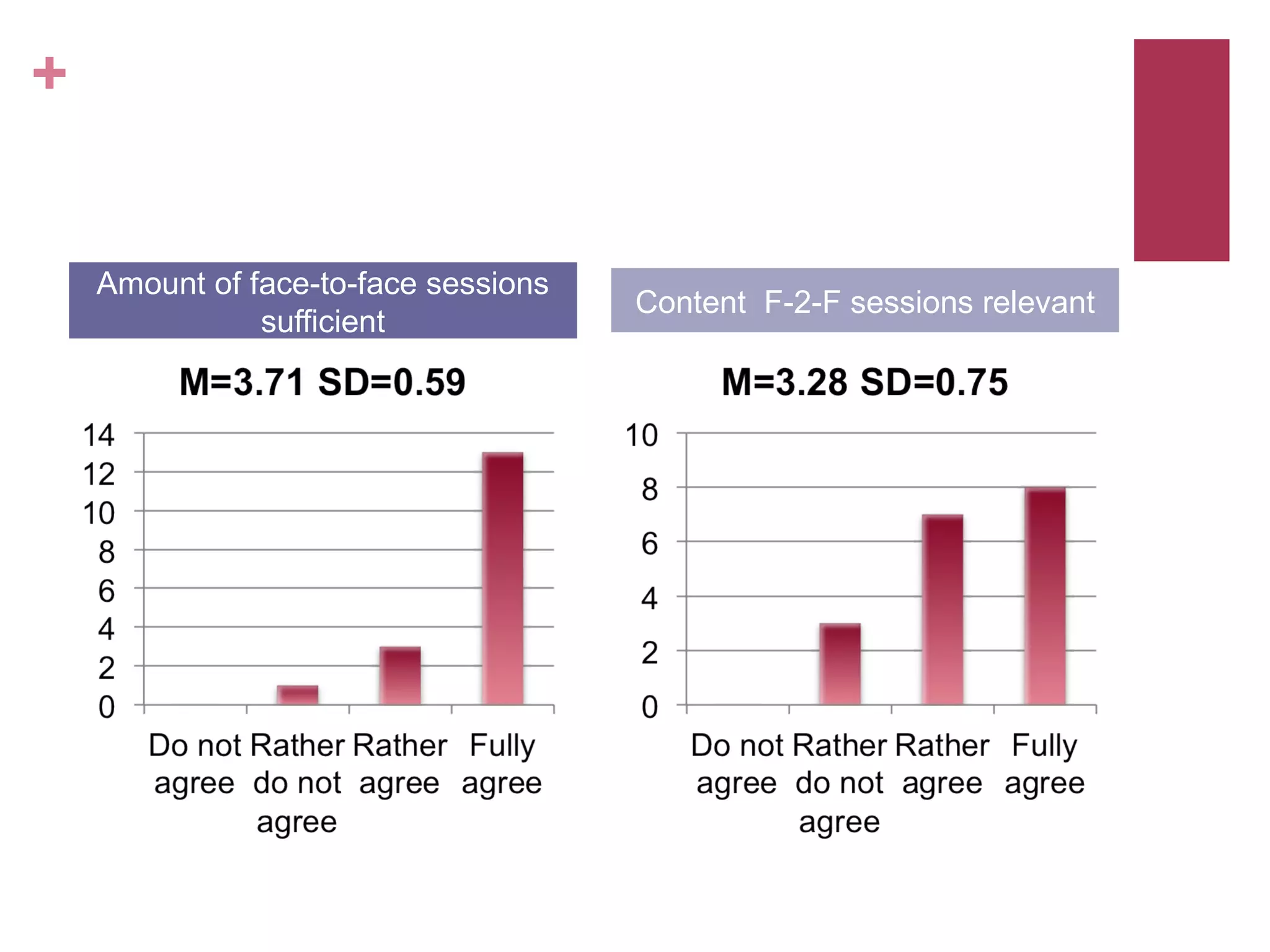
    Amount of face-to-face sessions
                                      Content F-2-F sessions relevant
               sufficient
+

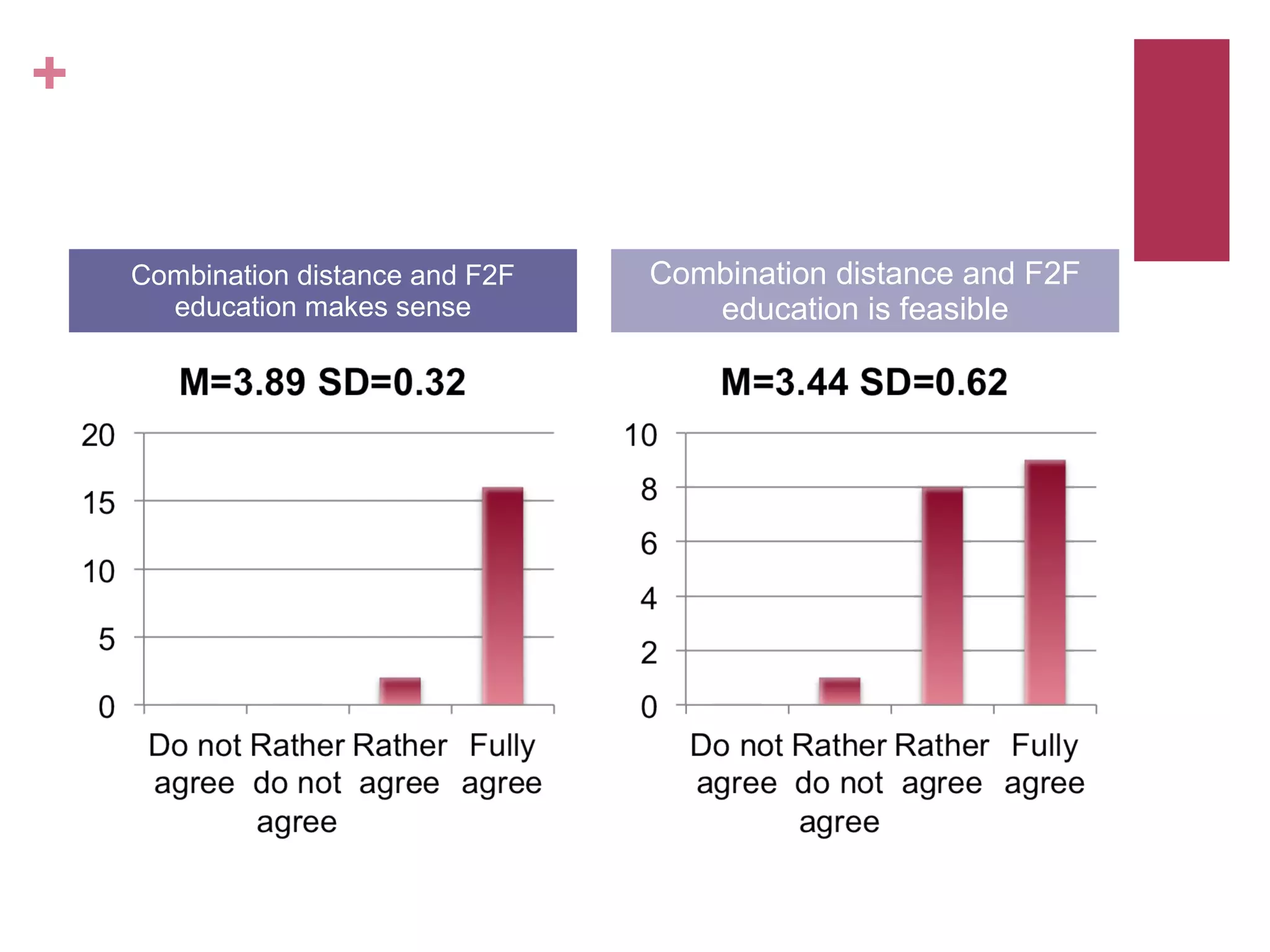
    Combination distance and F2F   Combination distance and F2F
      education makes sense           education is feasible
+


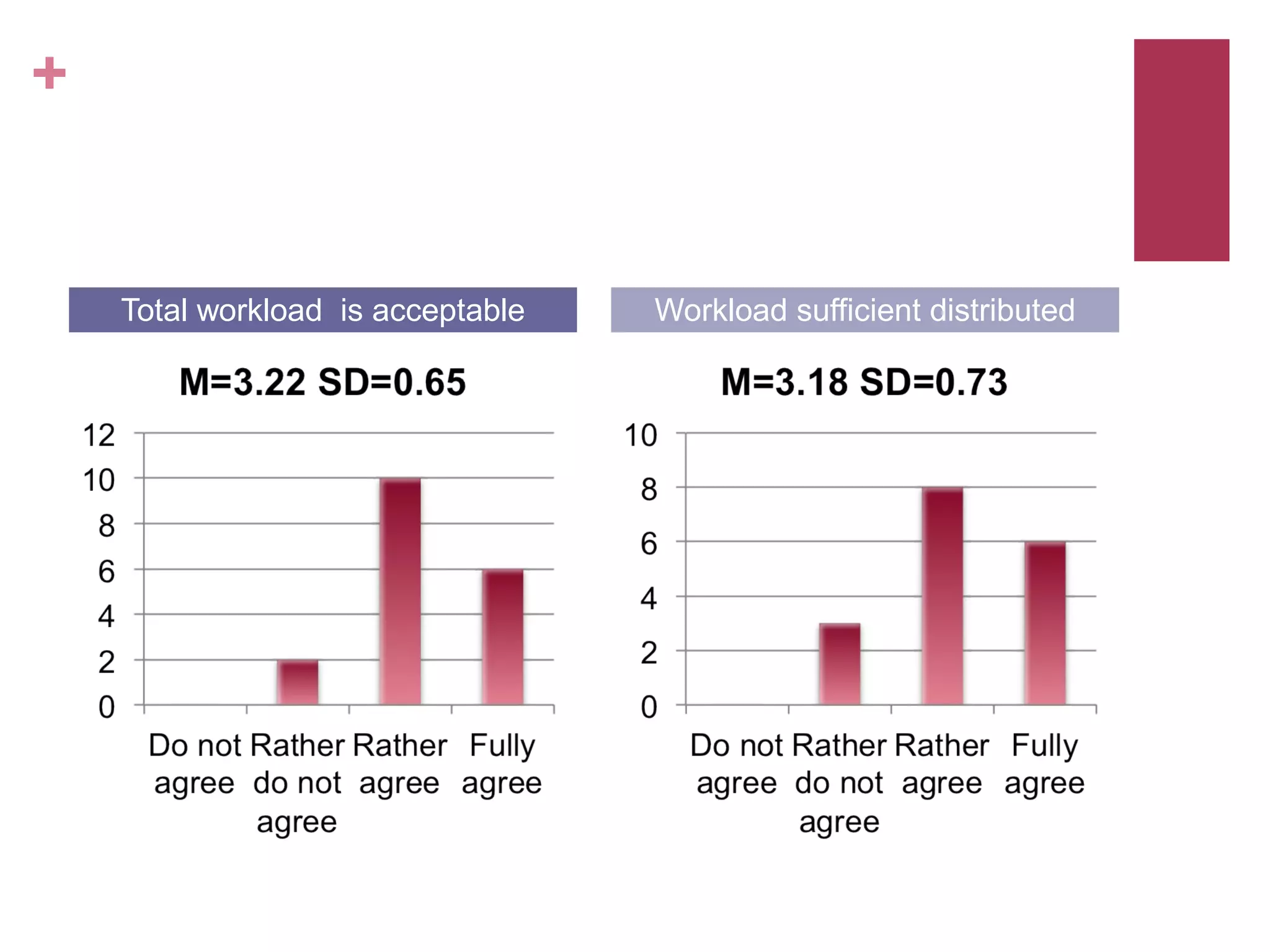
    Total workload is acceptable   Workload sufficient distributed
+


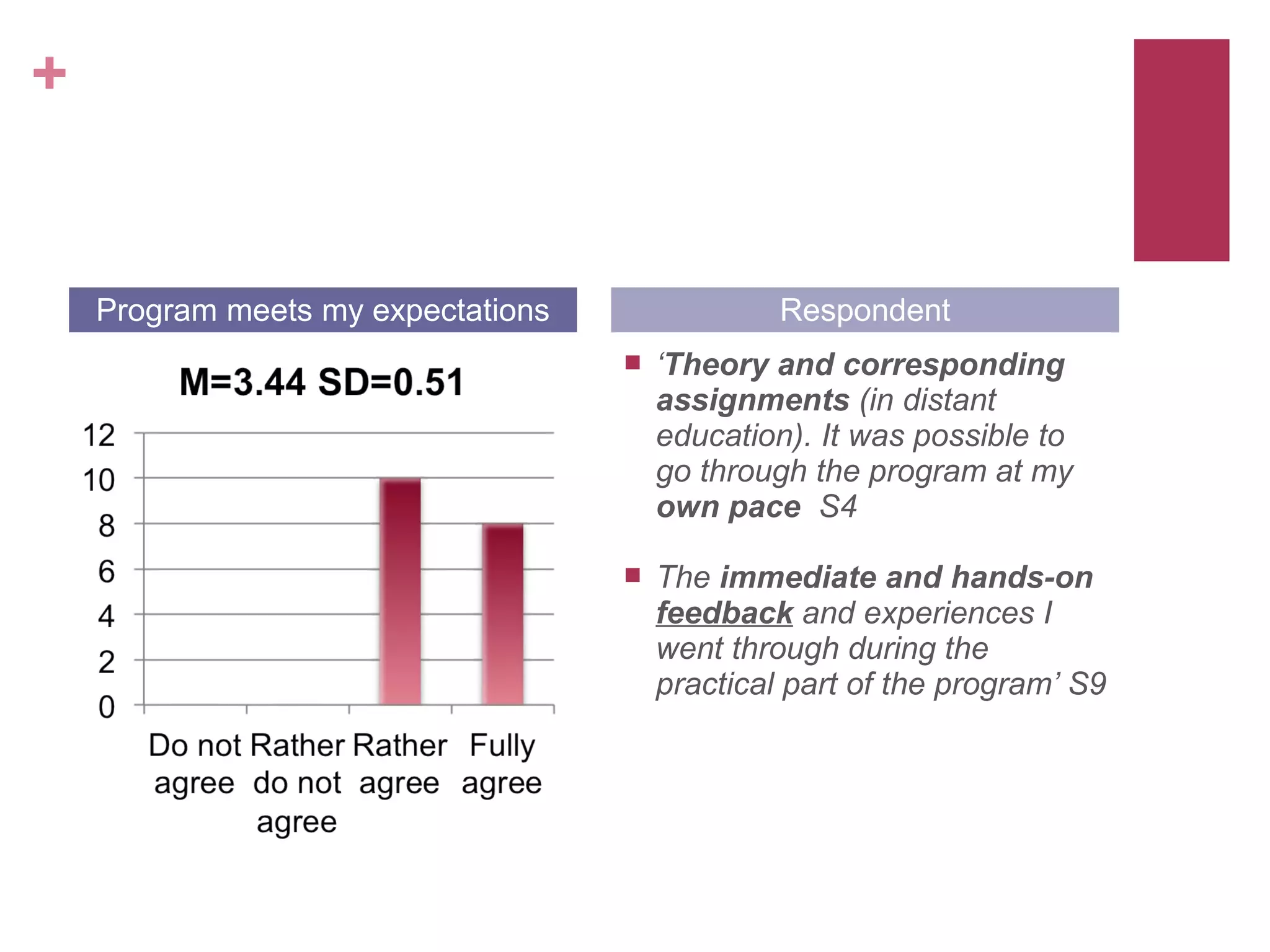
    Program meets my expectations                Respondent
                                       ‘Theory and corresponding
                                        assignments (in distant
                                        education). It was possible to
                                        go through the program at my
                                        own pace S4

                                       The immediate and hands-on
                                        feedback and experiences I
                                        went through during the
                                        practical part of the program’ S9
+


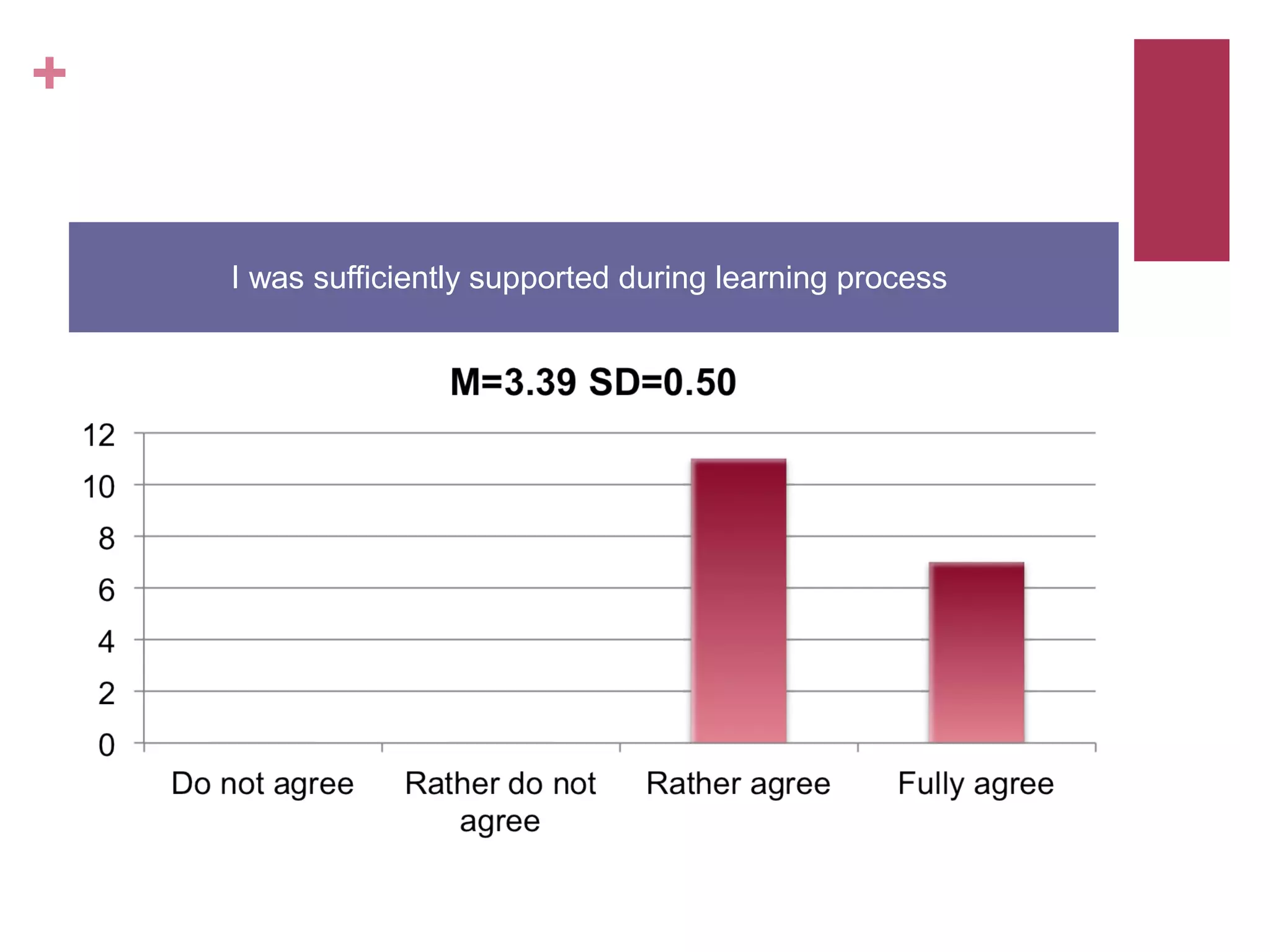
    I was sufficiently supported during learning process
+

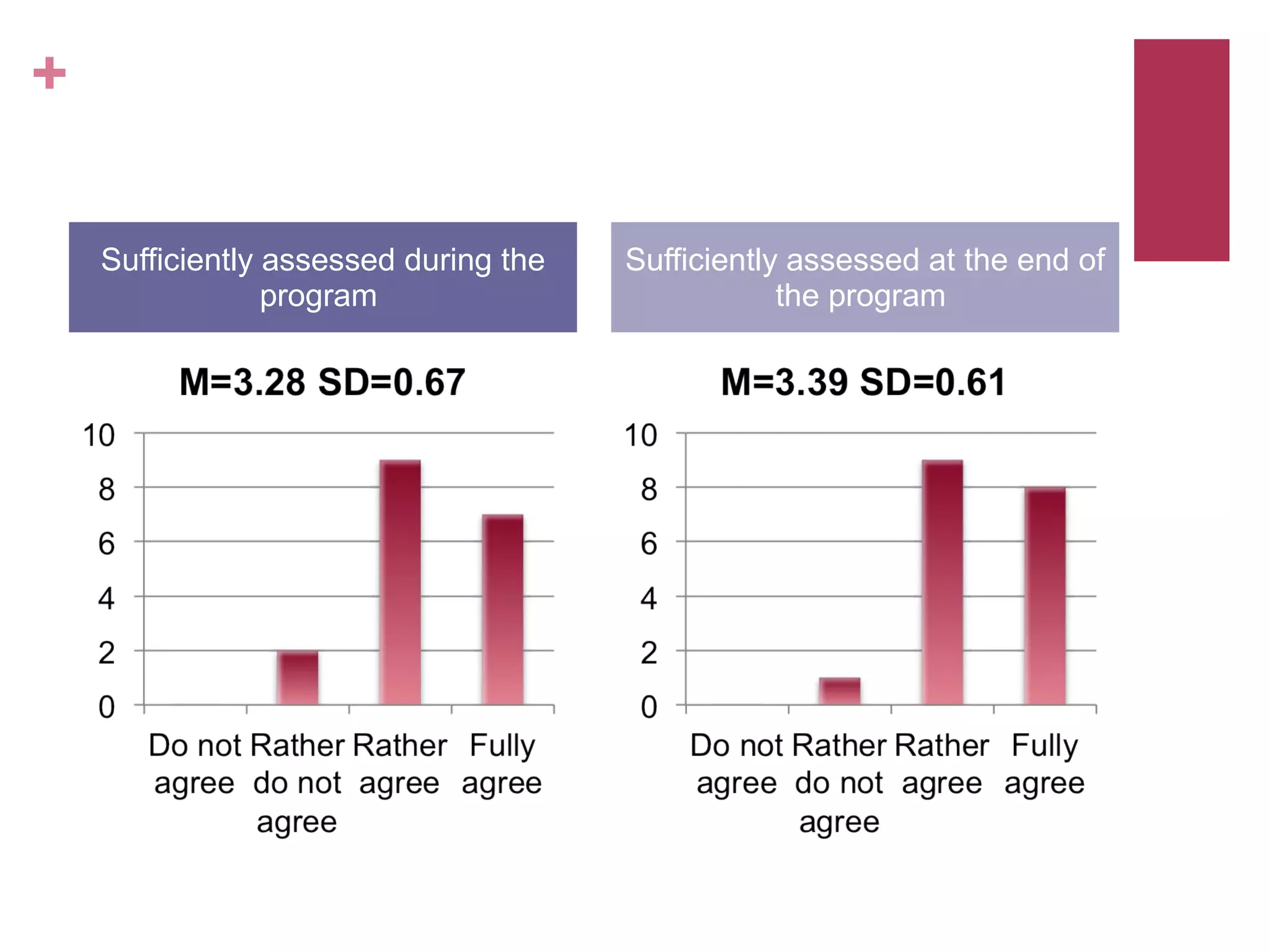
    Sufficiently assessed during the   Sufficiently assessed at the end of
                 program                           the program
+


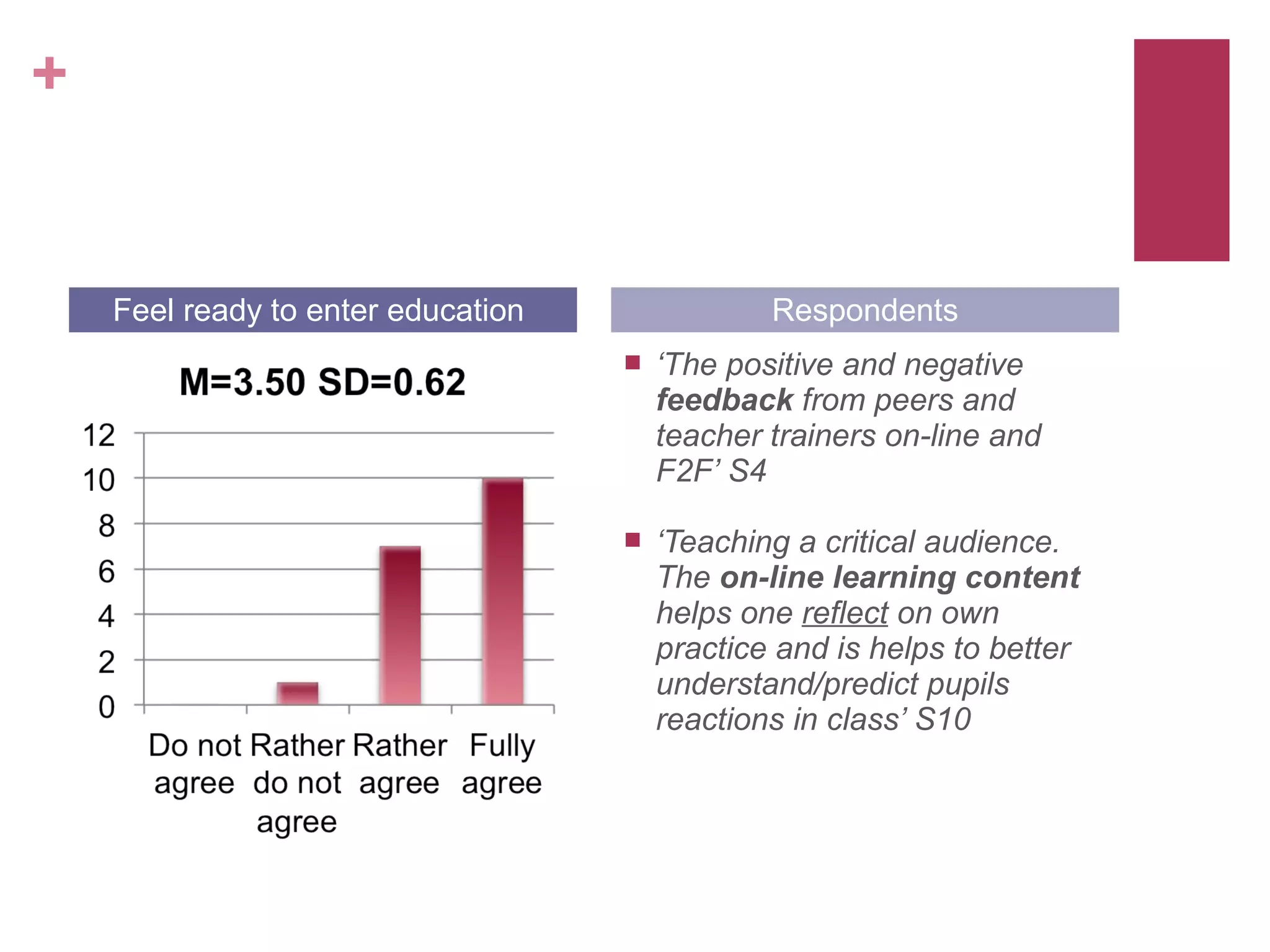
    Feel ready to enter education               Respondents
                                       ‘The positive and negative
                                        feedback from peers and
                                        teacher trainers on-line and
                                        F2F’ S4

                                       ‘Teaching a critical audience.
                                        The on-line learning content
                                        helps one reflect on own
                                        practice and is helps to better
                                        understand/predict pupils
                                        reactions in class’ S10
+
    Answers
+
    BUT…

     Limitations         / further research
        Small sample

        Selection bias (intake)

        Learning outcomes?

        Employability and success in education (attrition)?

        …
+
    Blended program
+
    Why Blended program?

       Transforming: move further (to meet
        more the needs target group)
        Enabling: increase access to program +
        flexible program
        Enhancing: increase productivity and re-
        invest ‘gain’ into education


    Shea, (2007), Garrison and Kanuka (2004), Graham and
     Robinson (2007)
+
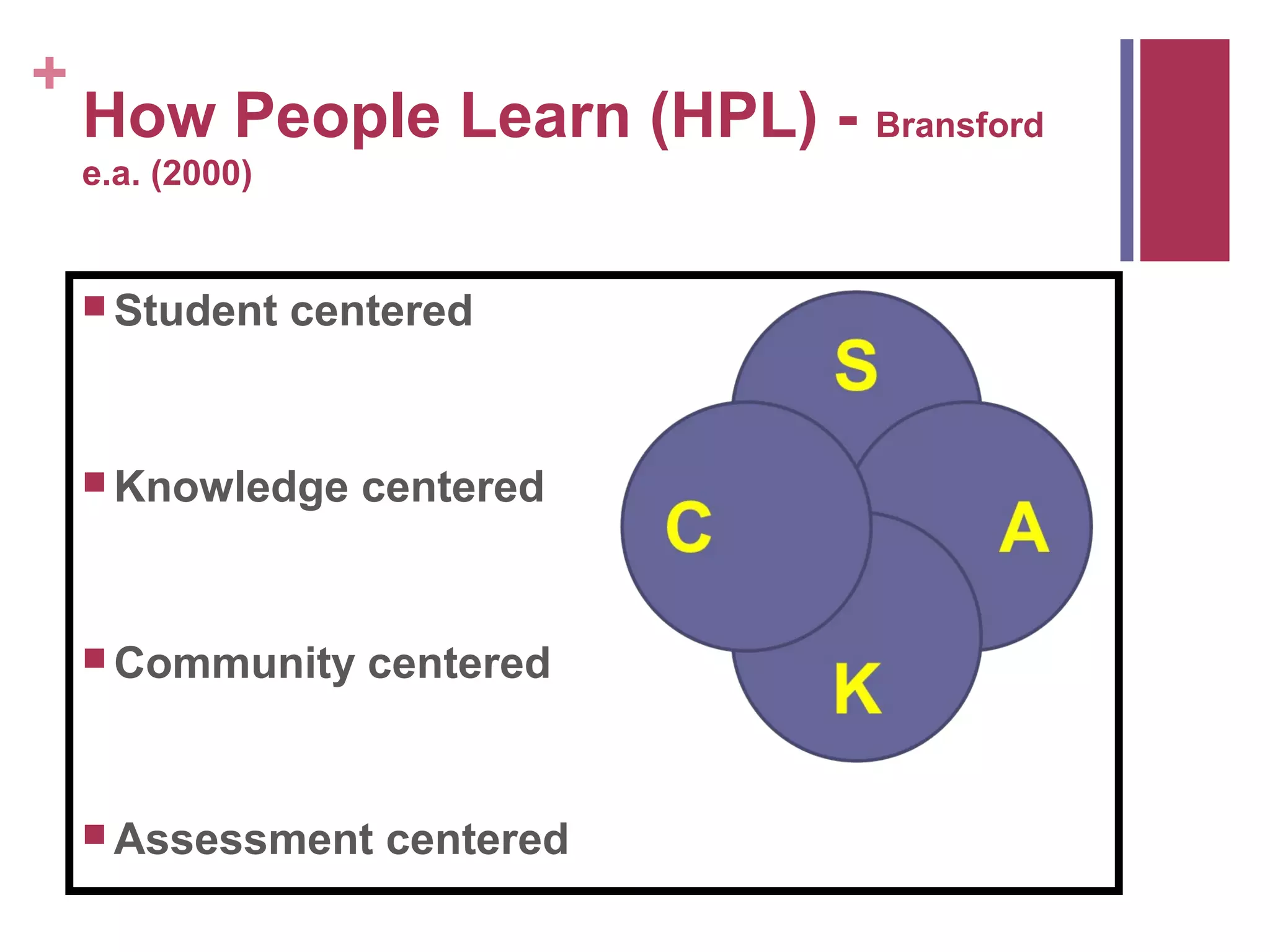
    How People Learn (HPL) - Bransford
    e.a. (2000)


     Student     centered


     Knowledge      centered


     Community      centered


     Assessment      centered
+
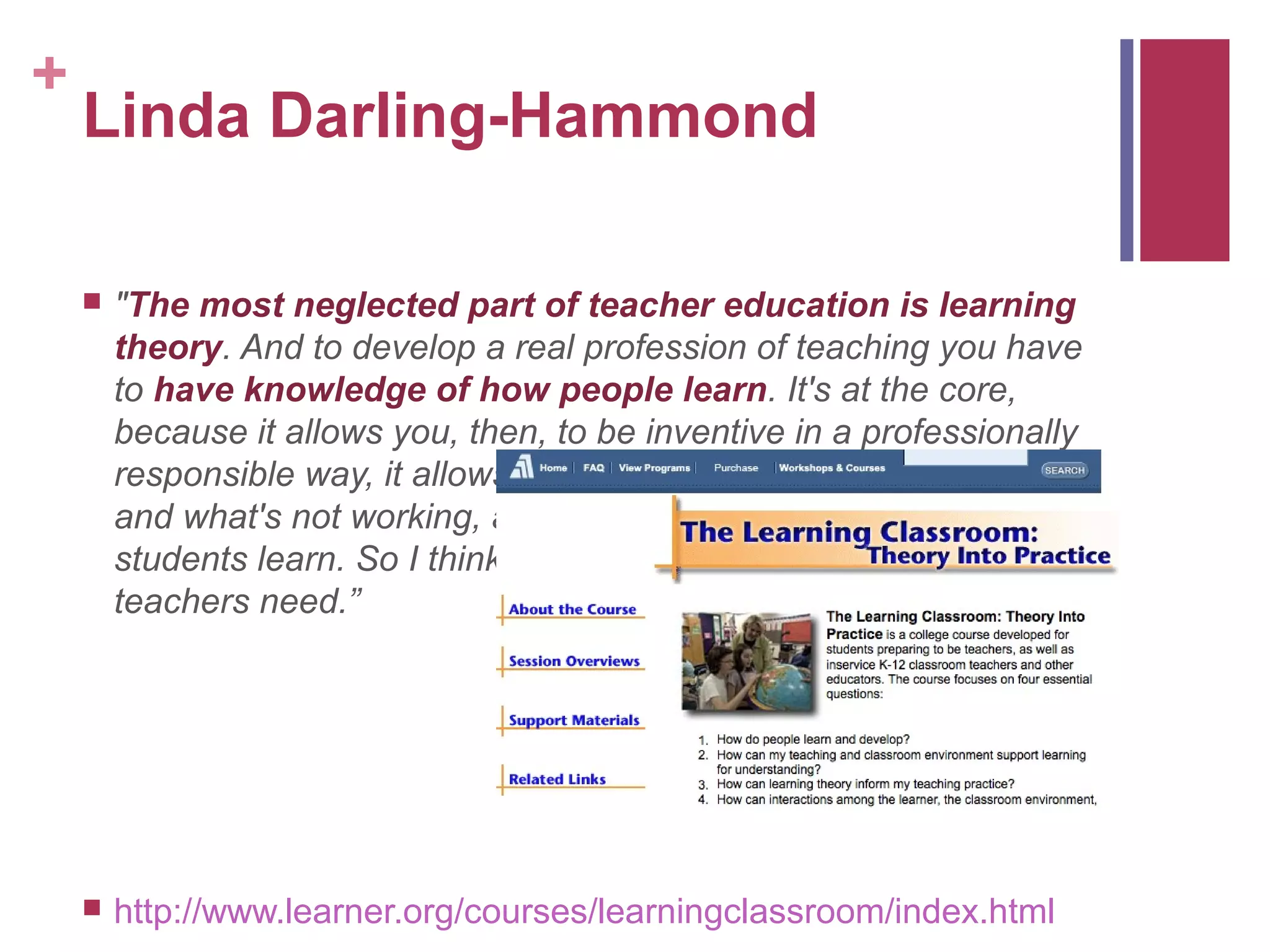
    Linda Darling-Hammond

       "The most neglected part of teacher education is learning
        theory. And to develop a real profession of teaching you have
        to have knowledge of how people learn. It's at the core,
        because it allows you, then, to be inventive in a professionally
        responsible way, it allows you to think about what's working
        and what's not working, and what you need to do to help
        students learn. So I think this is the core of what professional
        teachers need.”


       http://www.learner.org/courses/learningclassroom/index.html
+ How was this translated in
     our Blended program?
+
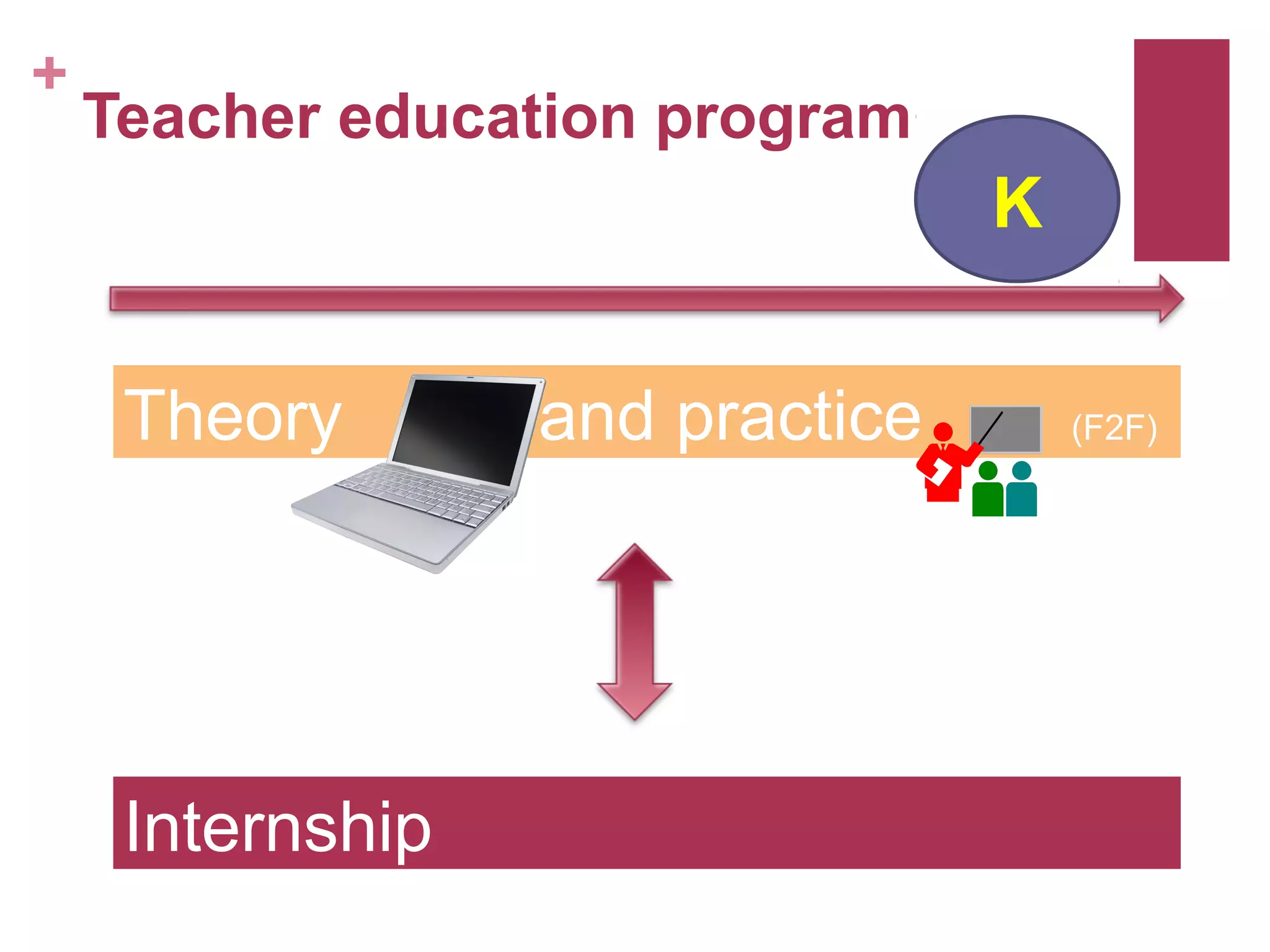
    Teacher education program
                                 K


     Theory       and practice       (F2F)


     Internship
+
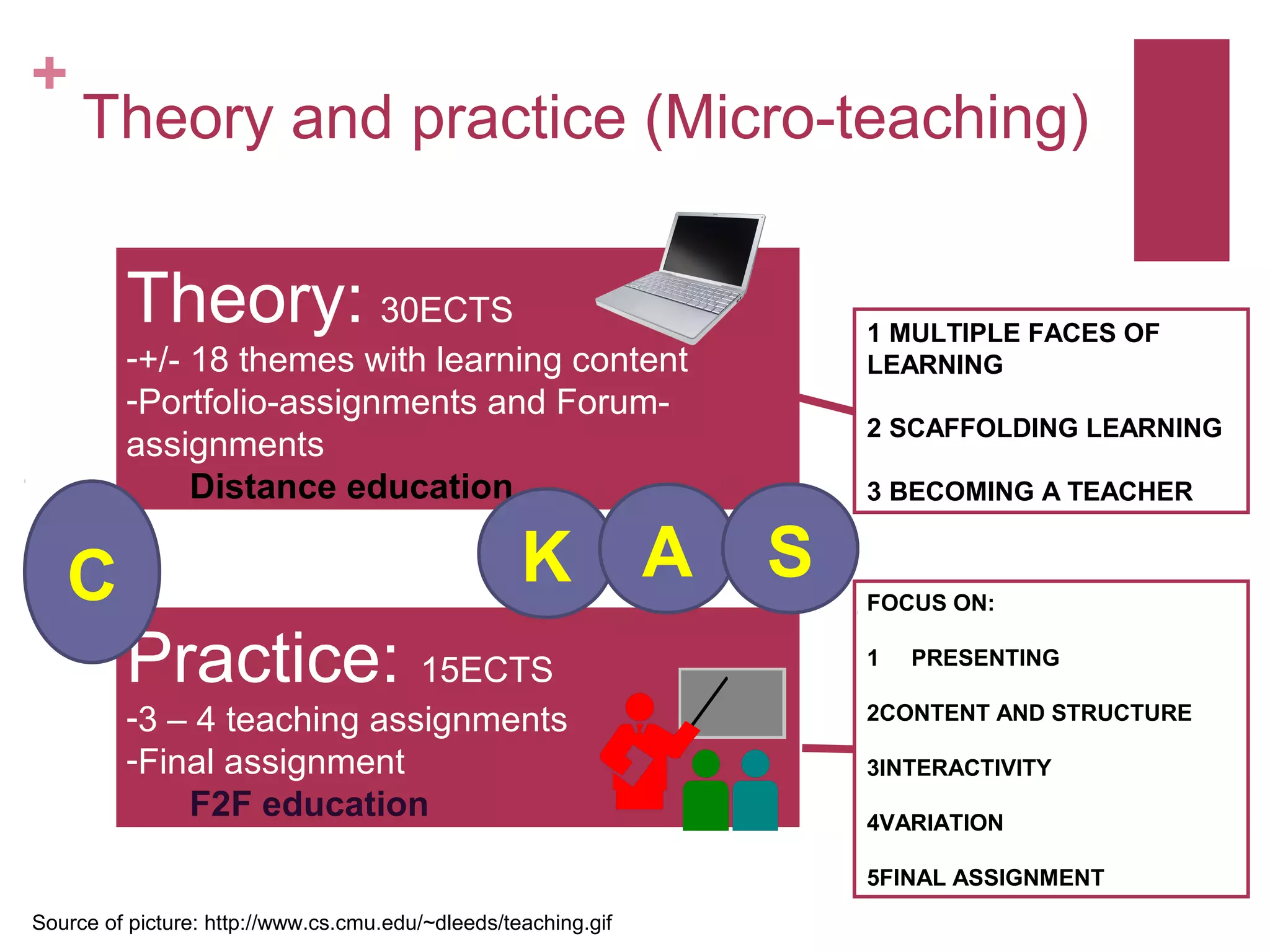
     Theory and practice (Micro-teaching)

         Theory: 30ECTS                                             1 MULTIPLE FACES OF
         -+/- 18 themes with learning content                       LEARNING
         -Portfolio-assignments and Forum-
                                                                    2 SCAFFOLDING LEARNING
         assignments
              Distance education                                    3 BECOMING A TEACHER


   C                                               K A          S   FOCUS ON:


         Practice: 15ECTS                                           1   PRESENTING

         -3 – 4 teaching assignments                                2CONTENT AND STRUCTURE

         -Final assignment                                          3INTERACTIVITY
             F2F education                                          4VARIATION

                                                                    5FINAL ASSIGNMENT
Source of picture: http://www.cs.cmu.edu/~dleeds/teaching.gif
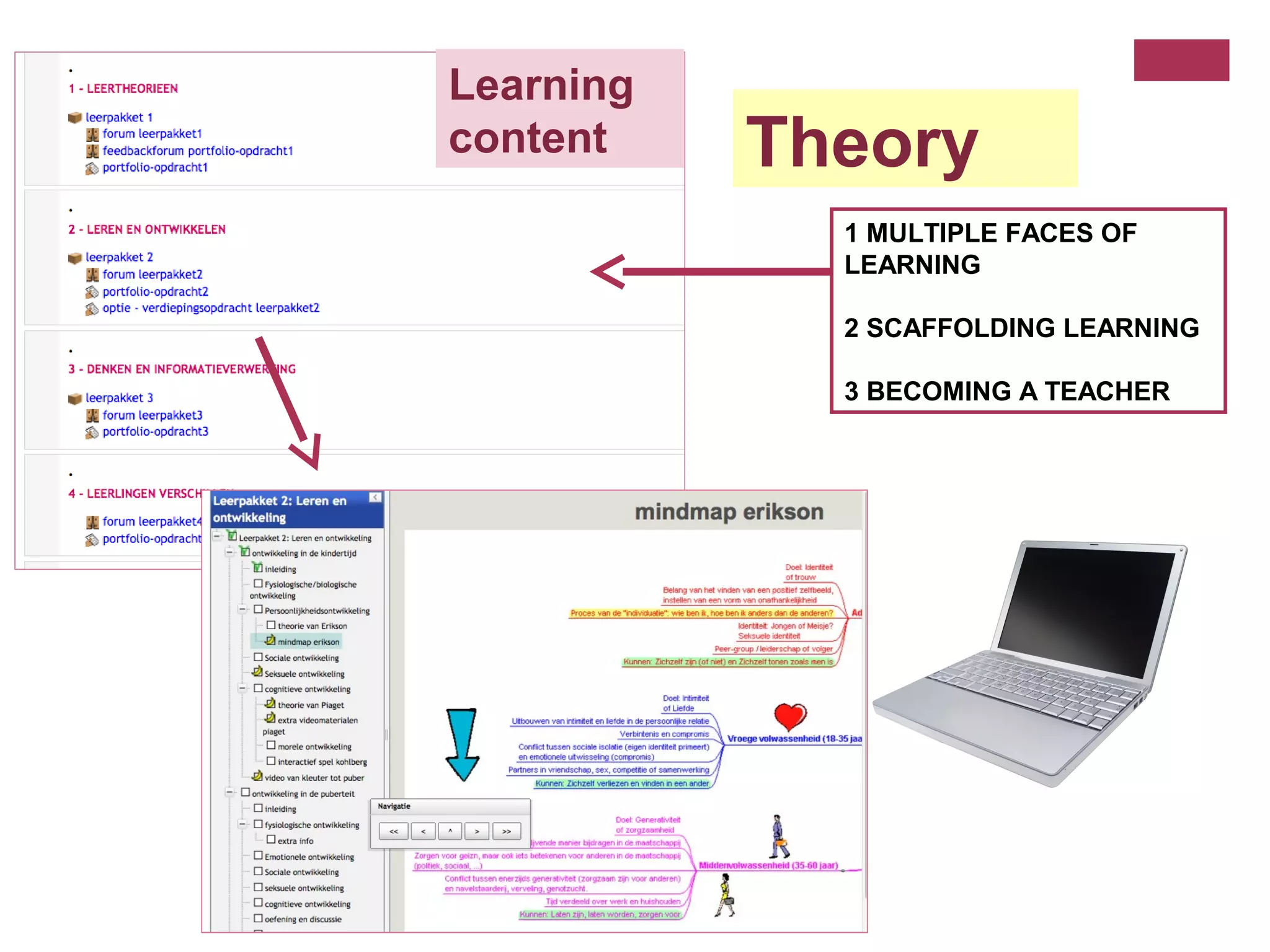
Learning
content    Theory
             1 MULTIPLE FACES OF
             LEARNING

             2 SCAFFOLDING LEARNING

             3 BECOMING A TEACHER
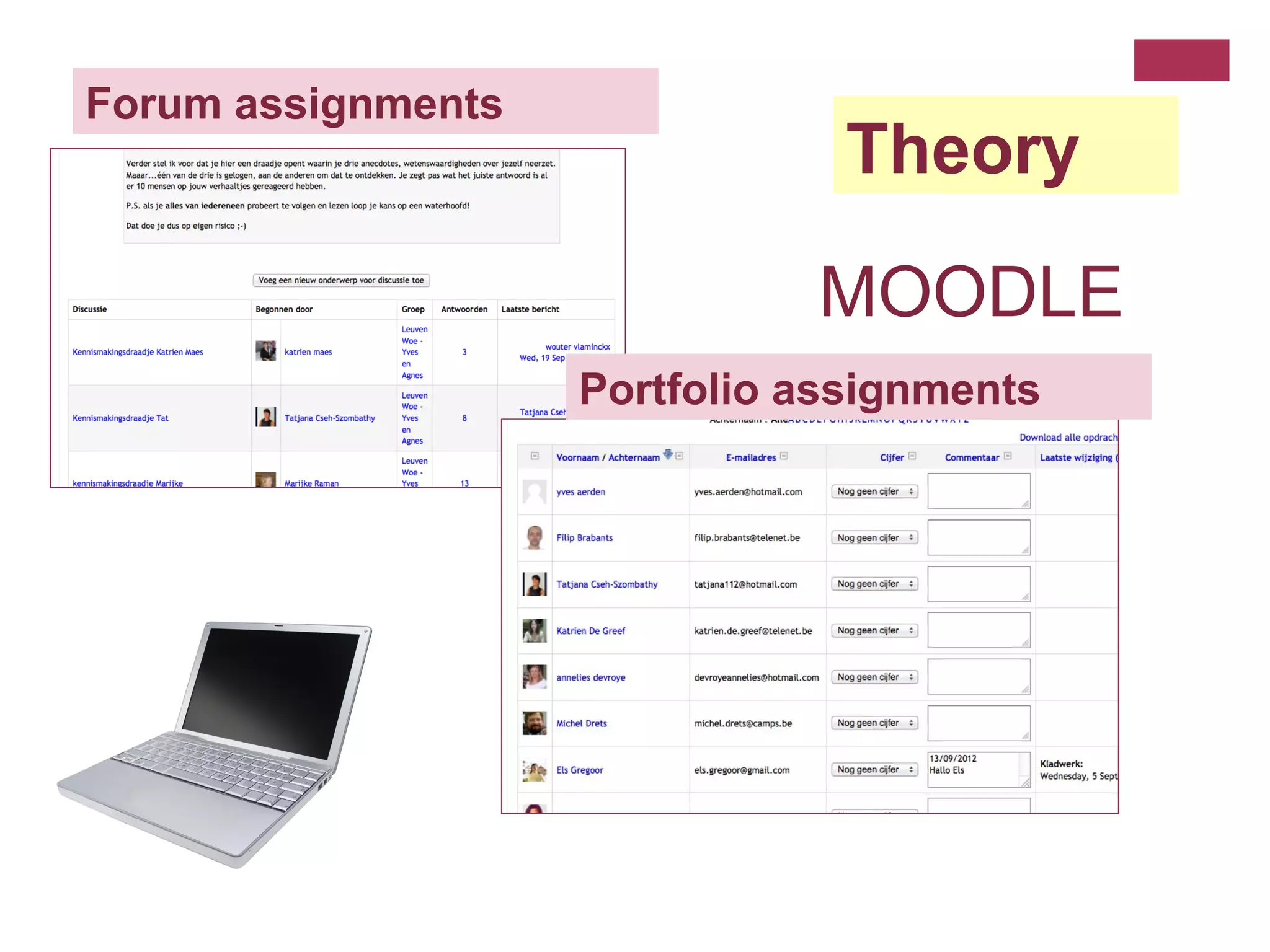
Forum assignments
                                Theory

                              MOODLE
                    Portfolio assignments
+
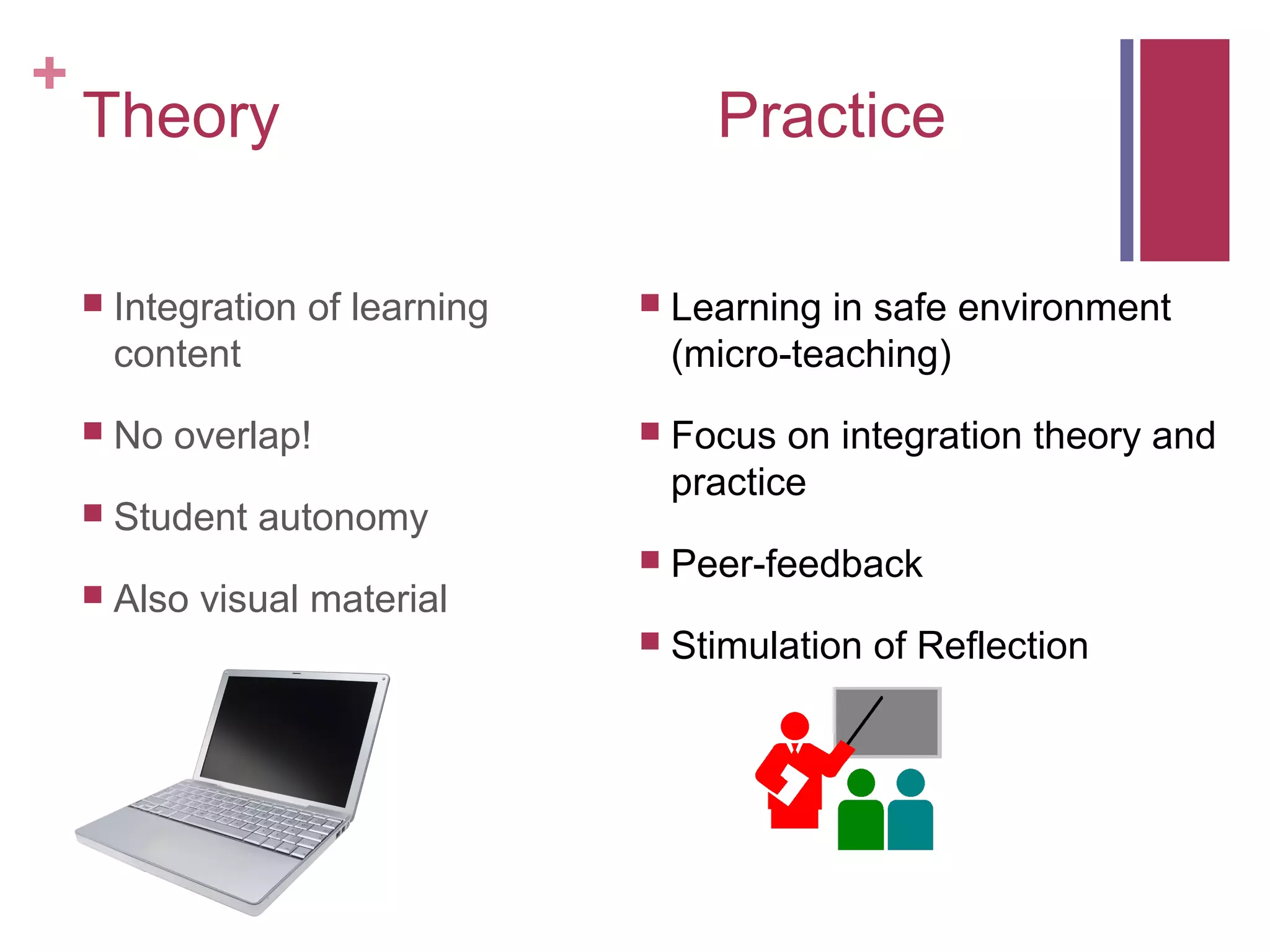
    Theory                              Practice

       Integration of learning      Learning in safe environment
        content                       (micro-teaching)
       No overlap!                  Focus on integration theory and
                                      practice
       Student autonomy
                                     Peer-feedback
       Also visual material
                                     Stimulation of Reflection
+
    Coaching and assessment
    From intake to graduation
+
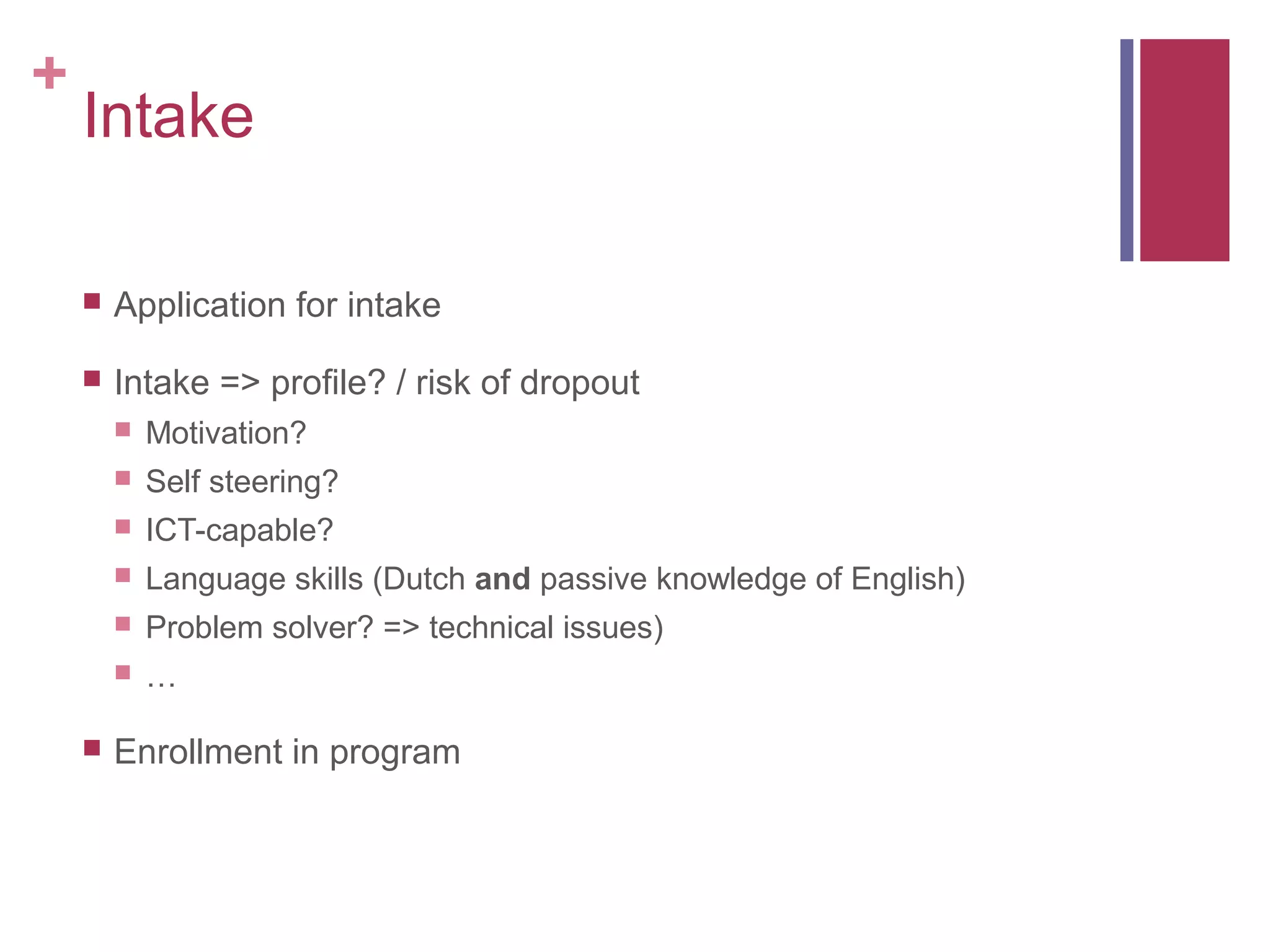
    Intake

       Application for intake

       Intake => profile? / risk of dropout
           Motivation?
           Self steering?
           ICT-capable?
           Language skills (Dutch and passive knowledge of English)
           Problem solver? => technical issues)
           …

       Enrollment in program
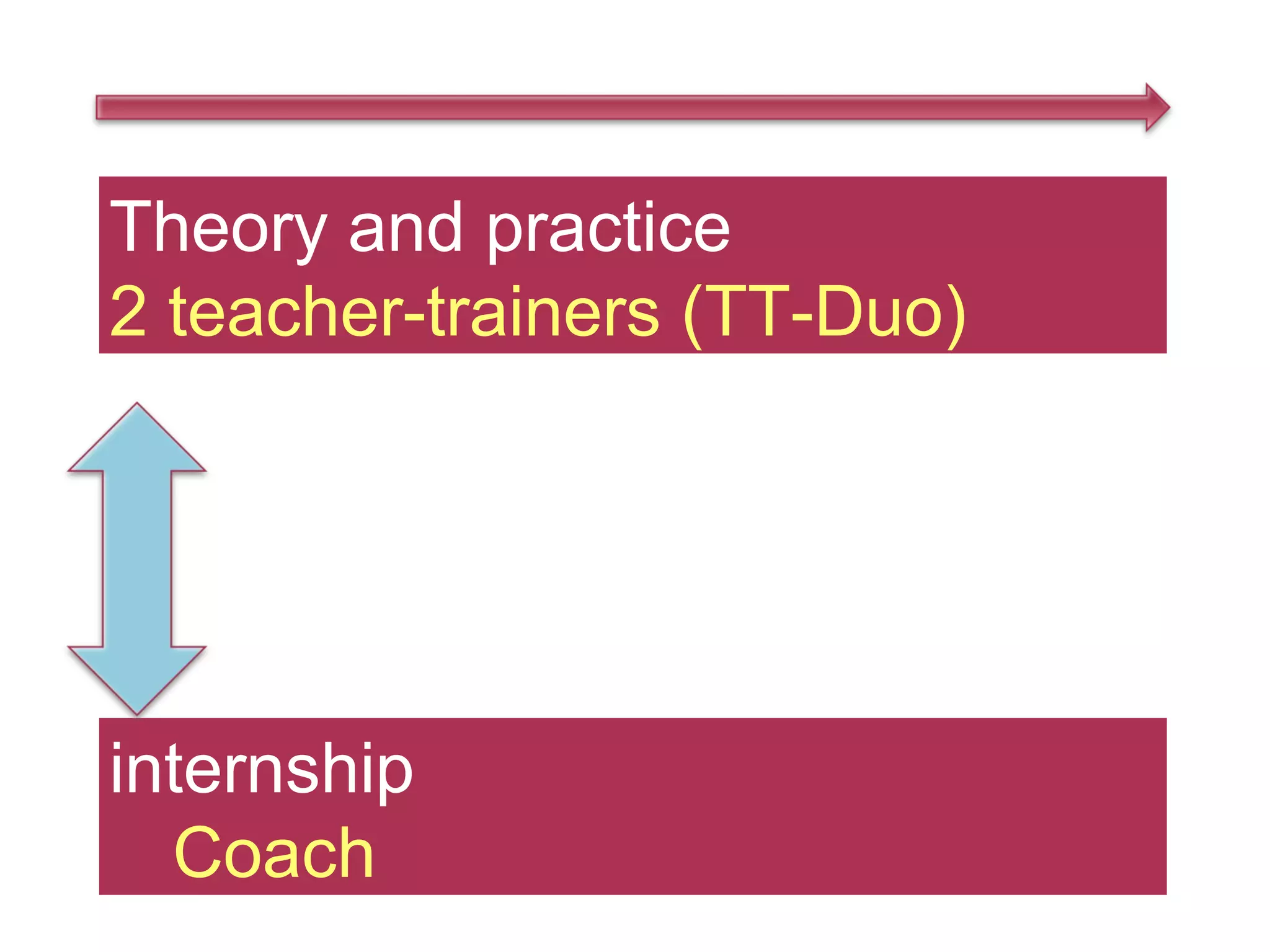
Theory and practice
2 teacher-trainers (TT-Duo)


internship
  Coach
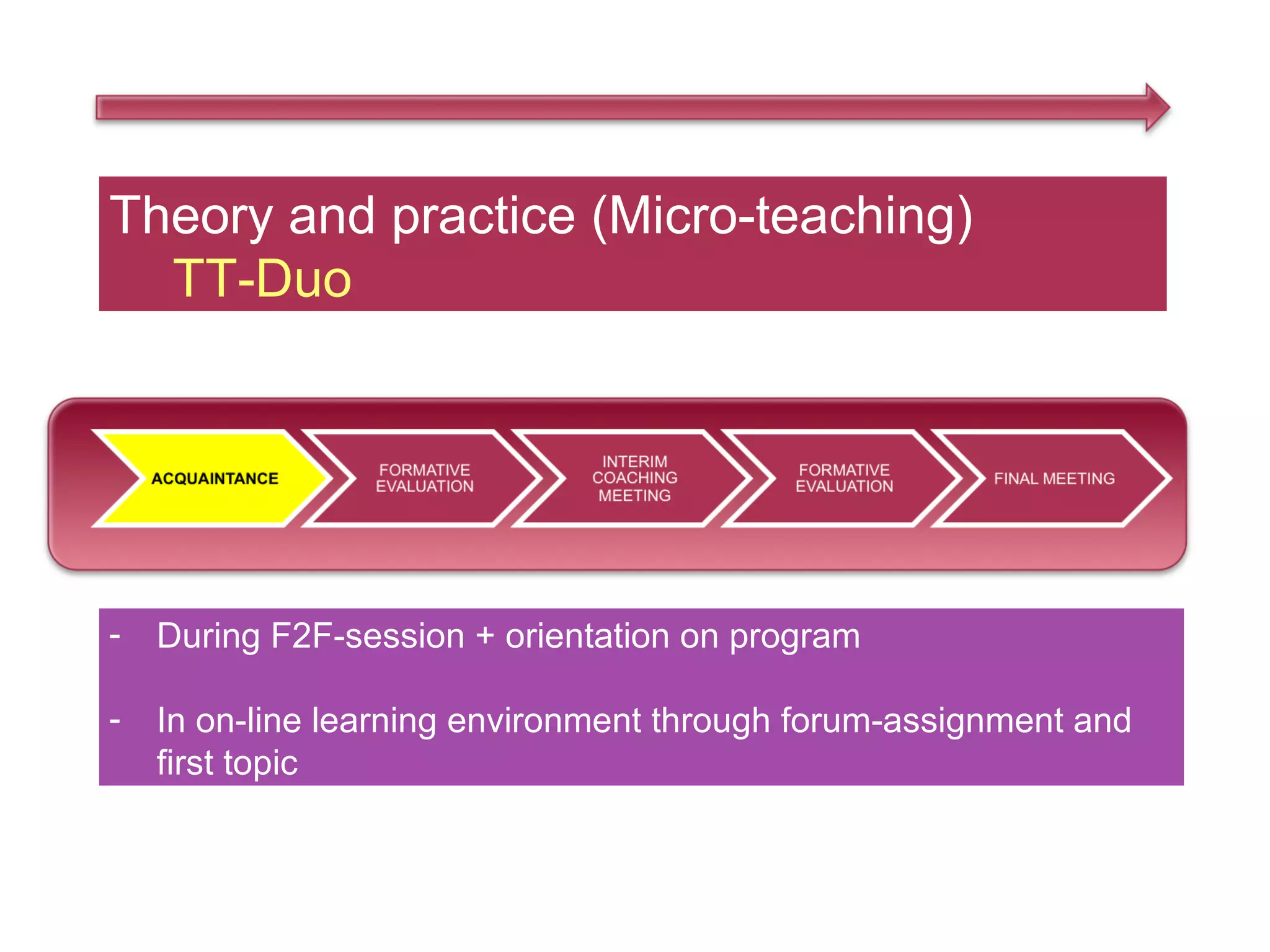
Theory and practice (Micro-teaching)
  TT-Duo


-   During F2F-session + orientation on program

-   In on-line learning environment through forum-assignment and
    first topic
Theory and practice (Micro-teaching)
  TT-Duo


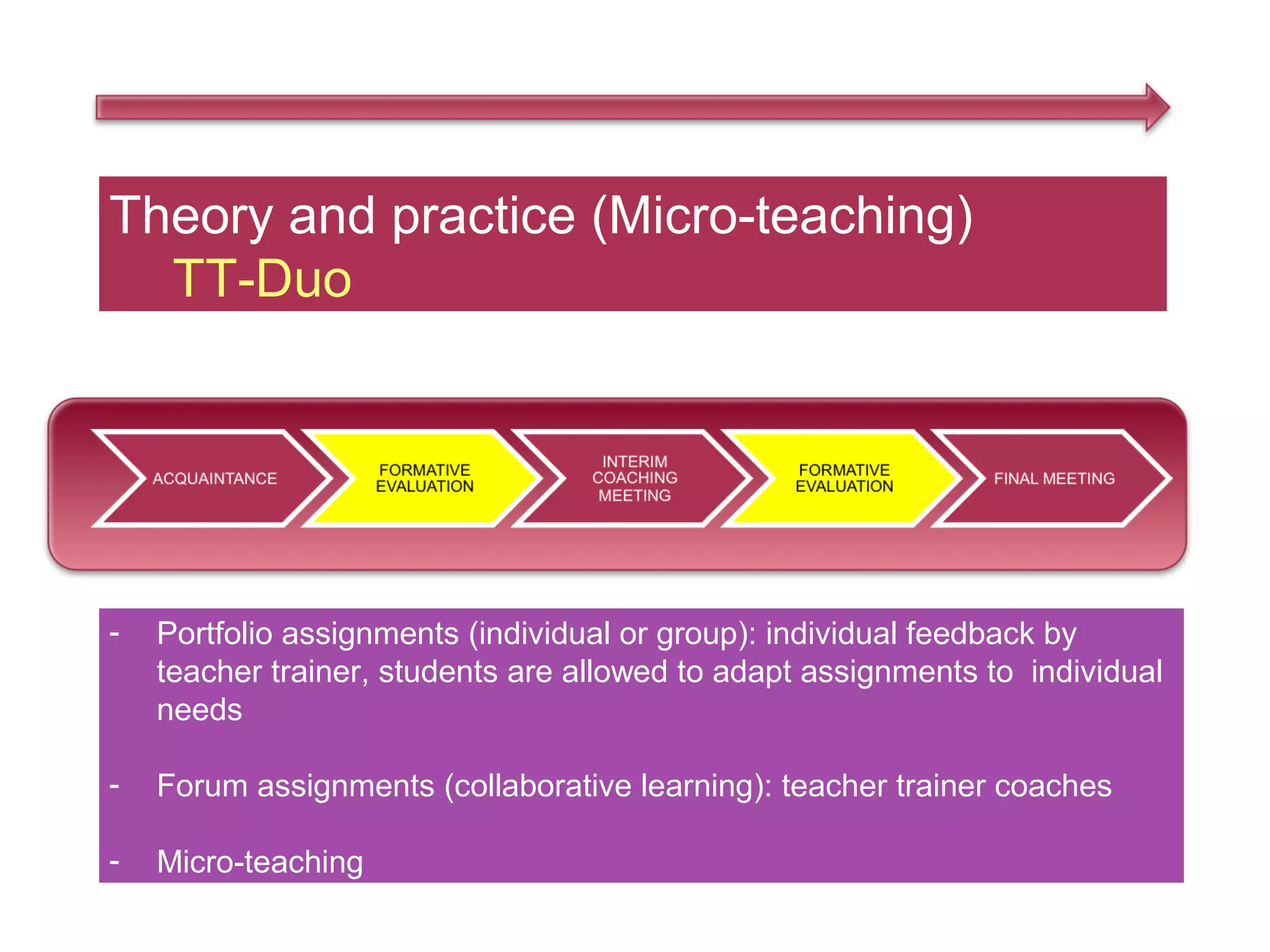
-   Portfolio assignments (individual or group): individual feedback by
    teacher trainer, students are allowed to adapt assignments to individual
    needs

-   Forum assignments (collaborative learning): teacher trainer coaches

-   Micro-teaching
Theory and practice (Micro-teaching)
      TT-Duo


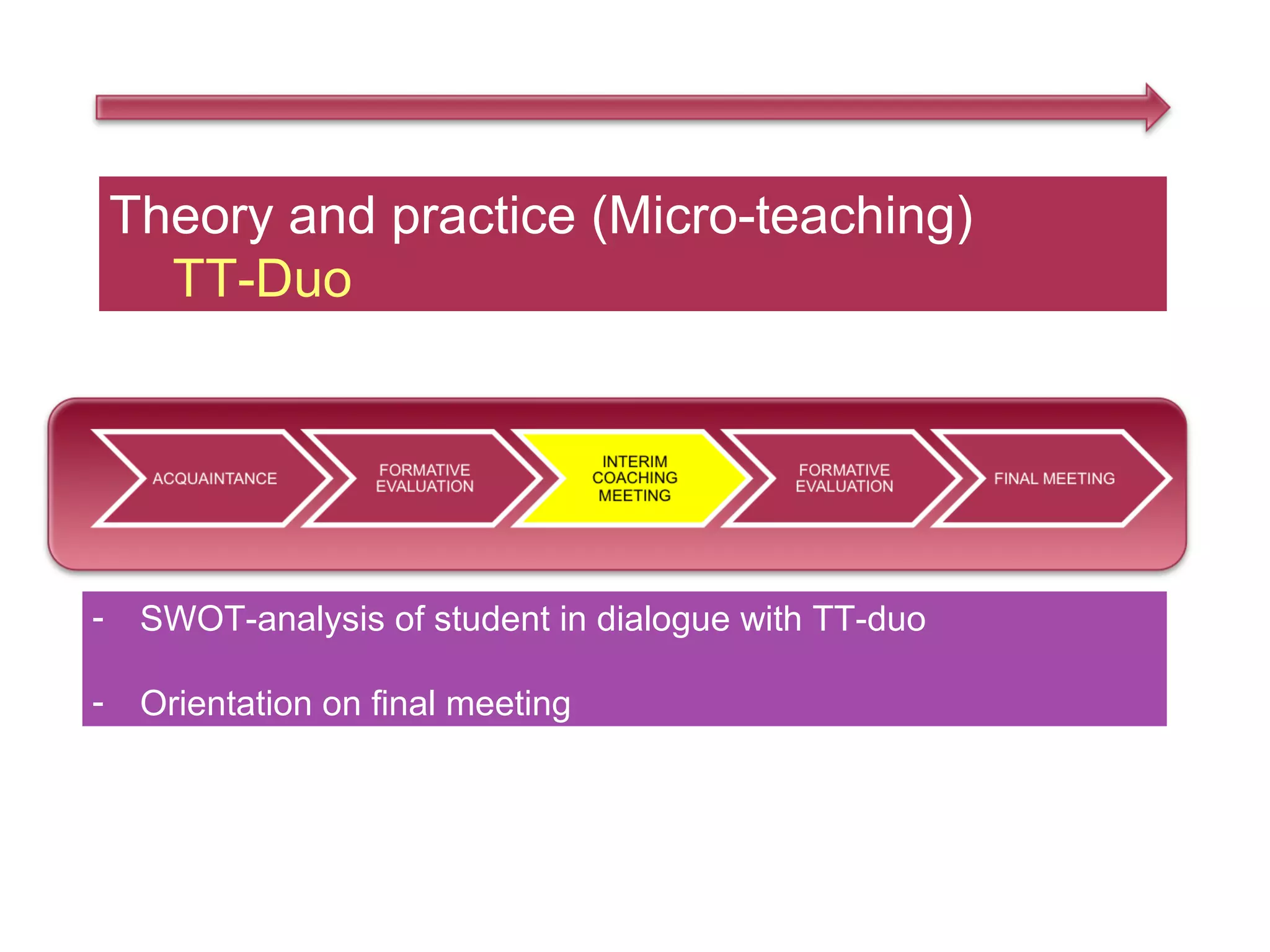
-    SWOT-analysis of student in dialogue with TT-duo

-    Orientation on final meeting
Theory and practice (Micro-teaching)
  TT-Duo


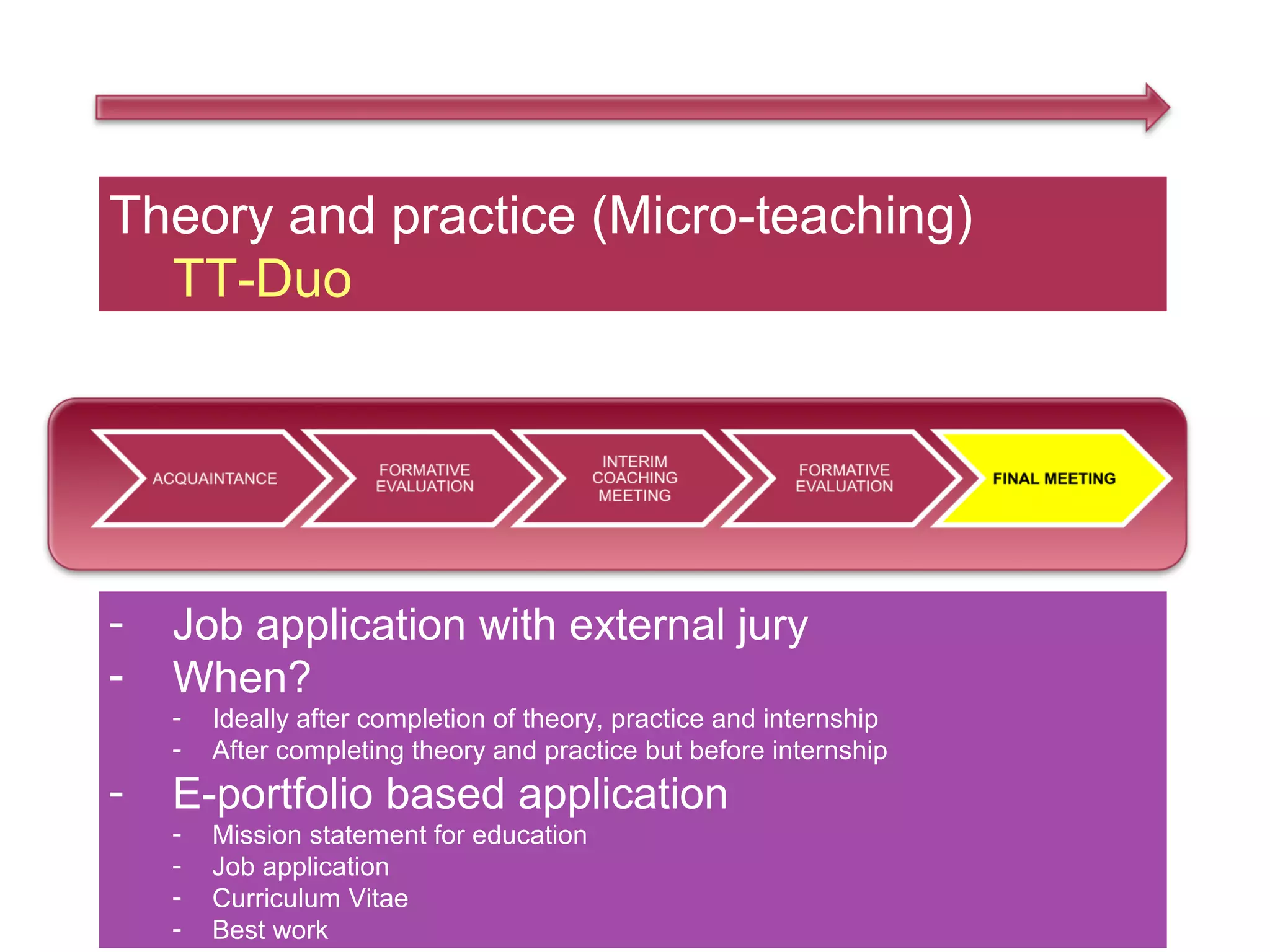
-   Job application with external jury
-   When?
    -   Ideally after completion of theory, practice and internship
    -   After completing theory and practice but before internship
-   E-portfolio based application
    -   Mission statement for education
    -   Job application
    -   Curriculum Vitae
    -   Best work
E-portfolio
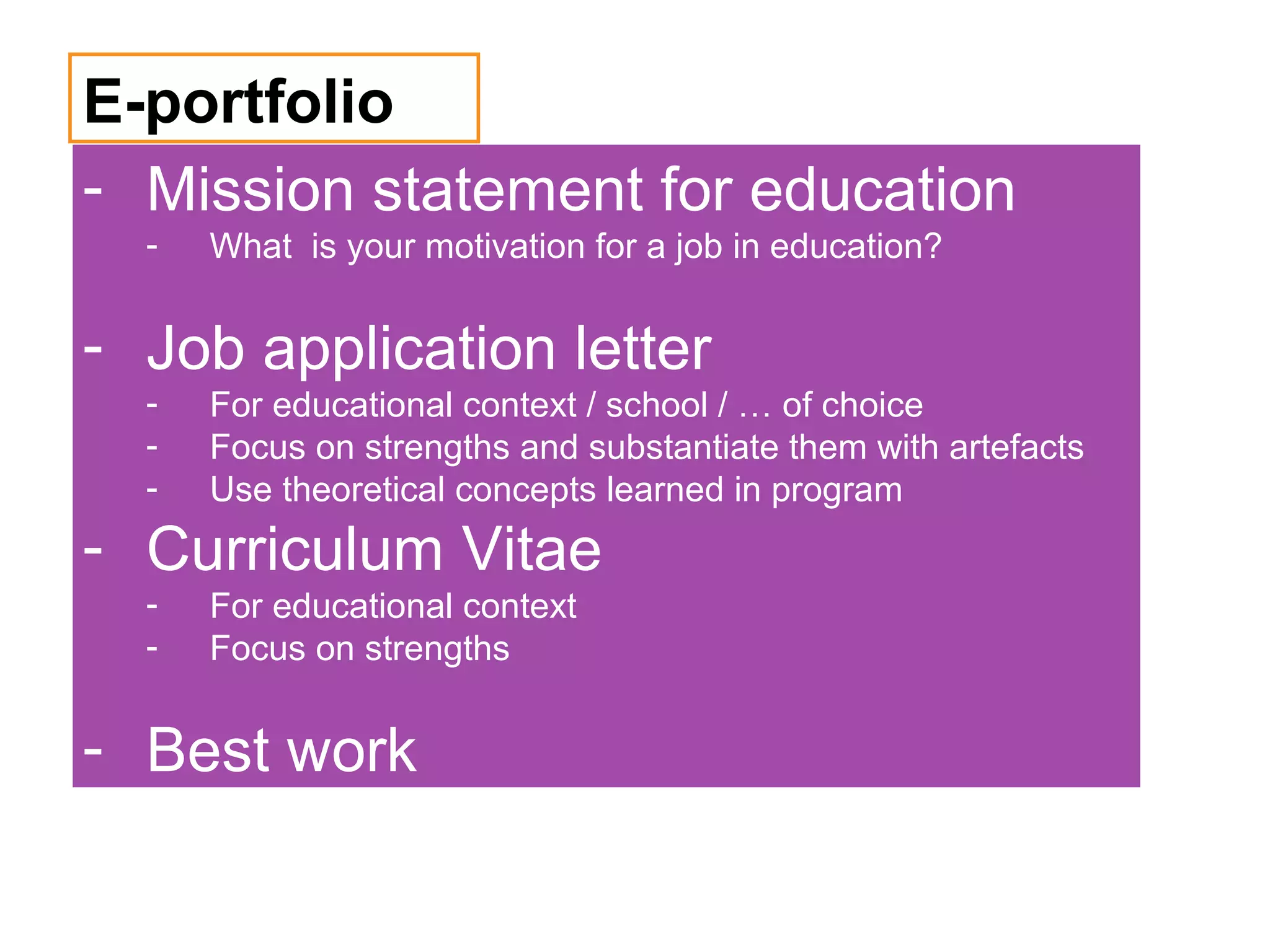
- Mission statement for education
  -   What is your motivation for a job in education?


- Job application letter
  -   For educational context / school / … of choice
  -   Focus on strengths and substantiate them with artefacts
  -   Use theoretical concepts learned in program
- Curriculum Vitae
  -   For educational context
  -   Focus on strengths


- Best work
After final meeting
- Deliberation
- Competence based end report by
  TTduo
  - Theory
  - Practice (micro-teaching)
  - Internship
+
    Answers
+
    Lessons learned

       Learners are focus!


       Create sense of community!


       Provide relevant knowledge


       Assess for learning!
+
    Some relevant literature

       Bransford, J.D., Brown, A. L., & Cocking, R. R. (Eds.). 2000. How People
        Learn: Brain, Mind, Experience, And School (expanded ed.). Washington, D.C.:
        National Academy Press.

       Shea, P. (2007). Towards a Conceptual Framework for Learning in Blended
        Environments. In A. Picciano, & C. Dziuban, (EDs.) Blended Learning:
        Research Perspectives (pp.19-37). United States of America: the Sloan
        Consortium.

       Garrison, R. & Kanuka, H. (2004). Blended Learning: Uncovering it’s
        transformative potential in higher education. The internet and higher education.
        7(2), pp.95-105.

       Graham, C. & Robinson, R. (2007). Realizing the Transformational Potential of
        Blended Learning. In A. Picciano, & C. Dziuban, (EDs.) Blended Learning:
        Research Perspectives (pp.83-111). United States of America: the Sloan
        Consortium
+
    Thank you for your attention
    Yves.blieck@deoranjerie.be

    Lut.Lippeveld@deoranjerie.be

Students perception of a blended learning program of teacher education in an adult education center (Belgium, Flanders)

  • 1.
    + Students perception ofa blended learning program of teacher education in an adult education center (Belgium, Flanders) Elearn Montreal 9 – 12 october 2012 Yves Blieck, Agnes Toison, Karen De Baere, Lut Lippeveld
  • 2.
    + Content  Some facts and figures  Practice Based Research  Blended program in teacher education  The program  Coaching and assessement in the program
  • 3.
    Blended learning ina teacher education program + - Facts and figures
  • 4.
    + Program and students Teacher education program (CVO De Oranjerie)  60 ECTS – 45 blend + 15 internship  Duration 1 – 2 y  # students a year = +/- 500  Career switchers  +/- 200 graduate each year
  • 5.
    + Evolution Blended program
  • 6.
    + Practice Based Research
  • 7.
    + Respondents (N=18)  Questionnaire: 4 point Likert scale  Analysis at item level Educa on Secundary educa on Bachelor Master
  • 8.
    + Questions  1. How is the learning environment perceived by students?  2. What are students perceptions about workload?
  • 9.
    + The structure on-line is clear Sufficient technical support
  • 10.
    + Amount of face-to-face sessions Content F-2-F sessions relevant sufficient
  • 11.
    + Combination distance and F2F Combination distance and F2F education makes sense education is feasible
  • 12.
    + Total workload is acceptable Workload sufficient distributed
  • 13.
    + Program meets my expectations Respondent  ‘Theory and corresponding assignments (in distant education). It was possible to go through the program at my own pace S4  The immediate and hands-on feedback and experiences I went through during the practical part of the program’ S9
  • 14.
    + I was sufficiently supported during learning process
  • 15.
    + Sufficiently assessed during the Sufficiently assessed at the end of program the program
  • 16.
    + Feel ready to enter education Respondents  ‘The positive and negative feedback from peers and teacher trainers on-line and F2F’ S4  ‘Teaching a critical audience. The on-line learning content helps one reflect on own practice and is helps to better understand/predict pupils reactions in class’ S10
  • 17.
    + Answers
  • 18.
    + BUT…  Limitations / further research  Small sample  Selection bias (intake)  Learning outcomes?  Employability and success in education (attrition)?  …
  • 19.
    + Blended program
  • 20.
    + Why Blended program?  Transforming: move further (to meet more the needs target group)  Enabling: increase access to program + flexible program  Enhancing: increase productivity and re- invest ‘gain’ into education Shea, (2007), Garrison and Kanuka (2004), Graham and Robinson (2007)
  • 21.
    + How People Learn (HPL) - Bransford e.a. (2000)  Student centered  Knowledge centered  Community centered  Assessment centered
  • 22.
    + Linda Darling-Hammond  "The most neglected part of teacher education is learning theory. And to develop a real profession of teaching you have to have knowledge of how people learn. It's at the core, because it allows you, then, to be inventive in a professionally responsible way, it allows you to think about what's working and what's not working, and what you need to do to help students learn. So I think this is the core of what professional teachers need.”  http://www.learner.org/courses/learningclassroom/index.html
  • 23.
    + How wasthis translated in our Blended program?
  • 24.
    + Teacher education program K Theory and practice (F2F) Internship
  • 25.
    + Theory and practice (Micro-teaching) Theory: 30ECTS 1 MULTIPLE FACES OF -+/- 18 themes with learning content LEARNING -Portfolio-assignments and Forum- 2 SCAFFOLDING LEARNING assignments Distance education 3 BECOMING A TEACHER C K A S FOCUS ON: Practice: 15ECTS 1 PRESENTING -3 – 4 teaching assignments 2CONTENT AND STRUCTURE -Final assignment 3INTERACTIVITY F2F education 4VARIATION 5FINAL ASSIGNMENT Source of picture: http://www.cs.cmu.edu/~dleeds/teaching.gif
  • 26.
    Learning content Theory 1 MULTIPLE FACES OF LEARNING 2 SCAFFOLDING LEARNING 3 BECOMING A TEACHER
  • 27.
    Forum assignments Theory MOODLE Portfolio assignments
  • 28.
    + Theory Practice  Integration of learning  Learning in safe environment content (micro-teaching)  No overlap!  Focus on integration theory and practice  Student autonomy  Peer-feedback  Also visual material  Stimulation of Reflection
  • 29.
    + Coaching and assessment From intake to graduation
  • 30.
    + Intake  Application for intake  Intake => profile? / risk of dropout  Motivation?  Self steering?  ICT-capable?  Language skills (Dutch and passive knowledge of English)  Problem solver? => technical issues)  …  Enrollment in program
  • 31.
    Theory and practice 2teacher-trainers (TT-Duo) internship Coach
  • 32.
    Theory and practice(Micro-teaching) TT-Duo - During F2F-session + orientation on program - In on-line learning environment through forum-assignment and first topic
  • 33.
    Theory and practice(Micro-teaching) TT-Duo - Portfolio assignments (individual or group): individual feedback by teacher trainer, students are allowed to adapt assignments to individual needs - Forum assignments (collaborative learning): teacher trainer coaches - Micro-teaching
  • 34.
    Theory and practice(Micro-teaching) TT-Duo - SWOT-analysis of student in dialogue with TT-duo - Orientation on final meeting
  • 35.
    Theory and practice(Micro-teaching) TT-Duo - Job application with external jury - When? - Ideally after completion of theory, practice and internship - After completing theory and practice but before internship - E-portfolio based application - Mission statement for education - Job application - Curriculum Vitae - Best work
  • 36.
    E-portfolio - Mission statementfor education - What is your motivation for a job in education? - Job application letter - For educational context / school / … of choice - Focus on strengths and substantiate them with artefacts - Use theoretical concepts learned in program - Curriculum Vitae - For educational context - Focus on strengths - Best work
  • 37.
    After final meeting -Deliberation - Competence based end report by TTduo - Theory - Practice (micro-teaching) - Internship
  • 38.
    + Answers
  • 39.
    + Lessons learned  Learners are focus!  Create sense of community!  Provide relevant knowledge  Assess for learning!
  • 40.
    + Some relevant literature  Bransford, J.D., Brown, A. L., & Cocking, R. R. (Eds.). 2000. How People Learn: Brain, Mind, Experience, And School (expanded ed.). Washington, D.C.: National Academy Press.  Shea, P. (2007). Towards a Conceptual Framework for Learning in Blended Environments. In A. Picciano, & C. Dziuban, (EDs.) Blended Learning: Research Perspectives (pp.19-37). United States of America: the Sloan Consortium.  Garrison, R. & Kanuka, H. (2004). Blended Learning: Uncovering it’s transformative potential in higher education. The internet and higher education. 7(2), pp.95-105.  Graham, C. & Robinson, R. (2007). Realizing the Transformational Potential of Blended Learning. In A. Picciano, & C. Dziuban, (EDs.) Blended Learning: Research Perspectives (pp.83-111). United States of America: the Sloan Consortium
  • 41.
    + Thank you for your attention Yves.blieck@deoranjerie.be Lut.Lippeveld@deoranjerie.be