Leveraging the Power of the Web Using
E-intelligence
Sponsored by Hewlett-Packard

Colin J. White

DataBase Associates
Leveraging the Power of the Web Using E-Intelligence


TABLE OF CONTENTS

Why E-Intelligence?                                     1
        The Business Case for E-Intelligence            2
        E-Intelligence Requirements                     3

A Framework for E-Intelligence                          5
        Business Intelligence Today                      5
        Closing the Loop                                 7
        The Role of the Enterprise Information Portal    8
        The Impact of e-Business                         9
        Optimizing the Product Supply Chain             10
        Real-Time Decision Making                       11
        E-Business Service and Support                  12
        E-Intelligence Infrastructure                   13


DataBase Associates
Leveraging the Power of the Web Using E-Intelligence


Brand and product names mentioned in this paper may be the trademarks or registered trademarks of
their respective owners.


DataBase Associates
Leveraging the Power of the Web Using E-Intelligence


WHY E-INTELLIGENCE?
                               E-intelligence enables organizations to exploit the power of e-business and
                                  business intelligence to increase market share, profits, and customer
                                                               satisfaction.

                            Organizations have been successfully employing business intelligence products,
                            including data warehousing and OLAP tools, for the past several years, to
                            improve the supply of business information to end users for cross industry
                            applications like finance and customer relationship management, and in vertical
                            markets such as retail, manufacturing, healthcare, banking, financial services,
                            telecommunications, and utilities. Easy access to clean, consistent, and
                            integrated business information has enabled executives and managers to
                            optimize day-to-day business operations, and to leverage enterprise-wide
                            corporate data for competitive advantage.

The Internet provides       The advent of the Internet has opened up a completely new and low-cost
a new low-cost sales        channel for selling and marketing products, and organizations are now rapidly
and marketing channel       moving toward the use of e-business applications to improve business
                            efficiency, decrease costs, and increase revenues, and also to compete
                            effectively against new dot com companies.

                                             Partner users         Consumers               Employees
                                                                                                            business
                                   Partner                                                                information/
                                  systems                                                              recommendations
                                               Extranet              Internet               Intranet

                                                          Enterprise information portal


                                                                                        Business           closed-loop
                                                                                       intelligence          decision
                                                                                         system              making


                                             Business-to-         Business-to-
                                               business            consumer                  Back- &
                                              e-business           e-business              front-office
                                                                                             systems       informed
                                               systems              systems
                                                                                                           business
                                                          External information providers                   decisions


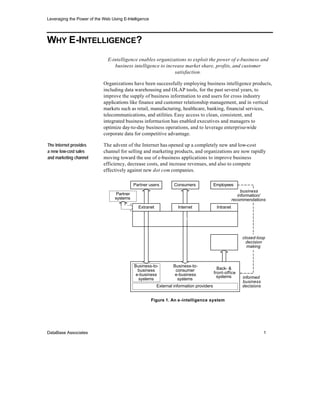
                                                       Figure 1. An e -intelligence system


DataBase Associates                                                                                                    1
Leveraging the Power of the Web Using E-Intelligence


E-business users            The issue facing end users as organizations deploy e-business systems is that
require business            they do have not have the same business intelligence capabilities available to
intelligence                them in e-business systems as they do in the traditional corporate operating
                            environment. This prevents businesses from exploiting the full power of the
                            Internet as a sales and marketing channel. To solve this issue, vendors are
                            rapidly enhancing business intelligence systems to capture and analyze the
                            information flowing through e-business systems, and are developing Web-based
                            information portals that provide an integrated and personalized view of
                            enterprise-wide business information, applications, and services. Enhanced
                            business intelligence systems, or so called e-intelligence systems (see Figure 1),
                            are now appearing on the market, and they have the potential to provide
                            significant business benefits to both traditional bricks-and-mortar companies
                            and new dot com companies as they build their e-business environments.

                            In this paper, we examine in detail the architecture of the e-intelligence system
                            shown in Figure 1, and discuss how such a system can be incorporated into the
                            existing business intelligence environment. Before doing so, however, we will
                            first examine why e-intelligence is critical to the success of e-business
                            operations, and provide an overview of the key requirements of an e-intelligence
                            system.

                     The Business Case for E-Intelligence
Many business benefits      E-intelligence systems provide internal business users, trading partners, and
to deploying an e-          corporate clients with rapid and easy access to the e-business information,
intelligence system         applications, and services they need to compete effectively and satisfy customer
                            needs. They offer a significant number of business benefits to organizations in
                            exploiting the power of the Internet.

                            1. They integrate e-business operations into the traditional business
                               environment, enabling end users to obtain a complete view of all corporate
                               business operations and business information.

                            2. They help business users make informed decisions based on accurate and
                               consistent e-business information that is collected and integrated from the
                               organization’s e-business applications. This business information helps
                               business users to optimize Web-based offerings (products offered, pricing
                               and promotions, service and support, etc.) to match marketplace
                               requirements, and to analyze business performance with respect to
                               competitors and the organization’s business performance objectives.

                            3. They assist e-business applications in profiling and segmenting e-business
                               customers to personalize the actual Web pages displayed, and the products
                               and services offered to the customer, through the Web interface.

                            4. They extend the business intelligence environment outside of the corporate
                               firewall to trading partners. This enables organizations to share internal


DataBase Associates                                                                                      2
Leveraging the Power of the Web Using E-Intelligence


                                 business information with trading partners with the objective of optimizing
                                 the product supply chain to match the demand for products sold through the
                                 Interent, while at the same time keeping the costs of maintaining inventory to
                                 a minimum.

                            5. They extend the business intelligence environment outside of the corporate
                               firewall to key corporate clients. This allows an organization to provide
                               clients with business information about their accounts. This enables clients
                               to analyze and tune their business relationships with the organization, and
                               thus improves both client service and satisfaction.

                            6. They link together e-business applications with business intelligence and
                               collaborative processing applications, allowing both internal and external
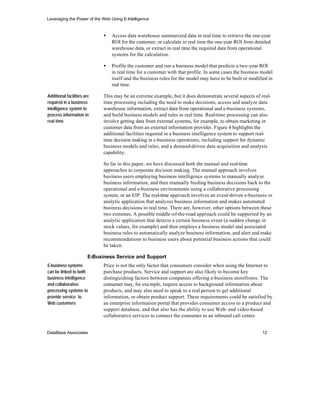
                               users to seamlessly move between different systems.

                    E-Intelligence Requirements
E-intelligence adds         An e-intelligence system builds on and extends existing business intelligence
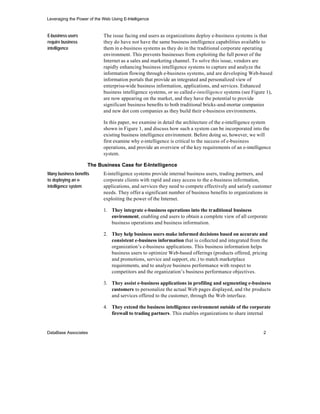
business intelligence       tools and applications, and enterprise information portals. Figure 2 shows
to e-business systems       examples of the types of business intelligence capabilities organizations are
                            looking for in such a system.

                                                     integrated e-intelligence interface
                                           Partner users          Consumers              Employees

                                 Partner                      1-to-1
                                systems                    e-marketing

                                             Extranet              Internet               Intranet
                                                        Enterprise information portal
                                                                           campaign &
                                                                         channel analysis     real-time decisions
                                                        content,                             & recommendations
                                  supply chain         customer                       Business
                                  optimization       & merchandise                   intelligence
                                                        analysis                       system
                                                                                                 on-demand data
                                                                                                capture & analysis
                                           Business-to-          Business-to-
                                             business             consumer                 Back- &
                                            e-business            e-business             front-office
                                             systems               systems                 systems

                                                        External information providers


                                             Figure 2. Examples of e -intelligence requirements

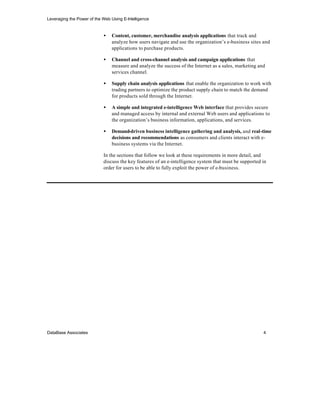
                            •    1-to-1 e-marketing analysis applications that customize and personalize the
                                 information, applications, services, and products offered to consumers and
                                 clients via the Internet.


DataBase Associates                                                                                                  3
Leveraging the Power of the Web Using E-Intelligence


                            •    Content, customer, merchandise analysis applications that track and
                                 analyze how users navigate and use the organization’s e-business sites and
                                 applications to purchase products.

                            •    Channel and cross-channel analysis and campaign applications that
                                 measure and analyze the success of the Internet as a sales, marketing and
                                 services channel.

                            •    Supply chain analysis applications that enable the organization to work with
                                 trading partners to optimize the product supply chain to match the demand
                                 for products sold through the Internet.

                            •    A simple and integrated e-intelligence Web interface that provides secure
                                 and managed access by internal and external Web users and applications to
                                 the organization’s business information, applications, and services.

                            •    Demand-driven business intelligence gathering and analysis, and real-time
                                 decisions and recommendations as consumers and clients interact with e-
                                 business systems via the Internet.

                            In the sections that follow we look at these requirements in more detail, and
                            discuss the key features of an e-intelligence system that must be supported in
                            order for users to be able to fully exploit the power of e-business.


DataBase Associates                                                                                      4
Leveraging the Power of the Web Using E-Intelligence


A FRAMEWORK FOR E-INTELLIGENCE
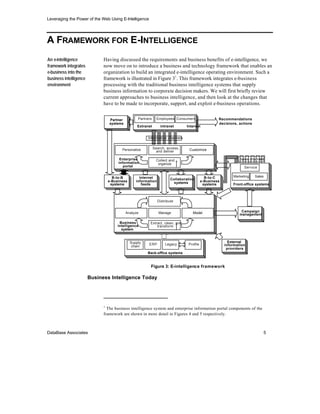
An e-intelligence             Having discussed the requirements and business benefits of e-intelligence, we
framework integrates          now move on to introduce a business and technology framework that enables an
e-business into the           organization to build an integrated e-intelligence operating environment. Such a
business intelligence         framework is illustrated in Figure 31. This framework integrates e-business
environment                   processing with the traditional business intelligence systems that supply
                              business information to corporate decision makers. We will first briefly review
                              current approaches to business intelligence, and then look at the changes that
                              have to be made to incorporate, support, and exploit e-business operations.


                                  Partner          Partners     Employees Consumers                  Recommendations
                                  systems                                                            decisions, actions
                                                   Extranet       intranet       Internet


                                                        Information channels


                                         Personalize          Search, access,     Customize
                                                                and deliver

                                        Enterprise             Collect and                                       Sales channels
                                       information              organize
                                          portal                                                                   Service

                                    B-to-B          Internet                                  B-to-C         Marketing    Sales
                                                                        Collaborative
                                  e-Business      information             systems           e-Business
                                   systems           feeds                                   systems         Front-office systems


                                                                Distribute


                                            Analyze              Manage             Model                         Campaign
                                                                                                                 management

                                        Business          Extract, clean, and
                                       intelligence           transform
                                         system


                                               Supply                                                      External
                                                         ERP         Legacy       Profile                information
                                               chain
                                                                                                          providers
                                                        Back-office systems


                                                          Figure 3: E-intelligence framework

                        Business Intelligence Today


                              1
                                The business intelligence system and enterprise information portal components of the
                              framework are shown in more detail in Figures 4 and 5 respectively.


DataBase Associates                                                                                                           5
Leveraging the Power of the Web Using E-Intelligence


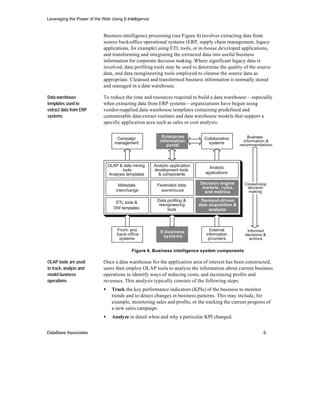
                            Business intelligence processing (see Figure 4) involves extracting data from
                            source back-office operational systems (ERP, supply chain management, legacy
                            applications, for example) using ETL tools, or in-house developed applications,
                            and transforming and integrating the extracted data into useful business
                            information for corporate decision making. Where significant legacy data is
                            involved, data profiling tools may be used to determine the quality of the source
                            data, and data reengineering tools employed to cleanse the source data as
                            appropriate. Cleansed and transformed business information is normally stored
                            and managed in a data warehouse.

Data warehouse              To reduce the time and resources required to build a data warehouse – especially
templates used to           when extracting data from ERP systems – organizations have begun using
extract data from ERP       vendor-supplied data warehouse templates containing predefined and
systems                     customizable data extract routines and data warehouse models that support a
                            specific application area such as sales or cost analysis.


                                    Campaign               Enterprise           Collaborative          Business
                                   management             information             systems            information &
                                                             portal                                recommendations


                                OLAP & data mining     Analytic application        Analytic
                                       tools           development tools
                                Analysis templates       & components            applications

                                     Metadata           Federated data        Decision engine        Closed-loop
                                                                               models, rules,         decision
                                    interchange           warehouse             and metrics            making

                                    ETL tools &         Data profiling &       Demand-driven
                                                         reengineering        data acquisition &
                                   DW templates              tools                 analysis


                                    Front- and            E-business               External           Informed
                                    back-office            systems               information         decisions &
                                     systems                                      providers            actions


                                           Figure 4. Business intelligence system components

OLAP tools are used         Once a data warehouse for the application area of interest has been constructed,
to track, analyze and       users then employ OLAP tools to analyze the information about current business
model business              operations to identify ways of reducing costs, and increasing profits and
operations                  revenues. This analysis typically consists of the following steps:
                            •     Track the key performance indicators (KPIs) of the business to monitor
                                  trends and to detect changes in business patterns. This may include, for
                                  example, monitoring sales and profits, or the tracking the current progress of
                                  a new sales campaign.
                            •     Analyze in detail when and why a particular KPI changed.


DataBase Associates                                                                                           6
Leveraging the Power of the Web Using E-Intelligence


                              •   Model potential business improvements to determine their impact on the
                                  business. This could involve, for example, the running of a financial business
                                  modes, or the use of a data mining tool to profile and segment customers for
                                  a new sales campaign.
                              •   Modify business operations to incorporate the decisions made as a result of
                                  business intelligence processing.

Analysis templates            Deploying OLAP tools can be a complex and time-consuming process, and
reduce OLAP                   organizations are looking for ways of improving tool ease-of-use and reducing
development time              implementation time. One approach is to use predefined and customizable
                              analysis templates that many vendors are now beginning to provide with OLAP
                              tools. These analysis templates are often packaged with the data warehousing
                              templates mentioned earlier.

Analytic applications         Another approach to reducing development effort is to employ analytic
provide a complete            application packages that provide a complete solution for both creating an
business intelligence         application-specific data warehouse and analyzing its contents. Application
solution and reduce           areas being addressed by these analytic application packages include financial
implementation effort         management (for financial consolidation, budgeting and planning, activity-based
                              costing, etc.), customer relationship management (for customer cross- and up-
                              selling, customer profitability analysis, promotion effectiveness, etc.), and
                              supply chain performance management (supply optimization, distribution
                              optimization, etc.).

                              The use of Web technology as an end-user interface also helps reduce the costs
                              of providing business users with access to business intelligence. Most modern
                              OLAP tools and analytic applications are Web-enabled, which not only reduces
                              deployment costs, but also improves ease-of-use.

                        Closing the Loop
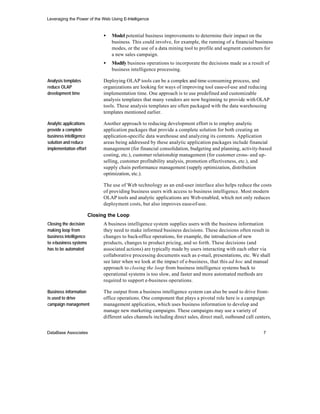
Closing the decision          A business intelligence system supplies users with the business information
making loop from              they need to make informed business decisions. These decisions often result in
business intelligence         changes to back-office operations, for example, the introduction of new
to e-business systems         products, changes to product pricing, and so forth. These decisions (and
has to be automated           associated actions) are typically made by users interacting with each other via
                              collaborative processing documents such as e-mail, presentations, etc. We shall
                              see later when we look at the impact of e-business, that this ad hoc and manual
                              approach to closing the loop from business intelligence systems back to
                              operational systems is too slow, and faster and more automated methods are
                              required to support e-business operations.

Business information          The output from a business intelligence system can also be used to drive front-
is used to drive              office operations. One component that plays a pivotal role here is a campaign
campaign management           management application, which uses business information to develop and
                              manage new marketing campaigns. These campaigns may use a variety of
                              different sales channels including direct sales, direct mail, outbound call centers,


DataBase Associates                                                                                           7
Leveraging the Power of the Web Using E-Intelligence


                              e-mail, fax, and kiosks – e-business systems also offer an additional sales
                              channel.

                              As a new sales campaign progresses, front-office data can be analyzed by the
                              business intelligence system, and/or campaign management application to fine-
                              tune the current campaign, and to provide valuable information for future
                              campaigns. Information from external information providers may also be input
                              into the business intelligence system to supplement existing corporate customer
                              and marketing data in areas like competitive and marketplace analysis.

Front-office systems          Front-office systems are a valuable source of data for analyzing, and thus
also provide valuable         improving, other aspects of company operations such as product quality, and
information for               the effectiveness of in-bound call centers that provide customer and product
business intelligence         support and services. As with back-office operational systems, the closing of the
processing                    loop from business intelligence systems back to the front-office systems at
                              present is done manually using collaborative processing.

                        The Role of the Enterprise Information Portal
An EIP provides               The flow of information from back- and front-office operational applications to
access to the complete        business intelligence and collaborative processing systems, and back to
information supply            operational systems can be thought of as a closed-loop information supply
chain                         chain. To obtain a complete and accurate picture of a company’s business
                              operations, users need to be able to access the complete information supply
                              chain. Although Web-enabled OLAP tools and analytic applications provide an
                              effective approach to accessing information managed by a business intelligence
                              system, they do not provide access to the complete information supply chain. To
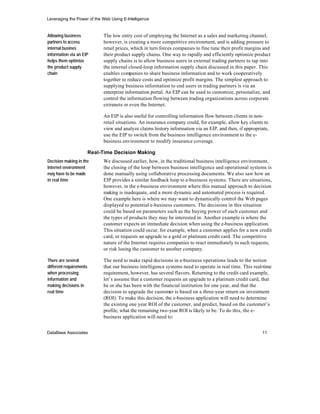
                              solve this problem vendors have introduced so-called enterprise information
                              portals.

                                                       Partners      Employees        Consumers
                                                        Extranet       intranet       Internet

                                                                Information channels


                                                           Personalization & customization

                                          Publishing and              Business               Subscription &
                                                                     information
                                         directory services            directory            delivery services

                                           Collaborative             Information                 Application
                                            interfaces                interfaces                 interfaces


                                     Collaborative                      Business        e-business       Front- &
                                                        Internet       intelligence                     back-office
                                       systems           feeds            system         systems         systems


DataBase Associates                                                                                                   8
Leveraging the Power of the Web Using E-Intelligence


                                            Figure 5. Enterprise information portal components

Information viewed            An enterprise information portal (see Figure 5) provides users with a single Web-
through an EIP is             based interface to business information and to the applications that produce
customized and                business information no matter where they reside. The information and
personalized to suit          applications viewed through an enterprise information portal (EIP) can be
each user’s needs             personalized to match the requirements and authorization level of each business
                              user, be they an executive, a business analyst, or a clerical assistant. An EIP also
                              customizes information and application access to suit the role of the user in the
                              organization. A business analyst in a marketing department, for example, could
                              be given a view of the marketing information required to launch a new marketing
                              campaign. This information could include analyses of customer profitability and
                              past campaigns stored in a business intelligence system, marketing collateral
                              managed by a collaborative processing system, and competitive marketing data
                              provided by an external information provider.

The business                  The cornerstone of an EIP is the business information directory, which points to
information directory         and links together information and applications throughout the information
is a key component of         supply chain. This directory can be maintained by a Web-based interactive
an EIP                        publishing facility, or via interfaces that provide connectors to information and
                              applications managed by collaborative processing, business intelligence, e-
                              business, front-office and back-office systems, and also internal and external
                              Web-servers. Later in this paper when we discuss the impact of e-business on
                              the decision making process, we will see that an EIP may also be used to provide
                              connectors to the information systems of trading partners and key clients.

                              The web-based interface of an EIP provides immediate access to the information
                              and applications that are of interest to a business user. The interface also
                              provides access to a subscription facility that enables business users to request
                              that information be delivered to them, or an application run, when a certain event
                              occurs. This event may be when a particular date and time is reached (an
                              analysis could be run at the end of each month, for example), or when a certain
                              business threshold is satisfied (when a customer account reaches a certain dollar
                              value, for example).

                        The Impact of e-Business
Web technology has a          It is often said that the Web changes everything. This is particularly true when it
major impact on the           comes to building systems that supply information to business users for
way we process and            corporate decision making. So far in this paper we have seen two uses of Web
analyze business              technology – the Web-enablement of OLAP tools and analytic applications, and
information                   the use of a Web-based enterprise information portal to provide access to
                              enterprise-wide business information. In these two cases, Web technology is
                              being used to provide a simple and cost-effective interface to business
                              information, which enables an organization to make business information
                              available to a much bigger and broader end-user audience.


DataBase Associates                                                                                          9
Leveraging the Power of the Web Using E-Intelligence


Business intelligence         The Web, however, is also a valuable source of business information.
systems need to be            Information stored on Web servers on the public Internet may, for example, be a
able to process and           potential data source for a data warehouse, or at least be made accessible from
analyze Web data              an EIP. Also, as corporations begin using Internet commerce sites as a sales and
                              marketing channel, the associated business-to-consumer e-business systems
                              become an additional source of information for business intelligence processing.
                              The source data here may be stored in conventional database and file systems,
                              but may also come from Web server logs, or even the Web click-stream as users
                              interact with e-business applications. This means that business intelligence
                              systems not only need to be able to extract new types of data, but also need to
                              be able to handle the huge data volumes that are potentially involved.

                              Once data has been extracted from business-to-consumer systems, it can be
                              analyzed using OLAP tools and analytic applications. This analysis can be used
                              to optimize e-business operations and to evaluate the use of the Internet as a
                              sales channel.

Business decisions            Using the Internet as a sales channel offers significant benefits – products can
need to be made more          be brought to market much faster and at a much lower cost. Selling through the
rapidly when using the        Internet, however, is very competitive, and organizations need to be able to react
Internet as a sales           rapidly to consumer requirements and changing marketplace conditions, if they
channel                       are to succeed in this new approach to marketing and selling products. There are
                              four key success factors here:

                              •   The product supply chain must be optimized to match consumer demand.

                              •   Business decisions need to be made more rapidly, possibly in real-time.

                              •   Service and support is a key differentiator.

                              •   The e-intelligence system must have an open and scalable infrastructure.

                        Optimizing the Product Supply Chain
                              The challenge in any consumer environment is to satisfy consumer demand
                              without incurring the costs of over-supply, i.e., excess inventory. Business
                              intelligence systems and their associated data warehouses have been used for
                              several years to analyze sales data and to optimize product supply and
                              inventory. These techniques can be applied equally well when selling products
                              through Internet commerce servers. One advantage of the Internet is that it
                              consists of a single virtual storefront, which is easier to manage and supply than
                              multiple physical stores.


DataBase Associates                                                                                         10
Leveraging the Power of the Web Using E-Intelligence


Allowing business             The low entry cost of employing the Internet as a sales and marketing channel,
partners to access            however, is creating a more competitive environment, and is adding pressure to
internal busines              retail prices, which in turn forces companies to fine tune their profit margins and
information via an EIP        their product supply chains. One way to rapidly and efficiently optimize product
helps them optimize           supply chains is to allow business users in external trading partners to tap into
the product supply            the internal closed-loop information supply chain discussed in this paper. This
chain                         enables companies to share business information and to work cooperatively
                              together to reduce costs and optimize profit margins. The simplest approach to
                              supplying business information to end users in trading partners is via an
                              enterprise information portal. An EIP can be used to customize, personalize, and
                              control the information flowing between trading organizations across corporate
                              extranets or even the Internet.

                              An EIP is also useful for controlling information flow between clients in non-
                              retail situations. An insurance company could, for example, allow key clients to
                              view and analyze claims history information via an EIP, and then, if appropriate,
                              use the EIP to switch from the business intelligence environment to the e-
                              business environment to modify insurance coverage.

                         Real-Time Decision Making
Decision making in the        We discussed earlier, how, in the traditional business intelligence environment,
Internet environment          the closing of the loop between business intelligence and operational systems is
may have to be made           done manually using collaborative processing documents. We also saw how an
in real time                  EIP provides a similar feedback loop to e-business systems. There are situations,
                              however, in the e-business environment where this manual approach to decision
                              making is inadequate, and a more dynamic and automated process is required.
                              One example here is where we may want to dynamically control the Web pages
                              displayed to potential e-business customers. The decisions in this situation
                              could be based on parameters such as the buying power of each customer and
                              the types of products they may be interested in. Another example is where the
                              customer expects an immediate decision when using the e-business application.
                              This situation could occur, for example, when a customer applies for a new credit
                              card, or requests an upgrade to a gold or platinum credit card. The competitive
                              nature of the Internet requires companies to react immediately to such requests,
                              or risk losing the customer to another company.

There are several             The need to make rapid decisions in e-business operations leads to the notion
different requirements        that our business intelligence systems need to operate in real time. This real-time
when processing               requirement, however, has several flavors. Returning to the credit card example,
information and               let’s assume that a customer requests an upgrade to a platinum credit card, that
making decisions in           he or she has been with the financial institution for one year, and that the
real time                     decision to upgrade the customer is based on a three-year return on investment
                              (ROI). To make this decision, the e-business application will need to determine
                              the existing one year ROI of the customer, and predict, based on the customer’s
                              profile, what the remaining two-year ROI is likely to be. To do this, the e-
                              business application will need to:


DataBase Associates                                                                                         11
Leveraging the Power of the Web Using E-Intelligence


                              •   Access data warehouse summarized data in real time to retrieve the one-year
                                  ROI for the customer, or calculate in real time the one-year ROI from detailed
                                  warehouse data, or extract in real time the required data from operational
                                  systems for the calculation.

                              •   Profile the customer and run a business model that predicts a two-year ROI
                                  in real time for a customer with that profile. In some cases the business model
                                  itself and the business rules for the model may have to be built or modified in
                                  real time.

Additional facilities are     This may be an extreme example, but it does demonstrate several aspects of real-
required in a business        time processing including the need to make decisions, access and analyze data
intelligence system to        warehouse information, extract data from operational and e-business systems,
process information in        and build business models and rules in real time. Real-time processing can also
real time                     involve getting data from external systems, for example, to obtain marketing or
                              customer data from an external information provider. Figure 4 highlights the
                              additional facilities required in a business intelligence system to support real-
                              time decision making in e-business operations, including support for dynamic
                              business models and rules, and a demand-driven data acquisition and analysis
                              capability.

                              So far in this paper, we have discussed both the manual and real-time
                              approaches to corporate decision making. The manual approach involves
                              business users employing business intelligence systems to manually analyze
                              business information, and then manually feeding business decisions back to the
                              operational and e-business environments using a collaborative processing
                              system, or an EIP. The real-time approach involves an event-driven e-business or
                              analytic application that analyzes business information and makes automated
                              business decisions in real time. There are, however, other options between these
                              two extremes. A possible middle-of-the-road approach could be supported by an
                              analytic application that detects a certain business event (a sudden change in
                              stock values, for example) and then employs a business model and associated
                              business rules to automatically analyze business information, and alert and make
                              recommendations to business users about potential business actions that could
                              be taken.

                        E-Business Service and Support
E-business systems            Price is not the only factor that consumers consider when using the Internet to
can be linked to both         purchase products. Service and support are also likely to become key
business intelligence         distinguishing factors between companies offering e-business storefronts. The
and collaborative             consumer may, for exa mple, require access to background information about
processing systems to         products, and may also need to speak to a real person to get additional
provide service to            information, or obtain product support. These requirements could be satisfied by
Web customers                 an enterprise information portal that provides consumer access to a product and
                              support database, and that also has the ability to use Web- and video-based
                              collaborative services to connect the consumer to an inbound call center.


DataBase Associates                                                                                         12
Leveraging the Power of the Web Using E-Intelligence


                    E-Intelligence Infrastructure
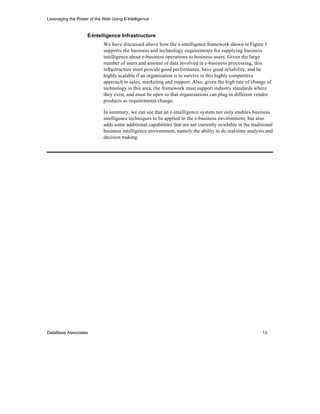
                            We have discussed above how the e-intelligence framework shown in Figure 3
                            supports the business and technology requirements for supplying business
                            intelligence about e-business operations to business users. Given the large
                            number of users and amount of data involved in e-business processing, this
                            infrastructure must provide good performance, have good reliability, and be
                            highly scalable if an organization is to survive in this highly competitive
                            approach to sales, marketing and support. Also, given the high rate of change of
                            technology in this area, the framework must support industry standards where
                            they exist, and must be open so that organizations can plug-in different vendor
                            products as requirements change.

                            In summary, we can see that an e-intelligence system not only enables business
                            intelligence techniques to be applied to the e-business environment, but also
                            adds some additional capabilities that are not currently available in the traditional
                            business intelligence environment, namely the ability to do real-time analysis and
                            decision making.


DataBase Associates                                                                                        13
Leveraging the Power of the Web Using E-Intelligence


                            About DataBase Associates

                            DataBase Associates is a consulting company specializing in leading-edge
                            technologies in the fields of data warehousing, business intelligence, analytic
                            applications, enterprise information portals, intelligent e-business, and database
                            technology.


                                            DataBase Associates
                                             Post Office Box 398
                                             Ashland, OR 97520
                                               (541) 552-9126
                                         www.databaseassociates.com
                                     info@databaseassociates.com (e-mail)

                            Leveraging the Power of the Web Using E-Intelligence
                                         Version 1, February 2000


DataBase Associates                                                                                       14
Leveraging the Power of the Web Using E-Intelligence


                                   Copyright © 2000 by DataBase Associates
                                              All rights reserved.


DataBase Associates                                                          15

E intelligence

  • 1.
    Leveraging the Powerof the Web Using E-intelligence Sponsored by Hewlett-Packard Colin J. White DataBase Associates
  • 2.
    Leveraging the Powerof the Web Using E-Intelligence TABLE OF CONTENTS Why E-Intelligence? 1 The Business Case for E-Intelligence 2 E-Intelligence Requirements 3 A Framework for E-Intelligence 5 Business Intelligence Today 5 Closing the Loop 7 The Role of the Enterprise Information Portal 8 The Impact of e-Business 9 Optimizing the Product Supply Chain 10 Real-Time Decision Making 11 E-Business Service and Support 12 E-Intelligence Infrastructure 13 DataBase Associates
  • 3.
    Leveraging the Powerof the Web Using E-Intelligence Brand and product names mentioned in this paper may be the trademarks or registered trademarks of their respective owners. DataBase Associates
  • 4.
    Leveraging the Powerof the Web Using E-Intelligence WHY E-INTELLIGENCE? E-intelligence enables organizations to exploit the power of e-business and business intelligence to increase market share, profits, and customer satisfaction. Organizations have been successfully employing business intelligence products, including data warehousing and OLAP tools, for the past several years, to improve the supply of business information to end users for cross industry applications like finance and customer relationship management, and in vertical markets such as retail, manufacturing, healthcare, banking, financial services, telecommunications, and utilities. Easy access to clean, consistent, and integrated business information has enabled executives and managers to optimize day-to-day business operations, and to leverage enterprise-wide corporate data for competitive advantage. The Internet provides The advent of the Internet has opened up a completely new and low-cost a new low-cost sales channel for selling and marketing products, and organizations are now rapidly and marketing channel moving toward the use of e-business applications to improve business efficiency, decrease costs, and increase revenues, and also to compete effectively against new dot com companies. Partner users Consumers Employees business Partner information/ systems recommendations Extranet Internet Intranet Enterprise information portal Business closed-loop intelligence decision system making Business-to- Business-to- business consumer Back- & e-business e-business front-office systems informed systems systems business External information providers decisions Figure 1. An e -intelligence system DataBase Associates 1
  • 5.
    Leveraging the Powerof the Web Using E-Intelligence E-business users The issue facing end users as organizations deploy e-business systems is that require business they do have not have the same business intelligence capabilities available to intelligence them in e-business systems as they do in the traditional corporate operating environment. This prevents businesses from exploiting the full power of the Internet as a sales and marketing channel. To solve this issue, vendors are rapidly enhancing business intelligence systems to capture and analyze the information flowing through e-business systems, and are developing Web-based information portals that provide an integrated and personalized view of enterprise-wide business information, applications, and services. Enhanced business intelligence systems, or so called e-intelligence systems (see Figure 1), are now appearing on the market, and they have the potential to provide significant business benefits to both traditional bricks-and-mortar companies and new dot com companies as they build their e-business environments. In this paper, we examine in detail the architecture of the e-intelligence system shown in Figure 1, and discuss how such a system can be incorporated into the existing business intelligence environment. Before doing so, however, we will first examine why e-intelligence is critical to the success of e-business operations, and provide an overview of the key requirements of an e-intelligence system. The Business Case for E-Intelligence Many business benefits E-intelligence systems provide internal business users, trading partners, and to deploying an e- corporate clients with rapid and easy access to the e-business information, intelligence system applications, and services they need to compete effectively and satisfy customer needs. They offer a significant number of business benefits to organizations in exploiting the power of the Internet. 1. They integrate e-business operations into the traditional business environment, enabling end users to obtain a complete view of all corporate business operations and business information. 2. They help business users make informed decisions based on accurate and consistent e-business information that is collected and integrated from the organization’s e-business applications. This business information helps business users to optimize Web-based offerings (products offered, pricing and promotions, service and support, etc.) to match marketplace requirements, and to analyze business performance with respect to competitors and the organization’s business performance objectives. 3. They assist e-business applications in profiling and segmenting e-business customers to personalize the actual Web pages displayed, and the products and services offered to the customer, through the Web interface. 4. They extend the business intelligence environment outside of the corporate firewall to trading partners. This enables organizations to share internal DataBase Associates 2
  • 6.
    Leveraging the Powerof the Web Using E-Intelligence business information with trading partners with the objective of optimizing the product supply chain to match the demand for products sold through the Interent, while at the same time keeping the costs of maintaining inventory to a minimum. 5. They extend the business intelligence environment outside of the corporate firewall to key corporate clients. This allows an organization to provide clients with business information about their accounts. This enables clients to analyze and tune their business relationships with the organization, and thus improves both client service and satisfaction. 6. They link together e-business applications with business intelligence and collaborative processing applications, allowing both internal and external users to seamlessly move between different systems. E-Intelligence Requirements E-intelligence adds An e-intelligence system builds on and extends existing business intelligence business intelligence tools and applications, and enterprise information portals. Figure 2 shows to e-business systems examples of the types of business intelligence capabilities organizations are looking for in such a system. integrated e-intelligence interface Partner users Consumers Employees Partner 1-to-1 systems e-marketing Extranet Internet Intranet Enterprise information portal campaign & channel analysis real-time decisions content, & recommendations supply chain customer Business optimization & merchandise intelligence analysis system on-demand data capture & analysis Business-to- Business-to- business consumer Back- & e-business e-business front-office systems systems systems External information providers Figure 2. Examples of e -intelligence requirements • 1-to-1 e-marketing analysis applications that customize and personalize the information, applications, services, and products offered to consumers and clients via the Internet. DataBase Associates 3
  • 7.
    Leveraging the Powerof the Web Using E-Intelligence • Content, customer, merchandise analysis applications that track and analyze how users navigate and use the organization’s e-business sites and applications to purchase products. • Channel and cross-channel analysis and campaign applications that measure and analyze the success of the Internet as a sales, marketing and services channel. • Supply chain analysis applications that enable the organization to work with trading partners to optimize the product supply chain to match the demand for products sold through the Internet. • A simple and integrated e-intelligence Web interface that provides secure and managed access by internal and external Web users and applications to the organization’s business information, applications, and services. • Demand-driven business intelligence gathering and analysis, and real-time decisions and recommendations as consumers and clients interact with e- business systems via the Internet. In the sections that follow we look at these requirements in more detail, and discuss the key features of an e-intelligence system that must be supported in order for users to be able to fully exploit the power of e-business. DataBase Associates 4
  • 8.
    Leveraging the Powerof the Web Using E-Intelligence A FRAMEWORK FOR E-INTELLIGENCE An e-intelligence Having discussed the requirements and business benefits of e-intelligence, we framework integrates now move on to introduce a business and technology framework that enables an e-business into the organization to build an integrated e-intelligence operating environment. Such a business intelligence framework is illustrated in Figure 31. This framework integrates e-business environment processing with the traditional business intelligence systems that supply business information to corporate decision makers. We will first briefly review current approaches to business intelligence, and then look at the changes that have to be made to incorporate, support, and exploit e-business operations. Partner Partners Employees Consumers Recommendations systems decisions, actions Extranet intranet Internet Information channels Personalize Search, access, Customize and deliver Enterprise Collect and Sales channels information organize portal Service B-to-B Internet B-to-C Marketing Sales Collaborative e-Business information systems e-Business systems feeds systems Front-office systems Distribute Analyze Manage Model Campaign management Business Extract, clean, and intelligence transform system Supply External ERP Legacy Profile information chain providers Back-office systems Figure 3: E-intelligence framework Business Intelligence Today 1 The business intelligence system and enterprise information portal components of the framework are shown in more detail in Figures 4 and 5 respectively. DataBase Associates 5
  • 9.
    Leveraging the Powerof the Web Using E-Intelligence Business intelligence processing (see Figure 4) involves extracting data from source back-office operational systems (ERP, supply chain management, legacy applications, for example) using ETL tools, or in-house developed applications, and transforming and integrating the extracted data into useful business information for corporate decision making. Where significant legacy data is involved, data profiling tools may be used to determine the quality of the source data, and data reengineering tools employed to cleanse the source data as appropriate. Cleansed and transformed business information is normally stored and managed in a data warehouse. Data warehouse To reduce the time and resources required to build a data warehouse – especially templates used to when extracting data from ERP systems – organizations have begun using extract data from ERP vendor-supplied data warehouse templates containing predefined and systems customizable data extract routines and data warehouse models that support a specific application area such as sales or cost analysis. Campaign Enterprise Collaborative Business management information systems information & portal recommendations OLAP & data mining Analytic application Analytic tools development tools Analysis templates & components applications Metadata Federated data Decision engine Closed-loop models, rules, decision interchange warehouse and metrics making ETL tools & Data profiling & Demand-driven reengineering data acquisition & DW templates tools analysis Front- and E-business External Informed back-office systems information decisions & systems providers actions Figure 4. Business intelligence system components OLAP tools are used Once a data warehouse for the application area of interest has been constructed, to track, analyze and users then employ OLAP tools to analyze the information about current business model business operations to identify ways of reducing costs, and increasing profits and operations revenues. This analysis typically consists of the following steps: • Track the key performance indicators (KPIs) of the business to monitor trends and to detect changes in business patterns. This may include, for example, monitoring sales and profits, or the tracking the current progress of a new sales campaign. • Analyze in detail when and why a particular KPI changed. DataBase Associates 6
  • 10.
    Leveraging the Powerof the Web Using E-Intelligence • Model potential business improvements to determine their impact on the business. This could involve, for example, the running of a financial business modes, or the use of a data mining tool to profile and segment customers for a new sales campaign. • Modify business operations to incorporate the decisions made as a result of business intelligence processing. Analysis templates Deploying OLAP tools can be a complex and time-consuming process, and reduce OLAP organizations are looking for ways of improving tool ease-of-use and reducing development time implementation time. One approach is to use predefined and customizable analysis templates that many vendors are now beginning to provide with OLAP tools. These analysis templates are often packaged with the data warehousing templates mentioned earlier. Analytic applications Another approach to reducing development effort is to employ analytic provide a complete application packages that provide a complete solution for both creating an business intelligence application-specific data warehouse and analyzing its contents. Application solution and reduce areas being addressed by these analytic application packages include financial implementation effort management (for financial consolidation, budgeting and planning, activity-based costing, etc.), customer relationship management (for customer cross- and up- selling, customer profitability analysis, promotion effectiveness, etc.), and supply chain performance management (supply optimization, distribution optimization, etc.). The use of Web technology as an end-user interface also helps reduce the costs of providing business users with access to business intelligence. Most modern OLAP tools and analytic applications are Web-enabled, which not only reduces deployment costs, but also improves ease-of-use. Closing the Loop Closing the decision A business intelligence system supplies users with the business information making loop from they need to make informed business decisions. These decisions often result in business intelligence changes to back-office operations, for example, the introduction of new to e-business systems products, changes to product pricing, and so forth. These decisions (and has to be automated associated actions) are typically made by users interacting with each other via collaborative processing documents such as e-mail, presentations, etc. We shall see later when we look at the impact of e-business, that this ad hoc and manual approach to closing the loop from business intelligence systems back to operational systems is too slow, and faster and more automated methods are required to support e-business operations. Business information The output from a business intelligence system can also be used to drive front- is used to drive office operations. One component that plays a pivotal role here is a campaign campaign management management application, which uses business information to develop and manage new marketing campaigns. These campaigns may use a variety of different sales channels including direct sales, direct mail, outbound call centers, DataBase Associates 7
  • 11.
    Leveraging the Powerof the Web Using E-Intelligence e-mail, fax, and kiosks – e-business systems also offer an additional sales channel. As a new sales campaign progresses, front-office data can be analyzed by the business intelligence system, and/or campaign management application to fine- tune the current campaign, and to provide valuable information for future campaigns. Information from external information providers may also be input into the business intelligence system to supplement existing corporate customer and marketing data in areas like competitive and marketplace analysis. Front-office systems Front-office systems are a valuable source of data for analyzing, and thus also provide valuable improving, other aspects of company operations such as product quality, and information for the effectiveness of in-bound call centers that provide customer and product business intelligence support and services. As with back-office operational systems, the closing of the processing loop from business intelligence systems back to the front-office systems at present is done manually using collaborative processing. The Role of the Enterprise Information Portal An EIP provides The flow of information from back- and front-office operational applications to access to the complete business intelligence and collaborative processing systems, and back to information supply operational systems can be thought of as a closed-loop information supply chain chain. To obtain a complete and accurate picture of a company’s business operations, users need to be able to access the complete information supply chain. Although Web-enabled OLAP tools and analytic applications provide an effective approach to accessing information managed by a business intelligence system, they do not provide access to the complete information supply chain. To solve this problem vendors have introduced so-called enterprise information portals. Partners Employees Consumers Extranet intranet Internet Information channels Personalization & customization Publishing and Business Subscription & information directory services directory delivery services Collaborative Information Application interfaces interfaces interfaces Collaborative Business e-business Front- & Internet intelligence back-office systems feeds system systems systems DataBase Associates 8
  • 12.
    Leveraging the Powerof the Web Using E-Intelligence Figure 5. Enterprise information portal components Information viewed An enterprise information portal (see Figure 5) provides users with a single Web- through an EIP is based interface to business information and to the applications that produce customized and business information no matter where they reside. The information and personalized to suit applications viewed through an enterprise information portal (EIP) can be each user’s needs personalized to match the requirements and authorization level of each business user, be they an executive, a business analyst, or a clerical assistant. An EIP also customizes information and application access to suit the role of the user in the organization. A business analyst in a marketing department, for example, could be given a view of the marketing information required to launch a new marketing campaign. This information could include analyses of customer profitability and past campaigns stored in a business intelligence system, marketing collateral managed by a collaborative processing system, and competitive marketing data provided by an external information provider. The business The cornerstone of an EIP is the business information directory, which points to information directory and links together information and applications throughout the information is a key component of supply chain. This directory can be maintained by a Web-based interactive an EIP publishing facility, or via interfaces that provide connectors to information and applications managed by collaborative processing, business intelligence, e- business, front-office and back-office systems, and also internal and external Web-servers. Later in this paper when we discuss the impact of e-business on the decision making process, we will see that an EIP may also be used to provide connectors to the information systems of trading partners and key clients. The web-based interface of an EIP provides immediate access to the information and applications that are of interest to a business user. The interface also provides access to a subscription facility that enables business users to request that information be delivered to them, or an application run, when a certain event occurs. This event may be when a particular date and time is reached (an analysis could be run at the end of each month, for example), or when a certain business threshold is satisfied (when a customer account reaches a certain dollar value, for example). The Impact of e-Business Web technology has a It is often said that the Web changes everything. This is particularly true when it major impact on the comes to building systems that supply information to business users for way we process and corporate decision making. So far in this paper we have seen two uses of Web analyze business technology – the Web-enablement of OLAP tools and analytic applications, and information the use of a Web-based enterprise information portal to provide access to enterprise-wide business information. In these two cases, Web technology is being used to provide a simple and cost-effective interface to business information, which enables an organization to make business information available to a much bigger and broader end-user audience. DataBase Associates 9
  • 13.
    Leveraging the Powerof the Web Using E-Intelligence Business intelligence The Web, however, is also a valuable source of business information. systems need to be Information stored on Web servers on the public Internet may, for example, be a able to process and potential data source for a data warehouse, or at least be made accessible from analyze Web data an EIP. Also, as corporations begin using Internet commerce sites as a sales and marketing channel, the associated business-to-consumer e-business systems become an additional source of information for business intelligence processing. The source data here may be stored in conventional database and file systems, but may also come from Web server logs, or even the Web click-stream as users interact with e-business applications. This means that business intelligence systems not only need to be able to extract new types of data, but also need to be able to handle the huge data volumes that are potentially involved. Once data has been extracted from business-to-consumer systems, it can be analyzed using OLAP tools and analytic applications. This analysis can be used to optimize e-business operations and to evaluate the use of the Internet as a sales channel. Business decisions Using the Internet as a sales channel offers significant benefits – products can need to be made more be brought to market much faster and at a much lower cost. Selling through the rapidly when using the Internet, however, is very competitive, and organizations need to be able to react Internet as a sales rapidly to consumer requirements and changing marketplace conditions, if they channel are to succeed in this new approach to marketing and selling products. There are four key success factors here: • The product supply chain must be optimized to match consumer demand. • Business decisions need to be made more rapidly, possibly in real-time. • Service and support is a key differentiator. • The e-intelligence system must have an open and scalable infrastructure. Optimizing the Product Supply Chain The challenge in any consumer environment is to satisfy consumer demand without incurring the costs of over-supply, i.e., excess inventory. Business intelligence systems and their associated data warehouses have been used for several years to analyze sales data and to optimize product supply and inventory. These techniques can be applied equally well when selling products through Internet commerce servers. One advantage of the Internet is that it consists of a single virtual storefront, which is easier to manage and supply than multiple physical stores. DataBase Associates 10
  • 14.
    Leveraging the Powerof the Web Using E-Intelligence Allowing business The low entry cost of employing the Internet as a sales and marketing channel, partners to access however, is creating a more competitive environment, and is adding pressure to internal busines retail prices, which in turn forces companies to fine tune their profit margins and information via an EIP their product supply chains. One way to rapidly and efficiently optimize product helps them optimize supply chains is to allow business users in external trading partners to tap into the product supply the internal closed-loop information supply chain discussed in this paper. This chain enables companies to share business information and to work cooperatively together to reduce costs and optimize profit margins. The simplest approach to supplying business information to end users in trading partners is via an enterprise information portal. An EIP can be used to customize, personalize, and control the information flowing between trading organizations across corporate extranets or even the Internet. An EIP is also useful for controlling information flow between clients in non- retail situations. An insurance company could, for example, allow key clients to view and analyze claims history information via an EIP, and then, if appropriate, use the EIP to switch from the business intelligence environment to the e- business environment to modify insurance coverage. Real-Time Decision Making Decision making in the We discussed earlier, how, in the traditional business intelligence environment, Internet environment the closing of the loop between business intelligence and operational systems is may have to be made done manually using collaborative processing documents. We also saw how an in real time EIP provides a similar feedback loop to e-business systems. There are situations, however, in the e-business environment where this manual approach to decision making is inadequate, and a more dynamic and automated process is required. One example here is where we may want to dynamically control the Web pages displayed to potential e-business customers. The decisions in this situation could be based on parameters such as the buying power of each customer and the types of products they may be interested in. Another example is where the customer expects an immediate decision when using the e-business application. This situation could occur, for example, when a customer applies for a new credit card, or requests an upgrade to a gold or platinum credit card. The competitive nature of the Internet requires companies to react immediately to such requests, or risk losing the customer to another company. There are several The need to make rapid decisions in e-business operations leads to the notion different requirements that our business intelligence systems need to operate in real time. This real-time when processing requirement, however, has several flavors. Returning to the credit card example, information and let’s assume that a customer requests an upgrade to a platinum credit card, that making decisions in he or she has been with the financial institution for one year, and that the real time decision to upgrade the customer is based on a three-year return on investment (ROI). To make this decision, the e-business application will need to determine the existing one year ROI of the customer, and predict, based on the customer’s profile, what the remaining two-year ROI is likely to be. To do this, the e- business application will need to: DataBase Associates 11
  • 15.
    Leveraging the Powerof the Web Using E-Intelligence • Access data warehouse summarized data in real time to retrieve the one-year ROI for the customer, or calculate in real time the one-year ROI from detailed warehouse data, or extract in real time the required data from operational systems for the calculation. • Profile the customer and run a business model that predicts a two-year ROI in real time for a customer with that profile. In some cases the business model itself and the business rules for the model may have to be built or modified in real time. Additional facilities are This may be an extreme example, but it does demonstrate several aspects of real- required in a business time processing including the need to make decisions, access and analyze data intelligence system to warehouse information, extract data from operational and e-business systems, process information in and build business models and rules in real time. Real-time processing can also real time involve getting data from external systems, for example, to obtain marketing or customer data from an external information provider. Figure 4 highlights the additional facilities required in a business intelligence system to support real- time decision making in e-business operations, including support for dynamic business models and rules, and a demand-driven data acquisition and analysis capability. So far in this paper, we have discussed both the manual and real-time approaches to corporate decision making. The manual approach involves business users employing business intelligence systems to manually analyze business information, and then manually feeding business decisions back to the operational and e-business environments using a collaborative processing system, or an EIP. The real-time approach involves an event-driven e-business or analytic application that analyzes business information and makes automated business decisions in real time. There are, however, other options between these two extremes. A possible middle-of-the-road approach could be supported by an analytic application that detects a certain business event (a sudden change in stock values, for example) and then employs a business model and associated business rules to automatically analyze business information, and alert and make recommendations to business users about potential business actions that could be taken. E-Business Service and Support E-business systems Price is not the only factor that consumers consider when using the Internet to can be linked to both purchase products. Service and support are also likely to become key business intelligence distinguishing factors between companies offering e-business storefronts. The and collaborative consumer may, for exa mple, require access to background information about processing systems to products, and may also need to speak to a real person to get additional provide service to information, or obtain product support. These requirements could be satisfied by Web customers an enterprise information portal that provides consumer access to a product and support database, and that also has the ability to use Web- and video-based collaborative services to connect the consumer to an inbound call center. DataBase Associates 12
  • 16.
    Leveraging the Powerof the Web Using E-Intelligence E-Intelligence Infrastructure We have discussed above how the e-intelligence framework shown in Figure 3 supports the business and technology requirements for supplying business intelligence about e-business operations to business users. Given the large number of users and amount of data involved in e-business processing, this infrastructure must provide good performance, have good reliability, and be highly scalable if an organization is to survive in this highly competitive approach to sales, marketing and support. Also, given the high rate of change of technology in this area, the framework must support industry standards where they exist, and must be open so that organizations can plug-in different vendor products as requirements change. In summary, we can see that an e-intelligence system not only enables business intelligence techniques to be applied to the e-business environment, but also adds some additional capabilities that are not currently available in the traditional business intelligence environment, namely the ability to do real-time analysis and decision making. DataBase Associates 13
  • 17.
    Leveraging the Powerof the Web Using E-Intelligence About DataBase Associates DataBase Associates is a consulting company specializing in leading-edge technologies in the fields of data warehousing, business intelligence, analytic applications, enterprise information portals, intelligent e-business, and database technology. DataBase Associates Post Office Box 398 Ashland, OR 97520 (541) 552-9126 www.databaseassociates.com info@databaseassociates.com (e-mail) Leveraging the Power of the Web Using E-Intelligence Version 1, February 2000 DataBase Associates 14
  • 18.
    Leveraging the Powerof the Web Using E-Intelligence Copyright © 2000 by DataBase Associates All rights reserved. DataBase Associates 15