VIRTUAL REALITY
BY PATEL BHAVIN
(12CE095)
What is virtual reality?
A computer generated simulation of 3-D image or environment
that can be interacted with a physical or real way by a person.
History of VR
 In 1950 an attempt by a cinematographer by Morton Heilig to simulate different senses
became the idea.
 During the 1980s and 90s, Virtual Reality became a concept that was been believed to be
the future.
Types of virtual reality
Non-Immersive (Desktop) Systems: Non-immersive systems, as the name suggests, are the least
immersive implementation of VR techniques. Using the desktop system, the virtual environment(VE) is
viewed through a portal or window by utilising a monitor.
Semi-Immersive Projection Systems: Semi-immersive systems are a relatively new implementation of
VR technology. A semi-immersive system will comprise a relatively high performance graphics
computing system which can be coupled with either a large screen projector system , multiple television
projection systems.
Fully Immersive Systems: All fully immersive systems will give a sense of presence that cannot be
equaled by the other approaches discussed earlier, but the sense of immersion depends on several
parameters including the field of view of resolution, the update rate, and contrast and illumination of
the display.
components
REALITY ENGINE : Reality engines are based largely on the same
components that make up a personal computer (PC), although much more computing
power is required for the reality engine than is available in a standard PC. Virtual reality
images are made with tiny dot like segments of a picture known as pixels, or picture
elements.
components
HEAD MOUNTED DISPLAY (HMD): Head-
mounted display (HMD) units use a small screen or screens that are
worn in a helmet or a pair glasses. Unlike a movie, the HMD allows
viewers to look at an image from various angles or change their field
of view by simply moving their heads.
components
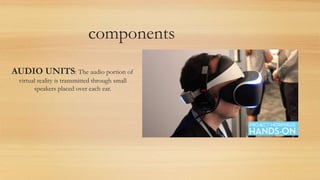
AUDIO UNITS: The audio portion of
virtual reality is transmitted through small
speakers placed over each ear.
components
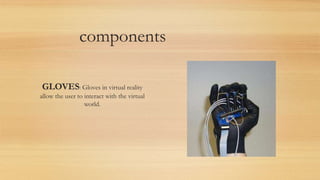
GLOVES: Gloves in virtual reality
allow the user to interact with the virtual
world.
Application
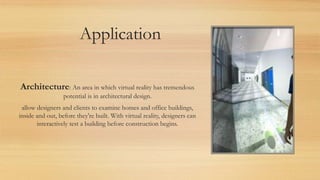
Architecture: An area in which virtual reality has tremendous
potential is in architectural design.
allow designers and clients to examine homes and office buildings,
inside and out, before they're built. With virtual reality, designers can
interactively test a building before construction begins.
Application
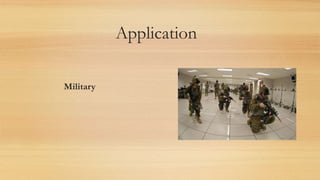
Military
Application
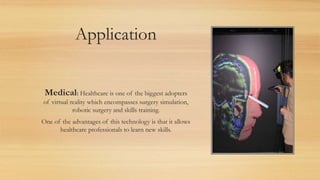
Medical: Healthcare is one of the biggest adopters
of virtual reality which encompasses surgery simulation,
robotic surgery and skills training.
One of the advantages of this technology is that it allows
healthcare professionals to learn new skills.
Drawbacks
Cost: This new technology is expensive. The cost of developing
hardware and software for the application of virtual reality
technology is too high.
Currently the prize of HMD is $350 .
Space: This equipment requires a large amount of space to
accommodate.

Virtual reality

  • 1.
    VIRTUAL REALITY BY PATELBHAVIN (12CE095)
  • 2.
    What is virtualreality? A computer generated simulation of 3-D image or environment that can be interacted with a physical or real way by a person.
  • 3.
    History of VR In 1950 an attempt by a cinematographer by Morton Heilig to simulate different senses became the idea.  During the 1980s and 90s, Virtual Reality became a concept that was been believed to be the future.
  • 4.
    Types of virtualreality Non-Immersive (Desktop) Systems: Non-immersive systems, as the name suggests, are the least immersive implementation of VR techniques. Using the desktop system, the virtual environment(VE) is viewed through a portal or window by utilising a monitor. Semi-Immersive Projection Systems: Semi-immersive systems are a relatively new implementation of VR technology. A semi-immersive system will comprise a relatively high performance graphics computing system which can be coupled with either a large screen projector system , multiple television projection systems. Fully Immersive Systems: All fully immersive systems will give a sense of presence that cannot be equaled by the other approaches discussed earlier, but the sense of immersion depends on several parameters including the field of view of resolution, the update rate, and contrast and illumination of the display.
  • 5.
    components REALITY ENGINE :Reality engines are based largely on the same components that make up a personal computer (PC), although much more computing power is required for the reality engine than is available in a standard PC. Virtual reality images are made with tiny dot like segments of a picture known as pixels, or picture elements.
  • 6.
    components HEAD MOUNTED DISPLAY(HMD): Head- mounted display (HMD) units use a small screen or screens that are worn in a helmet or a pair glasses. Unlike a movie, the HMD allows viewers to look at an image from various angles or change their field of view by simply moving their heads.
  • 7.
    components AUDIO UNITS: Theaudio portion of virtual reality is transmitted through small speakers placed over each ear.
  • 8.
    components GLOVES: Gloves invirtual reality allow the user to interact with the virtual world.
  • 9.
    Application Architecture: An areain which virtual reality has tremendous potential is in architectural design. allow designers and clients to examine homes and office buildings, inside and out, before they're built. With virtual reality, designers can interactively test a building before construction begins.
  • 10.
  • 11.
    Application Medical: Healthcare isone of the biggest adopters of virtual reality which encompasses surgery simulation, robotic surgery and skills training. One of the advantages of this technology is that it allows healthcare professionals to learn new skills.
  • 12.
    Drawbacks Cost: This newtechnology is expensive. The cost of developing hardware and software for the application of virtual reality technology is too high. Currently the prize of HMD is $350 . Space: This equipment requires a large amount of space to accommodate.