ERP II: The extended
enterprise system


F.C. “Ted” Weston, Jr.
Professor of Computer Information Systems,
Colorado State University, Fort Collins, Colorado
(tweston@lamar.colostate.edu)                       M              edium and large companies are quickly
                                                                   learning that integrating electronic systems
                                                                   within and between physical locations is,
                                                    more and more, a required element of doing business. At
                                                    the same time, real-time communications and integration
                                                    with both customers and vendors is a growing business
                                                    requirement. In all cases, information technology (IT)
                                                    drives the fundamental collaboration and integration
                                                    changes taking place in industry. To date, much of the
                                                    business transformation driven by IT is led by companies
                                                    in the United States; however, this trend of information
                                                    integration across extended enterprise systems will soon
                                                    be embraced by firms regardless of where they are located
                                                    and independent of the geographic addresses of business
                                                    partners, plants, sales offices, customers, and/or vendors.
                                                    Physical borders will have less future business relevance
                                                    except for issues of governance, taxes, and security. IT is
With IT as the infrastructure,                      rapidly propelling enterprise systems beyond simply en-
                                                    abling change to become the drivers of business change.
business is coming to rely on
                                                    The cost of developing an IT infrastructure is also well
real-time information integration                   documented. Weill, Subramani, and Broadbent (2002)
both within and between firms and                   report that the average firm spends more than 4.2 percent
                                                    of annual revenue on IT, accounting for more than 50
without regard to geography, borders,               percent of its total capital expenditure budget. Clearly,
or language. The foundation for this                businesses expect a return from these ongoing invest-
                                                    ments. Davenport et al. (2001) conclude that these bil-
system rests on a combination of technical
                                                    lions of dollars invested in technology that are used to
and general business issues. The former will        generate huge volumes of transaction data can be mis-
always be easier to address and manage than the     spent if the investments fail to convert data into knowl-
latter. However, people, structure, realignment,    edge, followed by business results. One clear trend from
                                                    these investments in IT, including enterprise systems, is
and change management will prove more
                                                    the expectation of an acceptable business return.
important to accomplishing such a vision than
                                                    In many firms and industries, early MRP I (material
raw IT. Firms must take both a technological and
                                                    requirements planning) and MRP II systems are being
philosophical view of how to trade information      replaced by enterprise resource planning (ERP) systems.
in the future and how to adapt to a changing        ERP I, using the MRP I metaphor, consists of software
business environment that is increasingly global    that integrates front- and back-office information systems
                                                    (ISs) within the firm. ERP II consists of both CRM (cus-
in nature and value-added driven.
                                                    tomer relationship management) system functionality
                                                    that links to customers, and SCM (supply chain manage-

                                                                                                             49
ment) system functionality that links to
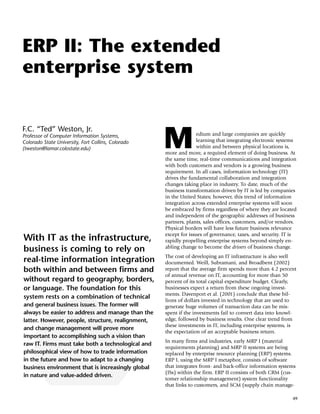
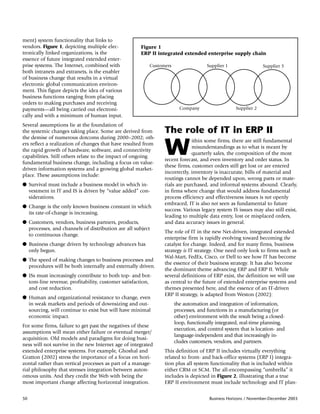
vendors. Figure 1, depicting multiple elec-          Figure 1
tronically linked organizations, is the              ERP II integrated extended enterprise supply chain
essence of future integrated extended enter-
prise systems. The Internet, combined with               Customers                  Supplier 1                Supplier 3
both intranets and extranets, is the enabler
of business change that results in a virtual
electronic global communication environ-
ment. This figure depicts the idea of various
business functions ranging from placing
orders to making purchases and receiving
payments—all being carried out electroni-                              Company                   Supplier 2
cally and with a minimum of human input.
Several assumptions lie at the foundation of
the systemic changes taking place. Some are derived from       The role of IT in ERP II
the demise of numerous dotcoms during 2000–2002; oth-


                                                               W
                                                                            ithin some firms, there are still fundamental
ers reflect a realization of changes that have resulted from
                                                                            misunderstandings as to what is meant by
the rapid growth of hardware, software, and connectivity
                                                                            quarterly sales, the composition of the most
capabilities. Still others relate to the impact of ongoing
                                                               recent forecast, and even inventory and order status. In
fundamental business change, including a focus on value-
                                                               these firms, customer orders still get lost or are entered
driven information systems and a growing global market-
                                                               incorrectly, inventory is inaccurate, bills of material and
place. These assumptions include:
                                                               routings cannot be depended upon, wrong parts or mate-
q Survival must include a business model in which in-          rials are purchased, and informal systems abound. Clearly,
  vestment in IT and IS is driven by “value added” con-        in firms where change that would address fundamental
  siderations.                                                 process efficiency and effectiveness issues is not openly
                                                               embraced, IT is also not seen as fundamental to future
q Change is the only known business constant in which
                                                               success. Various legacy system IS issues may also still exist,
  its rate-of-change is increasing.
                                                               leading to multiple data entry, lost or misplaced orders,
q Customers, vendors, business partners, products,             and data accuracy issues in general.
  processes, and channels of distribution are all subject
                                                               The role of IT in the new Net-driven, integrated extended
  to continuous change.
                                                               enterprise firm is rapidly evolving toward becoming the
q Business change driven by technology advances has            catalyst for change. Indeed, and for many firms, business
  only begun.                                                  strategy is IT strategy. One need only look to firms such as
                                                               Wal-Mart, FedEx, Cisco, or Dell to see how IT has become
q The speed of making changes to business processes and
                                                               the essence of their business strategy. It has also become
  procedures will be both internally and externally driven.
                                                               the dominant theme advancing ERP and ERP II. While
q ISs must increasingly contribute to both top- and bot-       several definitions of ERP exist, the definition we will use
  tom-line revenue, profitability, customer satisfaction,      as central to the future of extended enterprise systems and
  and cost reduction.                                          themes presented here, and the essence of an IT-driven
                                                               ERP II strategy, is adapted from Weston (2002):
q Human and organizational resistance to change, even
  in weak markets and periods of downsizing and out-                 the automation and integration of information,
  sourcing, will continue to exist but will have minimal             processes, and functions in a manufacturing (or
  economic impact.                                                   other) environment with the result being a closed-
                                                                     loop, functionally integrated, real-time planning,
For some firms, failure to get past the negatives of these
                                                                     execution, and control system that is location- and
assumptions will mean either failure or eventual merger/
                                                                     language-independent and that increasingly in-
acquisition. Old models and paradigms for doing busi-
                                                                     cludes customers, vendors, and partners.
ness will not survive in the new Internet age of integrated
extended enterprise systems. For example, Ghoshal and          This definition of ERP II includes virtually everything
Gratton (2002) stress the importance of a focus on hori-       related to front- and back-office systems (ERP I) integra-
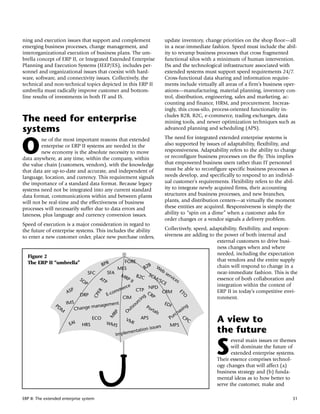
zontal rather than vertical processes as part of a manage-     tion plus all system functionality that is included within
rial philosophy that stresses integration between auton-       either CRM or SCM. The all-encompassing “umbrella” it
omous units. And they credit the Web with being the            includes is depicted in Figure 2, illustrating that a true
most important change affecting horizontal integration.        ERP II environment must include technology and IT plan-


50                                                                                   Business Horizons / November-December 2003
ning and execution issues that support and complement                             update inventory, change priorities on the shop floor—all
emerging business processes, change management, and                               in a near-immediate fashion. Speed must include the abil-
interorganizational execution of business plans. The um-                          ity to revamp business processes that cross fragmented
brella concept of ERP II, or Integrated Extended Enterprise                       functional silos with a minimum of human intervention.
Planning and Execution Systems (IEEP/ES), includes per-                           ISs and the technological infrastructure associated with
sonnel and organizational issues that coexist with hard-                          extended systems must support speed requirements 24/7.
ware, software, and connectivity issues. Collectively, the                        Cross-functional data sharing and information require-
technical and non-technical topics depicted in this ERP II                        ments include virtually all areas of a firm’s business oper-
umbrella must radically improve customer and bottom-                              ations—manufacturing, material planning, inventory con-
line results of investments in both IT and IS.                                    trol, distribution, engineering, sales and marketing, ac-
                                                                                  counting and finance, HRM, and procurement. Increas-
                                                                                  ingly, this cross-silo, process-oriented functionality in-
                                                                                  cludes B2B, B2C, e-commerce, trading exchanges, data
The need for enterprise                                                           mining tools, and newer optimization techniques such as
systems                                                                           advanced planning and scheduling (APS).
                                                                                  The need for integrated extended enterprise systems is

O
         ne of the most important reasons that extended
         enterprise or ERP II systems are needed in the                           also supported by issues of adaptability, flexibility, and
         new economy is the absolute necessity to move                            responsiveness. Adaptability refers to the ability to change
data anywhere, at any time, within the company, within                            or reconfigure business processes on the fly. This implies
the value chain (customers, vendors), with the knowledge                          that empowered business users rather than IT personnel
that data are up-to-date and accurate, and independent of                         must be able to reconfigure specific business processes as
language, location, and currency. This requirement signals                        needs develop, and specifically to respond to an individ-
the importance of a standard data format. Because legacy                          ual customer’s requirements. Flexibility refers to the abil-
systems need not be integrated into any current standard                          ity to integrate newly acquired firms, their accounting
data format, communications within and between plants                             structures and business processes, and new branches,
will not be real-time and the effectiveness of business                           plants, and distribution centers—at virtually the moment
processes will necessarily suffer due to data errors and                          these entities are acquired. Responsiveness is simply the
lateness, plus language and currency conversion issues.                           ability to “spin on a dime” when a customer asks for
                                                                                  order changes or a vendor signals a delivery problem.
Speed of execution is a major consideration in regard to
the future of enterprise systems. This includes the ability          Collectively, speed, adaptability, flexibility, and respon-
to enter a new customer order, place new purchase orders,            siveness are adding to the power of both internal and
                                                                                             external customers to drive busi-
                                                                                             ness changes when and where
                                                                                             needed, including the expectation
  Figure 2
                                              FORE                                           that vendors and the entire supply
  The ERP II “umbrella”          BPR                        B W
                                           MES           B2                                  chain will respond to change in a
                                                                 eb
                            SFC      SFA M                 SC        se                      near-immediate fashion. This is the
                                              RP B2C          M/        rvi
                       SO       AT               II              SC         ce               essence of both collaboration and
                          P        P                                E          s
                                              rce          NPD                               integration within the context of
                                            me
                 ASP                    com
                                                    CTP                                      ERP II in today’s competitive envi-
                                         R


                                                          CR      CRM
                                                                                         ET
                                        F


                        DRP          E-
                                     CP


                                                         g P
                                                                                           O


                                             CIM      in                                     ronment.
                                                                c
                 PD IM
                       S                 nt                   ur                  EDI
                                 anageme                 so
                   M    Change m                      ut
                                                                    Po
                                                                      rta                     ing
                                                     O                   ls                as
                                                                                        ch
                                              RP


                                                                                       r C
                                                                                    Pu
                                             M


                        EAI    HRS
                                     ECO
                                             WMS
                                                    VM
                                                          I
                                                                APS
                                                                                    MPS
                                                                                               PC        A view to
                                                                              s
                                                                n issue                                  the future
                                                         entatio
                                                 Implem


                                                                                                         S
                                                                                                                everal main issues or themes
                                                                                                                will dominate the future of
                                                                                                                extended enterprise systems.
                                                                                                         Their essence comprises technol-
                                                                                                         ogy changes that will affect (a)
                                                                                                         business strategy and (b) funda-
                                                                                                         mental ideas as to how better to
                                                                                                         serve the customer, make and

ERP II: The extended enterprise system                                                                                                      51
deliver a product or service, and compete more efficiently,     ices between firms over the Net, with speed and reliability
effectively, and profitably.                                    of communications as major selling points. Some of what
                                                                is being called “Web services” is not conceptually new.
Information flows                                               This includes e-business, where the focus is on the “busi-
ERP II of the future must first be focused on providing a       ness” with the “e” being the medium of electronics-based
clear flow of consistent, real-time information both within     communication. CRM is also part of Web services because
and between heterogeneous and disparate systems. This           of the focus on customer business intelligence, plus tools
flow includes information both within divisions/locations       and analytics including data mining—all related to both
that have different hardware and software scattered around      customer satisfaction and the ability to respond to order
the world, and between firms, customers, vendors, part-         changes (quantity, timing) in near real-time. Although
ners, and regulatory authorities. In this context, what is
today viewed as ERP I systems (functionality that integrates
front- and back-office IS) will be integrated with elements
of both SCM and CRM systems. This combined view of
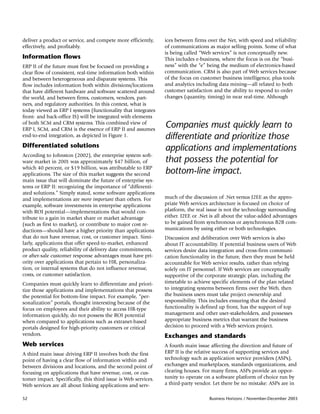
ERP I, SCM, and CRM is the essence of ERP II and assumes
                                                                Companies must quickly learn to
end-to-end integration, as depicted in Figure 1.                differentiate and prioritize those
Differentiated solutions                                        applications and implementations
According to Johnston (2002), the enterprise system soft-
ware market in 2001 was approximately $47 billion, of           that possess the potential for
which 40 percent, or $19 billion, was attributable to ERP
applications. The size of this market suggests the second       bottom-line impact.
main issue that will dominate the future of enterprise sys-
tems or ERP II: recognizing the importance of “differenti-
ated solutions.” Simply stated, some software applications
and implementations are more important than others. For         much of the discussion of .Net versus J2EE as the appro-
example, software investments in enterprise applications        priate Web services architecture is focused on choice of
with ROI potential—implementations that would con-              platform, the real issue is not the technology surrounding
tribute to a gain in market share or market advantage           either. J2EE or .Net is all about the value-added advantages
(such as first to market), or contribute to major cost re-      to be gained from synchronous or asynchronous B2B com-
ductions—should have a higher priority than applications        munications by using either or both technologies.
that do not have revenue, cost, or customer impact. Simi-       Discussion and deliberation over Web services is also
larly, applications that offer speed-to-market, enhanced        about IT accountability. If potential business users of Web
product quality, reliability of delivery date commitments,      services desire data integration and cross-firm communi-
or after-sale customer response advantages must have pri-       cation functionality in the future, then they must be held
ority over applications that pertain to HR, personaliza-        accountable for Web service results, rather than relying
tion, or internal systems that do not influence revenue,        solely on IT personnel. If Web services are conceptually
costs, or customer satisfaction.                                supportive of the corporate strategic plan, including the
Companies must quickly learn to differentiate and priori-       timetable to achieve specific elements of the plan related
tize those applications and implementations that possess        to integrating systems between firms over the Web, then
the potential for bottom-line impact. For example, “per-        the business users must take project ownership and
sonalization” portals, thought interesting because of the       responsibility. This includes ensuring that the desired
focus on employees and their ability to access HR-type          functionality is defined up front, has the support of top
information quickly, do not possess the ROI potential           management and other user-stakeholders, and possesses
when compared to applications such as extranet-based            appropriate business metrics that warrant the business
portals designed for high-priority customers or critical        decision to proceed with a Web services project.
vendors.                                                        Exchanges and standards
Web services                                                    A fourth main issue affecting the direction and future of
A third main issue driving ERP II involves both the first       ERP II is the relative success of supporting services and
point of having a clear flow of information within and          technology such as application service providers (ASPs),
between divisions and locations, and the second point of        exchanges and marketplaces, standards organizations, and
focusing on applications that have revenue, cost, or cus-       clearing houses. For many firms, ASPs provide an oppor-
tomer impact. Specifically, this third issue is Web services.   tunity to operate on a software platform of choice run by
Web services are all about linking applications and serv-       a third-party vendor. Let there be no mistake: ASPs are in

52                                                                                  Business Horizons / November-December 2003
their relative infancy and many will not be long-term sur-      “agile,” and “collaborative” all connote a basic theme—
vivors because their business model will not support con-       processes that are adaptable, flexible, responsive, and pro-
tinuous module upgrades, best-of-breed integrated soft-         vide ongoing business value. In the evolving business cli-
ware offerings, and/or ease of migration and implementa-        mate, changing processes must be viewed as having a pos-
tion tools. Security and cost are the two main issues sur-      itive impact on product or service flow and cannot be per-
rounding ASPs—and either or both can be a reason to             ceived as being disruptive to the general flow of opera-
place, or not place, ERP II applications with an exogenous      tions. BPR/BPM changes include sensitivity to the morale
provider of services.                                           of personnel who are more than aware of recent downsiz-
                                                                ing and outsourcing trends. Both internal and external
Exchanges and marketplaces are also part of this issue.
                                                                processes must be squeezed to become devoid of non-
“Collaborative commerce” is a term commonly used here.
                                                                value-added activities. Because both ERP I and ERP II nec-
Firms are rapidly discovering both the advantages and dis-
                                                                essarily incorporate myriad processes, selection of any
advantages of purchasing exchanges for B2B and B2C.
                                                                extended enterprise software system must be made with a
Speed, price, rapid information exchange, and the poten-
                                                                realization that processes can never be locked in concrete
tial for partnering and collaboration are clear advantages
                                                                and that users must be in control of which ones to change
of exchanges and marketplaces. Disadvantages include
                                                                as well as when, where, and how to make the changes.
margin pressure on vendors as well as the potential for
                                                                ERP II software selection decisions must reflect this need
erosion of the relationships and trust that had built up
                                                                to always be able to redesign or reconfigure business
over several years between customer and vendor.
                                                                processes as needs dictate.
Related issues                                                  As firms grow to understand the importance of the rate-
Infrastructural to all main issues affecting the future of      of-change of change, developing and maintaining quick
extended enterprise systems is the role of IT-based stan-       response processes becomes more and more important
dards organizations such as the World Wide Web Consor-          for keeping customers satisfied and internal operations
tium, or W3C. A major role of these organizations is to         effective. Processes in ERP II systems must be designed
serve the function of determining an agreed-upon set of         around goals of customer satisfaction and order fulfill-
standards and protocols for communicating over the Net          ment that will increasingly focus on synthesizing and
both within and between firms. Clearly, a unified set of        aggregating internal data in such a way that orders are
standards independent of hardware and software vendors          executed faster, cheaper, and with greater reliability. Data
and individual products is in the best interest of firms        relevant to both customer orders and the effectiveness of
that are expanding global business and expediting busi-         business processes will be crunched with the aid of enter-
ness communications. Clearinghouses pertaining to func-         prise systems in such a way that corporate decisions can
tionality such as digital signatures have a similar function:   be made more accurately and more cost-efficiently. BPR/
facilitate and expedite business communications between         BPM will increasingly take on an IT focus that continually
firms. Based on global communication standards, busi-           examines for internal bottlenecks and means of managing
ness processes will quickly be brought to the edge of the       resources in such a manner that throughput is maximized
Net. Differences in processes from firm to firm will be-        with optimal profitability.
come largely transparent, but not unimportant. What is
important is the ability to quickly and seamlessly commu-
nicate process results, details, events, and outcomes be-
tween firms in a common and consistent format and
                                                                Roadblocks to vision
independent of language or location.                            fulfillment
Any vision of the future of ERP II would not be complete

                                                                T
                                                                      here are several land mines and pitfalls that could
without including the role and importance of business                 prevent any of this vision for the future of enter-
process reengineering (BPR). For many firms, imple-                   prise systems from becoming reality. An Accenture
menting ERP II and engaging in an analysis of business          (2002) study cited several main reasons for the shortfall
processes are synonymous. Processes may be reengineered         of CRM implementations:
without an ongoing ERP II implementation; however, an
ERP implementation without significant BPR will be a            q no long-term CRM vision
rare and risky event.                                           q weak business case for investments
BPR has evolved from the radical restructuring of business      q investments not prioritized
processes originally called for by Hammer and Champy
(1993) to an approach focused more on value-added and           q return on investment not calculated properly
relabeled business process management (BPM), as espoused        Similar studies on the return from large-scale enterprise
by Smith and Fingar (2002). Today, terms like “lean,”           systems have produced results focusing on the lack of top

ERP II: The extended enterprise system                                                                                    53
management support, project management implementa-              q bad data, including not understanding the magnitude
tion issues, and people/organizational issues contrasted to        of the master data problem when implementing any
technology issues. There are many common threads from              new ERP II-type system
all these studies. One involves issues of change manage-
                                                                q clinging to outmoded legacy systems
ment—a point Nestlé learned well, as told by Worthen
(2002) in a story that includes issues of risk assessment,      q the inability and/or unwillingness to focus on business
ROI analysis, and impacts on change management on the              (value-added) metrics (revenue, cost, customer)
overall business culture. The whole issue of uncertainty
                                                                Collectively, any plan for implementing the type of ERP II
that can undermine a project was the subject of a related
                                                                system outlined above must take into account a myriad of
study by DeMeyer, Loch, and Pich (2002).
                                                                management and people issues that have the potential to
The Chaos Study conducted by the Standish Group is              derail any long-term vision of top management to pro-
arguably the best-known study to look at large-scale IT         ceed with an integrated extended enterprise planning and
projects such as ERP II. Repeated to present a longitudinal     execution system.
view of IT project results, it has consistently pointed
toward problems with large-scale system implementation
and project management. Problems cited in the original
1994 study, which involved projects costing an average of
$2.3 million, included 31 percent of the projects being
canceled before completion; more than half of them came
in at nearly double the original estimate, and only one-
                                                                T           he future of extended enterprise systems clearly
                                                                            includes an IT perspective in which companies,
                                                                            customers, and vendors are all linked electroni-
                                                                cally. IT is the infrastructural basis for all change related to
                                                                e-business, collaborative commerce, and the inclusion of
sixth of them were completed on time.                           SCM and CRM under an expanded ERP II umbrella. This
                                                                vision highlights the importance of clean data both within
An update of the Chaos Study presented a more positive
                                                                and between organizations, the importance of “differenti-
picture. Johnson et al. (2001) report that “success rates are
                                                                ated solutions,” the emerging role of Web services, and the
up across the board, while cost and schedule overruns are
                                                                growing importance of ASPs, exchanges and marketplaces,
declining.” They also report executive support, user in-
                                                                standards organizations, and clearing houses. For most
volvement, an experienced project manager, and clear busi-
                                                                firms, BPR must accompany a migration to ERP II.
ness objectives as the top four factors contributing to proj-
ect success and risk reduction. Clearly, the ability to man-    All this is not without risk. Understanding the role and
age large-scale projects such as ERP II has considerable        importance of resistance to change, local culture issues,
impact on whether or not the projects will be successful.       training, testing, and good project management are all key
                                                                to successful implementation. Any vision of future enter-
Several additional issues need to be examined carefully as
                                                                prise systems must recognize the role to be played by the
part of any vision of the future for a large-scale extended
                                                                Internet as a communication medium. However, it is the
enterprise system such as ERP II:
                                                                people within the firm seeking to implement an ERP II
q training to include both potential users of the system        strategy that will determine its overall success or failure.
     and management representing all stakeholder areas of       People plus bad data can disrupt any well-intended ex-
     the firm, plus major customers and vendors                 tended enterprise system integration strategy. ❍
q incomplete unit, integration, system, and user accept-
     ance testing
                                                                References and selected bibliography
q failure to take into account global stakeholders, includ-
                                                                Accenture. 2002. CRM potential hampered by hidden obstacles.
     ing the impact of a large-scale enterprise project on a
                                                                  @ www.idsystems.com/news/2002/07_02/0703/crm/news_
     foreign partner’s local culture                              main.htm (2 July).
q overall project size, including issues of scope creep,        APICS Dictionary, 10th ed. 2001. Falls Church, VA: American Pro-
     buy-in from user groups, and an agreed-upon plan for         duction and Inventory Control Society.
     module implementation                                      Blakely, Beth. 2002. Web services standards: The battle continues.
                                                                  Tech Republic. @ www.zdnet.com/filters/printerfriendly/
q a failure to implement an effective communication sys-          0,6061,2879451-92,00.html (6 September).
     tem that includes both the project manager and spon-       Davenport, Thomas H., Jeanne G. Harris, David W. De Long,
     sor, a steering committee, and major stakeholders, with      and Alvin L. Jacobson. 2001. Data to knowledge to results:
     regular project updates                                      Building an analytic capability. California Management Review
                                                                  43/2 (Winter): 117-138.
q a “death march” syndrome (Yourdon 1997) that                  De Meyer, Arnoud, Christoph H. Loch, and Michael T. Pich.
     includes unrealistic deliverables or deadlines               2002. Managing project uncertainty: From variation to chaos.
                                                                  Sloan Management Review 43/2 (Winter): 60-67.


54                                                                                    Business Horizons / November-December 2003
Ghoshal, Sumantra, and Lynda Gratton. 2002. Integrating the            tion and Inventory Management Journal 42/3-4 (Third/Fourth
  enterprise. Sloan Management Review 44/1 (Fall): 31-38.              Quarters): 46-51.
Goldratt, Eliyahu M., with Eli Schragenheim and Carol A. Ptak.       Matta, Nadim, and Sandy Krieger. 2001. From IT solutions to
  2000. Necessary but not sufficient. Great Barrington, MA: North      business results. Business Horizons 44/6 (November-December):
  River Press.                                                         45-50.
Goldratt, Eliyahu M., and Jeff Cox. 1992. The goal: A process of     Meehan, Michael. 2002. Dell expands into enterprise network-
  ongoing improvement, 2nd rev. ed. Croton-on-Hudson, NY:              ing. Computerworld (1 July): 15.
  North River Press.                                                 Nash, Kim. 2000. Companies don’t learn from previous IT sna-
Gordon, Mark. 2001. Next day change guaranteed. CIO Maga-              fus. Computerworld (30 October): 32-35.
  zine. @ www.cio.com/archive/051501 (15 May).                       O’Leary, Daniel L. 2000. Enterprise resource planning systems: Sys-
Hall, Mark. 2002. Web services open portal doors. Computerworld        tems, life cycle, electronic commerce, and risk. Cambridge, Eng.:
  (24 June): 28-30.                                                    Cambridge University Press.
Hammer, Michael, and James Champy. 1993. Reengineering the           Phillips, James, and Dan Foody. 2002. Building a foundation for
  corporation: A manifesto for business revolution. New York:          Web services. EAI Journal. @ bijonline.com/PDF/WSFoundation
  HarperBusiness.                                                      Foody.pdf (March).
Harreld, Heather. 2001. Extended ERP reborn in b-to-b.               Sandoe, Kent, Gail Corbitt, and Raymond Boykin. 2001. Enter-
  InfoWorld (27 August): 21-23.                                        prise integration. New York: Wiley.
Jacobs, F. Robert, and D. Clay Whybark. 2000. Why ERP? A             Smith, Howard, and Peter Fingar. 2002. Business process manage-
  primer on SAP implementation. Boston: Irwin McGraw-Hill.             ment: The third wave. Tampa: Meghan-Kiffer Press.
Jenkins, Jill. 2002. Supply chain management 2002: Collabora-        Standish Group. 1994. Chaos. @ www.standishgroup.com/chaos/.
  tion, analytics, and CRM. CIO Magazine. @ www.cio.com/             Weill, Peter, Mani Subramani, and Marianne Broadbent. 2002.
  analyst/010902_ca.html (9 January).                                  Building IT infrastructure for strategic agility. Sloan Manage-
Johnson, Jim, Karen D. Boucher, Kyle Connors, and James                ment Review 44/1 (Fall): 57-65.
  Robinson. 2001. Collaborating on project success. Software         Weston, F.C. “Ted,” Jr. 2001. ERP implementation and project
  Magazine. @ www.softwaremag.com/L.cfm?Doc=archive/                   management. Production and Inventory Management Journal
  2001feb/CollaborativeMgt.html (February-March).                      42/3-4 (Third/Fourth Quarter): 75-80.
Johnston, Sarah Jane. 2002. ERP: Payoffs and pitfalls. @             ———. 2002. A vision for the future of extended enterprise sys-
  hbsworkingknowledge.hbs.edu/pubitem.jhtml?id=3141&sid=               tems. Presentation, J.D. Edwards FOCUS Users Conference,
  0&pid=0&t=operations (14 October).                                   Denver, Colorado (12 June).
Karpinski, Richard. 2002. Five lessons on real-world Web services.   Wheatley, Malcolm. 2000. Her majesty’s flying I.T. circus. CIO
  The Open Enterprise. @ www.theopenenterprise.com/shared/             Magazine. @ www.cio.com/archive/080100 (1 August).
  printableArticle?doc_id=TOE20021114S0002 (14 November).            Worthen, Ben. 2002. Nestlé’s ERP odyssey. CIO Magazine. @
Lohmeyer, Dan, Sofya Pogreb, and Scott Robinson. 2002. Who’s           www.cio.com/archive/051502 (15 May).
  accountable for IT? McKinsey Quarterly No. 4 (Technology):         ———. 2002. Web services still not ready for prime time. CIO
  39-48.                                                               Magazine. @ www.cio.com/archive/090102 (1 September).
Lundberg, Abbie. 2002. The I.T. inside the world’s biggest com-      Yourdon, Edward. 1997. Death march: The complete software devel-
  pany. CIO Magazine. @ www.cio.com/archive/070102 (1 July).           oper’s guide to surviving “Mission Impossible” projects. Upper Sad-
Mabert, Vincent A., Ashok Soni, and M.A. Venkataramanan.               dle River, NJ: Prentice-Hall PTR.
  2001. Enterprise resource planning: Measuring value. Produc-


ERP II: The extended enterprise system                                                                                                 55

Business horizonsweston

  • 1.
    ERP II: Theextended enterprise system F.C. “Ted” Weston, Jr. Professor of Computer Information Systems, Colorado State University, Fort Collins, Colorado (tweston@lamar.colostate.edu) M edium and large companies are quickly learning that integrating electronic systems within and between physical locations is, more and more, a required element of doing business. At the same time, real-time communications and integration with both customers and vendors is a growing business requirement. In all cases, information technology (IT) drives the fundamental collaboration and integration changes taking place in industry. To date, much of the business transformation driven by IT is led by companies in the United States; however, this trend of information integration across extended enterprise systems will soon be embraced by firms regardless of where they are located and independent of the geographic addresses of business partners, plants, sales offices, customers, and/or vendors. Physical borders will have less future business relevance except for issues of governance, taxes, and security. IT is With IT as the infrastructure, rapidly propelling enterprise systems beyond simply en- abling change to become the drivers of business change. business is coming to rely on The cost of developing an IT infrastructure is also well real-time information integration documented. Weill, Subramani, and Broadbent (2002) both within and between firms and report that the average firm spends more than 4.2 percent of annual revenue on IT, accounting for more than 50 without regard to geography, borders, percent of its total capital expenditure budget. Clearly, or language. The foundation for this businesses expect a return from these ongoing invest- ments. Davenport et al. (2001) conclude that these bil- system rests on a combination of technical lions of dollars invested in technology that are used to and general business issues. The former will generate huge volumes of transaction data can be mis- always be easier to address and manage than the spent if the investments fail to convert data into knowl- latter. However, people, structure, realignment, edge, followed by business results. One clear trend from these investments in IT, including enterprise systems, is and change management will prove more the expectation of an acceptable business return. important to accomplishing such a vision than In many firms and industries, early MRP I (material raw IT. Firms must take both a technological and requirements planning) and MRP II systems are being philosophical view of how to trade information replaced by enterprise resource planning (ERP) systems. in the future and how to adapt to a changing ERP I, using the MRP I metaphor, consists of software business environment that is increasingly global that integrates front- and back-office information systems (ISs) within the firm. ERP II consists of both CRM (cus- in nature and value-added driven. tomer relationship management) system functionality that links to customers, and SCM (supply chain manage- 49
  • 2.
    ment) system functionalitythat links to vendors. Figure 1, depicting multiple elec- Figure 1 tronically linked organizations, is the ERP II integrated extended enterprise supply chain essence of future integrated extended enter- prise systems. The Internet, combined with Customers Supplier 1 Supplier 3 both intranets and extranets, is the enabler of business change that results in a virtual electronic global communication environ- ment. This figure depicts the idea of various business functions ranging from placing orders to making purchases and receiving payments—all being carried out electroni- Company Supplier 2 cally and with a minimum of human input. Several assumptions lie at the foundation of the systemic changes taking place. Some are derived from The role of IT in ERP II the demise of numerous dotcoms during 2000–2002; oth- W ithin some firms, there are still fundamental ers reflect a realization of changes that have resulted from misunderstandings as to what is meant by the rapid growth of hardware, software, and connectivity quarterly sales, the composition of the most capabilities. Still others relate to the impact of ongoing recent forecast, and even inventory and order status. In fundamental business change, including a focus on value- these firms, customer orders still get lost or are entered driven information systems and a growing global market- incorrectly, inventory is inaccurate, bills of material and place. These assumptions include: routings cannot be depended upon, wrong parts or mate- q Survival must include a business model in which in- rials are purchased, and informal systems abound. Clearly, vestment in IT and IS is driven by “value added” con- in firms where change that would address fundamental siderations. process efficiency and effectiveness issues is not openly embraced, IT is also not seen as fundamental to future q Change is the only known business constant in which success. Various legacy system IS issues may also still exist, its rate-of-change is increasing. leading to multiple data entry, lost or misplaced orders, q Customers, vendors, business partners, products, and data accuracy issues in general. processes, and channels of distribution are all subject The role of IT in the new Net-driven, integrated extended to continuous change. enterprise firm is rapidly evolving toward becoming the q Business change driven by technology advances has catalyst for change. Indeed, and for many firms, business only begun. strategy is IT strategy. One need only look to firms such as Wal-Mart, FedEx, Cisco, or Dell to see how IT has become q The speed of making changes to business processes and the essence of their business strategy. It has also become procedures will be both internally and externally driven. the dominant theme advancing ERP and ERP II. While q ISs must increasingly contribute to both top- and bot- several definitions of ERP exist, the definition we will use tom-line revenue, profitability, customer satisfaction, as central to the future of extended enterprise systems and and cost reduction. themes presented here, and the essence of an IT-driven ERP II strategy, is adapted from Weston (2002): q Human and organizational resistance to change, even in weak markets and periods of downsizing and out- the automation and integration of information, sourcing, will continue to exist but will have minimal processes, and functions in a manufacturing (or economic impact. other) environment with the result being a closed- loop, functionally integrated, real-time planning, For some firms, failure to get past the negatives of these execution, and control system that is location- and assumptions will mean either failure or eventual merger/ language-independent and that increasingly in- acquisition. Old models and paradigms for doing busi- cludes customers, vendors, and partners. ness will not survive in the new Internet age of integrated extended enterprise systems. For example, Ghoshal and This definition of ERP II includes virtually everything Gratton (2002) stress the importance of a focus on hori- related to front- and back-office systems (ERP I) integra- zontal rather than vertical processes as part of a manage- tion plus all system functionality that is included within rial philosophy that stresses integration between auton- either CRM or SCM. The all-encompassing “umbrella” it omous units. And they credit the Web with being the includes is depicted in Figure 2, illustrating that a true most important change affecting horizontal integration. ERP II environment must include technology and IT plan- 50 Business Horizons / November-December 2003
  • 3.
    ning and executionissues that support and complement update inventory, change priorities on the shop floor—all emerging business processes, change management, and in a near-immediate fashion. Speed must include the abil- interorganizational execution of business plans. The um- ity to revamp business processes that cross fragmented brella concept of ERP II, or Integrated Extended Enterprise functional silos with a minimum of human intervention. Planning and Execution Systems (IEEP/ES), includes per- ISs and the technological infrastructure associated with sonnel and organizational issues that coexist with hard- extended systems must support speed requirements 24/7. ware, software, and connectivity issues. Collectively, the Cross-functional data sharing and information require- technical and non-technical topics depicted in this ERP II ments include virtually all areas of a firm’s business oper- umbrella must radically improve customer and bottom- ations—manufacturing, material planning, inventory con- line results of investments in both IT and IS. trol, distribution, engineering, sales and marketing, ac- counting and finance, HRM, and procurement. Increas- ingly, this cross-silo, process-oriented functionality in- cludes B2B, B2C, e-commerce, trading exchanges, data The need for enterprise mining tools, and newer optimization techniques such as systems advanced planning and scheduling (APS). The need for integrated extended enterprise systems is O ne of the most important reasons that extended enterprise or ERP II systems are needed in the also supported by issues of adaptability, flexibility, and new economy is the absolute necessity to move responsiveness. Adaptability refers to the ability to change data anywhere, at any time, within the company, within or reconfigure business processes on the fly. This implies the value chain (customers, vendors), with the knowledge that empowered business users rather than IT personnel that data are up-to-date and accurate, and independent of must be able to reconfigure specific business processes as language, location, and currency. This requirement signals needs develop, and specifically to respond to an individ- the importance of a standard data format. Because legacy ual customer’s requirements. Flexibility refers to the abil- systems need not be integrated into any current standard ity to integrate newly acquired firms, their accounting data format, communications within and between plants structures and business processes, and new branches, will not be real-time and the effectiveness of business plants, and distribution centers—at virtually the moment processes will necessarily suffer due to data errors and these entities are acquired. Responsiveness is simply the lateness, plus language and currency conversion issues. ability to “spin on a dime” when a customer asks for order changes or a vendor signals a delivery problem. Speed of execution is a major consideration in regard to the future of enterprise systems. This includes the ability Collectively, speed, adaptability, flexibility, and respon- to enter a new customer order, place new purchase orders, siveness are adding to the power of both internal and external customers to drive busi- ness changes when and where needed, including the expectation Figure 2 FORE that vendors and the entire supply The ERP II “umbrella” BPR B W MES B2 chain will respond to change in a eb SFC SFA M SC se near-immediate fashion. This is the RP B2C M/ rvi SO AT II SC ce essence of both collaboration and P P E s rce NPD integration within the context of me ASP com CTP ERP II in today’s competitive envi- R CR CRM ET F DRP E- CP g P O CIM in ronment. c PD IM S nt ur EDI anageme so M Change m ut Po rta ing O ls as ch RP r C Pu M EAI HRS ECO WMS VM I APS MPS PC A view to s n issue the future entatio Implem S everal main issues or themes will dominate the future of extended enterprise systems. Their essence comprises technol- ogy changes that will affect (a) business strategy and (b) funda- mental ideas as to how better to serve the customer, make and ERP II: The extended enterprise system 51
  • 4.
    deliver a productor service, and compete more efficiently, ices between firms over the Net, with speed and reliability effectively, and profitably. of communications as major selling points. Some of what is being called “Web services” is not conceptually new. Information flows This includes e-business, where the focus is on the “busi- ERP II of the future must first be focused on providing a ness” with the “e” being the medium of electronics-based clear flow of consistent, real-time information both within communication. CRM is also part of Web services because and between heterogeneous and disparate systems. This of the focus on customer business intelligence, plus tools flow includes information both within divisions/locations and analytics including data mining—all related to both that have different hardware and software scattered around customer satisfaction and the ability to respond to order the world, and between firms, customers, vendors, part- changes (quantity, timing) in near real-time. Although ners, and regulatory authorities. In this context, what is today viewed as ERP I systems (functionality that integrates front- and back-office IS) will be integrated with elements of both SCM and CRM systems. This combined view of ERP I, SCM, and CRM is the essence of ERP II and assumes Companies must quickly learn to end-to-end integration, as depicted in Figure 1. differentiate and prioritize those Differentiated solutions applications and implementations According to Johnston (2002), the enterprise system soft- ware market in 2001 was approximately $47 billion, of that possess the potential for which 40 percent, or $19 billion, was attributable to ERP applications. The size of this market suggests the second bottom-line impact. main issue that will dominate the future of enterprise sys- tems or ERP II: recognizing the importance of “differenti- ated solutions.” Simply stated, some software applications and implementations are more important than others. For much of the discussion of .Net versus J2EE as the appro- example, software investments in enterprise applications priate Web services architecture is focused on choice of with ROI potential—implementations that would con- platform, the real issue is not the technology surrounding tribute to a gain in market share or market advantage either. J2EE or .Net is all about the value-added advantages (such as first to market), or contribute to major cost re- to be gained from synchronous or asynchronous B2B com- ductions—should have a higher priority than applications munications by using either or both technologies. that do not have revenue, cost, or customer impact. Simi- Discussion and deliberation over Web services is also larly, applications that offer speed-to-market, enhanced about IT accountability. If potential business users of Web product quality, reliability of delivery date commitments, services desire data integration and cross-firm communi- or after-sale customer response advantages must have pri- cation functionality in the future, then they must be held ority over applications that pertain to HR, personaliza- accountable for Web service results, rather than relying tion, or internal systems that do not influence revenue, solely on IT personnel. If Web services are conceptually costs, or customer satisfaction. supportive of the corporate strategic plan, including the Companies must quickly learn to differentiate and priori- timetable to achieve specific elements of the plan related tize those applications and implementations that possess to integrating systems between firms over the Web, then the potential for bottom-line impact. For example, “per- the business users must take project ownership and sonalization” portals, thought interesting because of the responsibility. This includes ensuring that the desired focus on employees and their ability to access HR-type functionality is defined up front, has the support of top information quickly, do not possess the ROI potential management and other user-stakeholders, and possesses when compared to applications such as extranet-based appropriate business metrics that warrant the business portals designed for high-priority customers or critical decision to proceed with a Web services project. vendors. Exchanges and standards Web services A fourth main issue affecting the direction and future of A third main issue driving ERP II involves both the first ERP II is the relative success of supporting services and point of having a clear flow of information within and technology such as application service providers (ASPs), between divisions and locations, and the second point of exchanges and marketplaces, standards organizations, and focusing on applications that have revenue, cost, or cus- clearing houses. For many firms, ASPs provide an oppor- tomer impact. Specifically, this third issue is Web services. tunity to operate on a software platform of choice run by Web services are all about linking applications and serv- a third-party vendor. Let there be no mistake: ASPs are in 52 Business Horizons / November-December 2003
  • 5.
    their relative infancyand many will not be long-term sur- “agile,” and “collaborative” all connote a basic theme— vivors because their business model will not support con- processes that are adaptable, flexible, responsive, and pro- tinuous module upgrades, best-of-breed integrated soft- vide ongoing business value. In the evolving business cli- ware offerings, and/or ease of migration and implementa- mate, changing processes must be viewed as having a pos- tion tools. Security and cost are the two main issues sur- itive impact on product or service flow and cannot be per- rounding ASPs—and either or both can be a reason to ceived as being disruptive to the general flow of opera- place, or not place, ERP II applications with an exogenous tions. BPR/BPM changes include sensitivity to the morale provider of services. of personnel who are more than aware of recent downsiz- ing and outsourcing trends. Both internal and external Exchanges and marketplaces are also part of this issue. processes must be squeezed to become devoid of non- “Collaborative commerce” is a term commonly used here. value-added activities. Because both ERP I and ERP II nec- Firms are rapidly discovering both the advantages and dis- essarily incorporate myriad processes, selection of any advantages of purchasing exchanges for B2B and B2C. extended enterprise software system must be made with a Speed, price, rapid information exchange, and the poten- realization that processes can never be locked in concrete tial for partnering and collaboration are clear advantages and that users must be in control of which ones to change of exchanges and marketplaces. Disadvantages include as well as when, where, and how to make the changes. margin pressure on vendors as well as the potential for ERP II software selection decisions must reflect this need erosion of the relationships and trust that had built up to always be able to redesign or reconfigure business over several years between customer and vendor. processes as needs dictate. Related issues As firms grow to understand the importance of the rate- Infrastructural to all main issues affecting the future of of-change of change, developing and maintaining quick extended enterprise systems is the role of IT-based stan- response processes becomes more and more important dards organizations such as the World Wide Web Consor- for keeping customers satisfied and internal operations tium, or W3C. A major role of these organizations is to effective. Processes in ERP II systems must be designed serve the function of determining an agreed-upon set of around goals of customer satisfaction and order fulfill- standards and protocols for communicating over the Net ment that will increasingly focus on synthesizing and both within and between firms. Clearly, a unified set of aggregating internal data in such a way that orders are standards independent of hardware and software vendors executed faster, cheaper, and with greater reliability. Data and individual products is in the best interest of firms relevant to both customer orders and the effectiveness of that are expanding global business and expediting busi- business processes will be crunched with the aid of enter- ness communications. Clearinghouses pertaining to func- prise systems in such a way that corporate decisions can tionality such as digital signatures have a similar function: be made more accurately and more cost-efficiently. BPR/ facilitate and expedite business communications between BPM will increasingly take on an IT focus that continually firms. Based on global communication standards, busi- examines for internal bottlenecks and means of managing ness processes will quickly be brought to the edge of the resources in such a manner that throughput is maximized Net. Differences in processes from firm to firm will be- with optimal profitability. come largely transparent, but not unimportant. What is important is the ability to quickly and seamlessly commu- nicate process results, details, events, and outcomes be- tween firms in a common and consistent format and Roadblocks to vision independent of language or location. fulfillment Any vision of the future of ERP II would not be complete T here are several land mines and pitfalls that could without including the role and importance of business prevent any of this vision for the future of enter- process reengineering (BPR). For many firms, imple- prise systems from becoming reality. An Accenture menting ERP II and engaging in an analysis of business (2002) study cited several main reasons for the shortfall processes are synonymous. Processes may be reengineered of CRM implementations: without an ongoing ERP II implementation; however, an ERP implementation without significant BPR will be a q no long-term CRM vision rare and risky event. q weak business case for investments BPR has evolved from the radical restructuring of business q investments not prioritized processes originally called for by Hammer and Champy (1993) to an approach focused more on value-added and q return on investment not calculated properly relabeled business process management (BPM), as espoused Similar studies on the return from large-scale enterprise by Smith and Fingar (2002). Today, terms like “lean,” systems have produced results focusing on the lack of top ERP II: The extended enterprise system 53
  • 6.
    management support, projectmanagement implementa- q bad data, including not understanding the magnitude tion issues, and people/organizational issues contrasted to of the master data problem when implementing any technology issues. There are many common threads from new ERP II-type system all these studies. One involves issues of change manage- q clinging to outmoded legacy systems ment—a point Nestlé learned well, as told by Worthen (2002) in a story that includes issues of risk assessment, q the inability and/or unwillingness to focus on business ROI analysis, and impacts on change management on the (value-added) metrics (revenue, cost, customer) overall business culture. The whole issue of uncertainty Collectively, any plan for implementing the type of ERP II that can undermine a project was the subject of a related system outlined above must take into account a myriad of study by DeMeyer, Loch, and Pich (2002). management and people issues that have the potential to The Chaos Study conducted by the Standish Group is derail any long-term vision of top management to pro- arguably the best-known study to look at large-scale IT ceed with an integrated extended enterprise planning and projects such as ERP II. Repeated to present a longitudinal execution system. view of IT project results, it has consistently pointed toward problems with large-scale system implementation and project management. Problems cited in the original 1994 study, which involved projects costing an average of $2.3 million, included 31 percent of the projects being canceled before completion; more than half of them came in at nearly double the original estimate, and only one- T he future of extended enterprise systems clearly includes an IT perspective in which companies, customers, and vendors are all linked electroni- cally. IT is the infrastructural basis for all change related to e-business, collaborative commerce, and the inclusion of sixth of them were completed on time. SCM and CRM under an expanded ERP II umbrella. This vision highlights the importance of clean data both within An update of the Chaos Study presented a more positive and between organizations, the importance of “differenti- picture. Johnson et al. (2001) report that “success rates are ated solutions,” the emerging role of Web services, and the up across the board, while cost and schedule overruns are growing importance of ASPs, exchanges and marketplaces, declining.” They also report executive support, user in- standards organizations, and clearing houses. For most volvement, an experienced project manager, and clear busi- firms, BPR must accompany a migration to ERP II. ness objectives as the top four factors contributing to proj- ect success and risk reduction. Clearly, the ability to man- All this is not without risk. Understanding the role and age large-scale projects such as ERP II has considerable importance of resistance to change, local culture issues, impact on whether or not the projects will be successful. training, testing, and good project management are all key to successful implementation. Any vision of future enter- Several additional issues need to be examined carefully as prise systems must recognize the role to be played by the part of any vision of the future for a large-scale extended Internet as a communication medium. However, it is the enterprise system such as ERP II: people within the firm seeking to implement an ERP II q training to include both potential users of the system strategy that will determine its overall success or failure. and management representing all stakeholder areas of People plus bad data can disrupt any well-intended ex- the firm, plus major customers and vendors tended enterprise system integration strategy. ❍ q incomplete unit, integration, system, and user accept- ance testing References and selected bibliography q failure to take into account global stakeholders, includ- Accenture. 2002. CRM potential hampered by hidden obstacles. ing the impact of a large-scale enterprise project on a @ www.idsystems.com/news/2002/07_02/0703/crm/news_ foreign partner’s local culture main.htm (2 July). q overall project size, including issues of scope creep, APICS Dictionary, 10th ed. 2001. Falls Church, VA: American Pro- buy-in from user groups, and an agreed-upon plan for duction and Inventory Control Society. module implementation Blakely, Beth. 2002. Web services standards: The battle continues. Tech Republic. @ www.zdnet.com/filters/printerfriendly/ q a failure to implement an effective communication sys- 0,6061,2879451-92,00.html (6 September). tem that includes both the project manager and spon- Davenport, Thomas H., Jeanne G. Harris, David W. De Long, sor, a steering committee, and major stakeholders, with and Alvin L. Jacobson. 2001. Data to knowledge to results: regular project updates Building an analytic capability. California Management Review 43/2 (Winter): 117-138. q a “death march” syndrome (Yourdon 1997) that De Meyer, Arnoud, Christoph H. Loch, and Michael T. Pich. includes unrealistic deliverables or deadlines 2002. Managing project uncertainty: From variation to chaos. Sloan Management Review 43/2 (Winter): 60-67. 54 Business Horizons / November-December 2003
  • 7.
    Ghoshal, Sumantra, andLynda Gratton. 2002. Integrating the tion and Inventory Management Journal 42/3-4 (Third/Fourth enterprise. Sloan Management Review 44/1 (Fall): 31-38. Quarters): 46-51. Goldratt, Eliyahu M., with Eli Schragenheim and Carol A. Ptak. Matta, Nadim, and Sandy Krieger. 2001. From IT solutions to 2000. Necessary but not sufficient. Great Barrington, MA: North business results. Business Horizons 44/6 (November-December): River Press. 45-50. Goldratt, Eliyahu M., and Jeff Cox. 1992. The goal: A process of Meehan, Michael. 2002. Dell expands into enterprise network- ongoing improvement, 2nd rev. ed. Croton-on-Hudson, NY: ing. Computerworld (1 July): 15. North River Press. Nash, Kim. 2000. Companies don’t learn from previous IT sna- Gordon, Mark. 2001. Next day change guaranteed. CIO Maga- fus. Computerworld (30 October): 32-35. zine. @ www.cio.com/archive/051501 (15 May). O’Leary, Daniel L. 2000. Enterprise resource planning systems: Sys- Hall, Mark. 2002. Web services open portal doors. Computerworld tems, life cycle, electronic commerce, and risk. Cambridge, Eng.: (24 June): 28-30. Cambridge University Press. Hammer, Michael, and James Champy. 1993. Reengineering the Phillips, James, and Dan Foody. 2002. Building a foundation for corporation: A manifesto for business revolution. New York: Web services. EAI Journal. @ bijonline.com/PDF/WSFoundation HarperBusiness. Foody.pdf (March). Harreld, Heather. 2001. Extended ERP reborn in b-to-b. Sandoe, Kent, Gail Corbitt, and Raymond Boykin. 2001. Enter- InfoWorld (27 August): 21-23. prise integration. New York: Wiley. Jacobs, F. Robert, and D. Clay Whybark. 2000. Why ERP? A Smith, Howard, and Peter Fingar. 2002. Business process manage- primer on SAP implementation. Boston: Irwin McGraw-Hill. ment: The third wave. Tampa: Meghan-Kiffer Press. Jenkins, Jill. 2002. Supply chain management 2002: Collabora- Standish Group. 1994. Chaos. @ www.standishgroup.com/chaos/. tion, analytics, and CRM. CIO Magazine. @ www.cio.com/ Weill, Peter, Mani Subramani, and Marianne Broadbent. 2002. analyst/010902_ca.html (9 January). Building IT infrastructure for strategic agility. Sloan Manage- Johnson, Jim, Karen D. Boucher, Kyle Connors, and James ment Review 44/1 (Fall): 57-65. Robinson. 2001. Collaborating on project success. Software Weston, F.C. “Ted,” Jr. 2001. ERP implementation and project Magazine. @ www.softwaremag.com/L.cfm?Doc=archive/ management. Production and Inventory Management Journal 2001feb/CollaborativeMgt.html (February-March). 42/3-4 (Third/Fourth Quarter): 75-80. Johnston, Sarah Jane. 2002. ERP: Payoffs and pitfalls. @ ———. 2002. A vision for the future of extended enterprise sys- hbsworkingknowledge.hbs.edu/pubitem.jhtml?id=3141&sid= tems. Presentation, J.D. Edwards FOCUS Users Conference, 0&pid=0&t=operations (14 October). Denver, Colorado (12 June). Karpinski, Richard. 2002. Five lessons on real-world Web services. Wheatley, Malcolm. 2000. Her majesty’s flying I.T. circus. CIO The Open Enterprise. @ www.theopenenterprise.com/shared/ Magazine. @ www.cio.com/archive/080100 (1 August). printableArticle?doc_id=TOE20021114S0002 (14 November). Worthen, Ben. 2002. Nestlé’s ERP odyssey. CIO Magazine. @ Lohmeyer, Dan, Sofya Pogreb, and Scott Robinson. 2002. Who’s www.cio.com/archive/051502 (15 May). accountable for IT? McKinsey Quarterly No. 4 (Technology): ———. 2002. Web services still not ready for prime time. CIO 39-48. Magazine. @ www.cio.com/archive/090102 (1 September). Lundberg, Abbie. 2002. The I.T. inside the world’s biggest com- Yourdon, Edward. 1997. Death march: The complete software devel- pany. CIO Magazine. @ www.cio.com/archive/070102 (1 July). oper’s guide to surviving “Mission Impossible” projects. Upper Sad- Mabert, Vincent A., Ashok Soni, and M.A. Venkataramanan. dle River, NJ: Prentice-Hall PTR. 2001. Enterprise resource planning: Measuring value. Produc- ERP II: The extended enterprise system 55