Competing with information
          technology


Topics:
-Fundamentals of Strategic Advantage
-Using information Technology for Strategic
Advantage
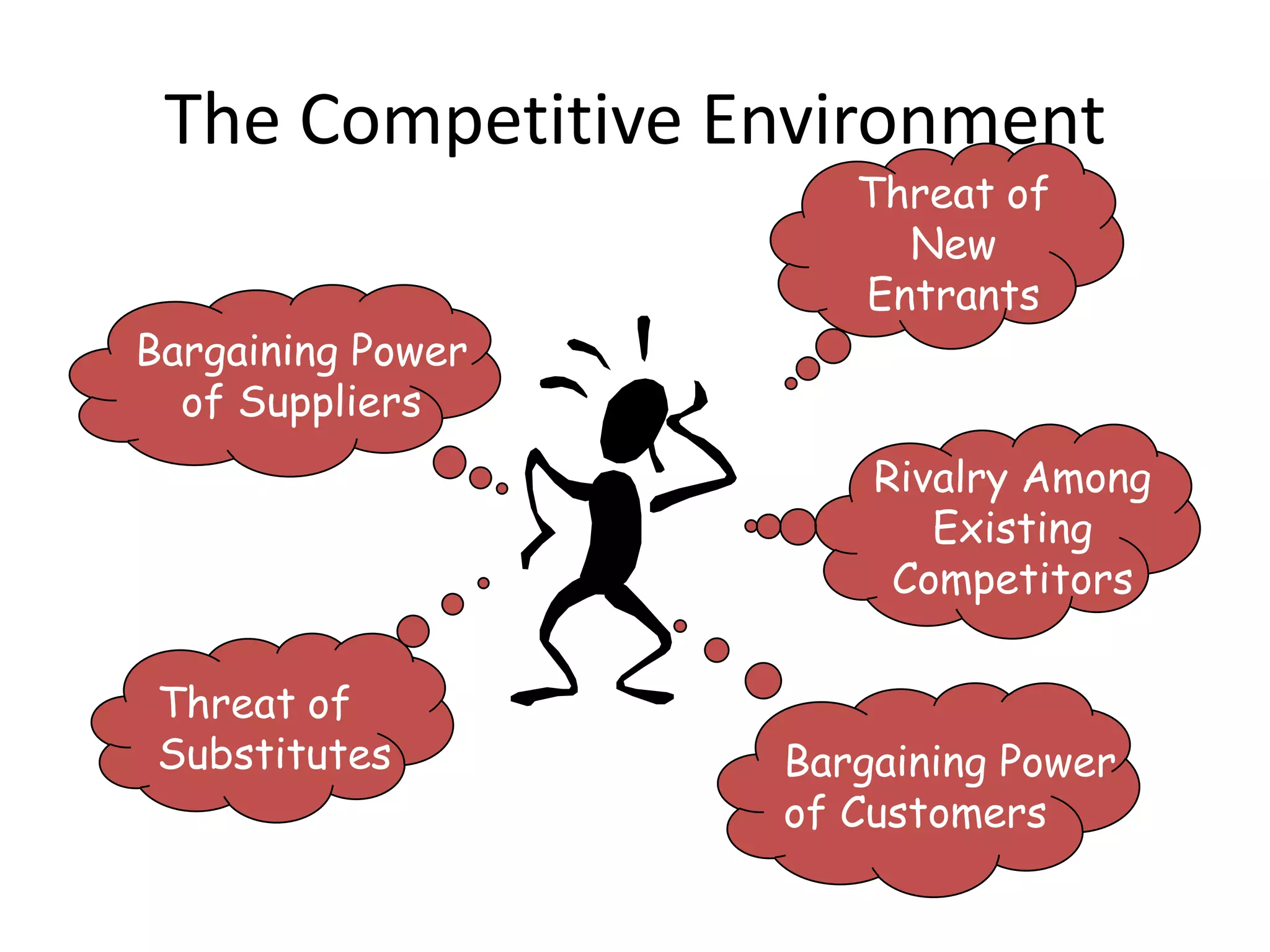
The Competitive Environment
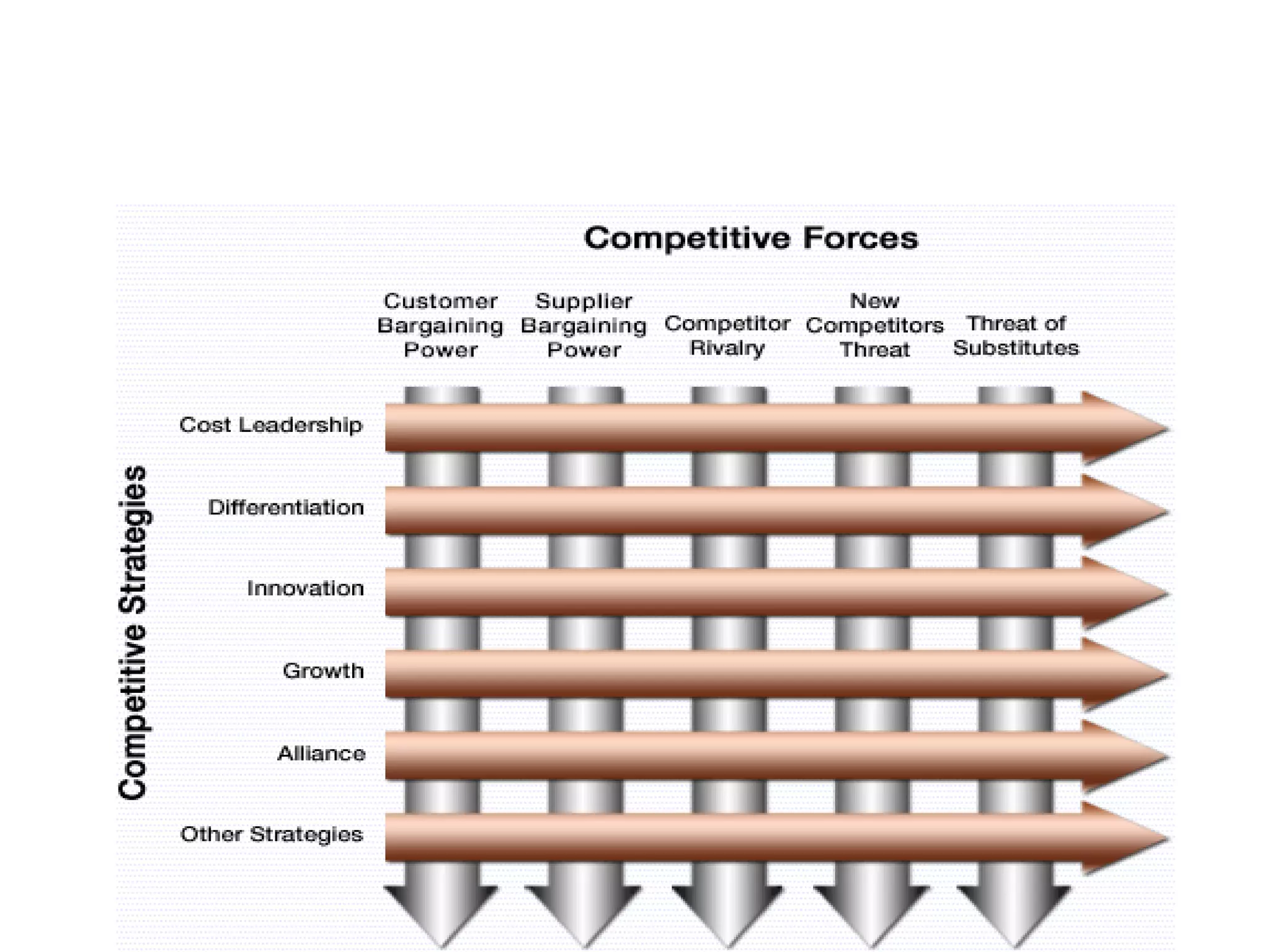
                      Threat of
                        New
                      Entrants
Bargaining Power
  of Suppliers
                       Rivalry Among
                          Existing
                        Competitors

 Threat of
 Substitutes       Bargaining Power
                   of Customers
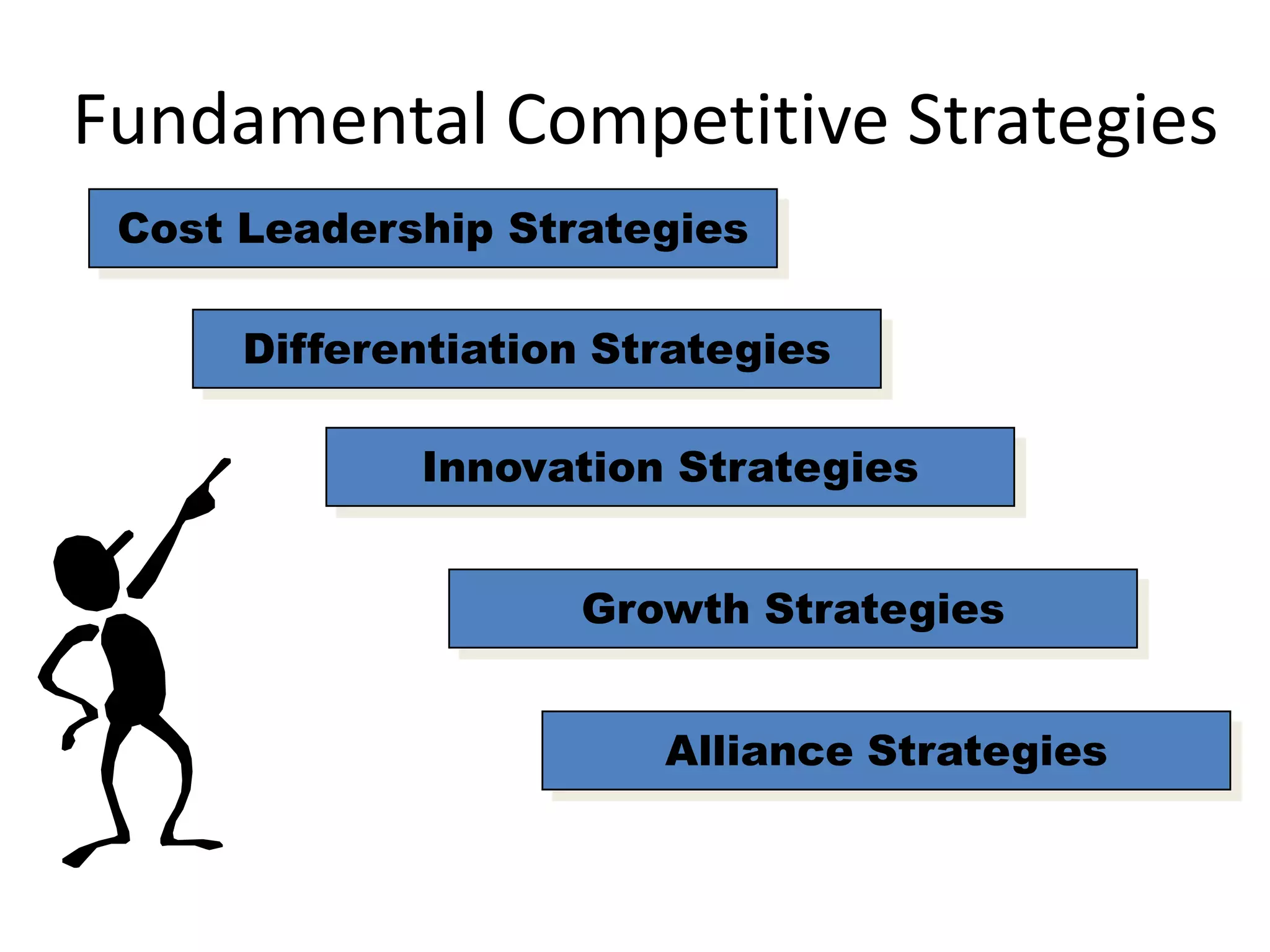
Fundamental Competitive Strategies
 Cost Leadership Strategies

      Differentiation Strategies

             Innovation Strategies


                    Growth Strategies


                        Alliance Strategies
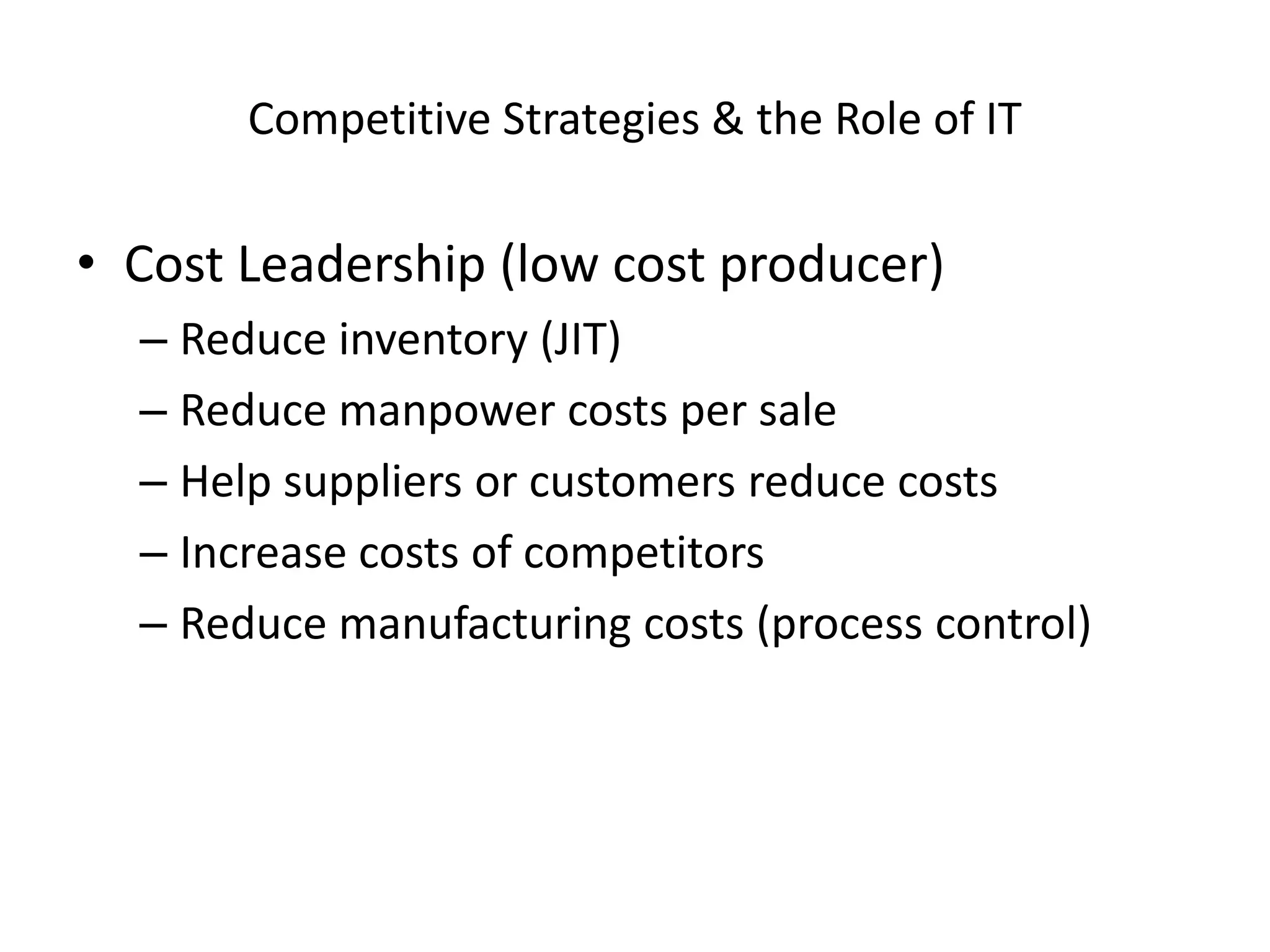
Competitive Strategies & the Role of IT

• Cost Leadership (low cost producer)
  – Reduce inventory (JIT)
  – Reduce manpower costs per sale
  – Help suppliers or customers reduce costs
  – Increase costs of competitors
  – Reduce manufacturing costs (process control)
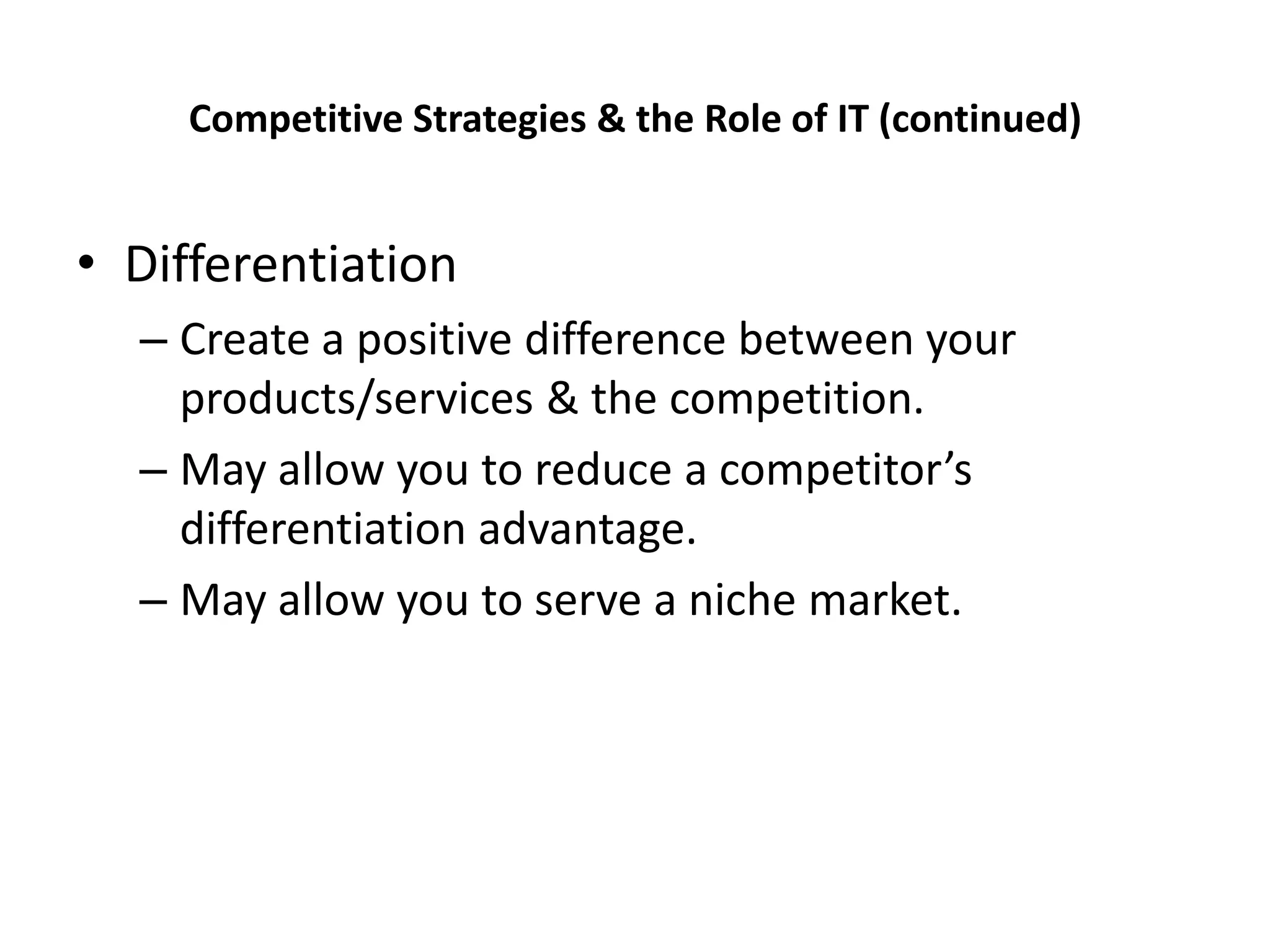
Competitive Strategies & the Role of IT (continued)


• Differentiation
  – Create a positive difference between your
    products/services & the competition.
  – May allow you to reduce a competitor’s
    differentiation advantage.
  – May allow you to serve a niche market.
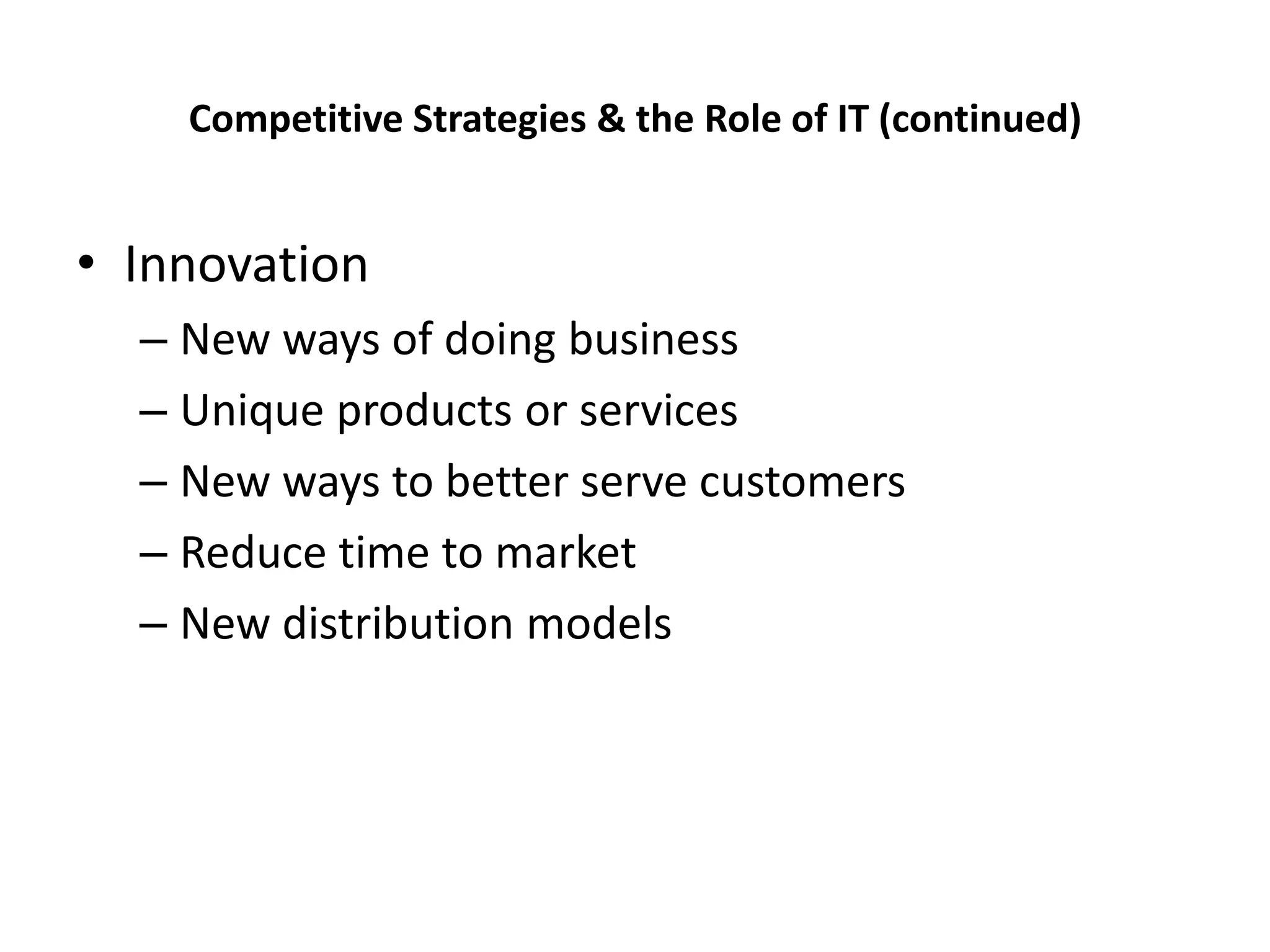
Competitive Strategies & the Role of IT (continued)


• Innovation
  – New ways of doing business
  – Unique products or services
  – New ways to better serve customers
  – Reduce time to market
  – New distribution models
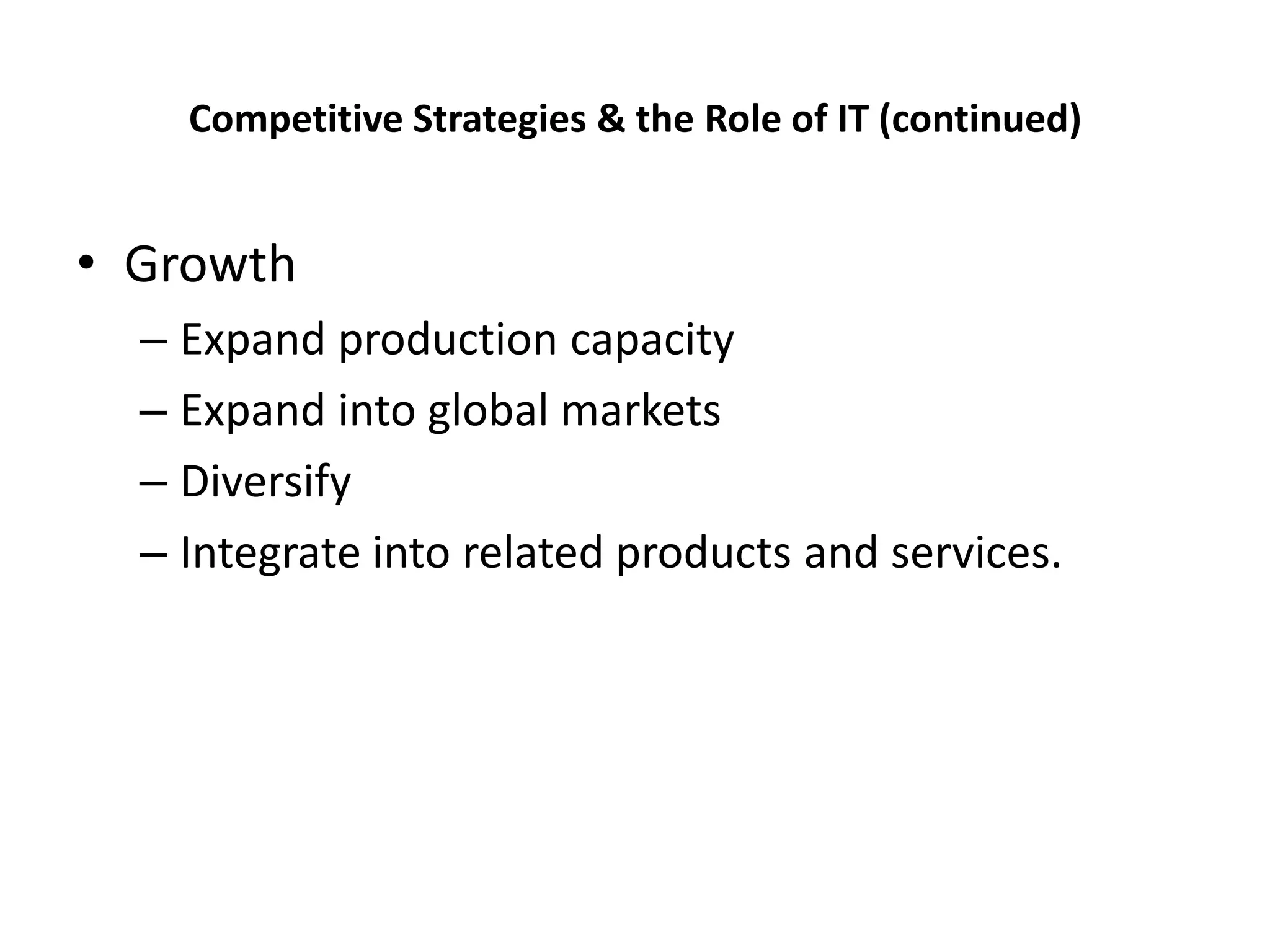
Competitive Strategies & the Role of IT (continued)


• Growth
  – Expand production capacity
  – Expand into global markets
  – Diversify
  – Integrate into related products and services.
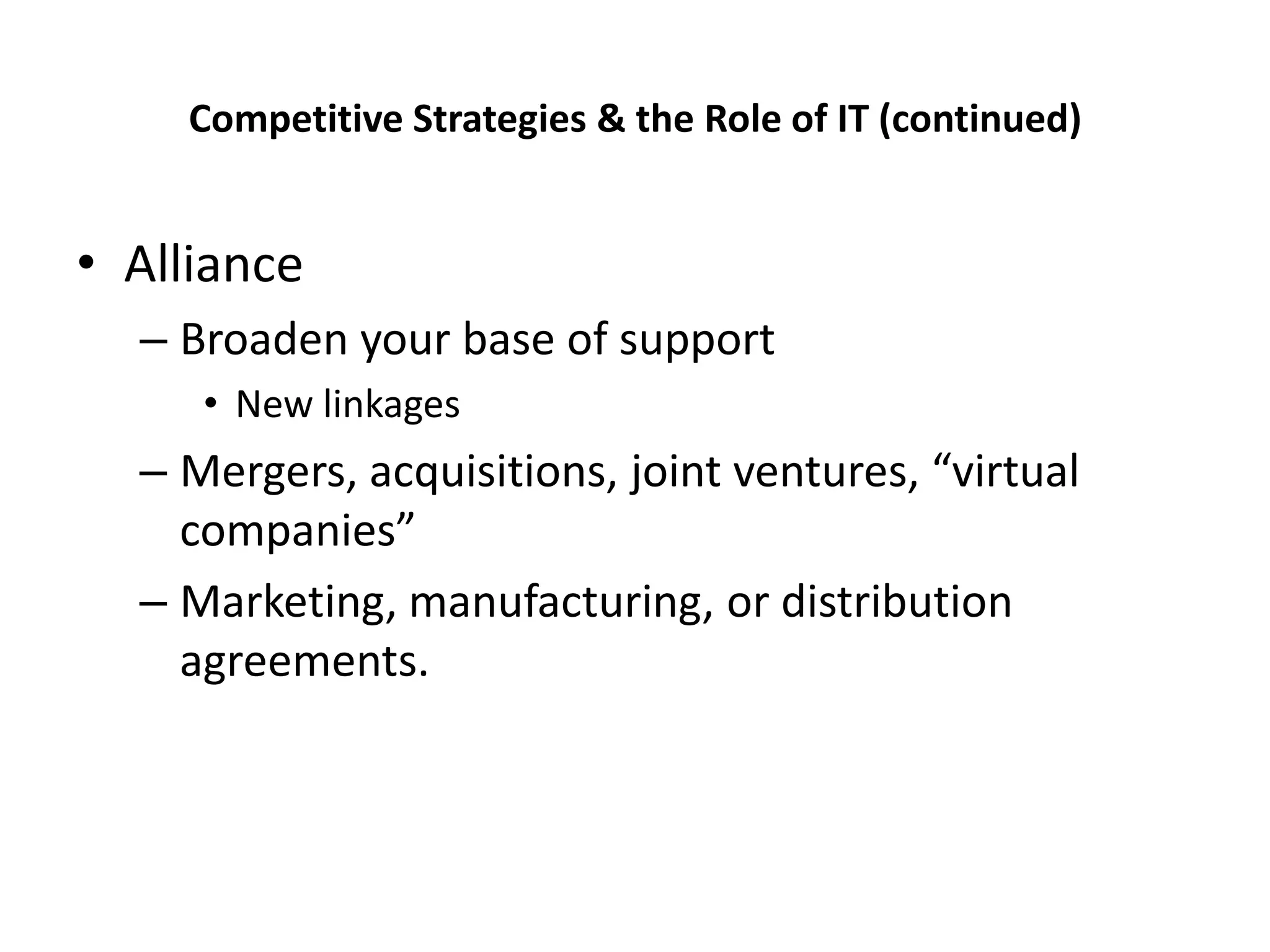
Competitive Strategies & the Role of IT (continued)


• Alliance
  – Broaden your base of support
     • New linkages
  – Mergers, acquisitions, joint ventures, “virtual
    companies”
  – Marketing, manufacturing, or distribution
    agreements.
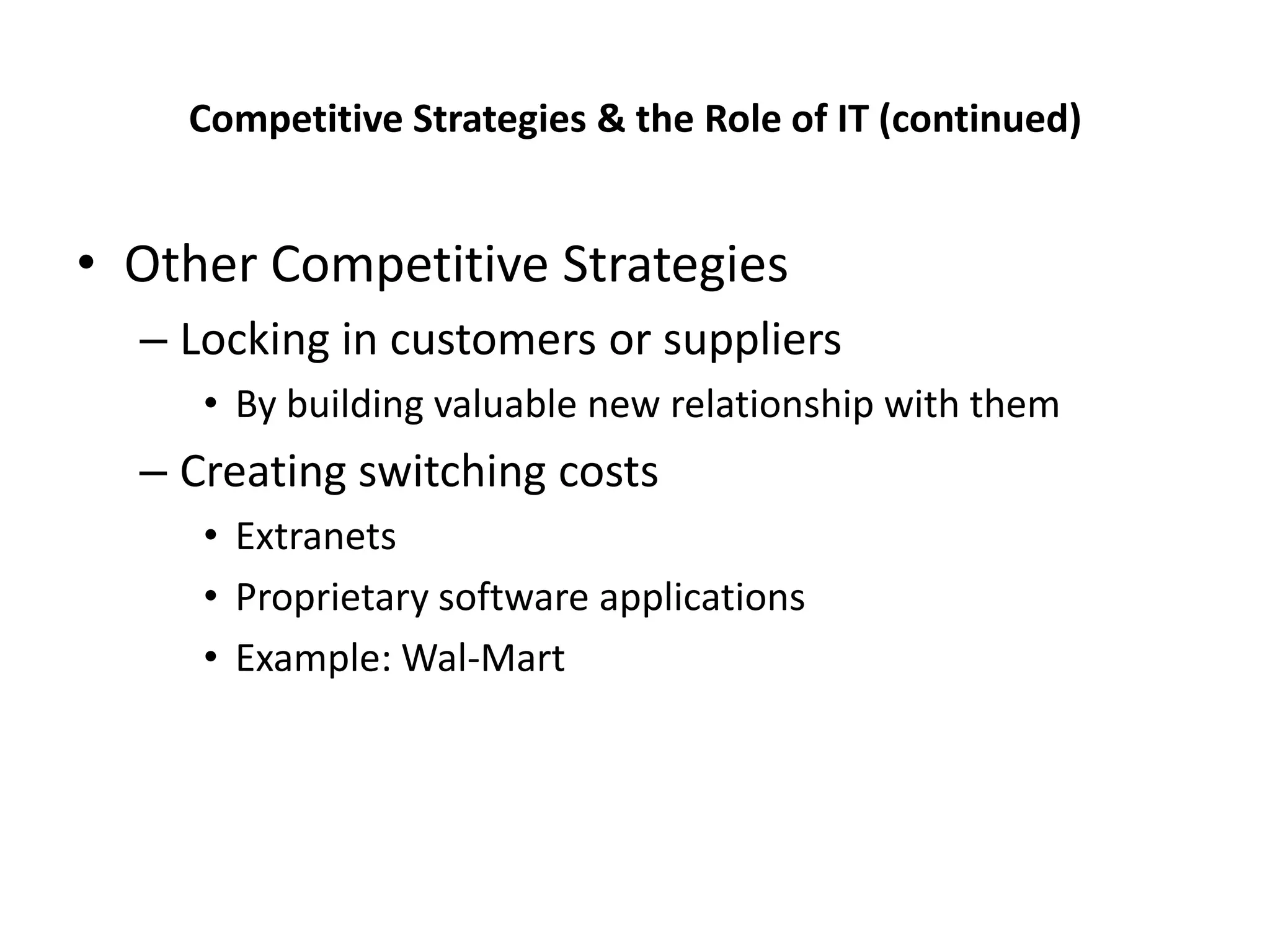
Competitive Strategies & the Role of IT (continued)


• Other Competitive Strategies
  – Locking in customers or suppliers
     • By building valuable new relationship with them
  – Creating switching costs
     • Extranets
     • Proprietary software applications
     • Example: Wal-Mart
Competitive Strategies & the Role of IT (continued)


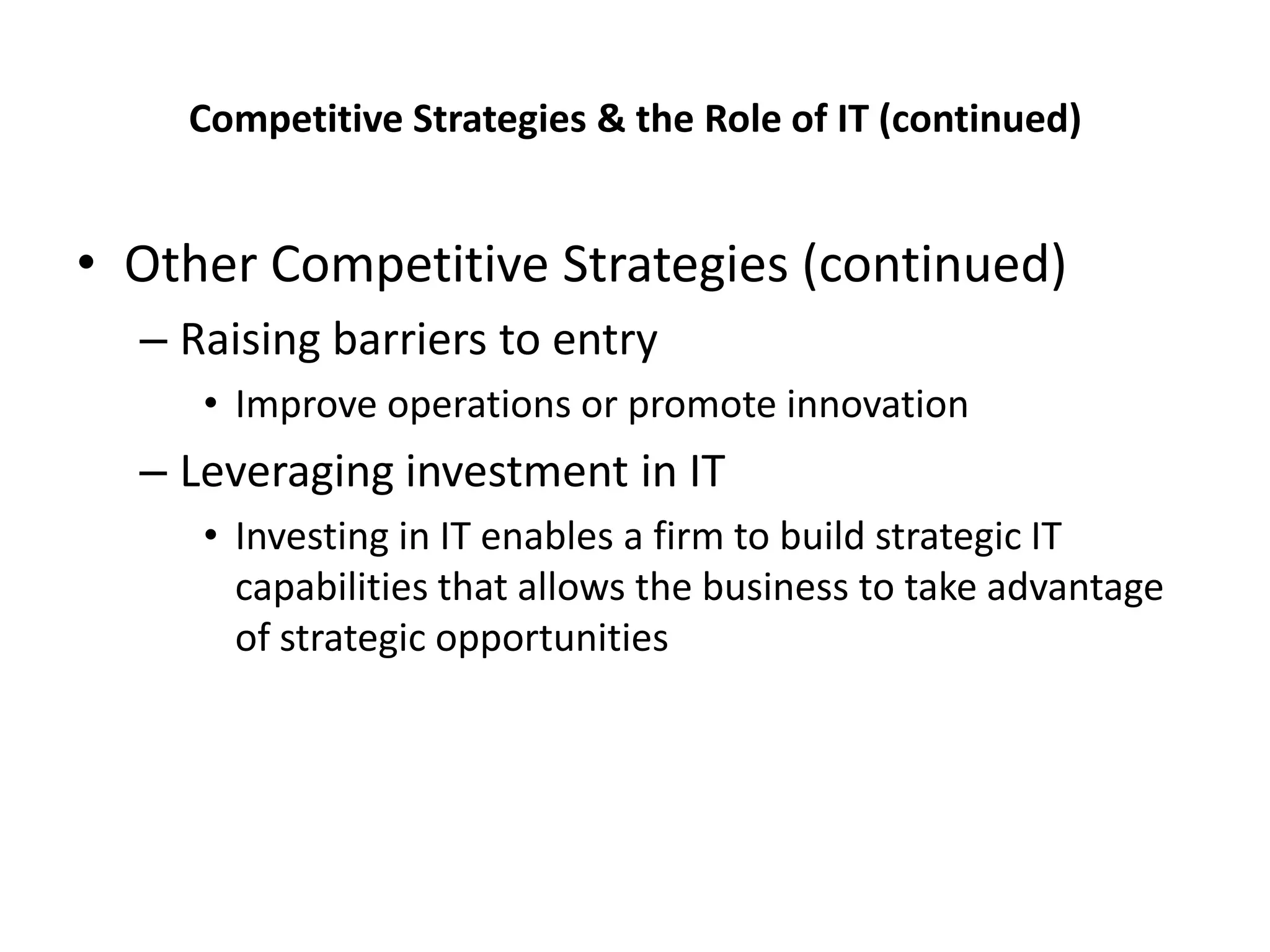
• Other Competitive Strategies (continued)
  – Raising barriers to entry
     • Improve operations or promote innovation
  – Leveraging investment in IT
     • Investing in IT enables a firm to build strategic IT
       capabilities that allows the business to take advantage
       of strategic opportunities
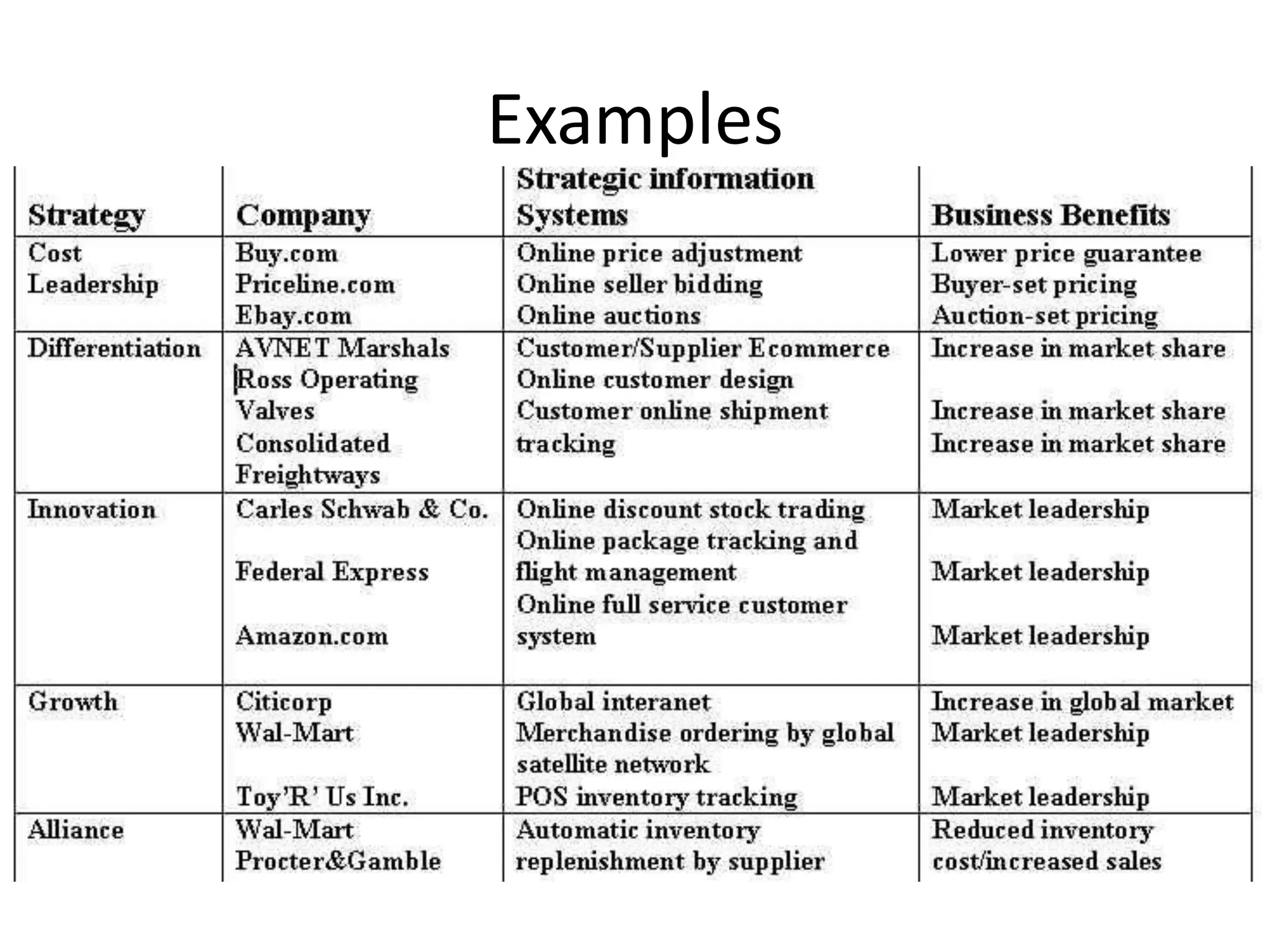
Examples
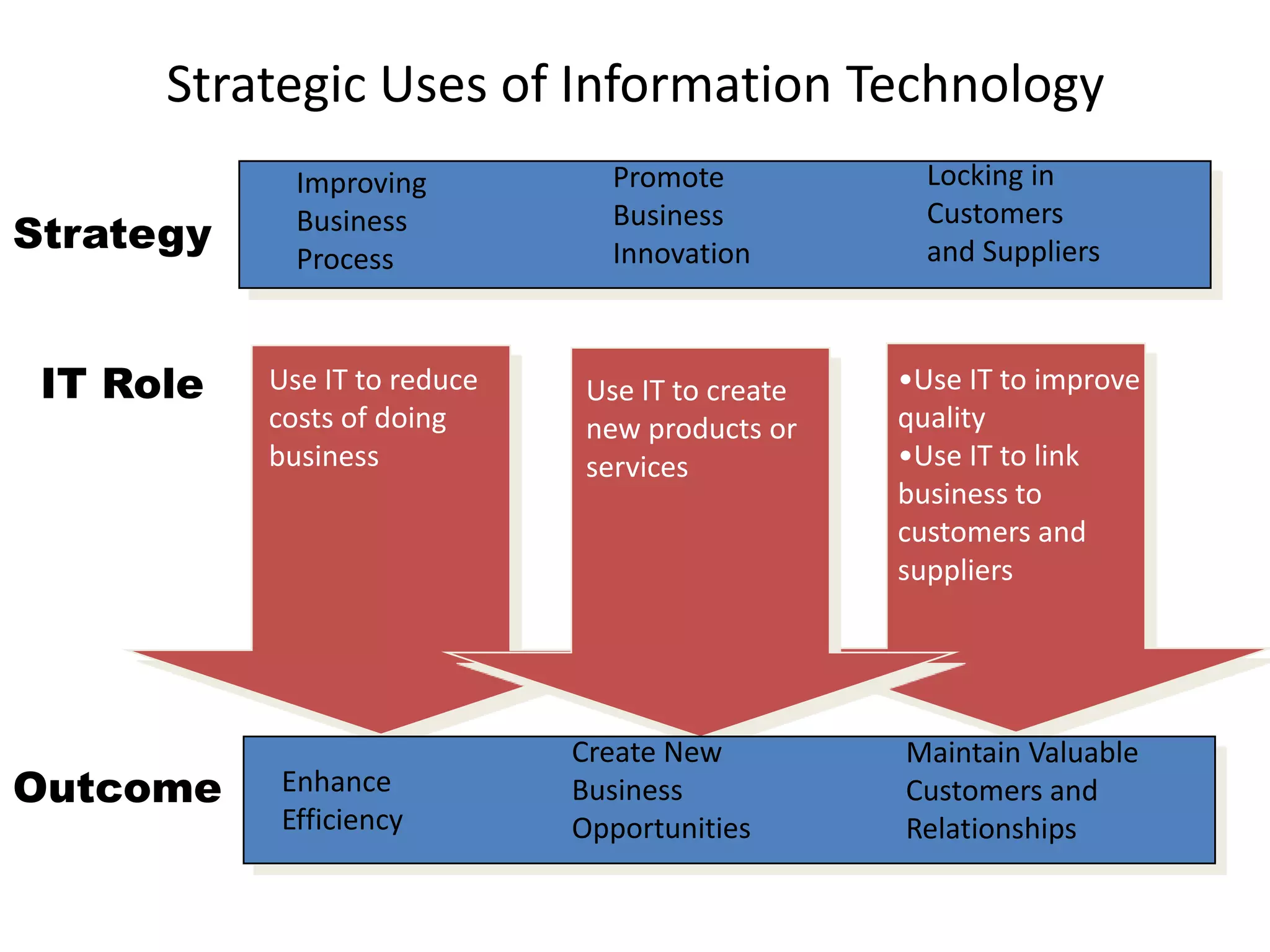
Strategic Uses of Information Technology
             Improving           Promote            Locking in
                                 Business           Customers
Strategy     Business
             Process             Innovation         and Suppliers


 IT Role   Use IT to reduce    Use IT to create   •Use IT to improve
           costs of doing      new products or    quality
           business            services           •Use IT to link
                                                  business to
                                                  customers and
                                                  suppliers


                              Create New          Maintain Valuable
Outcome    Enhance            Business            Customers and
           Efficiency         Opportunities       Relationships
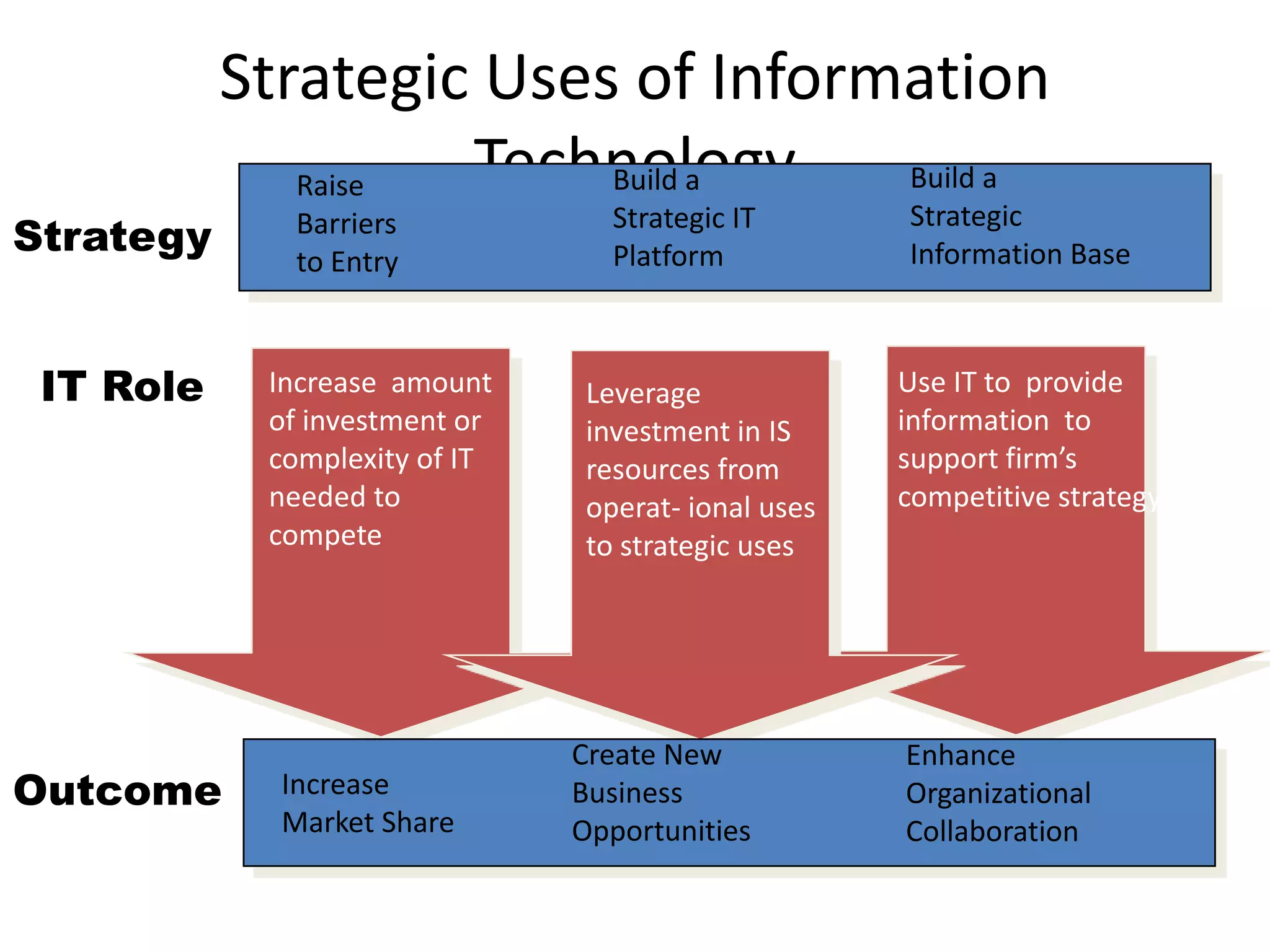
Strategic Uses of Information
              Raise Technology
                         Build a   Build a
                                  Strategic IT       Strategic
Strategy      Barriers
              to Entry            Platform           Information Base


 IT Role    Increase amount     Leverage             Use IT to provide
            of investment or    investment in IS     information to
            complexity of IT    resources from       support firm’s
            needed to           operat- ional uses   competitive strategy
            compete             to strategic uses


                               Create New            Enhance
Outcome      Increase          Business              Organizational
             Market Share      Opportunities         Collaboration
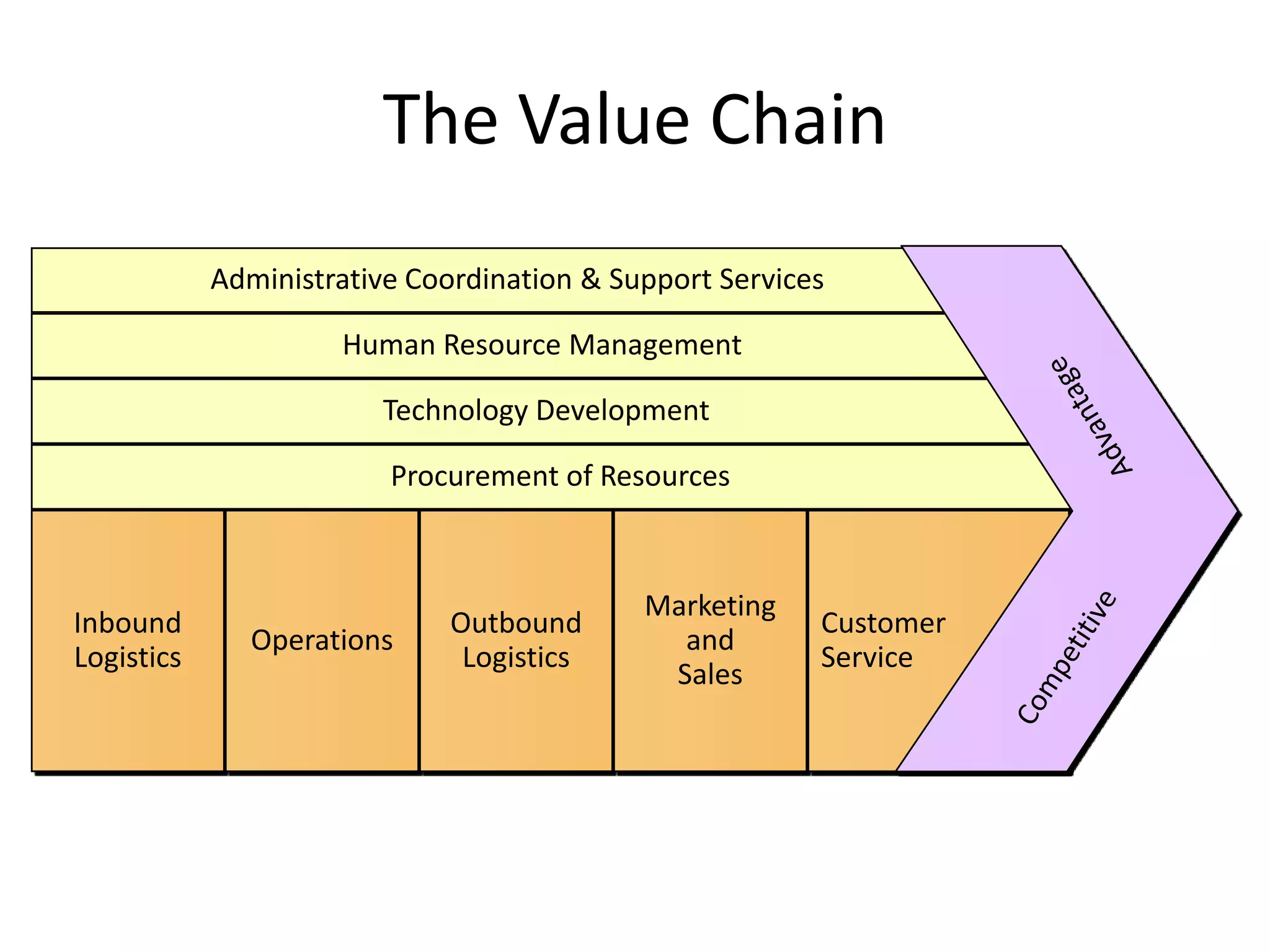
The Value Chain
            Administrative Coordination & Support Services

                     Human Resource Management

                        Technology Development

                         Procurement of Resources


                                            Marketing
Inbound                      Outbound                    Customer
               Operations                     and
Logistics                     Logistics                  Service
                                             Sales
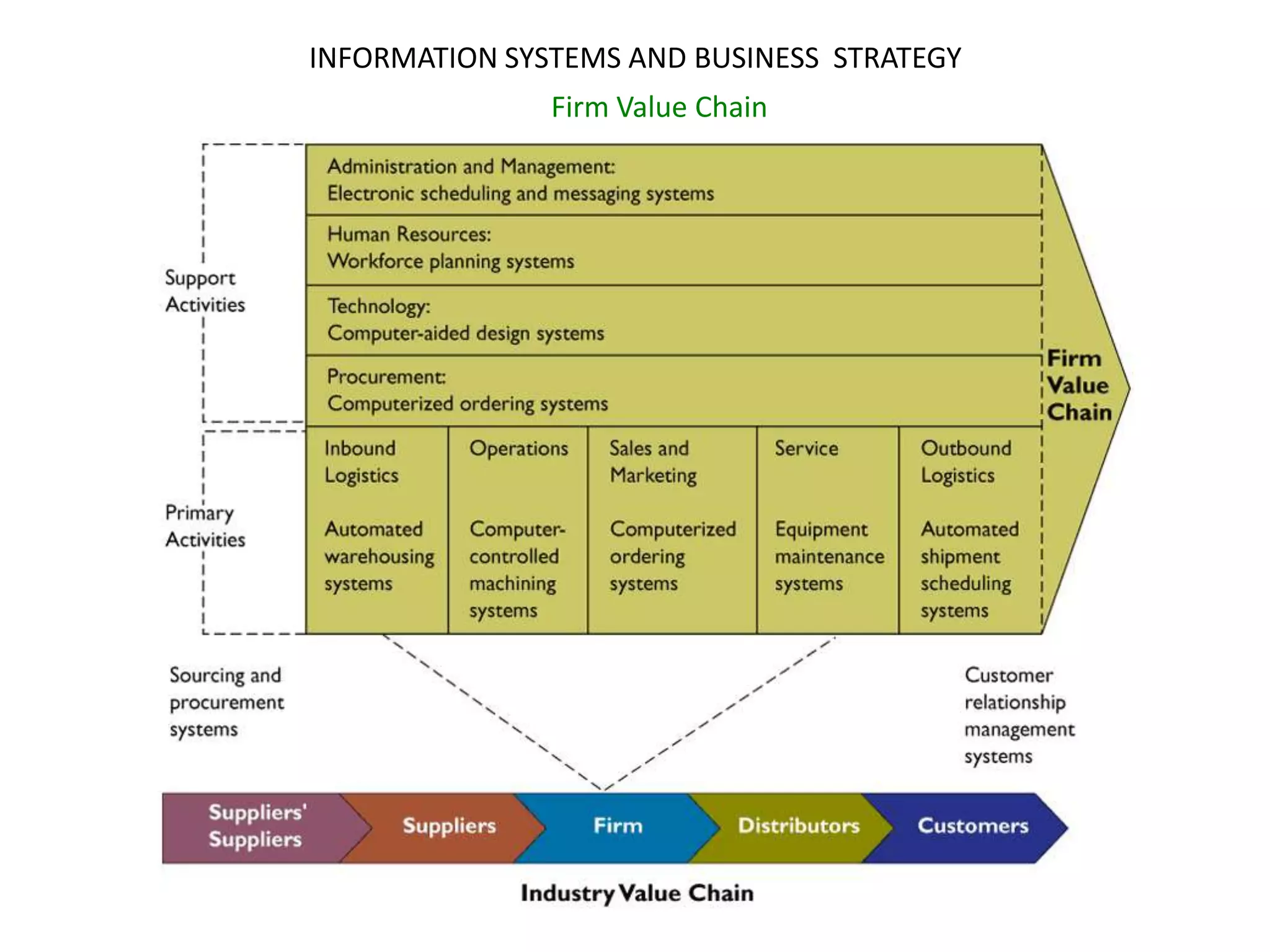
INFORMATION SYSTEMS AND BUSINESS STRATEGY
               Firm Value Chain
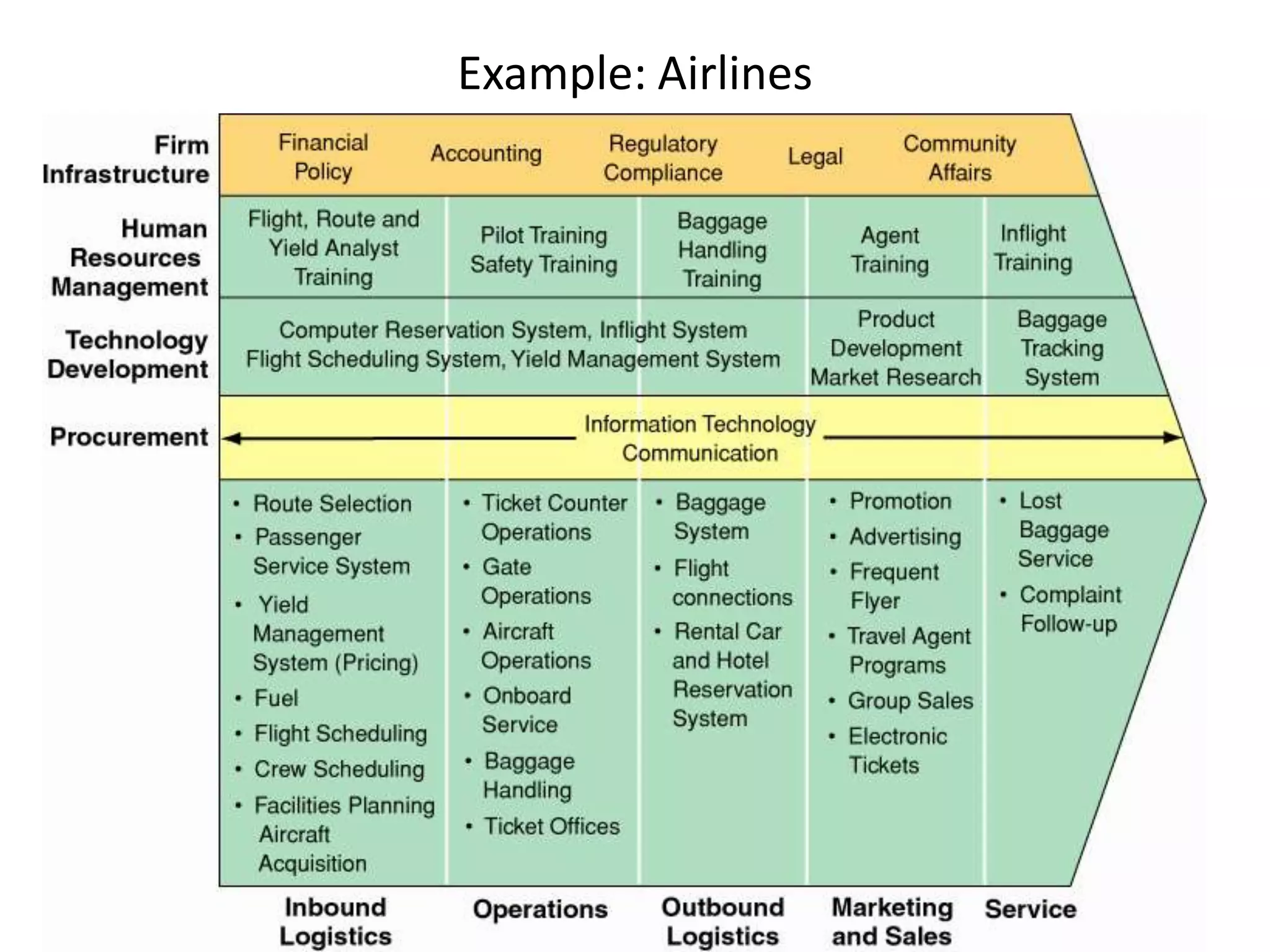
Example: Airlines
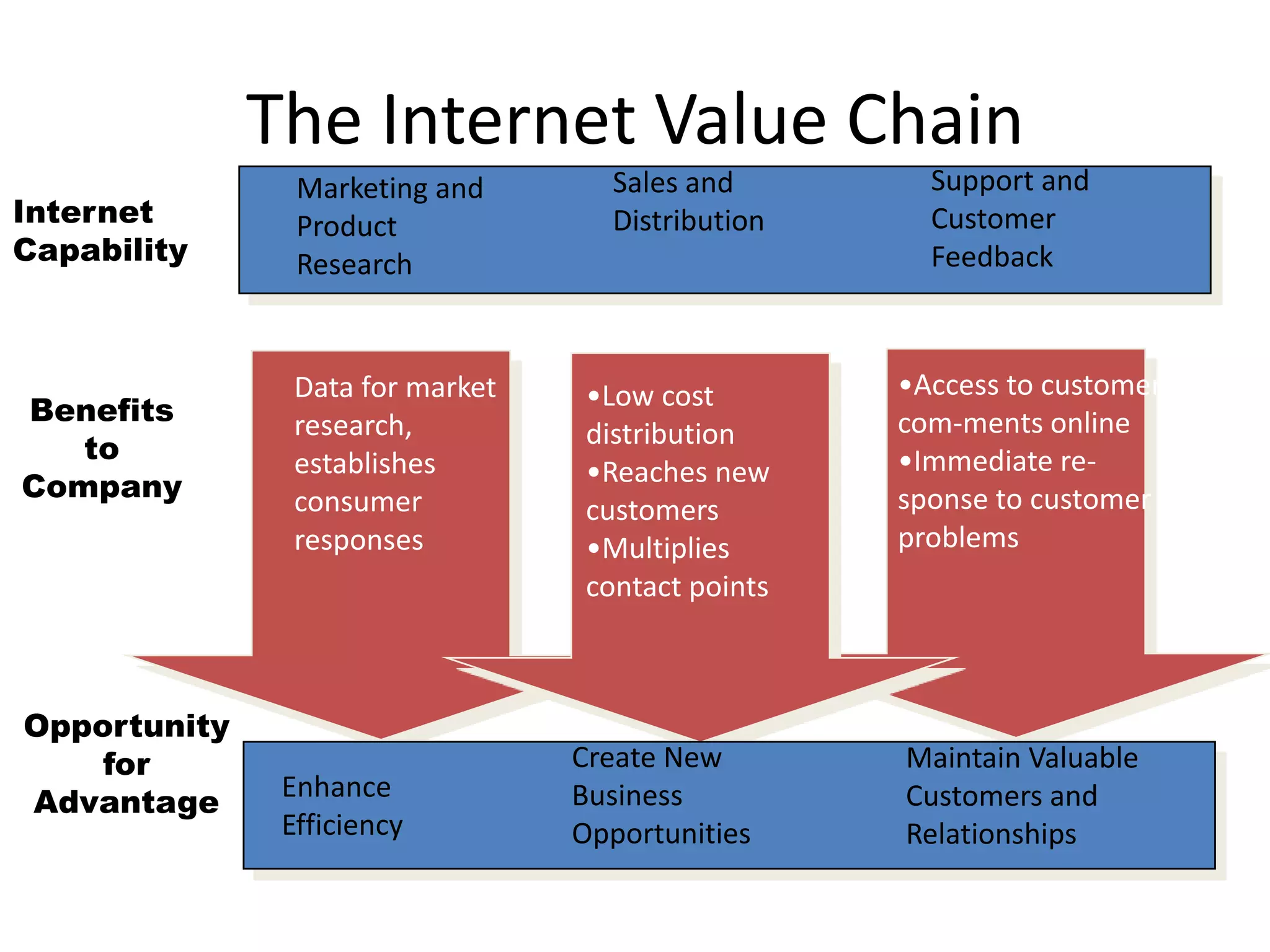
The Internet Value Chain
                Marketing and        Sales and        Support and
Internet        Product              Distribution     Customer
Capability      Research                              Feedback


                Data for market    •Low cost        •Access to customer
Benefits        research,                           com-ments online
   to                              distribution
                establishes        •Reaches new     •Immediate re-
Company         consumer                            sponse to customer
                                   customers
                responses          •Multiplies      problems
                                   contact points


Opportunity
    for                           Create New        Maintain Valuable
               Enhance
Advantage                         Business          Customers and
               Efficiency         Opportunities     Relationships
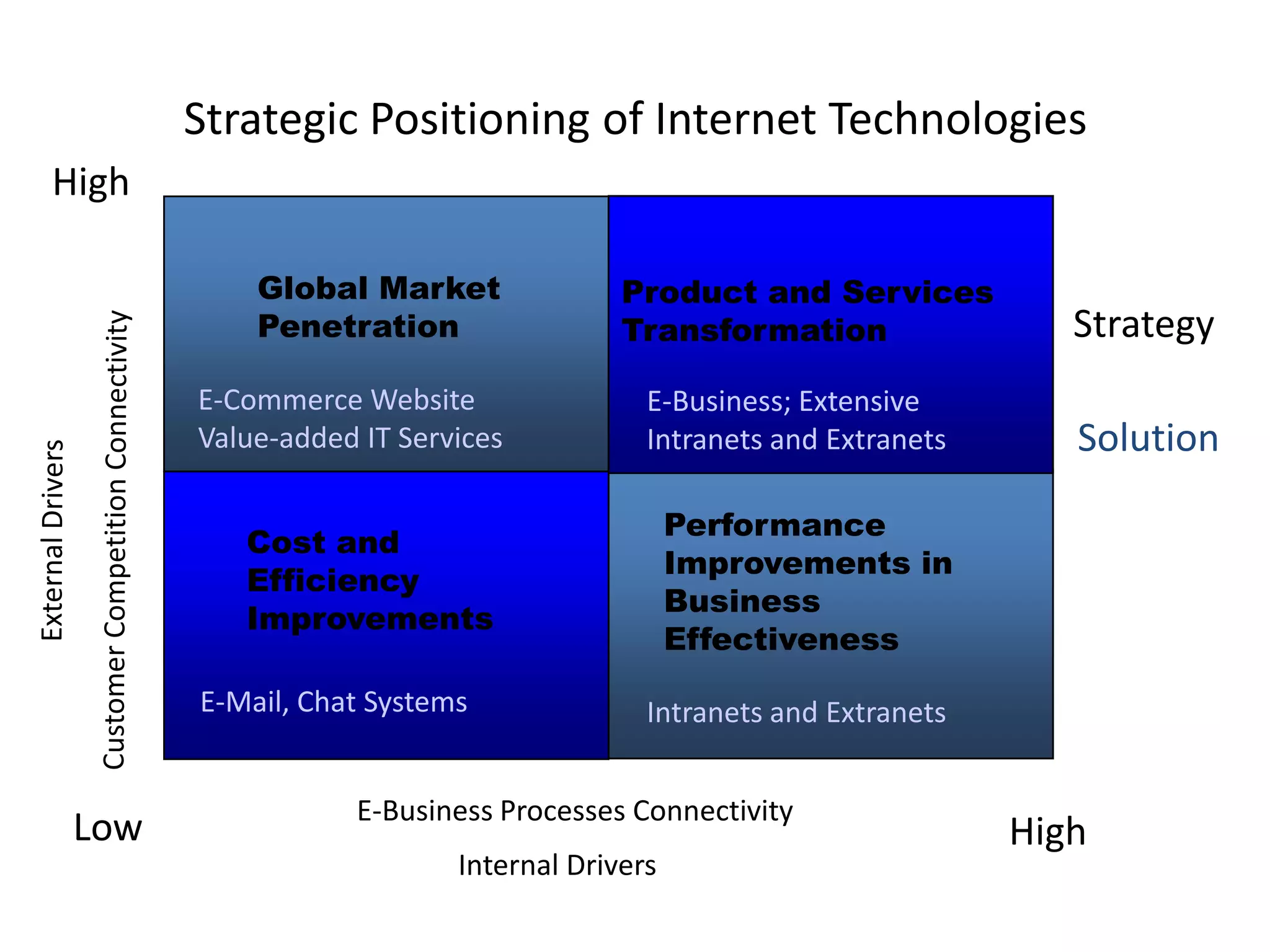
Strategic Positioning of Internet Technologies
High

           Global Market               Product and Services
           Penetration                 Transformation                 Strategy
       E-Commerce Website                E-Business; Extensive
       Value-added IT Services           Intranets and Extranets      Solution

                                             Performance
          Cost and
                                             Improvements in
          Efficiency
                                             Business
          Improvements
                                             Effectiveness
       E-Mail, Chat Systems              Intranets and Extranets


                  E-Business Processes Connectivity
 Low                                                               High
                          Internal Drivers
Section II


• Using Information Technology for Strategic
                 Advantage
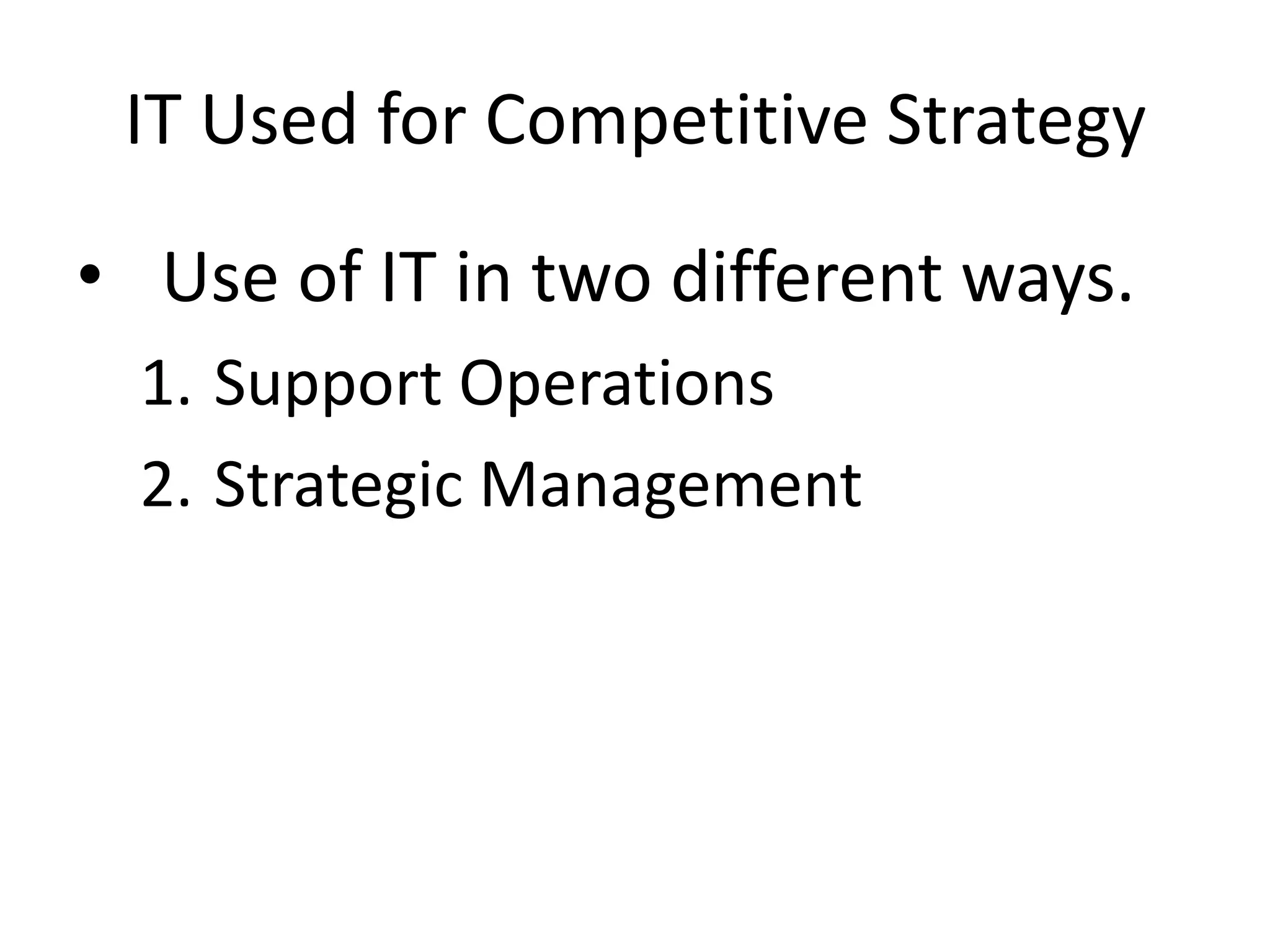
IT Used for Competitive Strategy

• Use of IT in two different ways.
  1. Support Operations
  2. Strategic Management
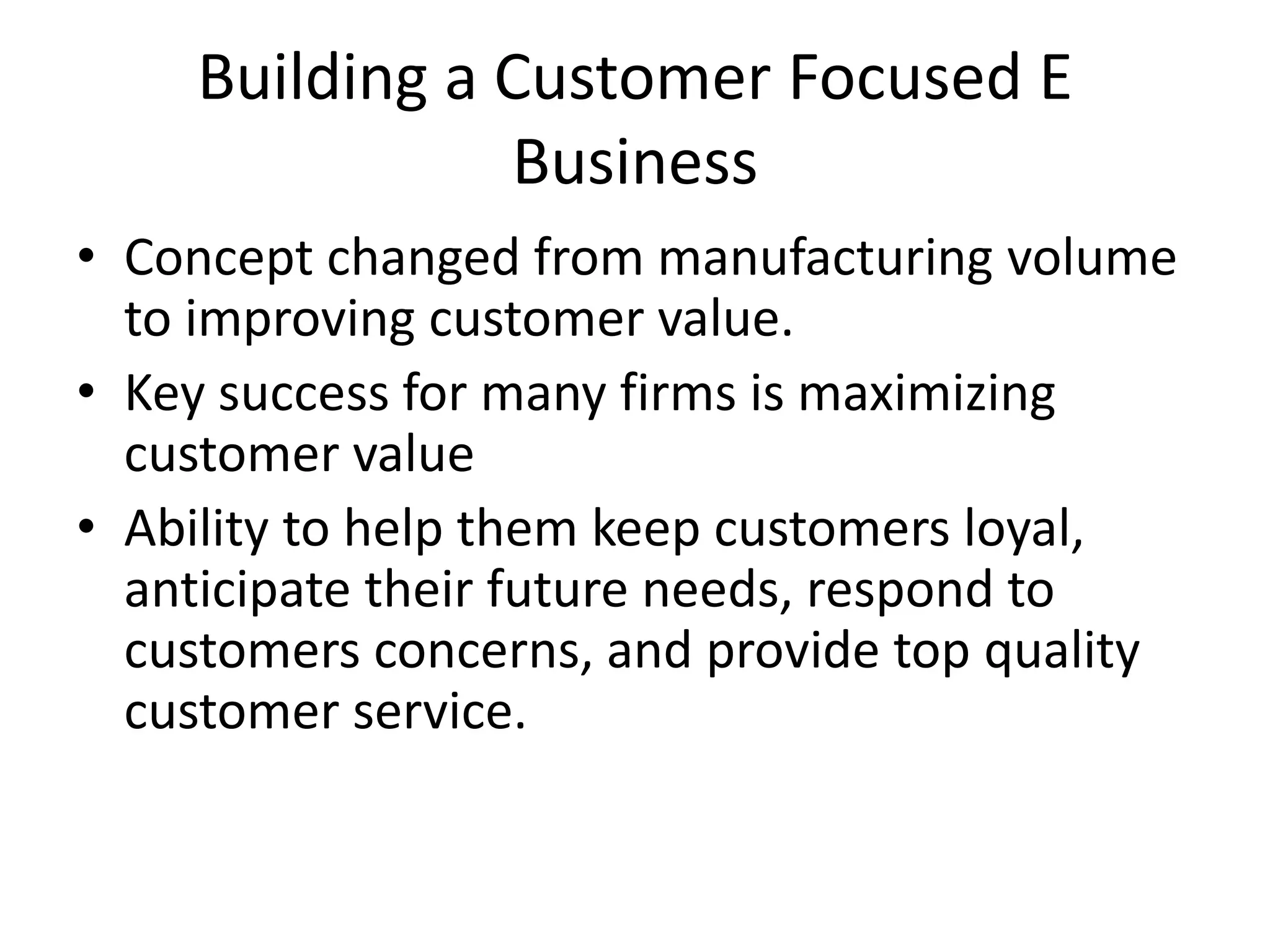
Building a Customer Focused E
               Business
• Concept changed from manufacturing volume
  to improving customer value.
• Key success for many firms is maximizing
  customer value
• Ability to help them keep customers loyal,
  anticipate their future needs, respond to
  customers concerns, and provide top quality
  customer service.
Customer Expectation
•   Keep track of their preferences
•   Keep up with market trends
•   Supply products and services
•   Ecommerce offers faster, responsive and high
    quality product and services tailored to
    individual customer preferences
Role of Ecommerce Customers
•   Use Internet to ask questions
•   Air complaints
•   Evaluate products, request support
•   Make and report purchases
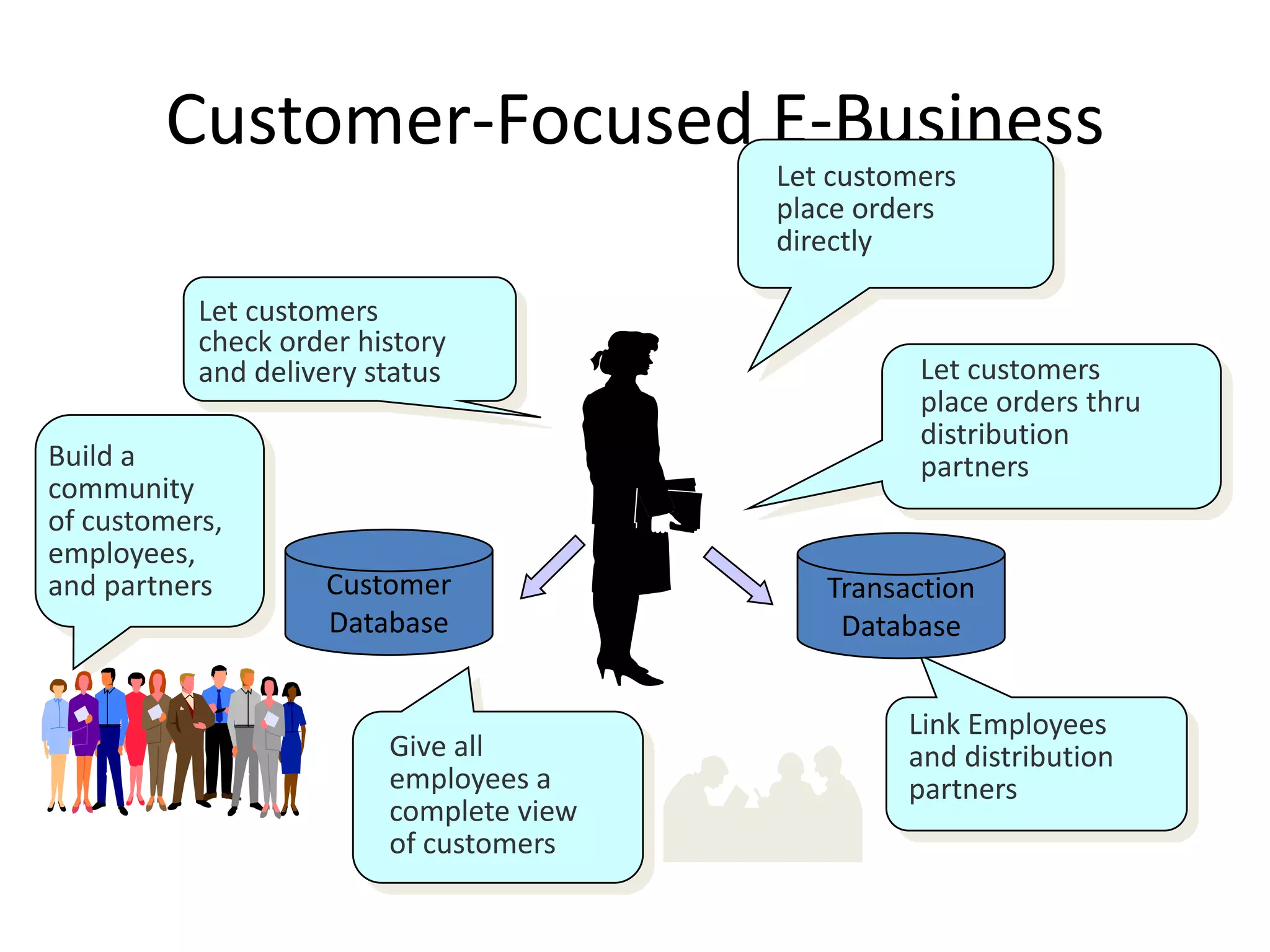
Customer-Focused E-Business
                                         Let customers
                                         place orders
                                         directly

           Let customers
           check order history
           and delivery status                     Let customers
                                                   place orders thru
                                                   distribution
Build a                                            partners
community
of customers,
employees,
and partners        Customer                Transaction
                    Database                 Database


                                                  Link Employees
                         Give all                 and distribution
                         employees a              partners
                         complete view
                         of customers
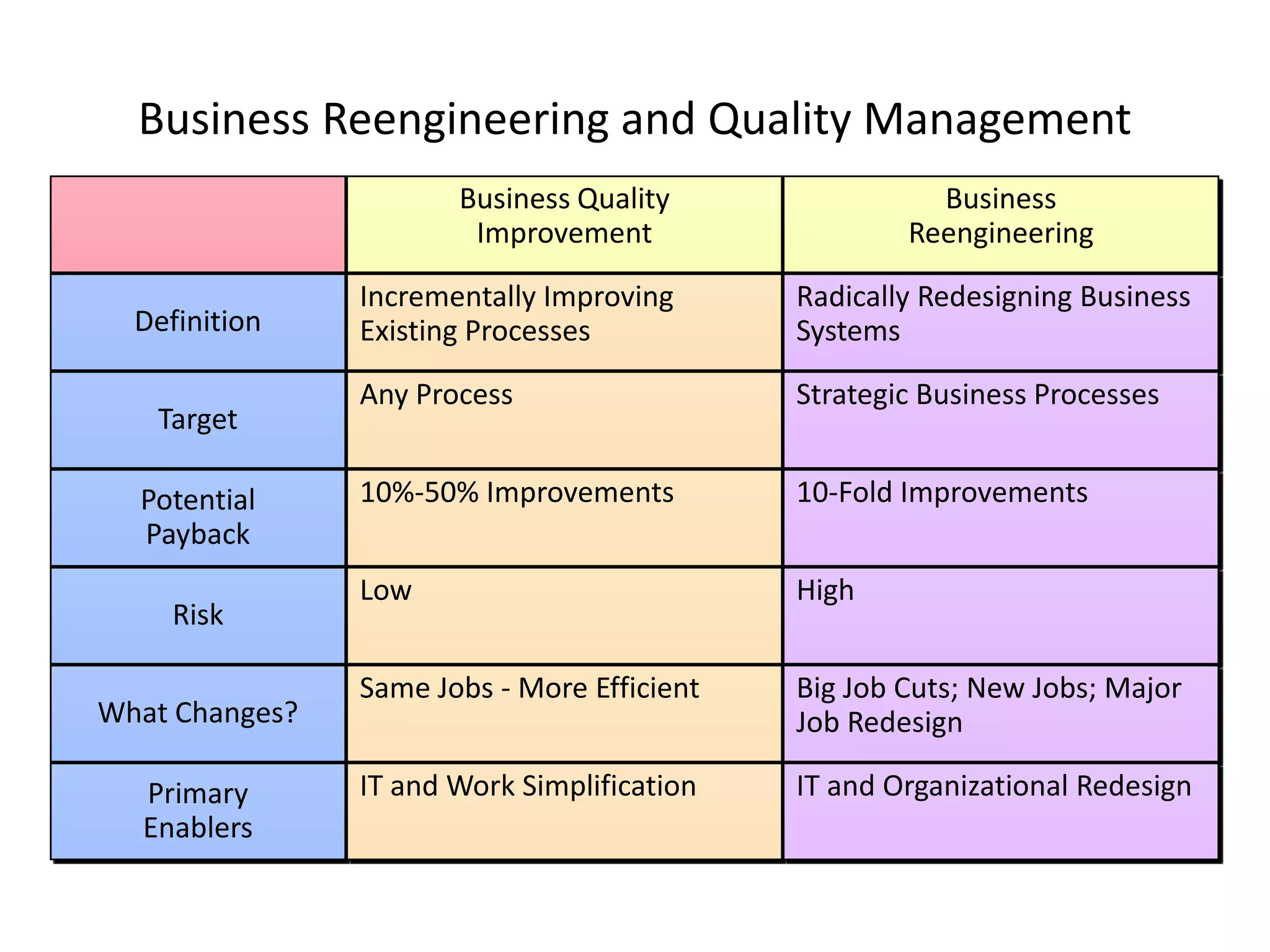
Business Reengineering and Quality Management
                       Business Quality                Business
                        Improvement                  Reengineering

                Incrementally Improving      Radically Redesigning Business
  Definition    Existing Processes           Systems

                Any Process                  Strategic Business Processes
   Target

  Potential     10%-50% Improvements         10-Fold Improvements
  Payback
                Low                          High
    Risk

                Same Jobs - More Efficient   Big Job Cuts; New Jobs; Major
What Changes?                                Job Redesign

  Primary       IT and Work Simplification   IT and Organizational Redesign
  Enablers
Example
Improving Business Quality
• IT can be used to improve business
  performance in many ways rather than
  supporting reengineering process
• TQM: Total Quality Management: Quality as
  per customer not supplier.
• Performance, reliability, durability,
  responsiveness
TQM
• May use a variety of tools and methods to
  seek continuous improvement of quality,
  productivity, flexibility, timeliness, and
  customer responsiveness.
Companies using TQM are committed
                to
• Even better more appealing and less variable
  quality of product or service
• Even Quicker less variable response from
  design and development through supplier and
  sales channels
• Even greater flexibility in adjusting to
  customers shifting volume and mix
  requirement
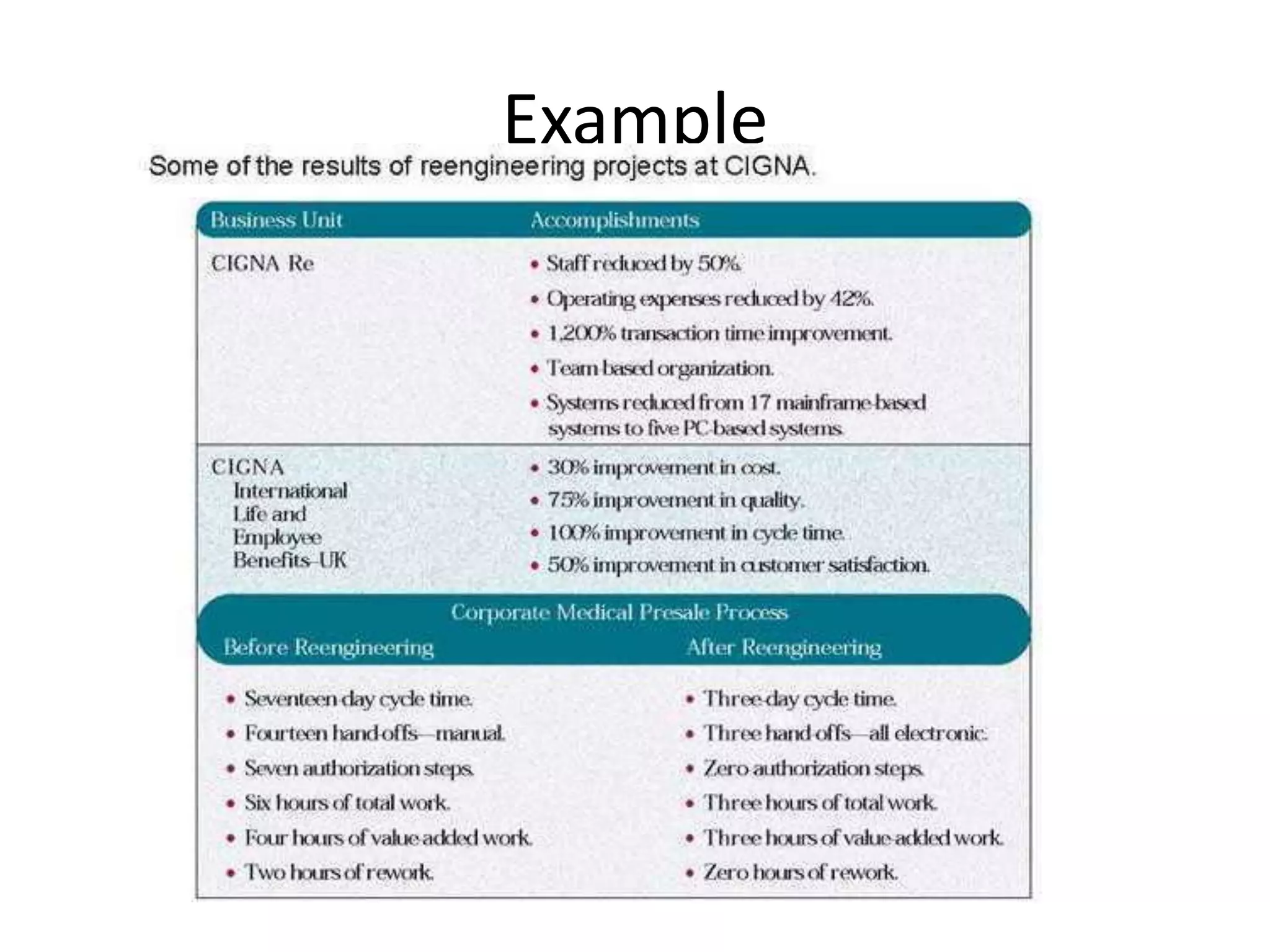
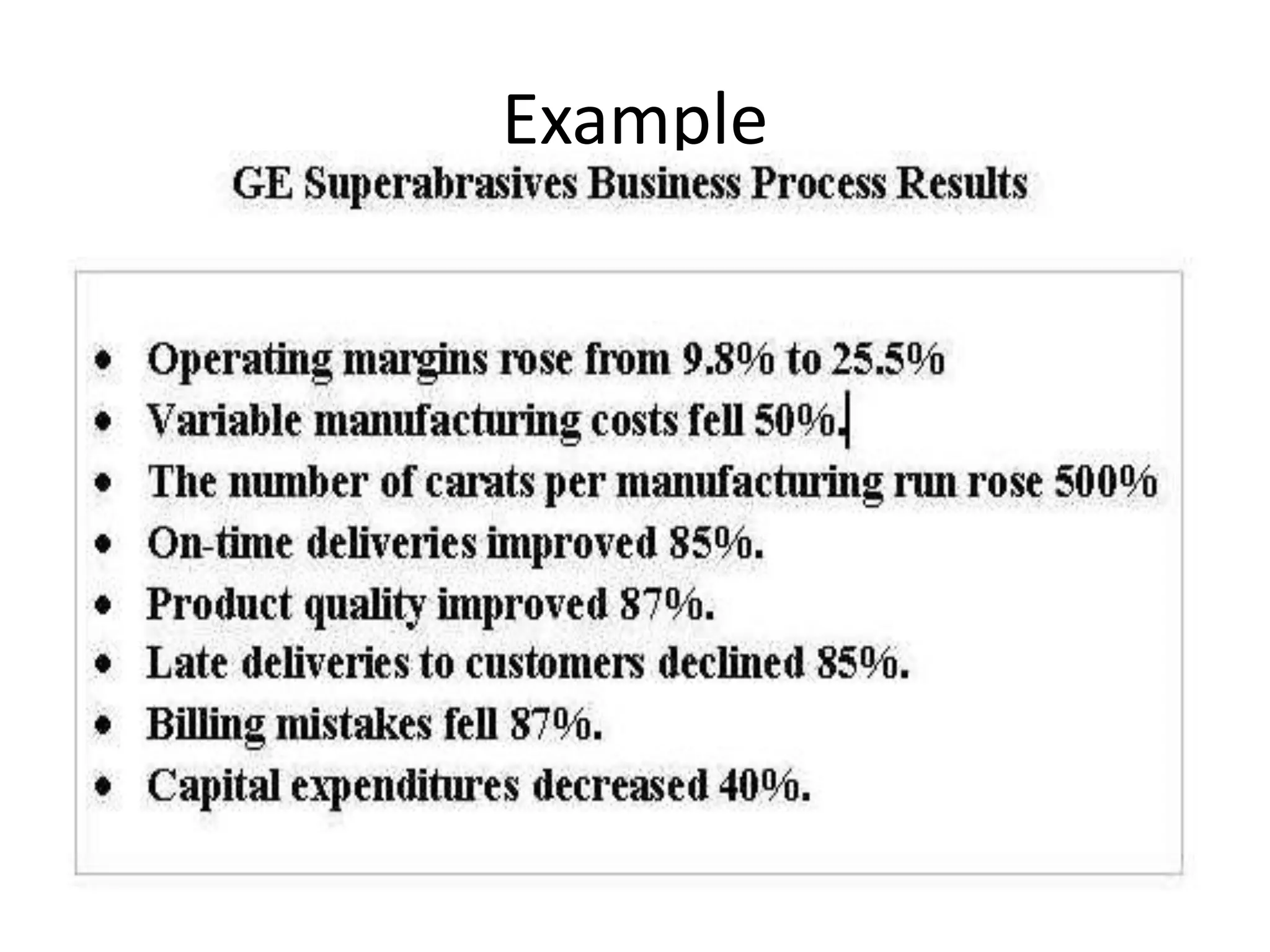
Example
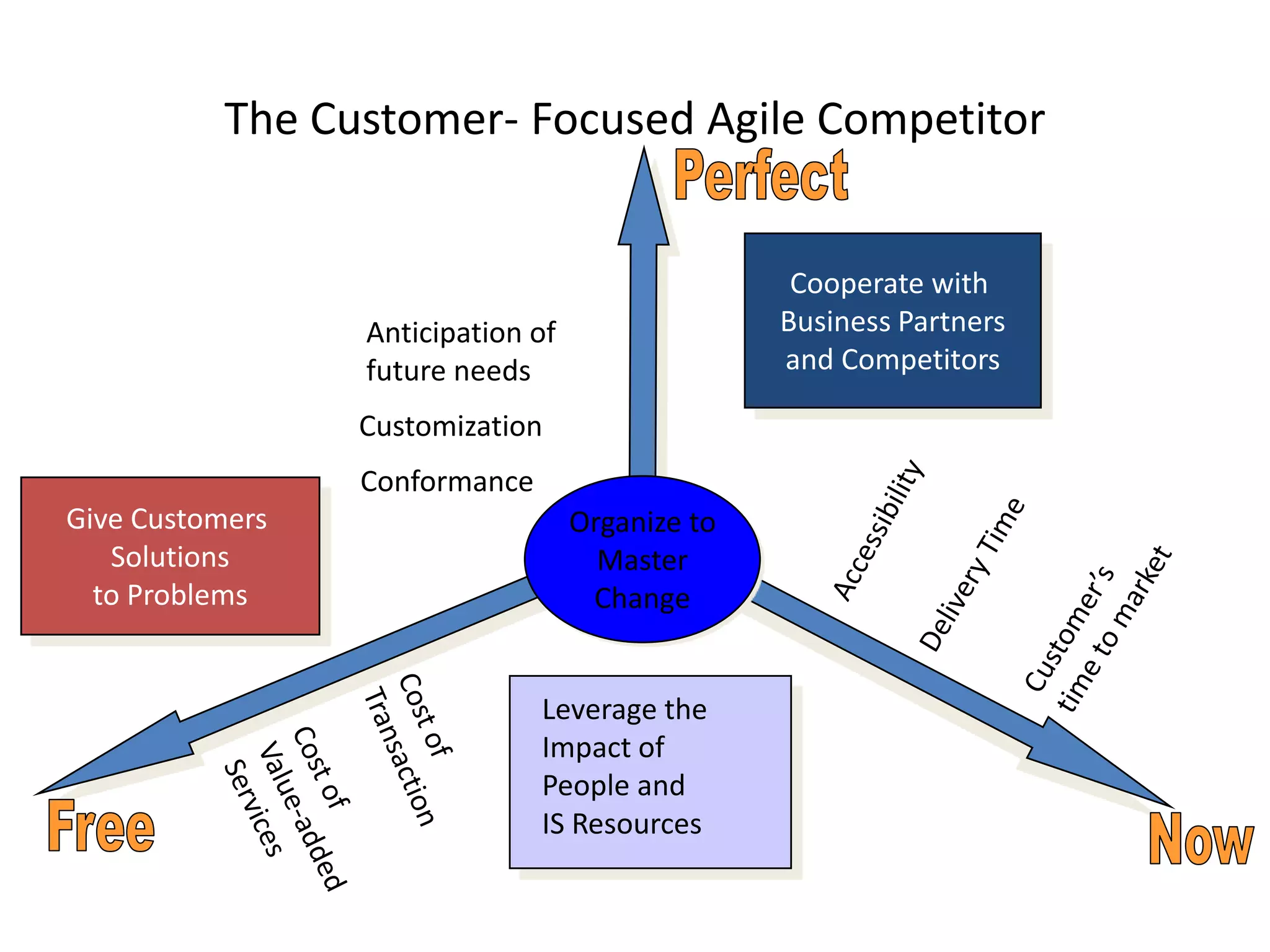
The Customer- Focused Agile Competitor


                                                  Cooperate with
                 Anticipation of                 Business Partners
                 future needs                    and Competitors

                 Customization
                 Conformance
Give Customers                     Organize to
   Solutions                         Master
  to Problems                       Change


                               Leverage the
                               Impact of
                               People and
                               IS Resources
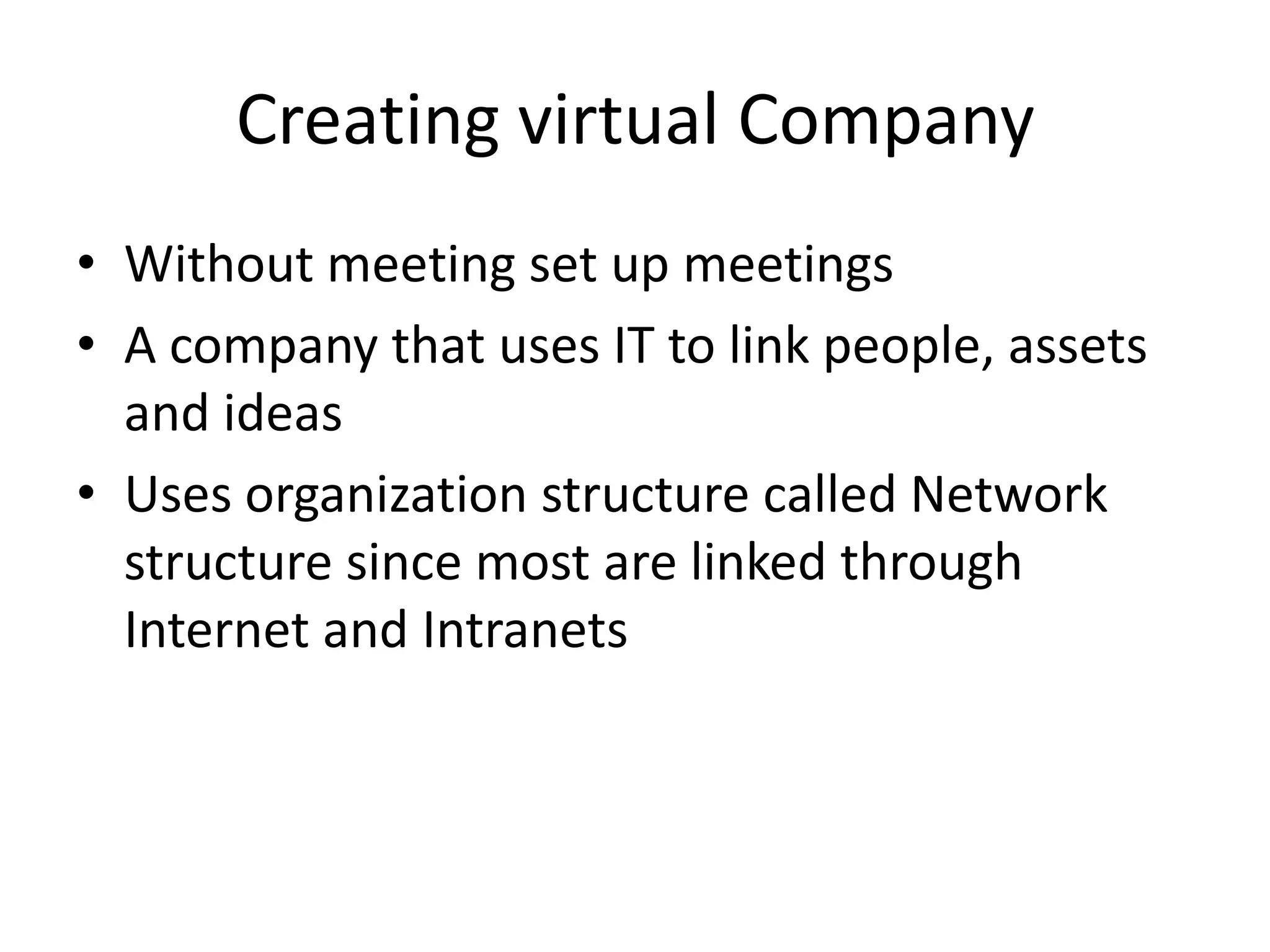
Creating virtual Company
• Without meeting set up meetings
• A company that uses IT to link people, assets
  and ideas
• Uses organization structure called Network
  structure since most are linked through
  Internet and Intranets
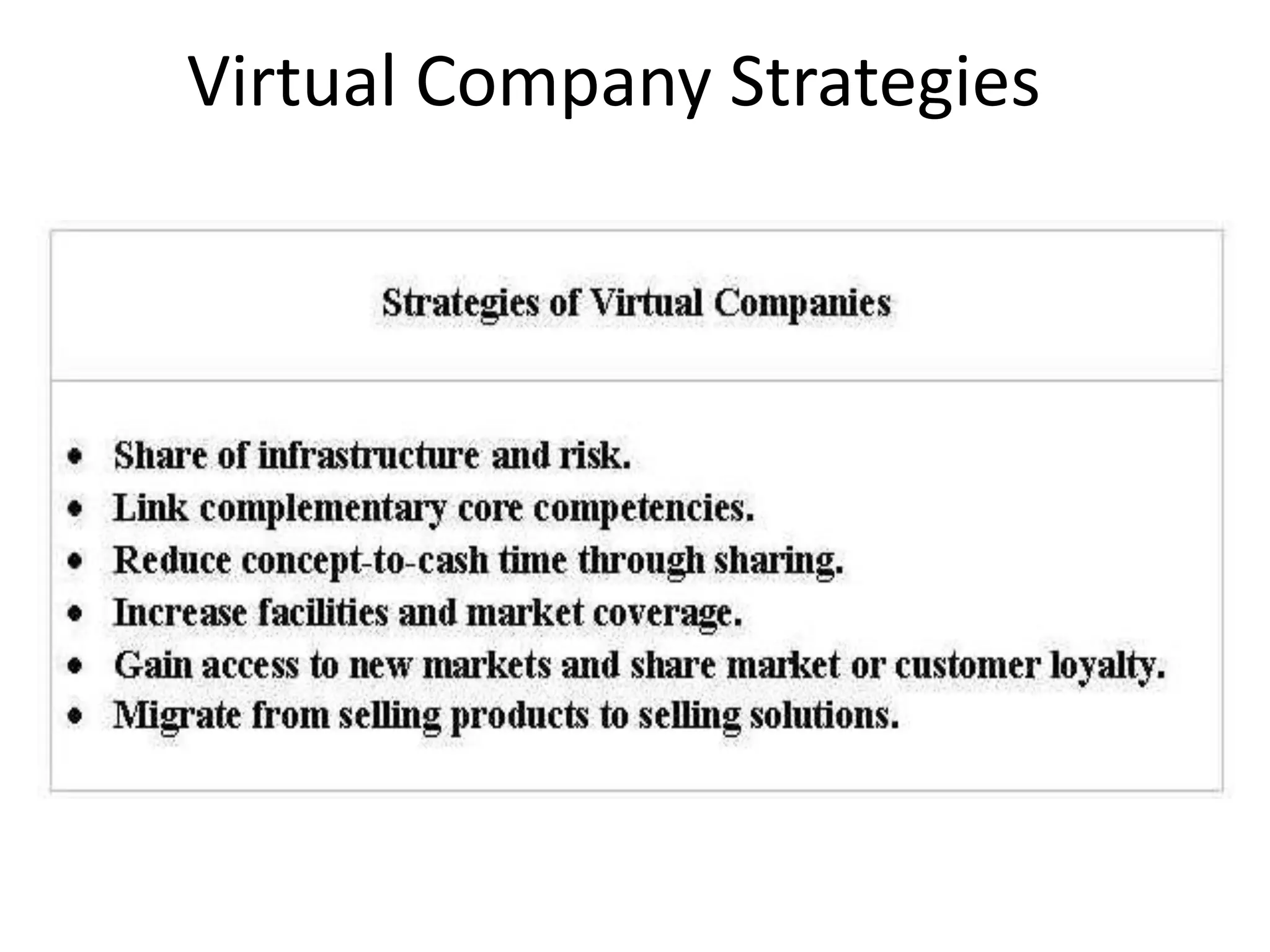
Virtual Company Strategies
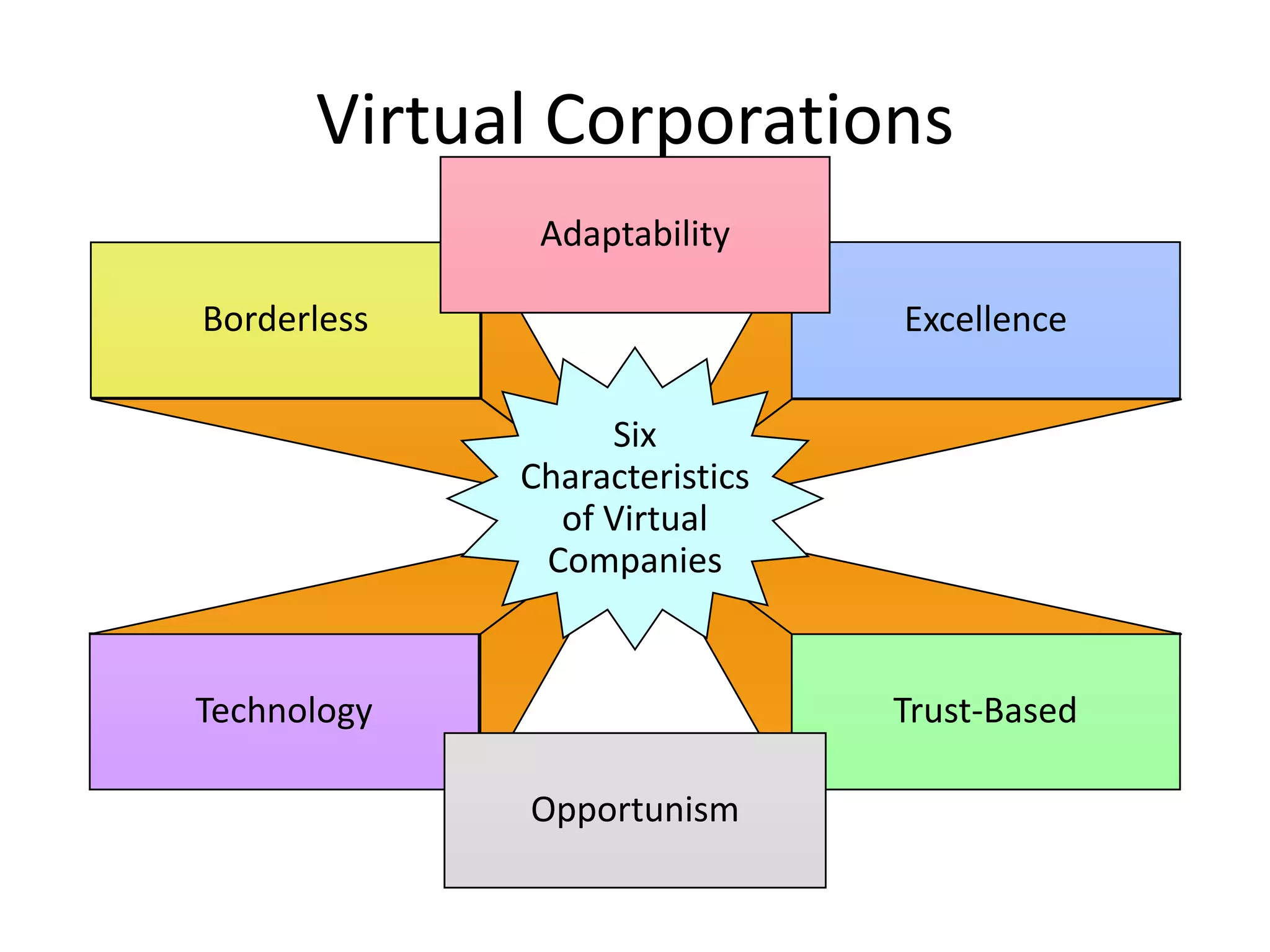
Virtual Corporations
              Adaptability

Borderless                     Excellence

                  Six
             Characteristics
               of Virtual
              Companies


Technology                     Trust-Based

             Opportunism
Knowledge Management Systems
• Many companies are building knowledge management
  systems to manage organizational learning and business
  know-how.
• Goal is to help knowledge workers create, organize and
  make important IS adjustments when ever there is a
  need in an organization
• Includes processes, procedures, patents, reference
  works, formulas, “best practices” etc.
• KMS facilitate organizational learning an knowledge
  creation.
• Internet and intranet, groupware, knowledge bases,
  online discussion groups are some key technologies
  that may be used by a KMS.
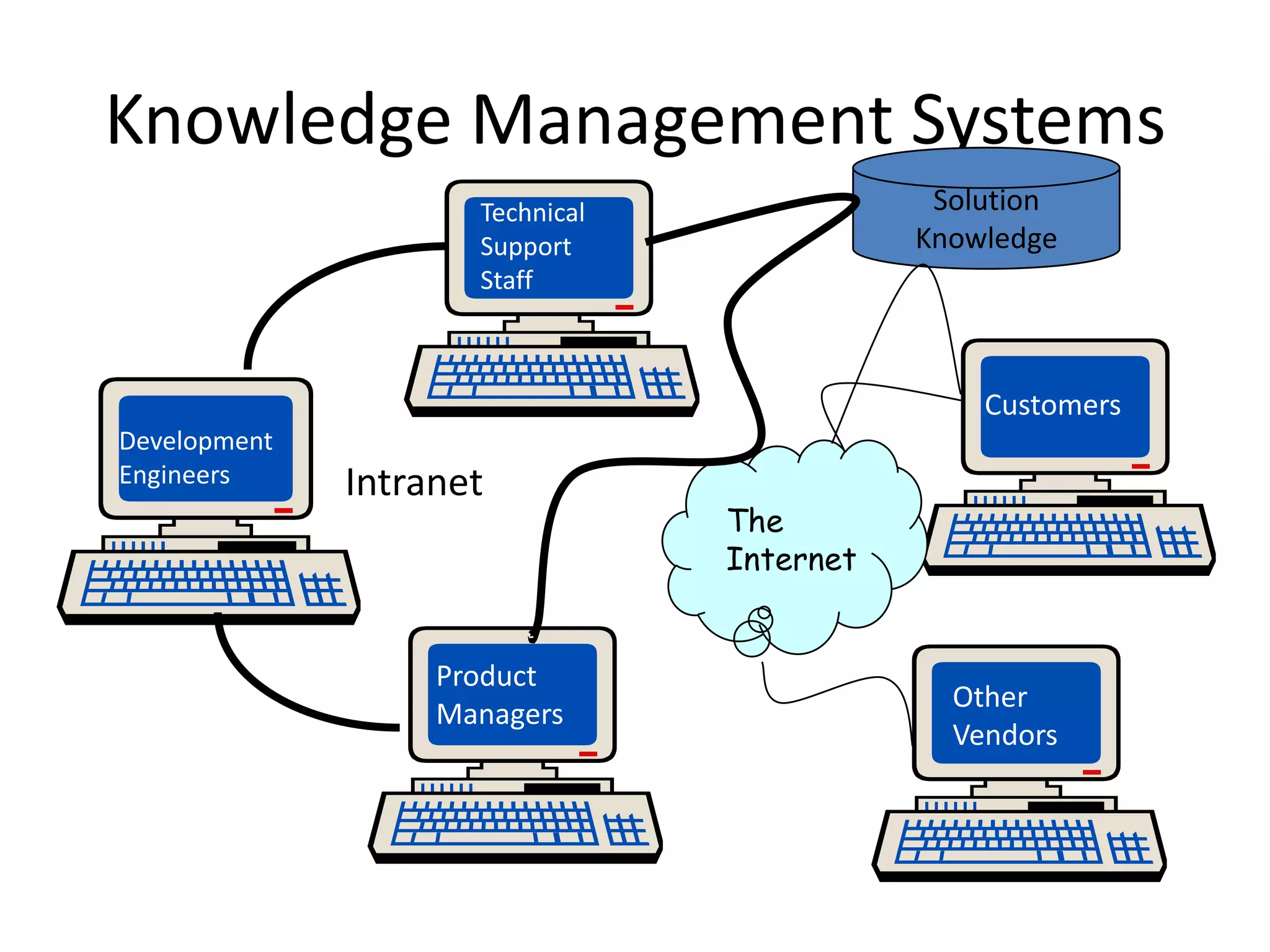
Knowledge Management Systems
                     Technical               Solution
                     Support                Knowledge
                     Staff


                                                Customers
Development
Engineers     Intranet
                                 The
                                 Internet


                   Product
                                              Other
                   Managers
                                              Vendors
Sustaining Strategic Success
• Sustained success in using IT
  strategically seems to depend on
  three sets o factors:
  –Environment
  –Foundation factors
  –Management Actions and Strategies
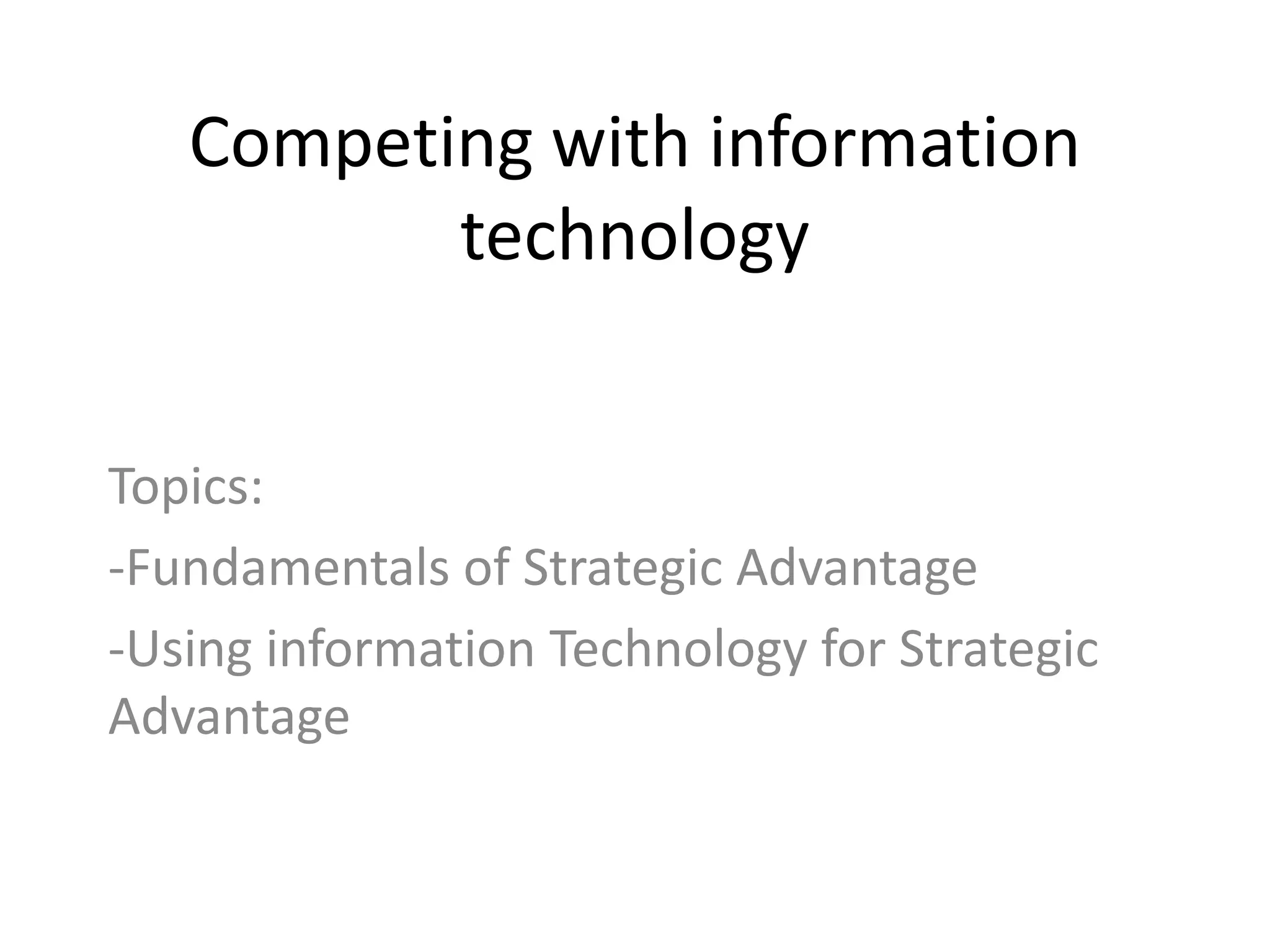
Key Factors for Sustaining Strategic
                     Success


              •Size                       •Creating switching
              •Geographical scope          costs
              •Product scope              •Exploiting
              •Organization structure      knowledge
              •Technological resources
Environment                               •Developing
              •Knowledge resources
                                           response strategies
                                          •Managing risks

                                                                 Performance
                                   Firm

Competing with information technology

  • 1.
    Competing with information technology Topics: -Fundamentals of Strategic Advantage -Using information Technology for Strategic Advantage
  • 2.
    The Competitive Environment Threat of New Entrants Bargaining Power of Suppliers Rivalry Among Existing Competitors Threat of Substitutes Bargaining Power of Customers
  • 3.
    Fundamental Competitive Strategies Cost Leadership Strategies Differentiation Strategies Innovation Strategies Growth Strategies Alliance Strategies
  • 5.
    Competitive Strategies &the Role of IT • Cost Leadership (low cost producer) – Reduce inventory (JIT) – Reduce manpower costs per sale – Help suppliers or customers reduce costs – Increase costs of competitors – Reduce manufacturing costs (process control)
  • 6.
    Competitive Strategies &the Role of IT (continued) • Differentiation – Create a positive difference between your products/services & the competition. – May allow you to reduce a competitor’s differentiation advantage. – May allow you to serve a niche market.
  • 7.
    Competitive Strategies &the Role of IT (continued) • Innovation – New ways of doing business – Unique products or services – New ways to better serve customers – Reduce time to market – New distribution models
  • 8.
    Competitive Strategies &the Role of IT (continued) • Growth – Expand production capacity – Expand into global markets – Diversify – Integrate into related products and services.
  • 9.
    Competitive Strategies &the Role of IT (continued) • Alliance – Broaden your base of support • New linkages – Mergers, acquisitions, joint ventures, “virtual companies” – Marketing, manufacturing, or distribution agreements.
  • 10.
    Competitive Strategies &the Role of IT (continued) • Other Competitive Strategies – Locking in customers or suppliers • By building valuable new relationship with them – Creating switching costs • Extranets • Proprietary software applications • Example: Wal-Mart
  • 11.
    Competitive Strategies &the Role of IT (continued) • Other Competitive Strategies (continued) – Raising barriers to entry • Improve operations or promote innovation – Leveraging investment in IT • Investing in IT enables a firm to build strategic IT capabilities that allows the business to take advantage of strategic opportunities
  • 12.
  • 13.
    Strategic Uses ofInformation Technology Improving Promote Locking in Business Customers Strategy Business Process Innovation and Suppliers IT Role Use IT to reduce Use IT to create •Use IT to improve costs of doing new products or quality business services •Use IT to link business to customers and suppliers Create New Maintain Valuable Outcome Enhance Business Customers and Efficiency Opportunities Relationships
  • 14.
    Strategic Uses ofInformation Raise Technology Build a Build a Strategic IT Strategic Strategy Barriers to Entry Platform Information Base IT Role Increase amount Leverage Use IT to provide of investment or investment in IS information to complexity of IT resources from support firm’s needed to operat- ional uses competitive strategy compete to strategic uses Create New Enhance Outcome Increase Business Organizational Market Share Opportunities Collaboration
  • 15.
    The Value Chain Administrative Coordination & Support Services Human Resource Management Technology Development Procurement of Resources Marketing Inbound Outbound Customer Operations and Logistics Logistics Service Sales
  • 16.
    INFORMATION SYSTEMS ANDBUSINESS STRATEGY Firm Value Chain
  • 17.
  • 18.
    The Internet ValueChain Marketing and Sales and Support and Internet Product Distribution Customer Capability Research Feedback Data for market •Low cost •Access to customer Benefits research, com-ments online to distribution establishes •Reaches new •Immediate re- Company consumer sponse to customer customers responses •Multiplies problems contact points Opportunity for Create New Maintain Valuable Enhance Advantage Business Customers and Efficiency Opportunities Relationships
  • 19.
    Strategic Positioning ofInternet Technologies High Global Market Product and Services Penetration Transformation Strategy E-Commerce Website E-Business; Extensive Value-added IT Services Intranets and Extranets Solution Performance Cost and Improvements in Efficiency Business Improvements Effectiveness E-Mail, Chat Systems Intranets and Extranets E-Business Processes Connectivity Low High Internal Drivers
  • 20.
    Section II • UsingInformation Technology for Strategic Advantage
  • 21.
    IT Used forCompetitive Strategy • Use of IT in two different ways. 1. Support Operations 2. Strategic Management
  • 22.
    Building a CustomerFocused E Business • Concept changed from manufacturing volume to improving customer value. • Key success for many firms is maximizing customer value • Ability to help them keep customers loyal, anticipate their future needs, respond to customers concerns, and provide top quality customer service.
  • 23.
    Customer Expectation • Keep track of their preferences • Keep up with market trends • Supply products and services • Ecommerce offers faster, responsive and high quality product and services tailored to individual customer preferences
  • 24.
    Role of EcommerceCustomers • Use Internet to ask questions • Air complaints • Evaluate products, request support • Make and report purchases
  • 25.
    Customer-Focused E-Business Let customers place orders directly Let customers check order history and delivery status Let customers place orders thru distribution Build a partners community of customers, employees, and partners Customer Transaction Database Database Link Employees Give all and distribution employees a partners complete view of customers
  • 26.
    Business Reengineering andQuality Management Business Quality Business Improvement Reengineering Incrementally Improving Radically Redesigning Business Definition Existing Processes Systems Any Process Strategic Business Processes Target Potential 10%-50% Improvements 10-Fold Improvements Payback Low High Risk Same Jobs - More Efficient Big Job Cuts; New Jobs; Major What Changes? Job Redesign Primary IT and Work Simplification IT and Organizational Redesign Enablers
  • 27.
  • 28.
    Improving Business Quality •IT can be used to improve business performance in many ways rather than supporting reengineering process • TQM: Total Quality Management: Quality as per customer not supplier. • Performance, reliability, durability, responsiveness
  • 29.
    TQM • May usea variety of tools and methods to seek continuous improvement of quality, productivity, flexibility, timeliness, and customer responsiveness.
  • 30.
    Companies using TQMare committed to • Even better more appealing and less variable quality of product or service • Even Quicker less variable response from design and development through supplier and sales channels • Even greater flexibility in adjusting to customers shifting volume and mix requirement
  • 31.
  • 32.
    The Customer- FocusedAgile Competitor Cooperate with Anticipation of Business Partners future needs and Competitors Customization Conformance Give Customers Organize to Solutions Master to Problems Change Leverage the Impact of People and IS Resources
  • 33.
    Creating virtual Company •Without meeting set up meetings • A company that uses IT to link people, assets and ideas • Uses organization structure called Network structure since most are linked through Internet and Intranets
  • 34.
  • 35.
    Virtual Corporations Adaptability Borderless Excellence Six Characteristics of Virtual Companies Technology Trust-Based Opportunism
  • 36.
    Knowledge Management Systems •Many companies are building knowledge management systems to manage organizational learning and business know-how. • Goal is to help knowledge workers create, organize and make important IS adjustments when ever there is a need in an organization • Includes processes, procedures, patents, reference works, formulas, “best practices” etc. • KMS facilitate organizational learning an knowledge creation. • Internet and intranet, groupware, knowledge bases, online discussion groups are some key technologies that may be used by a KMS.
  • 37.
    Knowledge Management Systems Technical Solution Support Knowledge Staff Customers Development Engineers Intranet The Internet Product Other Managers Vendors
  • 38.
    Sustaining Strategic Success •Sustained success in using IT strategically seems to depend on three sets o factors: –Environment –Foundation factors –Management Actions and Strategies
  • 39.
    Key Factors forSustaining Strategic Success •Size •Creating switching •Geographical scope costs •Product scope •Exploiting •Organization structure knowledge •Technological resources Environment •Developing •Knowledge resources response strategies •Managing risks Performance Firm