Online Marketing Mix
Puneet Bhatia – Digital Marketing
Made By : Priyanka Gautam
 Internet users in India have grown beyond 566 million (87% are regular
users )
 87% are regular users : 293 mn (Urban) & 200 mn (Rural)
 By 2020 : around 627 million
◦ 67% < 35 yrs & 33% > 35 yrs
 The Indian e-commerce market is expected to grow to US$ 200 billion by
2026 from US$ 38.5 billion as of 2017.
◦ (desire for convenience, lack of brand loyalty, willingness to switch, explore other products, take risks,
double income in families has given rise to an era of e-commerce)
 Understanding the optimal utilisation of the internet for enhanced
marketing efficiency
 Designing the best possible way to position products and servuces in the
online domain for greater marketing productivity
 Creating a value proposition in which the product and price meet the
consumers’ expectations
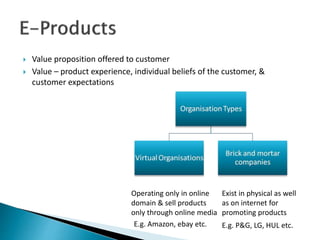
 Value proposition offered to customer
 Value – product experience, individual beliefs of the customer, &
customer expectations
Operating only in online
domain & sell products
only through online media
Exist in physical as well
as on internet for
promoting products
E.g. Amazon, ebay etc. E.g. P&G, LG, HUL etc.
 High levels of convenience for consumers
 Offers good customer service
 Saves consumer time and money
 Provides an enjoyable shopping experience
 Merchandises in the context of product offerings and product
information
 Provides site design and transaction security
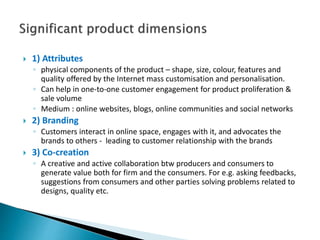
 1) Attributes
◦ physical components of the product – shape, size, colour, features and
quality offered by the Internet mass customisation and personalisation.
◦ Can help in one-to-one customer engagement for product proliferation &
sale volume
◦ Medium : online websites, blogs, online communities and social networks
 2) Branding
◦ Customers interact in online space, engages with it, and advocates the
brands to others - leading to customer relationship with the brands
 3) Co-creation
◦ A creative and active collaboration btw producers and consumers to
generate value both for firm and the consumers. For e.g. asking feedbacks,
suggestions from consumers and other parties solving problems related to
designs, quality etc.
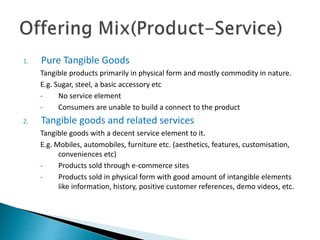
1. Pure Tangible Goods
Tangible products primarily in physical form and mostly commodity in nature.
E.g. Sugar, steel, a basic accessory etc
- No service element
- Consumers are unable to build a connect to the product
2. Tangible goods and related services
Tangible goods with a decent service element to it.
E.g. Mobiles, automobiles, furniture etc. (aesthetics, features, customisation,
conveniences etc)
- Products sold through e-commerce sites
- Products sold in physical form with good amount of intangible elements
like information, history, positive customer references, demo videos, etc.
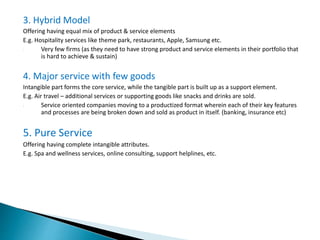
3. Hybrid Model
Offering having equal mix of product & service elements
E.g. Hospitality services like theme park, restaurants, Apple, Samsung etc.
- Very few firms (as they need to have strong product and service elements in their portfolio that
is hard to achieve & sustain)
4. Major service with few goods
Intangible part forms the core service, while the tangible part is built up as a support element.
E.g. Air travel – additional services or supporting goods like snacks and drinks are sold.
- Service oriented companies moving to a productized format wherein each of their key features
and processes are being broken down and sold as product in itself. (banking, insurance etc)
5. Pure Service
Offering having complete intangible attributes.
E.g. Spa and wellness services, online consulting, support helplines, etc.
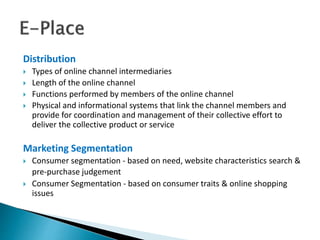
Distribution
 Types of online channel intermediaries
 Length of the online channel
 Functions performed by members of the online channel
 Physical and informational systems that link the channel members and
provide for coordination and management of their collective effort to
deliver the collective product or service
Marketing Segmentation
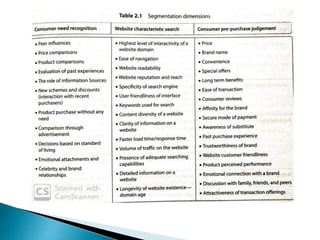
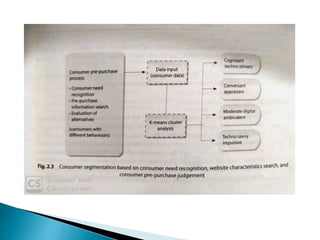
 Consumer segmentation - based on need, website characteristics search &
pre-purchase judgement
 Consumer Segmentation - based on consumer traits & online shopping
issues
Consumer Traits
 Willingness to take risk
 Seeking joy in surfing internet
 Saving time while shopping
 Feeling socially aware
 Likes playing games and using trendy apps with pleasant colour schemes
 Enjoys voicing their opinions
 Feeling smart in front of their peers
 Emotionally satisfying experience
Online shopping issues
 Product risk issues
 Interactive risk issues
 Transaction security issues
 Privacy issues
Targeting
Two main strategies:
1) Niche Marketing : a company selects a target segment and develops one
or more marketing mixes to meet the needs of the segment
2) Micro Marketing or individualised targeting : a company tailors all or part
of the marketing mix to a small number of people.
Positioning
- Creating image of the company & products
- Positioning among the competitors to carve out own market niche
- Positioning on the basis of service attributes, innovative technology
image, benefits, user categories, or comparisons with competitors
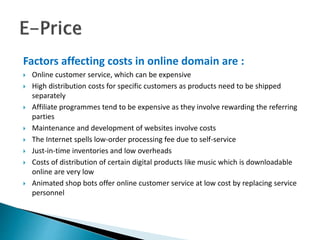
Factors affecting costs in online domain are :
 Online customer service, which can be expensive
 High distribution costs for specific customers as products need to be shipped
separately
 Affiliate programmes tend to be expensive as they involve rewarding the referring
parties
 Maintenance and development of websites involve costs
 The Internet spells low-order processing fee due to self-service
 Just-in-time inventories and low overheads
 Costs of distribution of certain digital products like music which is downloadable
online are very low
 Animated shop bots offer online customer service at low cost by replacing service
personnel
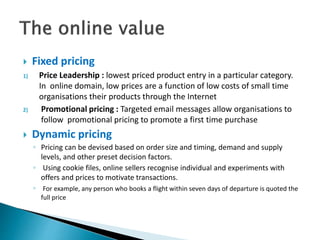
 Fixed pricing
1) Price Leadership : lowest priced product entry in a particular category.
In online domain, low prices are a function of low costs of small time
organisations their products through the Internet
2) Promotional pricing : Targeted email messages allow organisations to
follow promotional pricing to promote a first time purchase
 Dynamic pricing
◦ Pricing can be devised based on order size and timing, demand and supply
levels, and other preset decision factors.
◦ Using cookie files, online sellers recognise individual and experiments with
offers and prices to motivate transactions.
◦ For example, any person who books a flight within seven days of departure is quoted the
full price
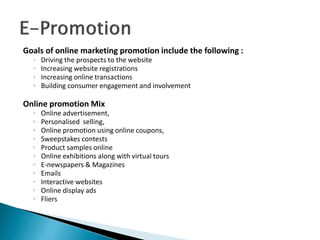
Goals of online marketing promotion include the following :
◦ Driving the prospects to the website
◦ Increasing website registrations
◦ Increasing online transactions
◦ Building consumer engagement and involvement
Online promotion Mix
◦ Online advertisement,
◦ Personalised selling,
◦ Online promotion using online coupons,
◦ Sweepstakes contests
◦ Product samples online
◦ Online exhibitions along with virtual tours
◦ E-newspapers & Magazines
◦ Emails
◦ Interactive websites
◦ Online display ads
◦ Fliers
 People – developing online teams with a mix of
◦ digital marketing expertise,
◦ technology know-how,
◦ multi-channel experience,
◦ knowledge of automation tools,
◦ and target customer insights,
◦ as well as understand of human impulse and desire.
 Processes – developing rigorous process-driven marketing organisation
– clear steps to
◦ identify target customer clusters,
◦ Develop integrated supplier-customer processes
◦ Manage campaigns
◦ Aligning goals to consumer funnel
 Programs : consumer –driven programs which run in a holistic
manner online and offline to meet a firm’s marketing
objectives. Includes multi-channel initiatives targeting all
stages
 Performance : setting up systems and ways to measure
performance and desired output at each stage of the
marketing activity
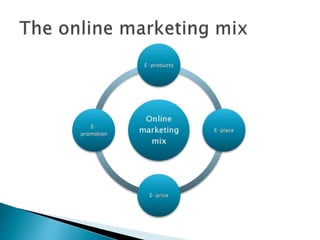
E-product
◦ Digitisation allows firms to create virtual marketplaces
◦ Helps firms to present expanded assortment of products options
◦ Direct and immediate delivery of digitizable products has created new
opportunities to wireless services such as bill payment, maps etc.
◦ Organisation selling products that can be evaluated adequately prior to
purchase have a higher success rate
E-price
◦ Wider and easier availability of price information increases consumer power in
the marketplace and create a tendency of price levels to decrease.
◦ The seller-provided advertised reference prices is reduced in the online
environments because of greater transparency.
 E-promotion
◦ When and where an ad is placed during an online session can significantly
impact advertising effectiveness
◦ Firms must devote considerable efforts to develop and implement an online
advertising and promotion strategy
◦ Carefully coordinated ads on channels like television, radio, and print can
lead to good returns and will add to firm’s online visibility
 E-place
◦ The retention rate of customer can vary significantly depending upon the
specific channel in which that customer was initially acquired.
◦ Compared to radio, television, and direct mail, websites is associated with
higher retention rates
◦ Consumers who shop access multiple channels provide higher revenues,
higher share of wallet, and tend to be more active than single-channel
customers.

Digital Marketing Mix : Challenges & Implications

  • 1.
    Online Marketing Mix PuneetBhatia – Digital Marketing Made By : Priyanka Gautam
  • 3.
     Internet usersin India have grown beyond 566 million (87% are regular users )  87% are regular users : 293 mn (Urban) & 200 mn (Rural)  By 2020 : around 627 million ◦ 67% < 35 yrs & 33% > 35 yrs  The Indian e-commerce market is expected to grow to US$ 200 billion by 2026 from US$ 38.5 billion as of 2017. ◦ (desire for convenience, lack of brand loyalty, willingness to switch, explore other products, take risks, double income in families has given rise to an era of e-commerce)
  • 4.
     Understanding theoptimal utilisation of the internet for enhanced marketing efficiency  Designing the best possible way to position products and servuces in the online domain for greater marketing productivity  Creating a value proposition in which the product and price meet the consumers’ expectations
  • 6.
     Value propositionoffered to customer  Value – product experience, individual beliefs of the customer, & customer expectations Operating only in online domain & sell products only through online media Exist in physical as well as on internet for promoting products E.g. Amazon, ebay etc. E.g. P&G, LG, HUL etc.
  • 7.
     High levelsof convenience for consumers  Offers good customer service  Saves consumer time and money  Provides an enjoyable shopping experience  Merchandises in the context of product offerings and product information  Provides site design and transaction security
  • 8.
     1) Attributes ◦physical components of the product – shape, size, colour, features and quality offered by the Internet mass customisation and personalisation. ◦ Can help in one-to-one customer engagement for product proliferation & sale volume ◦ Medium : online websites, blogs, online communities and social networks  2) Branding ◦ Customers interact in online space, engages with it, and advocates the brands to others - leading to customer relationship with the brands  3) Co-creation ◦ A creative and active collaboration btw producers and consumers to generate value both for firm and the consumers. For e.g. asking feedbacks, suggestions from consumers and other parties solving problems related to designs, quality etc.
  • 9.
    1. Pure TangibleGoods Tangible products primarily in physical form and mostly commodity in nature. E.g. Sugar, steel, a basic accessory etc - No service element - Consumers are unable to build a connect to the product 2. Tangible goods and related services Tangible goods with a decent service element to it. E.g. Mobiles, automobiles, furniture etc. (aesthetics, features, customisation, conveniences etc) - Products sold through e-commerce sites - Products sold in physical form with good amount of intangible elements like information, history, positive customer references, demo videos, etc.
  • 10.
    3. Hybrid Model Offeringhaving equal mix of product & service elements E.g. Hospitality services like theme park, restaurants, Apple, Samsung etc. - Very few firms (as they need to have strong product and service elements in their portfolio that is hard to achieve & sustain) 4. Major service with few goods Intangible part forms the core service, while the tangible part is built up as a support element. E.g. Air travel – additional services or supporting goods like snacks and drinks are sold. - Service oriented companies moving to a productized format wherein each of their key features and processes are being broken down and sold as product in itself. (banking, insurance etc) 5. Pure Service Offering having complete intangible attributes. E.g. Spa and wellness services, online consulting, support helplines, etc.
  • 11.
    Distribution  Types ofonline channel intermediaries  Length of the online channel  Functions performed by members of the online channel  Physical and informational systems that link the channel members and provide for coordination and management of their collective effort to deliver the collective product or service Marketing Segmentation  Consumer segmentation - based on need, website characteristics search & pre-purchase judgement  Consumer Segmentation - based on consumer traits & online shopping issues
  • 14.
    Consumer Traits  Willingnessto take risk  Seeking joy in surfing internet  Saving time while shopping  Feeling socially aware  Likes playing games and using trendy apps with pleasant colour schemes  Enjoys voicing their opinions  Feeling smart in front of their peers  Emotionally satisfying experience Online shopping issues  Product risk issues  Interactive risk issues  Transaction security issues  Privacy issues
  • 15.
    Targeting Two main strategies: 1)Niche Marketing : a company selects a target segment and develops one or more marketing mixes to meet the needs of the segment 2) Micro Marketing or individualised targeting : a company tailors all or part of the marketing mix to a small number of people. Positioning - Creating image of the company & products - Positioning among the competitors to carve out own market niche - Positioning on the basis of service attributes, innovative technology image, benefits, user categories, or comparisons with competitors
  • 16.
    Factors affecting costsin online domain are :  Online customer service, which can be expensive  High distribution costs for specific customers as products need to be shipped separately  Affiliate programmes tend to be expensive as they involve rewarding the referring parties  Maintenance and development of websites involve costs  The Internet spells low-order processing fee due to self-service  Just-in-time inventories and low overheads  Costs of distribution of certain digital products like music which is downloadable online are very low  Animated shop bots offer online customer service at low cost by replacing service personnel
  • 17.
     Fixed pricing 1)Price Leadership : lowest priced product entry in a particular category. In online domain, low prices are a function of low costs of small time organisations their products through the Internet 2) Promotional pricing : Targeted email messages allow organisations to follow promotional pricing to promote a first time purchase  Dynamic pricing ◦ Pricing can be devised based on order size and timing, demand and supply levels, and other preset decision factors. ◦ Using cookie files, online sellers recognise individual and experiments with offers and prices to motivate transactions. ◦ For example, any person who books a flight within seven days of departure is quoted the full price
  • 18.
    Goals of onlinemarketing promotion include the following : ◦ Driving the prospects to the website ◦ Increasing website registrations ◦ Increasing online transactions ◦ Building consumer engagement and involvement Online promotion Mix ◦ Online advertisement, ◦ Personalised selling, ◦ Online promotion using online coupons, ◦ Sweepstakes contests ◦ Product samples online ◦ Online exhibitions along with virtual tours ◦ E-newspapers & Magazines ◦ Emails ◦ Interactive websites ◦ Online display ads ◦ Fliers
  • 20.
     People –developing online teams with a mix of ◦ digital marketing expertise, ◦ technology know-how, ◦ multi-channel experience, ◦ knowledge of automation tools, ◦ and target customer insights, ◦ as well as understand of human impulse and desire.  Processes – developing rigorous process-driven marketing organisation – clear steps to ◦ identify target customer clusters, ◦ Develop integrated supplier-customer processes ◦ Manage campaigns ◦ Aligning goals to consumer funnel
  • 21.
     Programs :consumer –driven programs which run in a holistic manner online and offline to meet a firm’s marketing objectives. Includes multi-channel initiatives targeting all stages  Performance : setting up systems and ways to measure performance and desired output at each stage of the marketing activity
  • 22.
    E-product ◦ Digitisation allowsfirms to create virtual marketplaces ◦ Helps firms to present expanded assortment of products options ◦ Direct and immediate delivery of digitizable products has created new opportunities to wireless services such as bill payment, maps etc. ◦ Organisation selling products that can be evaluated adequately prior to purchase have a higher success rate E-price ◦ Wider and easier availability of price information increases consumer power in the marketplace and create a tendency of price levels to decrease. ◦ The seller-provided advertised reference prices is reduced in the online environments because of greater transparency.
  • 23.
     E-promotion ◦ Whenand where an ad is placed during an online session can significantly impact advertising effectiveness ◦ Firms must devote considerable efforts to develop and implement an online advertising and promotion strategy ◦ Carefully coordinated ads on channels like television, radio, and print can lead to good returns and will add to firm’s online visibility  E-place ◦ The retention rate of customer can vary significantly depending upon the specific channel in which that customer was initially acquired. ◦ Compared to radio, television, and direct mail, websites is associated with higher retention rates ◦ Consumers who shop access multiple channels provide higher revenues, higher share of wallet, and tend to be more active than single-channel customers.