Management 265
Introduction to E-Commerce
                Nicholas A. Davis
                  Session One
                   06/02/2010
Course Objectives
• Differentiate e-commerce from e-business
• Discuss history of, and developments in e-
  commerce
• Apply business concepts and strategies to
  an e-commerce strategy
• Explain the major business models across
  the various types of e-commerce
• Discuss trends in Internet technology
Who Is This Person?
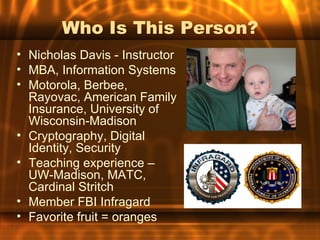
• Nicholas Davis - Instructor
• MBA, Information Systems
• Motorola, Berbee,
  Rayovac, American Family
  Insurance, University of
  Wisconsin-Madison
• Cryptography, Digital
  Identity, Security
• Teaching experience –
  UW-Madison, MATC,
  Cardinal Stritch
• Member FBI Infragard
• Favorite fruit = oranges
Snickers
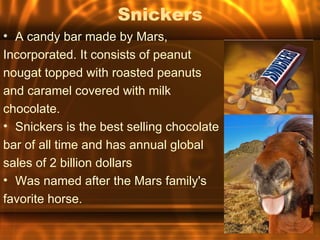
• A candy bar made by Mars,
Incorporated. It consists of peanut
nougat topped with roasted peanuts
and caramel covered with milk
chocolate.
• Snickers is the best selling chocolate
bar of all time and has annual global
sales of 2 billion dollars
• Was named after the Mars family's
favorite horse.
Student Introductions
• Your name
• Your professional
  background
• Something unique about
  yourself
• Why you chose this class
• What you hope to learn
• What your favorite fruit is
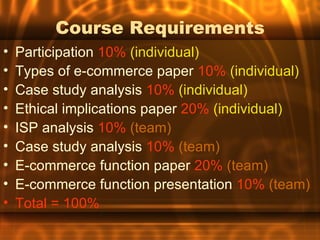
Course Requirements
•   Participation 10% (individual)
•   Types of e-commerce paper 10% (individual)
•   Case study analysis 10% (individual)
•   Ethical implications paper 20% (individual)
•   ISP analysis 10% (team)
•   Case study analysis 10% (team)
•   E-commerce function paper 20% (team)
•   E-commerce function presentation 10% (team)
•   Total = 100%
Assignments Due Today
• Read Chapters 1-3 in
  the textbook
• Skim chapters 9-12 in
  the textbook
• Submit paper on types
  of e-commerce
• Discuss article about a
  company’s innovative
  use of e-commerce
Your Experience With
          E-Commerce
• What are your
  personal and
  professional
  experiences with e-
  commerce?
• Do you shop online?
  Why or why not?
• Does your company
  conduct Internet
  sales? If so, what
  types? B2B, B2C
Class Exercise
• Split up into teams
• Make a list of the ways in which you
  believe e-commerce has changed over the
  course of the past 10 years (10 minutes)
• Step up to the front of the class, go over
  your lists
• What do these changes mean for the
  consumer and the business?
• Put your changes on a timeline, discuss
  the changes and effects of these changes
E-Commerce vs. E-Business
• E-commerce and E-business are not the
  same.
• E-commerce relates to the process of
  selling goods and services online
• E-business relates to using the Internet
  and other online technologies to increase
  operating efficiencies
• E-commerce is externally facing, while e-
  business can be both internally and
  externally facing
Benefits of E-commerce
• Expands markets from local to global
• Reduces costs with telecommunications and
  physical maintenance
• Minimizes resources used for storing physical
  receipts
• Instant product updates, including descriptions
  and pricing
• 24-hour store visibility to anyone with an Internet
  connection
• Search utilities far surpasses the speed used to
  find products through catalogs
• Encourages competition between small and large
  online retailers
Limitations of E-Commerce
• Credit Card security is a serious issue if vulnerable
• Costs involved with bandwidth and other computer and
  server costs
• Extensive database and technical knowledge and
  experience required
• Customer apprehension about online Credit Card orders
• Constantly changing technology may leave slow
  businesses behind
• Some customers need instant gratification, and shipment
  times interrupt that
• Search utilities far surpasses the speed used to find
  products through catalogs
• Encourages competition between small and large online
  retailers
Unique Features of
            E-Commerce
•   Ubiquity
•   Global reach
•   Universal standards
•   Richness
•   Interactivity
•   Information density
•   Personalization/Customization
•   Social technology
Class Exercise
• Identify the factors
  influencing the evolution
  of e-commerce, as
  outlined in the textbook
• Hint, think about
  Innovation, Consolidation,
  Re-invention
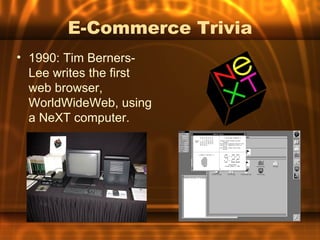
E-Commerce Trivia
• 1990: Tim Berners-
  Lee writes the first
  web browser,
  WorldWideWeb, using
  a NeXT computer.
E-Commerce Enabling
          Technologies
• The history of the Internet
• The key technologies
  enabling the Internet
• Future directions of the
  Internet
• The relationship between
  technology advances and
  e-commerce evolution
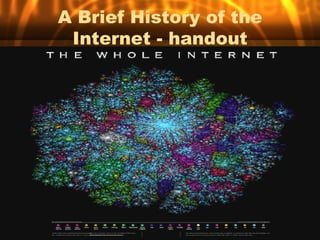
A Brief History of the
 Internet - handout
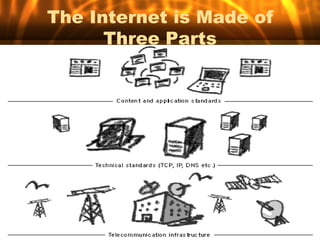
The Internet is Made of
      Three Parts
Future Directions of
              Technology
• Mobile, always on, more push,
  less pull
• Smart and environmentally
  aware appliances
• Increased throughput
• Standardized authentication,
  authorization, access and
  payment systems
• Behavioral customization
• The end of network anonymity
• What does this mean for e-
  commerce evolution?
Class Activity
• Divide into two groups
• Develop a timeline for the Internet
• Which elements of the Internet revolution
  have impacted the e-commerce revolution
  and vice versa?
• Discuss any differences between the two
  teams interpretations. Each team will then
  explain their reasoning
E-Commerce Articles
• Come to the front of the classroom
• Take a couple of minutes to:
• Give a summary of the article to the class
• How is the company in the article using e-
  commerce in an innovative fashion?
• Describe why you chose that article and
  what you found most interesting in the
  article
• Answer any questions the class may have
E-Commerce Innovations
•   Video solutions
•   Customer service
•   Real world guided selling
•   Multi store retailing
•   User interface design
•   Navigation tools
•   Effective merchandising
•   Social shopping
•   Customer loyalty
B2C Business Models Class
       Exercise - Portal
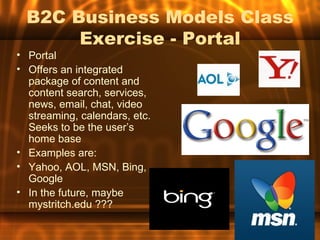
• Portal
• Offers an integrated
  package of content and
  content search, services,
  news, email, chat, video
  streaming, calendars, etc.
  Seeks to be the user’s
  home base
• Examples are:
• Yahoo, AOL, MSN, Bing,
  Google
• In the future, maybe
  mystritch.edu ???
B2C Business Models Class
  Exercise – Content Provider
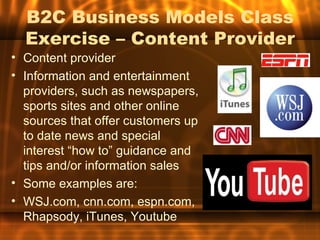
• Content provider
• Information and entertainment
  providers, such as newspapers,
  sports sites and other online
  sources that offer customers up
  to date news and special
  interest “how to” guidance and
  tips and/or information sales
• Some examples are:
• WSJ.com, cnn.com, espn.com,
  Rhapsody, iTunes, Youtube
B2C Business Models Class
  Exercise – Transaction Broker
• Transaction Broker
• Processors of online sales
  transactions, such as
  stockbrokers and travel agents,
  that increase customers’
  productivity by helping them get
  things done faster and more
  cheaply
• Examples:
• E-Trade, Expedia, Monster,
  Travelocity, Hotels.com, Orbitz
B2C Business Models Class
  Exercise – Market Creator
• Market Creator
• Web based business
  that uses Internet
  technology to create
  markets which bring
  buyers and sellers
  together
• Examples:
• Ebay, Priceline
B2C Business Models Class
 Exercise – Service Provider
• Service provider
• Companies that make
  money by selling
  users a service, rather
  than a product
• Examples:
• Carbonite, Mosi,
  Xdrive, 1.FM
B2C Business Models Class
 Exercise – Community Provider
• Community provider
• Sites where individuals with
  particular interests, hobbies,
  common experiences, or
  social networks, where
  people can come together
  and “meet” online
• Examples:
• Friendster, iVillage,
  Myspace, Facebook
Class Exercise
•   Pick one on these models
•   Describe:
•   The model’s history
•   Some examples of the model
•   The benefits and challenges of the model
•   Try to include visuals in your presentation
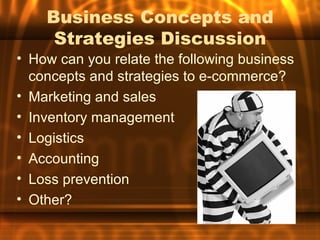
Business Concepts and
     Strategies Discussion
• How can you relate the following business
  concepts and strategies to e-commerce?
• Marketing and sales
• Inventory management
• Logistics
• Accounting
• Loss prevention
• Other?
Questions and Discussion of
           Today’s Class
• Was everything clear?
• What did you like?
• What didn’t you like?
• On a scale of 1-10, how would you rate the
  class so far?
• Remember, next time, read chapters 4 and
  5 in the textbook, submit the case study
  analysis, discuss article you select which is
  related to leading edge e-commerce
  technology and what impact it will have
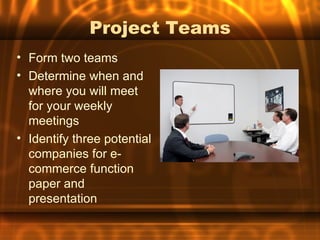
Project Teams
• Form two teams
• Determine when and
  where you will meet
  for your weekly
  meetings
• Identify three potential
  companies for e-
  commerce function
  paper and
  presentation
Additional Concerns

E Commerce Overview

  • 1.
    Management 265 Introduction toE-Commerce Nicholas A. Davis Session One 06/02/2010
  • 2.
    Course Objectives • Differentiatee-commerce from e-business • Discuss history of, and developments in e- commerce • Apply business concepts and strategies to an e-commerce strategy • Explain the major business models across the various types of e-commerce • Discuss trends in Internet technology
  • 3.
    Who Is ThisPerson? • Nicholas Davis - Instructor • MBA, Information Systems • Motorola, Berbee, Rayovac, American Family Insurance, University of Wisconsin-Madison • Cryptography, Digital Identity, Security • Teaching experience – UW-Madison, MATC, Cardinal Stritch • Member FBI Infragard • Favorite fruit = oranges
  • 4.
    Snickers • A candybar made by Mars, Incorporated. It consists of peanut nougat topped with roasted peanuts and caramel covered with milk chocolate. • Snickers is the best selling chocolate bar of all time and has annual global sales of 2 billion dollars • Was named after the Mars family's favorite horse.
  • 5.
    Student Introductions • Yourname • Your professional background • Something unique about yourself • Why you chose this class • What you hope to learn • What your favorite fruit is
  • 6.
    Course Requirements • Participation 10% (individual) • Types of e-commerce paper 10% (individual) • Case study analysis 10% (individual) • Ethical implications paper 20% (individual) • ISP analysis 10% (team) • Case study analysis 10% (team) • E-commerce function paper 20% (team) • E-commerce function presentation 10% (team) • Total = 100%
  • 7.
    Assignments Due Today •Read Chapters 1-3 in the textbook • Skim chapters 9-12 in the textbook • Submit paper on types of e-commerce • Discuss article about a company’s innovative use of e-commerce
  • 8.
    Your Experience With E-Commerce • What are your personal and professional experiences with e- commerce? • Do you shop online? Why or why not? • Does your company conduct Internet sales? If so, what types? B2B, B2C
  • 9.
    Class Exercise • Splitup into teams • Make a list of the ways in which you believe e-commerce has changed over the course of the past 10 years (10 minutes) • Step up to the front of the class, go over your lists • What do these changes mean for the consumer and the business? • Put your changes on a timeline, discuss the changes and effects of these changes
  • 10.
    E-Commerce vs. E-Business •E-commerce and E-business are not the same. • E-commerce relates to the process of selling goods and services online • E-business relates to using the Internet and other online technologies to increase operating efficiencies • E-commerce is externally facing, while e- business can be both internally and externally facing
  • 11.
    Benefits of E-commerce •Expands markets from local to global • Reduces costs with telecommunications and physical maintenance • Minimizes resources used for storing physical receipts • Instant product updates, including descriptions and pricing • 24-hour store visibility to anyone with an Internet connection • Search utilities far surpasses the speed used to find products through catalogs • Encourages competition between small and large online retailers
  • 12.
    Limitations of E-Commerce •Credit Card security is a serious issue if vulnerable • Costs involved with bandwidth and other computer and server costs • Extensive database and technical knowledge and experience required • Customer apprehension about online Credit Card orders • Constantly changing technology may leave slow businesses behind • Some customers need instant gratification, and shipment times interrupt that • Search utilities far surpasses the speed used to find products through catalogs • Encourages competition between small and large online retailers
  • 13.
    Unique Features of E-Commerce • Ubiquity • Global reach • Universal standards • Richness • Interactivity • Information density • Personalization/Customization • Social technology
  • 14.
    Class Exercise • Identifythe factors influencing the evolution of e-commerce, as outlined in the textbook • Hint, think about Innovation, Consolidation, Re-invention
  • 15.
    E-Commerce Trivia • 1990:Tim Berners- Lee writes the first web browser, WorldWideWeb, using a NeXT computer.
  • 16.
    E-Commerce Enabling Technologies • The history of the Internet • The key technologies enabling the Internet • Future directions of the Internet • The relationship between technology advances and e-commerce evolution
  • 17.
    A Brief Historyof the Internet - handout
  • 18.
    The Internet isMade of Three Parts
  • 19.
    Future Directions of Technology • Mobile, always on, more push, less pull • Smart and environmentally aware appliances • Increased throughput • Standardized authentication, authorization, access and payment systems • Behavioral customization • The end of network anonymity • What does this mean for e- commerce evolution?
  • 20.
    Class Activity • Divideinto two groups • Develop a timeline for the Internet • Which elements of the Internet revolution have impacted the e-commerce revolution and vice versa? • Discuss any differences between the two teams interpretations. Each team will then explain their reasoning
  • 21.
    E-Commerce Articles • Cometo the front of the classroom • Take a couple of minutes to: • Give a summary of the article to the class • How is the company in the article using e- commerce in an innovative fashion? • Describe why you chose that article and what you found most interesting in the article • Answer any questions the class may have
  • 22.
    E-Commerce Innovations • Video solutions • Customer service • Real world guided selling • Multi store retailing • User interface design • Navigation tools • Effective merchandising • Social shopping • Customer loyalty
  • 23.
    B2C Business ModelsClass Exercise - Portal • Portal • Offers an integrated package of content and content search, services, news, email, chat, video streaming, calendars, etc. Seeks to be the user’s home base • Examples are: • Yahoo, AOL, MSN, Bing, Google • In the future, maybe mystritch.edu ???
  • 24.
    B2C Business ModelsClass Exercise – Content Provider • Content provider • Information and entertainment providers, such as newspapers, sports sites and other online sources that offer customers up to date news and special interest “how to” guidance and tips and/or information sales • Some examples are: • WSJ.com, cnn.com, espn.com, Rhapsody, iTunes, Youtube
  • 25.
    B2C Business ModelsClass Exercise – Transaction Broker • Transaction Broker • Processors of online sales transactions, such as stockbrokers and travel agents, that increase customers’ productivity by helping them get things done faster and more cheaply • Examples: • E-Trade, Expedia, Monster, Travelocity, Hotels.com, Orbitz
  • 26.
    B2C Business ModelsClass Exercise – Market Creator • Market Creator • Web based business that uses Internet technology to create markets which bring buyers and sellers together • Examples: • Ebay, Priceline
  • 27.
    B2C Business ModelsClass Exercise – Service Provider • Service provider • Companies that make money by selling users a service, rather than a product • Examples: • Carbonite, Mosi, Xdrive, 1.FM
  • 28.
    B2C Business ModelsClass Exercise – Community Provider • Community provider • Sites where individuals with particular interests, hobbies, common experiences, or social networks, where people can come together and “meet” online • Examples: • Friendster, iVillage, Myspace, Facebook
  • 29.
    Class Exercise • Pick one on these models • Describe: • The model’s history • Some examples of the model • The benefits and challenges of the model • Try to include visuals in your presentation
  • 30.
    Business Concepts and Strategies Discussion • How can you relate the following business concepts and strategies to e-commerce? • Marketing and sales • Inventory management • Logistics • Accounting • Loss prevention • Other?
  • 31.
    Questions and Discussionof Today’s Class • Was everything clear? • What did you like? • What didn’t you like? • On a scale of 1-10, how would you rate the class so far? • Remember, next time, read chapters 4 and 5 in the textbook, submit the case study analysis, discuss article you select which is related to leading edge e-commerce technology and what impact it will have
  • 32.
    Project Teams • Formtwo teams • Determine when and where you will meet for your weekly meetings • Identify three potential companies for e- commerce function paper and presentation
  • 33.