
Cyberwar Gets Personal
Association of Information Systems Professionals
Nicholas Davis, CISA, CISSP
Chief Information Security Officer
University of Wisconsin System
Monday, March 5, 2018
Keep In Mind
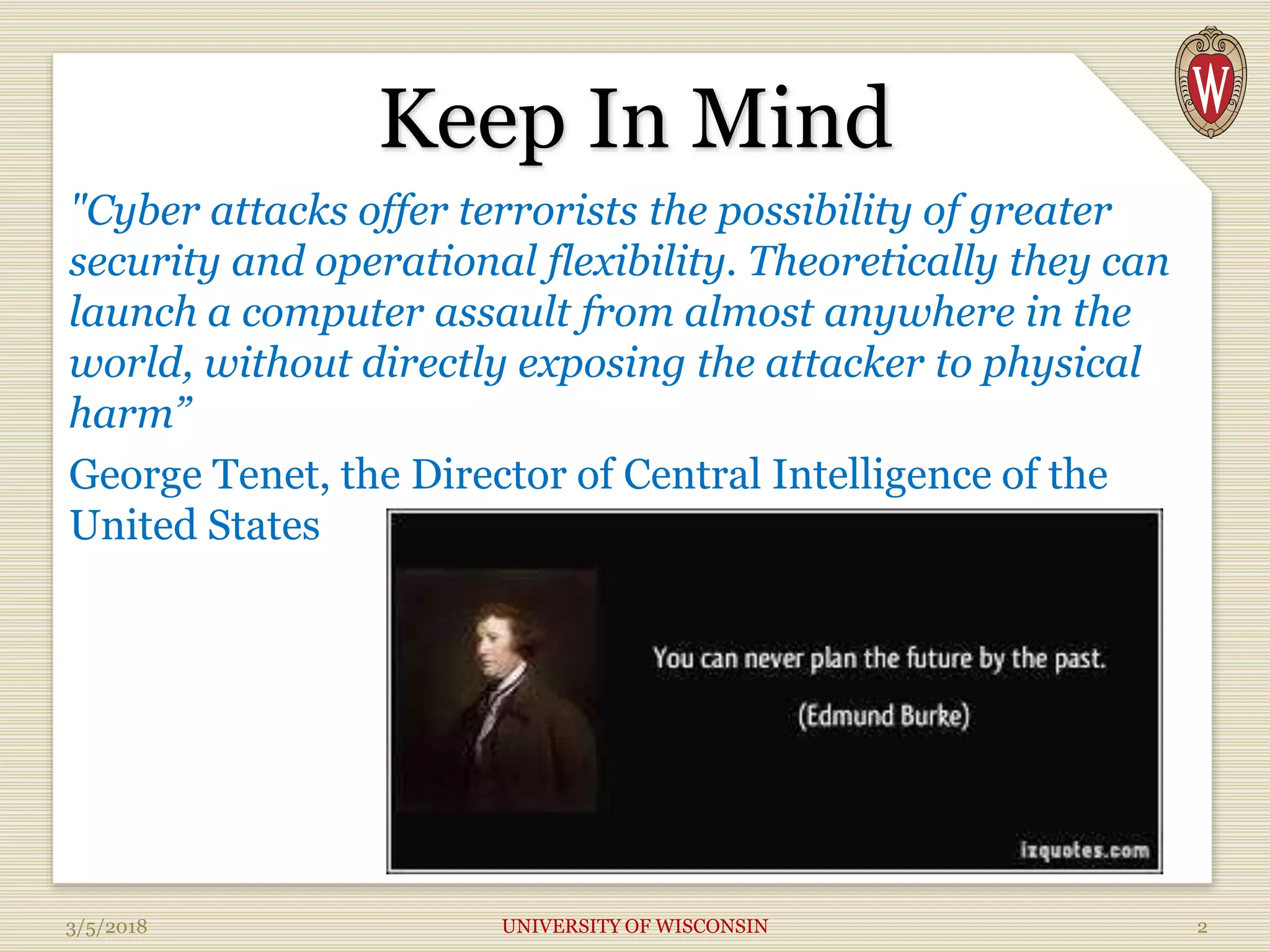
"Cyber attacks offer terrorists the possibility of greater
security and operational flexibility. Theoretically they can
launch a computer assault from almost anywhere in the
world, without directly exposing the attacker to physical
harm”
George Tenet, the Director of Central Intelligence of the
United States
3/5/2018 UNIVERSITY OF WISCONSIN 2
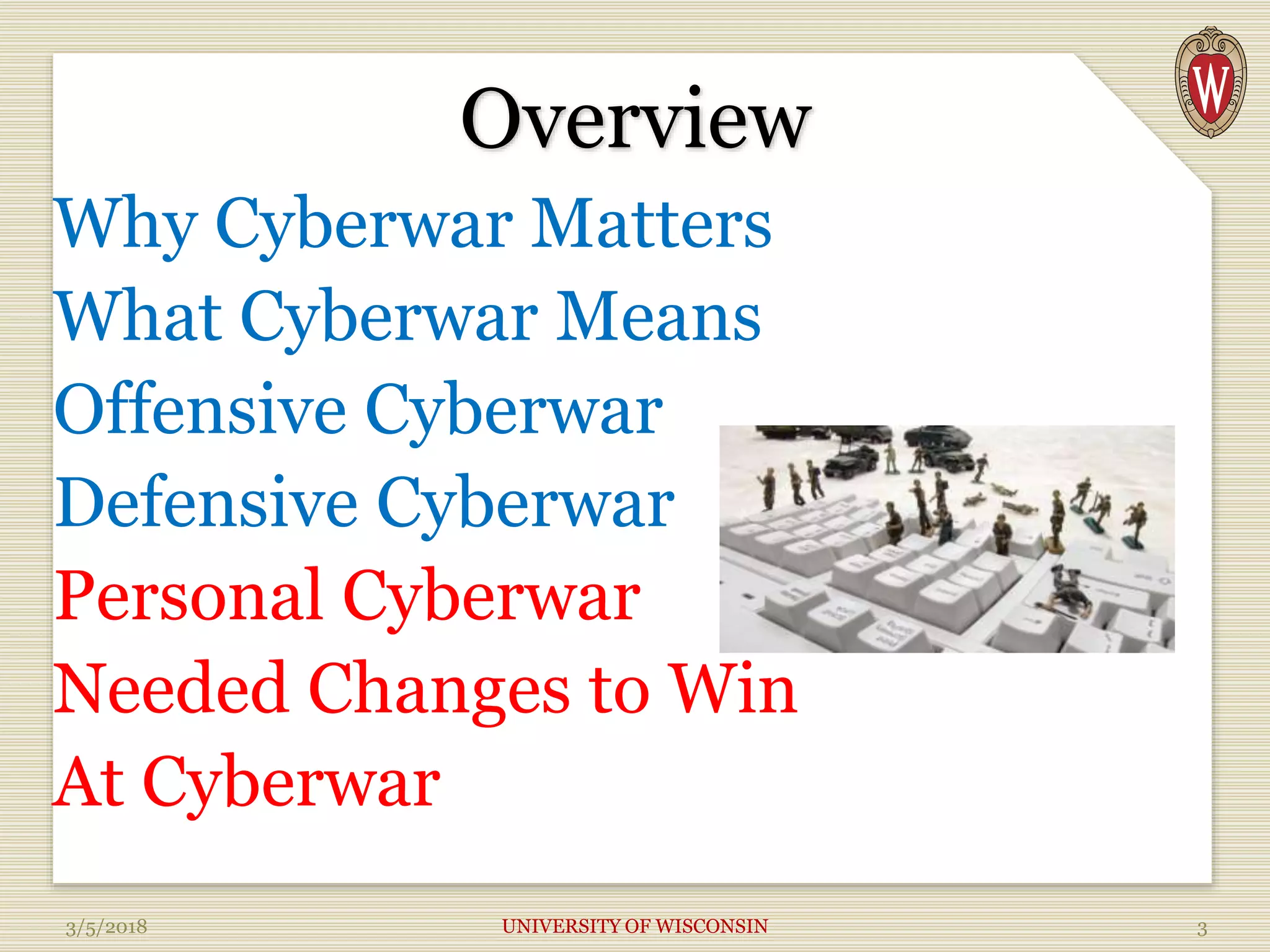
Overview
Why Cyberwar Matters
What Cyberwar Means
Offensive Cyberwar
Defensive Cyberwar
Personal Cyberwar
Needed Changes to Win
At Cyberwar
3/5/2018 UNIVERSITY OF WISCONSIN 3
Why Cyberwar Matters
Everything we do relies upon information
technology, as individuals, groups, and as a
society
We don’t think about it, but:
• Water supply
• Air traffic control
• Power
All depend upon and can be manipulated
and damaged through cyberattack
3/5/2018 UNIVERSITY OF WISCONSIN 4
Why Cyberwar Matters
3/5/2018 UNIVERSITY OF WISCONSIN 5
Why Cyberwar Matters
Imagine a Day Like This
9:00 AM, Stock market taken down by DOS attack
3/5/2018 UNIVERSITY OF WISCONSIN 6
Why Cyberwar Matters
Imagine a Day Like This
11:42 AM, Power to 23% of the country goes out
3/5/2018 UNIVERSITY OF WISCONSIN 7
Why Cyberwar Matters
Imagine a Day Like This
1:17 PM, mobile networks across 70% of the
country are dead
3/5/2018 UNIVERSITY OF WISCONSIN 8
Why Cyberwar Matters
Imagine a Day Like This
3:37 PM, All air traffic around the country is
grounded as radar goes down
3/5/2018 UNIVERSITY OF WISCONSIN 9
Why Cyberwar Matters
Imagine a Day Like This
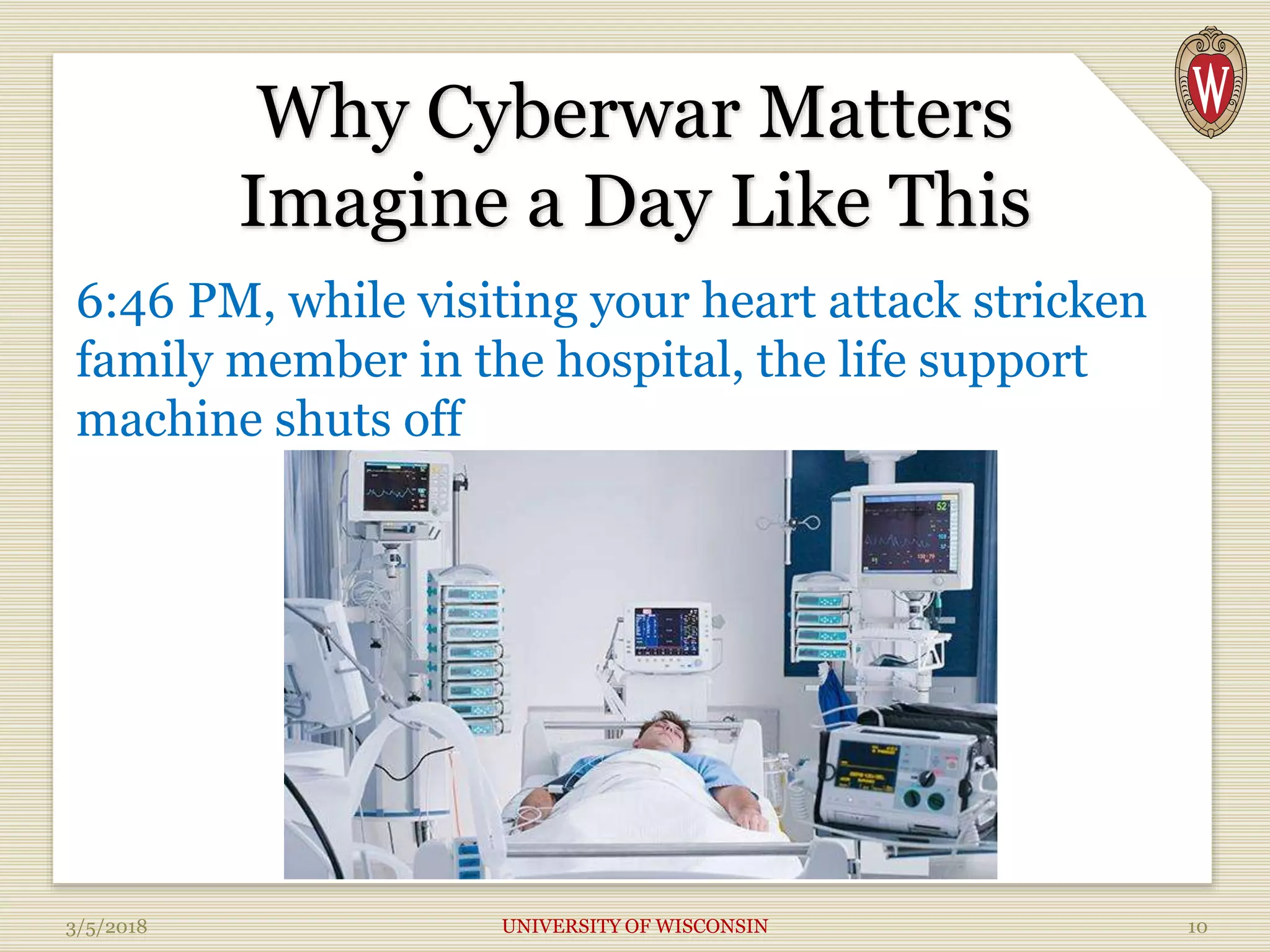
6:46 PM, while visiting your heart attack stricken
family member in the hospital, the life support
machine shuts off
3/5/2018 UNIVERSITY OF WISCONSIN 10
Why Cyberwar Matters
Information technology makes our lives
more enjoyable, and safe
Reliance on information technology has
made us all vulnerable, both directly or
indirectly
3/5/2018 UNIVERSITY OF WISCONSIN 11
Why Cyberwar Matters
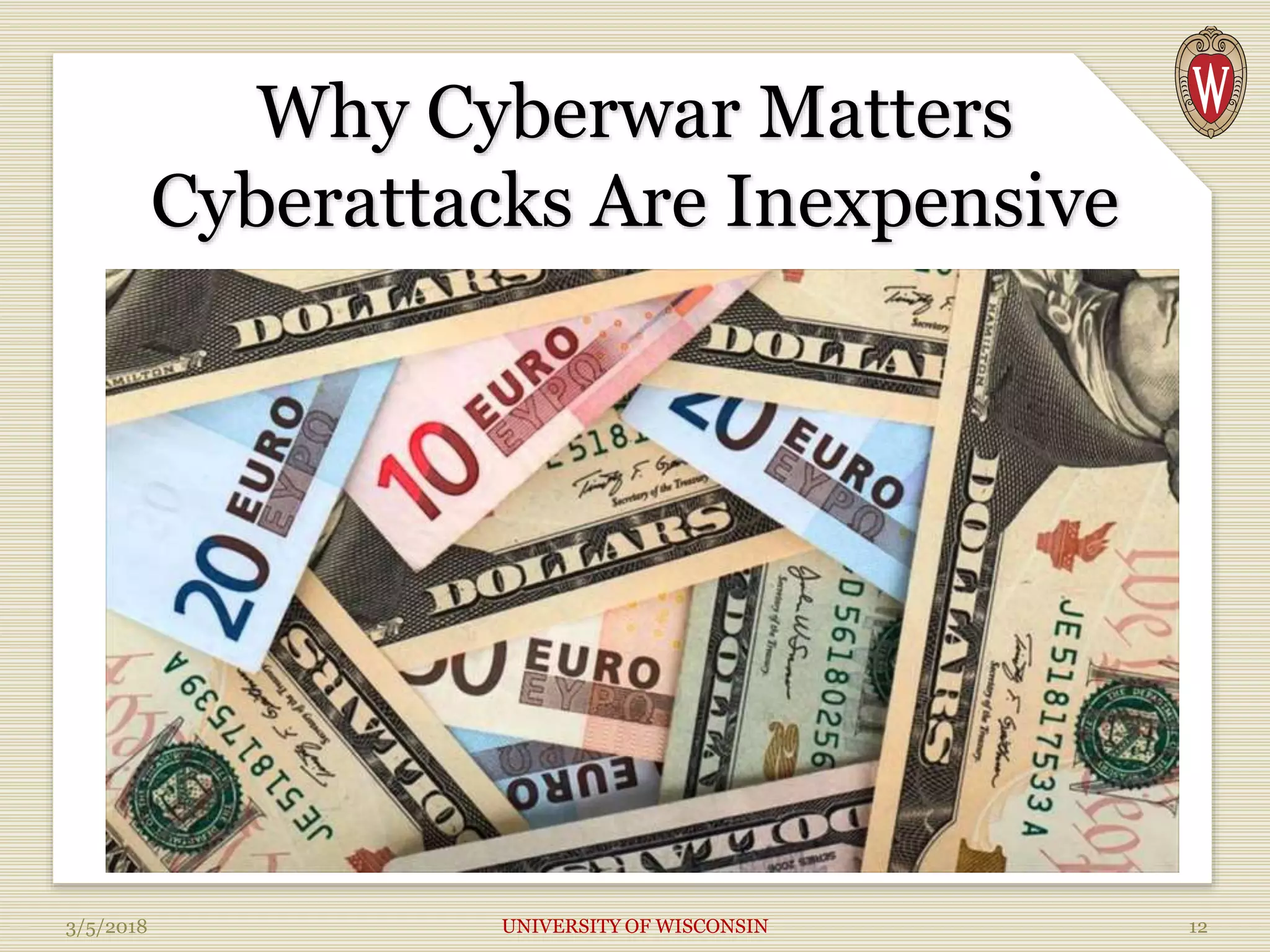
Cyberattacks Are Inexpensive
3/5/2018 UNIVERSITY OF WISCONSIN 12
Why Cyberwar Matters
Remotely Executed
3/5/2018 UNIVERSITY OF WISCONSIN 13
Why Cyberwar Matters
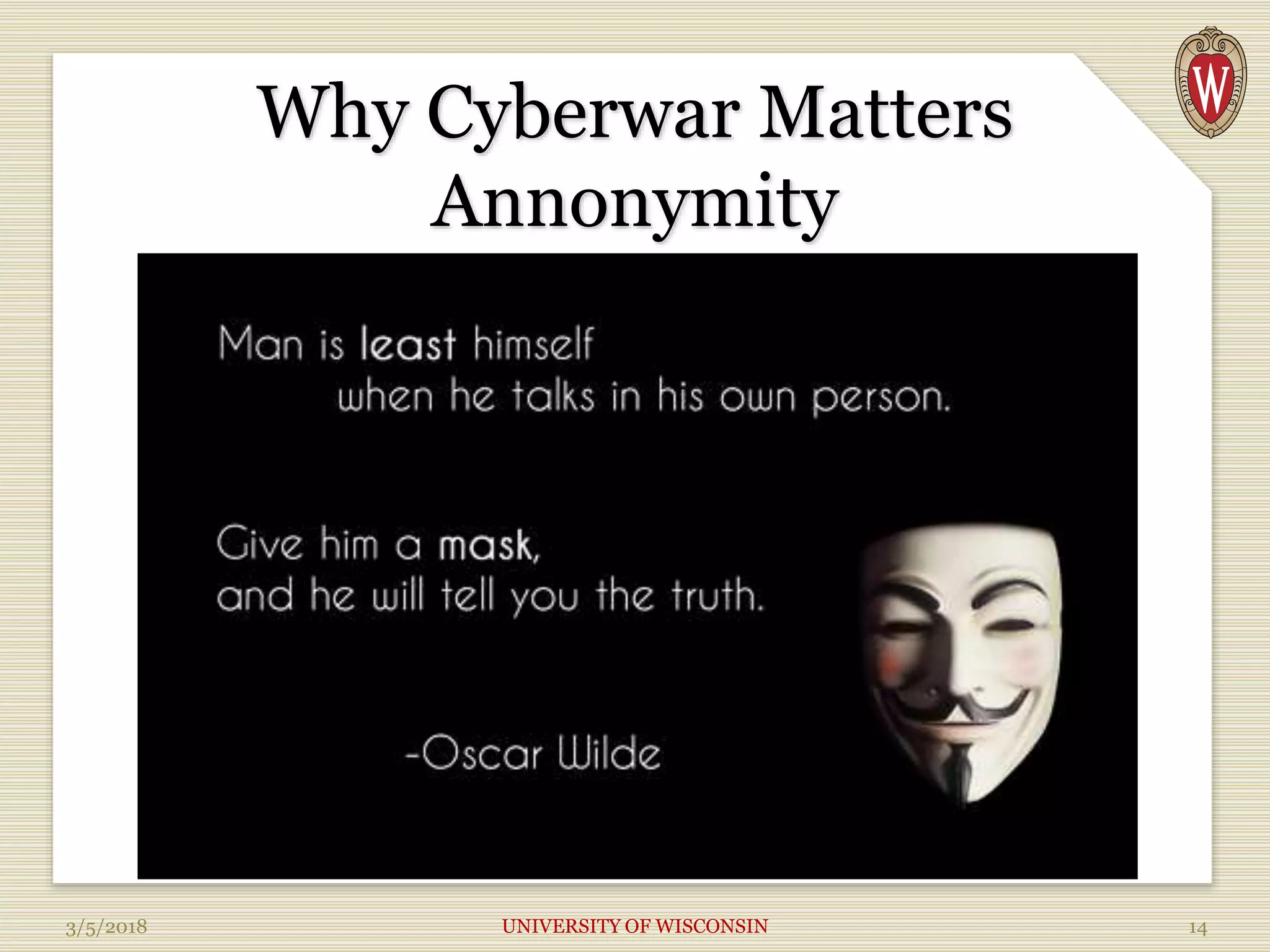
Annonymity
3/5/2018 UNIVERSITY OF WISCONSIN 14
Why Cyberwar Matters
Information is the most valuable asset to an
organization
3/5/2018 UNIVERSITY OF WISCONSIN 15
Why Cyberwar Matters
Authentication
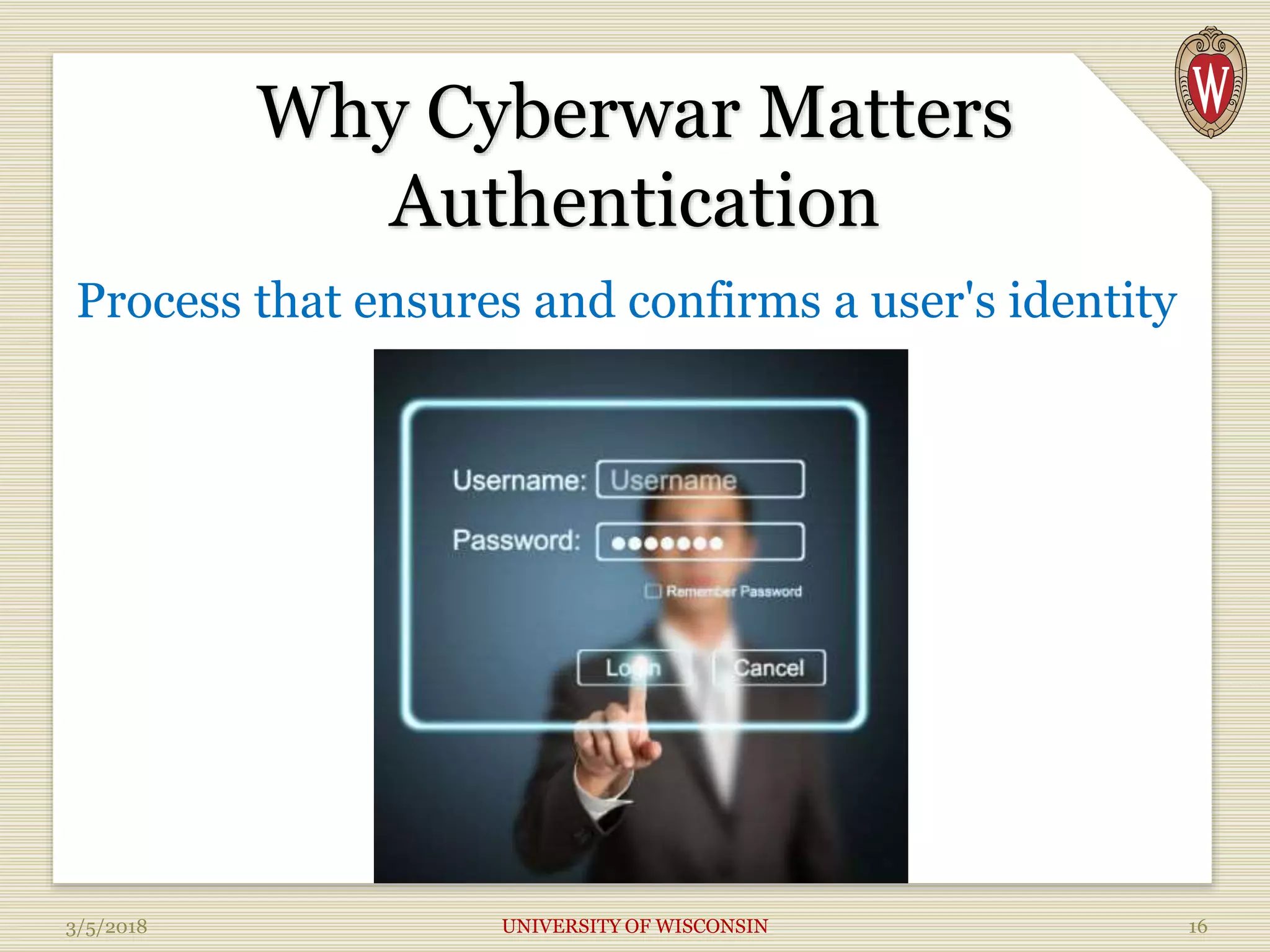
Process that ensures and confirms a user's identity
3/5/2018 UNIVERSITY OF WISCONSIN 16
Cyberwar Offense
Who is the Bad Guy?
National intelligence of foreign adversaries – it’s
their job.
3/5/2018 UNIVERSITY OF WISCONSIN 17
Cyber Offense
Who is the Bad Guy
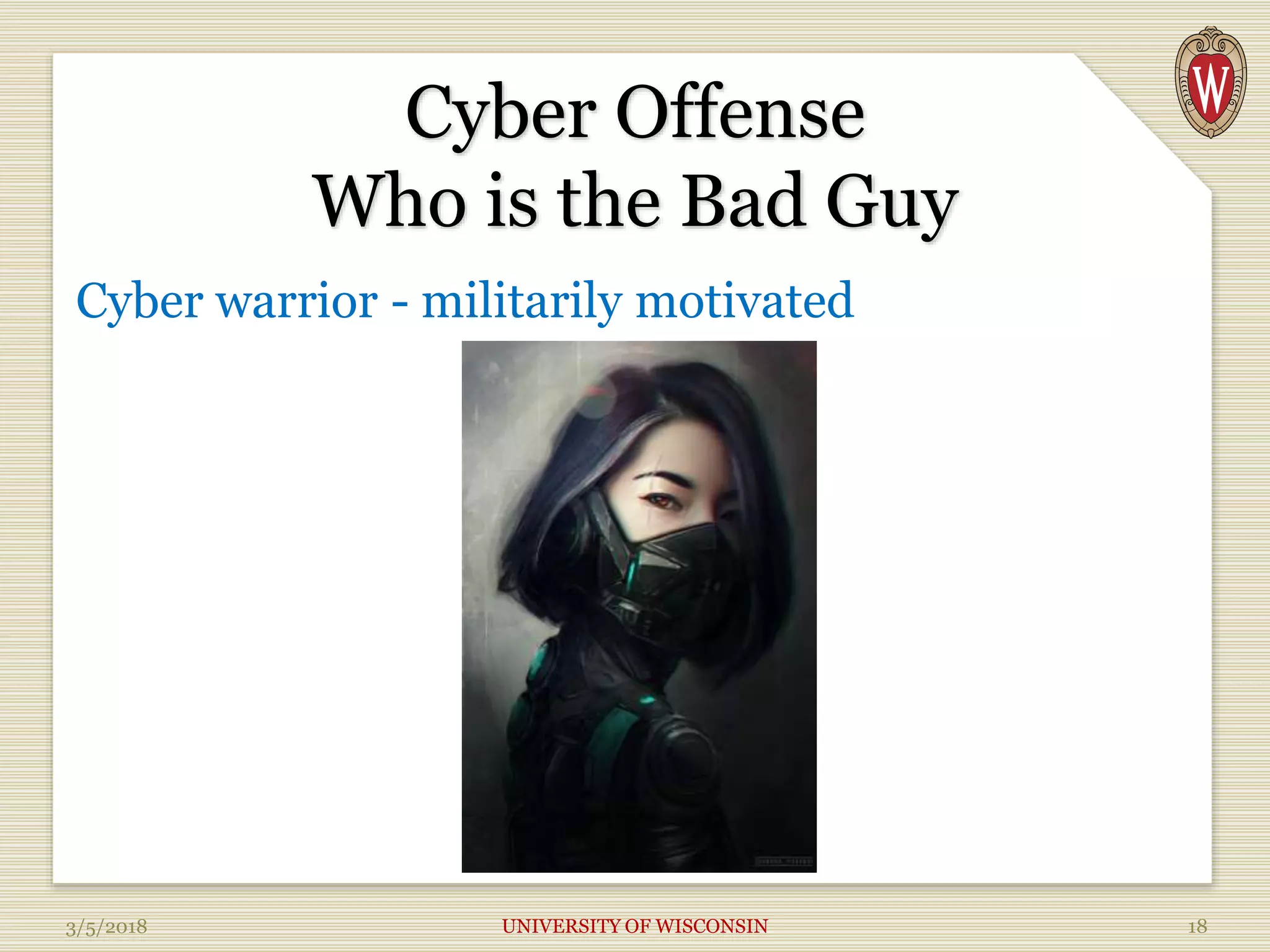
Cyber warrior - militarily motivated
3/5/2018 UNIVERSITY OF WISCONSIN 18
Cyber Offense
Who is the Bad Guy
Cyber Terrorist - politically and often religiously
motivated
3/5/2018 UNIVERSITY OF WISCONSIN 19
Cyber Offense
Who is the Bad Guy
Corporate competitors/Industrial espionage -
seeking competitive information; theft of
intellectual property
3/5/2018 UNIVERSITY OF WISCONSIN 20
Cyber Offense
Who is the Bad Guy
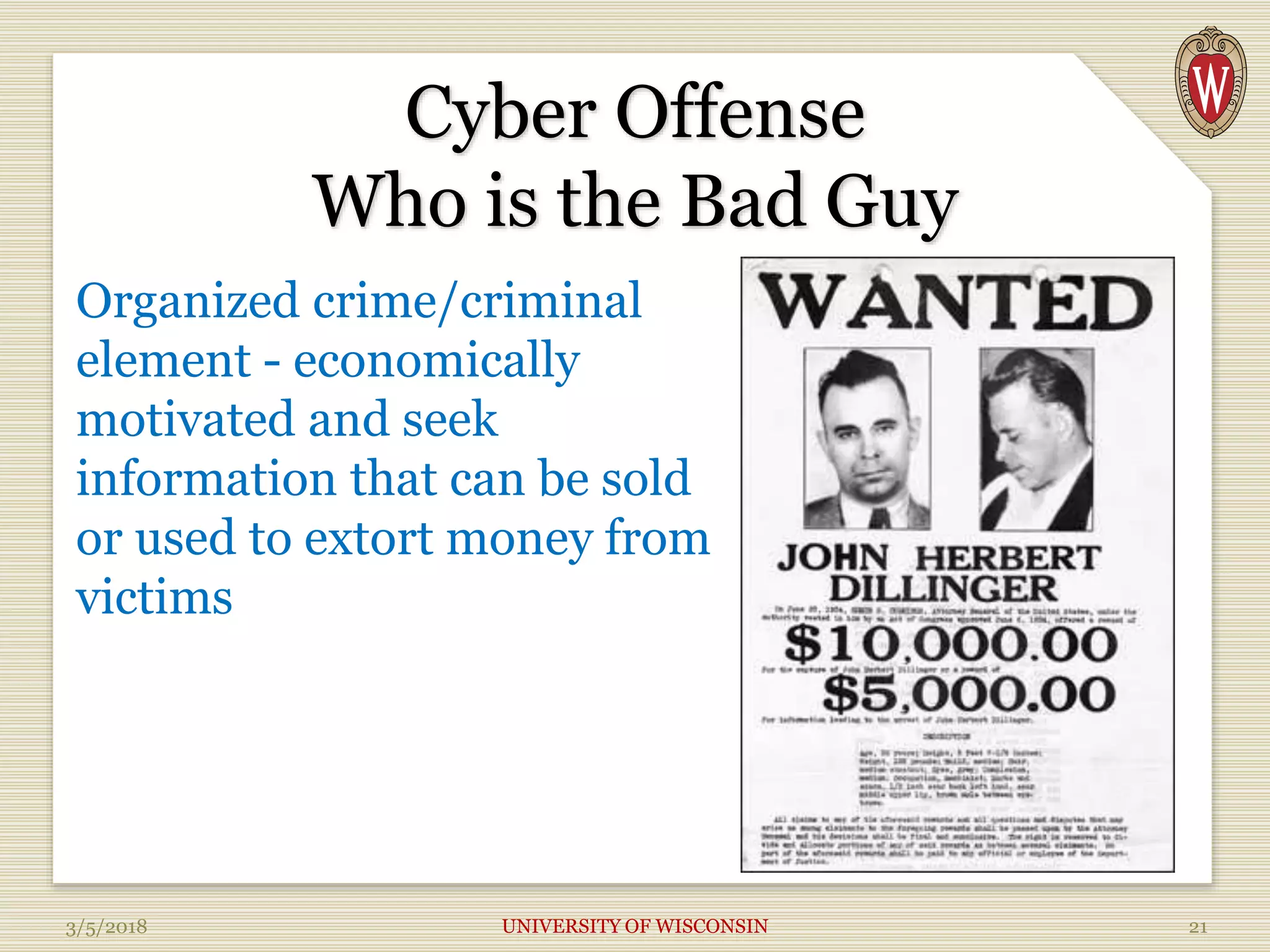
Organized crime/criminal
element - economically
motivated and seek
information that can be sold
or used to extort money from
victims
3/5/2018 UNIVERSITY OF WISCONSIN 21
Cyber Offense
Who is the Bad Guy
Insider/employees –Embarrassment, cash
3/5/2018 UNIVERSITY OF WISCONSIN 22
Cyber Offense
Who is the Bad Guy
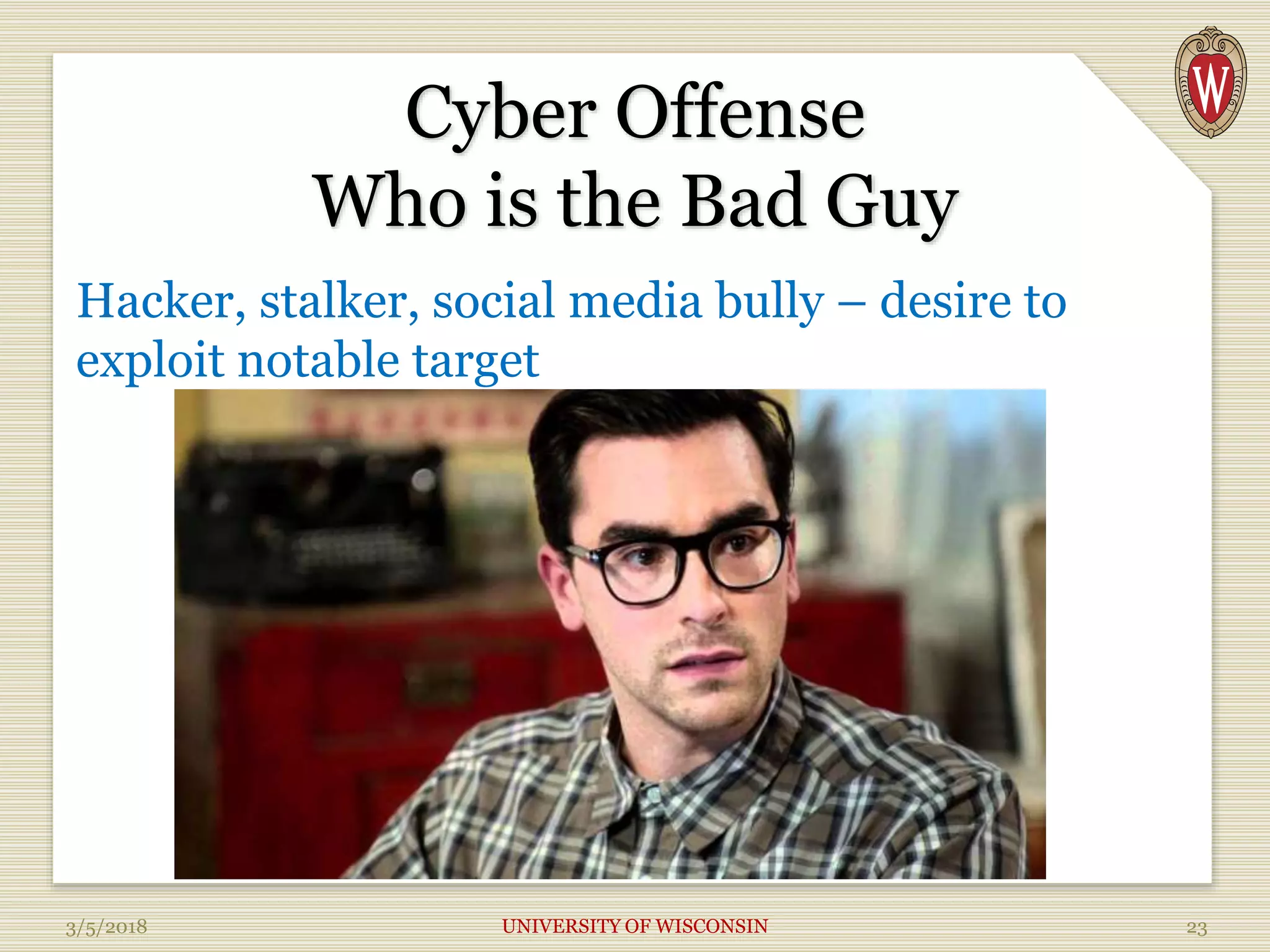
Hacker, stalker, social media bully – desire to
exploit notable target
3/5/2018 UNIVERSITY OF WISCONSIN 23
Cyber Offense
Attack Classes
Passive attack: A passive attack is a type of attack
where the attacker simply monitor the network activity
as a part of reconnaissance. A passive attack is difficult
to detect, because the attacker is not actively attacking
any target machine or participating in network traffic.
An example of a passive attack is an attacker capturing
packets from the network.
Prevention: Potential threats from Passive attacks can
be eliminated by implementing good network
encryption.
3/5/2018 UNIVERSITY OF WISCONSIN 24
Cyber Offense
Attack Classes
Active attack: Active attack is a type of attack where
the attacker actively launching attack against the
target servers. In active attack the attacker is
actively sending traffic that can be detected.
Prevention: Active attacks can be prevented by
using Firewalls and IPS (Intrusion Prevention
Systems).
3/5/2018 UNIVERSITY OF WISCONSIN 25
Cyber Offense
Attack Classes
Close-in attack: A Close-in attack is a type of attack
where the attacker is physically close to the target
system. Attacker can the the advantages of being
physically close to the target devices.
Prevention: Good physical security can prevent
Close-in attacks
3/5/2018 UNIVERSITY OF WISCONSIN 26
Cyber Offense
Attack Classes
Insider attack: An insider attack is an attack from
inside users, who use their access credentials and
knowledge of the network to attack the target
machines.
Prevention: Good layer 2 security, authentication
and physical security can prevent Insider attacks.
3/5/2018 UNIVERSITY OF WISCONSIN 27
Cyber Offense
Attack Classes
Distribution attack: Distribution attacks are the
attacks using backdoors introduced to hardware or
software systems at the time of manufacture. Once
the hardware or software became functional,
attackers can leverage the backdoor to attack the
target devices.
Prevention: Trusted hardware/software vendors
and integrity checks can prevent Distribution
attacks.
3/5/2018 UNIVERSITY OF WISCONSIN 28
Cyber Offense
Types of Attacks
Application-layer attacks are
implemented using
several different methods. One of
the most common methods is
exploiting well known
weaknesses in software that are
commonly found on servers, such
as send mail, HTTP, and FTP.
3/5/2018 UNIVERSITY OF WISCONSIN 29
Cyber Offense
Types of Attacks
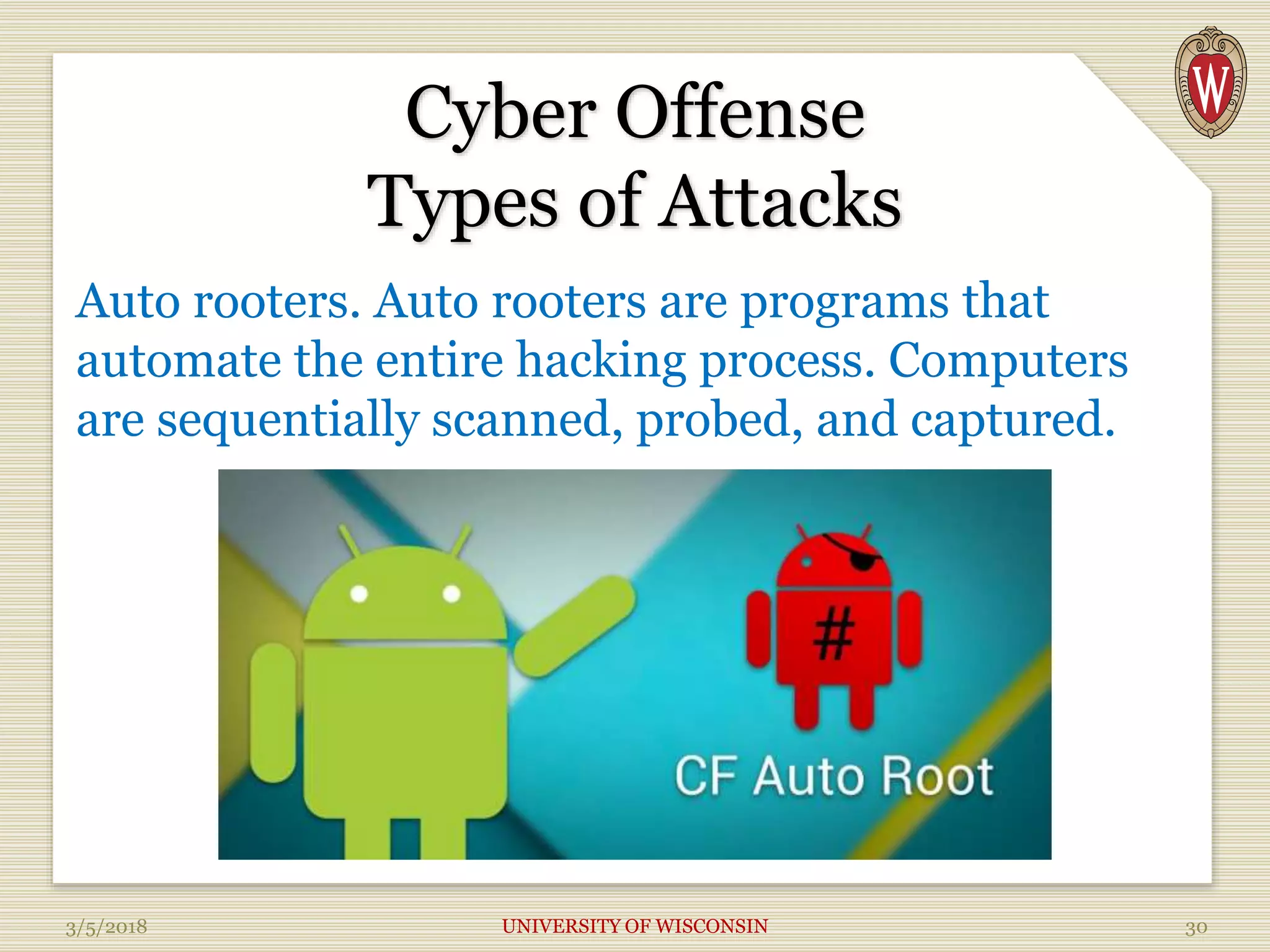
Auto rooters. Auto rooters are programs that
automate the entire hacking process. Computers
are sequentially scanned, probed, and captured.
3/5/2018 UNIVERSITY OF WISCONSIN 30
Cyber Offense
Types of Attacks
Backdoors are paths into
systems that can be created
during an intrusion or with
specifically designed Trojan
horse code.
The backdoor, unless
detected and removed, can
be used again
3/5/2018 UNIVERSITY OF WISCONSIN 31
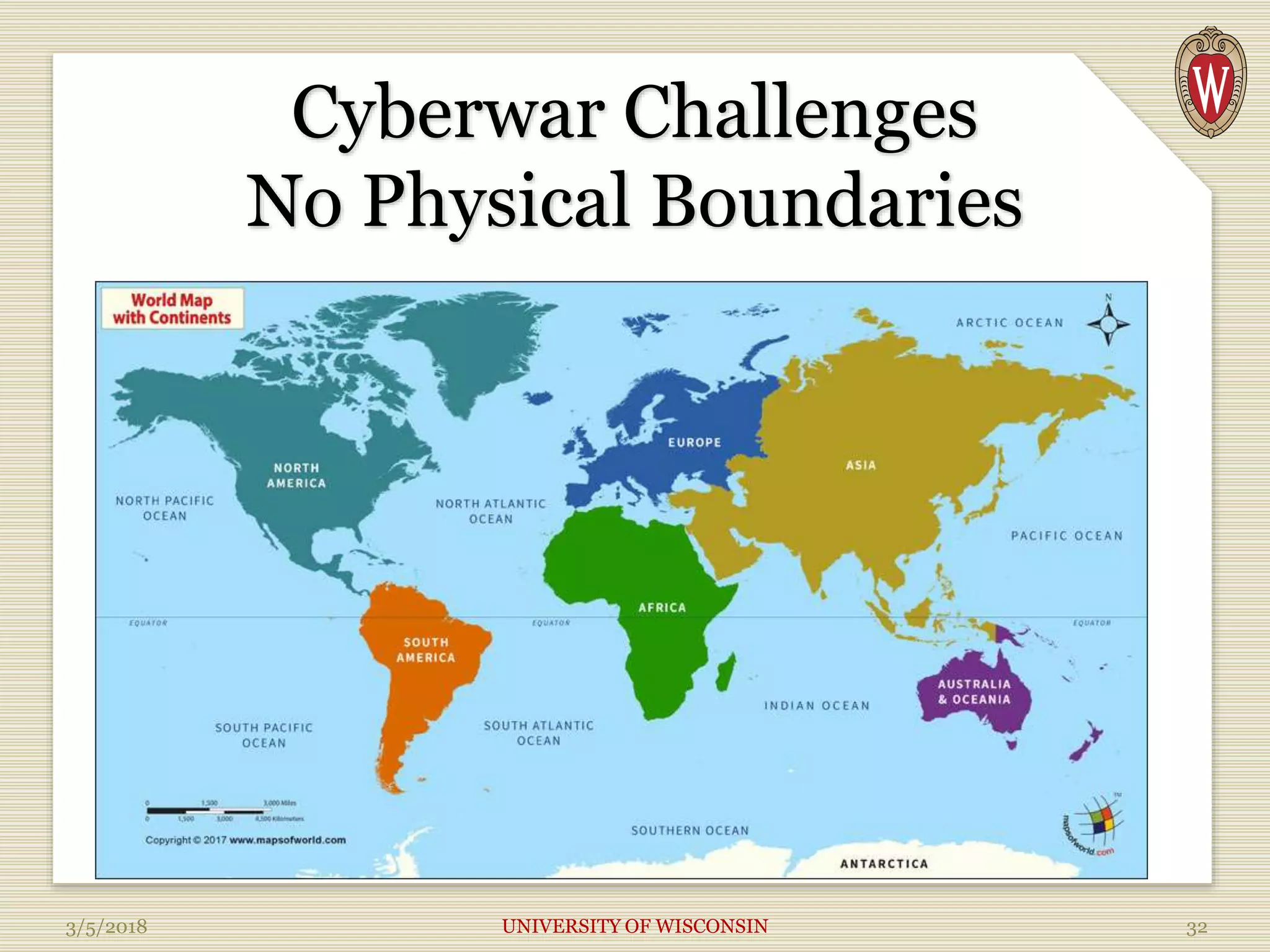
Cyberwar Challenges
No Physical Boundaries
3/5/2018 UNIVERSITY OF WISCONSIN 32
Cyberwar Challenges
Difficult to Detect and Track.
3/5/2018 UNIVERSITY OF WISCONSIN 33
Cyberwar Challenges
Cheap and Easy
3/5/2018 UNIVERSITY OF WISCONSIN 34
Cyberwar Challenges
Always On
3/5/2018 UNIVERSITY OF WISCONSIN 35
Cyberwar Challenges
Economic Impact
3/5/2018 UNIVERSITY OF WISCONSIN 36
Cyber Defense
Always vs Once
3/5/2018 UNIVERSITY OF WISCONSIN 37
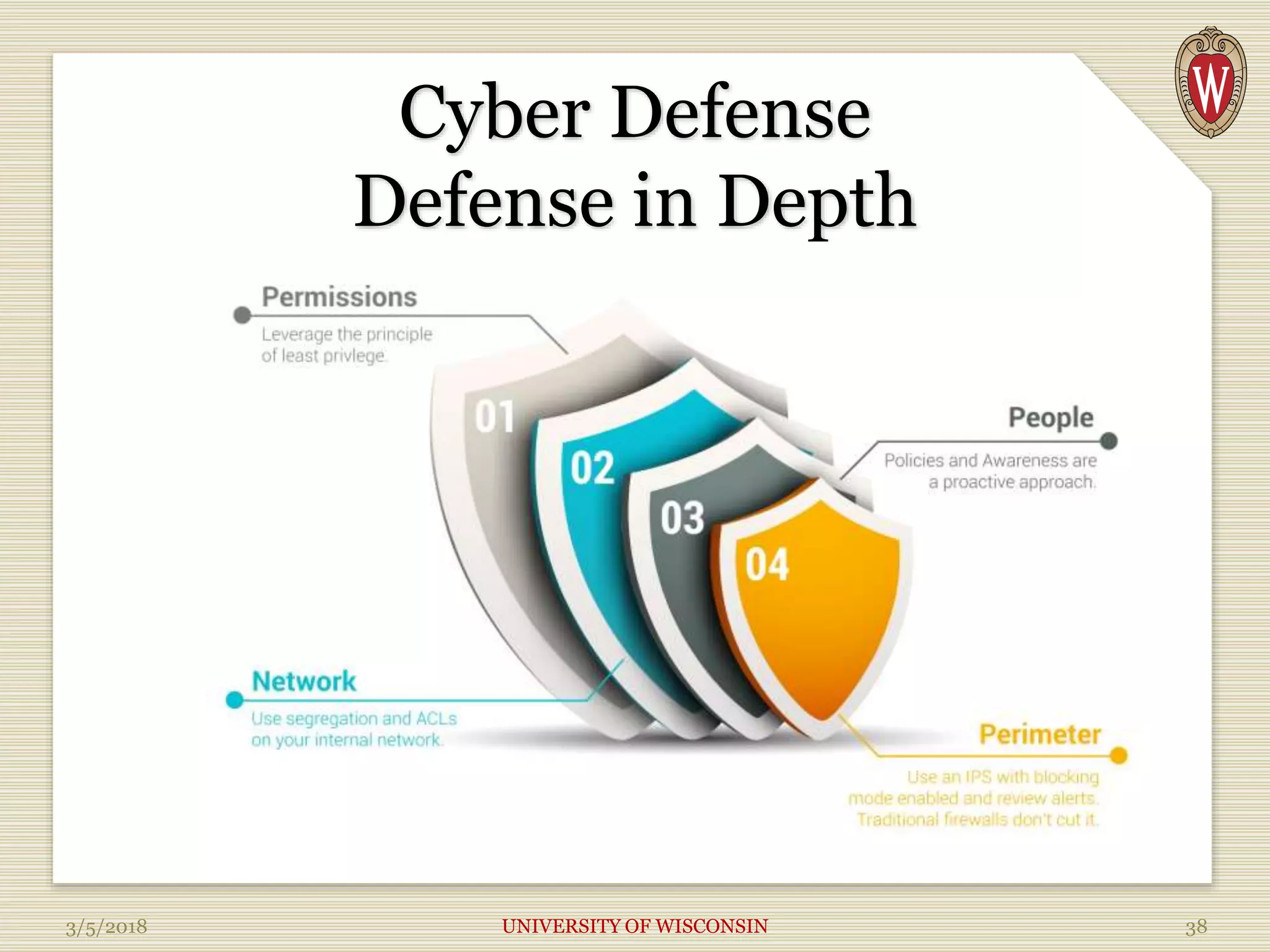
Cyber Defense
Defense in Depth
3/5/2018 UNIVERSITY OF WISCONSIN 38
Cyber Defense
Basic Methodology
3/5/2018 UNIVERSITY OF WISCONSIN 39
Cyber Defense
Digital Signature
3/5/2018 UNIVERSITY OF WISCONSIN 40
Cyber Defense
Encryption
3/5/2018 UNIVERSITY OF WISCONSIN 41
Cyberwar
Past – SCADA - Availability
3/5/2018 UNIVERSITY OF WISCONSIN 42
Cyberwar
Present – “Fake News” - Integrity
3/5/2018 UNIVERSITY OF WISCONSIN 43
Future of Cyberwar
As We Have Talked About
• Availability continues to be a concern
• Integrity of data and information is now
being questioned
• Any idea of what comes next?
3/5/2018 UNIVERSITY OF WISCONSIN 44
Cyberwar Future
Next Up - Confidentiality
3/5/2018 UNIVERSITY OF WISCONSIN 45
Cyberwar Future Personal Leverage
Complex Scenarios
• Your ISP is broken into and your web browsing records are stolen by
a foreign adversary
• Your church’s membership database is compromised by same
adversary
• You receive an email that demands you vote for a specific candidate,
or else the web surfing records get sent to your church pastor
3/5/2018 UNIVERSITY OF WISCONSIN 46
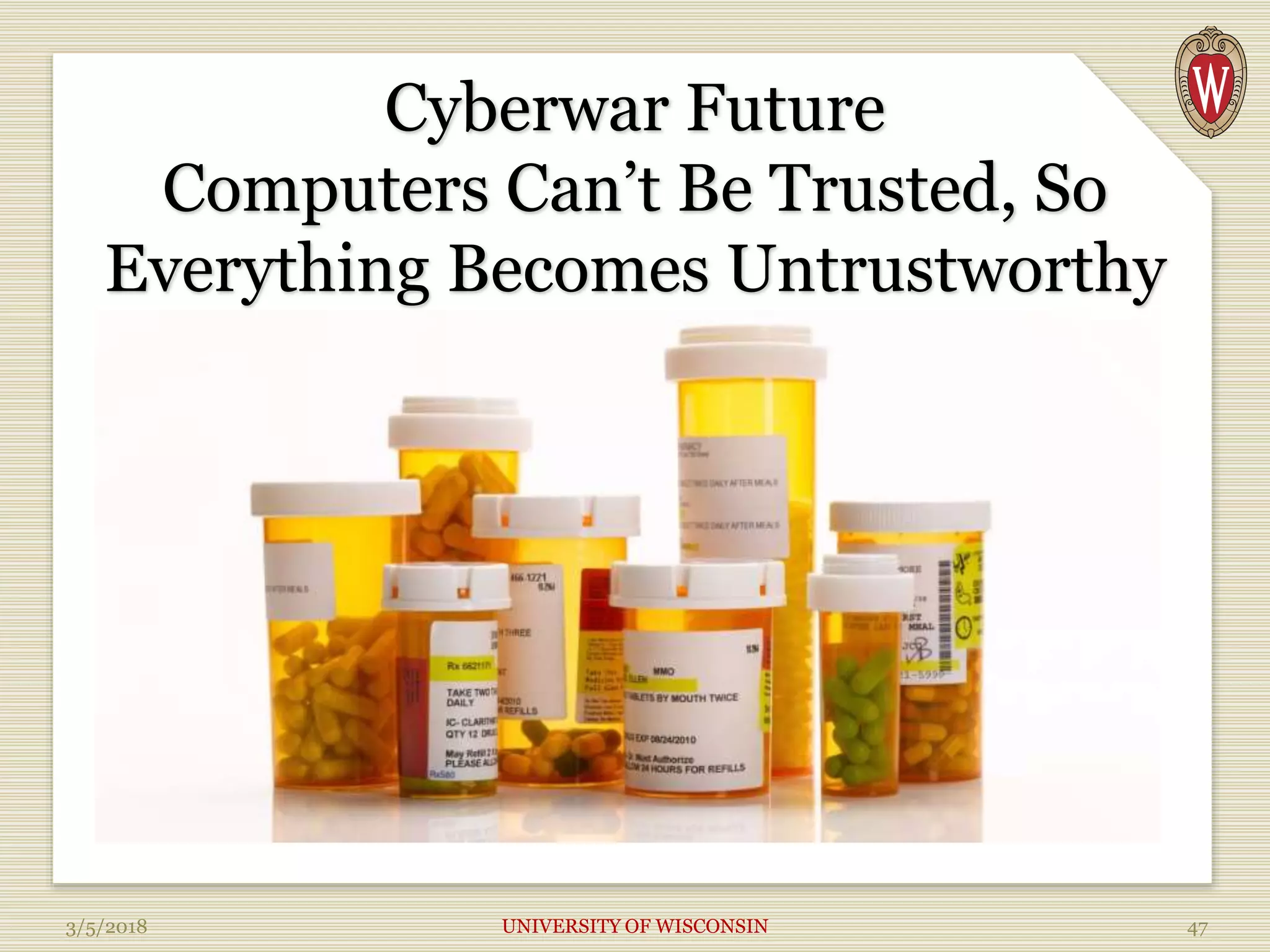
Cyberwar Future
Computers Can’t Be Trusted, So
Everything Becomes Untrustworthy
3/5/2018 UNIVERSITY OF WISCONSIN 47
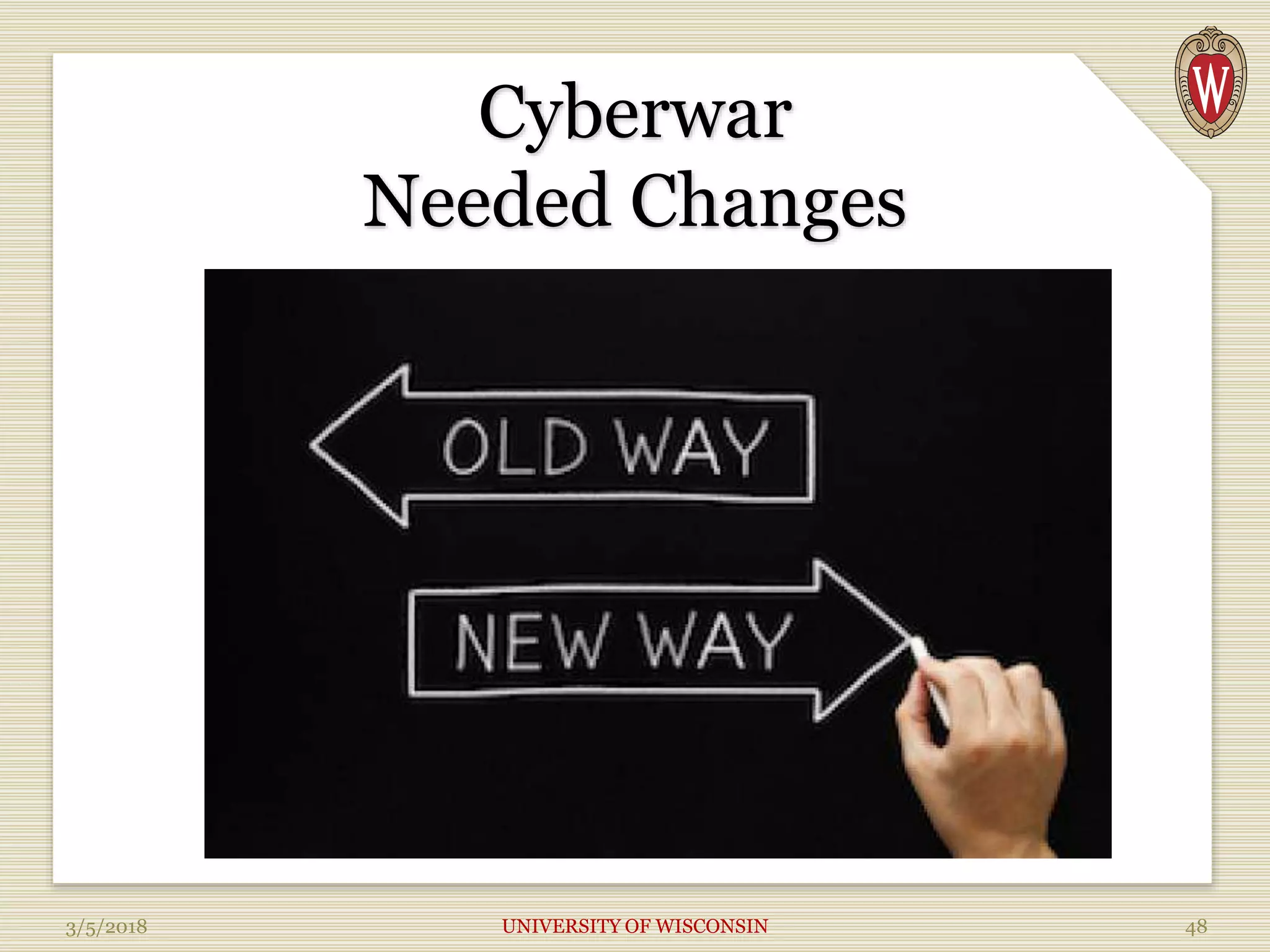
Cyberwar
Needed Changes
3/5/2018 UNIVERSITY OF WISCONSIN 48
Needed Defensive
Cyberwar Tools
• Personal Digital Identity
• Information Technology
Deployment Model Change
• Digital Reliance on Chain of
Logical and Physical Custody
3/5/2018 UNIVERSITY OF WISCONSIN 49
Currently, This is My
Weak Digital Identity
3/5/2018 UNIVERSITY OF WISCONSIN 50
Stronger Digital Identity Trust
Is On the Horizon
3/5/2018 UNIVERSITY OF WISCONSIN 51
You Can’t Defend
A Dispersed Castle
3/5/2018 UNIVERSITY OF WISCONSIN 52
Cyber Defense
Cloud (Herd = Strength)
3/5/2018 UNIVERSITY OF WISCONSIN 53
You Don’t Use a Toothbrush
If You Don’t Know Its History
3/5/2018 UNIVERSITY OF WISCONSIN 54
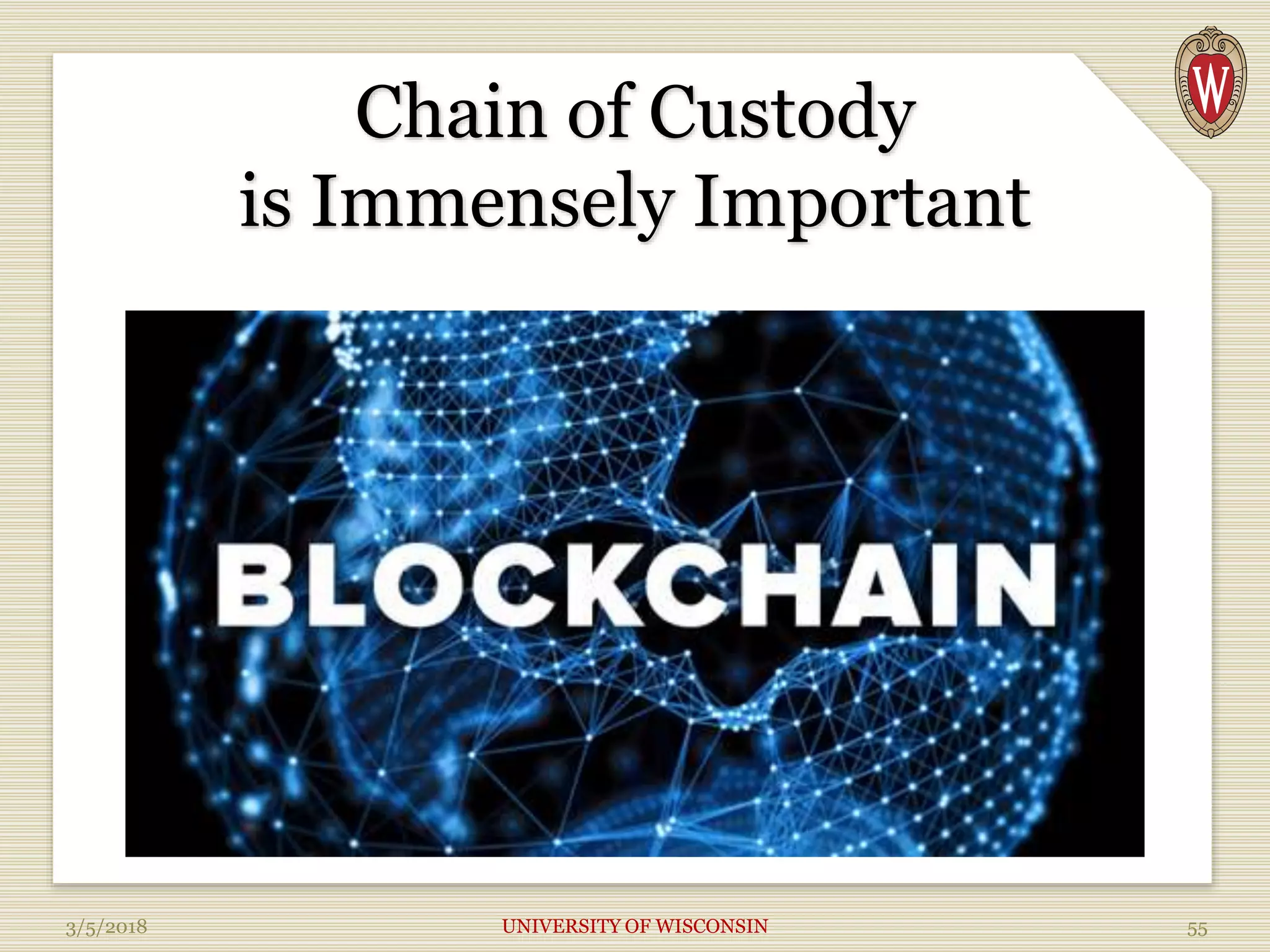
Chain of Custody
is Immensely Important
3/5/2018 UNIVERSITY OF WISCONSIN 55
Challenges to
Implementation
• Cost
• Talent
• Societal and
Government
Trust
3/5/2018 UNIVERSITY OF WISCONSIN 56
Question and Comments
Session
Nicholas Davis
ndavis@uwsa.edu
3/5/2018 UNIVERSITY OF WISCONSIN 57

Cyberwar Gets Personal

  • 1.
    Cyberwar Gets Personal Associationof Information Systems Professionals Nicholas Davis, CISA, CISSP Chief Information Security Officer University of Wisconsin System Monday, March 5, 2018
  • 2.
    Keep In Mind "Cyberattacks offer terrorists the possibility of greater security and operational flexibility. Theoretically they can launch a computer assault from almost anywhere in the world, without directly exposing the attacker to physical harm” George Tenet, the Director of Central Intelligence of the United States 3/5/2018 UNIVERSITY OF WISCONSIN 2
  • 3.
    Overview Why Cyberwar Matters WhatCyberwar Means Offensive Cyberwar Defensive Cyberwar Personal Cyberwar Needed Changes to Win At Cyberwar 3/5/2018 UNIVERSITY OF WISCONSIN 3
  • 4.
    Why Cyberwar Matters Everythingwe do relies upon information technology, as individuals, groups, and as a society We don’t think about it, but: • Water supply • Air traffic control • Power All depend upon and can be manipulated and damaged through cyberattack 3/5/2018 UNIVERSITY OF WISCONSIN 4
  • 5.
    Why Cyberwar Matters 3/5/2018UNIVERSITY OF WISCONSIN 5
  • 6.
    Why Cyberwar Matters Imaginea Day Like This 9:00 AM, Stock market taken down by DOS attack 3/5/2018 UNIVERSITY OF WISCONSIN 6
  • 7.
    Why Cyberwar Matters Imaginea Day Like This 11:42 AM, Power to 23% of the country goes out 3/5/2018 UNIVERSITY OF WISCONSIN 7
  • 8.
    Why Cyberwar Matters Imaginea Day Like This 1:17 PM, mobile networks across 70% of the country are dead 3/5/2018 UNIVERSITY OF WISCONSIN 8
  • 9.
    Why Cyberwar Matters Imaginea Day Like This 3:37 PM, All air traffic around the country is grounded as radar goes down 3/5/2018 UNIVERSITY OF WISCONSIN 9
  • 10.
    Why Cyberwar Matters Imaginea Day Like This 6:46 PM, while visiting your heart attack stricken family member in the hospital, the life support machine shuts off 3/5/2018 UNIVERSITY OF WISCONSIN 10
  • 11.
    Why Cyberwar Matters Informationtechnology makes our lives more enjoyable, and safe Reliance on information technology has made us all vulnerable, both directly or indirectly 3/5/2018 UNIVERSITY OF WISCONSIN 11
  • 12.
    Why Cyberwar Matters CyberattacksAre Inexpensive 3/5/2018 UNIVERSITY OF WISCONSIN 12
  • 13.
    Why Cyberwar Matters RemotelyExecuted 3/5/2018 UNIVERSITY OF WISCONSIN 13
  • 14.
    Why Cyberwar Matters Annonymity 3/5/2018UNIVERSITY OF WISCONSIN 14
  • 15.
    Why Cyberwar Matters Informationis the most valuable asset to an organization 3/5/2018 UNIVERSITY OF WISCONSIN 15
  • 16.
    Why Cyberwar Matters Authentication Processthat ensures and confirms a user's identity 3/5/2018 UNIVERSITY OF WISCONSIN 16
  • 17.
    Cyberwar Offense Who isthe Bad Guy? National intelligence of foreign adversaries – it’s their job. 3/5/2018 UNIVERSITY OF WISCONSIN 17
  • 18.
    Cyber Offense Who isthe Bad Guy Cyber warrior - militarily motivated 3/5/2018 UNIVERSITY OF WISCONSIN 18
  • 19.
    Cyber Offense Who isthe Bad Guy Cyber Terrorist - politically and often religiously motivated 3/5/2018 UNIVERSITY OF WISCONSIN 19
  • 20.
    Cyber Offense Who isthe Bad Guy Corporate competitors/Industrial espionage - seeking competitive information; theft of intellectual property 3/5/2018 UNIVERSITY OF WISCONSIN 20
  • 21.
    Cyber Offense Who isthe Bad Guy Organized crime/criminal element - economically motivated and seek information that can be sold or used to extort money from victims 3/5/2018 UNIVERSITY OF WISCONSIN 21
  • 22.
    Cyber Offense Who isthe Bad Guy Insider/employees –Embarrassment, cash 3/5/2018 UNIVERSITY OF WISCONSIN 22
  • 23.
    Cyber Offense Who isthe Bad Guy Hacker, stalker, social media bully – desire to exploit notable target 3/5/2018 UNIVERSITY OF WISCONSIN 23
  • 24.
    Cyber Offense Attack Classes Passiveattack: A passive attack is a type of attack where the attacker simply monitor the network activity as a part of reconnaissance. A passive attack is difficult to detect, because the attacker is not actively attacking any target machine or participating in network traffic. An example of a passive attack is an attacker capturing packets from the network. Prevention: Potential threats from Passive attacks can be eliminated by implementing good network encryption. 3/5/2018 UNIVERSITY OF WISCONSIN 24
  • 25.
    Cyber Offense Attack Classes Activeattack: Active attack is a type of attack where the attacker actively launching attack against the target servers. In active attack the attacker is actively sending traffic that can be detected. Prevention: Active attacks can be prevented by using Firewalls and IPS (Intrusion Prevention Systems). 3/5/2018 UNIVERSITY OF WISCONSIN 25
  • 26.
    Cyber Offense Attack Classes Close-inattack: A Close-in attack is a type of attack where the attacker is physically close to the target system. Attacker can the the advantages of being physically close to the target devices. Prevention: Good physical security can prevent Close-in attacks 3/5/2018 UNIVERSITY OF WISCONSIN 26
  • 27.
    Cyber Offense Attack Classes Insiderattack: An insider attack is an attack from inside users, who use their access credentials and knowledge of the network to attack the target machines. Prevention: Good layer 2 security, authentication and physical security can prevent Insider attacks. 3/5/2018 UNIVERSITY OF WISCONSIN 27
  • 28.
    Cyber Offense Attack Classes Distributionattack: Distribution attacks are the attacks using backdoors introduced to hardware or software systems at the time of manufacture. Once the hardware or software became functional, attackers can leverage the backdoor to attack the target devices. Prevention: Trusted hardware/software vendors and integrity checks can prevent Distribution attacks. 3/5/2018 UNIVERSITY OF WISCONSIN 28
  • 29.
    Cyber Offense Types ofAttacks Application-layer attacks are implemented using several different methods. One of the most common methods is exploiting well known weaknesses in software that are commonly found on servers, such as send mail, HTTP, and FTP. 3/5/2018 UNIVERSITY OF WISCONSIN 29
  • 30.
    Cyber Offense Types ofAttacks Auto rooters. Auto rooters are programs that automate the entire hacking process. Computers are sequentially scanned, probed, and captured. 3/5/2018 UNIVERSITY OF WISCONSIN 30
  • 31.
    Cyber Offense Types ofAttacks Backdoors are paths into systems that can be created during an intrusion or with specifically designed Trojan horse code. The backdoor, unless detected and removed, can be used again 3/5/2018 UNIVERSITY OF WISCONSIN 31
  • 32.
    Cyberwar Challenges No PhysicalBoundaries 3/5/2018 UNIVERSITY OF WISCONSIN 32
  • 33.
    Cyberwar Challenges Difficult toDetect and Track. 3/5/2018 UNIVERSITY OF WISCONSIN 33
  • 34.
    Cyberwar Challenges Cheap andEasy 3/5/2018 UNIVERSITY OF WISCONSIN 34
  • 35.
    Cyberwar Challenges Always On 3/5/2018UNIVERSITY OF WISCONSIN 35
  • 36.
  • 37.
    Cyber Defense Always vsOnce 3/5/2018 UNIVERSITY OF WISCONSIN 37
  • 38.
    Cyber Defense Defense inDepth 3/5/2018 UNIVERSITY OF WISCONSIN 38
  • 39.
    Cyber Defense Basic Methodology 3/5/2018UNIVERSITY OF WISCONSIN 39
  • 40.
    Cyber Defense Digital Signature 3/5/2018UNIVERSITY OF WISCONSIN 40
  • 41.
  • 42.
    Cyberwar Past – SCADA- Availability 3/5/2018 UNIVERSITY OF WISCONSIN 42
  • 43.
    Cyberwar Present – “FakeNews” - Integrity 3/5/2018 UNIVERSITY OF WISCONSIN 43
  • 44.
    Future of Cyberwar AsWe Have Talked About • Availability continues to be a concern • Integrity of data and information is now being questioned • Any idea of what comes next? 3/5/2018 UNIVERSITY OF WISCONSIN 44
  • 45.
    Cyberwar Future Next Up- Confidentiality 3/5/2018 UNIVERSITY OF WISCONSIN 45
  • 46.
    Cyberwar Future PersonalLeverage Complex Scenarios • Your ISP is broken into and your web browsing records are stolen by a foreign adversary • Your church’s membership database is compromised by same adversary • You receive an email that demands you vote for a specific candidate, or else the web surfing records get sent to your church pastor 3/5/2018 UNIVERSITY OF WISCONSIN 46
  • 47.
    Cyberwar Future Computers Can’tBe Trusted, So Everything Becomes Untrustworthy 3/5/2018 UNIVERSITY OF WISCONSIN 47
  • 48.
  • 49.
    Needed Defensive Cyberwar Tools •Personal Digital Identity • Information Technology Deployment Model Change • Digital Reliance on Chain of Logical and Physical Custody 3/5/2018 UNIVERSITY OF WISCONSIN 49
  • 50.
    Currently, This isMy Weak Digital Identity 3/5/2018 UNIVERSITY OF WISCONSIN 50
  • 51.
    Stronger Digital IdentityTrust Is On the Horizon 3/5/2018 UNIVERSITY OF WISCONSIN 51
  • 52.
    You Can’t Defend ADispersed Castle 3/5/2018 UNIVERSITY OF WISCONSIN 52
  • 53.
    Cyber Defense Cloud (Herd= Strength) 3/5/2018 UNIVERSITY OF WISCONSIN 53
  • 54.
    You Don’t Usea Toothbrush If You Don’t Know Its History 3/5/2018 UNIVERSITY OF WISCONSIN 54
  • 55.
    Chain of Custody isImmensely Important 3/5/2018 UNIVERSITY OF WISCONSIN 55
  • 56.
    Challenges to Implementation • Cost •Talent • Societal and Government Trust 3/5/2018 UNIVERSITY OF WISCONSIN 56
  • 57.
    Question and Comments Session NicholasDavis ndavis@uwsa.edu 3/5/2018 UNIVERSITY OF WISCONSIN 57