Information Systems 371
March 14, 2019
Topic: Decision Support Systems
Lecturer: Nicholas Davis
Decision Support Systems
Overview
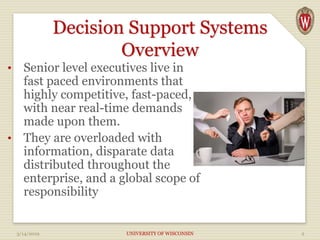
• Senior level executives live in
fast paced environments that
highly competitive, fast-paced,
with near real-time demands
made upon them.
• They are overloaded with
information, disparate data
distributed throughout the
enterprise, and a global scope of
responsibility
3/14/2019 UNIVERSITY OF WISCONSIN 2
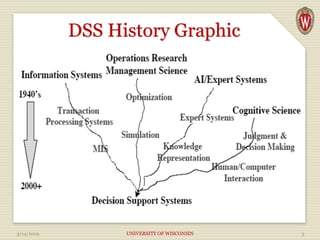
DSS History Graphic
3/14/2019 UNIVERSITY OF WISCONSIN 3
Decision Support Systems
Overview
The combination of high speed networks, in
combination with “Big Data” and the imminent rise
of Artificial Intelligence, has led to the creation of
information systems which can assist with the
assembling, evaluation and presentation of this
wealth of information
3/14/2019 UNIVERSITY OF WISCONSIN 4
Decision Support Systems
Overview
• These systems have the potential to improve
decision making by suggesting solutions that are
better than those made by humans alone.
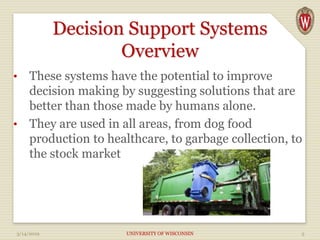
• They are used in all areas, from dog food
production to healthcare, to garbage collection, to
the stock market
3/14/2019 UNIVERSITY OF WISCONSIN 5
Decision Support Systems
Overview
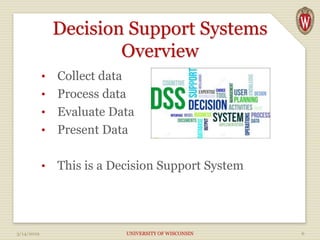
• Collect data
• Process data
• Evaluate Data
• Present Data
• This is a Decision Support System
3/14/2019 UNIVERSITY OF WISCONSIN 6
Components of a Decision
Support System
A DSS is made up of:
1. A source of data
2. A method or model to analyze the data
3. A user interface
3/14/2019 UNIVERSITY OF WISCONSIN 7
3 Steps in the DSS Process
3/14/2019 UNIVERSITY OF WISCONSIN 8
Let’s Look at an Example
Step 1 – Describe the Big Picture
A developing country is going to build a railway system to
connect a potential inland industrial area and a good
agricultural area with a port. An international development
agency recommended that iron already present in the area,
should be mined and refined locally, using an infrastructure
that still needs to be established The refined iron could
possibly be exported to Germany and Japan for use in the
automobile industry. A core component of success of the
project depends upon the supply of skilled labor. To
overcome this problem an education and training center has
to be established to get worker prepared by the time the
iron processing plant is ready to open The development
agency also recommends the fertile farm land in the area
should be prepared for intensive farming to provide food for
consumption by the people working at the iron processing
plant The railway should link the industrial area to local
farms and the sea port.
3/14/2019 UNIVERSITY OF WISCONSIN 9
Proceed?
Yes or No
• Does the high level plan seem
plausible and reasonable?
3/14/2019 UNIVERSITY OF WISCONSIN 10
Step 2 - List All Questions
That Must be Answered
3/14/2019 UNIVERSITY OF WISCONSIN 11
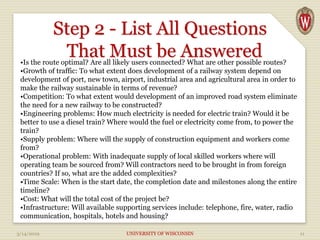
•Is the route optimal? Are all likely users connected? What are other possible routes?
•Growth of traffic: To what extent does development of a railway system depend on
development of port, new town, airport, industrial area and agricultural area in order to
make the railway sustainable in terms of revenue?
•Competition: To what extent would development of an improved road system eliminate
the need for a new railway to be constructed?
•Engineering problems: How much electricity is needed for electric train? Would it be
better to use a diesel train? Where would the fuel or electricity come from, to power the
train?
•Supply problem: Where will the supply of construction equipment and workers come
from?
•Operational problem: With inadequate supply of local skilled workers where will
operating team be sourced from? Will contractors need to be brought in from foreign
countries? If so, what are the added complexities?
•Time Scale: When is the start date, the completion date and milestones along the entire
timeline?
•Cost: What will the total cost of the project be?
•Infrastructure: Will available supporting services include: telephone, fire, water, radio
communication, hospitals, hotels and housing?
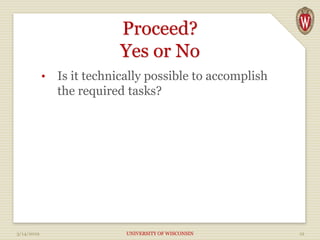
Proceed?
Yes or No
• Is it technically possible to accomplish
the required tasks?
3/14/2019 UNIVERSITY OF WISCONSIN 12
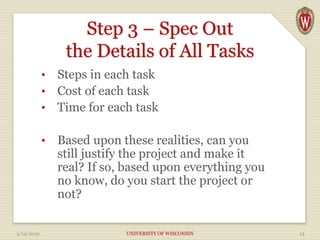
Step 3 – Spec Out
the Details of All Tasks
• Steps in each task
• Cost of each task
• Time for each task
• Based upon these realities, can you
still justify the project and make it
real? If so, based upon everything you
no know, do you start the project or
not?
3/14/2019 UNIVERSITY OF WISCONSIN 13
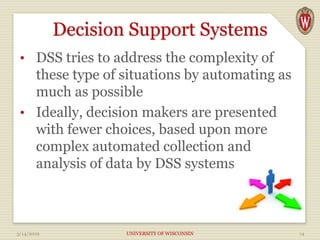
Decision Support Systems
• DSS tries to address the complexity of
these type of situations by automating as
much as possible
• Ideally, decision makers are presented
with fewer choices, based upon more
complex automated collection and
analysis of data by DSS systems
3/14/2019 UNIVERSITY OF WISCONSIN 14
DSS
Decision Making Characteristics
• Decision is made based only on the
information available, no
speculation
• The process is iterative, data and
decisions based upon that data may
change over time
• All decisions must be pragmatic:
For example, if there is not funding,
the project won’t move forward, no
matter how practical the path for the
project is.
3/14/2019 UNIVERSITY OF WISCONSIN 15
Everyone Who is Responsible
For Making Decisions is in Effect a
Manager
• Organizations are filled with decision
makers at all levels.
• Managing these decisions is an art, but
one which involves more and more
quantitative science, every day
• Technology permits new types of
evaluation
• Organizations are becoming more
complex
• The marketplace is changing more
rapidly
3/14/2019 UNIVERSITY OF WISCONSIN 16
DSS Evaluates 3 Core Elements
3/14/2019 UNIVERSITY OF WISCONSIN 17
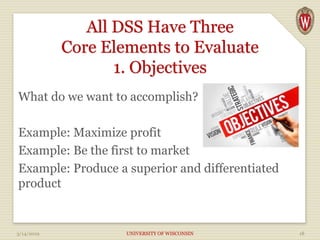
All DSS Have Three
Core Elements to Evaluate
1. Objectives
What do we want to accomplish?
Example: Maximize profit
Example: Be the first to market
Example: Produce a superior and differentiated
product
3/14/2019 UNIVERSITY OF WISCONSIN 18
All DSS Have Three
Core Elements to Evaluate
2. Decision Variables
What questions do we need to answer, in
order to accomplish our goal?
Example: Determine how to appropriately
price a product for sale
Example: Determine length of time tests
should be run on a new product/service to
verify that it functions as intended
Example: Determine the responsibilities to
assign to each worker
3/14/2019 UNIVERSITY OF WISCONSIN 19
All DSS Have Three
Core Elements to Evaluate
3. Constraints
What limitations are we facing?
Example: We can’t charge less than our cost
Example: We must test enough to meet minimum
safety regulations
Example: We must ensure that employees have enough
training, or they won’t be able to produce the product
3/14/2019 UNIVERSITY OF WISCONSIN 20
DSS Must Be Able to Address
3 Types of Problems
3/14/2019 UNIVERSITY OF WISCONSIN 21
DSS Must Be Able to Address
Three Types of Problems
1. Structured
Situations in which the procedures to follow when
a decision is needed can be specified in advance
• Repetitive
• Standard solution methods exist
• Complete automation may be feasible
• Example: Does the production line accept or
reject a burnt peanut?
3/14/2019 UNIVERSITY OF WISCONSIN 22
DSS Must Be Able to Address
Three Types of Problems
2. Unstructured
Decision situations where it is not possible to specify
in advance most of the decision procedures to follow
• One-time
• No standard solutions
• Rely on judgment
• Automation is usually infeasible
Example: Do you go to Jim’s party on Friday night,
or stay home, “watch Netflix and chill”?
Better Example: Should we source ball bearings from
China instead of Mexico?
3/14/2019 UNIVERSITY OF WISCONSIN 23
DSS Must Be Able to Address
Three Types of Problems
3. Semi-structured
Decision procedures that can be pre specified, but
not enough to lead to a definite recommended
decision
Some elements and/or phases of decision making
process have repetitive elements.
Example: if the ball bearings we source are not
round enough, we need to evaluate other
alternatives
3/14/2019 UNIVERSITY OF WISCONSIN 24
Technology Based DSS
• Gathers data
• Evaluates it using models and
algorithms
• Displays metrics in a user friendly
format, for use in
executive/managerial decision
making
3/14/2019 UNIVERSITY OF WISCONSIN 25
Why Do We Need DSS
Anyway?
Increasing Complexity in Decision
Making Process
• Technology
• Information
• Pace of change
3/14/2019 UNIVERSITY OF WISCONSIN 26
Why Do We Need DSS
Anyway?
Increasing availability of
computerized support
• Inexpensive high-powered
computing
• Better software
• More efficient software development
process
3/14/2019 UNIVERSITY OF WISCONSIN 27
Benefits of New Generation
DSS
• Decision quality
• Improved communication
• Cost reduction
• Increased productivity
• Time savings
• Improved customer and employee
satisfaction
3/14/2019 UNIVERSITY OF WISCONSIN 28
7 Types of DSS Systems
3/14/2019 UNIVERSITY OF WISCONSIN 29
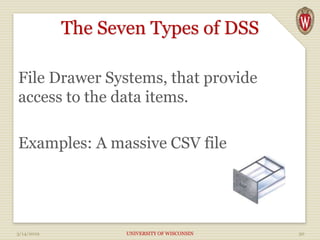
The Seven Types of DSS
File Drawer Systems, that provide
access to the data items.
Examples: A massive CSV file
3/14/2019 UNIVERSITY OF WISCONSIN 30
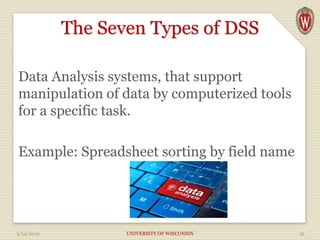
The Seven Types of DSS
Data Analysis systems, that support
manipulation of data by computerized tools
for a specific task.
Example: Spreadsheet sorting by field name
3/14/2019 UNIVERSITY OF WISCONSIN 31
The Seven Types of DSS
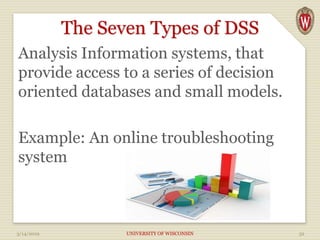
Analysis Information systems, that
provide access to a series of decision
oriented databases and small models.
Example: An online troubleshooting
system
3/14/2019 UNIVERSITY OF WISCONSIN 32
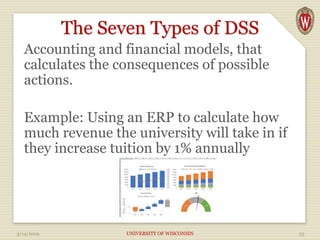
The Seven Types of DSS
Accounting and financial models, that
calculates the consequences of possible
actions.
Example: Using an ERP to calculate how
much revenue the university will take in if
they increase tuition by 1% annually
3/14/2019 UNIVERSITY OF WISCONSIN 33
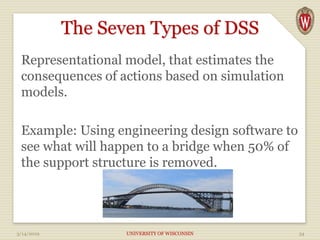
The Seven Types of DSS
Representational model, that estimates the
consequences of actions based on simulation
models.
Example: Using engineering design software to
see what will happen to a bridge when 50% of
the support structure is removed.
3/14/2019 UNIVERSITY OF WISCONSIN 34
The Seven Types of DSS
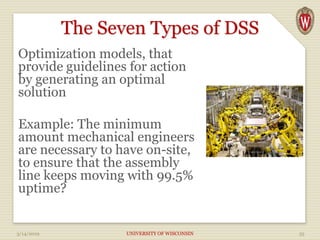
Optimization models, that
provide guidelines for action
by generating an optimal
solution
Example: The minimum
amount mechanical engineers
are necessary to have on-site,
to ensure that the assembly
line keeps moving with 99.5%
uptime?
3/14/2019 UNIVERSITY OF WISCONSIN 35
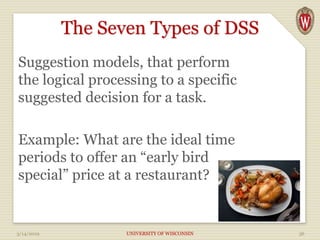
The Seven Types of DSS
Suggestion models, that perform
the logical processing to a specific
suggested decision for a task.
Example: What are the ideal time
periods to offer an “early bird
special” price at a restaurant?
3/14/2019 UNIVERSITY OF WISCONSIN 36
New Generation DSS
Requires Many Different Systems
• Database research
• Artificial intelligence
• Human-computer interaction
• Simulation methods
• Software engineering
• Telecommunications
3/14/2019 UNIVERSITY OF WISCONSIN 37
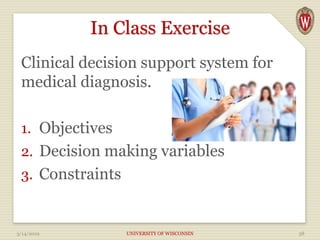
In Class Exercise
Clinical decision support system for
medical diagnosis.
1. Objectives
2. Decision making variables
3. Constraints
3/14/2019 UNIVERSITY OF WISCONSIN 38
In Class Exercise
A bank loan officer verifying the credit
of a loan applicant
1. Objectives
2. Decision making variables
3. Constraints
3/14/2019 UNIVERSITY OF WISCONSIN 39
In Class Exercise
An engineering firm that has bids on
several projects and wants to know if
they can be competitive with their
costs.
1. Objectives
2. Decision making variables
3. Constraints
3/14/2019 UNIVERSITY OF WISCONSIN 40
In Class Exercise
Apple iPhone X production quantity for coming
quarter example
DSS is extensively used in business and management.
Executive dashboards and other business
performance software allow faster decision making,
identification of negative trends, and better allocation
of business resources.
1. Objectives
2. Decision making variables
3. Constraints
3/14/2019 UNIVERSITY OF WISCONSIN 41
In Class Exercise
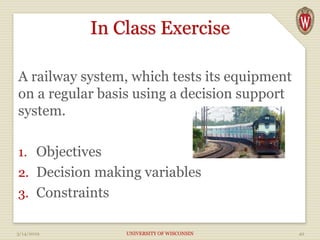
A railway system, which tests its equipment
on a regular basis using a decision support
system.
1. Objectives
2. Decision making variables
3. Constraints
3/14/2019 UNIVERSITY OF WISCONSIN 42
In Class Exercise
Make decisions in the stock market. Which
stocks and sectors to buy and sell today, and
what the triggers will be
1. Objectives
2. Decision making variables
3. Constraints
3/14/2019 UNIVERSITY OF WISCONSIN 43
How DSS Results are Delivered
Periodic Scheduled Reports:
Prespecified format on a regular basis,
available but not pushed to specific
people
3/14/2019 UNIVERSITY OF WISCONSIN 44
How DSS Results are Delivered
Exception Reports: Reports about
exceptional conditions. These may be
triggered by an event, or produced
regularly (How many times did the
production line go down unexpectedly
last qtr)
3/14/2019 UNIVERSITY OF WISCONSIN 45
How DSS Results are Delivered
Demand Reports and Responses,
Information available when
requested
3/14/2019 UNIVERSITY OF WISCONSIN 46
How DSS Results are Delivered
Push Reporting, Information
pushed to manager
3/14/2019 UNIVERSITY OF WISCONSIN 47
DSS Analysis Types
3/14/2019 UNIVERSITY OF WISCONSIN 48
Common DSS
Usage Techniques
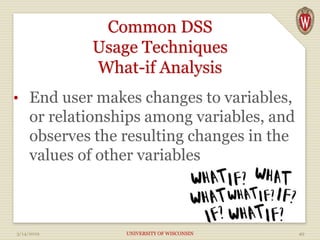
What-if Analysis
• End user makes changes to variables,
or relationships among variables, and
observes the resulting changes in the
values of other variables
3/14/2019 UNIVERSITY OF WISCONSIN 49
Common DSS
Usage Techniques
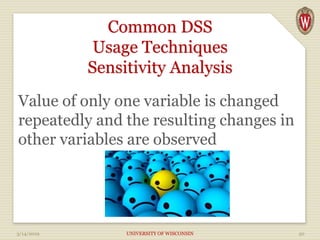
Sensitivity Analysis
Value of only one variable is changed
repeatedly and the resulting changes in
other variables are observed
3/14/2019 UNIVERSITY OF WISCONSIN 50
Common DSS
Usage Techniques
Goal-Seeking
Set a target value for a variable and
then repeatedly change other
variables until the target value is
achieved
3/14/2019 UNIVERSITY OF WISCONSIN 51
Common DSS
Usage Techniques
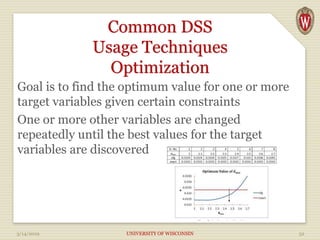
Optimization
Goal is to find the optimum value for one or more
target variables given certain constraints
One or more other variables are changed
repeatedly until the best values for the target
variables are discovered
3/14/2019 UNIVERSITY OF WISCONSIN 52
3/14/2019 UNIVERSITY OF WISCONSIN 53
3/14/2019 UNIVERSITY OF WISCONSIN 54
3/14/2019 UNIVERSITY OF WISCONSIN 55
3/14/2019 UNIVERSITY OF WISCONSIN 56
3/14/2019 UNIVERSITY OF WISCONSIN 57
3/14/2019 UNIVERSITY OF WISCONSIN 58
3/14/2019 UNIVERSITY OF WISCONSIN 59
3/14/2019 UNIVERSITY OF WISCONSIN 60
3/14/2019 UNIVERSITY OF WISCONSIN 61
3/14/2019 UNIVERSITY OF WISCONSIN 62
3/14/2019 UNIVERSITY OF WISCONSIN 63
3/14/2019 UNIVERSITY OF WISCONSIN 64

UW-Madison, Information Systems 371 - Decision Support Systems

  • 1.
    Information Systems 371 March14, 2019 Topic: Decision Support Systems Lecturer: Nicholas Davis
  • 2.
    Decision Support Systems Overview •Senior level executives live in fast paced environments that highly competitive, fast-paced, with near real-time demands made upon them. • They are overloaded with information, disparate data distributed throughout the enterprise, and a global scope of responsibility 3/14/2019 UNIVERSITY OF WISCONSIN 2
  • 3.
    DSS History Graphic 3/14/2019UNIVERSITY OF WISCONSIN 3
  • 4.
    Decision Support Systems Overview Thecombination of high speed networks, in combination with “Big Data” and the imminent rise of Artificial Intelligence, has led to the creation of information systems which can assist with the assembling, evaluation and presentation of this wealth of information 3/14/2019 UNIVERSITY OF WISCONSIN 4
  • 5.
    Decision Support Systems Overview •These systems have the potential to improve decision making by suggesting solutions that are better than those made by humans alone. • They are used in all areas, from dog food production to healthcare, to garbage collection, to the stock market 3/14/2019 UNIVERSITY OF WISCONSIN 5
  • 6.
    Decision Support Systems Overview •Collect data • Process data • Evaluate Data • Present Data • This is a Decision Support System 3/14/2019 UNIVERSITY OF WISCONSIN 6
  • 7.
    Components of aDecision Support System A DSS is made up of: 1. A source of data 2. A method or model to analyze the data 3. A user interface 3/14/2019 UNIVERSITY OF WISCONSIN 7
  • 8.
    3 Steps inthe DSS Process 3/14/2019 UNIVERSITY OF WISCONSIN 8
  • 9.
    Let’s Look atan Example Step 1 – Describe the Big Picture A developing country is going to build a railway system to connect a potential inland industrial area and a good agricultural area with a port. An international development agency recommended that iron already present in the area, should be mined and refined locally, using an infrastructure that still needs to be established The refined iron could possibly be exported to Germany and Japan for use in the automobile industry. A core component of success of the project depends upon the supply of skilled labor. To overcome this problem an education and training center has to be established to get worker prepared by the time the iron processing plant is ready to open The development agency also recommends the fertile farm land in the area should be prepared for intensive farming to provide food for consumption by the people working at the iron processing plant The railway should link the industrial area to local farms and the sea port. 3/14/2019 UNIVERSITY OF WISCONSIN 9
  • 10.
    Proceed? Yes or No •Does the high level plan seem plausible and reasonable? 3/14/2019 UNIVERSITY OF WISCONSIN 10
  • 11.
    Step 2 -List All Questions That Must be Answered 3/14/2019 UNIVERSITY OF WISCONSIN 11 •Is the route optimal? Are all likely users connected? What are other possible routes? •Growth of traffic: To what extent does development of a railway system depend on development of port, new town, airport, industrial area and agricultural area in order to make the railway sustainable in terms of revenue? •Competition: To what extent would development of an improved road system eliminate the need for a new railway to be constructed? •Engineering problems: How much electricity is needed for electric train? Would it be better to use a diesel train? Where would the fuel or electricity come from, to power the train? •Supply problem: Where will the supply of construction equipment and workers come from? •Operational problem: With inadequate supply of local skilled workers where will operating team be sourced from? Will contractors need to be brought in from foreign countries? If so, what are the added complexities? •Time Scale: When is the start date, the completion date and milestones along the entire timeline? •Cost: What will the total cost of the project be? •Infrastructure: Will available supporting services include: telephone, fire, water, radio communication, hospitals, hotels and housing?
  • 12.
    Proceed? Yes or No •Is it technically possible to accomplish the required tasks? 3/14/2019 UNIVERSITY OF WISCONSIN 12
  • 13.
    Step 3 –Spec Out the Details of All Tasks • Steps in each task • Cost of each task • Time for each task • Based upon these realities, can you still justify the project and make it real? If so, based upon everything you no know, do you start the project or not? 3/14/2019 UNIVERSITY OF WISCONSIN 13
  • 14.
    Decision Support Systems •DSS tries to address the complexity of these type of situations by automating as much as possible • Ideally, decision makers are presented with fewer choices, based upon more complex automated collection and analysis of data by DSS systems 3/14/2019 UNIVERSITY OF WISCONSIN 14
  • 15.
    DSS Decision Making Characteristics •Decision is made based only on the information available, no speculation • The process is iterative, data and decisions based upon that data may change over time • All decisions must be pragmatic: For example, if there is not funding, the project won’t move forward, no matter how practical the path for the project is. 3/14/2019 UNIVERSITY OF WISCONSIN 15
  • 16.
    Everyone Who isResponsible For Making Decisions is in Effect a Manager • Organizations are filled with decision makers at all levels. • Managing these decisions is an art, but one which involves more and more quantitative science, every day • Technology permits new types of evaluation • Organizations are becoming more complex • The marketplace is changing more rapidly 3/14/2019 UNIVERSITY OF WISCONSIN 16
  • 17.
    DSS Evaluates 3Core Elements 3/14/2019 UNIVERSITY OF WISCONSIN 17
  • 18.
    All DSS HaveThree Core Elements to Evaluate 1. Objectives What do we want to accomplish? Example: Maximize profit Example: Be the first to market Example: Produce a superior and differentiated product 3/14/2019 UNIVERSITY OF WISCONSIN 18
  • 19.
    All DSS HaveThree Core Elements to Evaluate 2. Decision Variables What questions do we need to answer, in order to accomplish our goal? Example: Determine how to appropriately price a product for sale Example: Determine length of time tests should be run on a new product/service to verify that it functions as intended Example: Determine the responsibilities to assign to each worker 3/14/2019 UNIVERSITY OF WISCONSIN 19
  • 20.
    All DSS HaveThree Core Elements to Evaluate 3. Constraints What limitations are we facing? Example: We can’t charge less than our cost Example: We must test enough to meet minimum safety regulations Example: We must ensure that employees have enough training, or they won’t be able to produce the product 3/14/2019 UNIVERSITY OF WISCONSIN 20
  • 21.
    DSS Must BeAble to Address 3 Types of Problems 3/14/2019 UNIVERSITY OF WISCONSIN 21
  • 22.
    DSS Must BeAble to Address Three Types of Problems 1. Structured Situations in which the procedures to follow when a decision is needed can be specified in advance • Repetitive • Standard solution methods exist • Complete automation may be feasible • Example: Does the production line accept or reject a burnt peanut? 3/14/2019 UNIVERSITY OF WISCONSIN 22
  • 23.
    DSS Must BeAble to Address Three Types of Problems 2. Unstructured Decision situations where it is not possible to specify in advance most of the decision procedures to follow • One-time • No standard solutions • Rely on judgment • Automation is usually infeasible Example: Do you go to Jim’s party on Friday night, or stay home, “watch Netflix and chill”? Better Example: Should we source ball bearings from China instead of Mexico? 3/14/2019 UNIVERSITY OF WISCONSIN 23
  • 24.
    DSS Must BeAble to Address Three Types of Problems 3. Semi-structured Decision procedures that can be pre specified, but not enough to lead to a definite recommended decision Some elements and/or phases of decision making process have repetitive elements. Example: if the ball bearings we source are not round enough, we need to evaluate other alternatives 3/14/2019 UNIVERSITY OF WISCONSIN 24
  • 25.
    Technology Based DSS •Gathers data • Evaluates it using models and algorithms • Displays metrics in a user friendly format, for use in executive/managerial decision making 3/14/2019 UNIVERSITY OF WISCONSIN 25
  • 26.
    Why Do WeNeed DSS Anyway? Increasing Complexity in Decision Making Process • Technology • Information • Pace of change 3/14/2019 UNIVERSITY OF WISCONSIN 26
  • 27.
    Why Do WeNeed DSS Anyway? Increasing availability of computerized support • Inexpensive high-powered computing • Better software • More efficient software development process 3/14/2019 UNIVERSITY OF WISCONSIN 27
  • 28.
    Benefits of NewGeneration DSS • Decision quality • Improved communication • Cost reduction • Increased productivity • Time savings • Improved customer and employee satisfaction 3/14/2019 UNIVERSITY OF WISCONSIN 28
  • 29.
    7 Types ofDSS Systems 3/14/2019 UNIVERSITY OF WISCONSIN 29
  • 30.
    The Seven Typesof DSS File Drawer Systems, that provide access to the data items. Examples: A massive CSV file 3/14/2019 UNIVERSITY OF WISCONSIN 30
  • 31.
    The Seven Typesof DSS Data Analysis systems, that support manipulation of data by computerized tools for a specific task. Example: Spreadsheet sorting by field name 3/14/2019 UNIVERSITY OF WISCONSIN 31
  • 32.
    The Seven Typesof DSS Analysis Information systems, that provide access to a series of decision oriented databases and small models. Example: An online troubleshooting system 3/14/2019 UNIVERSITY OF WISCONSIN 32
  • 33.
    The Seven Typesof DSS Accounting and financial models, that calculates the consequences of possible actions. Example: Using an ERP to calculate how much revenue the university will take in if they increase tuition by 1% annually 3/14/2019 UNIVERSITY OF WISCONSIN 33
  • 34.
    The Seven Typesof DSS Representational model, that estimates the consequences of actions based on simulation models. Example: Using engineering design software to see what will happen to a bridge when 50% of the support structure is removed. 3/14/2019 UNIVERSITY OF WISCONSIN 34
  • 35.
    The Seven Typesof DSS Optimization models, that provide guidelines for action by generating an optimal solution Example: The minimum amount mechanical engineers are necessary to have on-site, to ensure that the assembly line keeps moving with 99.5% uptime? 3/14/2019 UNIVERSITY OF WISCONSIN 35
  • 36.
    The Seven Typesof DSS Suggestion models, that perform the logical processing to a specific suggested decision for a task. Example: What are the ideal time periods to offer an “early bird special” price at a restaurant? 3/14/2019 UNIVERSITY OF WISCONSIN 36
  • 37.
    New Generation DSS RequiresMany Different Systems • Database research • Artificial intelligence • Human-computer interaction • Simulation methods • Software engineering • Telecommunications 3/14/2019 UNIVERSITY OF WISCONSIN 37
  • 38.
    In Class Exercise Clinicaldecision support system for medical diagnosis. 1. Objectives 2. Decision making variables 3. Constraints 3/14/2019 UNIVERSITY OF WISCONSIN 38
  • 39.
    In Class Exercise Abank loan officer verifying the credit of a loan applicant 1. Objectives 2. Decision making variables 3. Constraints 3/14/2019 UNIVERSITY OF WISCONSIN 39
  • 40.
    In Class Exercise Anengineering firm that has bids on several projects and wants to know if they can be competitive with their costs. 1. Objectives 2. Decision making variables 3. Constraints 3/14/2019 UNIVERSITY OF WISCONSIN 40
  • 41.
    In Class Exercise AppleiPhone X production quantity for coming quarter example DSS is extensively used in business and management. Executive dashboards and other business performance software allow faster decision making, identification of negative trends, and better allocation of business resources. 1. Objectives 2. Decision making variables 3. Constraints 3/14/2019 UNIVERSITY OF WISCONSIN 41
  • 42.
    In Class Exercise Arailway system, which tests its equipment on a regular basis using a decision support system. 1. Objectives 2. Decision making variables 3. Constraints 3/14/2019 UNIVERSITY OF WISCONSIN 42
  • 43.
    In Class Exercise Makedecisions in the stock market. Which stocks and sectors to buy and sell today, and what the triggers will be 1. Objectives 2. Decision making variables 3. Constraints 3/14/2019 UNIVERSITY OF WISCONSIN 43
  • 44.
    How DSS Resultsare Delivered Periodic Scheduled Reports: Prespecified format on a regular basis, available but not pushed to specific people 3/14/2019 UNIVERSITY OF WISCONSIN 44
  • 45.
    How DSS Resultsare Delivered Exception Reports: Reports about exceptional conditions. These may be triggered by an event, or produced regularly (How many times did the production line go down unexpectedly last qtr) 3/14/2019 UNIVERSITY OF WISCONSIN 45
  • 46.
    How DSS Resultsare Delivered Demand Reports and Responses, Information available when requested 3/14/2019 UNIVERSITY OF WISCONSIN 46
  • 47.
    How DSS Resultsare Delivered Push Reporting, Information pushed to manager 3/14/2019 UNIVERSITY OF WISCONSIN 47
  • 48.
    DSS Analysis Types 3/14/2019UNIVERSITY OF WISCONSIN 48
  • 49.
    Common DSS Usage Techniques What-ifAnalysis • End user makes changes to variables, or relationships among variables, and observes the resulting changes in the values of other variables 3/14/2019 UNIVERSITY OF WISCONSIN 49
  • 50.
    Common DSS Usage Techniques SensitivityAnalysis Value of only one variable is changed repeatedly and the resulting changes in other variables are observed 3/14/2019 UNIVERSITY OF WISCONSIN 50
  • 51.
    Common DSS Usage Techniques Goal-Seeking Seta target value for a variable and then repeatedly change other variables until the target value is achieved 3/14/2019 UNIVERSITY OF WISCONSIN 51
  • 52.
    Common DSS Usage Techniques Optimization Goalis to find the optimum value for one or more target variables given certain constraints One or more other variables are changed repeatedly until the best values for the target variables are discovered 3/14/2019 UNIVERSITY OF WISCONSIN 52
  • 53.
  • 54.
  • 55.
  • 56.
  • 57.
  • 58.
  • 59.
  • 60.
  • 61.
  • 62.
  • 63.
  • 64.