INDIAN E-COMMERCE
INDUSTRY
Submitted by:
• T.Sairam Singh
• G.Santhosh
• DA.Krishna
• M.Sushma
• K.Sudheera
What is E-commerce?
E-commerce is a type of industry where the
buying and selling of products or services is conducted
over electronic systems such as the Internet and other
computer networks.
This is an effective and efficient way of communicating
within an organization and one of the most effective and
useful ways of conducting business.
It is a Market entry strategy where the company may or
may not have a physical presence.
History
• In 1972 the E-commerce started as a sale
between students of MIT and SAIL.
• In 1990’s the world wide web made a platform
to E-commerce.
• IndiaMart: B2B market place in 1996.
• In 2013 the market is 12.6 billion $.
• In 2014 Indian E-commerce industry estimate
a growth of more than 30%.
Key players in E-Commerce industry
• Flipkart
• Snap deal
• Myntra
• Make my trip
• Red bus
• IRCTC and many others
E-commerce can be classified::
• C2C (Consumer to Consumer):This kind of transaction takes
place via online classified Ads or auctions or by selling
personal services online.
Ex: ebay.com auctions
• B2B(Business to Business): This takes place when a company
wants to conduct a commercial activity with another business
firm online. Ex: Altra, FreeMarkets
• B2C (Business to Consumer):This is the most common form
of E-Commerce in which a variety of goods ranging from
apparels, footwear, stationery, gifts, and services like travel
booking, online matrimonial and digital downloads are
available. This mode provide the consumer with services like
information gathering, comparing and buying or selling goods
online.
Ex: shaadi.com, makemytrip.com, shopclues.com,
flipkart.com
Flipkart
• Flipkart is an Indian e-commerce company headquartered in
Bangalore, Karnataka. It was founded by Sachin Bansal and
Binny Bansal in 2007 with the objective of making books
easily available to anyone who had internet access.
• Later on expanded to electronic goods and a diversity of other
products including
-Movies and Music, Games,
-Mobiles, Cameras, Computers,
-Healthcare and personal products,
-Home appliances and electronics, stationery,
perfumes, toys, apparels, shoes – and
still counting!
Snapdeal
• Snapdeal is a leading online marketplace,
headquartered in New Delhi, India.
• Snapdeal features products across categories like
-mobiles, electronics, fashion accessories,
-apparel, footwear, kids, home and kitchen,
-sports, books; and services like restaurants, spas
& entertainment amongst others.
Myntra
• Myntra was established by Mukesh Bansal,
Ashutosh Lawania, and Vineet Saxena in
February 2007.
• Myntra.com works as an online shopping retailer
of fashion and casual lifestyle products.
• The company started off in the business of
personalization of products, and soon expanded to
set up regional offices in New Delhi, Mumbai and
Chennai.
Make my trip
• MakeMyTrip (MMT) found in April, 2000
• Offices in 23 cities across India
• Major market share (48%)
• Every eleventh domestic flights in India booked via
MMT.
Red bus
• Red bus was founded in august 2006
• India’s first bus tickets booking site
• Has the largest network of bus operators in their list
(350+ and growing)
• Sells two cloud based software, called BOSS and
Seat Seller to bus operators and travel agents.
Pros
1) Convenience
2) Better Prices
3) Variety
4) Send Gifts
5) Fewer Expenses
6) Comparison of Prices
7) No Crowds
8) Discreet Purchases
Cons
1) Security
2) Touch and Sense
3) Time for delivery
4) Warranty Issues
5) Fake Products
Achieve
1. Attracting New Customers
2. Increasing Sales
3. Increasing Customer Loyalty and Retention
4. Providing Superior Customer Service and
Communications
5. Reducing Operating Costs and Increasing
Efficiency
6. Promoting Your Brand and Enhancing Your
Brand Image
7. Preparing for Future Needs
Strategies
Avoid
1. Weak or inconsistent branding
2. Shopping cart abandonment
3. Bad User Experience and usability
4. Poor navigation
5. Slow performance
6. Slow or limited site search
7. Inability to make changes quickly
8. Poor Performance with search engines
Strategies
• On 27th May'2012 Yebhi.com declared that they shortly
introduce "try and buy" where the shoppers can actually try the
clothes and shoes they buy on the portal when it is delivered to
them and return it if they are not satisfied.
• In October 2013 Amazon.in launches free home delivery for
every product purchased despite of minimum order as
promotional offer .
• Goibibo.com gives discount offers, gift coupons etc… on flight
tickets, bus tickets and hotel bookings through out the year.
• Flipkart.com is the first e-commerce website to offer cash on
delivery and gives 30-days guarantee replacement.
• Shopclues.com offers Sunday-flea-market which gives huge
discounts on the products specified
• Many E-Commerce websites are participating in GOSF(Google
online shopping festival) for giving huge discounts.
Promotions
Primary data
analysis• Case 1:
Finding the Gender perceptions
on e-commerce.
Sample: 50
Male: 34
Female: 16
1.How often do you buy online?
0%
10%
20%
30%
40%
50%
60%
70%
80%
90%
100%
Female Male
Sometimes
Regularly
Never
Row
Labels Never Regularly Sometimes
Grand
Total
Female 3 3 10 16
Male 2 7 25 34
Grand
Total 5 10 35 50
Finding:
Male candidates buy often than
females.
2.For what purpose do you use e-commerce?
0%
10%
20%
30%
40%
50%
60%
70%
80%
90%
100%
Female Male
For personal
use
For business
use
For both
personal and
business use
Row
Labels
For both
personal
and
business
use
For
business
use
For
personal
use
Grand
Total
Female 1 3 12 16
Male 7 27 34
Grand
Total 8 3 39 50
Finding:
Female candidates don’t use e-commerce for both
personal and business.
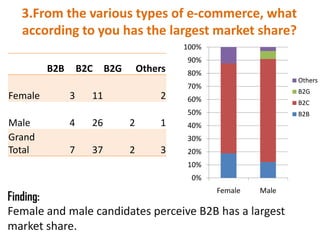
3.From the various types of e-commerce, what
according to you has the largest market share?
0%
10%
20%
30%
40%
50%
60%
70%
80%
90%
100%
Female Male
Others
B2G
B2C
B2B
B2B B2C B2G Others
Female 3 11 2
Male 4 26 2 1
Grand
Total 7 37 2 3
Finding:
Female and male candidates perceive B2B has a largest
market share.
4.According to you how is e-commerce helpful to
the consumer in the e-business domain?
0%
10%
20%
30%
40%
50%
60%
70%
80%
90%
100%
Female Male
Others
Fastens
business
process
Encourages
price
transparency
Broadens
consumer
choice
Broadens
consumer
choice
Encourages
price
transparency
Fastens
business
process
Female 6 3 7
Male 11 12 10
Finding:
Female perceive e-commerce helpful in FBS but male
perceive it encourages price transparency.
5.Do you think that the application of e-commerce
has increased over the years in India?
0%
10%
20%
30%
40%
50%
60%
70%
80%
90%
100%
Female Male
Yes
No
Do not know/
cannot say
Broadens
consumer
choice
Encourages
price
transparency
Fastens
business
process
Female 6 3 7
Male 11 12 10
Finding:
Female and male candidates perceive that the
application of e-commerce has increased in India.
6.Do you agree that e-commerce as commercial means has
its advantages over the traditional commercial methods?
80%
82%
84%
86%
88%
90%
92%
94%
96%
98%
100%
Female Male
Do not
know/
cannot say
Disagree
Agree
Agree Disagree
Do not know/
cannot say
Female 15 1
Male 28 3 1
Finding:
Female candidates agree there is a advantage in e-
commerce than male candidates.
7. Do you agree that e-commerce can provide an alternative
marketing channel by eliminating middleman?
0%
10%
20%
30%
40%
50%
60%
70%
80%
90%
100%
Female Male
Disagree
Agree
Agree Disagree
Female 11 5
Male 28 5
Finding:
Male candidates agree that e-commerce will eliminate
middle man than female candidates.
Chi square analysis:
7. Do you agree that e-commerce
can provide an alternative
marketing channel by eliminating
middleman?
Column
Labels
Agree Disagree Grand Total
Female 11 5 16
Male 28 6 34
Grand Total 39 10 50
Expected
Agree Disagree Grand Total
12.48 3.2 16
26.52 6.8 34
39 10 50
Ho: There is an independence in the decisions on gender for the question asked that e-
commerce can provide an alternative marketing channel by eliminating middleman?
H1: There is a dependence in the decisions on gender for the question asked that e-commerce
can provide an alternative marketing channel by eliminating middleman?
Conclusion: As the p value is greater than 0.05 we accept the Ho ,that there is an
independence in gender decisions that e-commerce can provide an alternative marketing
channel by eliminating middle man
p-value 0.24272
8. Which is the most prominent domain in which e-
commerce is used in India?
Banking
Others Matrimony
Online
shopping
Stocks &
shares
Travel
and
tourism
Female 1 2 10 1 2
Male 2 2 25 2 2
Finding:
Male candidates agree that e-commerce will eliminate
middle man than female candidates.
0%
10%
20%
30%
40%
50%
60%
70%
80%
90%
100%
Female Male
Travel and
tourism
Stocks &
shares
Online
shopping
Matrimony
Banking
Others
9. What are the challenges to the implementation of e-
commerce in India?
Consumers’
awareness
level is low
Lack of
trust
Other
factors
Security
concerns
Slow
penetration
of internet
Female 5 3 8
Male 10 9 2 9 3
Finding:
Female candidates feel security concern is a challenge
but male candidates feel all the reasons are challenges .
0%
10%
20%
30%
40%
50%
60%
70%
80%
90%
100%
Female Male
Slow
penetration
of internet
Security
concerns
Other
factors
Lack of
trust
Consumers’
awareness
level is low
Case 2:
Considering the perceptions of
the students and working
people towards e-commerce.
Sample: 50
Students:42
Employees: 08
How often do you buy online?
Never Regularly Sometimes Grand Total
Student 5 8 29 42
Working 2 6 8
Grand Total 5 10 35 50
0%
10%
20%
30%
40%
50%
60%
70%
80%
90%
100%
Student Working
Sometimes
Regularly
Never
Finding:
Students with comparison to
working people few of them never
buy through online .
From the various types of e-commerce, what
according to you has the largest market share?
B2B B2C B2G Others
Student 7 30 1 3
Working 7 1
0%
10%
20%
30%
40%
50%
60%
70%
80%
90%
100%
Student Working
(blank)
Others
B2G
B2C
B2B
Finding: most of the consumers
perceive that in e-commerce
industry business to consumer has
the largest market share.
According to you how is e-commerce helpful to
the consumer in the e-business domain?
Broadens
consumer choice
Encourages price
transparency
Fastens business
process
Student 15 12 14
Working 2 3 3
0%
10%
20%
30%
40%
50%
60%
70%
80%
90%
100%
Student Working
Fastens
business
process
Encourages
price
transparency
Broadens
consumer
choice
Finding:
Both students and working individuals
perceive that e-commerce will broadens
consumer choice , encourages price
transparency , fastens business process.
Do you think that the application of e-commerce
has increased over the years in India?
Do not know/
cannot say No Yes
Student 4 2 35
Working 8
0%
10%
20%
30%
40%
50%
60%
70%
80%
90%
100%
Student Working
(blank)
Yes
No
Do not know/
cannot say
Finding:
Working individuals feel that
e-commerce has increased
over the years in India where
few students don’t know
about it.
Do you agree that e-commerce as commercial means has
its advantages over the traditional commercial methods?
Agree Disagree
Student 36 3
Working 7 1
80%
82%
84%
86%
88%
90%
92%
94%
96%
98%
100%
Student Working
(blank)
Do not know/
cannot say
Disagree
Finding:
Both students as well as employees feel
that e-commerce as commercial means
has its advantage over the traditional
methods.
Do you agree that e-commerce can provide an
alternative marketing channel by eliminating middleman?
Agree Disagree
Student 31 10
Working 8
0%
10%
20%
30%
40%
50%
60%
70%
80%
90%
100%
Student Working
For personal use
For business use
For both
personal and
business use
Finding:
All the working individuals feel that
e-commerce can provide an
alternative marketing channel by
eliminating middleman.
What are the challenges to the implementation
of e-commerce in India?
Consumers’
awareness
level is low Lack of trust Other factors
Security
concerns
Slow
penetration
of internet
Student 13 9 2 14 3
Working 2 3 3
0%
10%
20%
30%
40%
50%
60%
70%
80%
90%
100%
Student Working
Slow
penetration
of internet
Security
concerns
Other factors
Lack of trust
Finding:
Both the students and employees feel
that consumer awareness and security
are the major concerns for the
implementation of e-commerce in India.
Which is the most prominent domain in which
e-commerce is used in India?
Banking
Others Matrimony Online shopping Stocks & shares
Travel and
tourism
1 3 30 3 4
2 1 5
0%
10%
20%
30%
40%
50%
60%
70%
80%
90%
100%
Student Working
(blank)
Travel and
tourism
Stocks & shares
Online shopping
Matrimony
Banking Others
Finding:
It is clearly evident that both the
Working and students feel online
shopping is the most prominent domain
in which e-commerce is used in India.
For what purpose do you use e-commerce?
For both personal
and business use For business use For personal use
Student 6 3 33
Working 2 6
0%
10%
20%
30%
40%
50%
60%
70%
80%
90%
100%
Student Working
For personal
use
For business
use
For both
personal and
business use
Finding:
Most of them perceive it only for
personal use and few use it for
Both personal and business use .

Indian E-commerce Industry

  • 1.
    INDIAN E-COMMERCE INDUSTRY Submitted by: •T.Sairam Singh • G.Santhosh • DA.Krishna • M.Sushma • K.Sudheera
  • 2.
    What is E-commerce? E-commerceis a type of industry where the buying and selling of products or services is conducted over electronic systems such as the Internet and other computer networks. This is an effective and efficient way of communicating within an organization and one of the most effective and useful ways of conducting business. It is a Market entry strategy where the company may or may not have a physical presence.
  • 3.
    History • In 1972the E-commerce started as a sale between students of MIT and SAIL. • In 1990’s the world wide web made a platform to E-commerce. • IndiaMart: B2B market place in 1996. • In 2013 the market is 12.6 billion $. • In 2014 Indian E-commerce industry estimate a growth of more than 30%.
  • 4.
    Key players inE-Commerce industry • Flipkart • Snap deal • Myntra • Make my trip • Red bus • IRCTC and many others
  • 5.
    E-commerce can beclassified:: • C2C (Consumer to Consumer):This kind of transaction takes place via online classified Ads or auctions or by selling personal services online. Ex: ebay.com auctions • B2B(Business to Business): This takes place when a company wants to conduct a commercial activity with another business firm online. Ex: Altra, FreeMarkets • B2C (Business to Consumer):This is the most common form of E-Commerce in which a variety of goods ranging from apparels, footwear, stationery, gifts, and services like travel booking, online matrimonial and digital downloads are available. This mode provide the consumer with services like information gathering, comparing and buying or selling goods online. Ex: shaadi.com, makemytrip.com, shopclues.com, flipkart.com
  • 6.
    Flipkart • Flipkart isan Indian e-commerce company headquartered in Bangalore, Karnataka. It was founded by Sachin Bansal and Binny Bansal in 2007 with the objective of making books easily available to anyone who had internet access. • Later on expanded to electronic goods and a diversity of other products including -Movies and Music, Games, -Mobiles, Cameras, Computers, -Healthcare and personal products, -Home appliances and electronics, stationery, perfumes, toys, apparels, shoes – and still counting!
  • 7.
    Snapdeal • Snapdeal isa leading online marketplace, headquartered in New Delhi, India. • Snapdeal features products across categories like -mobiles, electronics, fashion accessories, -apparel, footwear, kids, home and kitchen, -sports, books; and services like restaurants, spas & entertainment amongst others.
  • 8.
    Myntra • Myntra wasestablished by Mukesh Bansal, Ashutosh Lawania, and Vineet Saxena in February 2007. • Myntra.com works as an online shopping retailer of fashion and casual lifestyle products. • The company started off in the business of personalization of products, and soon expanded to set up regional offices in New Delhi, Mumbai and Chennai.
  • 9.
    Make my trip •MakeMyTrip (MMT) found in April, 2000 • Offices in 23 cities across India • Major market share (48%) • Every eleventh domestic flights in India booked via MMT.
  • 10.
    Red bus • Redbus was founded in august 2006 • India’s first bus tickets booking site • Has the largest network of bus operators in their list (350+ and growing) • Sells two cloud based software, called BOSS and Seat Seller to bus operators and travel agents.
  • 11.
    Pros 1) Convenience 2) BetterPrices 3) Variety 4) Send Gifts 5) Fewer Expenses 6) Comparison of Prices 7) No Crowds 8) Discreet Purchases
  • 12.
    Cons 1) Security 2) Touchand Sense 3) Time for delivery 4) Warranty Issues 5) Fake Products
  • 13.
    Achieve 1. Attracting NewCustomers 2. Increasing Sales 3. Increasing Customer Loyalty and Retention 4. Providing Superior Customer Service and Communications 5. Reducing Operating Costs and Increasing Efficiency 6. Promoting Your Brand and Enhancing Your Brand Image 7. Preparing for Future Needs Strategies
  • 14.
    Avoid 1. Weak orinconsistent branding 2. Shopping cart abandonment 3. Bad User Experience and usability 4. Poor navigation 5. Slow performance 6. Slow or limited site search 7. Inability to make changes quickly 8. Poor Performance with search engines Strategies
  • 15.
    • On 27thMay'2012 Yebhi.com declared that they shortly introduce "try and buy" where the shoppers can actually try the clothes and shoes they buy on the portal when it is delivered to them and return it if they are not satisfied. • In October 2013 Amazon.in launches free home delivery for every product purchased despite of minimum order as promotional offer . • Goibibo.com gives discount offers, gift coupons etc… on flight tickets, bus tickets and hotel bookings through out the year. • Flipkart.com is the first e-commerce website to offer cash on delivery and gives 30-days guarantee replacement. • Shopclues.com offers Sunday-flea-market which gives huge discounts on the products specified • Many E-Commerce websites are participating in GOSF(Google online shopping festival) for giving huge discounts. Promotions
  • 16.
    Primary data analysis• Case1: Finding the Gender perceptions on e-commerce. Sample: 50 Male: 34 Female: 16
  • 17.
    1.How often doyou buy online? 0% 10% 20% 30% 40% 50% 60% 70% 80% 90% 100% Female Male Sometimes Regularly Never Row Labels Never Regularly Sometimes Grand Total Female 3 3 10 16 Male 2 7 25 34 Grand Total 5 10 35 50 Finding: Male candidates buy often than females.
  • 18.
    2.For what purposedo you use e-commerce? 0% 10% 20% 30% 40% 50% 60% 70% 80% 90% 100% Female Male For personal use For business use For both personal and business use Row Labels For both personal and business use For business use For personal use Grand Total Female 1 3 12 16 Male 7 27 34 Grand Total 8 3 39 50 Finding: Female candidates don’t use e-commerce for both personal and business.
  • 19.
    3.From the varioustypes of e-commerce, what according to you has the largest market share? 0% 10% 20% 30% 40% 50% 60% 70% 80% 90% 100% Female Male Others B2G B2C B2B B2B B2C B2G Others Female 3 11 2 Male 4 26 2 1 Grand Total 7 37 2 3 Finding: Female and male candidates perceive B2B has a largest market share.
  • 20.
    4.According to youhow is e-commerce helpful to the consumer in the e-business domain? 0% 10% 20% 30% 40% 50% 60% 70% 80% 90% 100% Female Male Others Fastens business process Encourages price transparency Broadens consumer choice Broadens consumer choice Encourages price transparency Fastens business process Female 6 3 7 Male 11 12 10 Finding: Female perceive e-commerce helpful in FBS but male perceive it encourages price transparency.
  • 21.
    5.Do you thinkthat the application of e-commerce has increased over the years in India? 0% 10% 20% 30% 40% 50% 60% 70% 80% 90% 100% Female Male Yes No Do not know/ cannot say Broadens consumer choice Encourages price transparency Fastens business process Female 6 3 7 Male 11 12 10 Finding: Female and male candidates perceive that the application of e-commerce has increased in India.
  • 22.
    6.Do you agreethat e-commerce as commercial means has its advantages over the traditional commercial methods? 80% 82% 84% 86% 88% 90% 92% 94% 96% 98% 100% Female Male Do not know/ cannot say Disagree Agree Agree Disagree Do not know/ cannot say Female 15 1 Male 28 3 1 Finding: Female candidates agree there is a advantage in e- commerce than male candidates.
  • 23.
    7. Do youagree that e-commerce can provide an alternative marketing channel by eliminating middleman? 0% 10% 20% 30% 40% 50% 60% 70% 80% 90% 100% Female Male Disagree Agree Agree Disagree Female 11 5 Male 28 5 Finding: Male candidates agree that e-commerce will eliminate middle man than female candidates.
  • 24.
    Chi square analysis: 7.Do you agree that e-commerce can provide an alternative marketing channel by eliminating middleman? Column Labels Agree Disagree Grand Total Female 11 5 16 Male 28 6 34 Grand Total 39 10 50 Expected Agree Disagree Grand Total 12.48 3.2 16 26.52 6.8 34 39 10 50 Ho: There is an independence in the decisions on gender for the question asked that e- commerce can provide an alternative marketing channel by eliminating middleman? H1: There is a dependence in the decisions on gender for the question asked that e-commerce can provide an alternative marketing channel by eliminating middleman? Conclusion: As the p value is greater than 0.05 we accept the Ho ,that there is an independence in gender decisions that e-commerce can provide an alternative marketing channel by eliminating middle man p-value 0.24272
  • 25.
    8. Which isthe most prominent domain in which e- commerce is used in India? Banking Others Matrimony Online shopping Stocks & shares Travel and tourism Female 1 2 10 1 2 Male 2 2 25 2 2 Finding: Male candidates agree that e-commerce will eliminate middle man than female candidates. 0% 10% 20% 30% 40% 50% 60% 70% 80% 90% 100% Female Male Travel and tourism Stocks & shares Online shopping Matrimony Banking Others
  • 26.
    9. What arethe challenges to the implementation of e- commerce in India? Consumers’ awareness level is low Lack of trust Other factors Security concerns Slow penetration of internet Female 5 3 8 Male 10 9 2 9 3 Finding: Female candidates feel security concern is a challenge but male candidates feel all the reasons are challenges . 0% 10% 20% 30% 40% 50% 60% 70% 80% 90% 100% Female Male Slow penetration of internet Security concerns Other factors Lack of trust Consumers’ awareness level is low
  • 27.
    Case 2: Considering theperceptions of the students and working people towards e-commerce. Sample: 50 Students:42 Employees: 08
  • 28.
    How often doyou buy online? Never Regularly Sometimes Grand Total Student 5 8 29 42 Working 2 6 8 Grand Total 5 10 35 50 0% 10% 20% 30% 40% 50% 60% 70% 80% 90% 100% Student Working Sometimes Regularly Never Finding: Students with comparison to working people few of them never buy through online .
  • 29.
    From the varioustypes of e-commerce, what according to you has the largest market share? B2B B2C B2G Others Student 7 30 1 3 Working 7 1 0% 10% 20% 30% 40% 50% 60% 70% 80% 90% 100% Student Working (blank) Others B2G B2C B2B Finding: most of the consumers perceive that in e-commerce industry business to consumer has the largest market share.
  • 30.
    According to youhow is e-commerce helpful to the consumer in the e-business domain? Broadens consumer choice Encourages price transparency Fastens business process Student 15 12 14 Working 2 3 3 0% 10% 20% 30% 40% 50% 60% 70% 80% 90% 100% Student Working Fastens business process Encourages price transparency Broadens consumer choice Finding: Both students and working individuals perceive that e-commerce will broadens consumer choice , encourages price transparency , fastens business process.
  • 31.
    Do you thinkthat the application of e-commerce has increased over the years in India? Do not know/ cannot say No Yes Student 4 2 35 Working 8 0% 10% 20% 30% 40% 50% 60% 70% 80% 90% 100% Student Working (blank) Yes No Do not know/ cannot say Finding: Working individuals feel that e-commerce has increased over the years in India where few students don’t know about it.
  • 32.
    Do you agreethat e-commerce as commercial means has its advantages over the traditional commercial methods? Agree Disagree Student 36 3 Working 7 1 80% 82% 84% 86% 88% 90% 92% 94% 96% 98% 100% Student Working (blank) Do not know/ cannot say Disagree Finding: Both students as well as employees feel that e-commerce as commercial means has its advantage over the traditional methods.
  • 33.
    Do you agreethat e-commerce can provide an alternative marketing channel by eliminating middleman? Agree Disagree Student 31 10 Working 8 0% 10% 20% 30% 40% 50% 60% 70% 80% 90% 100% Student Working For personal use For business use For both personal and business use Finding: All the working individuals feel that e-commerce can provide an alternative marketing channel by eliminating middleman.
  • 34.
    What are thechallenges to the implementation of e-commerce in India? Consumers’ awareness level is low Lack of trust Other factors Security concerns Slow penetration of internet Student 13 9 2 14 3 Working 2 3 3 0% 10% 20% 30% 40% 50% 60% 70% 80% 90% 100% Student Working Slow penetration of internet Security concerns Other factors Lack of trust Finding: Both the students and employees feel that consumer awareness and security are the major concerns for the implementation of e-commerce in India.
  • 35.
    Which is themost prominent domain in which e-commerce is used in India? Banking Others Matrimony Online shopping Stocks & shares Travel and tourism 1 3 30 3 4 2 1 5 0% 10% 20% 30% 40% 50% 60% 70% 80% 90% 100% Student Working (blank) Travel and tourism Stocks & shares Online shopping Matrimony Banking Others Finding: It is clearly evident that both the Working and students feel online shopping is the most prominent domain in which e-commerce is used in India.
  • 36.
    For what purposedo you use e-commerce? For both personal and business use For business use For personal use Student 6 3 33 Working 2 6 0% 10% 20% 30% 40% 50% 60% 70% 80% 90% 100% Student Working For personal use For business use For both personal and business use Finding: Most of them perceive it only for personal use and few use it for Both personal and business use .