FOSTER DEVELOPMENT’S
HOMOEOPATHIC MEDICALCOLLEGE
CHH. SAMBHAJINAGAR
Seminar Topic: Dyspepsia
Name : Vaishnavi Raju Hemke
Roll No. - 23
Guided by : Dr. Pratibha
Gadhe
2.
Dyspepsia isa common symptom with an extensive
differential diagnosis and a heterogeneous
pathophysiology.
It occurs in approximately 25 percent of the
population each year, but most affected people do
not seek medical care
Although dyspepsia does not affect survival, it is
responsible for substantial health care costs and
significantly affects quality of life
Introduction
3.
Dyspepsia describesa wide and common
clinical entity which presents in one of the
three ways:
1. Epigastric pain/burning (epigastric pain
syndrome)
2. 2. Postprandial fullness
3. 3. Early satiety
Definition
Upper abdominalpain or discomfort is the most
prominent symptom in patients with peptic ulcers
While classic symptoms of duodenal ulcer occur when
acid is secreted in the absence of a food buffer (i.e, two
to five hours after meals or on an empty stomach),
peptic ulcers can be associated with food-provoked
symptoms
Peptic ulcers can also be associated with postprandial
belching, epigastric fullness, early satiation, fatty food
intolerance, nausea, and occasional vomiting
Peptic ulcer disease(PUD)
6.
The mostcommon symptoms of
gastroesophageal reflux disease (GERD) are
retrosternal burning pain and regurgitation
GERD should be suspected when these
symptoms accompany dyspepsia and are the
predominant complaints
Gastroesophageal reflux
disease(GERD)
7.
Uncommon causeof chronic dyspepsia
The incidence of malignancy also increases
with age.
When present, abdominal pain tends to be
epigastric, vague and mild early in the disease
but more severe and constant as the disease
progresses
Gastroesophageal Malignancy
8.
Classic biliarypain is characterized by episodic
acute and severe upper abdominal pain,
usually in the epigastrium or right upper
quadrant
The pain typically lasts for at least one hour
and may persist for several hours.
The pain may radiate to the back or scapula
Biliary pain
9.
Functional (idiopathicor nonulcer) dyspepsia is
defined as the presence of one or more of the
following:
postprandial fullness, early satiation, epigastric
pain or burning,
and no evidence of structural disease to explain
the symptoms
Functional dyspepsia
10.
A history,physical examination, and laboratory
evaluation are the first steps in the evaluation
of a patient with new onset of dyspepsia
A detailed history is necessary to narrow the
differential diagnosis and to identify GERD and
NSAID-induced dyspepsia, as well as patients
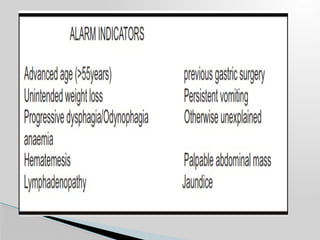
with alarm features
Initial Evaluation
11.
A dominanthistory ofheartburn,regurgitation, or
cough is suggestive of GERD
NSAID use raises the possibility of NSAID dyspepsia
and peptic ulcer disease
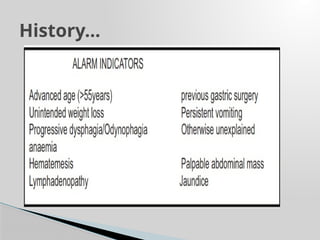
Significant weight loss, anorexia, vomiting, dysphagia,
odynophagia, and a family history of gastrointestinal
cancers suggest the presence of an underlying
malignancy
The presence of severe episodic epigastric or right
upper quadrant abdominal pain lasting more than an
hour or pain that occurs at any time is suggestive of
symptomatic cholelithiasis
History…
The physicalexamination in patients with
dyspepsia is usually normal, except for
epigastric tenderness
Other findings on physical examination may
include: a palpable abdominal mass (eg,
hepatoma) or lymphadenopathy (eg, left
supraclavicular or periumbilical in gastric
cancer), jaundice (eg, secondary to liver
metastasis) or pallor secondary to anemia
Physical Examination…
15.
CBC
H.Pylori test- IgG serology or stool antigen or
13C-urea test
stool for occult blood-when indicated
Liver enzymes
Upper GI Endoscopy when indicated
Investigation
16.
Patients with alarmfeatures:
Upper GI endoscopy:
Upper endoscopy provides a gold standard for
establishing a specific cause in patients with
upper abdominal pain.
Biopsies of the stomach should be obtained to
rule out Helicobacter pylori .
Patients with H. pylori should receive
eradication therapy in addition to treatment
based on the underlying diagnosis
Diagnostic strategies and Initial
Mangement
17.
Patients with noalarm features:
Test for H.Pylori:
If evidence of H.pylori infection: Eradication
therapy
If no evidence of of H.Pylori: Treat with anti acid
secretary agents: PPIs
Diagnostic…
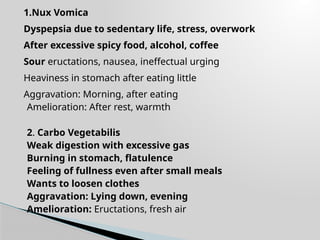
1.Nux Vomica
Dyspepsia dueto sedentary life, stress, overwork
After excessive spicy food, alcohol, coffee
Sour eructations, nausea, ineffectual urging
Heaviness in stomach after eating little
Aggravation: Morning, after eating
Amelioration: After rest, warmth
2. Carbo Vegetabilis
Weak digestion with excessive gas
Burning in stomach, flatulence
Feeling of fullness even after small meals
Wants to loosen clothes
Aggravation: Lying down, evening
Amelioration: Eructations, fresh air
21.
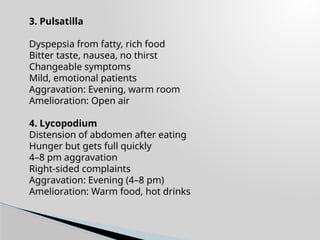
3. Pulsatilla
Dyspepsia fromfatty, rich food
Bitter taste, nausea, no thirst
Changeable symptoms
Mild, emotional patients
Aggravation: Evening, warm room
Amelioration: Open air
4. Lycopodium
Distension of abdomen after eating
Hunger but gets full quickly
4–8 pm aggravation
Right-sided complaints
Aggravation: Evening (4–8 pm)
Amelioration: Warm food, hot drinks