Guideline:
The Role of Endoscopy in Dyspepsia
The Standards of Practice Committee of
the American Society for Gastrointestinal Endoscopy
Dyspepsia
• Definition:
– upper abdominal discomfort that is thought to arise
from the upper-GI tract
Epigastric discomfort
Bloating
Anorexia
Early satiety
Belching or regurgitation
Nausea
Heartburn
Dyspepsia
• Most common
– peptic ulcer disease
– GERD
– Functional disorders (nonulcer dyspepsia)
– malignancy
• Less common
– medication intolerance
– Pancreatitis
– biliary-tract disease
– motility disorders
The Rome III Criteria
1 or more of the following 3 symptoms:
• Postprandial fullness
• Early satiety
• Epigastric pain or burning
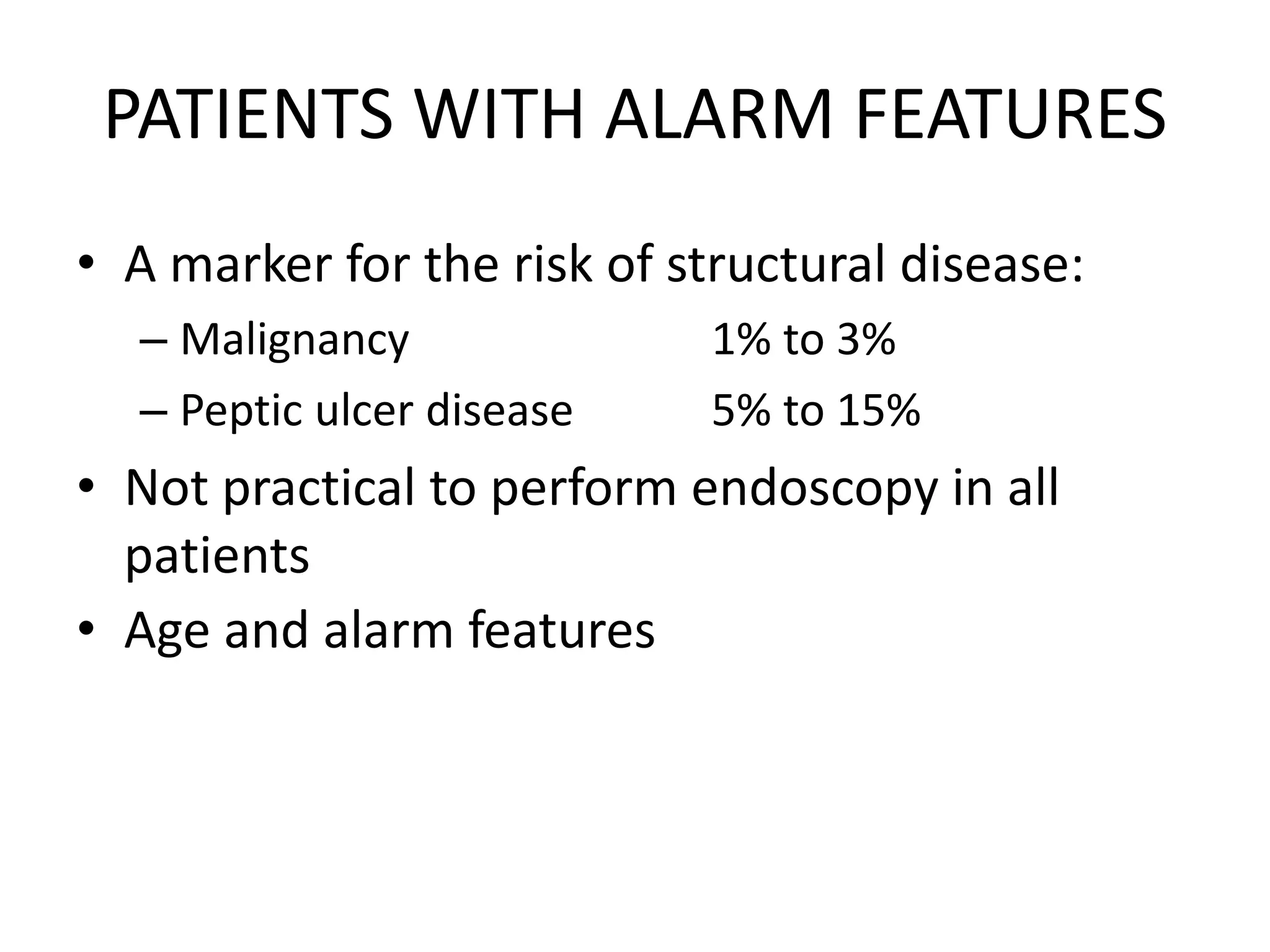
PATIENTS WITH ALARM FEATURES
• A marker for the risk of structural disease:
– Malignancy 1% to 3%
– Peptic ulcer disease 5% to 15%
• Not practical to perform endoscopy in all
patients
• Age and alarm features
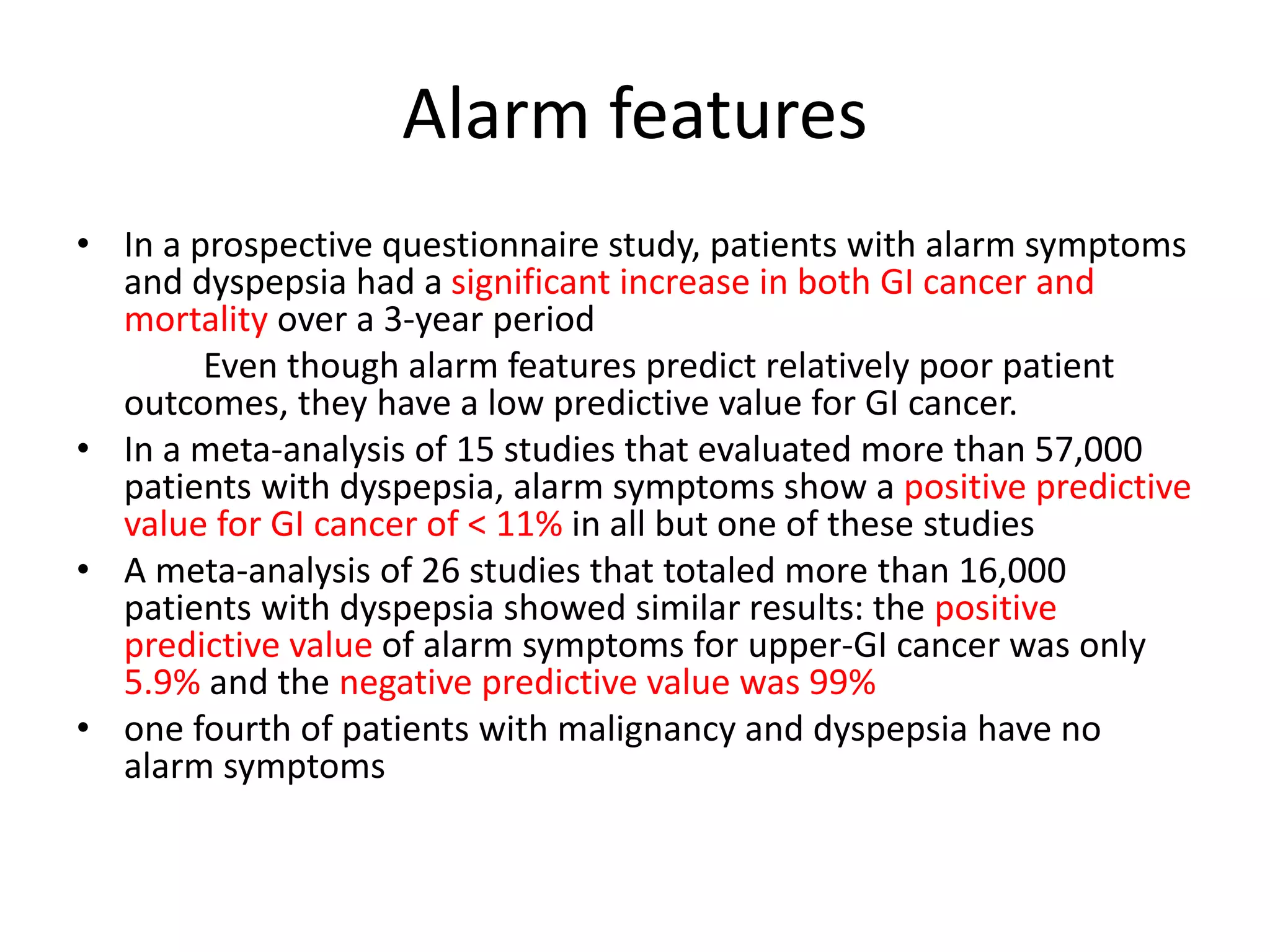
Alarm features
• In a prospective questionnaire study, patients with alarm symptoms
and dyspepsia had a significant increase in both GI cancer and
mortality over a 3-year period
Even though alarm features predict relatively poor patient
outcomes, they have a low predictive value for GI cancer.
• In a meta-analysis of 15 studies that evaluated more than 57,000
patients with dyspepsia, alarm symptoms show a positive predictive
value for GI cancer of < 11% in all but one of these studies
• A meta-analysis of 26 studies that totaled more than 16,000
patients with dyspepsia showed similar results: the positive
predictive value of alarm symptoms for upper-GI cancer was only
5.9% and the negative predictive value was 99%
• one fourth of patients with malignancy and dyspepsia have no
alarm symptoms
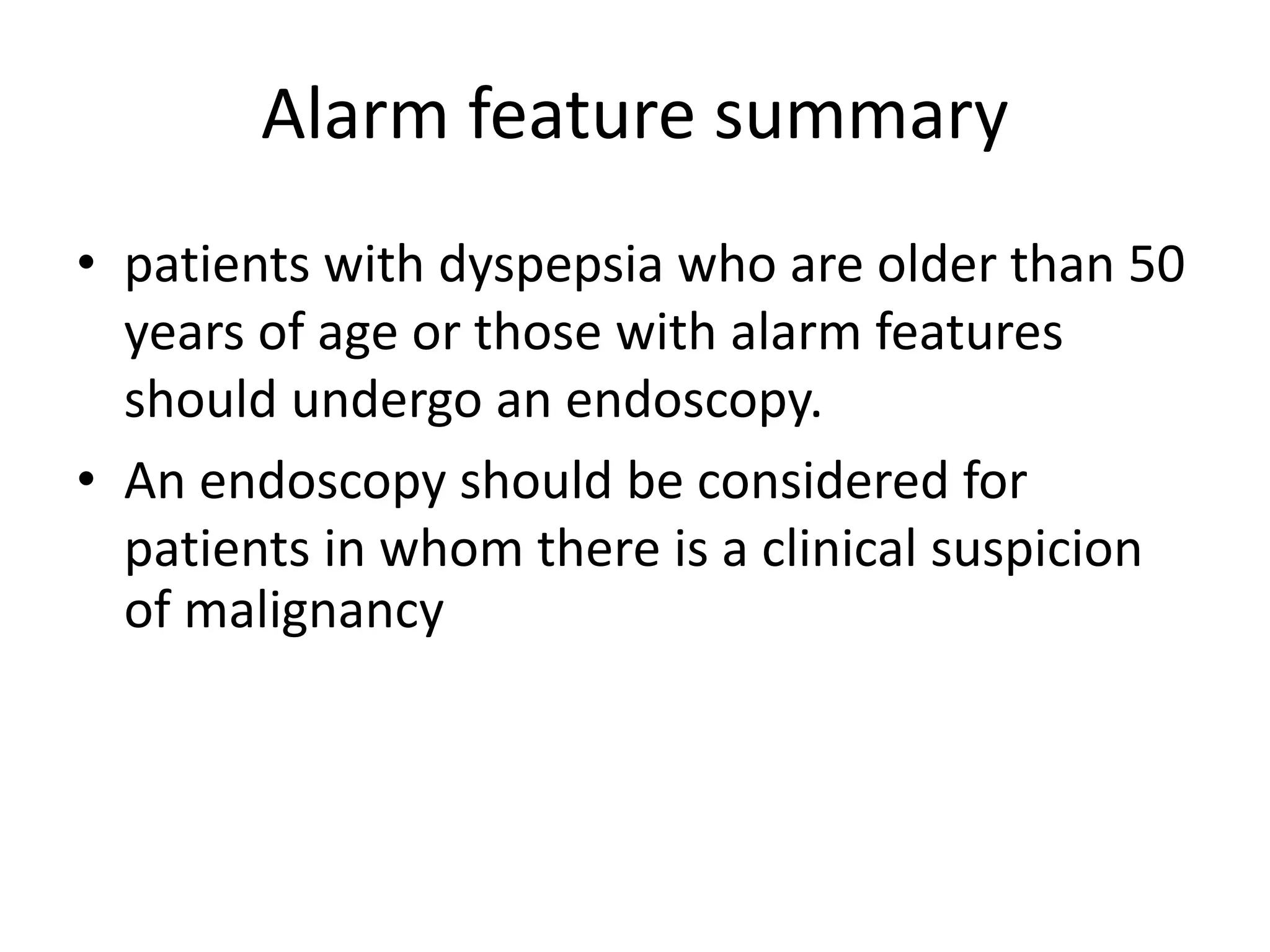
Alarm feature summary
• patients with dyspepsia who are older than 50
years of age or those with alarm features
should undergo an endoscopy.
• An endoscopy should be considered for
patients in whom there is a clinical suspicion
of malignancy
PATIENTS WITHOUT ALARM FEATURES
• Patients with dyspepsia who are younger than
age 50 and without alarm features
• 1 of 3 methods:
(1) test-and-treat approach
Noninvasive testing for H. pylori
if positive  treatment
(2) a trial of acid suppression
(3) an initial endoscopy
Test-and-treat approach
• 5-15% of patients in the United States with dyspepsia
have peptic ulcer disease
• The majority of these patients have H. pylori infection
• Noninvasive testing options for H. pylori
– Serology
• a sensitivity 85-100%
• a specificity 76% to 96%
– urea breath testing (UBT)--higher specificities
– stool antigen --higher specificities
• There is growing evidence--similar outcomes compared
to initial endoscopy
• More cost effective
test-and-treat versus initial endoscopy
• A meta-analysis of 5 randomized studies of
test-and-treat versus an initial endoscopy
showed a negligible improvement of
symptoms in the endoscopy group but a
savings of $389 per patient in the test-and-
treat group
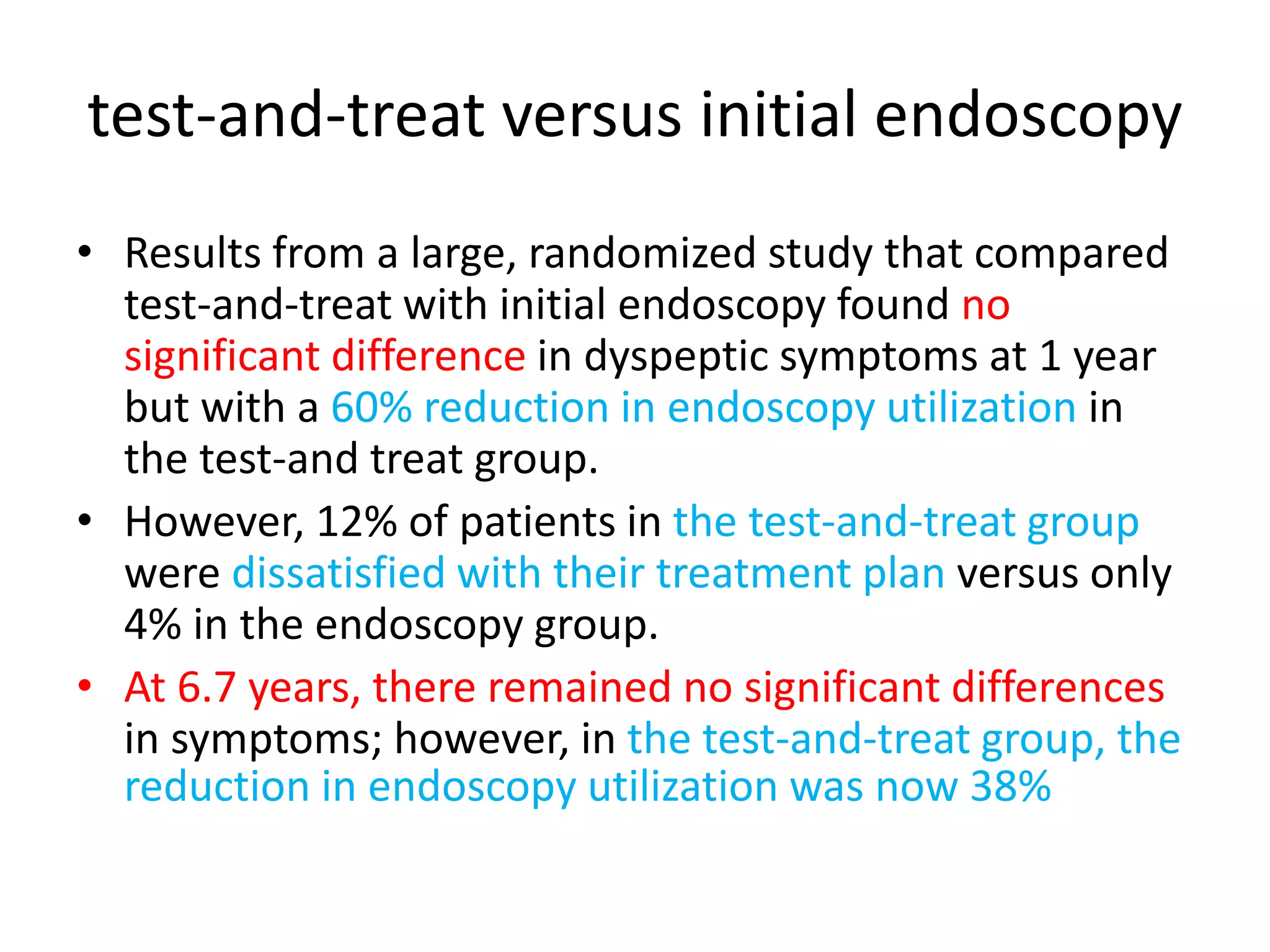
test-and-treat versus initial endoscopy
• Results from a large, randomized study that compared
test-and-treat with initial endoscopy found no
significant difference in dyspeptic symptoms at 1 year
but with a 60% reduction in endoscopy utilization in
the test-and treat group.
• However, 12% of patients in the test-and-treat group
were dissatisfied with their treatment plan versus only
4% in the endoscopy group.
• At 6.7 years, there remained no significant differences
in symptoms; however, in the test-and-treat group, the
reduction in endoscopy utilization was now 38%
Initial upper endoscopy
• The standard for the diagnosis of structural disease in
patients with dyspepsia
• Barium evaluation
– lower sensitivity and specificity
– does not allow for biopsy
should generally be limited to patients at high risk for
endoscopic complications
• Possibility of establishing a specific diagnosis, such as
peptic ulcer disease or erosive esophagitis
• Reduction in anxiety and an increase in patient
Satisfaction
• Cost-effectiveness
Acid-suppression therapy
• Proton pump inhibitors (PPI) are most
effective
• H. pylori–associated peptic ulcer disease
risk of recurrent symptoms when acid
suppression is withdrawn
long-term acid suppression
PPI VS test-and-treat approach
• In a study in patients of 45 years of age, a higher
endoscopy rate was seen in the PPI treatment
group (88% vs 55%) This was likely because of a
high prevalence of H. pylori in this population.
• A decision analysis showed that cost-
effectiveness of the test-and-treat approach
versus empiric acid suppression depends on the
prevalence of H pylori.
– If the incidence of H pylori is < 20% 
empiric acid-suppression therapy is more cost
effective
acid suppression VS early endoscopy
• In a study that compared empiric H2 blockers
with early endoscopy, endoscopy was eventually
performed in 66% of the H2 blocker group. Costs
were higher in this group primarily because of
days lost from work and the cost of medications.
• There are limited comparative studies of empiric
PPI therapy and endoscopy, and the results are
mixed with respect to cost-effectiveness
PPI VS and endoscopy
• There are limited comparative studies of
empiric PPI therapy and endoscopy, and the
results are mixed with respect to cost-
effectiveness
Acid-suppression therapy
• It is unclear whether patients with dyspepsia who require
prolonged PPI use should undergo an endoscopy. An
endoscopy may still need to be considered in the group of
nonresponders to exclude structural disease.
• short trial of PPI for patients without alarm symptoms, who
are younger than age 50 years, and who do not respond after
the test-and-treat approach has not been formally evaluated.
RECOMMENDATIONS
• >50 years of age or those with alarm features 
endoscopic evaluation
• <50 years of age + NO alarm features  an initial
test-and-treat approach for H pylori
• <50 years of age + H pylori negative initial
endoscopy or a short trial of PPI
• Patients with dyspepsia who do not respond to
empiric PPI therapy or have recurrent symptoms
after an adequate trial  endoscopy
REFERENCE
The Standards of Practice Committee of
the American Society for Gastrointestinal Endoscopy
THANK YOU

Dyspepsia endoscopy guideline

  • 1.
    Guideline: The Role ofEndoscopy in Dyspepsia The Standards of Practice Committee of the American Society for Gastrointestinal Endoscopy
  • 2.
    Dyspepsia • Definition: – upperabdominal discomfort that is thought to arise from the upper-GI tract Epigastric discomfort Bloating Anorexia Early satiety Belching or regurgitation Nausea Heartburn
  • 3.
    Dyspepsia • Most common –peptic ulcer disease – GERD – Functional disorders (nonulcer dyspepsia) – malignancy • Less common – medication intolerance – Pancreatitis – biliary-tract disease – motility disorders
  • 4.
    The Rome IIICriteria 1 or more of the following 3 symptoms: • Postprandial fullness • Early satiety • Epigastric pain or burning
  • 5.
    PATIENTS WITH ALARMFEATURES • A marker for the risk of structural disease: – Malignancy 1% to 3% – Peptic ulcer disease 5% to 15% • Not practical to perform endoscopy in all patients • Age and alarm features
  • 7.
    Alarm features • Ina prospective questionnaire study, patients with alarm symptoms and dyspepsia had a significant increase in both GI cancer and mortality over a 3-year period Even though alarm features predict relatively poor patient outcomes, they have a low predictive value for GI cancer. • In a meta-analysis of 15 studies that evaluated more than 57,000 patients with dyspepsia, alarm symptoms show a positive predictive value for GI cancer of < 11% in all but one of these studies • A meta-analysis of 26 studies that totaled more than 16,000 patients with dyspepsia showed similar results: the positive predictive value of alarm symptoms for upper-GI cancer was only 5.9% and the negative predictive value was 99% • one fourth of patients with malignancy and dyspepsia have no alarm symptoms
  • 8.
    Alarm feature summary •patients with dyspepsia who are older than 50 years of age or those with alarm features should undergo an endoscopy. • An endoscopy should be considered for patients in whom there is a clinical suspicion of malignancy
  • 9.
    PATIENTS WITHOUT ALARMFEATURES • Patients with dyspepsia who are younger than age 50 and without alarm features • 1 of 3 methods: (1) test-and-treat approach Noninvasive testing for H. pylori if positive  treatment (2) a trial of acid suppression (3) an initial endoscopy
  • 10.
    Test-and-treat approach • 5-15%of patients in the United States with dyspepsia have peptic ulcer disease • The majority of these patients have H. pylori infection • Noninvasive testing options for H. pylori – Serology • a sensitivity 85-100% • a specificity 76% to 96% – urea breath testing (UBT)--higher specificities – stool antigen --higher specificities • There is growing evidence--similar outcomes compared to initial endoscopy • More cost effective
  • 11.
    test-and-treat versus initialendoscopy • A meta-analysis of 5 randomized studies of test-and-treat versus an initial endoscopy showed a negligible improvement of symptoms in the endoscopy group but a savings of $389 per patient in the test-and- treat group
  • 12.
    test-and-treat versus initialendoscopy • Results from a large, randomized study that compared test-and-treat with initial endoscopy found no significant difference in dyspeptic symptoms at 1 year but with a 60% reduction in endoscopy utilization in the test-and treat group. • However, 12% of patients in the test-and-treat group were dissatisfied with their treatment plan versus only 4% in the endoscopy group. • At 6.7 years, there remained no significant differences in symptoms; however, in the test-and-treat group, the reduction in endoscopy utilization was now 38%
  • 13.
    Initial upper endoscopy •The standard for the diagnosis of structural disease in patients with dyspepsia • Barium evaluation – lower sensitivity and specificity – does not allow for biopsy should generally be limited to patients at high risk for endoscopic complications • Possibility of establishing a specific diagnosis, such as peptic ulcer disease or erosive esophagitis • Reduction in anxiety and an increase in patient Satisfaction • Cost-effectiveness
  • 14.
    Acid-suppression therapy • Protonpump inhibitors (PPI) are most effective • H. pylori–associated peptic ulcer disease risk of recurrent symptoms when acid suppression is withdrawn long-term acid suppression
  • 15.
    PPI VS test-and-treatapproach • In a study in patients of 45 years of age, a higher endoscopy rate was seen in the PPI treatment group (88% vs 55%) This was likely because of a high prevalence of H. pylori in this population. • A decision analysis showed that cost- effectiveness of the test-and-treat approach versus empiric acid suppression depends on the prevalence of H pylori. – If the incidence of H pylori is < 20%  empiric acid-suppression therapy is more cost effective
  • 16.
    acid suppression VSearly endoscopy • In a study that compared empiric H2 blockers with early endoscopy, endoscopy was eventually performed in 66% of the H2 blocker group. Costs were higher in this group primarily because of days lost from work and the cost of medications. • There are limited comparative studies of empiric PPI therapy and endoscopy, and the results are mixed with respect to cost-effectiveness
  • 17.
    PPI VS andendoscopy • There are limited comparative studies of empiric PPI therapy and endoscopy, and the results are mixed with respect to cost- effectiveness
  • 18.
    Acid-suppression therapy • Itis unclear whether patients with dyspepsia who require prolonged PPI use should undergo an endoscopy. An endoscopy may still need to be considered in the group of nonresponders to exclude structural disease. • short trial of PPI for patients without alarm symptoms, who are younger than age 50 years, and who do not respond after the test-and-treat approach has not been formally evaluated.
  • 20.
    RECOMMENDATIONS • >50 yearsof age or those with alarm features  endoscopic evaluation • <50 years of age + NO alarm features  an initial test-and-treat approach for H pylori • <50 years of age + H pylori negative initial endoscopy or a short trial of PPI • Patients with dyspepsia who do not respond to empiric PPI therapy or have recurrent symptoms after an adequate trial  endoscopy
  • 21.
    REFERENCE The Standards ofPractice Committee of the American Society for Gastrointestinal Endoscopy THANK YOU