Failure to progress
Benha University Hospital, Egypt
Email: elnashar53@hotmail.com
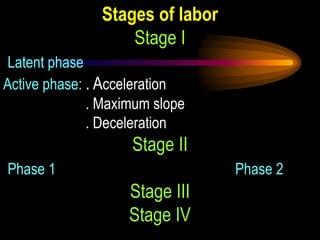
Stages of labor
Stage I
Latent phase
Active phase: . Acceleration
. Maximum slope
. Deceleration
Stage II
Phase 1 Phase 2
Stage III
Stage IV
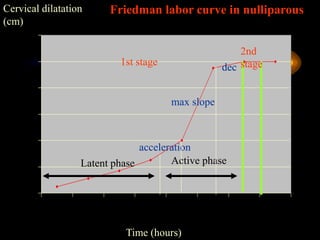
Latent phase Active phase
2nd
stage
1st stage
max slope
acceleration
dec
Time (hours)
Cervical dilatation
(cm)
Friedman labor curve in nulliparous
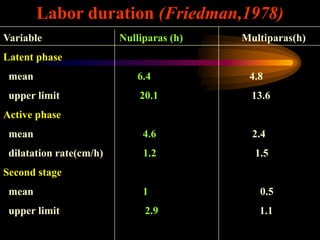
Labor duration (Friedman,1978)
Variable Nulliparas (h) Multiparas(h)
Latent phase
mean 6.4 4.8
upper limit 20.1 13.6
Active phase
mean 4.6 2.4
dilatation rate(cm/h) 1.2 1.5
Second stage
mean 1 0.5
upper limit 2.9 1.1
Dysfunctional labor
Definition
Any deviation in normal
progress of labor , either in
cervical dilatation or in descent
of the presenting part
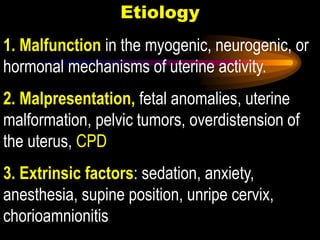
Etiology
1. Malfunction in the myogenic, neurogenic, or
hormonal mechanisms of uterine activity.
2. Malpresentation, fetal anomalies, uterine
malformation, pelvic tumors, overdistension of
the uterus, CPD
3. Extrinsic factors: sedation, anxiety,
anesthesia, supine position, unripe cervix,
chorioamnionitis
Classification
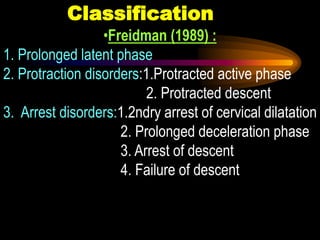
•Freidman (1989) :
1. Prolonged latent phase
2. Protraction disorders:1.Protracted active phase
2. Protracted descent
3. Arrest disorders:1.2ndry arrest of cervical dilatation
2. Prolonged deceleration phase
3. Arrest of descent
4. Failure of descent
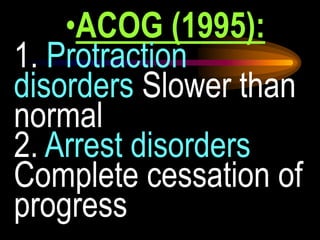
•ACOG (1995):
1. Protraction
disorders Slower than
normal
2. Arrest disorders
Complete cessation of
progress
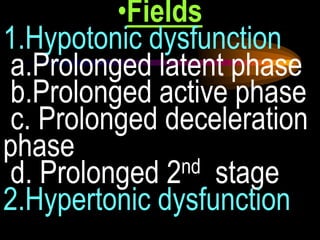
•Fields
1.Hypotonic dysfunction
a.Prolonged latent phase
b.Prolonged active phase
c. Prolonged deceleration
phase
d. Prolonged 2nd stage
2.Hypertonic dysfunction
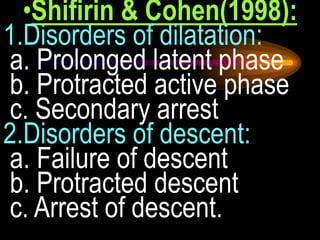
•Shifirin & Cohen(1998):
1.Disorders of dilatation:
a. Prolonged latent phase
b. Protracted active phase
c. Secondary arrest
2.Disorders of descent:
a. Failure of descent
b. Protracted descent
c. Arrest of descent.
•Philpott (1979)
1. Prolonged latent
phase
2. Primary dysfunctional
labor
3. 2ndry arrest of labor.
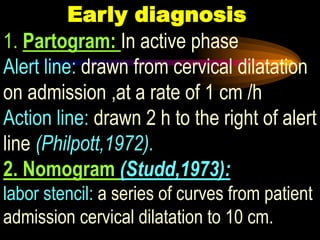
Early diagnosis
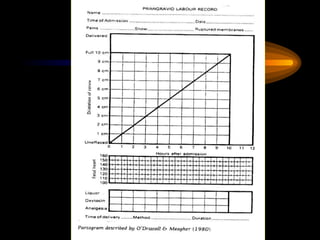
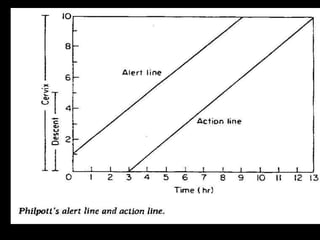
1. Partogram: In active phase
Alert line: drawn from cervical dilatation
on admission ,at a rate of 1 cm /h
Action line: drawn 2 h to the right of alert
line (Philpott,1972).
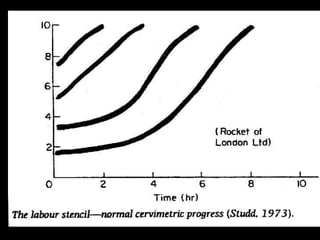
2. Nomogram (Studd,1973):
labor stencil: a series of curves from patient
admission cervical dilatation to 10 cm.
Prevention
O,Driscol method of active
management of labor (1969)
• Diagnosis of labor
• 1 h: ARM
• 2h:cervical dilatation <1 cm /h:
oxytocin drip
Prolonged latent phase
Define
Freidman: > 20 h in PG, > 14 h in MG
from onset of labor (difficult to determine)
Philpott:> 6h in PG , > 4h in MG from
admission in labor.
Incidence
PG: 4% MG: 1%
Etiology
1. Wrong diagnosis of labor
2.Excess sedation
3. An abnormal or high presenting part
4. PROM
5.Idiopathic.
Risks
are created by aggressive intervention.
If membranes are intact, no risk , only
maternal anxiety.
Treatment
True labor or not: PV, CTG, palpation of the
cervix & reexamine after 4h:
1.C stop or no cx changes: not in labor
2. C persist & no cervical changes: sedation.
3. C. persist & cx changes : ARM + Syntocinon
drip. A. In 85% labor will progress rapidly .
B.In 15% adequate C will not cause cx
dilatation. If after 4-8 h of syntocinon, the
cervix is not further dilated, CS.
Primary dysfunctional labor
Define
Cx. Dil. < 1cm/h before normal active phase has
been established
Incidence
PG: 20% MG: 8%
Etiology
1. Inefficient C.: the commonest
2. CPD: 1/ 3
3. Malpresentation or malposition
Risks
1. F. distress
2. Maternal fear & anxiety , dehydration &
acidosis
3. Incordinate u. activity.
Treatment
Exclude CPD, ARM + oxytocin drip.
15%: vag. Delivery
35%: instrumental delivery
50%: CS for F. distress.
2ndry arrest of labor
Define
Active phase started normally( cervical
dilatation reached 5-7 cm ) then cervical
dilatation stop or slows significantly within 2 h
Incidence
PG: 6% MG: 2%
Etiology
1.CPD:50%
2. Malposition
Risks
F. distress: rare
Treatment
Exclude CPD , ARM & Syntocinon drip
No progress after 4 h : CS (15% ).
O, Driscol advised oxytocin
regardless of pelvimetry.
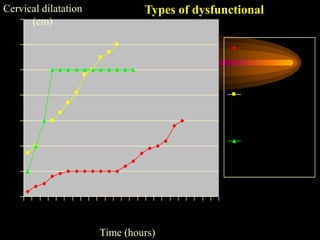
Cervical dilatation
(cm)
Time (hours)
Types of dysfunctional
Prolonged deceleration
phase
Define
Arrest or slow of cervical dilatation after 8 cm
(PG > 3h , MG > 1h)
Etiology
1. CPD 2. Uterine exhaustion
Risks
1. High incidence of shoulder dystocia
2. Forceps is difficult
Treatment
Syntocinon is not helpful. C.S.
Elnashar et al (2000) compared oxytocin
infusion alone & with propranolol in the
management of DL (Primary DL & 2ndry
arrest).
The study group (50 women) was given propranolol
I.V. in a dose of 2 mg to be repeated after one hour if
there was no response in cervical dilatation.
The control group (50 women) & the study group
received oxytocin infusion for at least 4 hours & for
maximum of 6 hours & if there was no response,CS
was done.
There were a significant differences in the drug-
delivery interval (2.2 vs 3.7 hours) & CS rate (20 vs
38 %) between the study & the control groups.
Between the two groups, no statistically significant
differences were observed in low Apgar scores or
incidence of admissions to the NICU.
Conclusion: Propranolol combined with
oxytocin infusion in management of DL safely
shortened the drug-delivery interval & reduced
CS rate.
Active
management of
labor
Dr Aboubakr Elnashar
•First introduced by O, Driscol
et al (1969) in Dublin.
•Many modifications
Protocol
1.This approach to management is confined to
nulliparas.
2. Patient education during pregnancy: signs &
symptoms of labor
3.Strict criteria for diagnosis of labor:
painful uterine contractions as well as
complete effacement of the cervix,
ruptured membranes or
passage of blood stained mucous
The diagnosis of labor is made within 1 hr of
presentation.
4.Each woman in labor is assigned to
trained professional companion.
5.Amniotomy within 1 hr of admission.
6.Strict criteria for diagnosis of abnormal labor
progress. partogram or labor graph.
7.Oxytocin high dose infusion:
if progress of labor is < 1 cm/h over 2 h.
Oxytocin infusion is begun at 6mu/min &
increased by 6 mu/min every 15 min until 7
C/15min. or 40 mu/min.
8.Assess FHR by auscultation
intermittently Continuous electronic fetal
heart rate monitoring is used only if there is
me conium stained amniotic fluid
9.All methods of pain relief are freely
available.
10. C.S if no delivery12 hr post admission
or if fetal scalp ph sampling revealed fetal
compromise.
Benefits
1.Prevention of dysfunctional labor
2.Decrease the incidence of prolonged labor
from 30% to 7% (Boylan,1997)
3.Decrease incidence of operative delivery.
4. Decrease maternal infectious mrbidity
5.Decrease incidence of C.S to 4.8% (Lopez-
Zeno,1992).
Some found no decrease in CS rate (Fraser et
al,1993) & others found an increase in CS rate
(Boylan et al,1993).
Amniotomy for shortening
spontaneous labour
Fraser et al, The Cochrane Library, 2, 2001.
Routine early amniotomy is associated with
both benefits and risks.
•Benefits include a reduction in labor
duration( between 60 and 120 minutes) and
a possible reduction in abnormal 5-minute
Apgar scores.
•No support for the hypothesis that routine
early amniotomy reduces the risk of CS.
Indeed there is a trend toward an increase
in CS. An association between early
amniotomy and CS for fetal distress is
noted in one large trial.
This suggests that amniotomy should be
reserved for women with abnormal labor
progress.
Benha University Hospital, Egypt
Email: elnashar53@hotmail.com

dysfunctional-labour.ppt

  • 1.
    Failure to progress BenhaUniversity Hospital, Egypt Email: elnashar53@hotmail.com
  • 2.
    Stages of labor StageI Latent phase Active phase: . Acceleration . Maximum slope . Deceleration Stage II Phase 1 Phase 2 Stage III Stage IV
  • 3.
    Latent phase Activephase 2nd stage 1st stage max slope acceleration dec Time (hours) Cervical dilatation (cm) Friedman labor curve in nulliparous
  • 4.
    Labor duration (Friedman,1978) VariableNulliparas (h) Multiparas(h) Latent phase mean 6.4 4.8 upper limit 20.1 13.6 Active phase mean 4.6 2.4 dilatation rate(cm/h) 1.2 1.5 Second stage mean 1 0.5 upper limit 2.9 1.1
  • 5.
    Dysfunctional labor Definition Any deviationin normal progress of labor , either in cervical dilatation or in descent of the presenting part
  • 6.
    Etiology 1. Malfunction inthe myogenic, neurogenic, or hormonal mechanisms of uterine activity. 2. Malpresentation, fetal anomalies, uterine malformation, pelvic tumors, overdistension of the uterus, CPD 3. Extrinsic factors: sedation, anxiety, anesthesia, supine position, unripe cervix, chorioamnionitis
  • 7.
    Classification •Freidman (1989) : 1.Prolonged latent phase 2. Protraction disorders:1.Protracted active phase 2. Protracted descent 3. Arrest disorders:1.2ndry arrest of cervical dilatation 2. Prolonged deceleration phase 3. Arrest of descent 4. Failure of descent
  • 8.
    •ACOG (1995): 1. Protraction disordersSlower than normal 2. Arrest disorders Complete cessation of progress
  • 9.
    •Fields 1.Hypotonic dysfunction a.Prolonged latentphase b.Prolonged active phase c. Prolonged deceleration phase d. Prolonged 2nd stage 2.Hypertonic dysfunction
  • 10.
    •Shifirin & Cohen(1998): 1.Disordersof dilatation: a. Prolonged latent phase b. Protracted active phase c. Secondary arrest 2.Disorders of descent: a. Failure of descent b. Protracted descent c. Arrest of descent.
  • 11.
    •Philpott (1979) 1. Prolongedlatent phase 2. Primary dysfunctional labor 3. 2ndry arrest of labor.
  • 12.
    Early diagnosis 1. Partogram:In active phase Alert line: drawn from cervical dilatation on admission ,at a rate of 1 cm /h Action line: drawn 2 h to the right of alert line (Philpott,1972). 2. Nomogram (Studd,1973): labor stencil: a series of curves from patient admission cervical dilatation to 10 cm.
  • 16.
    Prevention O,Driscol method ofactive management of labor (1969) • Diagnosis of labor • 1 h: ARM • 2h:cervical dilatation <1 cm /h: oxytocin drip
  • 17.
    Prolonged latent phase Define Freidman:> 20 h in PG, > 14 h in MG from onset of labor (difficult to determine) Philpott:> 6h in PG , > 4h in MG from admission in labor. Incidence PG: 4% MG: 1%
  • 18.
    Etiology 1. Wrong diagnosisof labor 2.Excess sedation 3. An abnormal or high presenting part 4. PROM 5.Idiopathic. Risks are created by aggressive intervention. If membranes are intact, no risk , only maternal anxiety.
  • 19.
    Treatment True labor ornot: PV, CTG, palpation of the cervix & reexamine after 4h: 1.C stop or no cx changes: not in labor 2. C persist & no cervical changes: sedation. 3. C. persist & cx changes : ARM + Syntocinon drip. A. In 85% labor will progress rapidly . B.In 15% adequate C will not cause cx dilatation. If after 4-8 h of syntocinon, the cervix is not further dilated, CS.
  • 20.
    Primary dysfunctional labor Define Cx.Dil. < 1cm/h before normal active phase has been established Incidence PG: 20% MG: 8% Etiology 1. Inefficient C.: the commonest 2. CPD: 1/ 3 3. Malpresentation or malposition
  • 21.
    Risks 1. F. distress 2.Maternal fear & anxiety , dehydration & acidosis 3. Incordinate u. activity. Treatment Exclude CPD, ARM + oxytocin drip. 15%: vag. Delivery 35%: instrumental delivery 50%: CS for F. distress.
  • 22.
    2ndry arrest oflabor Define Active phase started normally( cervical dilatation reached 5-7 cm ) then cervical dilatation stop or slows significantly within 2 h Incidence PG: 6% MG: 2% Etiology 1.CPD:50% 2. Malposition
  • 23.
    Risks F. distress: rare Treatment ExcludeCPD , ARM & Syntocinon drip No progress after 4 h : CS (15% ). O, Driscol advised oxytocin regardless of pelvimetry.
  • 24.
  • 25.
    Prolonged deceleration phase Define Arrest orslow of cervical dilatation after 8 cm (PG > 3h , MG > 1h) Etiology 1. CPD 2. Uterine exhaustion Risks 1. High incidence of shoulder dystocia 2. Forceps is difficult Treatment Syntocinon is not helpful. C.S.
  • 26.
    Elnashar et al(2000) compared oxytocin infusion alone & with propranolol in the management of DL (Primary DL & 2ndry arrest). The study group (50 women) was given propranolol I.V. in a dose of 2 mg to be repeated after one hour if there was no response in cervical dilatation. The control group (50 women) & the study group received oxytocin infusion for at least 4 hours & for maximum of 6 hours & if there was no response,CS was done.
  • 27.
    There were asignificant differences in the drug- delivery interval (2.2 vs 3.7 hours) & CS rate (20 vs 38 %) between the study & the control groups. Between the two groups, no statistically significant differences were observed in low Apgar scores or incidence of admissions to the NICU. Conclusion: Propranolol combined with oxytocin infusion in management of DL safely shortened the drug-delivery interval & reduced CS rate.
  • 28.
    Active management of labor Dr AboubakrElnashar •First introduced by O, Driscol et al (1969) in Dublin. •Many modifications
  • 29.
    Protocol 1.This approach tomanagement is confined to nulliparas. 2. Patient education during pregnancy: signs & symptoms of labor 3.Strict criteria for diagnosis of labor: painful uterine contractions as well as complete effacement of the cervix, ruptured membranes or passage of blood stained mucous The diagnosis of labor is made within 1 hr of presentation.
  • 30.
    4.Each woman inlabor is assigned to trained professional companion. 5.Amniotomy within 1 hr of admission. 6.Strict criteria for diagnosis of abnormal labor progress. partogram or labor graph. 7.Oxytocin high dose infusion: if progress of labor is < 1 cm/h over 2 h. Oxytocin infusion is begun at 6mu/min & increased by 6 mu/min every 15 min until 7 C/15min. or 40 mu/min.
  • 31.
    8.Assess FHR byauscultation intermittently Continuous electronic fetal heart rate monitoring is used only if there is me conium stained amniotic fluid 9.All methods of pain relief are freely available. 10. C.S if no delivery12 hr post admission or if fetal scalp ph sampling revealed fetal compromise.
  • 32.
    Benefits 1.Prevention of dysfunctionallabor 2.Decrease the incidence of prolonged labor from 30% to 7% (Boylan,1997) 3.Decrease incidence of operative delivery. 4. Decrease maternal infectious mrbidity 5.Decrease incidence of C.S to 4.8% (Lopez- Zeno,1992). Some found no decrease in CS rate (Fraser et al,1993) & others found an increase in CS rate (Boylan et al,1993).
  • 33.
    Amniotomy for shortening spontaneouslabour Fraser et al, The Cochrane Library, 2, 2001. Routine early amniotomy is associated with both benefits and risks. •Benefits include a reduction in labor duration( between 60 and 120 minutes) and a possible reduction in abnormal 5-minute Apgar scores.
  • 34.
    •No support forthe hypothesis that routine early amniotomy reduces the risk of CS. Indeed there is a trend toward an increase in CS. An association between early amniotomy and CS for fetal distress is noted in one large trial. This suggests that amniotomy should be reserved for women with abnormal labor progress.
  • 35.
    Benha University Hospital,Egypt Email: elnashar53@hotmail.com