Labour and
Partograph
By Yusnita
Labour
 Def-physiologic process during which the
products of conception (ie, the fetus,
membranes, umbilical cord, and placenta)
are expelled outside of the uterus.
 Sign and symptoms of labour
 Regular painful uterine contraction
 Show ( blood-stained mucous discharge)
 Leaking liquor (ROM)
 Shortening and dilatation of cervix
 Three Stages of labour
Stages of Labour
 First stage – stage of cervical dilatation
 From onset of labour/ true labour until cervix is
fully effaced( 10 cm )
1.Latent phase- mild, irregular uterine
contractions that soften and shorten the cervix.
2.Active phase-begins at about 3-4 cm to 10 cm
fully dilated cervix and is characterized by rapid
cervical dilation and descent of the presenting
fetal part
- Primi ( 12 hours)
- Multigravida (8 hours)
 Second Stage – stage of expulsion or
delivery of fetus
 begins with full cervical dilatation until the delivery
of the fetus.
 Primid (2 hours)
 Multi (1hour)
 Third stage-time period from birth of the fetus
until the delivery of the placenta and fetal
membranes (20-30min)
 Gushing of fluid
 Cord lengthening
 Uterus contracted and raised
Mechanism of Labour
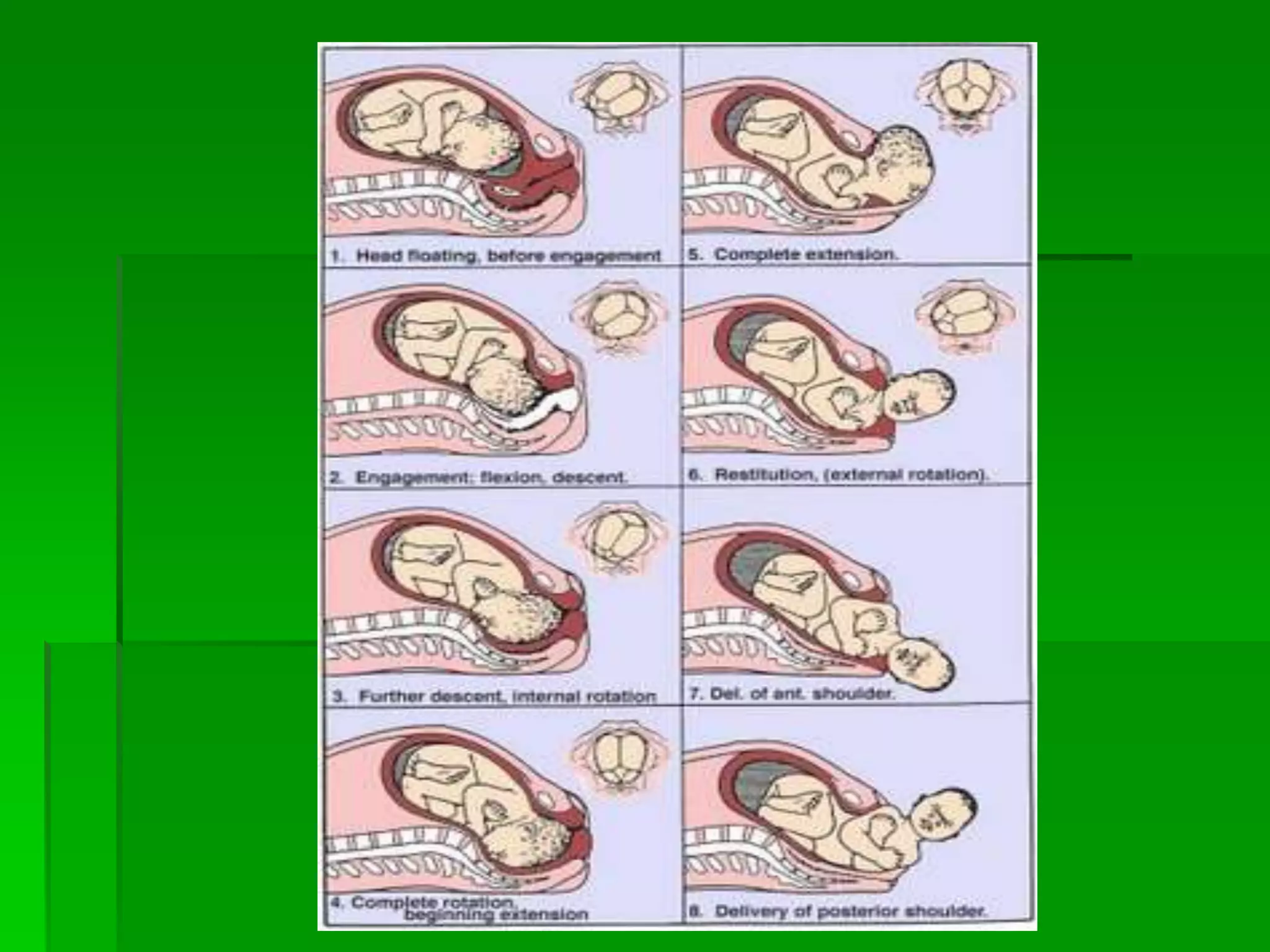
 Engagement
 The widest diameter
of the presenting
part or Biparietal
(vertex) diameter
descent below the
pelvic brim
 Descent of fetal
head into pelvis
usually described as
if the head is divided
into five segments
 Imaginary line joining
the ischial spine is
station 0
 Descent and Flexion and internal rotation
 fetal vertex descents through the pelvis with
contraction
 Fetal head well- flexed
 Fetal head enters in the ocipitotransverse
then rotates to address anteroposterior
diameter of outlet
 Extension and delivery of head
 Upward resistance from the pelvic floor and
the downward forces from the uterine
contractions cause the occiput to extend and
rotate around the symphysis. This is
followed by the delivery of the fetus' head.
 Restitution, external rotation and delivery of
the shoulders
 Head restitutes to align itself naturally
perpendicular to shoulder
 shoulder enter pelvis in oblique position
 Anterior shoulder deliver assisted by lateral
flexion of the body
 Delivery of body
 Post shoulder deliver with opposite traction
upward
Partograph
 The partograph is a printed graph representing the
stages of labor
 partograph consist of three sections:
 the fetal record, - track fetal heart rate, amniotic
liquor, and moulding of the fetal skull
 the labor record - tracks cervical dilatation and
descent of the fetus’ head over time, comparing it to
a pre-printed “alert” and “action” lines
 the maternal record - often captures contractions,
blood pressure, pulse, urine output, temperature,
and drugs administered (including oxytocin).
 The alert line is plotted to correspond with the onset
of the active phase of labor(dilation of the cervix to 4
centimeters).
 should expect dilation to continue at about the rate of 1
centimeter per hour.
 The action line is plotted 4 hours after the alert line. If
the woman’s labor is not following the expected
course after 4 hours, the plot of her labor will begin
to approach the action line, signaling the need to
take action.
 Interventions that may be appropriate when the
action line is crossed include the use of oxytocin to
augment labor, vacuum-assisted birth (if the cervix is
fully dilated),or cesarean section.
 FHR –
 Normal ( 120-160 bpm)
 Fetal bradycardia ( below 120 bpm) –
maternal asministered drugs eg; opiates or
fetal cardiac abnormalities eg; heart block
and fetal hypoxia
 Fetal tachycardia ( above 160 bpm ) –
maternal disease such as infection and
thyrotoxicosis, administered drug as atropine
and hydralazine, fetal prematurity, infection
 Look for liquor
 Clear
 MSL indicate underlying fetal hypoxia
 Light MSL if CTG reactive, manage as
normal labour
 Thick MSL – LSCS if in early labour
 If advanced labour, consider instrumental
delivery
Moulding
 Fetal scalp bones are not fused allow
separation or overlap during passage
through maternal pelvis
 Described as the extent of overlapping
of fetal skull bones
 To identify moulding, first palpate the
suture lines on the fetal head
 0 Bones are separated and the sutures
can be felt easily.
 +1 Bones are just touching each other.
 +2 Bones are overlapping but can be
separated easily with pressure by your
finger.
 +3 Bones are overlapping but cannot be
separated easily with pressure by your
finger
Cervical dilatation
 Opening of cervix measuring in
centimeters
Management in 1st stage
pf labour
 Mother
 Half hourly BP/vital sign
 4hrly temp, urine output, ketone or albumin
 effective analgesia
 Record progression of labour in partograph
 Fetus
 FHR
 CTG- hourly CTG for ( medical disorder,
previous scar, oligohdramnions, suspected fetal
compromised, MSL
Management of 2 nd stage
of labour
 Should not encourage maternal bearing
down until fetal head descended to pelvic
floor
 Support perineum with pad during
delivery
 Ensure fetal head is well flexed till
delivery
 Give syntometrin at delivery of anterior
shoulder
Management of 3 rd stage
of labour
 Delivery placenta by CCT and check
completeness
 Make sure vital sign mother are stable
and uterus well contracted before
Abnormal labour
 Prolonged labour
 Obstructed labour
Prolonged labour
 Progress in labour dependend on 3 variables
 Powers(uterine efficiency)
 Inefficient uterine contraction a/w maternal age
 Also a/w CPD , uterine overdistension eg; twin and
malposition
 Passenger(fetus)
 Size or macrosomia baby, malposition ,
malpresentation( brow, shoulder,face. Breech)
 Passages
 Primary uterine dysfunction due to dispropotion,
stenosis ofvagina , stenosis or scarring of cervix,
contracted bony pelvis, pelvic tumor
Prolongation of labour
 Prolong latent phase
 Primary dysfunctional labour
 Secondary arrest
 Prolonged second stage of labour
Prolonged Latent phase
 Failure of thinning of lower segment, effacement of
dilatation of cervix despite several hours of painful
contractions
 8 hours in primi and 4-6 hours in multipara
 Management
 Assess after 4-6 hrs
 If in labour and a/w CPD or malpresentation, LSCS is
indicated
 In absent of complication, need reassurance ,
hydration, nutrition and ambulation
 Best manage conservatively, in most instances, may
develop painful contraction within 24-48 hrs and
deliver normally
Primary dysfunction
labour
 Most common in first labour
 A slow progress during active phase of labour a/w
inefficient uterine contractions
 (delay in the early part of active phase ie 3-7 cm )often
respond well to augmentation
 Management
 TRO possible genuine CPD , large baby, malpresentation or
small pelvis
 Ensure adequate Hydration and analgesia in labour
 ARM if MI
 Considered oxytocin augmentation
 LSCS when there is poor progress in cervical dilatation or
descent of presenting part or CTG show variable deceleration
suggesting head compression due to CPD
Secondary Arrest
 Normal progress of labour in initial active
phasebut prolongation of late first stage
of labour, arrest of cervical dilatation
typically after 7 cm
 Commonly a/w malposition and CPD
 Management
 Oxytocin augmentation if there is no CPD
 LSCS indicated If CPD is present
Prolonged 2nd stage of
labour
 After full dilatation of cervix , the delivery is not
effected within an hour or less
 Management
 TRO possibility of CPD
 Hydration if weak contractions are a/w maternal
dehydration or ketosis
 Some more time allowed in these situtation provided
mother and fetus carefully monitored
 In absence of CPD, prev uterine scar or multiparity,
controlled oxytocin infusion may help if the contractions
are not adequate
 Assisted vaginal delivery if labour progress and head
descent
 LSCS if no descent especially if evidence of maternal
exhaustion or fetal distress
 THANK YOU

Labour and Partograph.pptx

  • 1.
  • 2.
    Labour  Def-physiologic processduring which the products of conception (ie, the fetus, membranes, umbilical cord, and placenta) are expelled outside of the uterus.  Sign and symptoms of labour  Regular painful uterine contraction  Show ( blood-stained mucous discharge)  Leaking liquor (ROM)  Shortening and dilatation of cervix  Three Stages of labour
  • 3.
    Stages of Labour First stage – stage of cervical dilatation  From onset of labour/ true labour until cervix is fully effaced( 10 cm ) 1.Latent phase- mild, irregular uterine contractions that soften and shorten the cervix. 2.Active phase-begins at about 3-4 cm to 10 cm fully dilated cervix and is characterized by rapid cervical dilation and descent of the presenting fetal part - Primi ( 12 hours) - Multigravida (8 hours)
  • 4.
     Second Stage– stage of expulsion or delivery of fetus  begins with full cervical dilatation until the delivery of the fetus.  Primid (2 hours)  Multi (1hour)  Third stage-time period from birth of the fetus until the delivery of the placenta and fetal membranes (20-30min)  Gushing of fluid  Cord lengthening  Uterus contracted and raised
  • 5.
    Mechanism of Labour Engagement  The widest diameter of the presenting part or Biparietal (vertex) diameter descent below the pelvic brim  Descent of fetal head into pelvis usually described as if the head is divided into five segments  Imaginary line joining the ischial spine is station 0
  • 7.
     Descent andFlexion and internal rotation  fetal vertex descents through the pelvis with contraction  Fetal head well- flexed  Fetal head enters in the ocipitotransverse then rotates to address anteroposterior diameter of outlet
  • 8.
     Extension anddelivery of head  Upward resistance from the pelvic floor and the downward forces from the uterine contractions cause the occiput to extend and rotate around the symphysis. This is followed by the delivery of the fetus' head.
  • 9.
     Restitution, externalrotation and delivery of the shoulders  Head restitutes to align itself naturally perpendicular to shoulder  shoulder enter pelvis in oblique position  Anterior shoulder deliver assisted by lateral flexion of the body  Delivery of body  Post shoulder deliver with opposite traction upward
  • 11.
    Partograph  The partographis a printed graph representing the stages of labor  partograph consist of three sections:  the fetal record, - track fetal heart rate, amniotic liquor, and moulding of the fetal skull  the labor record - tracks cervical dilatation and descent of the fetus’ head over time, comparing it to a pre-printed “alert” and “action” lines  the maternal record - often captures contractions, blood pressure, pulse, urine output, temperature, and drugs administered (including oxytocin).
  • 14.
     The alertline is plotted to correspond with the onset of the active phase of labor(dilation of the cervix to 4 centimeters).  should expect dilation to continue at about the rate of 1 centimeter per hour.  The action line is plotted 4 hours after the alert line. If the woman’s labor is not following the expected course after 4 hours, the plot of her labor will begin to approach the action line, signaling the need to take action.  Interventions that may be appropriate when the action line is crossed include the use of oxytocin to augment labor, vacuum-assisted birth (if the cervix is fully dilated),or cesarean section.
  • 15.
     FHR – Normal ( 120-160 bpm)  Fetal bradycardia ( below 120 bpm) – maternal asministered drugs eg; opiates or fetal cardiac abnormalities eg; heart block and fetal hypoxia  Fetal tachycardia ( above 160 bpm ) – maternal disease such as infection and thyrotoxicosis, administered drug as atropine and hydralazine, fetal prematurity, infection
  • 16.
     Look forliquor  Clear  MSL indicate underlying fetal hypoxia  Light MSL if CTG reactive, manage as normal labour  Thick MSL – LSCS if in early labour  If advanced labour, consider instrumental delivery
  • 17.
    Moulding  Fetal scalpbones are not fused allow separation or overlap during passage through maternal pelvis  Described as the extent of overlapping of fetal skull bones  To identify moulding, first palpate the suture lines on the fetal head  0 Bones are separated and the sutures can be felt easily.  +1 Bones are just touching each other.  +2 Bones are overlapping but can be separated easily with pressure by your finger.  +3 Bones are overlapping but cannot be separated easily with pressure by your finger
  • 18.
    Cervical dilatation  Openingof cervix measuring in centimeters
  • 19.
    Management in 1ststage pf labour  Mother  Half hourly BP/vital sign  4hrly temp, urine output, ketone or albumin  effective analgesia  Record progression of labour in partograph  Fetus  FHR  CTG- hourly CTG for ( medical disorder, previous scar, oligohdramnions, suspected fetal compromised, MSL
  • 20.
    Management of 2nd stage of labour  Should not encourage maternal bearing down until fetal head descended to pelvic floor  Support perineum with pad during delivery  Ensure fetal head is well flexed till delivery  Give syntometrin at delivery of anterior shoulder
  • 21.
    Management of 3rd stage of labour  Delivery placenta by CCT and check completeness  Make sure vital sign mother are stable and uterus well contracted before
  • 22.
    Abnormal labour  Prolongedlabour  Obstructed labour
  • 23.
    Prolonged labour  Progressin labour dependend on 3 variables  Powers(uterine efficiency)  Inefficient uterine contraction a/w maternal age  Also a/w CPD , uterine overdistension eg; twin and malposition  Passenger(fetus)  Size or macrosomia baby, malposition , malpresentation( brow, shoulder,face. Breech)  Passages  Primary uterine dysfunction due to dispropotion, stenosis ofvagina , stenosis or scarring of cervix, contracted bony pelvis, pelvic tumor
  • 24.
    Prolongation of labour Prolong latent phase  Primary dysfunctional labour  Secondary arrest  Prolonged second stage of labour
  • 25.
    Prolonged Latent phase Failure of thinning of lower segment, effacement of dilatation of cervix despite several hours of painful contractions  8 hours in primi and 4-6 hours in multipara  Management  Assess after 4-6 hrs  If in labour and a/w CPD or malpresentation, LSCS is indicated  In absent of complication, need reassurance , hydration, nutrition and ambulation  Best manage conservatively, in most instances, may develop painful contraction within 24-48 hrs and deliver normally
  • 26.
    Primary dysfunction labour  Mostcommon in first labour  A slow progress during active phase of labour a/w inefficient uterine contractions  (delay in the early part of active phase ie 3-7 cm )often respond well to augmentation  Management  TRO possible genuine CPD , large baby, malpresentation or small pelvis  Ensure adequate Hydration and analgesia in labour  ARM if MI  Considered oxytocin augmentation  LSCS when there is poor progress in cervical dilatation or descent of presenting part or CTG show variable deceleration suggesting head compression due to CPD
  • 27.
    Secondary Arrest  Normalprogress of labour in initial active phasebut prolongation of late first stage of labour, arrest of cervical dilatation typically after 7 cm  Commonly a/w malposition and CPD  Management  Oxytocin augmentation if there is no CPD  LSCS indicated If CPD is present
  • 28.
    Prolonged 2nd stageof labour  After full dilatation of cervix , the delivery is not effected within an hour or less  Management  TRO possibility of CPD  Hydration if weak contractions are a/w maternal dehydration or ketosis  Some more time allowed in these situtation provided mother and fetus carefully monitored  In absence of CPD, prev uterine scar or multiparity, controlled oxytocin infusion may help if the contractions are not adequate  Assisted vaginal delivery if labour progress and head descent  LSCS if no descent especially if evidence of maternal exhaustion or fetal distress
  • 29.