POOR PROGRESS OF LABOUR Dr.M.Thirukumar Consultant obstetrician and Gynaecologist Teaching Hospital  Batticaloa
What is the importance? 1/3  of  caesarean section, mainly in nulliparous –due to poor progress of labour. Uncommon in multiparous- only in 2% The rates of dystocia differs among practitioners mainly due to difference in labour management. Success in decreasing the incidence of dystocia among nulliparous will have impact on overall rate of caesareans birth
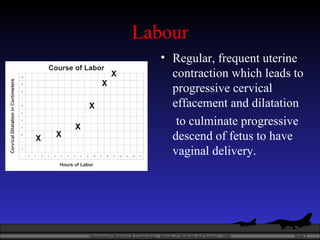
Labour Regular, frequent uterine contraction which leads to progressive cervical effacement and dilatation to culminate progressive descend of fetus to have vaginal delivery.
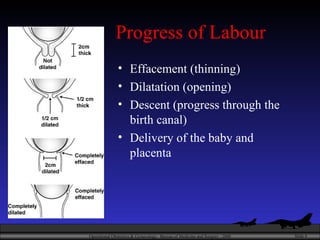
Progress of Labour Effacement (thinning) Dilatation (opening) Descent (progress through the birth canal) Delivery of the baby and placenta
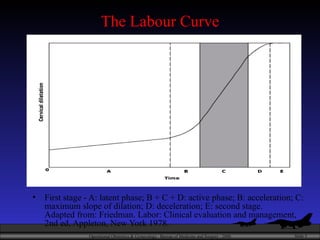
The Labour Curve First stage - A: latent phase; B + C + D: active phase; B: acceleration; C: maximum slope of dilation; D: deceleration; E: second stage. Adapted from: Friedman. Labor: Clinical evaluation and management, 2nd ed, Appleton, New York 1978.
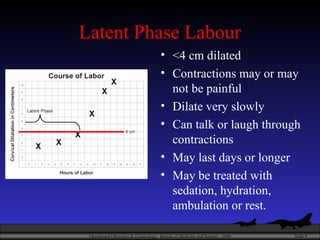
Definition of the first stage Latent first stage of labour  –  when -there are painful contractions, and -there is some cervical change, including cervical  effacement and dilatation up to 4 cm. Established first stage of labour  – when: regular painful contractions, and progressive cervical dilatation from 4 cm.
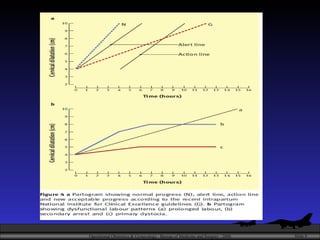
Disorders of labour 3 major disorders 1)prolonged latent phase 2)primary dysfunctional labour 3)secondary arrest
 
Latent Phase Labour <4 cm dilated Contractions may or may not be painful Dilate very slowly Can talk or laugh through contractions May last days or longer May be treated with sedation, hydration, ambulation or rest.
During latent phase changes occurs in  -collagen content of the cervix -ground substance of the cervix -hydration state of the cervix so remodelling effacement of the cervix occur
Duration of latent phase Primi -20 hours(average-8.6 hours) Multi -14 hours(average 5.3 hours)
Management of latent phase Reassurance Pain relief Mobilisation Augmentation with oxytocin increases -caesarean rates by 10 fold -3 fold increase in law apgar score
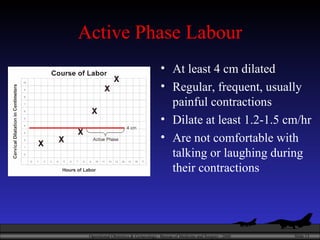
Active Phase Labour At least 4 cm dilated Regular, frequent, usually painful contractions Dilate at least 1.2-1.5 cm/hr Are not comfortable with talking or laughing during their contractions
Duration of the first stage varies between women,  first labours last on average 8 hours and are unlikely to last over 18 hours. Second and subsequent labours last on average 5 hours and are unlikely to last over 12 hours.
Definition of delay in the established first stage  needs to take into consideration all aspects of progress in labour and should include:  cervical dilatation of less than 2 cm in 4 hours for first labours cervical dilatation of less than 2 cm in 4 hours or a slowing in the progress of labour for second or subsequent labours
descent and rotation of the fetal head changes in the strength, duration and frequency of uterine contractions.
Primary dysfunctional labour Poor progress in active phase of labour(up to 7 cm dilation of the cervix) Affects 26% of nullipara 8% of multipara
Causes of dystocia 1)inefficient uterine activity is a significant factor. Due to -induction of labour -inadequate stimulation of contraction -failure of uterine response to stimulation  2) relative disproportion due to deflexion of the fetal head-OPP,asynclitism,inaduate cephalic flexion
3) Cephalo pelvic dispropotion
Possible outcome of primary dysfunctional labour It leads to-obstructed labour - infection - uterine rupture -PPH 70% of nullipara and 80% of multipara will respond to oxytocin
Secondary arrest Cessation of cervical dilation following a normal period of active phase dilatation. i.e after 7 cm of  cervical dilation Affects 6% of nulliparae and 2 % of multiparae CPD is more likely to be associated with it
Assessment in secondary arrest 1) fetal size-fundal height >40 cm in this stage is due to large baby 2)degree of engagement(fifth palpable) 3)position of the presenting part 4)signs of obstruction 5)any pelvic mass
6)descent of presenting part with contraction 7)contraction frequency 8)fetal well being
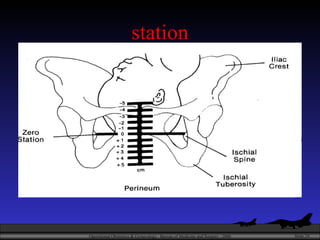
station SO assess following before any intervention 1)EFW-fundal height > 40 cm at this stage  is large baby 2)Degree of engagement 3)Position of the presenting part 4)Evidence of obstruction 5)Any pelvic mass
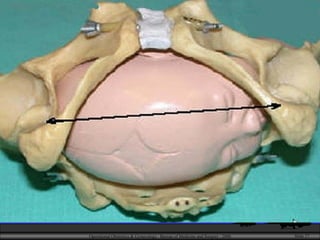
Engagement entrance of the  largest diameter of the presenting part into the true pelvis.  In relation to the head, the fetus is said to be engaged when it reaches the midpelvis or at a zero (0) station.  Once  engaged, fetus does not go back up. Prior to engagement occurring, the fetus is said to be &quot;floating&quot; or ballottable.
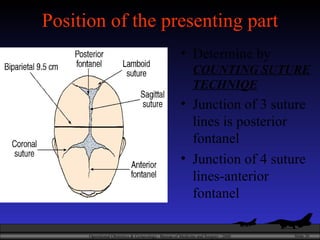
Position of the presenting part Determine by  COUNTING SUTURE TECHNIQE Junction of 3 suture lines is posterior fontanel Junction of 4 suture  lines-anterior fontanel
 
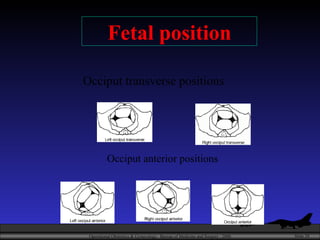
Occiput transverse positions     Occiput anterior positions     Fetal position
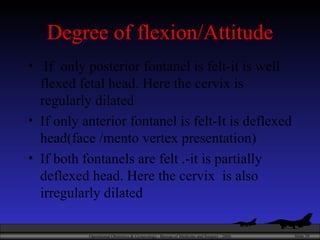
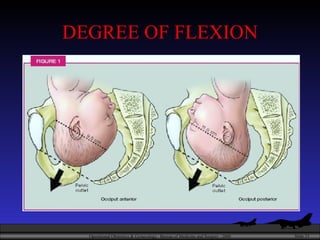
Degree of flexion/Attitude If  only posterior fontanel is felt-it is well flexed fetal head. Here the cervix is regularly dilated  If only anterior fontanel is felt-It is deflexed head(face /mento vertex presentation) If both fontanels are felt .-it is partially deflexed head. Here the cervix  is also irregularly dilated
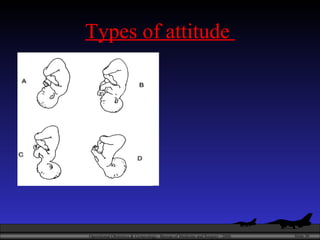
Types of attitude
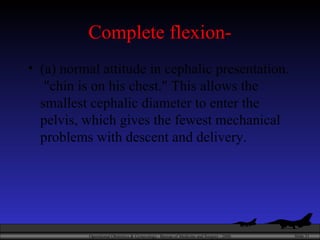
Complete flexion- (a) normal attitude in cephalic presentation.  &quot;chin is on his chest.&quot; This allows the smallest cephalic diameter to enter the pelvis, which gives the fewest mechanical problems with descent and delivery.
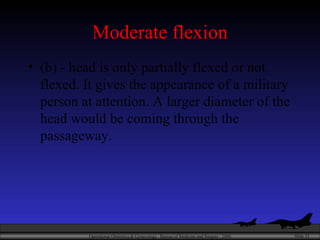
Moderate flexion (b) - head is only partially flexed or not flexed. It gives the appearance of a military person at attention. A larger diameter of the head would be coming through the passageway.
DEGREE OF FLEXION
Poor flexion or marked extension .  it is extended or bent backwards. This would be called a brow presentation. It is difficult to deliver because the widest diameter of the head enters the pelvis first. This type of cephalic presentation may require a C/Section if the attitude cannot be changed.
Hyperextended . In reference to the cephalic position, the fetus head is extended all the way back. This allows a face or chin to present first in the pelvis. If there is adequate room in the pelvis, the fetus may be delivered vaginally.
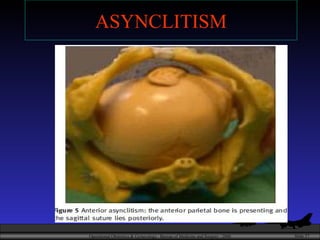
Asynclitism One parietal bone presents at a higher plane than other ,with the head in the transeverse position as it enters the pelvis.  Anterior asynclitism –physiological Posterior asynclitism is unfavourable and may indicate dispropotion
ASYNCLITISM
 
Management of poor progress in labour Decide whether it is safe to continue the labour If obstruction of labour / fetal distress-need operative delivery decide whether  expectant policy is appropriate
Management of poor progress in labour (1)One to one care - it decreases the likelihood of  medication  for pain relief, instrumental delivery,C/S, APGAR <7in 5 minutes -encourage to adopt whatever the position comfortable-sitting, reclining,lateral semi recumbent position
(2)  Maternal hydration and pain relief -40 % of nulliparous will respond to normal saline  infusion -edidural or narcotics (3)  Mobilization (4)  Amniotomy – if not done earlier
If delay in the established first stage of labour is suspected, amniotomy should be considered for all women with intact membranes.  perform a vaginal examination 2 h .and if progress is less than 1 cm a diagnosis of delay is made.
When delay in the established first stage of labour is confirmed the use of oxytocin should be considered
5) Oxytocin for augmentation -evaluate clinical situation i.e exclude obstructed labour and fetal distress .also consider maternal wishes in decision making. -for poor progress due to inefficient/ in coordinate uterus contraction. -60-80% of patients will respond to oxytocin by improving cervical dilation.
perform a vaginal examination 4 hours after commencing oxytocin in established labour. If there is less than 2 cm progress after 4 hours of oxytocin, further obstetric review is required to consider caesarean section. If there is 2 cm or more progress, vaginal examinations should be advised 4-hourly.
Titrate every 30 minutes till 4 contraction for 10 min with each last 40 seconds. Moniter continuously –CTG If augmentation exceeds 8 hours duration it is unlikely to result in successful vaginal delivery 8% of muliparae and 22% of nulliparae -fail to respond to oxytocin
Ways to reduce the poor progress of labour Correct diagnosis of labour.(Pay attention on effacement of the cervix) Good midwifery care  in labour room. Sustaining the morale of the woman and her partner Maintain hydration well Provide adequate analgesia maintain  the partogram
THANK YOU

poor progress of labour

  • 1.
    POOR PROGRESS OFLABOUR Dr.M.Thirukumar Consultant obstetrician and Gynaecologist Teaching Hospital Batticaloa
  • 2.
    What is theimportance? 1/3 of caesarean section, mainly in nulliparous –due to poor progress of labour. Uncommon in multiparous- only in 2% The rates of dystocia differs among practitioners mainly due to difference in labour management. Success in decreasing the incidence of dystocia among nulliparous will have impact on overall rate of caesareans birth
  • 3.
    Labour Regular, frequentuterine contraction which leads to progressive cervical effacement and dilatation to culminate progressive descend of fetus to have vaginal delivery.
  • 4.
    Progress of LabourEffacement (thinning) Dilatation (opening) Descent (progress through the birth canal) Delivery of the baby and placenta
  • 5.
    The Labour CurveFirst stage - A: latent phase; B + C + D: active phase; B: acceleration; C: maximum slope of dilation; D: deceleration; E: second stage. Adapted from: Friedman. Labor: Clinical evaluation and management, 2nd ed, Appleton, New York 1978.
  • 6.
    Definition of thefirst stage Latent first stage of labour – when -there are painful contractions, and -there is some cervical change, including cervical effacement and dilatation up to 4 cm. Established first stage of labour – when: regular painful contractions, and progressive cervical dilatation from 4 cm.
  • 7.
    Disorders of labour3 major disorders 1)prolonged latent phase 2)primary dysfunctional labour 3)secondary arrest
  • 8.
  • 9.
    Latent Phase Labour<4 cm dilated Contractions may or may not be painful Dilate very slowly Can talk or laugh through contractions May last days or longer May be treated with sedation, hydration, ambulation or rest.
  • 10.
    During latent phasechanges occurs in -collagen content of the cervix -ground substance of the cervix -hydration state of the cervix so remodelling effacement of the cervix occur
  • 11.
    Duration of latentphase Primi -20 hours(average-8.6 hours) Multi -14 hours(average 5.3 hours)
  • 12.
    Management of latentphase Reassurance Pain relief Mobilisation Augmentation with oxytocin increases -caesarean rates by 10 fold -3 fold increase in law apgar score
  • 13.
    Active Phase LabourAt least 4 cm dilated Regular, frequent, usually painful contractions Dilate at least 1.2-1.5 cm/hr Are not comfortable with talking or laughing during their contractions
  • 14.
    Duration of thefirst stage varies between women, first labours last on average 8 hours and are unlikely to last over 18 hours. Second and subsequent labours last on average 5 hours and are unlikely to last over 12 hours.
  • 15.
    Definition of delayin the established first stage needs to take into consideration all aspects of progress in labour and should include: cervical dilatation of less than 2 cm in 4 hours for first labours cervical dilatation of less than 2 cm in 4 hours or a slowing in the progress of labour for second or subsequent labours
  • 16.
    descent and rotationof the fetal head changes in the strength, duration and frequency of uterine contractions.
  • 17.
    Primary dysfunctional labourPoor progress in active phase of labour(up to 7 cm dilation of the cervix) Affects 26% of nullipara 8% of multipara
  • 18.
    Causes of dystocia1)inefficient uterine activity is a significant factor. Due to -induction of labour -inadequate stimulation of contraction -failure of uterine response to stimulation 2) relative disproportion due to deflexion of the fetal head-OPP,asynclitism,inaduate cephalic flexion
  • 19.
    3) Cephalo pelvicdispropotion
  • 20.
    Possible outcome ofprimary dysfunctional labour It leads to-obstructed labour - infection - uterine rupture -PPH 70% of nullipara and 80% of multipara will respond to oxytocin
  • 21.
    Secondary arrest Cessationof cervical dilation following a normal period of active phase dilatation. i.e after 7 cm of cervical dilation Affects 6% of nulliparae and 2 % of multiparae CPD is more likely to be associated with it
  • 22.
    Assessment in secondaryarrest 1) fetal size-fundal height >40 cm in this stage is due to large baby 2)degree of engagement(fifth palpable) 3)position of the presenting part 4)signs of obstruction 5)any pelvic mass
  • 23.
    6)descent of presentingpart with contraction 7)contraction frequency 8)fetal well being
  • 24.
    station SO assessfollowing before any intervention 1)EFW-fundal height > 40 cm at this stage is large baby 2)Degree of engagement 3)Position of the presenting part 4)Evidence of obstruction 5)Any pelvic mass
  • 25.
    Engagement entrance ofthe largest diameter of the presenting part into the true pelvis. In relation to the head, the fetus is said to be engaged when it reaches the midpelvis or at a zero (0) station. Once engaged, fetus does not go back up. Prior to engagement occurring, the fetus is said to be &quot;floating&quot; or ballottable.
  • 26.
    Position of thepresenting part Determine by COUNTING SUTURE TECHNIQE Junction of 3 suture lines is posterior fontanel Junction of 4 suture lines-anterior fontanel
  • 27.
  • 28.
    Occiput transverse positions  Occiput anterior positions   Fetal position
  • 29.
    Degree of flexion/AttitudeIf only posterior fontanel is felt-it is well flexed fetal head. Here the cervix is regularly dilated If only anterior fontanel is felt-It is deflexed head(face /mento vertex presentation) If both fontanels are felt .-it is partially deflexed head. Here the cervix is also irregularly dilated
  • 30.
  • 31.
    Complete flexion- (a)normal attitude in cephalic presentation. &quot;chin is on his chest.&quot; This allows the smallest cephalic diameter to enter the pelvis, which gives the fewest mechanical problems with descent and delivery.
  • 32.
    Moderate flexion (b)- head is only partially flexed or not flexed. It gives the appearance of a military person at attention. A larger diameter of the head would be coming through the passageway.
  • 33.
  • 34.
    Poor flexion ormarked extension . it is extended or bent backwards. This would be called a brow presentation. It is difficult to deliver because the widest diameter of the head enters the pelvis first. This type of cephalic presentation may require a C/Section if the attitude cannot be changed.
  • 35.
    Hyperextended . Inreference to the cephalic position, the fetus head is extended all the way back. This allows a face or chin to present first in the pelvis. If there is adequate room in the pelvis, the fetus may be delivered vaginally.
  • 36.
    Asynclitism One parietalbone presents at a higher plane than other ,with the head in the transeverse position as it enters the pelvis. Anterior asynclitism –physiological Posterior asynclitism is unfavourable and may indicate dispropotion
  • 37.
  • 38.
  • 39.
    Management of poorprogress in labour Decide whether it is safe to continue the labour If obstruction of labour / fetal distress-need operative delivery decide whether expectant policy is appropriate
  • 40.
    Management of poorprogress in labour (1)One to one care - it decreases the likelihood of medication for pain relief, instrumental delivery,C/S, APGAR <7in 5 minutes -encourage to adopt whatever the position comfortable-sitting, reclining,lateral semi recumbent position
  • 41.
    (2) Maternalhydration and pain relief -40 % of nulliparous will respond to normal saline infusion -edidural or narcotics (3) Mobilization (4) Amniotomy – if not done earlier
  • 42.
    If delay inthe established first stage of labour is suspected, amniotomy should be considered for all women with intact membranes. perform a vaginal examination 2 h .and if progress is less than 1 cm a diagnosis of delay is made.
  • 43.
    When delay inthe established first stage of labour is confirmed the use of oxytocin should be considered
  • 44.
    5) Oxytocin foraugmentation -evaluate clinical situation i.e exclude obstructed labour and fetal distress .also consider maternal wishes in decision making. -for poor progress due to inefficient/ in coordinate uterus contraction. -60-80% of patients will respond to oxytocin by improving cervical dilation.
  • 45.
    perform a vaginalexamination 4 hours after commencing oxytocin in established labour. If there is less than 2 cm progress after 4 hours of oxytocin, further obstetric review is required to consider caesarean section. If there is 2 cm or more progress, vaginal examinations should be advised 4-hourly.
  • 46.
    Titrate every 30minutes till 4 contraction for 10 min with each last 40 seconds. Moniter continuously –CTG If augmentation exceeds 8 hours duration it is unlikely to result in successful vaginal delivery 8% of muliparae and 22% of nulliparae -fail to respond to oxytocin
  • 47.
    Ways to reducethe poor progress of labour Correct diagnosis of labour.(Pay attention on effacement of the cervix) Good midwifery care in labour room. Sustaining the morale of the woman and her partner Maintain hydration well Provide adequate analgesia maintain the partogram
  • 48.