Dynamic Programming
Jaehyun Park
CS 97SI
Stanford University
June 29, 2015
Outline
Dynamic Programming
1-dimensional DP
2-dimensional DP
Interval DP
Tree DP
Subset DP
Dynamic Programming 2
What is DP?
◮ Wikipedia definition: “method for solving complex problems
by breaking them down into simpler subproblems”
◮ This definition will make sense once we see some examples
– Actually, we’ll only see problem solving examples today
Dynamic Programming 3
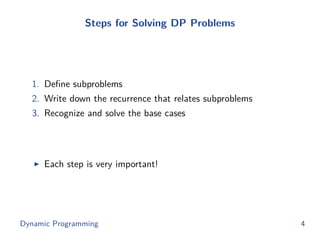
Steps for Solving DP Problems
1. Define subproblems
2. Write down the recurrence that relates subproblems
3. Recognize and solve the base cases
◮ Each step is very important!
Dynamic Programming 4
Outline
Dynamic Programming
1-dimensional DP
2-dimensional DP
Interval DP
Tree DP
Subset DP
1-dimensional DP 5
1-dimensional DP Example
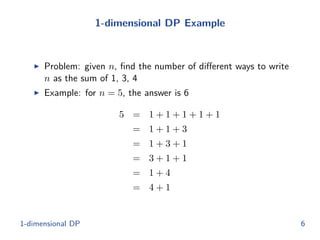
◮ Problem: given n, find the number of different ways to write
n as the sum of 1, 3, 4
◮ Example: for n = 5, the answer is 6
5 = 1 + 1 + 1 + 1 + 1
= 1 + 1 + 3
= 1 + 3 + 1
= 3 + 1 + 1
= 1 + 4
= 4 + 1
1-dimensional DP 6
1-dimensional DP Example
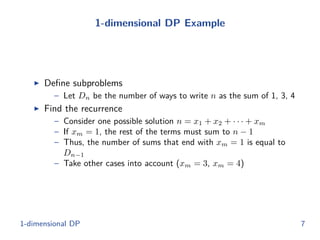
◮ Define subproblems
– Let Dn be the number of ways to write n as the sum of 1, 3, 4
◮ Find the recurrence
– Consider one possible solution n = x1 + x2 + · · · + xm
– If xm = 1, the rest of the terms must sum to n − 1
– Thus, the number of sums that end with xm = 1 is equal to
Dn−1
– Take other cases into account (xm = 3, xm = 4)
1-dimensional DP 7
1-dimensional DP Example
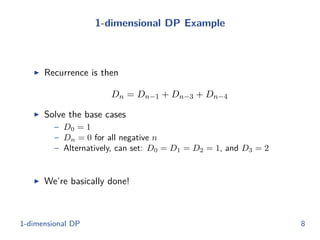
◮ Recurrence is then
Dn = Dn−1 + Dn−3 + Dn−4
◮ Solve the base cases
– D0 = 1
– Dn = 0 for all negative n
– Alternatively, can set: D0 = D1 = D2 = 1, and D3 = 2
◮ We’re basically done!
1-dimensional DP 8
Implementation
D[0] = D[1] = D[2] = 1; D[3] = 2;
for(i = 4; i <= n; i++)
D[i] = D[i-1] + D[i-3] + D[i-4];
◮ Very short!
◮ Extension: solving this for huge n, say n ≈ 1012
– Recall the matrix form of Fibonacci numbers
1-dimensional DP 9
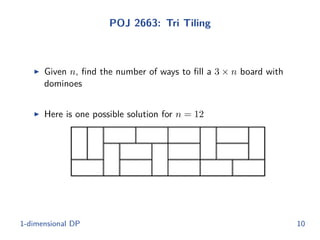
POJ 2663: Tri Tiling
◮ Given n, find the number of ways to fill a 3 × n board with
dominoes
◮ Here is one possible solution for n = 12
1-dimensional DP 10
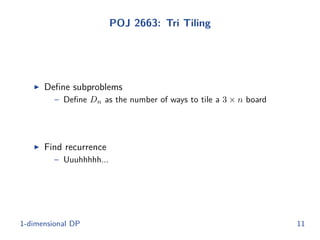
POJ 2663: Tri Tiling
◮ Define subproblems
– Define Dn as the number of ways to tile a 3 × n board
◮ Find recurrence
– Uuuhhhhh...
1-dimensional DP 11
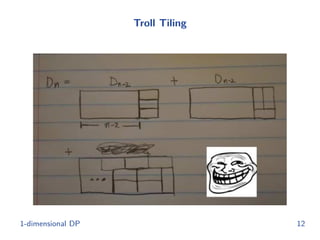
Troll Tiling
1-dimensional DP 12
Defining Subproblems
◮ Obviously, the previous definition didn’t work very well
◮ Dn’s don’t relate in simple terms
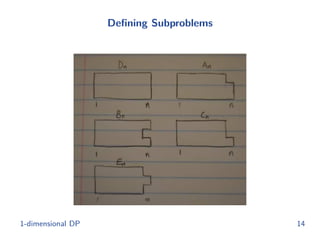
◮ What if we introduce more subproblems?
1-dimensional DP 13
Defining Subproblems
1-dimensional DP 14
Finding Recurrences
1-dimensional DP 15
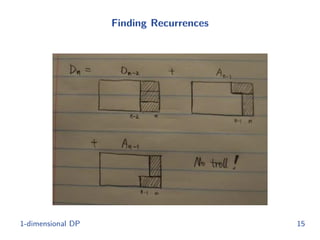
Finding Recurrences
◮ Consider different ways to fill the nth column
– And see what the remaining shape is
◮ Exercise:
– Finding recurrences for An, Bn, Cn
– Just for fun, why is Bn and En always zero?
◮ Extension: solving the problem for n × m grids, where n is
small, say n ≤ 10
– How many subproblems should we consider?
1-dimensional DP 16
Outline
Dynamic Programming
1-dimensional DP
2-dimensional DP
Interval DP
Tree DP
Subset DP
2-dimensional DP 17
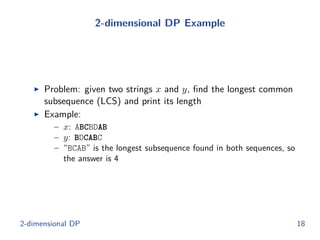
2-dimensional DP Example
◮ Problem: given two strings x and y, find the longest common
subsequence (LCS) and print its length
◮ Example:
– x: ABCBDAB
– y: BDCABC
– “BCAB” is the longest subsequence found in both sequences, so
the answer is 4
2-dimensional DP 18
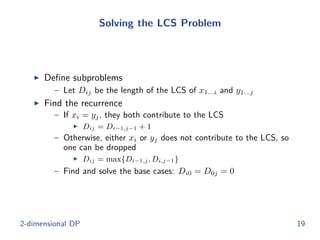
Solving the LCS Problem
◮ Define subproblems
– Let Dij be the length of the LCS of x1...i and y1...j
◮ Find the recurrence
– If xi = yj, they both contribute to the LCS
◮ Dij = Di−1,j−1 + 1
– Otherwise, either xi or yj does not contribute to the LCS, so
one can be dropped
◮ Dij = max{Di−1,j, Di,j−1}
– Find and solve the base cases: Di0 = D0j = 0
2-dimensional DP 19
Implementation
for(i = 0; i <= n; i++) D[i][0] = 0;
for(j = 0; j <= m; j++) D[0][j] = 0;
for(i = 1; i <= n; i++) {
for(j = 1; j <= m; j++) {
if(x[i] == y[j])
D[i][j] = D[i-1][j-1] + 1;
else
D[i][j] = max(D[i-1][j], D[i][j-1]);
}
}
2-dimensional DP 20
Outline
Dynamic Programming
1-dimensional DP
2-dimensional DP
Interval DP
Tree DP
Subset DP
Interval DP 21
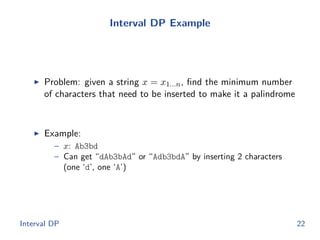
Interval DP Example
◮ Problem: given a string x = x1...n, find the minimum number
of characters that need to be inserted to make it a palindrome
◮ Example:
– x: Ab3bd
– Can get “dAb3bAd” or “Adb3bdA” by inserting 2 characters
(one ‘d’, one ‘A’)
Interval DP 22
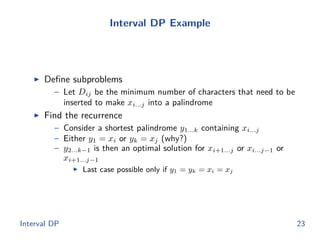
Interval DP Example
◮ Define subproblems
– Let Dij be the minimum number of characters that need to be
inserted to make xi...j into a palindrome
◮ Find the recurrence
– Consider a shortest palindrome y1...k containing xi...j
– Either y1 = xi or yk = xj (why?)
– y2...k−1 is then an optimal solution for xi+1...j or xi...j−1 or
xi+1...j−1
◮ Last case possible only if y1 = yk = xi = xj
Interval DP 23
Interval DP Example
◮ Find the recurrence
Dij =
1 + min{Di+1,j, Di,j−1} xi = xj
Di+1,j−1 xi = xj
◮ Find and solve the base cases: Dii = Di,i−1 = 0 for all i
◮ The entries of D must be filled in increasing order of j − i
Interval DP 24
Interval DP Example
// fill in base cases here
for(t = 2; t <= n; t++)
for(i = 1, j = t; j <= n; i++, j++)
// fill in D[i][j] here
◮ Note how we use an additional variable t to fill the table in
correct order
◮ And yes, for loops can work with multiple variables
Interval DP 25
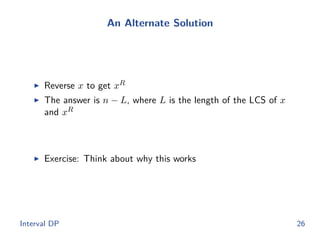
An Alternate Solution
◮ Reverse x to get xR
◮ The answer is n − L, where L is the length of the LCS of x
and xR
◮ Exercise: Think about why this works
Interval DP 26
Outline
Dynamic Programming
1-dimensional DP
2-dimensional DP
Interval DP
Tree DP
Subset DP
Tree DP 27
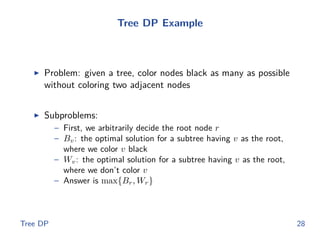
Tree DP Example
◮ Problem: given a tree, color nodes black as many as possible
without coloring two adjacent nodes
◮ Subproblems:
– First, we arbitrarily decide the root node r
– Bv: the optimal solution for a subtree having v as the root,
where we color v black
– Wv: the optimal solution for a subtree having v as the root,
where we don’t color v
– Answer is max{Br, Wr}
Tree DP 28
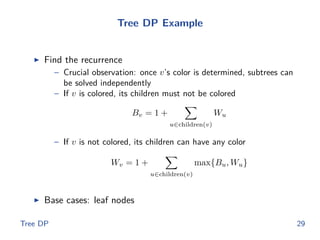
Tree DP Example
◮ Find the recurrence
– Crucial observation: once v’s color is determined, subtrees can
be solved independently
– If v is colored, its children must not be colored
Bv = 1 +
u∈children(v)
Wu
– If v is not colored, its children can have any color
Wv = 1 +
u∈children(v)
max{Bu, Wu}
◮ Base cases: leaf nodes
Tree DP 29
Outline
Dynamic Programming
1-dimensional DP
2-dimensional DP
Interval DP
Tree DP
Subset DP
Subset DP 30
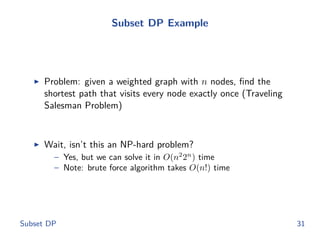
Subset DP Example
◮ Problem: given a weighted graph with n nodes, find the
shortest path that visits every node exactly once (Traveling
Salesman Problem)
◮ Wait, isn’t this an NP-hard problem?
– Yes, but we can solve it in O(n2
2n
) time
– Note: brute force algorithm takes O(n!) time
Subset DP 31
Subset DP Example
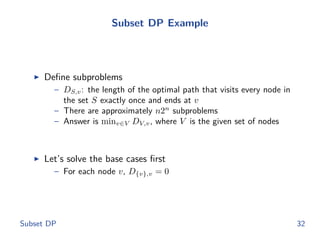
◮ Define subproblems
– DS,v: the length of the optimal path that visits every node in
the set S exactly once and ends at v
– There are approximately n2n
subproblems
– Answer is minv∈V DV,v, where V is the given set of nodes
◮ Let’s solve the base cases first
– For each node v, D{v},v = 0
Subset DP 32
Subset DP Example
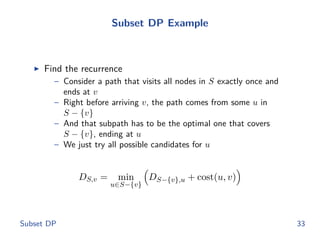
◮ Find the recurrence
– Consider a path that visits all nodes in S exactly once and
ends at v
– Right before arriving v, the path comes from some u in
S − {v}
– And that subpath has to be the optimal one that covers
S − {v}, ending at u
– We just try all possible candidates for u
DS,v = min
u∈S−{v}
DS−{v},u + cost(u, v)
Subset DP 33
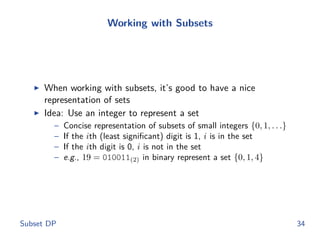
Working with Subsets
◮ When working with subsets, it’s good to have a nice
representation of sets
◮ Idea: Use an integer to represent a set
– Concise representation of subsets of small integers {0, 1, . . .}
– If the ith (least significant) digit is 1, i is in the set
– If the ith digit is 0, i is not in the set
– e.g., 19 = 010011(2) in binary represent a set {0, 1, 4}
Subset DP 34
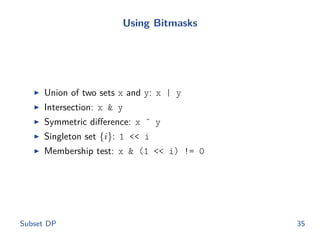
Using Bitmasks
◮ Union of two sets x and y: x | y
◮ Intersection: x & y
◮ Symmetric difference: x ˆ y
◮ Singleton set {i}: 1 << i
◮ Membership test: x & (1 << i) != 0
Subset DP 35
Conclusion
◮ Wikipedia definition: “a method for solving complex problems
by breaking them down into simpler subproblems”
– Does this make sense now?
◮ Remember the three steps!
1. Defining subproblems
2. Finding recurrences
3. Solving the base cases
Subset DP 36

Dynamic programming

  • 1.
    Dynamic Programming Jaehyun Park CS97SI Stanford University June 29, 2015
  • 2.
    Outline Dynamic Programming 1-dimensional DP 2-dimensionalDP Interval DP Tree DP Subset DP Dynamic Programming 2
  • 3.
    What is DP? ◮Wikipedia definition: “method for solving complex problems by breaking them down into simpler subproblems” ◮ This definition will make sense once we see some examples – Actually, we’ll only see problem solving examples today Dynamic Programming 3
  • 4.
    Steps for SolvingDP Problems 1. Define subproblems 2. Write down the recurrence that relates subproblems 3. Recognize and solve the base cases ◮ Each step is very important! Dynamic Programming 4
  • 5.
    Outline Dynamic Programming 1-dimensional DP 2-dimensionalDP Interval DP Tree DP Subset DP 1-dimensional DP 5
  • 6.
    1-dimensional DP Example ◮Problem: given n, find the number of different ways to write n as the sum of 1, 3, 4 ◮ Example: for n = 5, the answer is 6 5 = 1 + 1 + 1 + 1 + 1 = 1 + 1 + 3 = 1 + 3 + 1 = 3 + 1 + 1 = 1 + 4 = 4 + 1 1-dimensional DP 6
  • 7.
    1-dimensional DP Example ◮Define subproblems – Let Dn be the number of ways to write n as the sum of 1, 3, 4 ◮ Find the recurrence – Consider one possible solution n = x1 + x2 + · · · + xm – If xm = 1, the rest of the terms must sum to n − 1 – Thus, the number of sums that end with xm = 1 is equal to Dn−1 – Take other cases into account (xm = 3, xm = 4) 1-dimensional DP 7
  • 8.
    1-dimensional DP Example ◮Recurrence is then Dn = Dn−1 + Dn−3 + Dn−4 ◮ Solve the base cases – D0 = 1 – Dn = 0 for all negative n – Alternatively, can set: D0 = D1 = D2 = 1, and D3 = 2 ◮ We’re basically done! 1-dimensional DP 8
  • 9.
    Implementation D[0] = D[1]= D[2] = 1; D[3] = 2; for(i = 4; i <= n; i++) D[i] = D[i-1] + D[i-3] + D[i-4]; ◮ Very short! ◮ Extension: solving this for huge n, say n ≈ 1012 – Recall the matrix form of Fibonacci numbers 1-dimensional DP 9
  • 10.
    POJ 2663: TriTiling ◮ Given n, find the number of ways to fill a 3 × n board with dominoes ◮ Here is one possible solution for n = 12 1-dimensional DP 10
  • 11.
    POJ 2663: TriTiling ◮ Define subproblems – Define Dn as the number of ways to tile a 3 × n board ◮ Find recurrence – Uuuhhhhh... 1-dimensional DP 11
  • 12.
  • 13.
    Defining Subproblems ◮ Obviously,the previous definition didn’t work very well ◮ Dn’s don’t relate in simple terms ◮ What if we introduce more subproblems? 1-dimensional DP 13
  • 14.
  • 15.
  • 16.
    Finding Recurrences ◮ Considerdifferent ways to fill the nth column – And see what the remaining shape is ◮ Exercise: – Finding recurrences for An, Bn, Cn – Just for fun, why is Bn and En always zero? ◮ Extension: solving the problem for n × m grids, where n is small, say n ≤ 10 – How many subproblems should we consider? 1-dimensional DP 16
  • 17.
    Outline Dynamic Programming 1-dimensional DP 2-dimensionalDP Interval DP Tree DP Subset DP 2-dimensional DP 17
  • 18.
    2-dimensional DP Example ◮Problem: given two strings x and y, find the longest common subsequence (LCS) and print its length ◮ Example: – x: ABCBDAB – y: BDCABC – “BCAB” is the longest subsequence found in both sequences, so the answer is 4 2-dimensional DP 18
  • 19.
    Solving the LCSProblem ◮ Define subproblems – Let Dij be the length of the LCS of x1...i and y1...j ◮ Find the recurrence – If xi = yj, they both contribute to the LCS ◮ Dij = Di−1,j−1 + 1 – Otherwise, either xi or yj does not contribute to the LCS, so one can be dropped ◮ Dij = max{Di−1,j, Di,j−1} – Find and solve the base cases: Di0 = D0j = 0 2-dimensional DP 19
  • 20.
    Implementation for(i = 0;i <= n; i++) D[i][0] = 0; for(j = 0; j <= m; j++) D[0][j] = 0; for(i = 1; i <= n; i++) { for(j = 1; j <= m; j++) { if(x[i] == y[j]) D[i][j] = D[i-1][j-1] + 1; else D[i][j] = max(D[i-1][j], D[i][j-1]); } } 2-dimensional DP 20
  • 21.
    Outline Dynamic Programming 1-dimensional DP 2-dimensionalDP Interval DP Tree DP Subset DP Interval DP 21
  • 22.
    Interval DP Example ◮Problem: given a string x = x1...n, find the minimum number of characters that need to be inserted to make it a palindrome ◮ Example: – x: Ab3bd – Can get “dAb3bAd” or “Adb3bdA” by inserting 2 characters (one ‘d’, one ‘A’) Interval DP 22
  • 23.
    Interval DP Example ◮Define subproblems – Let Dij be the minimum number of characters that need to be inserted to make xi...j into a palindrome ◮ Find the recurrence – Consider a shortest palindrome y1...k containing xi...j – Either y1 = xi or yk = xj (why?) – y2...k−1 is then an optimal solution for xi+1...j or xi...j−1 or xi+1...j−1 ◮ Last case possible only if y1 = yk = xi = xj Interval DP 23
  • 24.
    Interval DP Example ◮Find the recurrence Dij = 1 + min{Di+1,j, Di,j−1} xi = xj Di+1,j−1 xi = xj ◮ Find and solve the base cases: Dii = Di,i−1 = 0 for all i ◮ The entries of D must be filled in increasing order of j − i Interval DP 24
  • 25.
    Interval DP Example //fill in base cases here for(t = 2; t <= n; t++) for(i = 1, j = t; j <= n; i++, j++) // fill in D[i][j] here ◮ Note how we use an additional variable t to fill the table in correct order ◮ And yes, for loops can work with multiple variables Interval DP 25
  • 26.
    An Alternate Solution ◮Reverse x to get xR ◮ The answer is n − L, where L is the length of the LCS of x and xR ◮ Exercise: Think about why this works Interval DP 26
  • 27.
    Outline Dynamic Programming 1-dimensional DP 2-dimensionalDP Interval DP Tree DP Subset DP Tree DP 27
  • 28.
    Tree DP Example ◮Problem: given a tree, color nodes black as many as possible without coloring two adjacent nodes ◮ Subproblems: – First, we arbitrarily decide the root node r – Bv: the optimal solution for a subtree having v as the root, where we color v black – Wv: the optimal solution for a subtree having v as the root, where we don’t color v – Answer is max{Br, Wr} Tree DP 28
  • 29.
    Tree DP Example ◮Find the recurrence – Crucial observation: once v’s color is determined, subtrees can be solved independently – If v is colored, its children must not be colored Bv = 1 + u∈children(v) Wu – If v is not colored, its children can have any color Wv = 1 + u∈children(v) max{Bu, Wu} ◮ Base cases: leaf nodes Tree DP 29
  • 30.
    Outline Dynamic Programming 1-dimensional DP 2-dimensionalDP Interval DP Tree DP Subset DP Subset DP 30
  • 31.
    Subset DP Example ◮Problem: given a weighted graph with n nodes, find the shortest path that visits every node exactly once (Traveling Salesman Problem) ◮ Wait, isn’t this an NP-hard problem? – Yes, but we can solve it in O(n2 2n ) time – Note: brute force algorithm takes O(n!) time Subset DP 31
  • 32.
    Subset DP Example ◮Define subproblems – DS,v: the length of the optimal path that visits every node in the set S exactly once and ends at v – There are approximately n2n subproblems – Answer is minv∈V DV,v, where V is the given set of nodes ◮ Let’s solve the base cases first – For each node v, D{v},v = 0 Subset DP 32
  • 33.
    Subset DP Example ◮Find the recurrence – Consider a path that visits all nodes in S exactly once and ends at v – Right before arriving v, the path comes from some u in S − {v} – And that subpath has to be the optimal one that covers S − {v}, ending at u – We just try all possible candidates for u DS,v = min u∈S−{v} DS−{v},u + cost(u, v) Subset DP 33
  • 34.
    Working with Subsets ◮When working with subsets, it’s good to have a nice representation of sets ◮ Idea: Use an integer to represent a set – Concise representation of subsets of small integers {0, 1, . . .} – If the ith (least significant) digit is 1, i is in the set – If the ith digit is 0, i is not in the set – e.g., 19 = 010011(2) in binary represent a set {0, 1, 4} Subset DP 34
  • 35.
    Using Bitmasks ◮ Unionof two sets x and y: x | y ◮ Intersection: x & y ◮ Symmetric difference: x ˆ y ◮ Singleton set {i}: 1 << i ◮ Membership test: x & (1 << i) != 0 Subset DP 35
  • 36.
    Conclusion ◮ Wikipedia definition:“a method for solving complex problems by breaking them down into simpler subproblems” – Does this make sense now? ◮ Remember the three steps! 1. Defining subproblems 2. Finding recurrences 3. Solving the base cases Subset DP 36