Dynamics light
scattering (DLS)
Key points:
• Introduction
• Brownian motion
• Sample preparation
• Working mechanism
• Auto correlation function
• Stock Einstein equation
• Calculations
• Advantage and disadvantage
INTRODUCTION:
• Dynamics light scattering is a technique in physics that can be
used to determine the size of distribution profile of small
particle in suspension or polymers in solution.
• This technique develop in the 1960s for measuring range , in a
suspension or solution
• The first theoretical basis for DLS was established by Berne
and Pecora in 1970s.
• The method is based on the analysis of the fluctuations of
intensity of scattered light, caused by the brownian motion of
the particle .
Brownian motion:
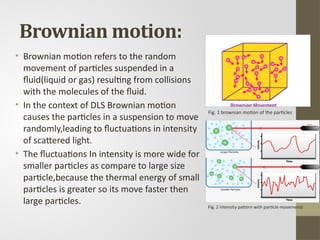
• Brownian motion refers to the random
movement of particles suspended in a
fluid(liquid or gas) resulting from collisions
with the molecules of the fluid.
• In the context of DLS Brownian motion
causes the particles in a suspension to move
randomly,leading to fluctuations in intensity
of scattered light.
• The fluctuations In intensity is more wide for
smaller particles as compare to large size
particle,because the thermal energy of small
particles is greater so its move faster then
large particles. Fig. 2 intensity pattern with particle movements
Fig. 1 brownian motion of the particles
SAMPLE PREPRATION
WORKING MECHENISM
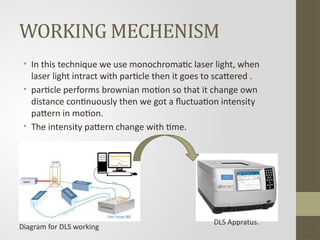
• In this technique we use monochromatic laser light, when
laser light intract with particle then it goes to scattered .
• particle performs brownian motion so that it change own
distance continuously then we got a fluctuation intensity
pattern in motion.
• The intensity pattern change with time.
Diagram for DLS working
DLS Appratus.
Auto correlation function
• In DLS we use auto correlation function,the autocorrelation is
a crucial tool for analyzing the motion of particle in a fluid.
• It provide information about size dynamics by examining , how
the intensity of scattered light fluctuated over time.
• The autocorrelation function G(τ) measure the intensity of the
scattered light with a delayed version of itself as a fluction of
time τ.
G(τ) = <I(t) . I(t+τ)>
Here:
<I(t)> = intensity at time t.
• for monodisprsion spherical particle , the autocorrelation
function typically decays exponentially.
G(q;τ)=exp⁡
(−Γτ)

DYNAMICS LIGHT SCATTERING IN PHYCICS .pptx

  • 1.
    Dynamics light scattering (DLS) Keypoints: • Introduction • Brownian motion • Sample preparation • Working mechanism • Auto correlation function • Stock Einstein equation • Calculations • Advantage and disadvantage
  • 2.
    INTRODUCTION: • Dynamics lightscattering is a technique in physics that can be used to determine the size of distribution profile of small particle in suspension or polymers in solution. • This technique develop in the 1960s for measuring range , in a suspension or solution • The first theoretical basis for DLS was established by Berne and Pecora in 1970s. • The method is based on the analysis of the fluctuations of intensity of scattered light, caused by the brownian motion of the particle .
  • 3.
    Brownian motion: • Brownianmotion refers to the random movement of particles suspended in a fluid(liquid or gas) resulting from collisions with the molecules of the fluid. • In the context of DLS Brownian motion causes the particles in a suspension to move randomly,leading to fluctuations in intensity of scattered light. • The fluctuations In intensity is more wide for smaller particles as compare to large size particle,because the thermal energy of small particles is greater so its move faster then large particles. Fig. 2 intensity pattern with particle movements Fig. 1 brownian motion of the particles
  • 4.
  • 5.
    WORKING MECHENISM • Inthis technique we use monochromatic laser light, when laser light intract with particle then it goes to scattered . • particle performs brownian motion so that it change own distance continuously then we got a fluctuation intensity pattern in motion. • The intensity pattern change with time. Diagram for DLS working DLS Appratus.
  • 6.
    Auto correlation function •In DLS we use auto correlation function,the autocorrelation is a crucial tool for analyzing the motion of particle in a fluid. • It provide information about size dynamics by examining , how the intensity of scattered light fluctuated over time. • The autocorrelation function G(τ) measure the intensity of the scattered light with a delayed version of itself as a fluction of time τ. G(τ) = <I(t) . I(t+τ)> Here: <I(t)> = intensity at time t.
  • 7.
    • for monodisprsionspherical particle , the autocorrelation function typically decays exponentially. G(q;τ)=exp⁡ (−Γτ)