



Company presentation
Light Scattering Fundamentals
Andrea Vaccaro, PhD
Chief Technical Officer
LS Instruments AG
CONFIDENTIAL
Table of contents
2
» Part I: Theory Fundamentals
» Static Light Scattering (SLS)
» Dynamic Light Scattering (DLS)
» Part II: Applications
» Part III: Concentrated Systems
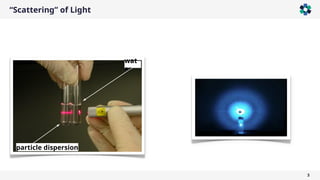
“Scattering” of Light
3
particle dispersion
wat
er
Light Scattering as Sizing Tool
4
Nanoparticles: 1-100 nm
Polymers, Macromolecules
Clays, Oxides, Proteins etc.
Company presentation
Light Scattering Fundamentals
Part I: Theory Fundamentals
Company presentation
Light Scattering Fundamentals
Static Light Scattering (SLS)
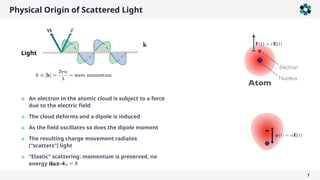
Physical Origin of Scattered Light
7
» An electron in the atomic cloud is subject to a force
due to the electric field
» The cloud deforms and a dipole is induced
» As the field oscillates so does the dipole moment
» The resulting charge movement radiates
(“scatters”) light
» “Elastic” scattering: momentum is preserved, no
energy loss ⇒
+
–
Light
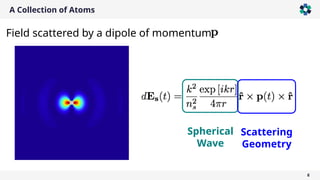
A Collection of Atoms
8
Field scattered by a dipole of momentum
Spherical
Wave
Scattering
Geometry
A Collection of Atoms
9
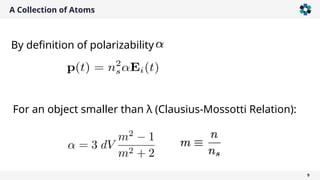
By definition of polarizability
For an object smaller than λ (Clausius-Mossotti Relation):
A Collection of Atoms
10
Spherical
Wave
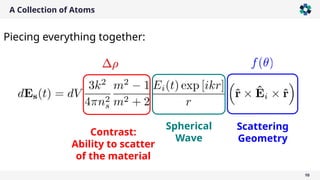
Contrast:
Ability to scatter
of the material
Piecing everything together:
Scattering
Geometry
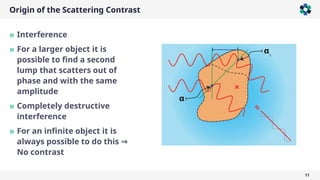
Origin of the Scattering Contrast
11
» Interference
» For a larger object it is
possible to find a second
lump that scatters out of
phase and with the same
amplitude
» Completely destructive
interference
» For an infinite object it is
always possible to do this ⇒
No contrast
The Measured Quantity: the Scattered Intensity
12
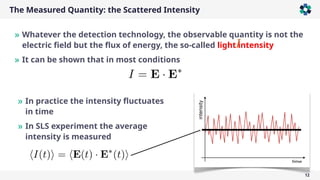
» Whatever the detection technology, the observable quantity is not the
electric field but the flux of energy, the so-called light intensity
» It can be shown that in most conditions
» In practice the intensity fluctuates
in time
» In SLS experiment the average
intensity is measured
RGD Theory
13
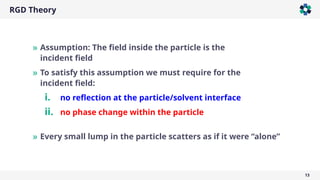
» Assumption: The field inside the particle is the
incident field
» To satisfy this assumption we must require for the
incident field:
i. no reflection at the particle/solvent interface
ii. no phase change within the particle
» Every small lump in the particle scatters as if it were “alone”
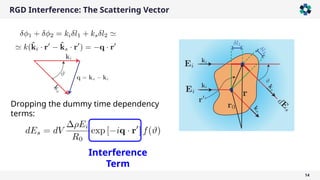
RGD Interference: The Scattering Vector
14
Interference
Term
Dropping the dummy time dependency
terms:
Light Scattering as Sizing Tool
15
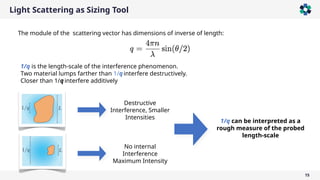
The module of the scattering vector has dimensions of inverse of length:
1/q is the length-scale of the interference phenomenon.
Two material lumps farther than 1/q interfere destructively.
Closer than 1/qinterfere additively
Destructive
Interference, Smaller
Intensities
No internal
Interference
Maximum Intensity
1/q can be interpreted as a
rough measure of the probed
length-scale
One Particle: The Scattering Amplitude
16
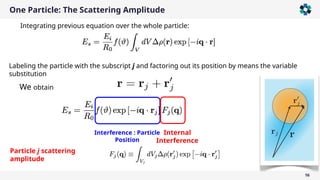
Integrating previous equation over the whole particle:
Labeling the particle with the subscript j and factoring out its position by means the variable
substitution
We obtain
Particle j scattering
amplitude
Interference : Particle
Position
Internal
Interference
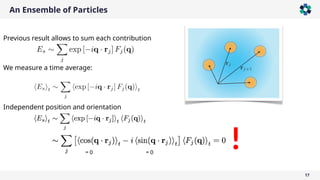
An Ensemble of Particles
17
Previous result allows to sum each contribution
= 0 = 0
!
Independent position and orientation
We measure a time average:
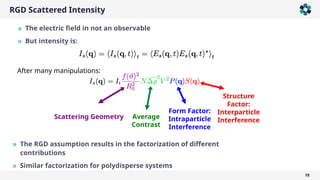
RGD Scattered Intensity
18
» The electric field in not an observable
» But intensity is:
Average
Contrast
Structure
Factor:
Interparticle
Interference
Form Factor:
Intraparticle
Interference
Scattering Geometry
» The RGD assumption results in the factorization of different
contributions
» Similar factorization for polydisperse systems
After many manipulations:
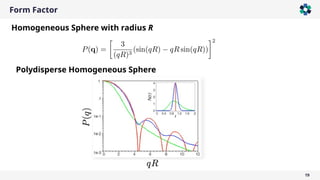
Form Factor
19
Homogeneous Sphere with radius R
Polydisperse Homogeneous Sphere
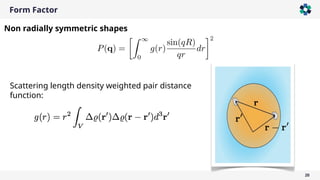
Form Factor
20
Non radially symmetric shapes
Scattering length density weighted pair distance
function:
Form Factor at Small q: The Radius of Gyration
21
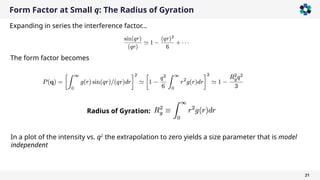
Expanding in series the interference factor...
The form factor becomes
Radius of Gyration:
In a plot of the intensity vs. q2
the extrapolation to zero yields a size parameter that is model
independent
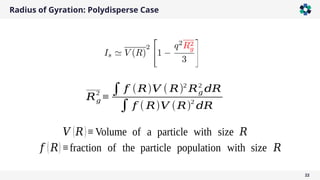
Radius of Gyration: Polydisperse Case
22
𝑅𝑔
2
≡
∫ 𝑓 (𝑅)𝑉 ( 𝑅)2
𝑅𝑔
2
𝑑𝑅
∫ 𝑓 ( 𝑅)𝑉 (𝑅)2
𝑑𝑅
𝑉 (𝑅)≡Volume of a particle with size 𝑅
𝑓 (𝑅)≡fraction of the particle population with size 𝑅
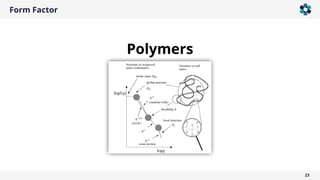
Form Factor
23
Polymers
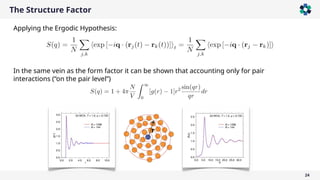
The Structure Factor
24
In the same vein as the form factor it can be shown that accounting only for pair
interactions (“on the pair level”)
Applying the Ergodic Hypothesis:
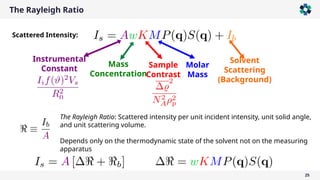
The Rayleigh Ratio
25
Scattered Intensity:
The Rayleigh Ratio: Scattered intensity per unit incident intensity, unit solid angle,
and unit scattering volume.
Depends only on the thermodynamic state of the solvent not on the measuring
apparatus
Mass
Concentration
Sample
Contrast
Molar
Mass
Instrumental
Constant
Solvent
Scattering
(Background)
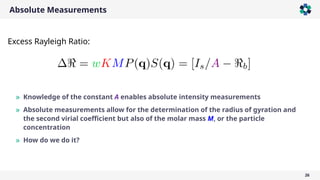
Absolute Measurements
26
» Knowledge of the constant A enables absolute intensity measurements
» Absolute measurements allow for the determination of the radius of gyration and
the second virial coefficient but also of the molar mass M, or the particle
concentration
» How do we do it?
Excess Rayleigh Ratio:
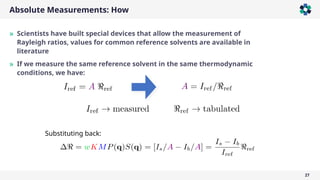
Absolute Measurements: How
27
» Scientists have built special devices that allow the measurement of
Rayleigh ratios, values for common reference solvents are available in
literature
» If we measure the same reference solvent in the same thermodynamic
conditions, we have:
Substituting back:
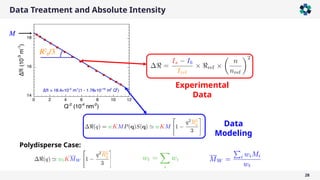
Data Treatment and Absolute Intensity
28
M
R2
g/3
Polydisperse Case:
Experimental
Data
Data
Modeling
Company presentation
Light Scattering Fundamentals
Dynamic Light Scattering (DLS)
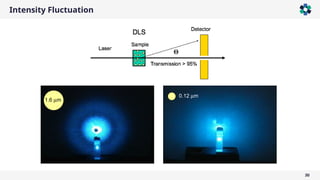
Intensity Fluctuation
30
1.6 mm
0.12 mm
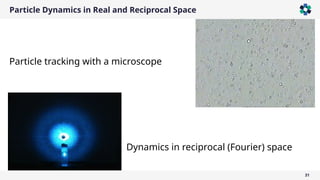
Particle Dynamics in Real and Reciprocal Space
31
Particle tracking with a microscope
Dynamics in reciprocal (Fourier) space
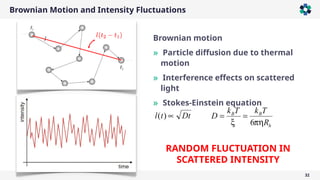
Brownian Motion and Intensity Fluctuations
32
Brownian motion
» Particle diffusion due to thermal
motion
» Interference effects on scattered
light
» Stokes-Einstein equation
RANDOM FLUCTUATION IN
SCATTERED INTENSITY
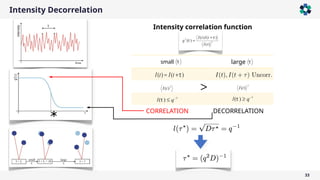
Intensity Decorrelation
33
Intensity correlation function
∗
small large
CORRELATION DECORRELATION
>
Field Correlation Function
34
Upon normalization:
Identical Independent
Particles
It can be modeled, but cannot be measured!
The electric field correlation function is important as it is directly connected
to colloid dynamics models
∑
𝑗 ,𝑘
𝐹 𝑗 (𝑞)𝐹𝑘
∗
(𝑞)exp{−𝑖𝒒⋅[𝒓 𝑗 (0)−𝒓𝑘 (𝜏)]}
⟨𝐸(𝒒,0)𝐸
∗
(𝒒,𝜏)⟩ ∑
𝑗,𝑘
𝐹𝑗 (𝑞)exp{−𝑖𝒒⋅𝒓 𝑗 (0)}ℑ(𝐹𝑘(𝑞)exp{−𝑖𝒒⋅𝒓𝑘 (𝜏)})
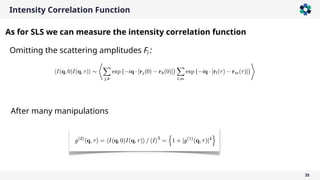
Intensity Correlation Function
35
After many manipulations
As for SLS we can measure the intensity correlation function
Omitting the scattering amplitudes Fj :
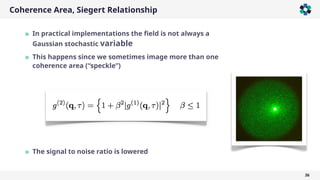
Coherence Area, Siegert Relationship
36
» In practical implementations the field is not always a
Gaussian stochastic variable
» This happens since we sometimes image more than one
coherence area (“speckle”)
» The signal to noise ratio is lowered
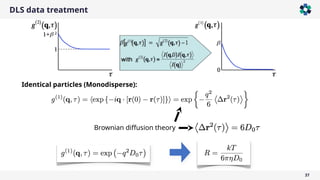
DLS data treatment
37
Identical particles (Monodisperse):
Brownian diffusion theory
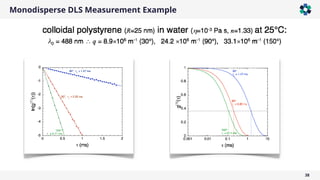
Monodisperse DLS Measurement Example
38
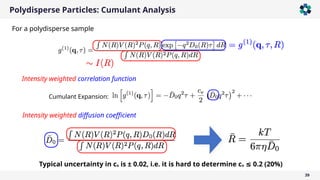
Polydisperse Particles: Cumulant Analysis
39
Intensity weighted correlation function
Cumulant Expansion:
Typical uncertainty in cv is ± 0.02, i.e. it is hard to determine cv 0.2 (20%)
≤
For a polydisperse sample
Intensity weighted diffusion coefficient
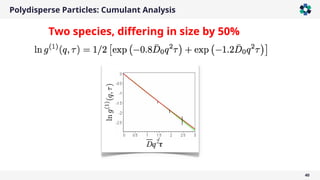
Polydisperse Particles: Cumulant Analysis
40
Two species, differing in size by 50%
Company presentation
Light Scattering Fundamentals
Part II: Applications
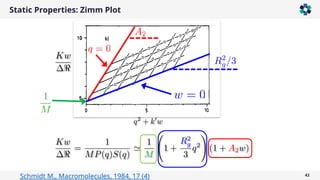
Static Properties: Zimm Plot
42
Schmidt M., Macromolecules, 1984, 17 (4)
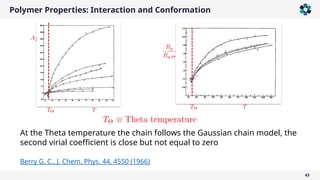
Polymer Properties: Interaction and Conformation
43
At the Theta temperature the chain follows the Gaussian chain model, the
second virial coefficient is close but not equal to zero
Berry G. C., J. Chem. Phys. 44, 4550 (1966)
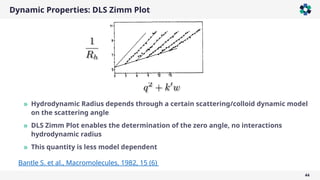
Dynamic Properties: DLS Zimm Plot
44
» Hydrodynamic Radius depends through a certain scattering/colloid dynamic model
on the scattering angle
» DLS Zimm Plot enables the determination of the zero angle, no interactions
hydrodynamic radius
» This quantity is less model dependent
Bantle S. et al., Macromolecules, 1982, 15 (6)
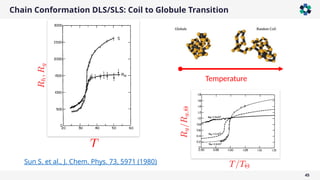
Chain Conformation DLS/SLS: Coil to Globule Transition
45
Sun S. et al., J. Chem. Phys. 73, 5971 (1980)
Temperature
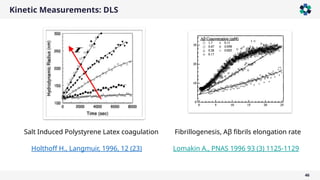
Kinetic Measurements: DLS
46
Salt Induced Polystyrene Latex coagulation Fibrillogenesis, Aβ fibrils elongation rate
𝐼
Holthoff H., Langmuir, 1996, 12 (23) Lomakin A., PNAS 1996 93 (3) 1125-1129
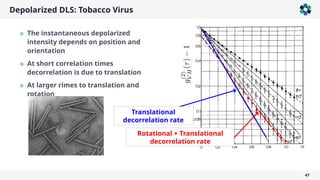
Depolarized DLS: Tobacco Virus
47
Rotational + Translational
decorrelation rate
Translational
decorrelation rate
» The instantaneous depolarized
intensity depends on position and
orientation
» At short correlation times
decorrelation is due to translation
» At larger rimes to translation and
rotation
Depolarized DLS: Tobacco Virus
48
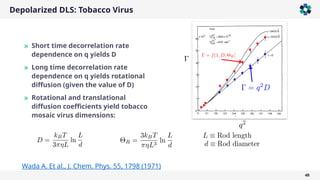
» Short time decorrelation rate
dependence on q yields D
» Long time decorrelation rate
dependence on q yields rotational
diffusion (given the value of D)
» Rotational and translational
diffusion coefficients yield tobacco
mosaic virus dimensions:
Wada A. Et al., J. Chem. Phys. 55, 1798 (1971)
Microgel Characterization
49
» Capture/Release of small agents (small molecules,
drugs
» Viscoelastic properties (thickener, hydraulic damping
etc.)
» Catalysis, Oil recovery, Nano Reactors
» Control of colloidal stability
» Tunable optical/magnetic properties sensors,
→
switches
» Hydrogel opals, Hu, Lu & Gao, J. Adv. Mat (2001)
The fuzzy sphere model
Microgel Characterization
50
Δ 𝜌 (𝑟 )∝ ∫
− ∞
∞
Θ [𝑥 − 𝑅 ] 1
𝜎 √2 𝜋
𝑒
−
(𝑟 −𝑥 )
2
2 𝜎
2
𝑑𝑥=
1
2
erfc
[𝑟 − 𝑅
√2 𝜎 ]
𝑃 (𝑞) ∝
3[sin (𝑞𝑅)−𝑞𝑅 cos(𝑞𝑅)]
(𝑞𝑅)
3
exp[−
(𝜎 𝑞)2
2 ]
*M. Stieger, W. Richtering, J. S. Pedersen, and P. Lindner, Small-angle neutron scattering study of structural
changes in temperature sensitive microgel colloids, The Journal of Chemical Physics 120, 6197 (2004). More
than 500 citations.
‘Smeared’ density profile
𝑟 [nm ]
𝜌 (𝑟 )[arb. u]
𝑟 [nm ]
sphere
Fuzzy
sphere
𝜌 (𝑟 )[arb. u]
The fuzzy sphere model
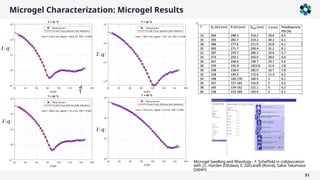
Microgel Characterization: Microgel Results
51
5
1
𝐼 (𝑞)
𝐼 (𝑞)
𝐼 (𝑞)
𝐼 (𝑞)
Microgel Swelling and Rheology - F. Scheffold in collaboration
with J.L. Harden (Ottawa), E. Zaccarelli (Rome), Sakai Takamasa
(Japan)
Company presentation
Light Scattering Fundamentals
Part III: Concentrated Systems
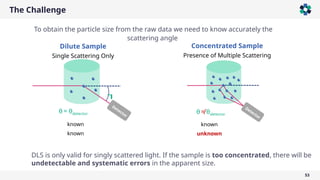
The Challenge
53
Detector
Dilute Sample
Single Scattering Only
Concentrated Sample
Presence of Multiple Scattering
Detector
θ = θdetector

DLS is only valid for singly scattered light. If the sample is too concentrated, there will be
undetectable and systematic errors in the apparent size.
θ ≠ θdetector
Detector
To obtain the particle size from the raw data we need to know accurately the
scattering angle
known
known
known
unknown
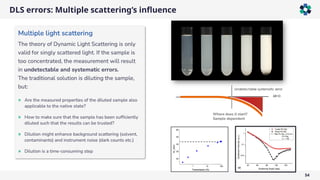
DLS errors: Multiple scattering’s influence
54
Modulated 3D DLS
Filter for multiple scattering suppression
55
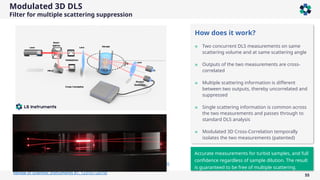
How does it work?
» Two concurrent DLS measurements on same
scattering volume and at same scattering angle
» Outputs of the two measurements are cross-
correlated
» Multiple scattering information is different
between two outputs, thereby uncorrelated and
suppressed
» Single scattering information is common across
the two measurements and passes through to
standard DLS analysis
» Modulated 3D Cross-Correlation temporally
isolates the two measurements (patented)
Accurate measurements for turbid samples, and full
confidence regardless of sample dilution. The result
is guaranteed to be free of multiple scattering.
Block, I. and Scheffold, F., Modulated 3D cross-correlation light scattering: improvin
g turbid sample characterization,
Review of Scientific Instruments 81, 123107 (2010)
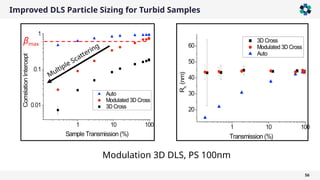
Improved DLS Particle Sizing for Turbid Samples
56
Modulation 3D DLS, PS 100nm
Multiple Scattering
βmax
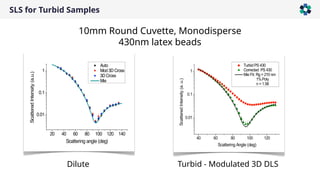
SLS for Turbid Samples
Dilute
Correct scattered
intensity to get single
scattering
contribution
Turbid - Modulated 3D DLS
10mm Round Cuvette, Monodisperse
430nm latex beads
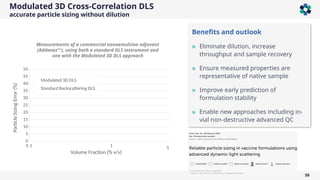
Modulated 3D Cross-Correlation DLS
accurate particle sizing without dilution
58
Benefits and outlook
» Eliminate dilution, increase
throughput and sample recovery
» Ensure measured properties are
representative of native sample
» Improve early prediction of
formulation stability
» Enable new approaches including in-
vial non-destructive advanced QC
0.1 1
0
5
10
15
20
25
30
35
40
45
50
Modulated 3D DLS
Standard Backscattering DLS
Volume Fraction (% v/v)
Particle
Sizing
Error
(%)
Measurements of a commercial nanoemulsion adjuvant
(Addavax™), using both a standard DLS instrument and
one with the Modulated 3D DLS approach
5
Contact us
LS Instruments AG
Passage du Cardinal 1 1700 Fribourg Switzerland
www.lsinstruments.ch
GENERAL
+41 (0)26 422 24 29
info@lsinstruments.c
h
SALES
+41 (0)26 508 54 98
sales
@lsinstruments.ch
SUPPORT
+41 (0)26 508 54 24
support
@lsinstruments.ch

Static and Dynamic Light Scattering Fundamentals 2025

  • 1.
    Company presentation Light ScatteringFundamentals Andrea Vaccaro, PhD Chief Technical Officer LS Instruments AG
  • 2.
    CONFIDENTIAL Table of contents 2 »Part I: Theory Fundamentals » Static Light Scattering (SLS) » Dynamic Light Scattering (DLS) » Part II: Applications » Part III: Concentrated Systems
  • 3.
  • 4.
    Light Scattering asSizing Tool 4 Nanoparticles: 1-100 nm Polymers, Macromolecules Clays, Oxides, Proteins etc.
  • 5.
    Company presentation Light ScatteringFundamentals Part I: Theory Fundamentals
  • 6.
    Company presentation Light ScatteringFundamentals Static Light Scattering (SLS)
  • 7.
    Physical Origin ofScattered Light 7 » An electron in the atomic cloud is subject to a force due to the electric field » The cloud deforms and a dipole is induced » As the field oscillates so does the dipole moment » The resulting charge movement radiates (“scatters”) light » “Elastic” scattering: momentum is preserved, no energy loss ⇒ + – Light
  • 8.
    A Collection ofAtoms 8 Field scattered by a dipole of momentum Spherical Wave Scattering Geometry
  • 9.
    A Collection ofAtoms 9 By definition of polarizability For an object smaller than λ (Clausius-Mossotti Relation):
  • 10.
    A Collection ofAtoms 10 Spherical Wave Contrast: Ability to scatter of the material Piecing everything together: Scattering Geometry
  • 11.
    Origin of theScattering Contrast 11 » Interference » For a larger object it is possible to find a second lump that scatters out of phase and with the same amplitude » Completely destructive interference » For an infinite object it is always possible to do this ⇒ No contrast
  • 12.
    The Measured Quantity:the Scattered Intensity 12 » Whatever the detection technology, the observable quantity is not the electric field but the flux of energy, the so-called light intensity » It can be shown that in most conditions » In practice the intensity fluctuates in time » In SLS experiment the average intensity is measured
  • 13.
    RGD Theory 13 » Assumption:The field inside the particle is the incident field » To satisfy this assumption we must require for the incident field: i. no reflection at the particle/solvent interface ii. no phase change within the particle » Every small lump in the particle scatters as if it were “alone”
  • 14.
    RGD Interference: TheScattering Vector 14 Interference Term Dropping the dummy time dependency terms:
  • 15.
    Light Scattering asSizing Tool 15 The module of the scattering vector has dimensions of inverse of length: 1/q is the length-scale of the interference phenomenon. Two material lumps farther than 1/q interfere destructively. Closer than 1/qinterfere additively Destructive Interference, Smaller Intensities No internal Interference Maximum Intensity 1/q can be interpreted as a rough measure of the probed length-scale
  • 16.
    One Particle: TheScattering Amplitude 16 Integrating previous equation over the whole particle: Labeling the particle with the subscript j and factoring out its position by means the variable substitution We obtain Particle j scattering amplitude Interference : Particle Position Internal Interference
  • 17.
    An Ensemble ofParticles 17 Previous result allows to sum each contribution = 0 = 0 ! Independent position and orientation We measure a time average:
  • 18.
    RGD Scattered Intensity 18 »The electric field in not an observable » But intensity is: Average Contrast Structure Factor: Interparticle Interference Form Factor: Intraparticle Interference Scattering Geometry » The RGD assumption results in the factorization of different contributions » Similar factorization for polydisperse systems After many manipulations:
  • 19.
    Form Factor 19 Homogeneous Spherewith radius R Polydisperse Homogeneous Sphere
  • 20.
    Form Factor 20 Non radiallysymmetric shapes Scattering length density weighted pair distance function:
  • 21.
    Form Factor atSmall q: The Radius of Gyration 21 Expanding in series the interference factor... The form factor becomes Radius of Gyration: In a plot of the intensity vs. q2 the extrapolation to zero yields a size parameter that is model independent
  • 22.
    Radius of Gyration:Polydisperse Case 22 𝑅𝑔 2 ≡ ∫ 𝑓 (𝑅)𝑉 ( 𝑅)2 𝑅𝑔 2 𝑑𝑅 ∫ 𝑓 ( 𝑅)𝑉 (𝑅)2 𝑑𝑅 𝑉 (𝑅)≡Volume of a particle with size 𝑅 𝑓 (𝑅)≡fraction of the particle population with size 𝑅
  • 23.
  • 24.
    The Structure Factor 24 Inthe same vein as the form factor it can be shown that accounting only for pair interactions (“on the pair level”) Applying the Ergodic Hypothesis:
  • 25.
    The Rayleigh Ratio 25 ScatteredIntensity: The Rayleigh Ratio: Scattered intensity per unit incident intensity, unit solid angle, and unit scattering volume. Depends only on the thermodynamic state of the solvent not on the measuring apparatus Mass Concentration Sample Contrast Molar Mass Instrumental Constant Solvent Scattering (Background)
  • 26.
    Absolute Measurements 26 » Knowledgeof the constant A enables absolute intensity measurements » Absolute measurements allow for the determination of the radius of gyration and the second virial coefficient but also of the molar mass M, or the particle concentration » How do we do it? Excess Rayleigh Ratio:
  • 27.
    Absolute Measurements: How 27 »Scientists have built special devices that allow the measurement of Rayleigh ratios, values for common reference solvents are available in literature » If we measure the same reference solvent in the same thermodynamic conditions, we have: Substituting back:
  • 28.
    Data Treatment andAbsolute Intensity 28 M R2 g/3 Polydisperse Case: Experimental Data Data Modeling
  • 29.
    Company presentation Light ScatteringFundamentals Dynamic Light Scattering (DLS)
  • 30.
  • 31.
    Particle Dynamics inReal and Reciprocal Space 31 Particle tracking with a microscope Dynamics in reciprocal (Fourier) space
  • 32.
    Brownian Motion andIntensity Fluctuations 32 Brownian motion » Particle diffusion due to thermal motion » Interference effects on scattered light » Stokes-Einstein equation RANDOM FLUCTUATION IN SCATTERED INTENSITY
  • 33.
    Intensity Decorrelation 33 Intensity correlationfunction ∗ small large CORRELATION DECORRELATION >
  • 34.
    Field Correlation Function 34 Uponnormalization: Identical Independent Particles It can be modeled, but cannot be measured! The electric field correlation function is important as it is directly connected to colloid dynamics models ∑ 𝑗 ,𝑘 𝐹 𝑗 (𝑞)𝐹𝑘 ∗ (𝑞)exp{−𝑖𝒒⋅[𝒓 𝑗 (0)−𝒓𝑘 (𝜏)]} ⟨𝐸(𝒒,0)𝐸 ∗ (𝒒,𝜏)⟩ ∑ 𝑗,𝑘 𝐹𝑗 (𝑞)exp{−𝑖𝒒⋅𝒓 𝑗 (0)}ℑ(𝐹𝑘(𝑞)exp{−𝑖𝒒⋅𝒓𝑘 (𝜏)})
  • 35.
    Intensity Correlation Function 35 Aftermany manipulations As for SLS we can measure the intensity correlation function Omitting the scattering amplitudes Fj :
  • 36.
    Coherence Area, SiegertRelationship 36 » In practical implementations the field is not always a Gaussian stochastic variable » This happens since we sometimes image more than one coherence area (“speckle”) » The signal to noise ratio is lowered
  • 37.
    DLS data treatment 37 Identicalparticles (Monodisperse): Brownian diffusion theory
  • 38.
  • 39.
    Polydisperse Particles: CumulantAnalysis 39 Intensity weighted correlation function Cumulant Expansion: Typical uncertainty in cv is ± 0.02, i.e. it is hard to determine cv 0.2 (20%) ≤ For a polydisperse sample Intensity weighted diffusion coefficient
  • 40.
    Polydisperse Particles: CumulantAnalysis 40 Two species, differing in size by 50%
  • 41.
    Company presentation Light ScatteringFundamentals Part II: Applications
  • 42.
    Static Properties: ZimmPlot 42 Schmidt M., Macromolecules, 1984, 17 (4)
  • 43.
    Polymer Properties: Interactionand Conformation 43 At the Theta temperature the chain follows the Gaussian chain model, the second virial coefficient is close but not equal to zero Berry G. C., J. Chem. Phys. 44, 4550 (1966)
  • 44.
    Dynamic Properties: DLSZimm Plot 44 » Hydrodynamic Radius depends through a certain scattering/colloid dynamic model on the scattering angle » DLS Zimm Plot enables the determination of the zero angle, no interactions hydrodynamic radius » This quantity is less model dependent Bantle S. et al., Macromolecules, 1982, 15 (6)
  • 45.
    Chain Conformation DLS/SLS:Coil to Globule Transition 45 Sun S. et al., J. Chem. Phys. 73, 5971 (1980) Temperature
  • 46.
    Kinetic Measurements: DLS 46 SaltInduced Polystyrene Latex coagulation Fibrillogenesis, Aβ fibrils elongation rate 𝐼 Holthoff H., Langmuir, 1996, 12 (23) Lomakin A., PNAS 1996 93 (3) 1125-1129
  • 47.
    Depolarized DLS: TobaccoVirus 47 Rotational + Translational decorrelation rate Translational decorrelation rate » The instantaneous depolarized intensity depends on position and orientation » At short correlation times decorrelation is due to translation » At larger rimes to translation and rotation
  • 48.
    Depolarized DLS: TobaccoVirus 48 » Short time decorrelation rate dependence on q yields D » Long time decorrelation rate dependence on q yields rotational diffusion (given the value of D) » Rotational and translational diffusion coefficients yield tobacco mosaic virus dimensions: Wada A. Et al., J. Chem. Phys. 55, 1798 (1971)
  • 49.
    Microgel Characterization 49 » Capture/Releaseof small agents (small molecules, drugs » Viscoelastic properties (thickener, hydraulic damping etc.) » Catalysis, Oil recovery, Nano Reactors » Control of colloidal stability » Tunable optical/magnetic properties sensors, → switches » Hydrogel opals, Hu, Lu & Gao, J. Adv. Mat (2001) The fuzzy sphere model
  • 50.
    Microgel Characterization 50 Δ 𝜌(𝑟 )∝ ∫ − ∞ ∞ Θ [𝑥 − 𝑅 ] 1 𝜎 √2 𝜋 𝑒 − (𝑟 −𝑥 ) 2 2 𝜎 2 𝑑𝑥= 1 2 erfc [𝑟 − 𝑅 √2 𝜎 ] 𝑃 (𝑞) ∝ 3[sin (𝑞𝑅)−𝑞𝑅 cos(𝑞𝑅)] (𝑞𝑅) 3 exp[− (𝜎 𝑞)2 2 ] *M. Stieger, W. Richtering, J. S. Pedersen, and P. Lindner, Small-angle neutron scattering study of structural changes in temperature sensitive microgel colloids, The Journal of Chemical Physics 120, 6197 (2004). More than 500 citations. ‘Smeared’ density profile 𝑟 [nm ] 𝜌 (𝑟 )[arb. u] 𝑟 [nm ] sphere Fuzzy sphere 𝜌 (𝑟 )[arb. u] The fuzzy sphere model
  • 51.
    Microgel Characterization: MicrogelResults 51 5 1 𝐼 (𝑞) 𝐼 (𝑞) 𝐼 (𝑞) 𝐼 (𝑞) Microgel Swelling and Rheology - F. Scheffold in collaboration with J.L. Harden (Ottawa), E. Zaccarelli (Rome), Sakai Takamasa (Japan)
  • 52.
    Company presentation Light ScatteringFundamentals Part III: Concentrated Systems
  • 53.
    The Challenge 53 Detector Dilute Sample SingleScattering Only Concentrated Sample Presence of Multiple Scattering Detector θ = θdetector  DLS is only valid for singly scattered light. If the sample is too concentrated, there will be undetectable and systematic errors in the apparent size. θ ≠ θdetector Detector To obtain the particle size from the raw data we need to know accurately the scattering angle known known known unknown
  • 54.
    DLS errors: Multiplescattering’s influence 54
  • 55.
    Modulated 3D DLS Filterfor multiple scattering suppression 55 How does it work? » Two concurrent DLS measurements on same scattering volume and at same scattering angle » Outputs of the two measurements are cross- correlated » Multiple scattering information is different between two outputs, thereby uncorrelated and suppressed » Single scattering information is common across the two measurements and passes through to standard DLS analysis » Modulated 3D Cross-Correlation temporally isolates the two measurements (patented) Accurate measurements for turbid samples, and full confidence regardless of sample dilution. The result is guaranteed to be free of multiple scattering. Block, I. and Scheffold, F., Modulated 3D cross-correlation light scattering: improvin g turbid sample characterization, Review of Scientific Instruments 81, 123107 (2010)
  • 56.
    Improved DLS ParticleSizing for Turbid Samples 56 Modulation 3D DLS, PS 100nm Multiple Scattering βmax
  • 57.
    SLS for TurbidSamples Dilute Correct scattered intensity to get single scattering contribution Turbid - Modulated 3D DLS 10mm Round Cuvette, Monodisperse 430nm latex beads
  • 58.
    Modulated 3D Cross-CorrelationDLS accurate particle sizing without dilution 58 Benefits and outlook » Eliminate dilution, increase throughput and sample recovery » Ensure measured properties are representative of native sample » Improve early prediction of formulation stability » Enable new approaches including in- vial non-destructive advanced QC 0.1 1 0 5 10 15 20 25 30 35 40 45 50 Modulated 3D DLS Standard Backscattering DLS Volume Fraction (% v/v) Particle Sizing Error (%) Measurements of a commercial nanoemulsion adjuvant (Addavax™), using both a standard DLS instrument and one with the Modulated 3D DLS approach 5
  • 59.
    Contact us LS InstrumentsAG Passage du Cardinal 1 1700 Fribourg Switzerland www.lsinstruments.ch GENERAL +41 (0)26 422 24 29 info@lsinstruments.c h SALES +41 (0)26 508 54 98 sales @lsinstruments.ch SUPPORT +41 (0)26 508 54 24 support @lsinstruments.ch