Shri Shivaji Education Society, Amravat
J.D.Patil Sanguldkar Mahavidyalay,
Daryapur
Dr. Aparana. S. Dighade
Department of Chemistry
Topic – Dyes II
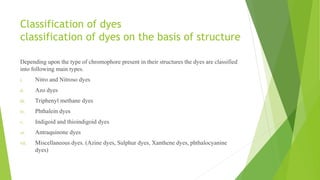
Classification of dyes
classification of dyes on the basis of structure
Depending upon the type of chromophore present in their structures the dyes are classified
into following main types.
i. Nitro and Nitroso dyes
ii. Azo dyes
iii. Triphenyl methane dyes
iv. Phthalein dyes
v. Indigoid and thioindigoid dyes
vi. Antraquinone dyes
vii. Miscellaneous dyes. (Azine dyes, Sulphur dyes, Xanthene dyes, phthalocyanine
dyes)
Nitro and Nitroso dyes
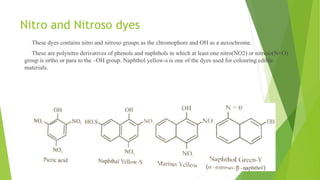
These dyes contains nitro and nitroso groups as the chromophore and OH as a auxochrome.
These are polynitro derivatives of phenols and naphthols in which at least one nitro(NO2) or nitroso(N=O)
group is ortho or para to the –OH group. Naphthol yellow-s is one of the dyes used for colouring edible
materials.
Azo dyes
Azo dye is a large class of synthetic organic dye that contains nitrogen as the azo gp –N=N- as
primary chromophore their molecular structure. More than half the commercial dyes belong to this
class.
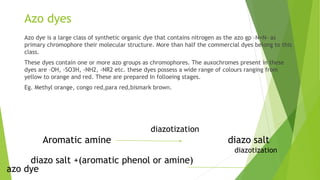
These dyes contain one or more azo groups as chromophores. The auxochromes present in these
dyes are –OH, -SO3H, -NH2, -NR2 etc. these dyes possess a wide range of colours ranging from
yellow to orange and red. These are prepared In folloeing stages.
Eg. Methyl orange, congo red,para red,bismark brown.
diazotization
Aromatic amine diazo salt
diazotization
diazo salt +(aromatic phenol or amine)
azo dye
Methyl orange
It is a azo dye containing one azo(-N=N-) gps. It contains sulphonic acid gp. And hence it is a acidic azo
dye. This SO3H gp makes the dye more soluble and is also used as reactive point for fixing the dye. This SO3H
gp. acts as auxochrome
Methyl orange – dimethyl amino azobenzene sulphonic acid as follow.
Properties and uses
 Water soluble because it contains acidic –SO3H group..
 It is not sufficiently fast to light and soap. Hence it is used as a dye.
 It is generally isolated as the sodium salt, which is used as dyeing.
 It imparts orange
 It is used as an indicator in acid alkali titration. It is orange in alkaline
solution an red in acid solution.
dyes part II.pptx

dyes part II.pptx

  • 1.
    Shri Shivaji EducationSociety, Amravat J.D.Patil Sanguldkar Mahavidyalay, Daryapur Dr. Aparana. S. Dighade Department of Chemistry Topic – Dyes II
  • 2.
    Classification of dyes classificationof dyes on the basis of structure Depending upon the type of chromophore present in their structures the dyes are classified into following main types. i. Nitro and Nitroso dyes ii. Azo dyes iii. Triphenyl methane dyes iv. Phthalein dyes v. Indigoid and thioindigoid dyes vi. Antraquinone dyes vii. Miscellaneous dyes. (Azine dyes, Sulphur dyes, Xanthene dyes, phthalocyanine dyes)
  • 3.
    Nitro and Nitrosodyes These dyes contains nitro and nitroso groups as the chromophore and OH as a auxochrome. These are polynitro derivatives of phenols and naphthols in which at least one nitro(NO2) or nitroso(N=O) group is ortho or para to the –OH group. Naphthol yellow-s is one of the dyes used for colouring edible materials.
  • 4.
    Azo dyes Azo dyeis a large class of synthetic organic dye that contains nitrogen as the azo gp –N=N- as primary chromophore their molecular structure. More than half the commercial dyes belong to this class. These dyes contain one or more azo groups as chromophores. The auxochromes present in these dyes are –OH, -SO3H, -NH2, -NR2 etc. these dyes possess a wide range of colours ranging from yellow to orange and red. These are prepared In folloeing stages. Eg. Methyl orange, congo red,para red,bismark brown. diazotization Aromatic amine diazo salt diazotization diazo salt +(aromatic phenol or amine) azo dye
  • 5.
    Methyl orange It isa azo dye containing one azo(-N=N-) gps. It contains sulphonic acid gp. And hence it is a acidic azo dye. This SO3H gp makes the dye more soluble and is also used as reactive point for fixing the dye. This SO3H gp. acts as auxochrome Methyl orange – dimethyl amino azobenzene sulphonic acid as follow.
  • 7.
    Properties and uses Water soluble because it contains acidic –SO3H group..  It is not sufficiently fast to light and soap. Hence it is used as a dye.  It is generally isolated as the sodium salt, which is used as dyeing.  It imparts orange  It is used as an indicator in acid alkali titration. It is orange in alkaline solution an red in acid solution.