presentation on Dyes
By:
Dipak
Guarav
Aaditya
Khagesh
Gulshan
Sobit
Introduction of Dyes
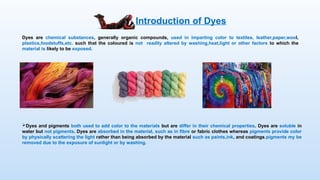
Dyes are chemical substances, generally organic compounds, used in imparting color to textiles, leather,paper,wool,
plastics,foodstuffs,etc. such that the coloured is not readily altered by washing,heat,light or other factors to which the
material is likely to be exposed.
Dyes and pigments both used to add color to the materials but are differ in their chemical properties. Dyes are soluble in
water but not pigments. Dyes are absorbed in the material, such as in fibre or fabric clothes whereas pigments provide color
by physically scattering the light rather than being absorbed by the material such as paints,ink, and coatings.pigments my be
removed due to the exposure of sunlight or by washing.
History of dyes
Until the 1850s virtually all dyes were obtained from natural sources, most commonly from vegetables, such as plants, trees,
and lichens, with a few from insects.
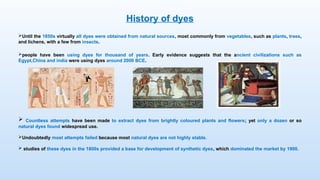
people have been using dyes for thousand of years. Early evidence suggests that the ancient civilizations such as
Egypt,China and india were using dyes around 2000 BCE.
 Countless attempts have been made to extract dyes from brightly coloured plants and flowers; yet only a dozen or so
natural dyes found widespread use.
Undoubtedly most attempts failed because most natural dyes are not highly stable.
 studies of these dyes in the 1800s provided a base for development of synthetic dyes, which dominated the market by 1900.
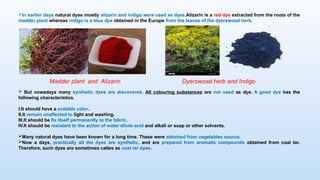
In earlier days natural dyes mostly alizarin and indigo were used as dyes.Alizarin is a red dye extracted from the roots of the
madder plant whereas indigo is a blue dye obtained in the Europe from the leaves of the dyerswoad herb.
Madder plant and Alizarin Dyerswoad herb and Indigo
 But nowadays many synthetic dyes are discovered. All colouring substances are not used as dye. A good dye has the
following characteristics.
I.It should have a suitable color.
II.It remain unaffected to light and washing.
III.It should be fix itself permanently to the fabric.
IV.It should be resistant to the action of water dilute acid and alkali or soap or other solvents.
Many natural dyes have been known for a long time. These were obtained from vegetables source.
Now a days, practically all the dyes are synthetic, and are prepared from aromatic compounds obtained from coal tar.
Therefore, such dyes are sometimes calles as coal tar dyes.
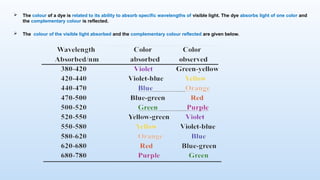
 The colour of a dye is related to its ability to absorb specific wavelengths of visible light. The dye absorbs light of one color and
the complementary colour is reflected.
 The colour of the visible light absorbed and the complementary colour reflected are given below.
colour and structure of dye
The relationship between the colour of a substance and its structure was explained by a German scientist Otto witt(1876) through its
‘chromophore auxochrome theory’. According to this theory.
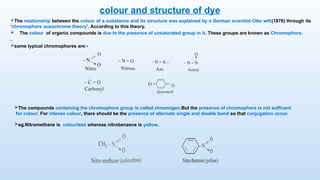
 The colour of organic compounds is due to the presence of unsaturated group in it. These groups are known as Chromophore.
.
some typical chromophores are:-
The compounds containing the chromophore group is called chromogen.But the presence of chromophore is not sufficent
for colour. For intense colour, there should be the presence of alternate single and double bond so that conjugation occur.
eg.Nitromethane is colourless whereas nitrobenzene is yellow.
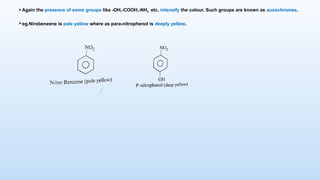
Again the presence of some groups like -OH,-COOH,-NH2 ,etc. intensify the colour. Such groups are known as auxochromes.
eg.Nirobenzene is pale yellow where as para-nitrophenol is deeply yellow.
classification of dye
1) classification based on the source
On the basis of source, dyes can be classified into natural dyes and synthetic dyes.
i) Natural dyes
Dyes obtained from plants and animals are called natural dyes.
 In ancient times people used various plants and animals extracts for coloring household materials, clothes,etc.
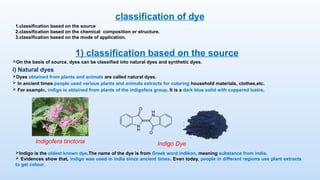
 For example, indigo is obtained from plants of the indigofera group. It is a dark blue solid with coppered lustre.
Indigofera tinctoria Indigo Dye
1.classification based on the source
2.classification based on the chemical composition or structure.
3.classification based on the mode of application.
Indigo is the oldest known dye.The name of the dye is from Greek word indikon, meaning substance from india.
 Evidences show that, indigo was used in india since ancient times. Even today, people in different regions use plant extracts
to get colour.
ii) synthetic dyes
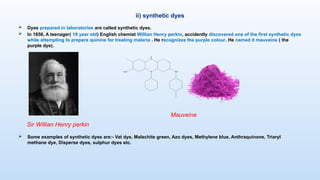
 Dyes prepared in laboratories are called synthetic dyes.
 In 1856, A teenager( 18 year old) English chemist Willian Henry perkin, accidently discovered one of the first synthetic dyes
while attempting to prepare quinine for treating malaria . He recognizes the purple colour. He named it mauveine ( the
purple dye).
 Some examples of synthetic dyes are:- Vat dye, Malachite green, Azo dyes, Methylene blue, Anthraquinone, Triaryl
methane dye, Disperse dyes, sulphur dyes etc.
Sir Willian Henry perkin
Mauveine
2)classification on the basis of structure
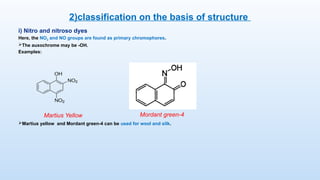
i) Nitro and nitroso dyes
Here, the NO2 and NO groups are found as primary chromophores.
The auxochrome may be -OH.
Examples:
Martius yellow and Mordant green-4 can be used for wool and silk.
Martius Yellow Mordant green-4
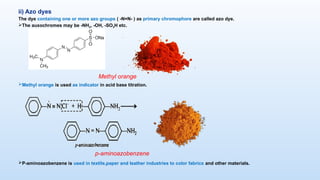
ii) Azo dyes
The dye containing one or more azo groups ( -N=N- ) as primary chromophore are called azo dye.
The auxochromes may be -NH2, -OH, -SO3H etc.
Methyl orange is used as indicator in acid base titration.
P-aminoazobenzene is used in textile,paper and leather industries to color fabrics and other materials.
Methyl orange
p-aminoazobenzene
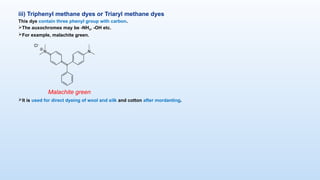
iii) Triphenyl methane dyes or Triaryl methane dyes
This dye contain three phenyl group with carbon.
The auxochromes may be -NH2, -OH etc.
For example, malachite green.
It is used for direct dyeing of wool and silk and cotton after mordanting.
Malachite green
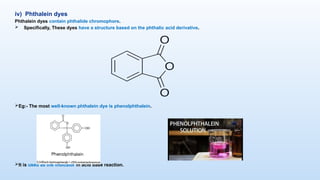
iv) Phthalein dyes
Phthalein dyes contain phthalide chromophore.
 Specifically, These dyes have a structure based on the phthalic acid derivative.
Eg:- The most well-known phthalein dye is phenolphthalein.
It is used as the indicator in acid base reaction.
vi) Indigo dyes
The dye containing carbonyl chromophore i.e.
It is used for dyeing cotton by the vat process.
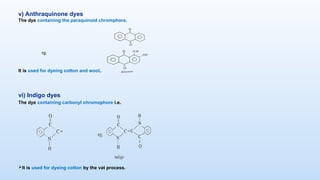
v) Anthraquinone dyes
The dye containing the paraquinoid chromphore.
It is used for dyeing cotton and wool.
3) Classification on the basis of methods of application
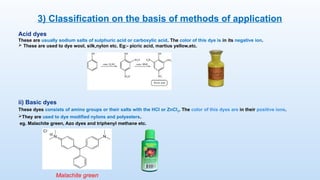
ii) Basic dyes
These dyes consists of amino groups or their salts with the HCl or ZnCl2. The color of this dyes are in their positive ions.
They are used to dye modified nylons and polyesters.
eg. Malachite green, Azo dyes and triphenyl methane etc.
Malachite green
Acid dyes
These are usually sodium salts of sulphuric acid or carboxylic acid. The color of this dye is in its negative ion.
 These are used to dye wool, silk,nylon etc. Eg:- picric acid, martius yellow,etc.
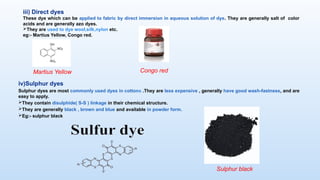
iv)Sulphur dyes
Sulphur dyes are most commonly used dyes in cottons .They are less expensive , generally have good wash-fastness, and are
easy to apply.
They contain disulphide( S-S ) linkage in their chemical structure.
They are generally black , brown and blue and available in powder form.
Eg:- sulphur black
Sulphur black
iii) Direct dyes
These dye which can be applied to fabric by direct immersion in aqueous solution of dye. They are generally salt of color
acids and are generally azo dyes.
They are used to dye wool,silk,nylon etc.
eg:- Martius Yellow, Congo red.
Congo red
Martius Yellow
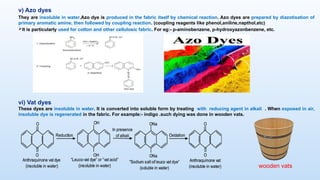
v) Azo dyes
They are insoluble in water.Azo dye is produced in the fabric itself by chemical reaction. Azo dyes are prepared by diazotisation of
primary aromatic amine, then followed by coupling reaction. (coupling reagents like phenol,aniline,napthol,etc)
It is particularly used for cotton and other cellulosic fabric. For eg:- p-aminobenzene, p-hydroxyazonbenzene, etc.
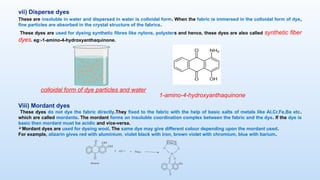
vi) Vat dyes
These dyes are insoluble in water. It is converted into soluble form by treating with reducing agent in alkali . When exposed in air,
insoluble dye is regenerated in the fabric. For example:- indigo .such dying was done in wooden vats.
wooden vats
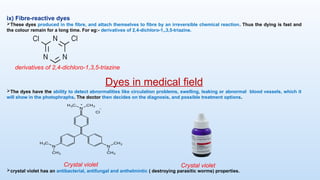
vii) Disperse dyes
These are insoluble in water and dispersed in water is colloidal form. When the fabric is immersed in the colloidal form of dye,
fine particles are absorbed in the crystal structure of the fabrics.
These dyes are used for dyeing synthetic fibres like nylons, polysters and hence, these dyes are also called synthetic fiber
dyes. eg:-1-amino-4-hydroxyanthaquinone.
1-amino-4-hydroxyanthaquinone
colloidal form of dye particles and water
Viii) Mordant dyes
These dyes do not dye the fabric directly.They fixed to the fabric with the help of basic salts of metals like Al,Cr,Fe,Ba etc.
which are called mordants. The mordant forms an insoluble coordination complex between the fabric and the dye. If the dye is
basic then mordant must be acidic and vice-versa.
Mordant dyes are used for dyeing wool. The same dye may give different colour depending upon the mordant used.
For example, alizarin gives red with aluminium, violet black with iron, brown violet with chromium, blue with barium.
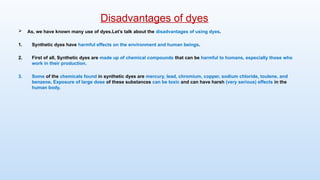
Dyes in medical field
The dyes have the ability to detect abnormalities like circulation problems, swelling, leaking or abnormal blood vessels, which it
will show in the photophraphs. The doctor then decides on the diagnosis, and possible treatment options.
crystal violet has an antibacterial, antifungal and anthelmintic ( destroying parasitic worms) properties.
Crystal violet Crystal violet
derivatives of 2,4-dichloro-1,3,5-triazine
ix) Fibre-reactive dyes
These dyes produced in the fibre, and attach themselves to fibre by an irreversible chemical reaction. Thus the dying is fast and
the colour remain for a long time. For eg:- derivatives of 2,4-dichloro-1,,3,5-triazine.
 As, we have known many use of dyes.Let’s talk about the disadvantages of using dyes.
1. Synthetic dyes have harmful effects on the environment and human beings.
2. First of all, Synthetic dyes are made up of chemical compounds that can be harmful to humans, especially those who
work in their production.
3. Some of the chemicals found in synthetic dyes are mercury, lead, chromium, copper, sodium chloride, toulene, and
benzene. Exposure of large dose of these substances can be toxic and can have harsh (very serious) effects in the
human body.
Disadvantages of dyes
Dyes presentation full explaination.pptx

Dyes presentation full explaination.pptx

  • 1.
  • 2.
    Introduction of Dyes Dyesare chemical substances, generally organic compounds, used in imparting color to textiles, leather,paper,wool, plastics,foodstuffs,etc. such that the coloured is not readily altered by washing,heat,light or other factors to which the material is likely to be exposed. Dyes and pigments both used to add color to the materials but are differ in their chemical properties. Dyes are soluble in water but not pigments. Dyes are absorbed in the material, such as in fibre or fabric clothes whereas pigments provide color by physically scattering the light rather than being absorbed by the material such as paints,ink, and coatings.pigments my be removed due to the exposure of sunlight or by washing.
  • 3.
    History of dyes Untilthe 1850s virtually all dyes were obtained from natural sources, most commonly from vegetables, such as plants, trees, and lichens, with a few from insects. people have been using dyes for thousand of years. Early evidence suggests that the ancient civilizations such as Egypt,China and india were using dyes around 2000 BCE.  Countless attempts have been made to extract dyes from brightly coloured plants and flowers; yet only a dozen or so natural dyes found widespread use. Undoubtedly most attempts failed because most natural dyes are not highly stable.  studies of these dyes in the 1800s provided a base for development of synthetic dyes, which dominated the market by 1900.
  • 4.
    In earlier daysnatural dyes mostly alizarin and indigo were used as dyes.Alizarin is a red dye extracted from the roots of the madder plant whereas indigo is a blue dye obtained in the Europe from the leaves of the dyerswoad herb. Madder plant and Alizarin Dyerswoad herb and Indigo  But nowadays many synthetic dyes are discovered. All colouring substances are not used as dye. A good dye has the following characteristics. I.It should have a suitable color. II.It remain unaffected to light and washing. III.It should be fix itself permanently to the fabric. IV.It should be resistant to the action of water dilute acid and alkali or soap or other solvents. Many natural dyes have been known for a long time. These were obtained from vegetables source. Now a days, practically all the dyes are synthetic, and are prepared from aromatic compounds obtained from coal tar. Therefore, such dyes are sometimes calles as coal tar dyes.
  • 5.
     The colourof a dye is related to its ability to absorb specific wavelengths of visible light. The dye absorbs light of one color and the complementary colour is reflected.  The colour of the visible light absorbed and the complementary colour reflected are given below.
  • 6.
    colour and structureof dye The relationship between the colour of a substance and its structure was explained by a German scientist Otto witt(1876) through its ‘chromophore auxochrome theory’. According to this theory.  The colour of organic compounds is due to the presence of unsaturated group in it. These groups are known as Chromophore. . some typical chromophores are:- The compounds containing the chromophore group is called chromogen.But the presence of chromophore is not sufficent for colour. For intense colour, there should be the presence of alternate single and double bond so that conjugation occur. eg.Nitromethane is colourless whereas nitrobenzene is yellow.
  • 7.
    Again the presenceof some groups like -OH,-COOH,-NH2 ,etc. intensify the colour. Such groups are known as auxochromes. eg.Nirobenzene is pale yellow where as para-nitrophenol is deeply yellow.
  • 8.
    classification of dye 1)classification based on the source On the basis of source, dyes can be classified into natural dyes and synthetic dyes. i) Natural dyes Dyes obtained from plants and animals are called natural dyes.  In ancient times people used various plants and animals extracts for coloring household materials, clothes,etc.  For example, indigo is obtained from plants of the indigofera group. It is a dark blue solid with coppered lustre. Indigofera tinctoria Indigo Dye 1.classification based on the source 2.classification based on the chemical composition or structure. 3.classification based on the mode of application. Indigo is the oldest known dye.The name of the dye is from Greek word indikon, meaning substance from india.  Evidences show that, indigo was used in india since ancient times. Even today, people in different regions use plant extracts to get colour.
  • 9.
    ii) synthetic dyes Dyes prepared in laboratories are called synthetic dyes.  In 1856, A teenager( 18 year old) English chemist Willian Henry perkin, accidently discovered one of the first synthetic dyes while attempting to prepare quinine for treating malaria . He recognizes the purple colour. He named it mauveine ( the purple dye).  Some examples of synthetic dyes are:- Vat dye, Malachite green, Azo dyes, Methylene blue, Anthraquinone, Triaryl methane dye, Disperse dyes, sulphur dyes etc. Sir Willian Henry perkin Mauveine
  • 10.
    2)classification on thebasis of structure i) Nitro and nitroso dyes Here, the NO2 and NO groups are found as primary chromophores. The auxochrome may be -OH. Examples: Martius yellow and Mordant green-4 can be used for wool and silk. Martius Yellow Mordant green-4
  • 11.
    ii) Azo dyes Thedye containing one or more azo groups ( -N=N- ) as primary chromophore are called azo dye. The auxochromes may be -NH2, -OH, -SO3H etc. Methyl orange is used as indicator in acid base titration. P-aminoazobenzene is used in textile,paper and leather industries to color fabrics and other materials. Methyl orange p-aminoazobenzene
  • 12.
    iii) Triphenyl methanedyes or Triaryl methane dyes This dye contain three phenyl group with carbon. The auxochromes may be -NH2, -OH etc. For example, malachite green. It is used for direct dyeing of wool and silk and cotton after mordanting. Malachite green
  • 13.
    iv) Phthalein dyes Phthaleindyes contain phthalide chromophore.  Specifically, These dyes have a structure based on the phthalic acid derivative. Eg:- The most well-known phthalein dye is phenolphthalein. It is used as the indicator in acid base reaction.
  • 14.
    vi) Indigo dyes Thedye containing carbonyl chromophore i.e. It is used for dyeing cotton by the vat process. v) Anthraquinone dyes The dye containing the paraquinoid chromphore. It is used for dyeing cotton and wool.
  • 15.
    3) Classification onthe basis of methods of application ii) Basic dyes These dyes consists of amino groups or their salts with the HCl or ZnCl2. The color of this dyes are in their positive ions. They are used to dye modified nylons and polyesters. eg. Malachite green, Azo dyes and triphenyl methane etc. Malachite green Acid dyes These are usually sodium salts of sulphuric acid or carboxylic acid. The color of this dye is in its negative ion.  These are used to dye wool, silk,nylon etc. Eg:- picric acid, martius yellow,etc.
  • 16.
    iv)Sulphur dyes Sulphur dyesare most commonly used dyes in cottons .They are less expensive , generally have good wash-fastness, and are easy to apply. They contain disulphide( S-S ) linkage in their chemical structure. They are generally black , brown and blue and available in powder form. Eg:- sulphur black Sulphur black iii) Direct dyes These dye which can be applied to fabric by direct immersion in aqueous solution of dye. They are generally salt of color acids and are generally azo dyes. They are used to dye wool,silk,nylon etc. eg:- Martius Yellow, Congo red. Congo red Martius Yellow
  • 17.
    v) Azo dyes Theyare insoluble in water.Azo dye is produced in the fabric itself by chemical reaction. Azo dyes are prepared by diazotisation of primary aromatic amine, then followed by coupling reaction. (coupling reagents like phenol,aniline,napthol,etc) It is particularly used for cotton and other cellulosic fabric. For eg:- p-aminobenzene, p-hydroxyazonbenzene, etc. vi) Vat dyes These dyes are insoluble in water. It is converted into soluble form by treating with reducing agent in alkali . When exposed in air, insoluble dye is regenerated in the fabric. For example:- indigo .such dying was done in wooden vats. wooden vats
  • 18.
    vii) Disperse dyes Theseare insoluble in water and dispersed in water is colloidal form. When the fabric is immersed in the colloidal form of dye, fine particles are absorbed in the crystal structure of the fabrics. These dyes are used for dyeing synthetic fibres like nylons, polysters and hence, these dyes are also called synthetic fiber dyes. eg:-1-amino-4-hydroxyanthaquinone. 1-amino-4-hydroxyanthaquinone colloidal form of dye particles and water Viii) Mordant dyes These dyes do not dye the fabric directly.They fixed to the fabric with the help of basic salts of metals like Al,Cr,Fe,Ba etc. which are called mordants. The mordant forms an insoluble coordination complex between the fabric and the dye. If the dye is basic then mordant must be acidic and vice-versa. Mordant dyes are used for dyeing wool. The same dye may give different colour depending upon the mordant used. For example, alizarin gives red with aluminium, violet black with iron, brown violet with chromium, blue with barium.
  • 19.
    Dyes in medicalfield The dyes have the ability to detect abnormalities like circulation problems, swelling, leaking or abnormal blood vessels, which it will show in the photophraphs. The doctor then decides on the diagnosis, and possible treatment options. crystal violet has an antibacterial, antifungal and anthelmintic ( destroying parasitic worms) properties. Crystal violet Crystal violet derivatives of 2,4-dichloro-1,3,5-triazine ix) Fibre-reactive dyes These dyes produced in the fibre, and attach themselves to fibre by an irreversible chemical reaction. Thus the dying is fast and the colour remain for a long time. For eg:- derivatives of 2,4-dichloro-1,,3,5-triazine.
  • 20.
     As, wehave known many use of dyes.Let’s talk about the disadvantages of using dyes. 1. Synthetic dyes have harmful effects on the environment and human beings. 2. First of all, Synthetic dyes are made up of chemical compounds that can be harmful to humans, especially those who work in their production. 3. Some of the chemicals found in synthetic dyes are mercury, lead, chromium, copper, sodium chloride, toulene, and benzene. Exposure of large dose of these substances can be toxic and can have harsh (very serious) effects in the human body. Disadvantages of dyes