WELCOME
Dr.P.BHUVANESWARI,
Assistant Professor of Chemistry,
E.M.G.YadavaWomen’s College,
Madurai-14
 It is an organic compounds, imparts colour to the fibre.
Good dye-Resistant towards heat, light, moisture, dilute
acids , washing soaps
 Fast dye-permanently fixes on the surface, its colour will
not change or lose brightness when it is washed.
 Fugitive dye-A dye that fades out or washed off
 Dye is generally applied in an aqueous solution, and may
require a mordant to improve the fastness of the dye on
the fiber.
 Mordant-a substance, typically an inorganic oxide, that
combines with a dye or stain and thereby fixes it in a
material.
 An organic compound appears coloured only if it
absorbs the radiations in the visible part of the
electromagnetic spectrum.
 Visible region range 400-800nm.
 When the white light falls on object,it may be
 i)totally reflected back,the object appears white
 ii)totally absorbed, the object appears black
 iii) a part of light is absorbed and the rest is
reflected back, the object appears coloured.
S.no λ(nm) Wavelength of light Absorbed
colour
Reflected
colour
1. 400-440 Violet Yellow-green
2. 440-480 Blue Yellow
3. 480-490 Green-blue Orange
4. 490-500 Blue-green Red
5. 500-560 Green Purple
6. 560-580 Yellow-green Violet
7. 580-595 Yellow Blue
8. 595-605 Orange Green-blue
9. 605-750 Red Blue-green
10. 750-800 Purple Green
 German chemist Witt suggested the chromophore-
Auxochrome theory for coloured compounds.
 The groups with unsaturation and electron
withdrawing nature have an appreciable effect on
the absorption of light and when present in
conjucation , are responsible for the colour of
compound.Such group known as Chromophores.
 azo, quinoid structure
 The compounds containing chromophore group are
known as chromogens.
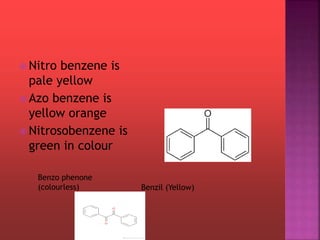
 Nitro benzene is
pale yellow
 Azo benzene is
yellow orange
 Nitrosobenzene is
green in colour
Benzo phenone
(colourless) Benzil (Yellow)
 These groups are not responsible for
colour but when present along with
chromophore groups are responsible for
deepening of the colour. These are electron
donating groups.
Examples: -NH2, -NHR, -OH, -OR
yellow colour
Orange colour
 The chromophores and auxochrome groups
present in a compound cause deepening of
colour by increasing the number of charged
contributing structures during resonance
effect.
 When a molecule
absorbs a photon of
the visible frequency
, one of its bonding
or a nonbonding
electrons undergoes
transition to the
vacant antibonding
orbitals.Absorption of
a photon of visible
light commonly
causes π π* n π*
transition of
electrons.
 Natural dyes are dyes or colorants derived
from plants, or minerals. The majority of
natural dyes are vegetable dyes from plant
sources—roots, berries, bark, leaves,
and wood—and other biological sources such
as fungi.
 Henna: Reddish brown dye obtained from
leaves of plant native to
India, Egypt, Arabia and Iran.
 It is a fast dye, the colour of henna is due
to the presence of lawsone - quinonoid
 Lawsone reacts chemically with the
protein keratin in skin and hair via Michael
addition
 Wallnut shells:Wallnut shells stain the skin
brown.
 The brown colour is due to the presence of a
quinonoid component juglone present in the
shells.
 Turmeric: It is obtained from tubers of plants
‘Curcuma langa’. The colour of turmeric is
due to the presence of curcumin, a highly
conjucated system.In presence of alkali,
curcurmin imparts red colour due to the
formation of quinonoid structure.
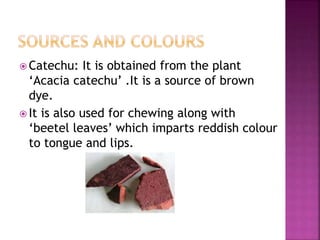
 Catechu: It is obtained from the plant
‘Acacia catechu’ .It is a source of brown
dye.
 It is also used for chewing along with
‘beetel leaves’ which imparts reddish colour
to tongue and lips.
 Indigo dyes from stem and leaves of indigo
 Alizarin dyes from roots of Madder plants
 In 1856, an 18-year-old English
chemist, William Henry Perkin, accidentally
discovered one of the first synthetic dyes. In
search of a treatment for malaria, Perkin
experimented with coal tar, a thick, dark
liquid by-product of coal-gas production.
Based on mode
of application
Based on
chemical
structure
 Acid dyes
 Basic dyes
 Direct or substantive dyes
 Mordant dyes
 Vat dyes
 Azo dyes
 Sulfur dyes
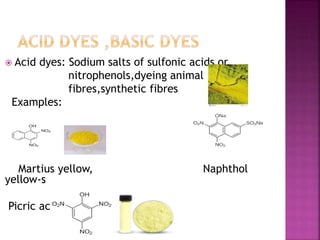
 Acid dyes: Sodium salts of sulfonic acids or
nitrophenols,dyeing animal
fibres,synthetic fibres
Examples:
Martius yellow, Naphthol
yellow-s
Picric acid
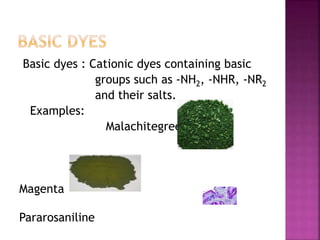
Basic dyes : Cationic dyes containing basic
groups such as -NH2, -NHR, -NR2
and their salts.
Examples:
Malachitegreen,
Magenta
Pararosaniline
 This class of dyes mainly includes
various acid or basic dyes and can be
directly used for the fibres of plant
origin.
 The dyeing of the fibres is carried out in
the presence of common salt.
 eg:Congo red
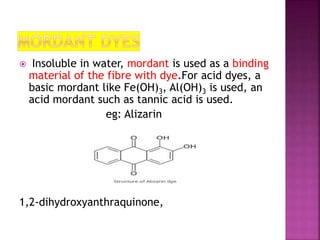
 Insoluble in water, mordant is used as a binding
material of the fibre with dye.For acid dyes, a
basic mordant like Fe(OH)3, Al(OH)3 is used, an
acid mordant such as tannic acid is used.
eg: Alizarin
1,2-dihydroxyanthraquinone,
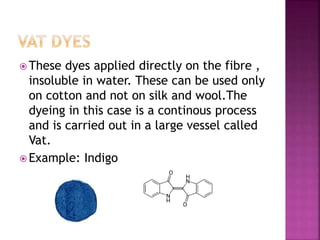
 These dyes applied directly on the fibre ,
insoluble in water. These can be used only
on cotton and not on silk and wool.The
dyeing in this case is a continous process
and is carried out in a large vessel called
Vat.
 Example: Indigo
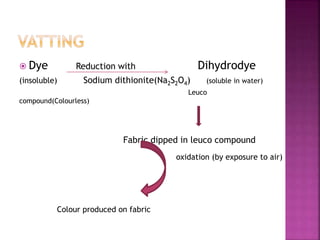
 Dye Reduction with Dihydrodye
(insoluble) Sodium dithionite(Na2S2O4) (soluble in water)
Leuco
compound(Colourless)
Fabric dipped in leuco compound
oxidation (by exposure to air)
Colour produced on fabric
 These are applied directly on the fibre. The
process includes the diazotization and the
coupling reaction at low temperature on the
fibre itself.
 Sulfur dyes: These are complex water
insoluble dyes containing sulfur. But these
dyes are soluble in sodium sulfide and thus
the dyeing process is carried out in Na2S
solution. These dyes are generally used for
dyeing cotton fibre.
 Classification can be given depending on
their chemical constitutions.
i) Azo dyes
Azo dyes are organic compounds bearing the
functional group R−N=N−R′, in which R and R′
are usually aryl. They are a commercially
important family of azo compounds, i.e.
compounds containing the linkage C-N=N-C.
Azo dyes are widely used to treat textiles,
leather articles, and some foods. Chemically
related to azo dyes are azo pigments, which
are insoluble in water and other solvents.
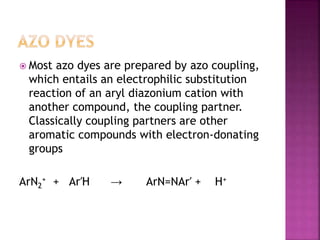
 Most azo dyes are prepared by azo coupling,
which entails an electrophilic substitution
reaction of an aryl diazonium cation with
another compound, the coupling partner.
Classically coupling partners are other
aromatic compounds with electron-donating
groups
ArN2
+ + Ar′H → ArN=NAr′ + H+
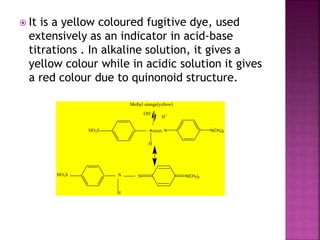
 It is a yellow coloured fugitive dye, used
extensively as an indicator in acid-base
titrations . In alkaline solution, it gives a
yellow colour while in acidic solution it gives
a red colour due to quinonoid structure.
Methyl orange(yellow)
N(CH3)2
N
N
HO3S
H
+
N(CH3)2
N
N
HO3S
H
OH-
H+
NH2
H2N N
ClN NCl
N
NH2
SO3H
+ N
N N
N
+ +
+
- +
+
NH2
SO3H
NH2
SO3H
N N N N
NH2
SO3H
Congo red
-
NaNO2/HCl
<5OC
Benzidine Tetra-azotized benzidine
Naphthionic acid
Coupling occurs at a position
ortho to amino group
Direct dye
CH
O
H
N(CH3)2
N(CH3)2
C
H
N(CH3)2
N(CH3)2
H2SO4
Leuco base
(colourless)
PbO2/HCl
C
N(CH3)2
N(CH3)2
HO
Colour base
C
H
N(CH3)2
N(CH3)2
+
Cl
-
HCl
Malachite Green
H
-H2O
Triphenyl methane dyes
OH
OH
H
OH
H
HO
C
C
O
O
O
O
C
C
O
O-
HO OH
H2SO4
-2H20
Fluorescin
Orange
solid
Phthalein dyes –acid dyes
NH2
NH
CH2
C
O
OH
ClCH2COOH
N
H
CH2
C
O
NaOH
ONa
- +
NaNH2, 300o
C
C
O
CH2
N
H
Oxidation
C
N
O
H
C C
N
C
O
H
Indigo
Indoxyl
Phenyl
glycine
THANKYOU

Bhuvana_Dyes.pptx

  • 1.
    WELCOME Dr.P.BHUVANESWARI, Assistant Professor ofChemistry, E.M.G.YadavaWomen’s College, Madurai-14
  • 2.
     It isan organic compounds, imparts colour to the fibre. Good dye-Resistant towards heat, light, moisture, dilute acids , washing soaps  Fast dye-permanently fixes on the surface, its colour will not change or lose brightness when it is washed.  Fugitive dye-A dye that fades out or washed off  Dye is generally applied in an aqueous solution, and may require a mordant to improve the fastness of the dye on the fiber.  Mordant-a substance, typically an inorganic oxide, that combines with a dye or stain and thereby fixes it in a material.
  • 3.
     An organiccompound appears coloured only if it absorbs the radiations in the visible part of the electromagnetic spectrum.  Visible region range 400-800nm.  When the white light falls on object,it may be  i)totally reflected back,the object appears white  ii)totally absorbed, the object appears black  iii) a part of light is absorbed and the rest is reflected back, the object appears coloured.
  • 5.
    S.no λ(nm) Wavelengthof light Absorbed colour Reflected colour 1. 400-440 Violet Yellow-green 2. 440-480 Blue Yellow 3. 480-490 Green-blue Orange 4. 490-500 Blue-green Red 5. 500-560 Green Purple 6. 560-580 Yellow-green Violet 7. 580-595 Yellow Blue 8. 595-605 Orange Green-blue 9. 605-750 Red Blue-green 10. 750-800 Purple Green
  • 6.
     German chemistWitt suggested the chromophore- Auxochrome theory for coloured compounds.  The groups with unsaturation and electron withdrawing nature have an appreciable effect on the absorption of light and when present in conjucation , are responsible for the colour of compound.Such group known as Chromophores.  azo, quinoid structure  The compounds containing chromophore group are known as chromogens.
  • 7.
     Nitro benzeneis pale yellow  Azo benzene is yellow orange  Nitrosobenzene is green in colour Benzo phenone (colourless) Benzil (Yellow)
  • 8.
     These groupsare not responsible for colour but when present along with chromophore groups are responsible for deepening of the colour. These are electron donating groups. Examples: -NH2, -NHR, -OH, -OR yellow colour Orange colour
  • 9.
     The chromophoresand auxochrome groups present in a compound cause deepening of colour by increasing the number of charged contributing structures during resonance effect.
  • 10.
     When amolecule absorbs a photon of the visible frequency , one of its bonding or a nonbonding electrons undergoes transition to the vacant antibonding orbitals.Absorption of a photon of visible light commonly causes π π* n π* transition of electrons.
  • 11.
     Natural dyesare dyes or colorants derived from plants, or minerals. The majority of natural dyes are vegetable dyes from plant sources—roots, berries, bark, leaves, and wood—and other biological sources such as fungi.
  • 12.
     Henna: Reddishbrown dye obtained from leaves of plant native to India, Egypt, Arabia and Iran.  It is a fast dye, the colour of henna is due to the presence of lawsone - quinonoid  Lawsone reacts chemically with the protein keratin in skin and hair via Michael addition
  • 13.
     Wallnut shells:Wallnutshells stain the skin brown.  The brown colour is due to the presence of a quinonoid component juglone present in the shells.  Turmeric: It is obtained from tubers of plants ‘Curcuma langa’. The colour of turmeric is due to the presence of curcumin, a highly conjucated system.In presence of alkali, curcurmin imparts red colour due to the formation of quinonoid structure.
  • 14.
     Catechu: Itis obtained from the plant ‘Acacia catechu’ .It is a source of brown dye.  It is also used for chewing along with ‘beetel leaves’ which imparts reddish colour to tongue and lips.
  • 15.
     Indigo dyesfrom stem and leaves of indigo  Alizarin dyes from roots of Madder plants
  • 16.
     In 1856,an 18-year-old English chemist, William Henry Perkin, accidentally discovered one of the first synthetic dyes. In search of a treatment for malaria, Perkin experimented with coal tar, a thick, dark liquid by-product of coal-gas production.
  • 17.
    Based on mode ofapplication Based on chemical structure
  • 18.
     Acid dyes Basic dyes  Direct or substantive dyes  Mordant dyes  Vat dyes  Azo dyes  Sulfur dyes
  • 19.
     Acid dyes:Sodium salts of sulfonic acids or nitrophenols,dyeing animal fibres,synthetic fibres Examples: Martius yellow, Naphthol yellow-s Picric acid
  • 20.
    Basic dyes :Cationic dyes containing basic groups such as -NH2, -NHR, -NR2 and their salts. Examples: Malachitegreen, Magenta Pararosaniline
  • 21.
     This classof dyes mainly includes various acid or basic dyes and can be directly used for the fibres of plant origin.  The dyeing of the fibres is carried out in the presence of common salt.  eg:Congo red
  • 22.
     Insoluble inwater, mordant is used as a binding material of the fibre with dye.For acid dyes, a basic mordant like Fe(OH)3, Al(OH)3 is used, an acid mordant such as tannic acid is used. eg: Alizarin 1,2-dihydroxyanthraquinone,
  • 23.
     These dyesapplied directly on the fibre , insoluble in water. These can be used only on cotton and not on silk and wool.The dyeing in this case is a continous process and is carried out in a large vessel called Vat.  Example: Indigo
  • 24.
     Dye Reductionwith Dihydrodye (insoluble) Sodium dithionite(Na2S2O4) (soluble in water) Leuco compound(Colourless) Fabric dipped in leuco compound oxidation (by exposure to air) Colour produced on fabric
  • 25.
     These areapplied directly on the fibre. The process includes the diazotization and the coupling reaction at low temperature on the fibre itself.  Sulfur dyes: These are complex water insoluble dyes containing sulfur. But these dyes are soluble in sodium sulfide and thus the dyeing process is carried out in Na2S solution. These dyes are generally used for dyeing cotton fibre.
  • 26.
     Classification canbe given depending on their chemical constitutions. i) Azo dyes Azo dyes are organic compounds bearing the functional group R−N=N−R′, in which R and R′ are usually aryl. They are a commercially important family of azo compounds, i.e. compounds containing the linkage C-N=N-C. Azo dyes are widely used to treat textiles, leather articles, and some foods. Chemically related to azo dyes are azo pigments, which are insoluble in water and other solvents.
  • 27.
     Most azodyes are prepared by azo coupling, which entails an electrophilic substitution reaction of an aryl diazonium cation with another compound, the coupling partner. Classically coupling partners are other aromatic compounds with electron-donating groups ArN2 + + Ar′H → ArN=NAr′ + H+
  • 29.
     It isa yellow coloured fugitive dye, used extensively as an indicator in acid-base titrations . In alkaline solution, it gives a yellow colour while in acidic solution it gives a red colour due to quinonoid structure. Methyl orange(yellow) N(CH3)2 N N HO3S H + N(CH3)2 N N HO3S H OH- H+
  • 30.
    NH2 H2N N ClN NCl N NH2 SO3H +N N N N + + + - + + NH2 SO3H NH2 SO3H N N N N NH2 SO3H Congo red - NaNO2/HCl <5OC Benzidine Tetra-azotized benzidine Naphthionic acid Coupling occurs at a position ortho to amino group Direct dye
  • 31.
  • 32.
  • 33.
  • 34.