Prepared By : Mazadul Hasan sheshir
ID: 2010000400008
13th
Batch (session 2009-2013)
Department : Wet Processing Technology
Email: mazadulhasan@yahoo.com
Blog : www. Textilelab.blogspot.com (visit)
Southeast University
Department Of Textile Engineering
I/A 251,252 Tejgaon Dhaka Bangladesh
Prepared By :
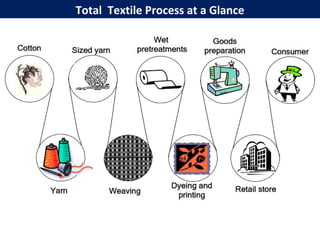
Total Textile Process at a Glance
Dyes and pigments are two fundamental things of Wet
Processing Technology. In order to dye a substrate a pupil
should have some basics about the dyes and pigments. Such as
a) what is dye and pigment? b) Their classification c) details
about individual. This presentation details the Reactive dye,
the groups of Reactive dyes, reactions of Reactive dyes to
fibre and its chemical approach to fibre. A process curve is
also represented to explain its thermal effect towards the
dyeing. At the end, there is a Factory profile of a wet
processing plant to illustrate the function of a dyeing plant .
Introduction
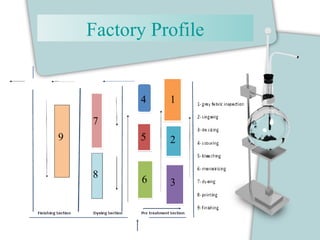
Factory Profile
1
2
3
4
5
6
7
8
9
Dyes & pigments
Dye is a colored substance that has
an affinity to the substrate to which
it is being applied. The dye is
generally applied in an aqueous
solution, and requires a mordant to
improve the fastness of the dye on
the fiber.
Pigment is a insoluble material that
changes the color of reflected or
transmitted light as the result of
wavelength-selective absorption.
Color Posessing Factors
 Absorb light in the visible
Spectrum(400-700)
 Contain chromophore group.
 Contain alternating double and single
bonds.
 Exhibit resonance of electrons.
Moreover , there is also electron donating
group named Auxochrome which is not
responsible for colour but deepens the shade.
Chromophore & Auxochrome
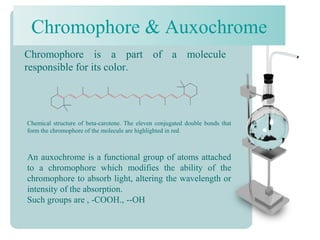
Chemical structure of beta-carotene. The eleven conjugated double bonds that
form the chromophore of the molecule are highlighted in red.
An auxochrome is a functional group of atoms attached
to a chromophore which modifies the ability of the
chromophore to absorb light, altering the wavelength or
intensity of the absorption.
Such groups are , -COOH., --OH
Chromophore is a part of a molecule
responsible for its color.
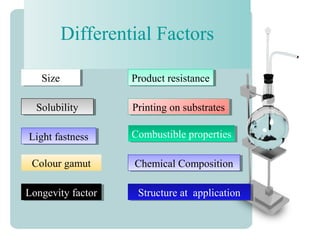
Differential Factors
SolubilitySolubility
Product resistanceProduct resistance
Light fastnessLight fastness
SizeSize
Structure at applicationStructure at application
Combustible propertiesCombustible properties
Chemical CompositionChemical Composition
Longevity factorLongevity factor
Printing on substratesPrinting on substrates
Colour gamut
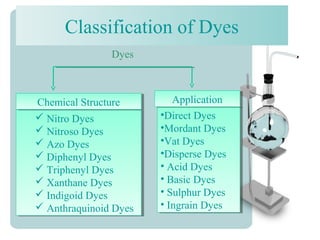
Classification of Dyes
Dyes
 Nitro Dyes
 Nitroso Dyes
 Azo Dyes
 Diphenyl Dyes
 Triphenyl Dyes
 Xanthane Dyes
 Indigoid Dyes
 Anthraquinoid Dyes
 Nitro Dyes
 Nitroso Dyes
 Azo Dyes
 Diphenyl Dyes
 Triphenyl Dyes
 Xanthane Dyes
 Indigoid Dyes
 Anthraquinoid Dyes
•Direct Dyes
•Mordant Dyes
•Vat Dyes
•Disperse Dyes
• Acid Dyes
• Basic Dyes
• Sulphur Dyes
• Ingrain Dyes
•Direct Dyes
•Mordant Dyes
•Vat Dyes
•Disperse Dyes
• Acid Dyes
• Basic Dyes
• Sulphur Dyes
• Ingrain Dyes
Chemical StructureChemical Structure ApplicationApplication
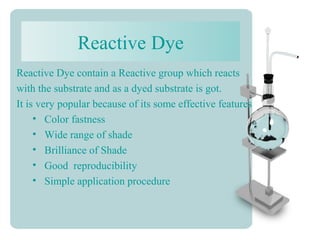
Reactive Dye
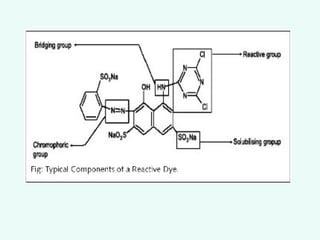
Reactive Dye contain a Reactive group which reacts
with the substrate and as a dyed substrate is got.
It is very popular because of its some effective features
• Color fastness
• Wide range of shade
• Brilliance of Shade
• Good reproducibility
• Simple application procedure
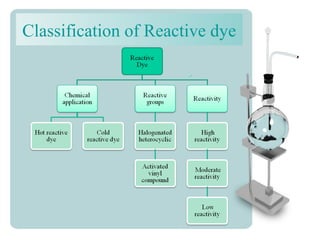
Classification of Reactive dye
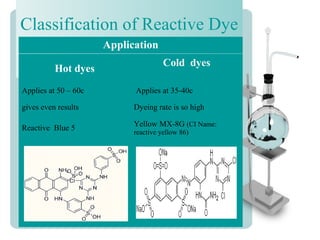
Classification of Reactive Dye
Application
Hot dyes
Cold dyes
Applies at 50 – 60c Applies at 35-40c
gives even results Dyeing rate is so high
Reactive Blue 5 Yellow MX-8G (CI Name:
reactive yellow 86)
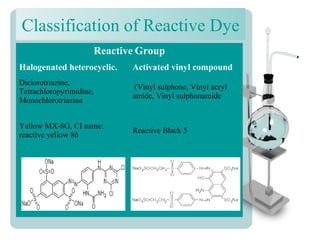
Classification of Reactive Dye
Halogenated heterocyclic. Activated vinyl compound
Diclorotriazine,
Tetrachloropyrimidine,
Monochlorotriazine
(Vinyl sulphone, Vinyl acryl
amide, Vinyl sulphonamide
Yellow MX-8G, CI name:
reactive yellow 86
Reactive Black 5
Reactive Group
Classification of Reactive Dye
High reactivity Moderate reactivity Low reactivity
Example:
Dichlorotriazine
Example: Vinyl
sulphone
Example:
Trichloropyrimidine,
Dichloroquinoxaline
Orang MX-G
Ci name :Reactive
orange 1
Reactive Orange 16
Reactivity
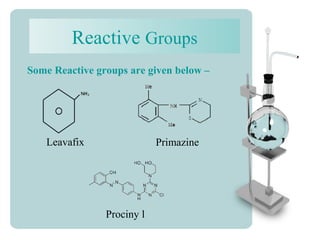
Reactive Groups
Prociny l
Some Reactive groups are given below –
Leavafix Primazine
Parameters of dye absorption for
reactive dyeing
 Nature of the reactive dye
 Liquor ratio of reactive dye bath
 Electrolyte concentration in side the dye bath
 pH of the liquor
 Temperature of the reactive dye bath
 Type of the fiber to be dyed with reactive dye
 Reactive Dyeing time
 Alkali concentration in the liquor
Approach of Reactive Dye
to Fibre
Reactive Dye colors a fibre by three basic
approach.
 Absorption-Due to affinity dyes get attached on
fibre
 Exhaustion- The dye molecules diffused into
the fibre and distributed all over the fibre
 Fixation- The dye molecules affix with the fibre
by making strong bonds.
 After treatment- By a successive washing
process, overall shades and fastness improved
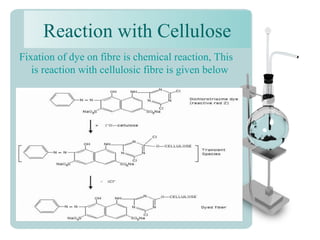
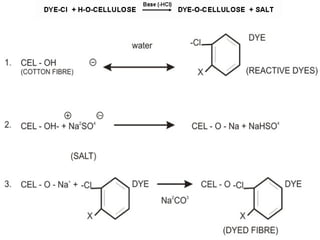
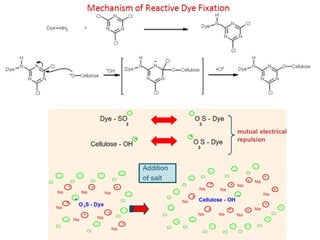
Reaction with Cellulose
Fixation of dye on fibre is chemical reaction, This
is reaction with cellulosic fibre is given below
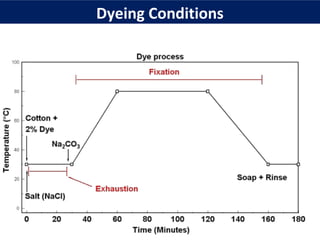
Dyeing Conditions
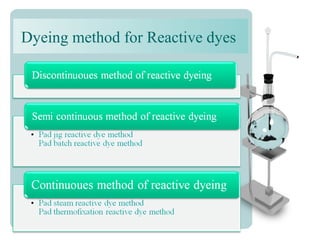
Dyeing method for Reactive dyes
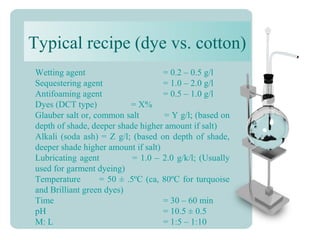
Typical recipe (dye vs. cotton)
Wetting agent = 0.2 – 0.5 g/l
Sequestering agent = 1.0 – 2.0 g/l
Antifoaming agent = 0.5 – 1.0 g/l
Dyes (DCT type) = X%
Glauber salt or, common salt = Y g/l; (based on
depth of shade, deeper shade higher amount if salt)
Alkali (soda ash) = Z g/l; (based on depth of shade,
deeper shade higher amount if salt)
Lubricating agent = 1.0 – 2.0 g/k/l; (Usually
used for garment dyeing)
Temperature = 50 ± .5ºC (ca, 80ºC for turquoise
and Brilliant green dyes)
Time = 30 – 60 min
pH = 10.5 ± 0.5
M: L = 1:5 – 1:10
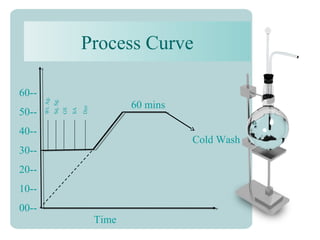
Process Curve
60--
50--
40--
30--
20--
10--
00--
Time
60 mins
Dye
SA
GS
Sq.Sg.
Wt.Ag.
Cold Wash
Conclusion
In conclusion, Dye and pigments both have the property
of imparting colour on substrates. However, they work in
different media in different form. In this discussion,
there is given two types of classification according to
there parental structure and application. This helps to
catagorise a dye either according to their structural group
or application. Here is also a endeavour to give a
transparent view about the Reactive dye. Its mechanism
and process of application are also discussed. However,
the process curve is not appropriately drawn in lieu of
some limitations.A profile of a standard WPT plant is
presented in lay out form.
1. Yarn Manufacturing Technology
Link : http://www.facebook.com/pages/Yarn-Manufacturing-Technology/485014954866808
2. Fabric Manufacturing Technology
Link : http://www.facebook.com/pages/Fabric-Manufacturing-Technology/459520217425605
3. Garments Manufacturing Technology
Link : http://www.facebook.com/pages/Garments-Manufacturing-
Technology/472364799463126
3. Wet processing Technology
Link : http://www.facebook.com/pages/Wet-Processing-Technology-Dyeing-/468645219825404
4. Fashion-Design-and-Technology
Link : http://www.facebook.com/pages/Fashion-Design-and-Technology/587655294583875?
ref=ts&fref=ts
My Facebook Textile related Pages
http://www.textilelab.blogspot.com (Visit )

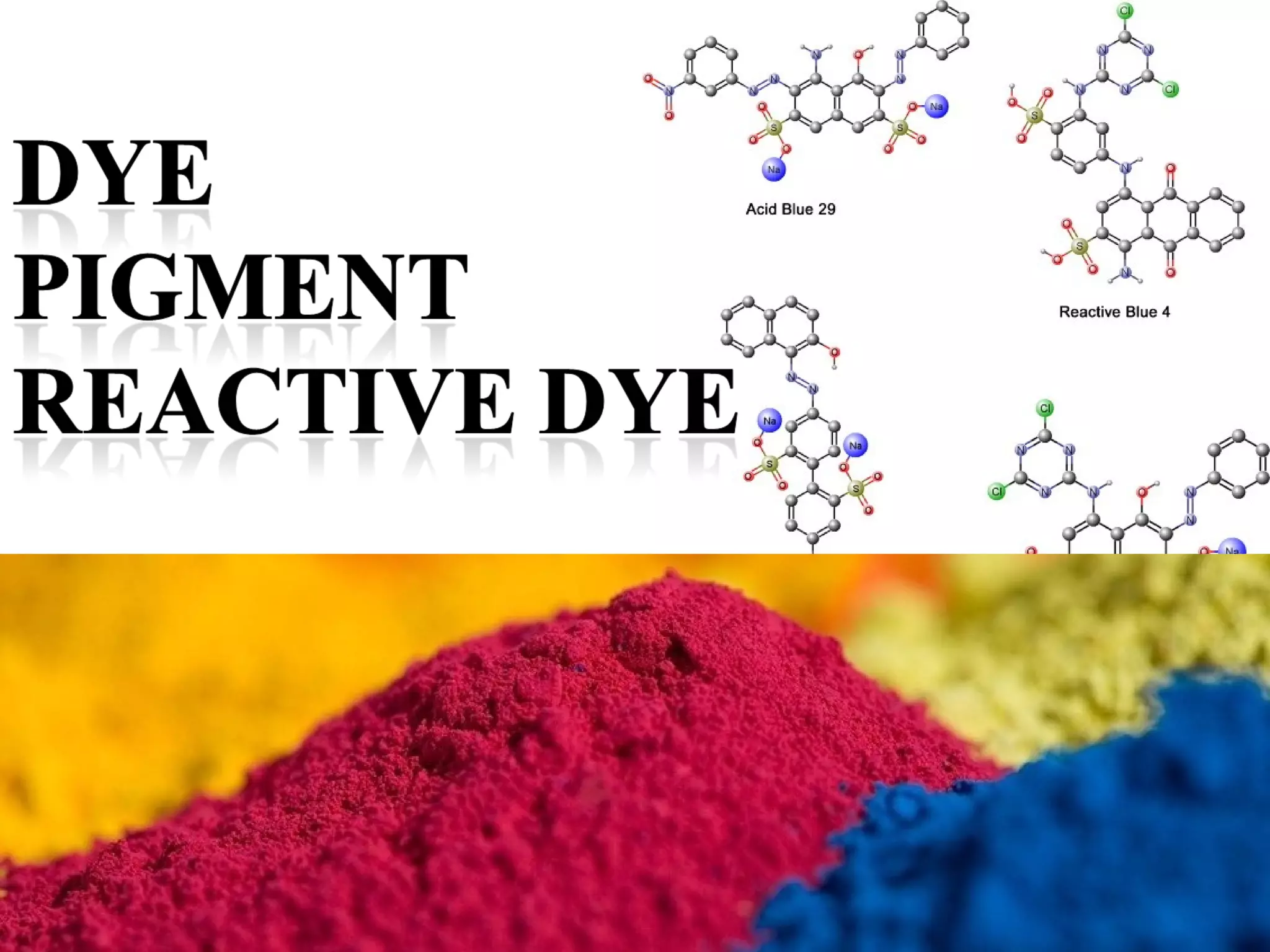
Dye Pigment reactive dye

  • 2.
    Prepared By :Mazadul Hasan sheshir ID: 2010000400008 13th Batch (session 2009-2013) Department : Wet Processing Technology Email: mazadulhasan@yahoo.com Blog : www. Textilelab.blogspot.com (visit) Southeast University Department Of Textile Engineering I/A 251,252 Tejgaon Dhaka Bangladesh Prepared By :
  • 3.
  • 4.
    Dyes and pigmentsare two fundamental things of Wet Processing Technology. In order to dye a substrate a pupil should have some basics about the dyes and pigments. Such as a) what is dye and pigment? b) Their classification c) details about individual. This presentation details the Reactive dye, the groups of Reactive dyes, reactions of Reactive dyes to fibre and its chemical approach to fibre. A process curve is also represented to explain its thermal effect towards the dyeing. At the end, there is a Factory profile of a wet processing plant to illustrate the function of a dyeing plant . Introduction
  • 6.
  • 7.
    Dyes & pigments Dyeis a colored substance that has an affinity to the substrate to which it is being applied. The dye is generally applied in an aqueous solution, and requires a mordant to improve the fastness of the dye on the fiber. Pigment is a insoluble material that changes the color of reflected or transmitted light as the result of wavelength-selective absorption.
  • 8.
    Color Posessing Factors Absorb light in the visible Spectrum(400-700)  Contain chromophore group.  Contain alternating double and single bonds.  Exhibit resonance of electrons. Moreover , there is also electron donating group named Auxochrome which is not responsible for colour but deepens the shade.
  • 9.
    Chromophore & Auxochrome Chemicalstructure of beta-carotene. The eleven conjugated double bonds that form the chromophore of the molecule are highlighted in red. An auxochrome is a functional group of atoms attached to a chromophore which modifies the ability of the chromophore to absorb light, altering the wavelength or intensity of the absorption. Such groups are , -COOH., --OH Chromophore is a part of a molecule responsible for its color.
  • 10.
    Differential Factors SolubilitySolubility Product resistanceProductresistance Light fastnessLight fastness SizeSize Structure at applicationStructure at application Combustible propertiesCombustible properties Chemical CompositionChemical Composition Longevity factorLongevity factor Printing on substratesPrinting on substrates Colour gamut
  • 11.
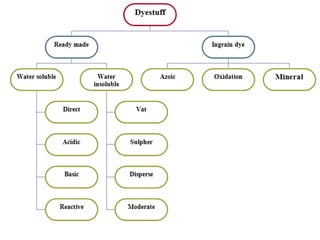
    Classification of Dyes Dyes Nitro Dyes  Nitroso Dyes  Azo Dyes  Diphenyl Dyes  Triphenyl Dyes  Xanthane Dyes  Indigoid Dyes  Anthraquinoid Dyes  Nitro Dyes  Nitroso Dyes  Azo Dyes  Diphenyl Dyes  Triphenyl Dyes  Xanthane Dyes  Indigoid Dyes  Anthraquinoid Dyes •Direct Dyes •Mordant Dyes •Vat Dyes •Disperse Dyes • Acid Dyes • Basic Dyes • Sulphur Dyes • Ingrain Dyes •Direct Dyes •Mordant Dyes •Vat Dyes •Disperse Dyes • Acid Dyes • Basic Dyes • Sulphur Dyes • Ingrain Dyes Chemical StructureChemical Structure ApplicationApplication
  • 12.
    Reactive Dye Reactive Dyecontain a Reactive group which reacts with the substrate and as a dyed substrate is got. It is very popular because of its some effective features • Color fastness • Wide range of shade • Brilliance of Shade • Good reproducibility • Simple application procedure
  • 13.
  • 14.
    Classification of ReactiveDye Application Hot dyes Cold dyes Applies at 50 – 60c Applies at 35-40c gives even results Dyeing rate is so high Reactive Blue 5 Yellow MX-8G (CI Name: reactive yellow 86)
  • 15.
    Classification of ReactiveDye Halogenated heterocyclic. Activated vinyl compound Diclorotriazine, Tetrachloropyrimidine, Monochlorotriazine (Vinyl sulphone, Vinyl acryl amide, Vinyl sulphonamide Yellow MX-8G, CI name: reactive yellow 86 Reactive Black 5 Reactive Group
  • 16.
    Classification of ReactiveDye High reactivity Moderate reactivity Low reactivity Example: Dichlorotriazine Example: Vinyl sulphone Example: Trichloropyrimidine, Dichloroquinoxaline Orang MX-G Ci name :Reactive orange 1 Reactive Orange 16 Reactivity
  • 17.
    Reactive Groups Prociny l SomeReactive groups are given below – Leavafix Primazine
  • 18.
    Parameters of dyeabsorption for reactive dyeing  Nature of the reactive dye  Liquor ratio of reactive dye bath  Electrolyte concentration in side the dye bath  pH of the liquor  Temperature of the reactive dye bath  Type of the fiber to be dyed with reactive dye  Reactive Dyeing time  Alkali concentration in the liquor
  • 19.
    Approach of ReactiveDye to Fibre Reactive Dye colors a fibre by three basic approach.  Absorption-Due to affinity dyes get attached on fibre  Exhaustion- The dye molecules diffused into the fibre and distributed all over the fibre  Fixation- The dye molecules affix with the fibre by making strong bonds.  After treatment- By a successive washing process, overall shades and fastness improved
  • 20.
    Reaction with Cellulose Fixationof dye on fibre is chemical reaction, This is reaction with cellulosic fibre is given below
  • 24.
  • 25.
    Dyeing method forReactive dyes
  • 26.
    Typical recipe (dyevs. cotton) Wetting agent = 0.2 – 0.5 g/l Sequestering agent = 1.0 – 2.0 g/l Antifoaming agent = 0.5 – 1.0 g/l Dyes (DCT type) = X% Glauber salt or, common salt = Y g/l; (based on depth of shade, deeper shade higher amount if salt) Alkali (soda ash) = Z g/l; (based on depth of shade, deeper shade higher amount if salt) Lubricating agent = 1.0 – 2.0 g/k/l; (Usually used for garment dyeing) Temperature = 50 ± .5ºC (ca, 80ºC for turquoise and Brilliant green dyes) Time = 30 – 60 min pH = 10.5 ± 0.5 M: L = 1:5 – 1:10
  • 27.
  • 28.
    Conclusion In conclusion, Dyeand pigments both have the property of imparting colour on substrates. However, they work in different media in different form. In this discussion, there is given two types of classification according to there parental structure and application. This helps to catagorise a dye either according to their structural group or application. Here is also a endeavour to give a transparent view about the Reactive dye. Its mechanism and process of application are also discussed. However, the process curve is not appropriately drawn in lieu of some limitations.A profile of a standard WPT plant is presented in lay out form.
  • 31.
    1. Yarn ManufacturingTechnology Link : http://www.facebook.com/pages/Yarn-Manufacturing-Technology/485014954866808 2. Fabric Manufacturing Technology Link : http://www.facebook.com/pages/Fabric-Manufacturing-Technology/459520217425605 3. Garments Manufacturing Technology Link : http://www.facebook.com/pages/Garments-Manufacturing- Technology/472364799463126 3. Wet processing Technology Link : http://www.facebook.com/pages/Wet-Processing-Technology-Dyeing-/468645219825404 4. Fashion-Design-and-Technology Link : http://www.facebook.com/pages/Fashion-Design-and-Technology/587655294583875? ref=ts&fref=ts My Facebook Textile related Pages http://www.textilelab.blogspot.com (Visit )