General Structure of Reactive Dyes 
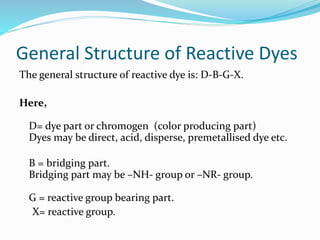
The general structure of reactive dye is: D-B-G-X. 
Here, 
D= dye part or chromogen (color producing part) 
Dyes may be direct, acid, disperse, premetallised dye etc. 
B = bridging part. 
Bridging part may be –NH- group or –NR- group. 
G = reactive group bearing part. 
X= reactive group.
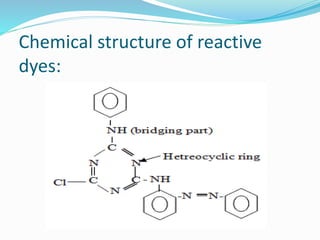
Chemical structure of reactive 
dyes:
Reactive Dyes: 
 A dye which is capable of reacting chemically with a 
substrate to form a covalent dye substrate linkage 
 Only a class of dye that have a reactive Group in their 
structure 
 Covalent bond formation with the substrate
Characteristics of Reactive Dye: 
Reactive group: Responsible for the reaction between the 
substrate & dye molecule 
Chromophoric group: Coloring agent 
Bridging group: That links the reactive system to the 
chromophore. Also influence the reactivity & degree of fixation. 
Solubilizing group: Solubilizing agent
Classification of reactive 
dyes: 
Depending on chemical constitution reactive dyes can be 
classified as: 
Monofunctional Reactive system: Have only one reactive 
system 
Bifunctional Reactive system: Have two reactive system. 
Homobifunctional reactive system and Heterobifunctional 
reactive system 
Polyfunctional reactive system: May have more then two 
reactive system.
Depending on application method of temperature 
reactive dyes can be classified as: 
Cold Reactive dyes: 
Dyes which have high reactivity need low temperature for 
dyeing (25-50 0C) 
Hot reactive dyes: 
Dye which have low reactivity need high temperature for dyeing 
the textile substrate (60-90 0C)
General properties of reactive 
dyes: 
 Reactive dye is anionic in nature. 
 Reactive dye is a water soluble dye. 
 They have better wash and light fastness properties. 
 They have better substantivity. 
 They form strong covalent bond with the cellulosic fibers. 
 Alkaline condition is must required for dyeing. 
 Electrolyte is must required for dye exhaustion in the fiber. 
 Wide range of color can produce. 
 Comparatively cheap in price.
Influencing factors 
ph 
Reactive dyeing is done in alkaline condition for this 
reason ph of the dye bath should control. ph should be 
between 11.5-11. 
Temperature 
Temperature should fix depending on the nature of dye.
Concentration of electrolyte 
Concentration of electrolyte depends upon the type of 
shade. 
Substantivity: 
Substantivity more depends upon chromophore as compared to 
reactive system. A high substantivity may results: 
Lower dye solubility. 
High primary exhaustion. 
A high reaction rate.
Defects in Dyeing with Reactive Dyes: 
Defects: 
Colors are not fast to washing, Abrasion, Staining in the fabric when 
transporting from place to the other, water marks on the fabric. 
Remedy: 
Wash the fabric with soap and soda ash at right temperature. 
Adding sequestering agent will yield good results. Treating with 
Ammonia will also give good results.
Defect: The fabric has been dyed in darker shade, 
uneven dyeing 
Remedy: 
To take out color from the fabric treat it with caustic for 45-60 min at 
70 oC. Thereafter treat the fabric with 10-20 g/l . Acetic Acid for 40-60 
min at 80-85 oC. 
Defect: 
Bleeding in colors during washing, abrasion. 
Remedy: 
Boil the fabric with caustic, Treat the fabric with Hydrogen 
Peroxide ( 5-10 g/l, 60-70 oC) to make the color fast.
General steps of dyeing with 
reactive dyes: 
 Exhaustion of dyes 
 Adsorption 
 Diffusion of dye 
 Migration of dye molecule 
 Fixation of dye in the textile substrate
.

Reactive dyes by Engr Aashiq

  • 2.
    General Structure ofReactive Dyes The general structure of reactive dye is: D-B-G-X. Here, D= dye part or chromogen (color producing part) Dyes may be direct, acid, disperse, premetallised dye etc. B = bridging part. Bridging part may be –NH- group or –NR- group. G = reactive group bearing part. X= reactive group.
  • 3.
    Chemical structure ofreactive dyes:
  • 4.
    Reactive Dyes: A dye which is capable of reacting chemically with a substrate to form a covalent dye substrate linkage  Only a class of dye that have a reactive Group in their structure  Covalent bond formation with the substrate
  • 5.
    Characteristics of ReactiveDye: Reactive group: Responsible for the reaction between the substrate & dye molecule Chromophoric group: Coloring agent Bridging group: That links the reactive system to the chromophore. Also influence the reactivity & degree of fixation. Solubilizing group: Solubilizing agent
  • 6.
    Classification of reactive dyes: Depending on chemical constitution reactive dyes can be classified as: Monofunctional Reactive system: Have only one reactive system Bifunctional Reactive system: Have two reactive system. Homobifunctional reactive system and Heterobifunctional reactive system Polyfunctional reactive system: May have more then two reactive system.
  • 7.
    Depending on applicationmethod of temperature reactive dyes can be classified as: Cold Reactive dyes: Dyes which have high reactivity need low temperature for dyeing (25-50 0C) Hot reactive dyes: Dye which have low reactivity need high temperature for dyeing the textile substrate (60-90 0C)
  • 8.
    General properties ofreactive dyes:  Reactive dye is anionic in nature.  Reactive dye is a water soluble dye.  They have better wash and light fastness properties.  They have better substantivity.  They form strong covalent bond with the cellulosic fibers.  Alkaline condition is must required for dyeing.  Electrolyte is must required for dye exhaustion in the fiber.  Wide range of color can produce.  Comparatively cheap in price.
  • 9.
    Influencing factors ph Reactive dyeing is done in alkaline condition for this reason ph of the dye bath should control. ph should be between 11.5-11. Temperature Temperature should fix depending on the nature of dye.
  • 10.
    Concentration of electrolyte Concentration of electrolyte depends upon the type of shade. Substantivity: Substantivity more depends upon chromophore as compared to reactive system. A high substantivity may results: Lower dye solubility. High primary exhaustion. A high reaction rate.
  • 11.
    Defects in Dyeingwith Reactive Dyes: Defects: Colors are not fast to washing, Abrasion, Staining in the fabric when transporting from place to the other, water marks on the fabric. Remedy: Wash the fabric with soap and soda ash at right temperature. Adding sequestering agent will yield good results. Treating with Ammonia will also give good results.
  • 12.
    Defect: The fabrichas been dyed in darker shade, uneven dyeing Remedy: To take out color from the fabric treat it with caustic for 45-60 min at 70 oC. Thereafter treat the fabric with 10-20 g/l . Acetic Acid for 40-60 min at 80-85 oC. Defect: Bleeding in colors during washing, abrasion. Remedy: Boil the fabric with caustic, Treat the fabric with Hydrogen Peroxide ( 5-10 g/l, 60-70 oC) to make the color fast.
  • 13.
    General steps ofdyeing with reactive dyes:  Exhaustion of dyes  Adsorption  Diffusion of dye  Migration of dye molecule  Fixation of dye in the textile substrate
  • 14.