2012
www.mplsvpn.info

Shivlu Jain


[MPLS-TP]
History

Most of the operators are using circuit switched technology as transport network. But most of the
services are packet based services, so why not to use packet based networks to offer high bandwidth
packet based services. The need of high bandwidth hungry application demands to upgrade the
infrastructure. But the same time operators want to reduce their per bit infrastructure cost with
minimal capex and opex involved. MPLS had already been deployed widely to offer packet based
services, then why not to use MPLS as transport too. This was the reason to add T-MPLS (Transport
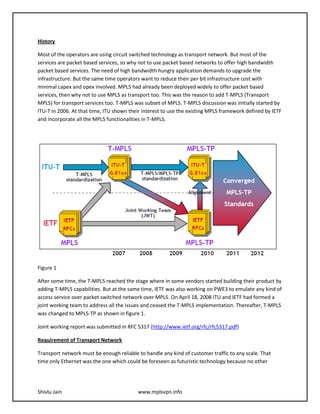
MPLS) for transport services too. T-MPLS was subset of MPLS. T-MPLS discussion was initially started by
ITU-T in 2006. At that time, ITU shown their interest to use the existing MPLS framework defined by IETF
and incorporate all the MPLS functionalities in T-MPLS.


Figure 1

After some time, the T-MPLS reached the stage where in some vendors started building their product by
adding T-MPLS capabilities. But at the same time, IETF was also working on PWE3 to emulate any kind of
access service over packet switched network over MPLS. On April 18, 2008 ITU and IETF had formed a
joint working team to address all the issues and ceased the T-MPLS implementation. Thereafter, T-MPLS
was changed to MPLS-TP as shown in figure 1.

Joint working report was submitted in RFC 5317 (http://www.ietf.org/rfc/rfc5317.pdf)

Requirement of Transport Network

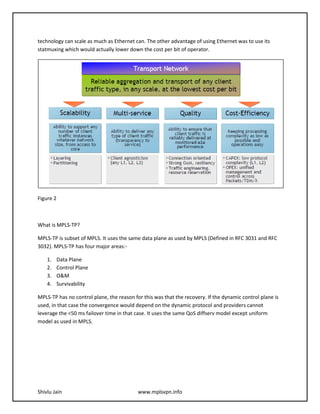
Transport network must be enough reliable to handle any kind of customer traffic to any scale. That
time only Ethernet was the one which could be foreseen as futuristic technology because no other


Shivlu Jain                               www.mplsvpn.info
technology can scale as much as Ethernet can. The other advantage of using Ethernet was to use its
statmuxing which would actually lower down the cost per bit of operator.


Figure 2


What is MPLS-TP?

MPLS-TP is subset of MPLS. It uses the same data plane as used by MPLS (Defined in RFC 3031 and RFC
3032). MPLS-TP has four major areas:-

    1.     Data Plane
    2.     Control Plane
    3.     O&M
    4.     Survivability

MPLS-TP has no control plane, the reason for this was that the recovery. If the dynamic control plane is
used, in that case the convergence would depend on the dynamic protocol and providers cannot
leverage the <50 ms failover time in that case. It uses the same QoS diffserv model except uniform
model as used in MPLS.


Shivlu Jain                                www.mplsvpn.info
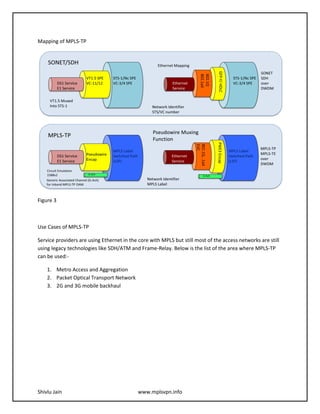
Mapping of MPLS-TP


Figure 3


Use Cases of MPLS-TP

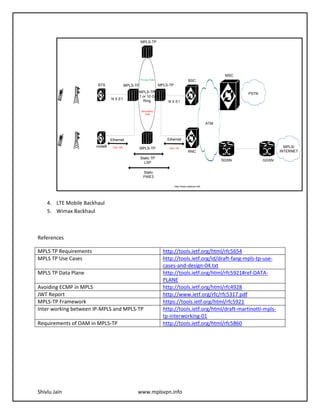
Service providers are using Ethernet in the core with MPLS but still most of the access networks are still
using legacy technologies like SDH/ATM and Frame-Relay. Below is the list of the area where MPLS-TP
can be used:-

    1. Metro Access and Aggregation
    2. Packet Optical Transport Network
    3. 2G and 3G mobile backhaul


Shivlu Jain                                 www.mplsvpn.info
MPLS-TP


                                                                                                               MSC
                                                     Primary Path                         BSC
                       BTS                 MPLS-TP                  MPLS-TP
                                                 MPLS-TP                                                             PSTN
                                                 1 or 10 G
                               N X E1
                                                   Ring                 N X E1

                                                      Secondary
                                                         Path


                                                                                                        ATM


                               Ethernet                                 Ethernet
                       nodeB    Vlan 100                                                                                             MPLS/
                                                     MPLS-TP             Vlan 100
                                                                                         RNC                                       INTERNET
                                                     Static TP
                                                                                                              SGSN          GGSN
                                                       LSP

                                                       Static
                                                       PWE3

                                                                              http://www.mplsvpn.info


    4. LTE Mobile Backhaul
    5. Wimax Backhaul


References

MPLS TP Requirements                                                  http://tools.ietf.org/html/rfc5654
MPLS TP Use Cases                                                     http://tools.ietf.org/id/draft-fang-mpls-tp-use-
                                                                      cases-and-design-04.txt
MPLS TP Data Plane                                                    http://tools.ietf.org/html/rfc5921#ref-DATA-
                                                                      PLANE
Avoiding ECMP in MPLS                                                 http://tools.ietf.org/html/rfc4928
JWT Report                                                            http://www.ietf.org/rfc/rfc5317.pdf
MPLS-TP Framework                                                     https://tools.ietf.org/html/rfc5921
Inter working between IP-MPLS and MPLS-TP                             http://tools.ietf.org/html/draft-martinotti-mpls-
                                                                      tp-interworking-01
Requirements of OAM in MPLS-TP                                        http://tools.ietf.org/html/rfc5860


Shivlu Jain                                      www.mplsvpn.info

MPLS-TP (MPLS Transport Profile)

  • 1.
  • 2.
    History Most of theoperators are using circuit switched technology as transport network. But most of the services are packet based services, so why not to use packet based networks to offer high bandwidth packet based services. The need of high bandwidth hungry application demands to upgrade the infrastructure. But the same time operators want to reduce their per bit infrastructure cost with minimal capex and opex involved. MPLS had already been deployed widely to offer packet based services, then why not to use MPLS as transport too. This was the reason to add T-MPLS (Transport MPLS) for transport services too. T-MPLS was subset of MPLS. T-MPLS discussion was initially started by ITU-T in 2006. At that time, ITU shown their interest to use the existing MPLS framework defined by IETF and incorporate all the MPLS functionalities in T-MPLS. Figure 1 After some time, the T-MPLS reached the stage where in some vendors started building their product by adding T-MPLS capabilities. But at the same time, IETF was also working on PWE3 to emulate any kind of access service over packet switched network over MPLS. On April 18, 2008 ITU and IETF had formed a joint working team to address all the issues and ceased the T-MPLS implementation. Thereafter, T-MPLS was changed to MPLS-TP as shown in figure 1. Joint working report was submitted in RFC 5317 (http://www.ietf.org/rfc/rfc5317.pdf) Requirement of Transport Network Transport network must be enough reliable to handle any kind of customer traffic to any scale. That time only Ethernet was the one which could be foreseen as futuristic technology because no other Shivlu Jain www.mplsvpn.info
  • 3.
    technology can scaleas much as Ethernet can. The other advantage of using Ethernet was to use its statmuxing which would actually lower down the cost per bit of operator. Figure 2 What is MPLS-TP? MPLS-TP is subset of MPLS. It uses the same data plane as used by MPLS (Defined in RFC 3031 and RFC 3032). MPLS-TP has four major areas:- 1. Data Plane 2. Control Plane 3. O&M 4. Survivability MPLS-TP has no control plane, the reason for this was that the recovery. If the dynamic control plane is used, in that case the convergence would depend on the dynamic protocol and providers cannot leverage the <50 ms failover time in that case. It uses the same QoS diffserv model except uniform model as used in MPLS. Shivlu Jain www.mplsvpn.info
  • 4.
    Mapping of MPLS-TP Figure3 Use Cases of MPLS-TP Service providers are using Ethernet in the core with MPLS but still most of the access networks are still using legacy technologies like SDH/ATM and Frame-Relay. Below is the list of the area where MPLS-TP can be used:- 1. Metro Access and Aggregation 2. Packet Optical Transport Network 3. 2G and 3G mobile backhaul Shivlu Jain www.mplsvpn.info
  • 5.
    MPLS-TP MSC Primary Path BSC BTS MPLS-TP MPLS-TP MPLS-TP PSTN 1 or 10 G N X E1 Ring N X E1 Secondary Path ATM Ethernet Ethernet nodeB Vlan 100 MPLS/ MPLS-TP Vlan 100 RNC INTERNET Static TP SGSN GGSN LSP Static PWE3 http://www.mplsvpn.info 4. LTE Mobile Backhaul 5. Wimax Backhaul References MPLS TP Requirements http://tools.ietf.org/html/rfc5654 MPLS TP Use Cases http://tools.ietf.org/id/draft-fang-mpls-tp-use- cases-and-design-04.txt MPLS TP Data Plane http://tools.ietf.org/html/rfc5921#ref-DATA- PLANE Avoiding ECMP in MPLS http://tools.ietf.org/html/rfc4928 JWT Report http://www.ietf.org/rfc/rfc5317.pdf MPLS-TP Framework https://tools.ietf.org/html/rfc5921 Inter working between IP-MPLS and MPLS-TP http://tools.ietf.org/html/draft-martinotti-mpls- tp-interworking-01 Requirements of OAM in MPLS-TP http://tools.ietf.org/html/rfc5860 Shivlu Jain www.mplsvpn.info