VENOUS SINUSES IN
DURA MATER &
CAVERNOUS SINUS
PRESENTED BY:
DR. URVASHI SODVADIA
DEPT OF CONSERVATIVE
DENTISTRY & ENDODONTICS
CONTENTS
Brief Introduction of meninges
Structure of dura mater
Introduction of venous sinuses
Cavernous sinus
Clinical aspect
Drainage of venous sinuses
Summary
MENINGES
DURA MATER
ARACHNOID MATER
PIA MATER
DURA MATER
Outer most layer
Latin meaning : “hard mother”
Two layers:
o Periosteal layer
o Meningeal layer
Subdural space
Epidural space
FOUR DURAL INFOLDING :
Falx cerebri
Tentorium cerebelli
Falx cerebelli
Diaphragma celli
Dural venous
sinuses
SPINAL DURA MATER
FALX CEREBRI
LARGEST dural infolding
Sickle shaped
Separates cerebral
hemispheres
Attachments
Superior Sagittal Sinus
Inferior Sagittal Sinus
Straight Sinus
Confluence of Sinuses
TENTORIUM
CEREBELLI
“TENT OF CEREBELLUM”
Straight sinus
Relations
Superior Petrosal SinusTransverse Sinus
CLINICAL ASPECTS
o Epidural haematoma (middle meningeal artery)
o Subdural haematoma (superior cerebral vein)
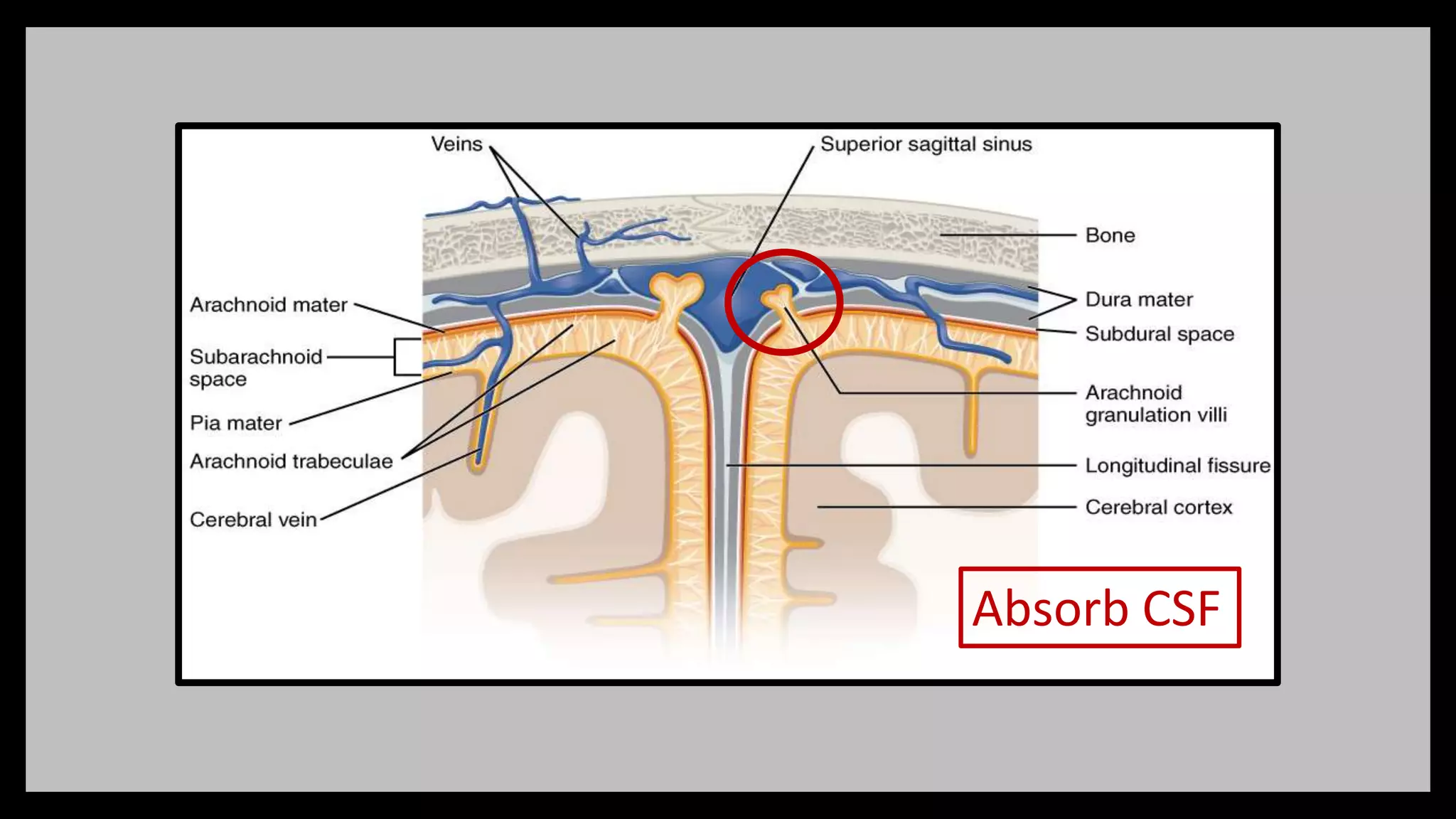
ARACHNOID
MATER
Loosely surrounds the
brain without dipping into
sulci
Subarachnoid space
contains CSF
Arachnoid villi
Arachnoid granulation
Absorb CSF
PIA MATER
Innermost layer
“TENDER MOHER”
Highly vascular, impermeable to
fluid
Arachnoid trabeculae
MENINGITIS
VENOUS SINUSES
ARTERIAL SUPPLY VENOUS SUPPLY
MAINLY BY 2 SYSTEMS :
oInternal carotid system
oVertebral basillary
system
Does not follow the
arterial supply !
Drains by “ DURAL
VENOUS SINUS”
B
R
A
I
N
ARTERIAL SUPPLY B
R
A
I
N
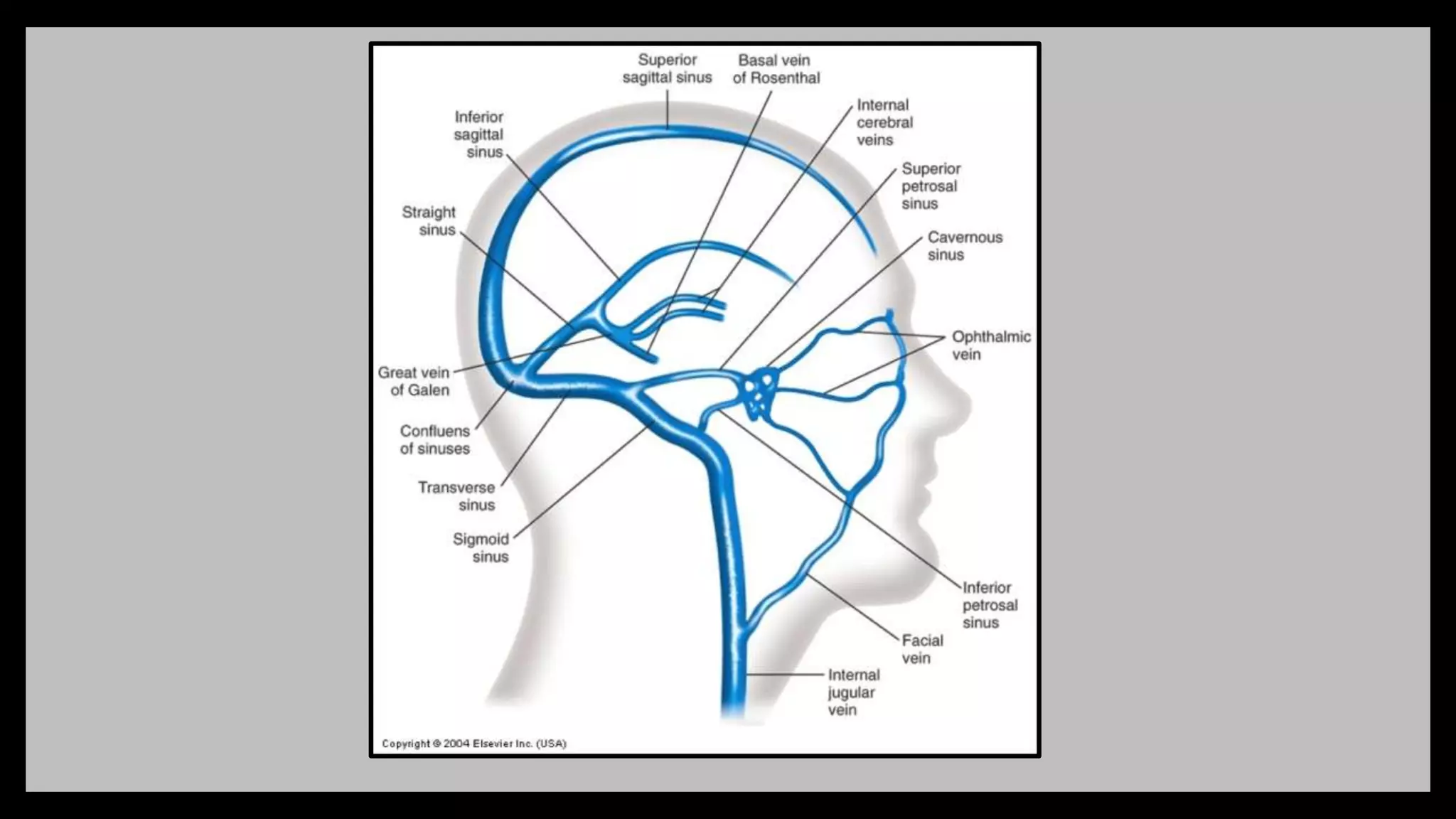
VENOUS SINUSES
Intracranial venous channels
lined by endothelium
No muscles
No valves
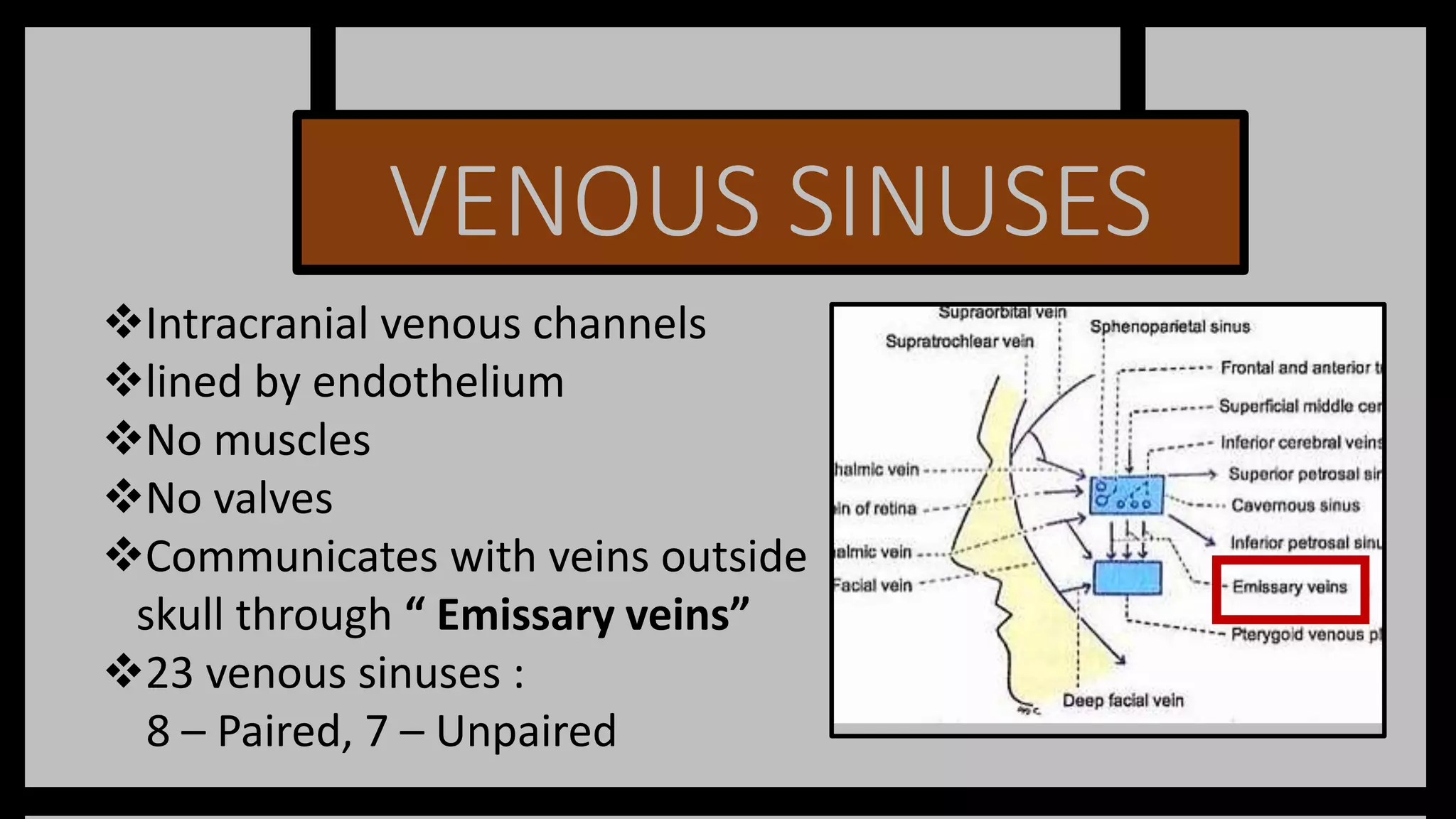
Communicates with veins outside
skull through “ Emissary veins”
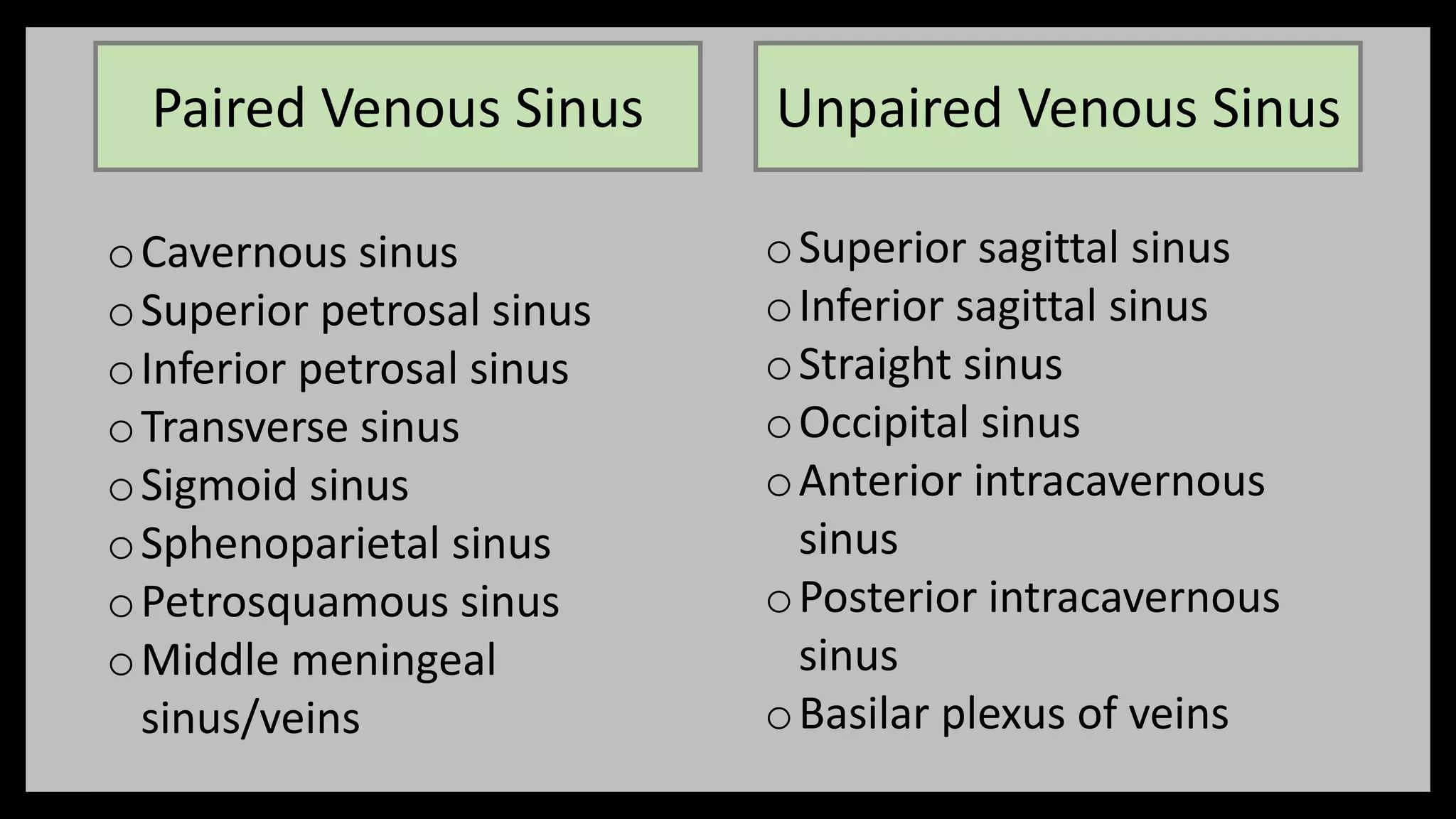
23 venous sinuses :
8 – Paired, 7 – Unpaired
VENOUS SINUSES
Paired Venous Sinus Unpaired Venous Sinus
oCavernous sinus
oSuperior petrosal sinus
oInferior petrosal sinus
oTransverse sinus
oSigmoid sinus
oSphenoparietal sinus
oPetrosquamous sinus
oMiddle meningeal
sinus/veins
oSuperior sagittal sinus
oInferior sagittal sinus
oStraight sinus
oOccipital sinus
oAnterior intracavernous
sinus
oPosterior intracavernous
sinus
oBasilar plexus of veins
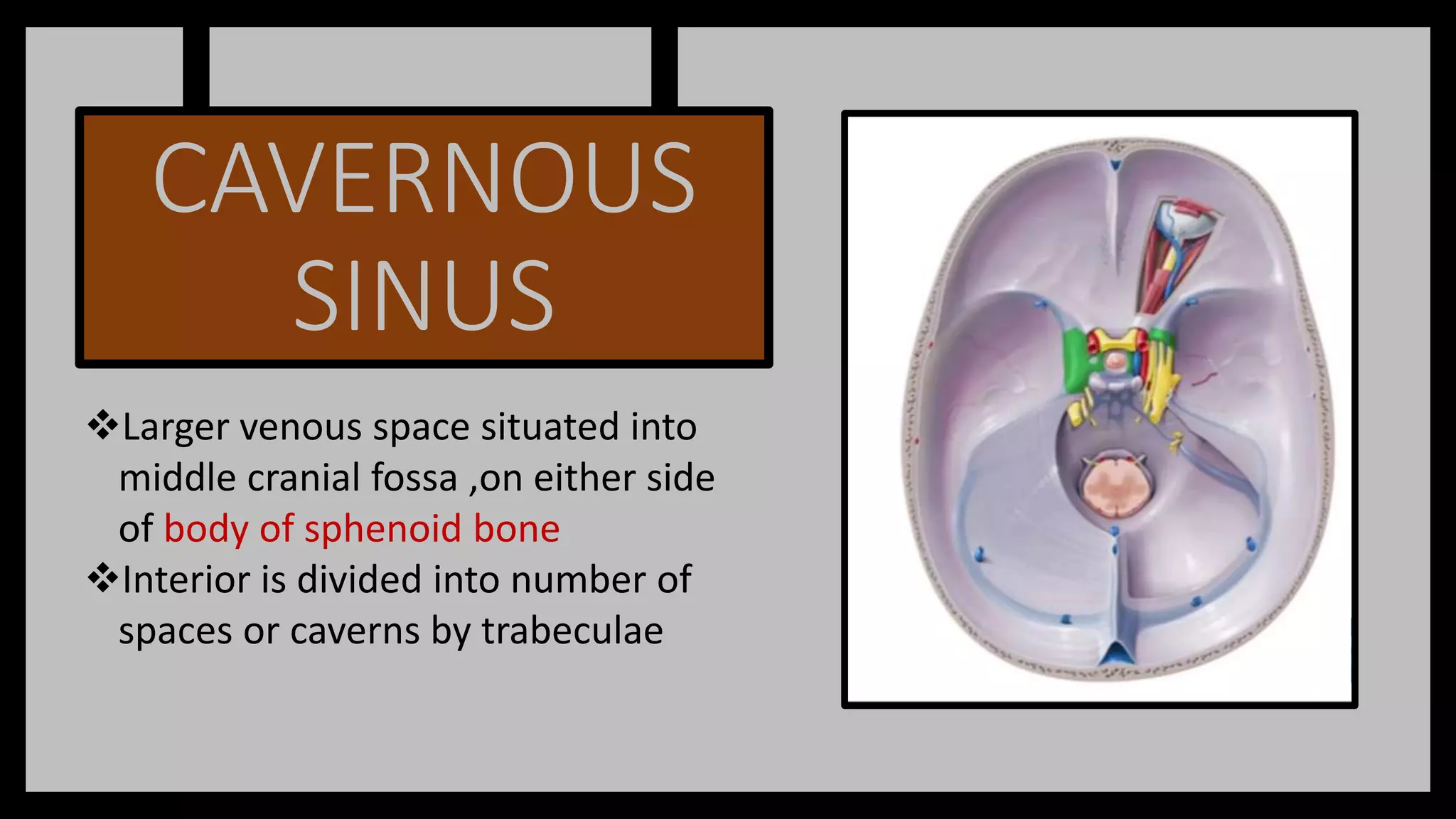
Larger venous space situated into
middle cranial fossa ,on either side
of body of sphenoid bone
Interior is divided into number of
spaces or caverns by trabeculae
CAVERNOUS
SINUS
R
L M
F
MENINGEAL
DURA MATER
ENDOSTEAL
DURA MATER
2
cm
1 cm ATTACHMENTS
RELATIONS
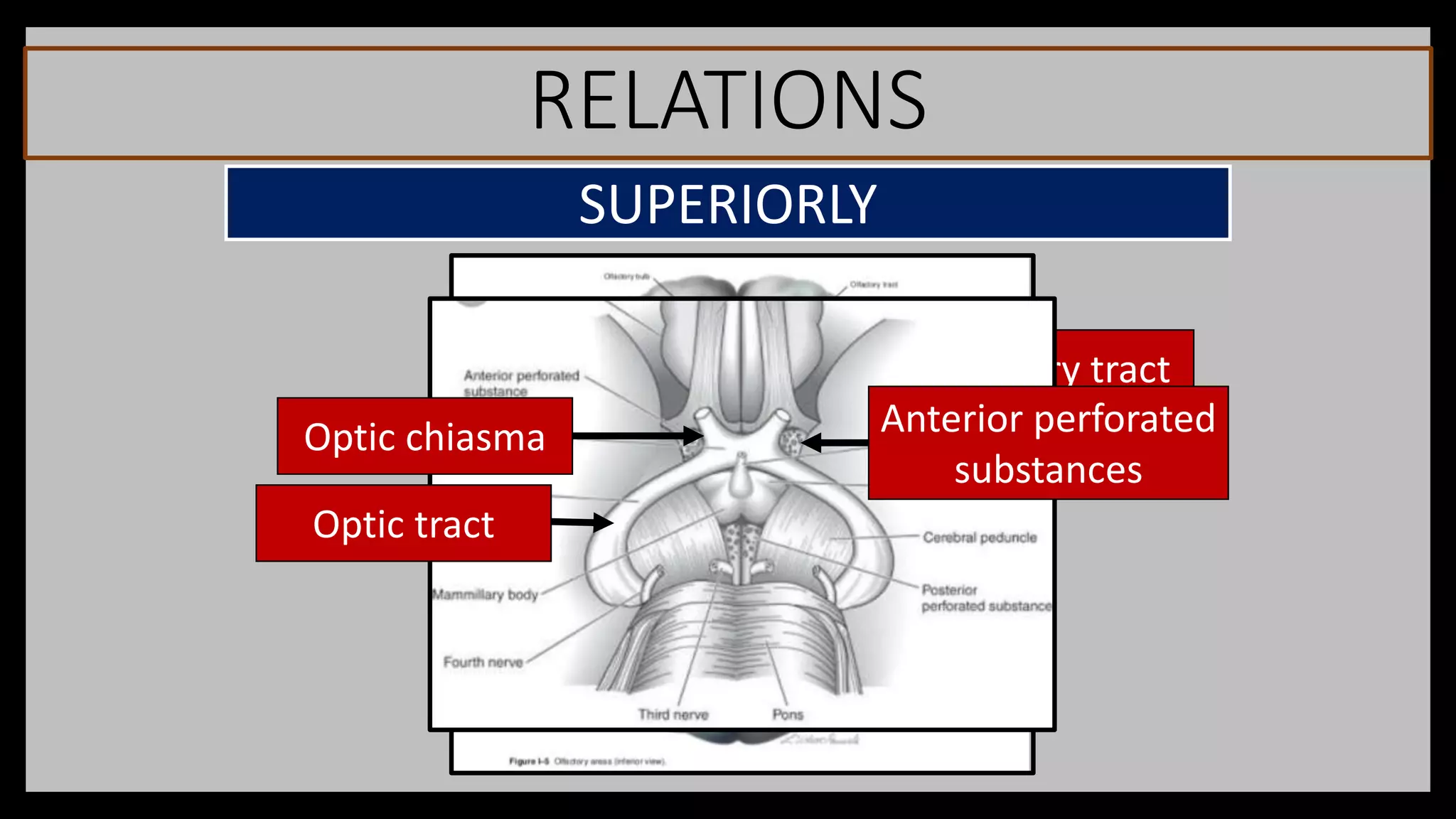
SUPERIORLY
Olfactory tract
Optic tract
Optic chiasma Anterior perforated
substances
INFERIORLY
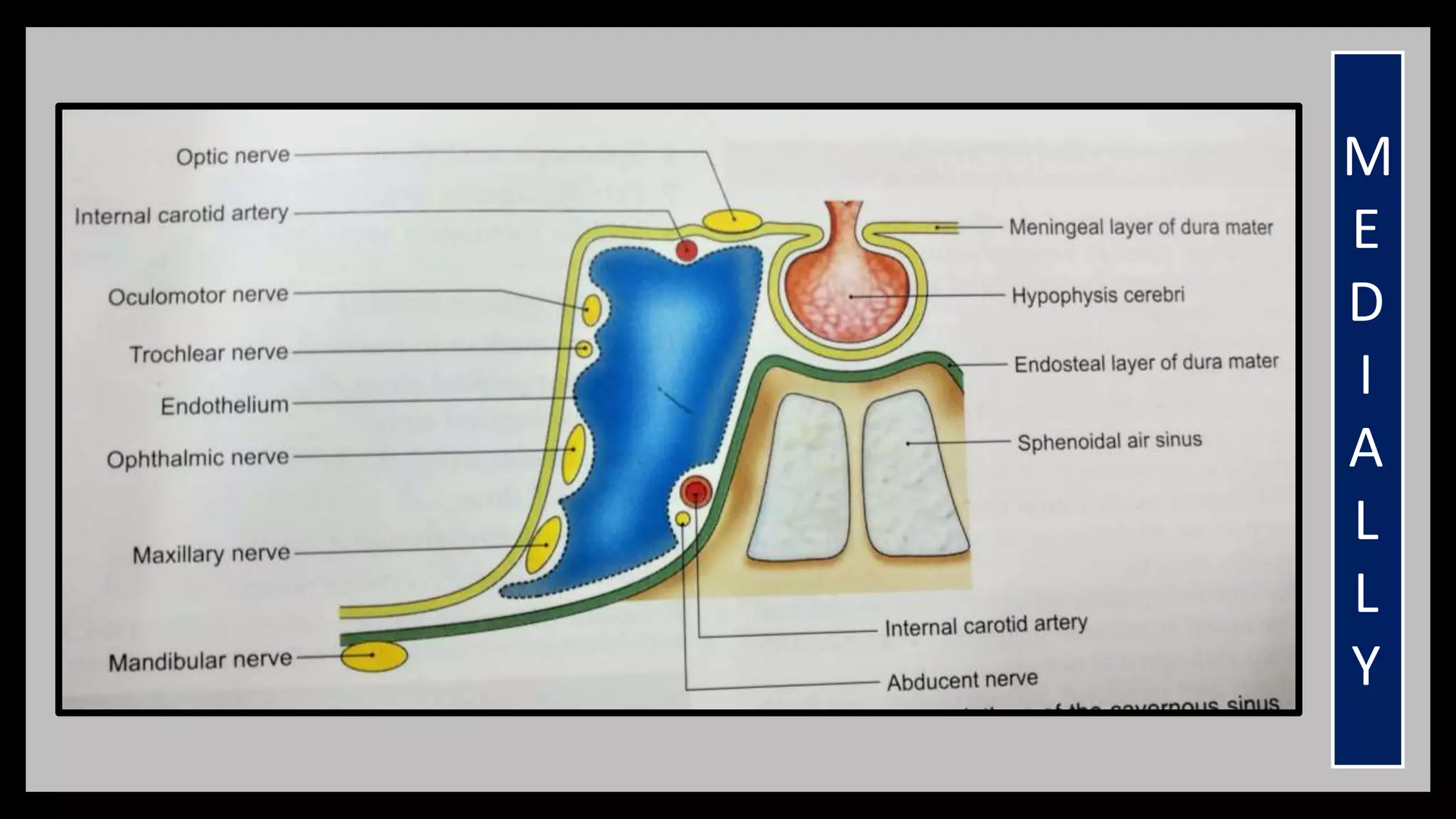
M
E
D
I
A
L
L
Y
L
A
T
E
R
A
L
L
Y
Temporal lobe with
Uncus
POSTERIORLY
ANTERIORLY
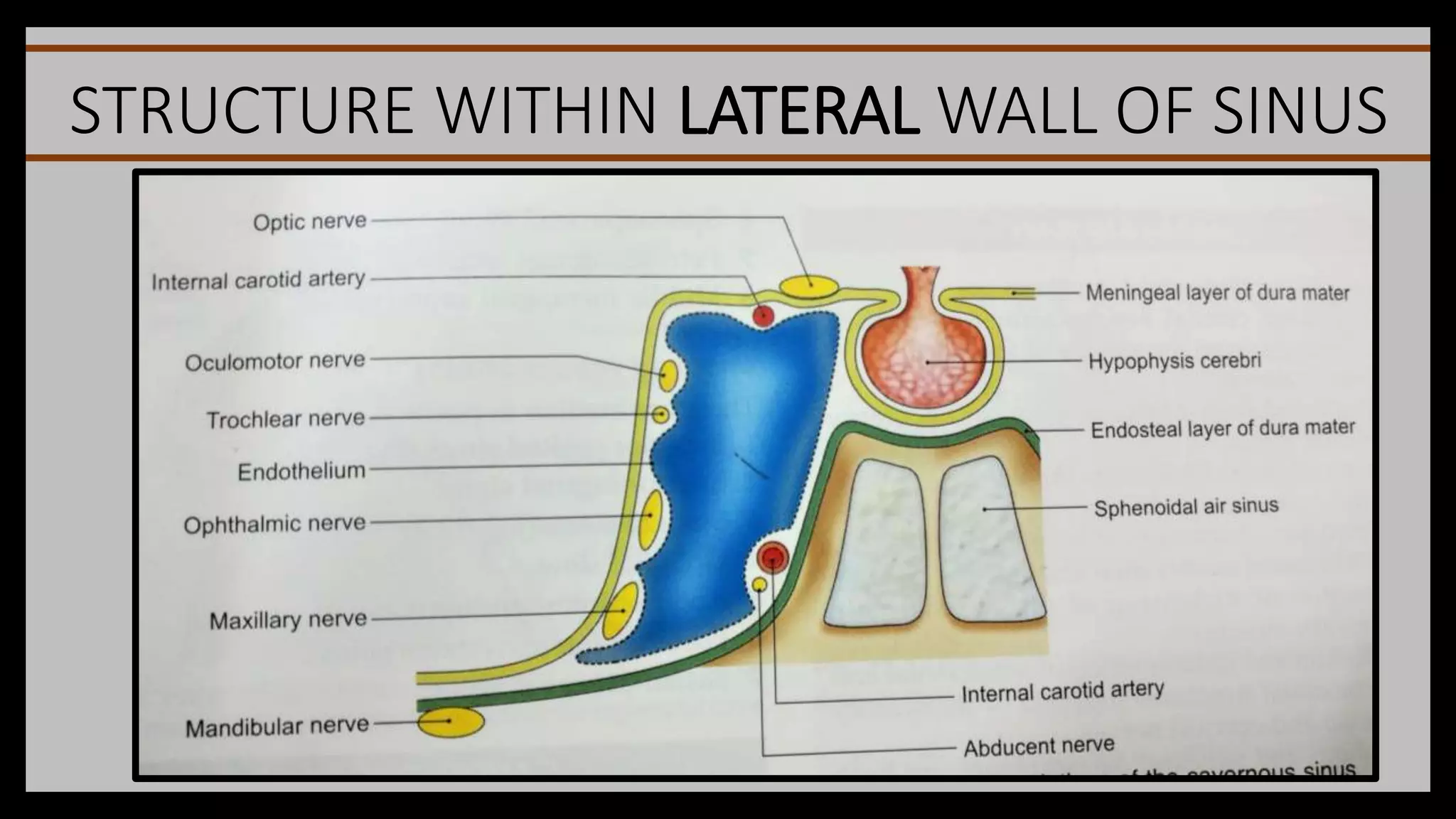
STRUCTURE WITHIN LATERAL WALL OF SINUS
IIIIVV
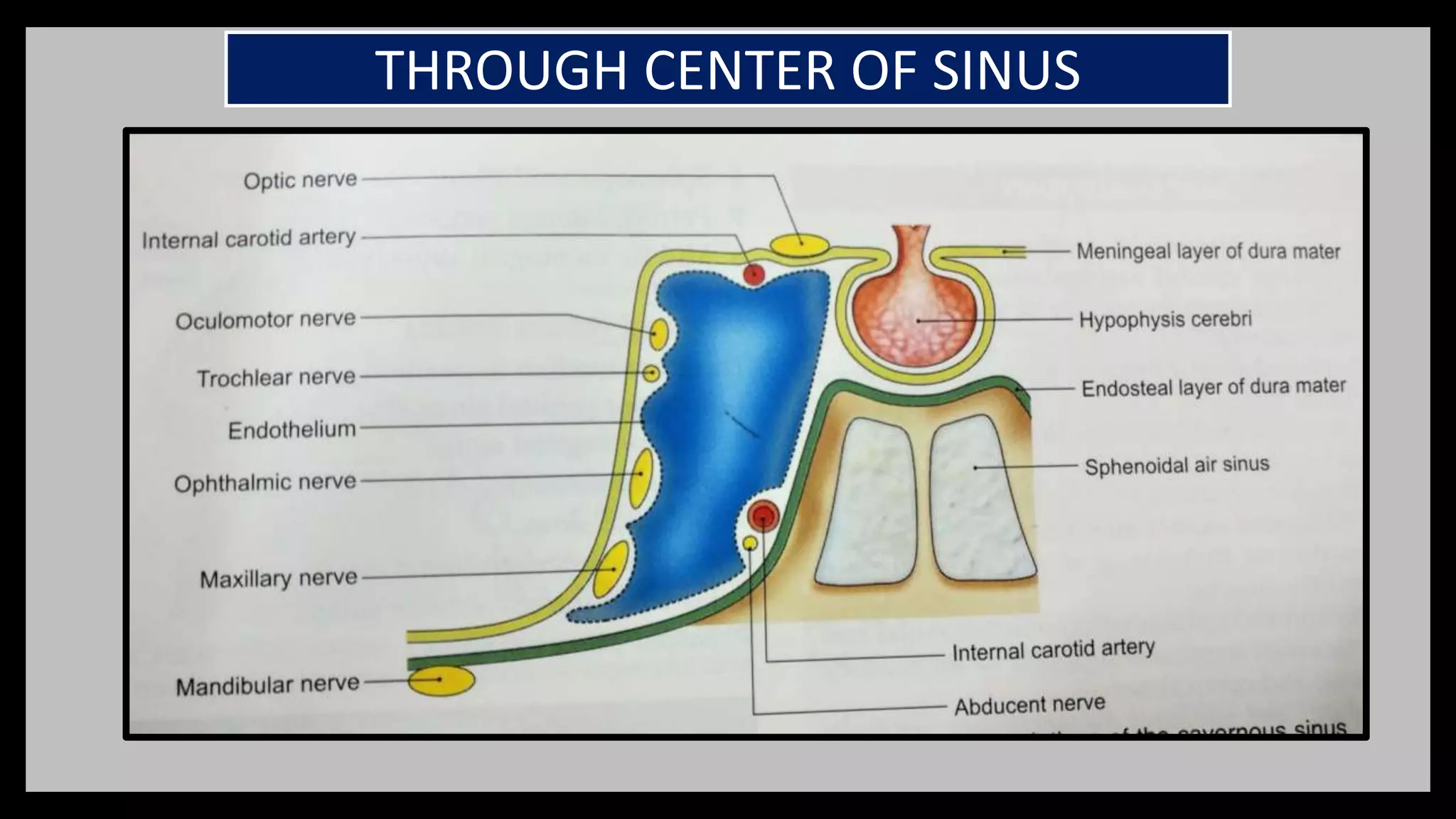
THROUGH CENTER OF SINUS
Internal
carotid artery
VI
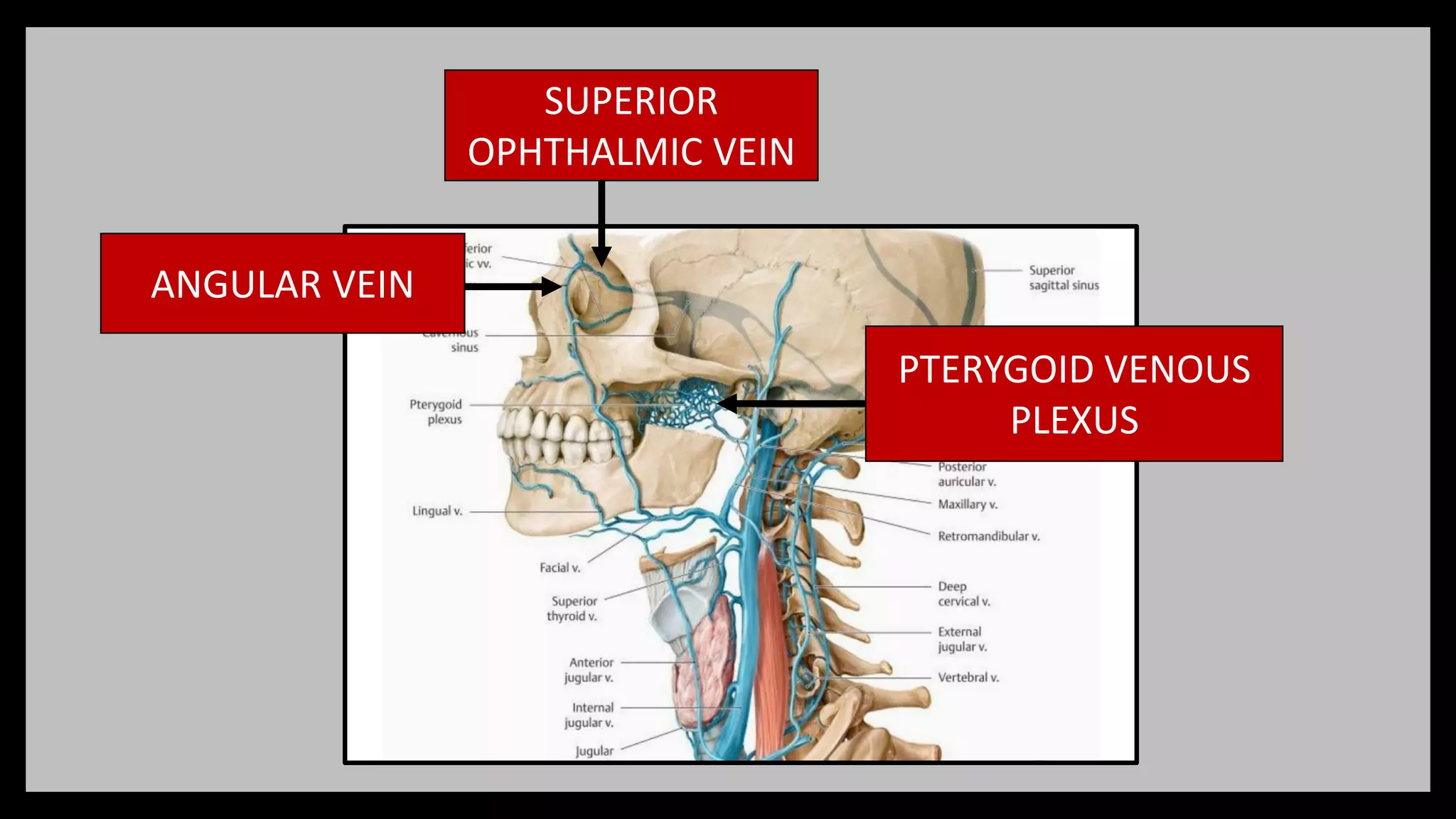
TRIBUTARIES OR INCOMING CHANNELS
FROM ORBIT
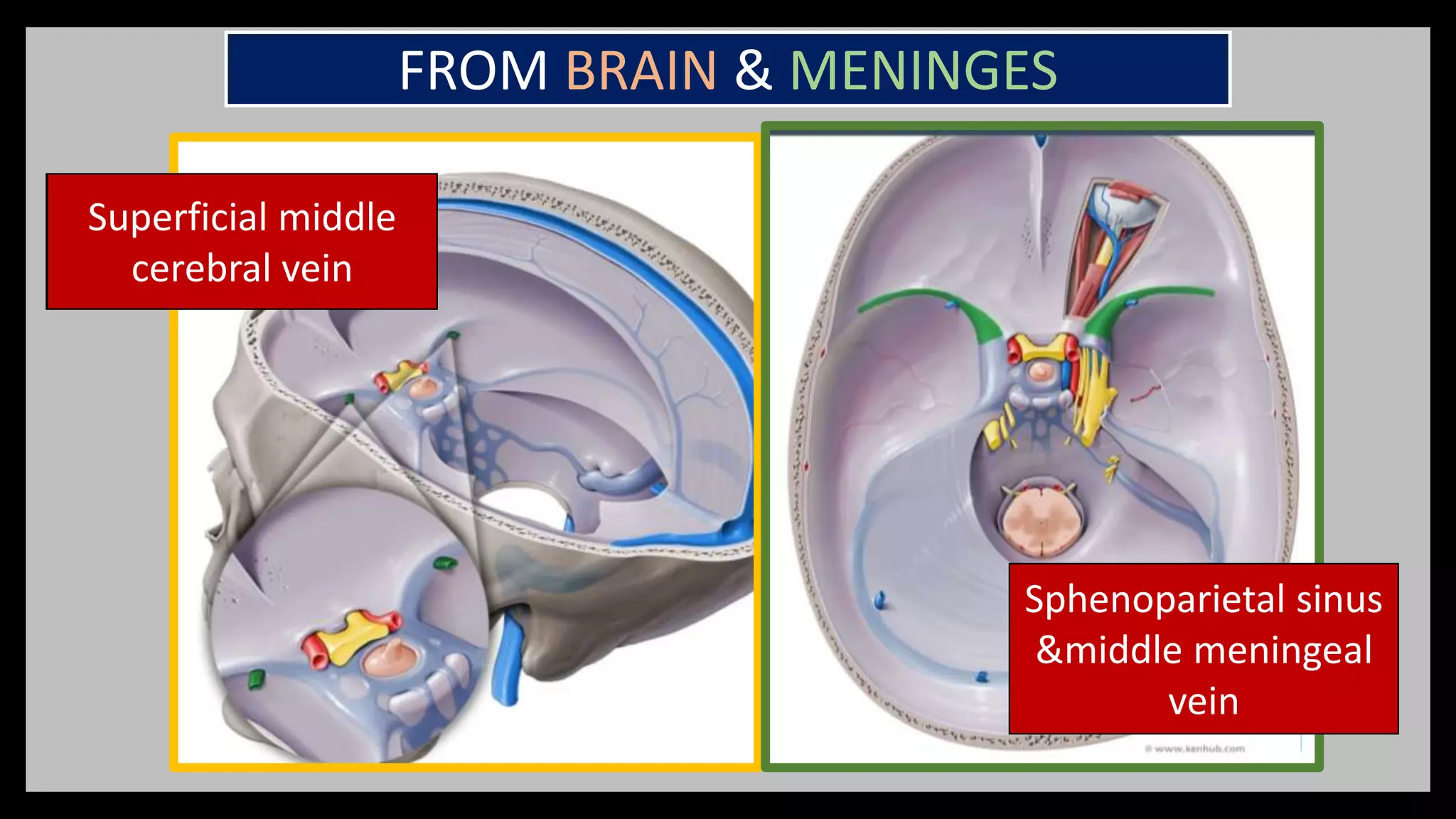
FROM BRAIN & MENINGES
Superficial middle
cerebral vein
Superficial middle
cerebral vein
Sphenoparietal sinus
&middle meningeal
vein
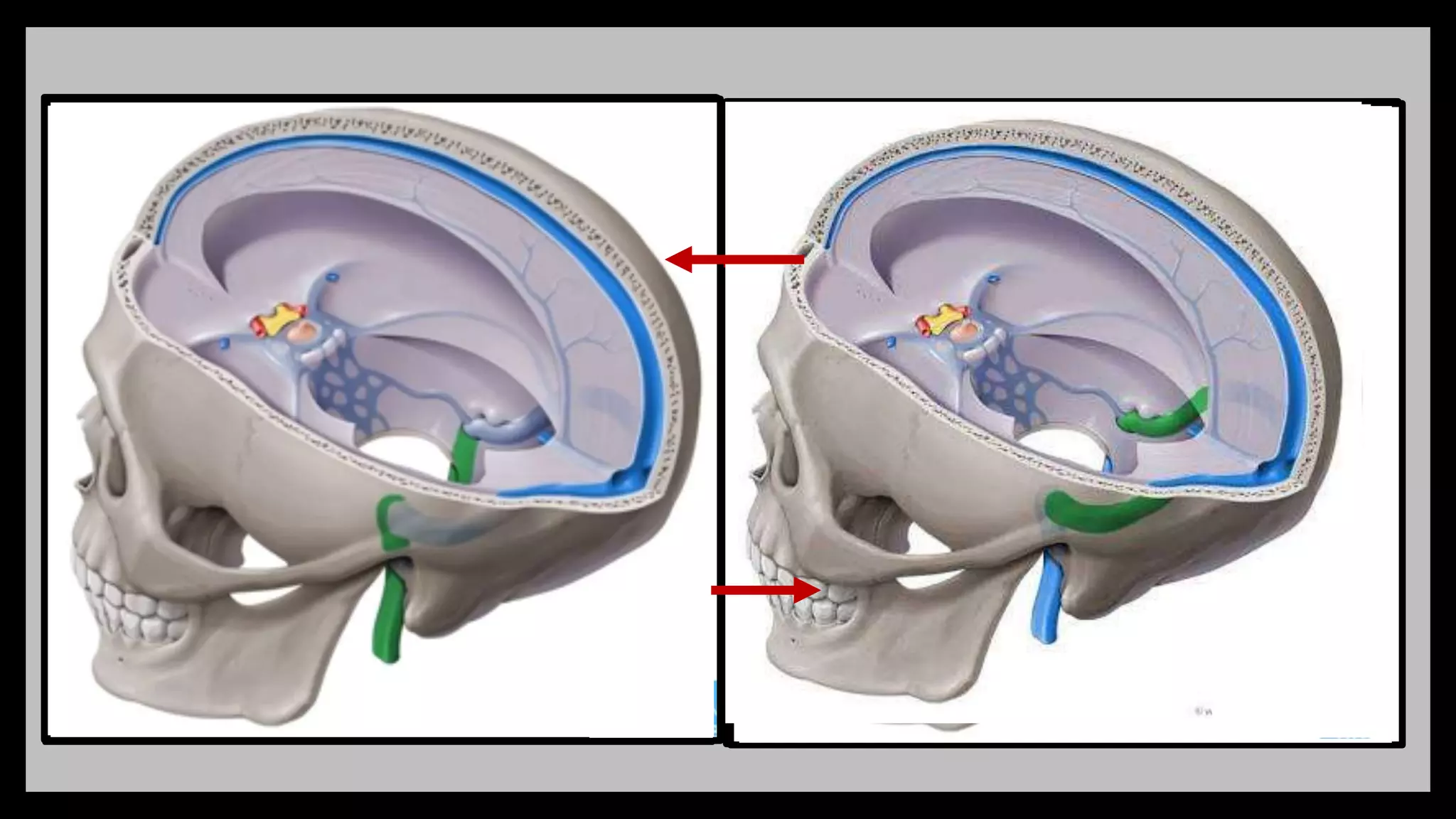
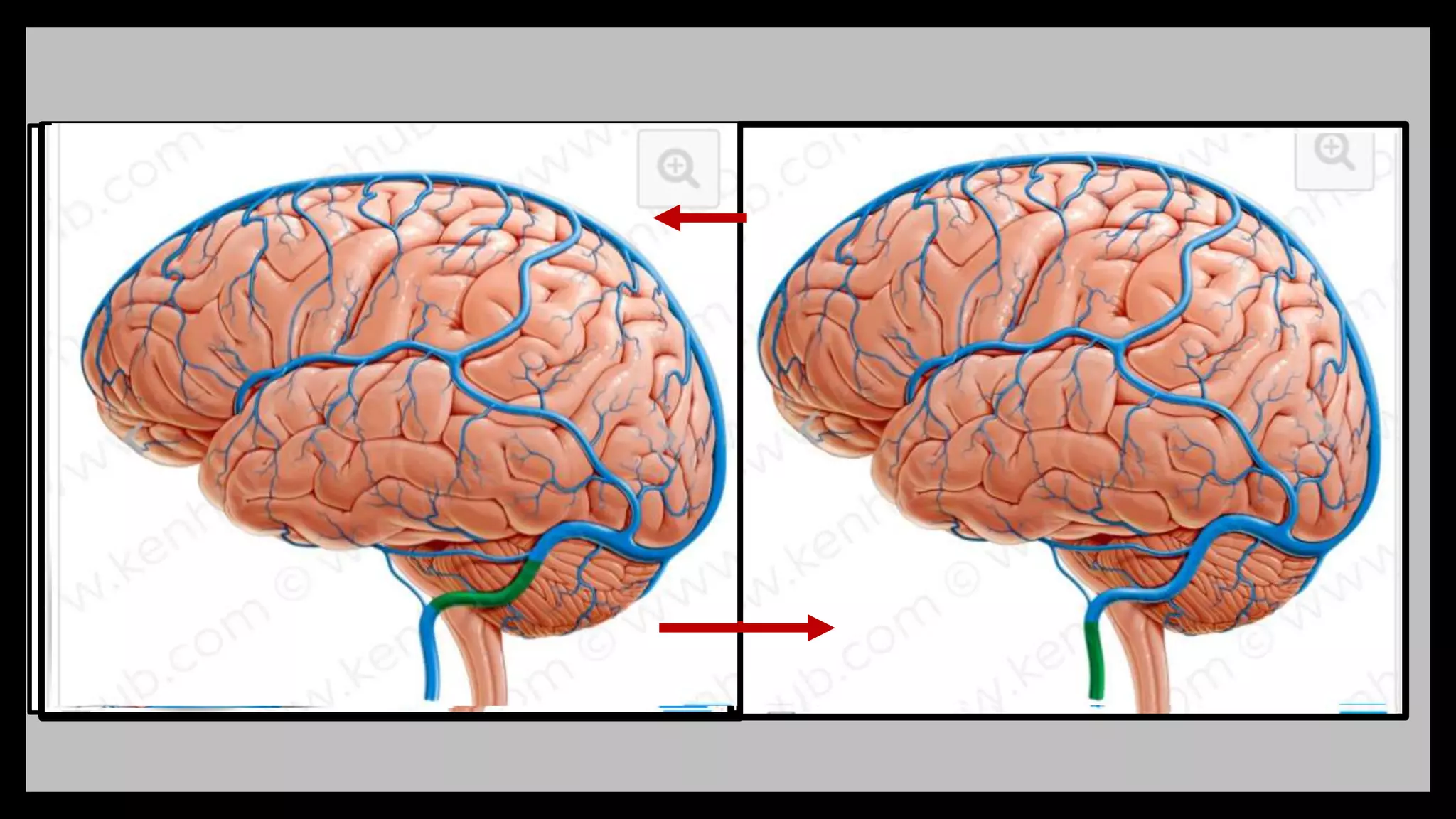
DRAINING CHANNELS OR COMMUNICATIONS
superior petrosal
sinus
Transverse sinus
Inferior petrosal
sinus
PTERYGOID VENOUS
PLEXUS
SUPERIOR
OPHTHALMIC VEIN
ANGULAR VEIN
CLINICAL ANATOMY OF CAVERNOUS SINUS
THROMBOSIS OF
CAVERNOUS
SINUS
ETIOLOGY
NERVOUS SYMPTOMS VENOUS SYMPTOMS
Severe pain
Headache
III nerve
IV nerve
VI nerve
Edema of eyelid,cornea
& root of nose
exophthalmosKnown site
of
infection
“EAGLETON CRITERIA”
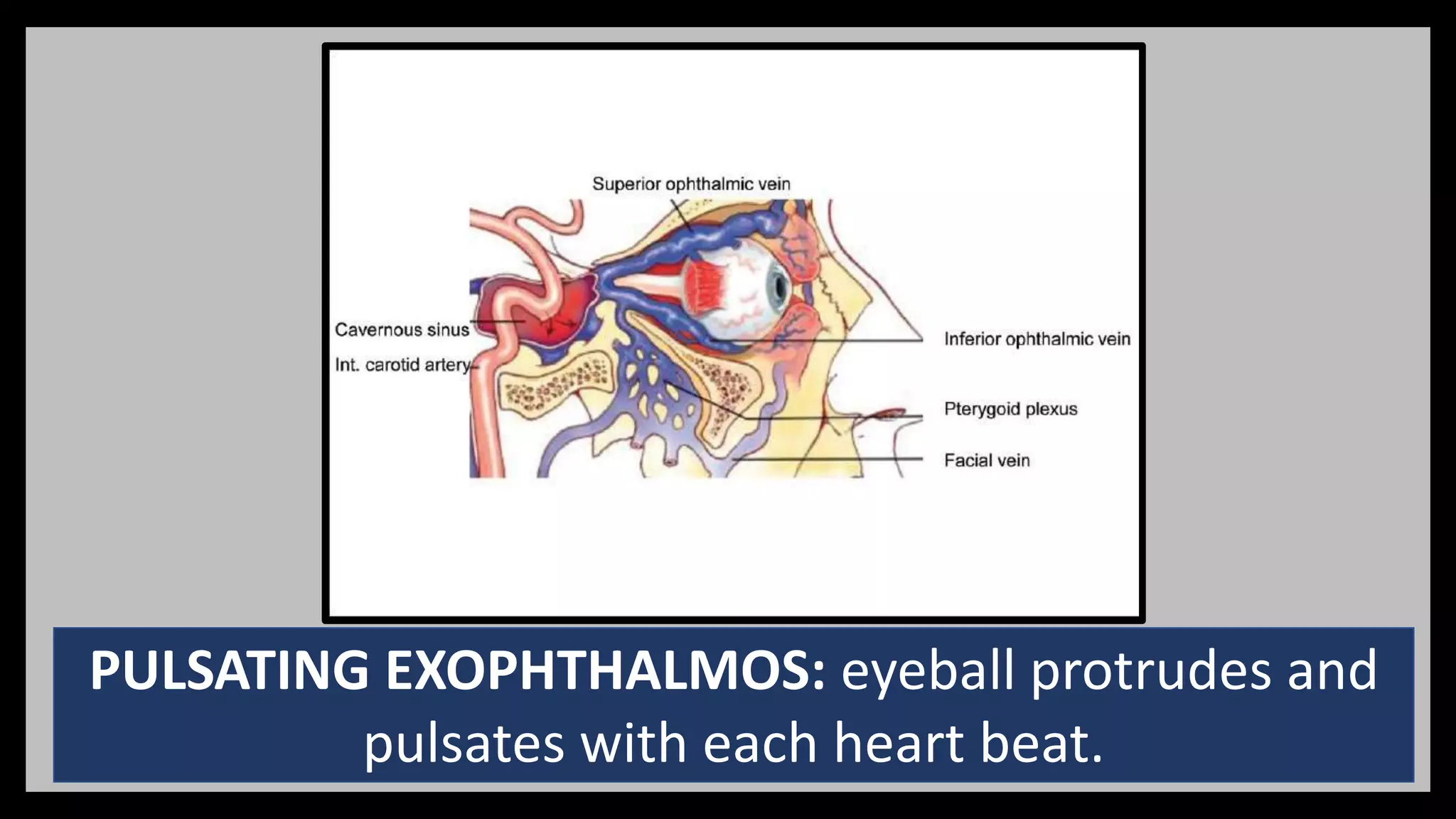
CAROTID
CAVERNOUS
FISTULA
PULSATING EXOPHTHALMOS: eyeball protrudes and
pulsates with each heart beat.
THANK YOU!

venous dural sinuses and cavenous venous sinus