Support Vector Machines & Kernels
Lecture 6
David Sontag
New York University
Slides adapted from Luke Zettlemoyer and Carlos Guestrin,
and Vibhav Gogate
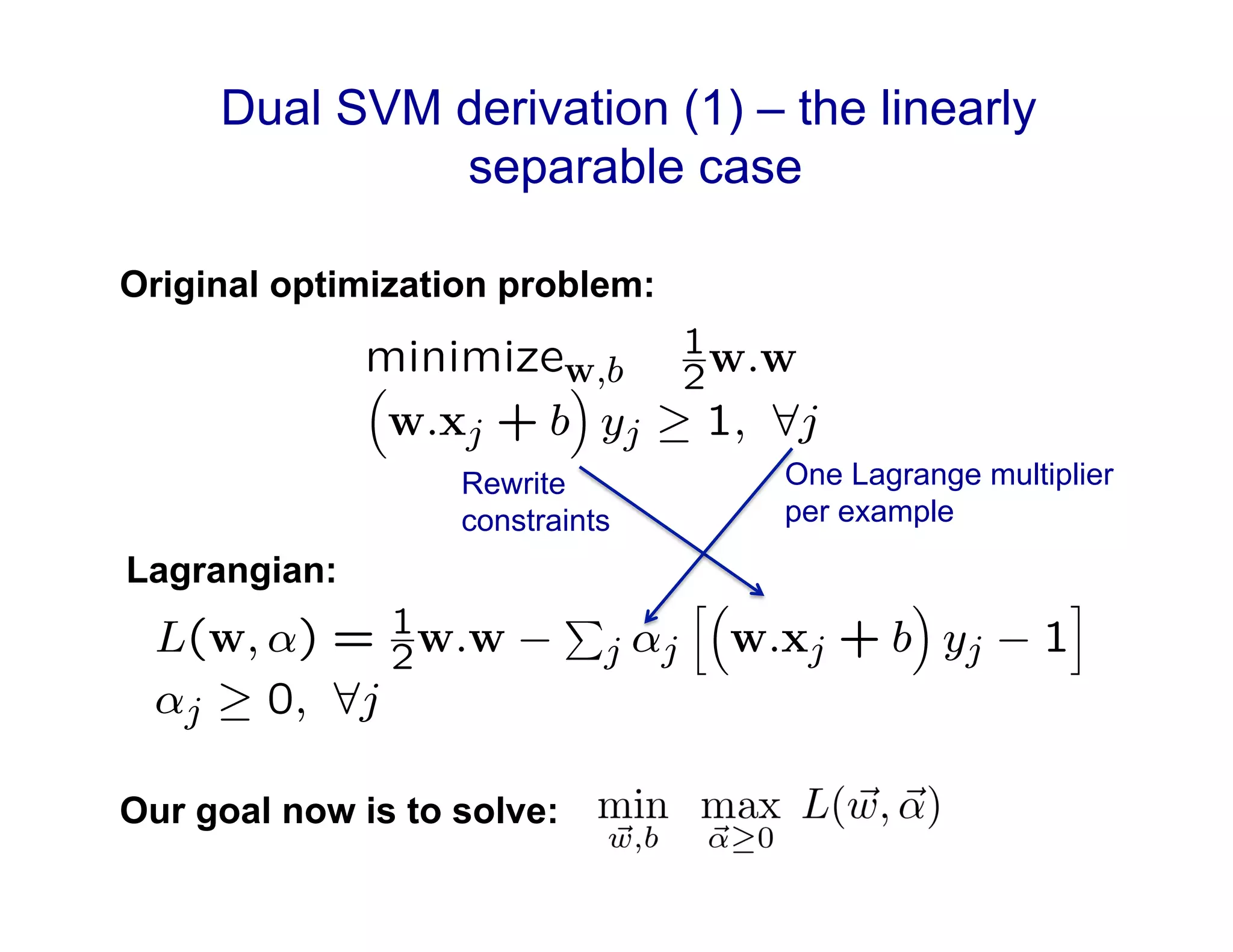
Dual SVM derivation (1) – the linearly
separable case
Original optimization problem:
Lagrangian:
Rewrite
constraints
One Lagrange multiplier
per example
Our goal now is to solve:
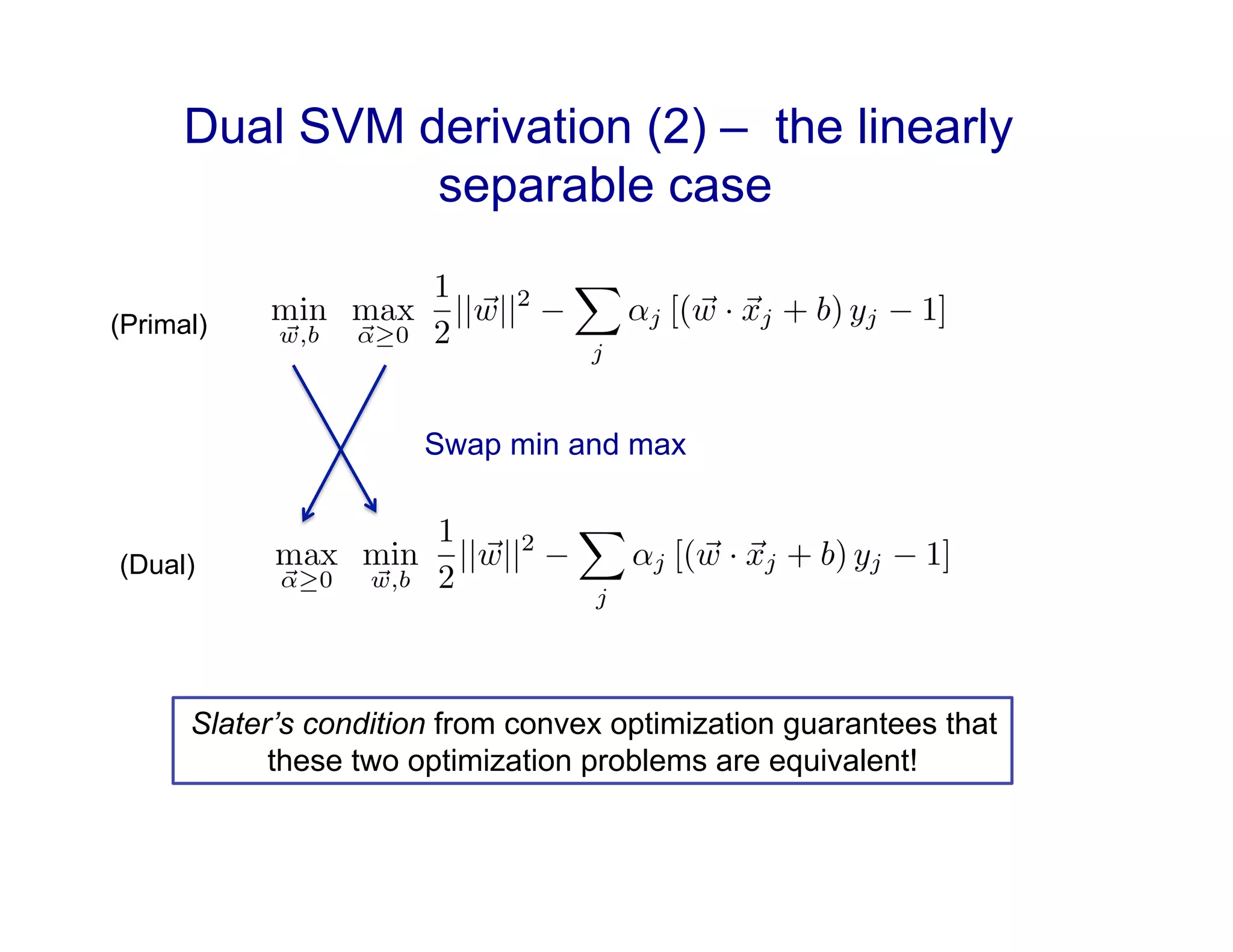
Dual SVM derivation (2) – the linearly
separable case
Swap min and max
Slater’s condition from convex optimization guarantees that
these two optimization problems are equivalent!
(Primal)
(Dual)
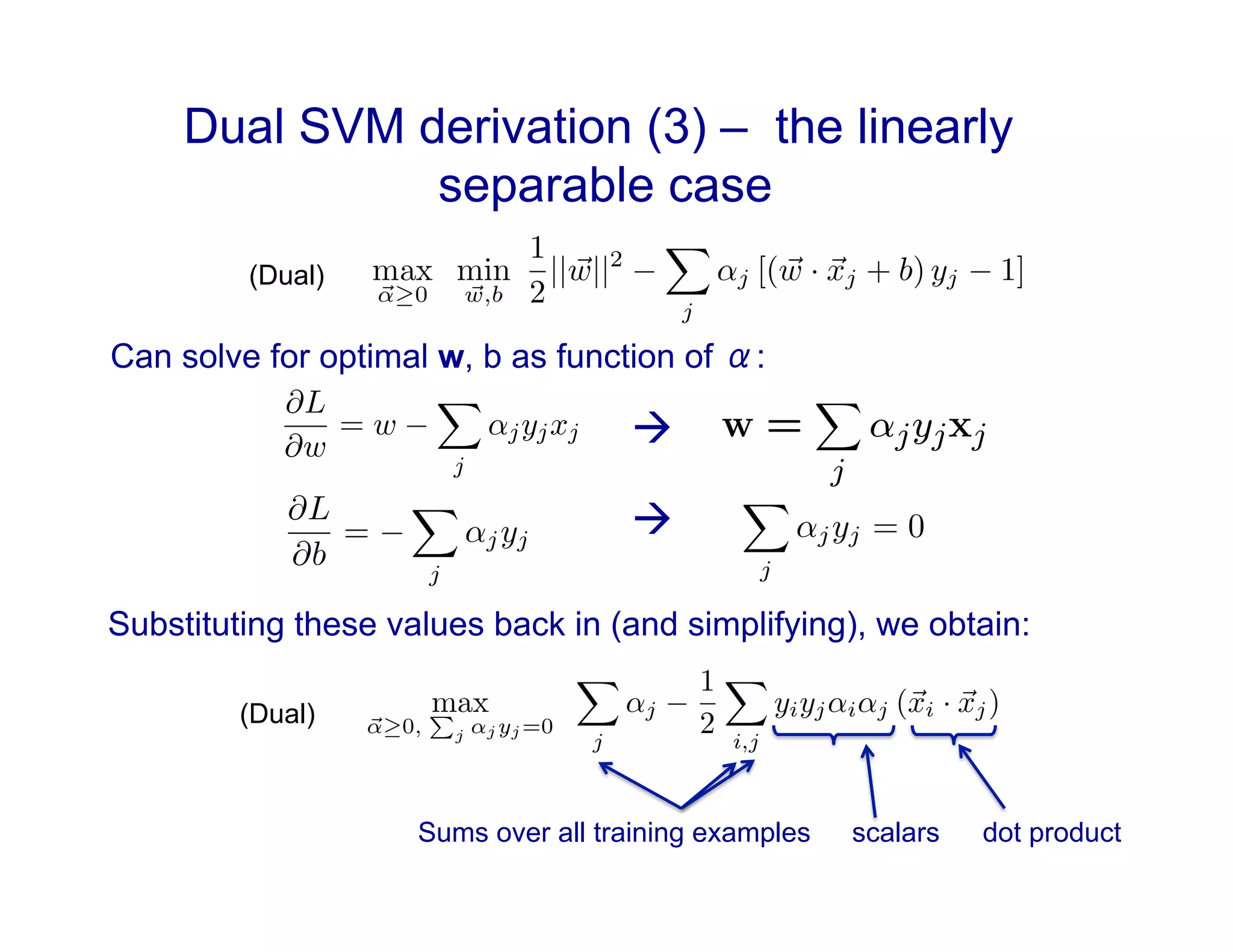
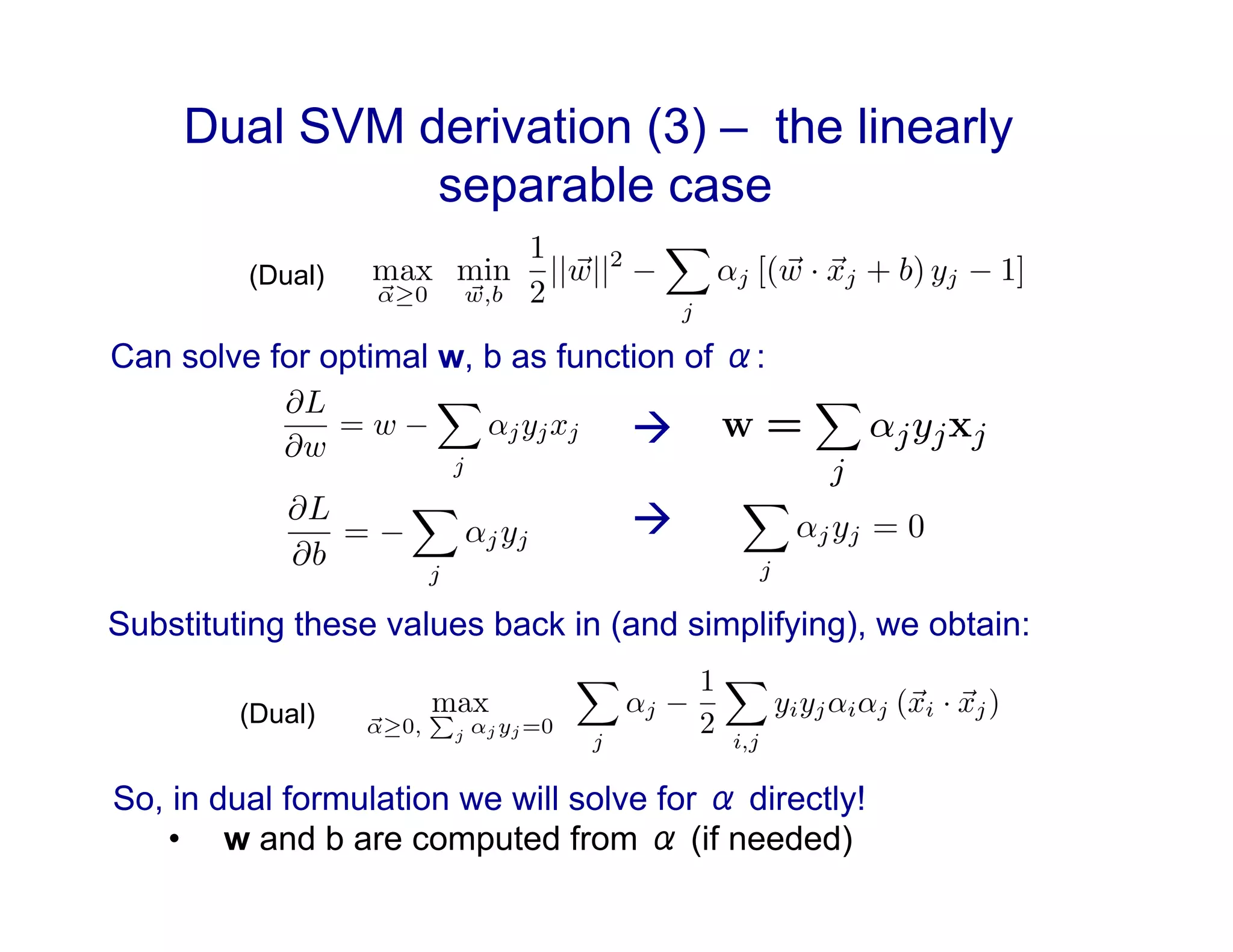
Dual SVM derivation (3) – the linearly
separable case
Can solve for optimal w, b as function of α:

⇥(x) =
⇧
⇧
⇧
⇧
⇧
⇧
⇧
⇧
⇧
⇧
⇧
⇤
x(1)
. . .
x(n)
x(1)x(2)
x(1)x(3)
. . .
ex(1)
. . .
⇥
⌃
⌃
⌃
⌃
⌃
⌃
⌃
⌃
⌃
⌃
⌃
⌅
⇤L
⇤w
= w
⌥
j
jyjxj
(Dual)

Substituting these values back in (and simplifying), we obtain:
(Dual)
Sums over all training examples dot product
scalars
Dual SVM derivation (3) – the linearly
separable case
Can solve for optimal w, b as function of α:

⇥(x) =
⇧
⇧
⇧
⇧
⇧
⇧
⇧
⇧
⇧
⇧
⇧
⇤
x(1)
. . .
x(n)
x(1)x(2)
x(1)x(3)
. . .
ex(1)
. . .
⇥
⌃
⌃
⌃
⌃
⌃
⌃
⌃
⌃
⌃
⌃
⌃
⌅
⇤L
⇤w
= w
⌥
j
jyjxj
So, in dual formulation we will solve for α directly!
•  w and b are computed from α (if needed)
(Dual)

Substituting these values back in (and simplifying), we obtain:
(Dual)
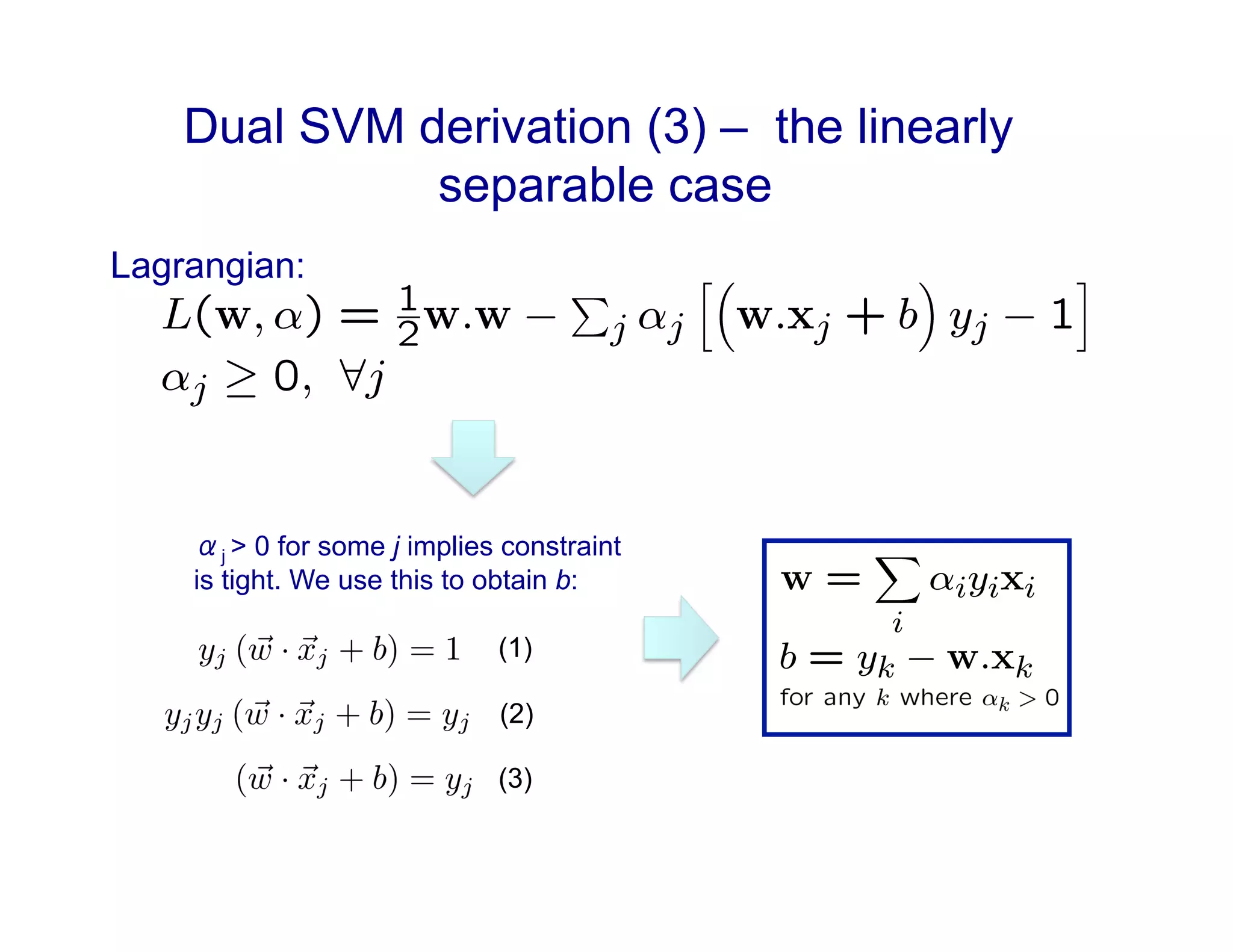
Dual SVM derivation (3) – the linearly
separable case
Lagrangian:
αj > 0 for some j implies constraint
is tight. We use this to obtain b:
(1)
(2)
(3)
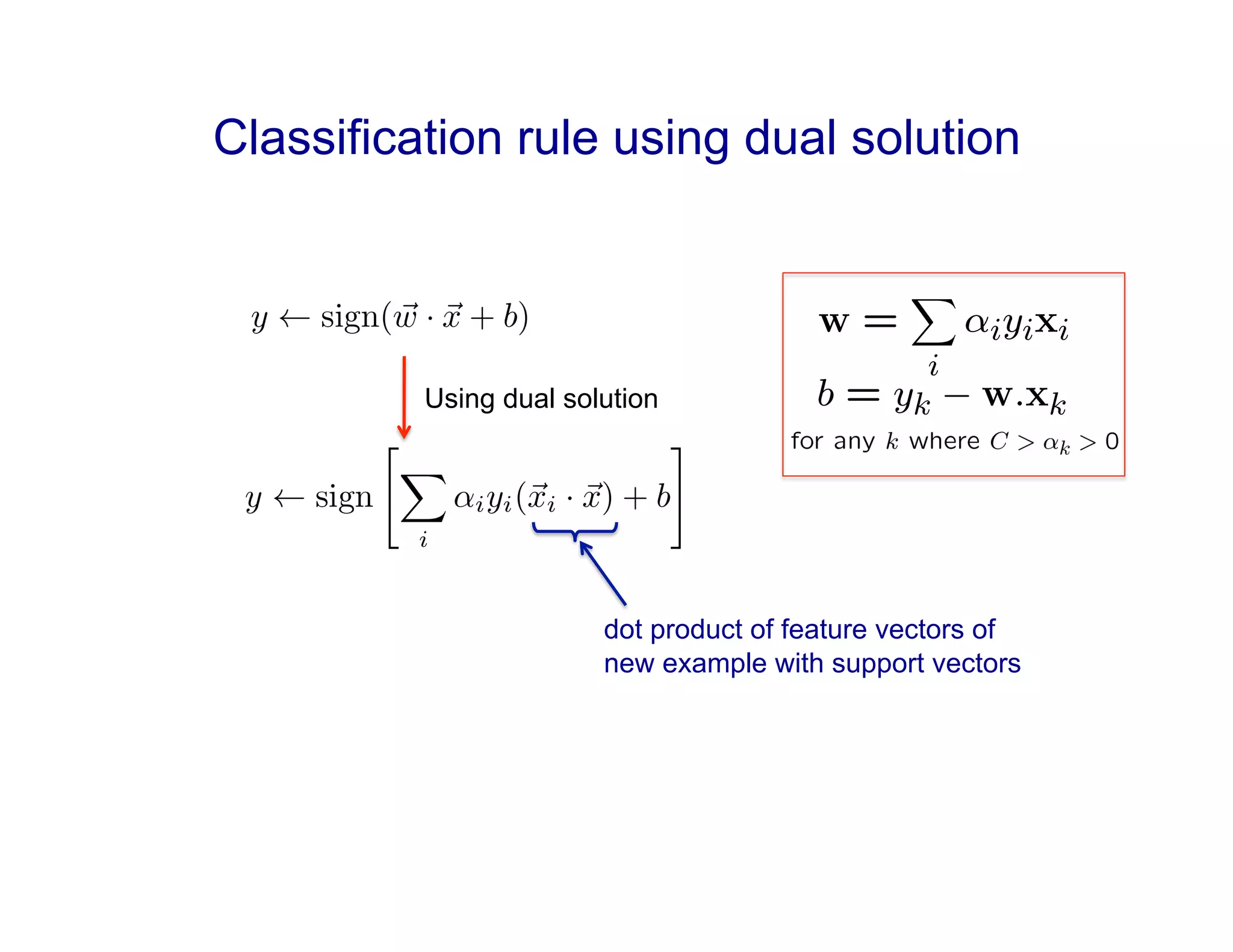
Classification rule using dual solution
Using dual solution
dot product of feature vectors of
new example with support vectors
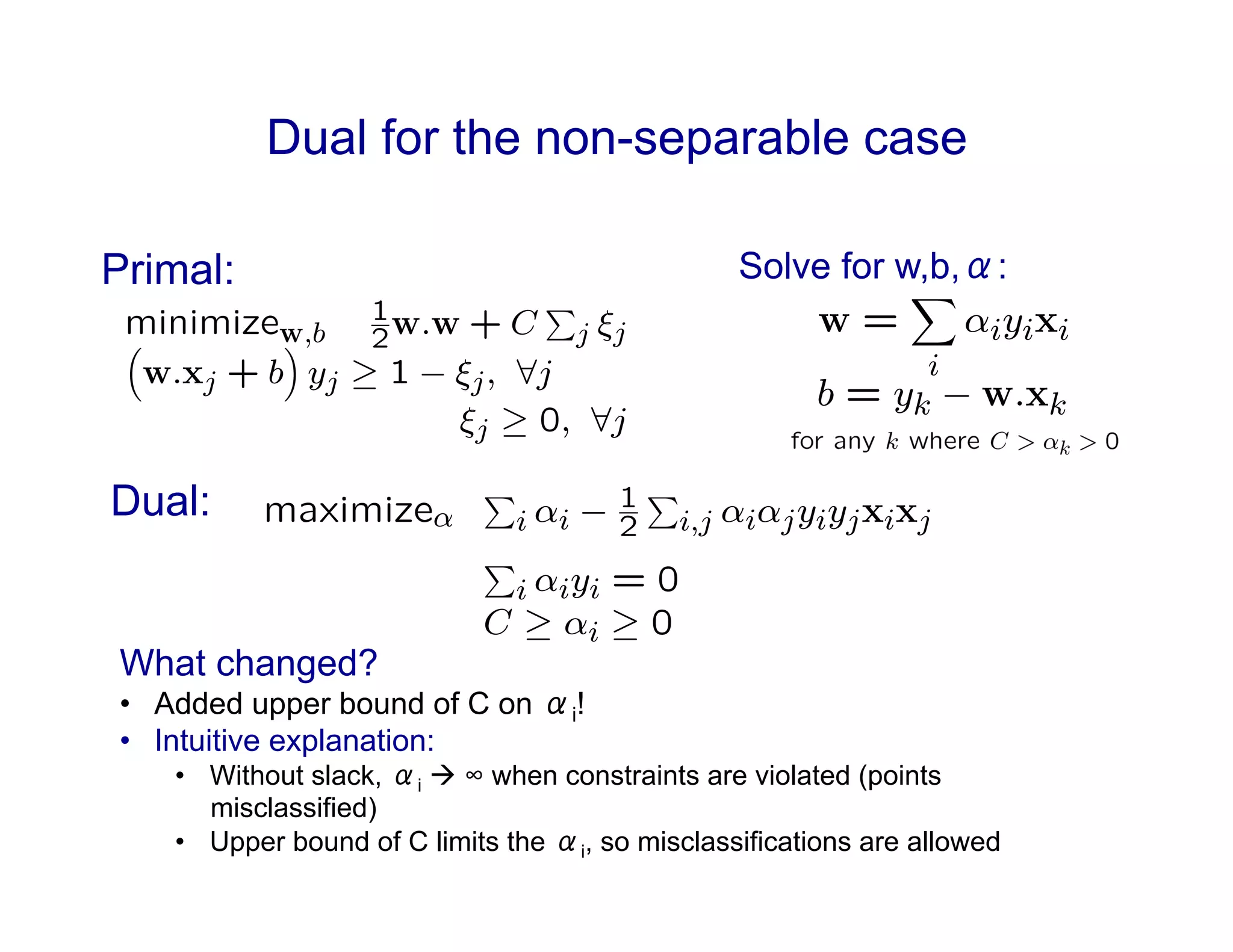
Dual for the non-separable case
Primal: Solve for w,b,α:
Dual:
What changed?
•  Added upper bound of C on αi!
•  Intuitive explanation:
•  Without slack, αi  ∞ when constraints are violated (points
misclassified)
•  Upper bound of C limits the αi, so misclassifications are allowed
Support vectors
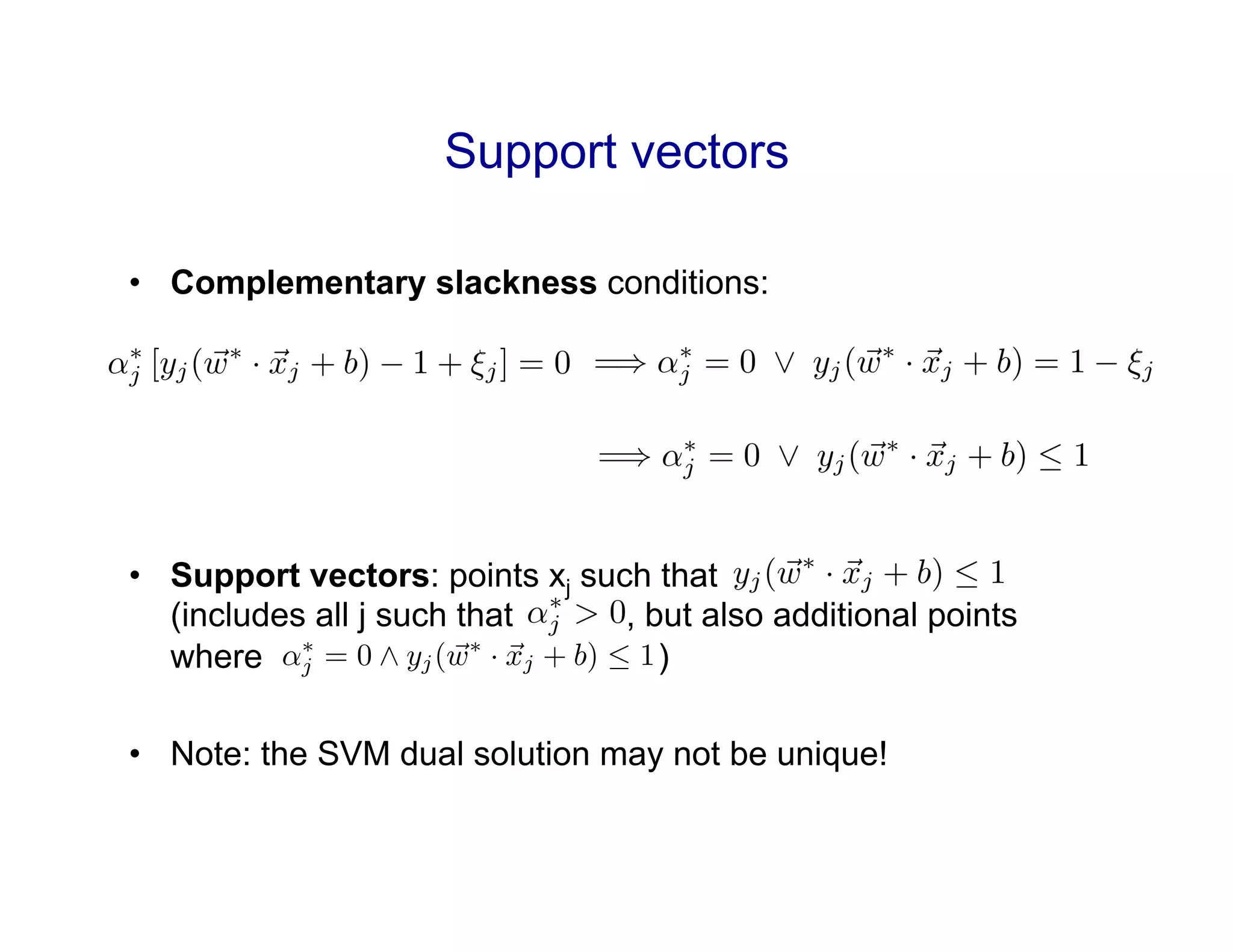
•  Complementary slackness conditions:
•  Support vectors: points xj such that
(includes all j such that , but also additional points
where )
•  Note: the SVM dual solution may not be unique!
↵⇤
j = 0 ^ yj(~
w⇤
· ~
xj + b)  1
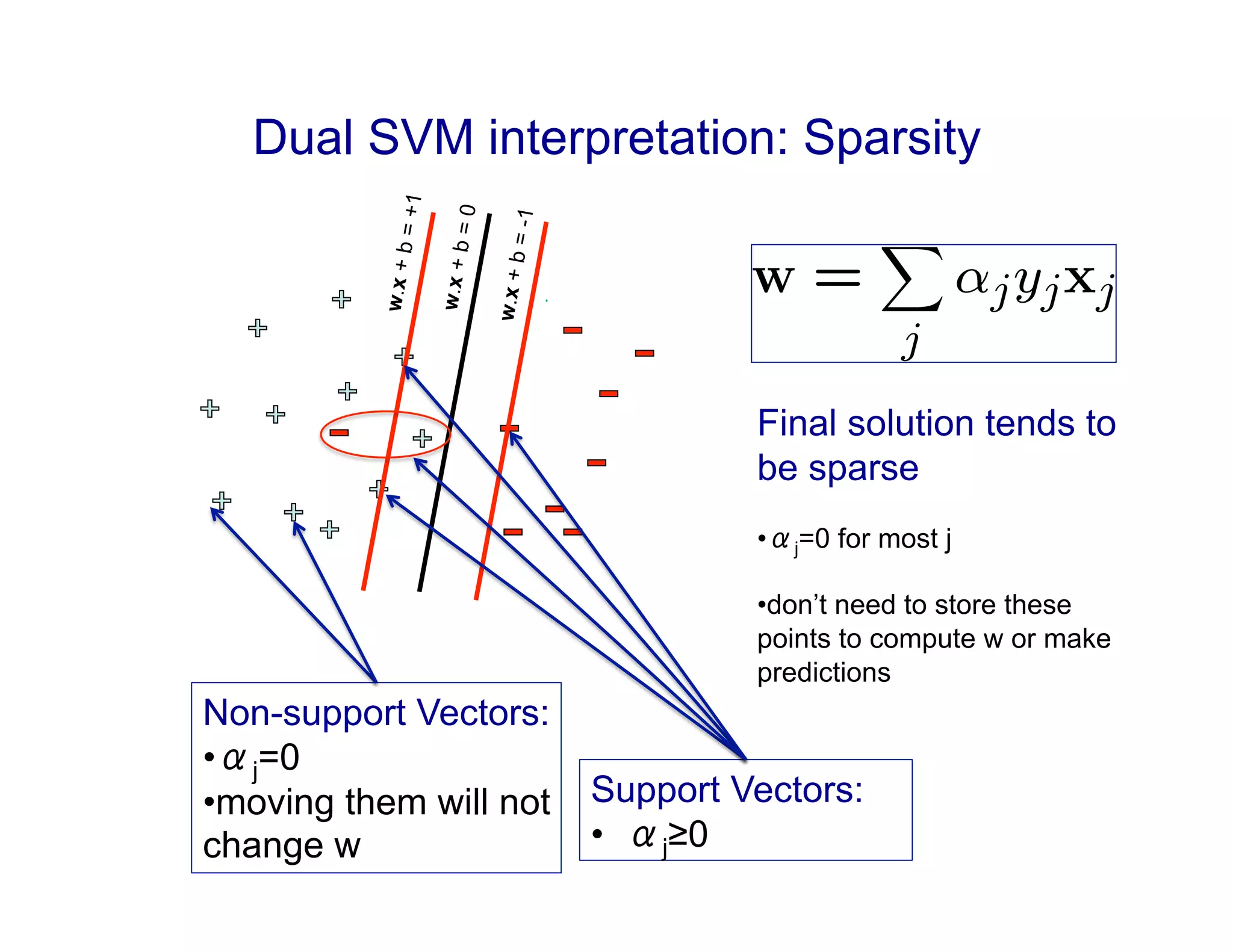
Dual SVM interpretation: Sparsity
w
.
x
+
b
=
+
1
w
.
x
+
b
=
-
1
w
.
x
+
b
=
0
Support Vectors:
•  αj≥0
Non-support Vectors:
• αj=0
• moving them will not
change w
Final solution tends to
be sparse
• αj=0 for most j
• don’t need to store these
points to compute w or make
predictions
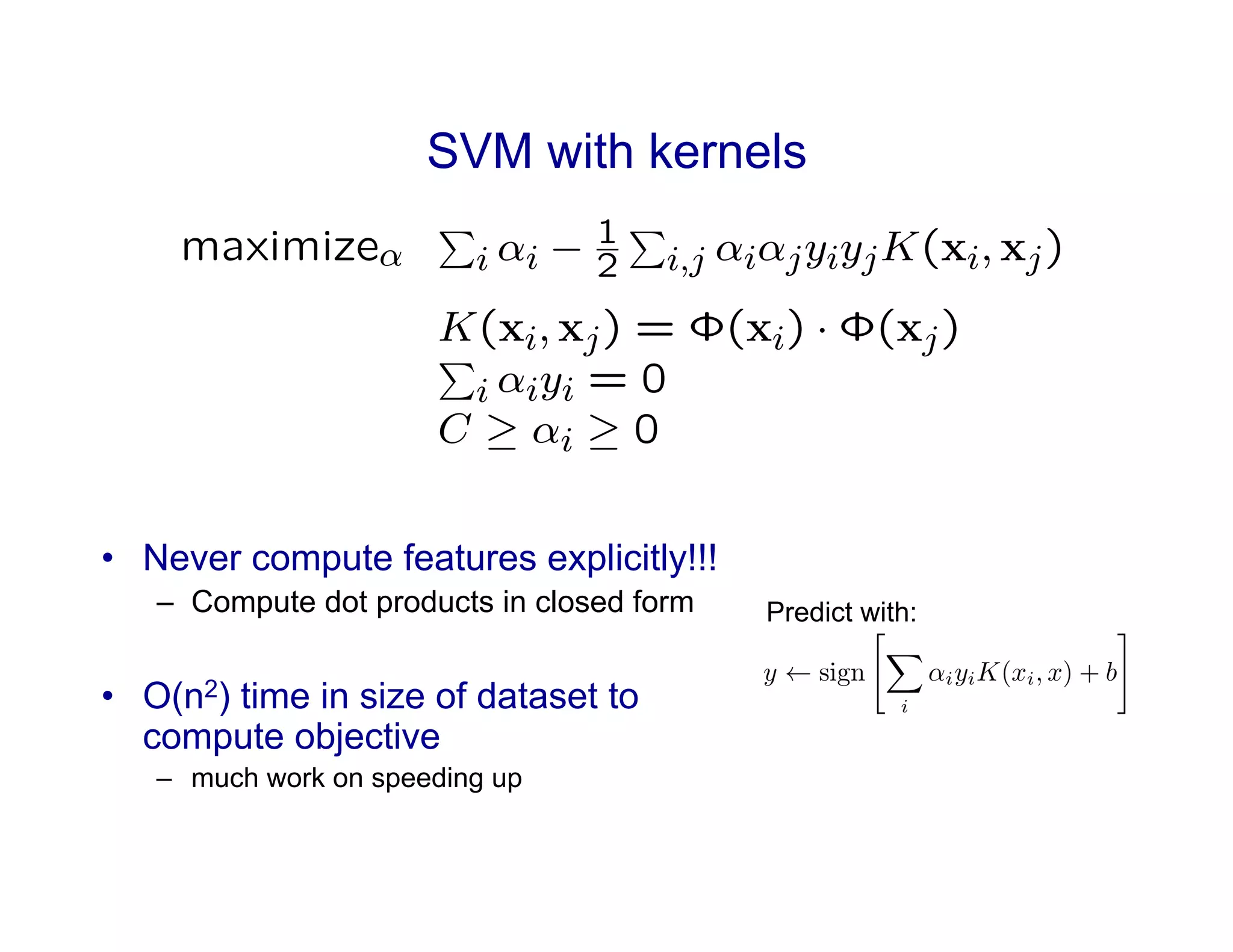
SVM with kernels
•  Never compute features explicitly!!!
–  Compute dot products in closed form
•  O(n2) time in size of dataset to
compute objective
–  much work on speeding up
Predict with:
[Tommi Jaakkola]
Quadratic kernel
Quadratic kernel
[Cynthia Rudin]
Feature mapping given by:
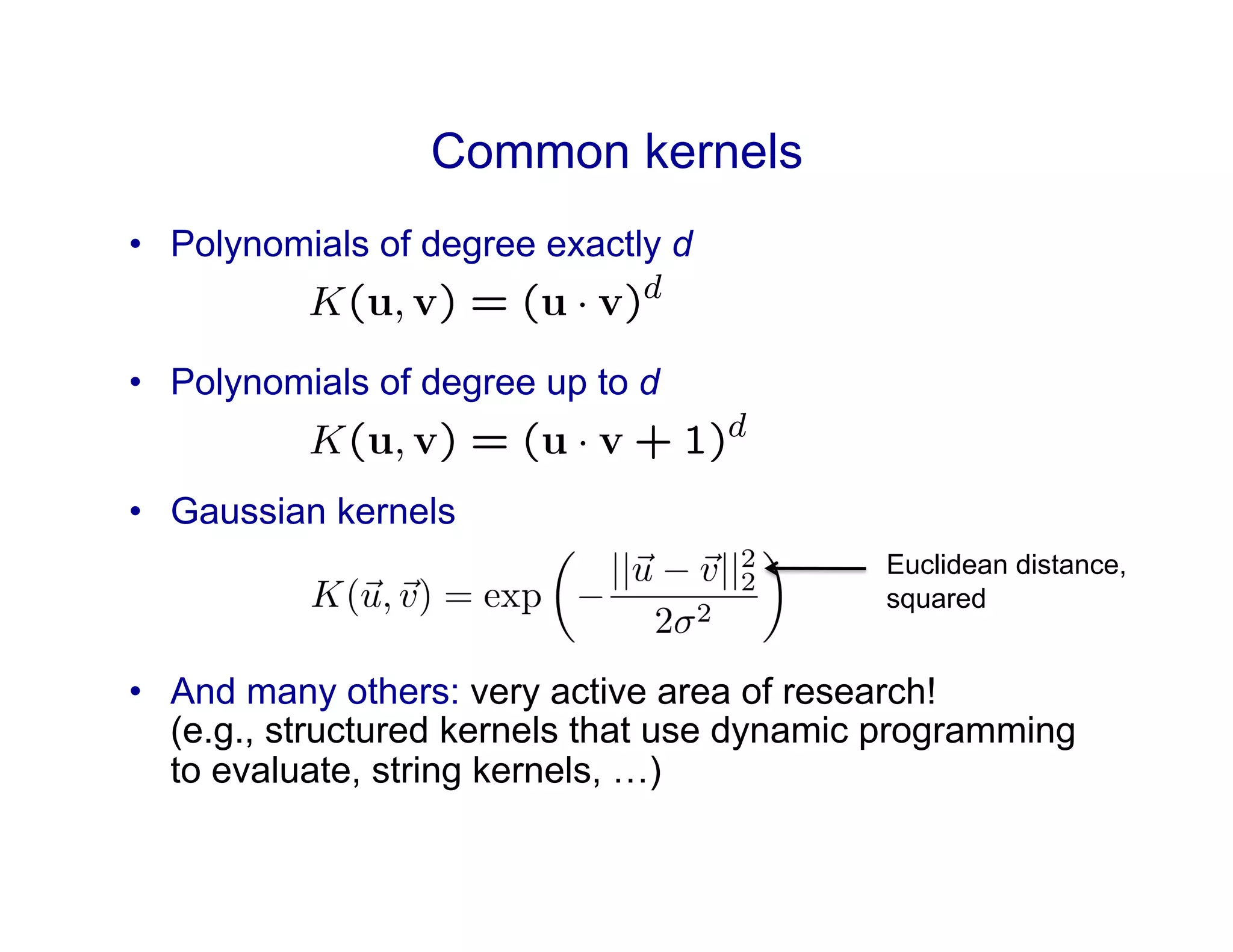
Common kernels
•  Polynomials of degree exactly d
•  Polynomials of degree up to d
•  Gaussian kernels
•  And many others: very active area of research!
(e.g., structured kernels that use dynamic programming
to evaluate, string kernels, …)
Euclidean distance,
squared
Gaussian kernel
[Cynthia Rudin] [mblondel.org]
Support vectors
Level sets, i.e. w.x=r for some r
Kernel algebra
[Justin Domke]
Q: How would you prove that the “Gaussian kernel” is a valid kernel?
A: Expand the Euclidean norm as follows:
Then, apply (e) from above
To see that this is a kernel, use the
Taylor series expansion of the
exponential, together with repeated
application of (a), (b), and (c):
The feature mapping is
infinite dimensional!
Overfitting?
•  Huge feature space with kernels: should we worry about
overfitting?
–  SVM objective seeks a solution with large margin
•  Theory says that large margin leads to good generalization
(we will see this in a couple of lectures)
–  But everything overfits sometimes!!!
–  Can control by:
•  Setting C
•  Choosing a better Kernel
•  Varying parameters of the Kernel (width of Gaussian, etc.)

Dual SVM Problem.pdf

  • 1.
    Support Vector Machines& Kernels Lecture 6 David Sontag New York University Slides adapted from Luke Zettlemoyer and Carlos Guestrin, and Vibhav Gogate
  • 2.
    Dual SVM derivation(1) – the linearly separable case Original optimization problem: Lagrangian: Rewrite constraints One Lagrange multiplier per example Our goal now is to solve:
  • 3.
    Dual SVM derivation(2) – the linearly separable case Swap min and max Slater’s condition from convex optimization guarantees that these two optimization problems are equivalent! (Primal) (Dual)
  • 4.
    Dual SVM derivation(3) – the linearly separable case Can solve for optimal w, b as function of α:  ⇥(x) = ⇧ ⇧ ⇧ ⇧ ⇧ ⇧ ⇧ ⇧ ⇧ ⇧ ⇧ ⇤ x(1) . . . x(n) x(1)x(2) x(1)x(3) . . . ex(1) . . . ⇥ ⌃ ⌃ ⌃ ⌃ ⌃ ⌃ ⌃ ⌃ ⌃ ⌃ ⌃ ⌅ ⇤L ⇤w = w ⌥ j jyjxj (Dual)  Substituting these values back in (and simplifying), we obtain: (Dual) Sums over all training examples dot product scalars
  • 5.
    Dual SVM derivation(3) – the linearly separable case Can solve for optimal w, b as function of α:  ⇥(x) = ⇧ ⇧ ⇧ ⇧ ⇧ ⇧ ⇧ ⇧ ⇧ ⇧ ⇧ ⇤ x(1) . . . x(n) x(1)x(2) x(1)x(3) . . . ex(1) . . . ⇥ ⌃ ⌃ ⌃ ⌃ ⌃ ⌃ ⌃ ⌃ ⌃ ⌃ ⌃ ⌅ ⇤L ⇤w = w ⌥ j jyjxj So, in dual formulation we will solve for α directly! •  w and b are computed from α (if needed) (Dual)  Substituting these values back in (and simplifying), we obtain: (Dual)
  • 6.
    Dual SVM derivation(3) – the linearly separable case Lagrangian: αj > 0 for some j implies constraint is tight. We use this to obtain b: (1) (2) (3)
  • 7.
    Classification rule usingdual solution Using dual solution dot product of feature vectors of new example with support vectors
  • 8.
    Dual for thenon-separable case Primal: Solve for w,b,α: Dual: What changed? •  Added upper bound of C on αi! •  Intuitive explanation: •  Without slack, αi  ∞ when constraints are violated (points misclassified) •  Upper bound of C limits the αi, so misclassifications are allowed
  • 9.
    Support vectors •  Complementaryslackness conditions: •  Support vectors: points xj such that (includes all j such that , but also additional points where ) •  Note: the SVM dual solution may not be unique! ↵⇤ j = 0 ^ yj(~ w⇤ · ~ xj + b)  1
  • 10.
    Dual SVM interpretation:Sparsity w . x + b = + 1 w . x + b = - 1 w . x + b = 0 Support Vectors: •  αj≥0 Non-support Vectors: • αj=0 • moving them will not change w Final solution tends to be sparse • αj=0 for most j • don’t need to store these points to compute w or make predictions
  • 11.
    SVM with kernels • Never compute features explicitly!!! –  Compute dot products in closed form •  O(n2) time in size of dataset to compute objective –  much work on speeding up Predict with:
  • 12.
  • 13.
  • 14.
    Common kernels •  Polynomialsof degree exactly d •  Polynomials of degree up to d •  Gaussian kernels •  And many others: very active area of research! (e.g., structured kernels that use dynamic programming to evaluate, string kernels, …) Euclidean distance, squared
  • 15.
    Gaussian kernel [Cynthia Rudin][mblondel.org] Support vectors Level sets, i.e. w.x=r for some r
  • 16.
    Kernel algebra [Justin Domke] Q:How would you prove that the “Gaussian kernel” is a valid kernel? A: Expand the Euclidean norm as follows: Then, apply (e) from above To see that this is a kernel, use the Taylor series expansion of the exponential, together with repeated application of (a), (b), and (c): The feature mapping is infinite dimensional!
  • 17.
    Overfitting? •  Huge featurespace with kernels: should we worry about overfitting? –  SVM objective seeks a solution with large margin •  Theory says that large margin leads to good generalization (we will see this in a couple of lectures) –  But everything overfits sometimes!!! –  Can control by: •  Setting C •  Choosing a better Kernel •  Varying parameters of the Kernel (width of Gaussian, etc.)