An Introduction to Support Vector
Machines
CSE 573 Autumn 2005
Henry Kautz
based on slides stolen from Pierre Dönnes’ web site
Main Ideas
• Max-Margin Classifier
– Formalize notion of the best linear separator
• Lagrangian Multipliers
– Way to convert a constrained optimization problem
to one that is easier to solve
• Kernels
– Projecting data into higher-dimensional space
makes it linearly separable
• Complexity
– Depends only on the number of training examples,
not on dimensionality of the kernel space!
Tennis example
Humidity
Temperature
= play tennis
= do not play tennis
Linear Support Vector
Machines
x1
x2
=+1
=-1
Data: <xi,yi>, i=1,..,l
xi  Rd
yi  {-1,+1}
=-1
=+1
Data: <xi,yi>, i=1,..,l
xi  Rd
yi  {-1,+1}
All hyperplanes in Rd are parameterize by a vector (w) and a constant b.
Can be expressed as w•x+b=0 (remember the equation for a hyperplane
from algebra!)
Our aim is to find such a hyperplane f(x)=sign(w•x+b), that
correctly classify our data.
f(x)
Linear SVM 2
d+
d-
Definitions
Define the hyperplane H such that:
xi•w+b  +1 when yi =+1
xi•w+b  -1 when yi =-1
d+ = the shortest distance to the closest positive point
d- = the shortest distance to the closest negative point
The margin of a separating hyperplane is d+ + d-.
H
H1 and H2 are the planes:
H1: xi•w+b = +1
H2: xi•w+b = -1
The points on the planes
H1 and H2 are the
Support Vectors
H1
H2
Maximizing the margin
d+
d-
We want a classifier with as big margin as possible.
Recall the distance from a point(x0,y0) to a line:
Ax+By+c = 0 is|A x0 +B y0 +c|/sqrt(A2+B2)
The distance between H and H1 is:
|w•x+b|/||w||=1/||w||
The distance between H1 and H2 is: 2/||w||
In order to maximize the margin, we need to minimize ||w||. With the
condition that there are no datapoints between H1 and H2:
xi•w+b  +1 when yi =+1
xi•w+b  -1 when yi =-1 Can be combined into yi(xi•w)  1
H1
H2
H
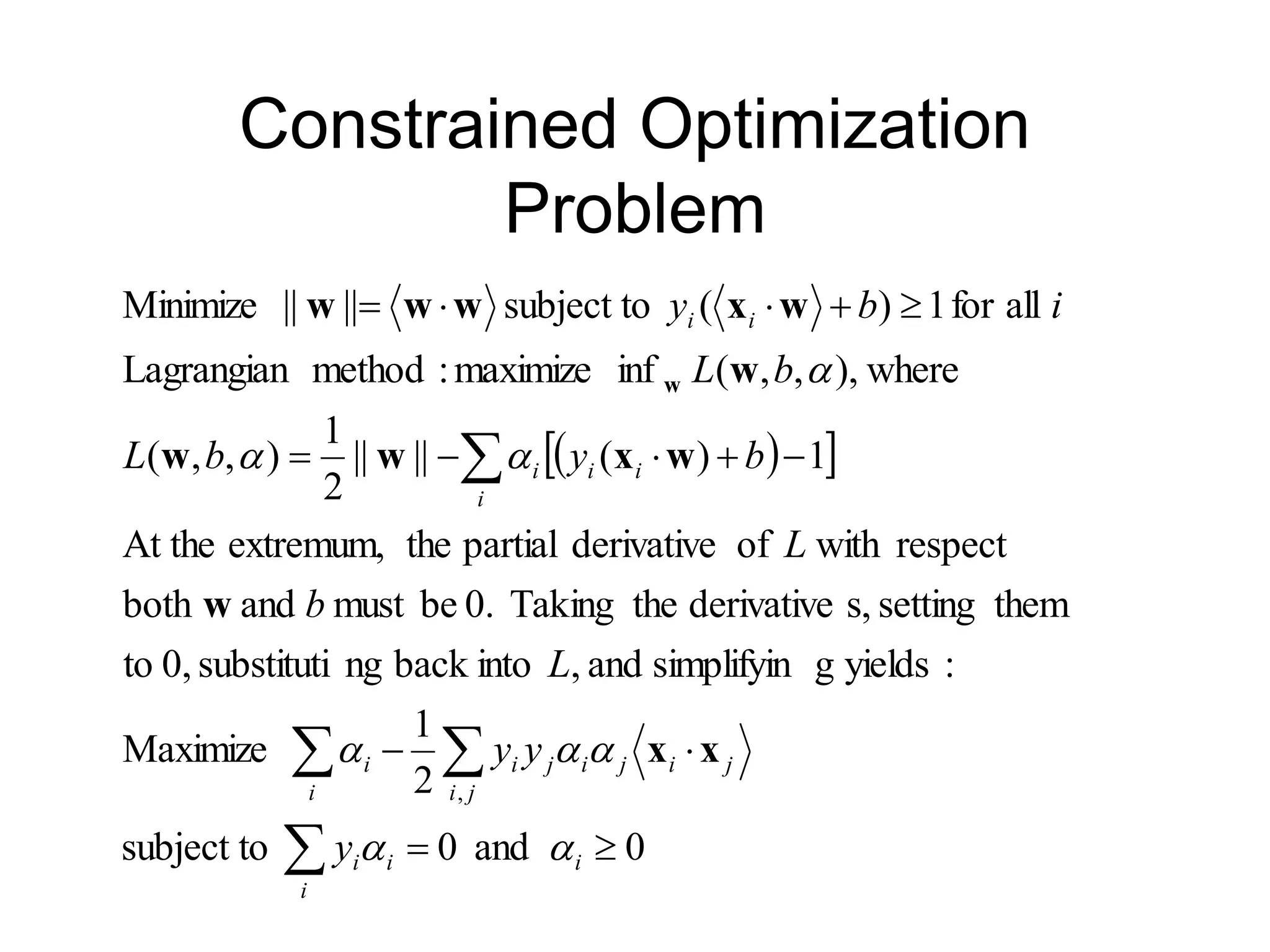
Constrained Optimization
Problem
 
 
0
and
0
subject to
2
1
Maximize
:
yields
g
simplifyin
and
,
into
back
ng
substituti
0,
to
them
setting
s,
derivative
the
Taking
0.
be
must
and
both
respect
with
of
derivative
partial
the
extremum,
At the
1
)
(
||
||
2
1
)
,
,
(
where
,
)
,
,
(
inf
maximize
:
method
Lagrangian
all
for
1
)
(
subject to
||
||
Minimize
,















 

i
i
i
i
i j
i
j
i
j
i
j
i
i
i
i
i
i
i
i
y
y
y
L
b
L
b
y
b
L
b
L
i
b
y








x
x
w
w
x
w
w
w
w
x
w
w
w
w
Quadratic Programming
• Why is this reformulation a good thing?
• The problem
is an instance of what is called a positive, semi-definite
programming problem
• For a fixed real-number accuracy, can be solved in
O(n log n) time = O(|D|2 log |D|2)
0
and
0
subject to
2
1
Maximize
,





 
i
i
i
i
i j
i
j
i
j
i
j
i
i
y
y
y




 x
x
Problems with linear SVM
=-1
=+1
What if the decision function is not a linear?
Kernel Trick
)
2
,
,
(
space
in the
separable
linearly
are
points
Data
2
1
2
2
2
1 x
x
x
x
2
,
)
,
(
Here,
directly!
compute
easy to
often
is
:
thing
Cool
)
(
)
(
)
,
(
Define
)
(
)
(
2
1
maximize
want to
We
j
i
j
i
j
i
j
i
i j
i
j
i
j
i
j
i
i
K
K
F
F
K
F
F
y
y
x
x
x
x
x
x
x
x
x
x






  


Other Kernels
The polynomial kernel
K(xi,xj) = (xi•xj + 1)p, where p is a tunable parameter.
Evaluating K only require one addition and one exponentiation
more than the original dot product.
Gaussian kernels (also called radius basis functions)
K(xi,xj) = exp(||xi-xj ||2/22)
Overtraining/overfitting
=-1
=+1
An example: A botanist really knowing trees.Everytime he sees a new tree,
he claims it is not a tree.
A well known problem with machine learning methods is overtraining.
This means that we have learned the training data very well, but
we can not classify unseen examples correctly.
Overtraining/overfitting 2
It can be shown that: The portion, n, of unseen data that will be
missclassified is bounded by:
n  Number of support vectors / number of training examples
A measure of the risk of overtraining with SVM (there are also other
measures).
Ockham´s razor principle: Simpler system are better than more complex ones.
In SVM case: fewer support vectors mean a simpler representation of the
hyperplane.
Example: Understanding a certain cancer if it can be described by one gene
is easier than if we have to describe it with 5000.
A practical example, protein
localization
• Proteins are synthesized in the cytosol.
• Transported into different subcellular
locations where they carry out their
functions.
• Aim: To predict in what location a
certain protein will end up!!!
Subcellular Locations
Method
• Hypothesis: The amino acid composition of proteins
from different compartments should differ.
• Extract proteins with know subcellular location from
SWISSPROT.
• Calculate the amino acid composition of the proteins.
• Try to differentiate between: cytosol, extracellular,
mitochondria and nuclear by using SVM
Input encoding
Prediction of nuclear proteins:
Label the known nuclear proteins as +1 and all others
as –1.
The input vector xi represents the amino acid
composition.
Eg xi =(4.2,6.7,12,….,0.5)
A , C , D,….., Y)
Nuclear
All others
SVM Model
Cross-validation
Cross validation: Split the data into n sets, train on n-1 set, test on the set left
out of training.
Nuclear
All others
1
2
3
1
2
3
Test set
1
1
Training set
2
3
2
3
Performance measurments
Model
=+1
=-1
Predictions
+1
-1
Test data TP
FP
TN
FN
SP = TP /(TP+FP), the fraction of predicted +1 that actually are +1.
SE = TP /(TP+FN), the fraction of the +1 that actually are predicted as +1.
In this case: SP=5/(5+1) =0.83
SE = 5/(5+2) = 0.71
A Cautionary Example
Image classification of tanks. Autofire when an enemy tank is spotted.
Input data: Photos of own and enemy tanks.
Worked really good with the training set used.
In reality it failed completely.
Reason: All enemy tank photos taken in the morning. All own tanks in dawn.
The classifier could recognize dusk from dawn!!!!
References
http://www.kernel-machines.org/
AN INTRODUCTION TO SUPPORT VECTOR MACHINES
(and other kernel-based learning methods)
N. Cristianini and J. Shawe-Taylor
Cambridge University Press
2000 ISBN: 0 521 78019 5
http://www.support-vector.net/
Papers by Vapnik
C.J.C. Burges: A tutorial on Support Vector Machines. Data Mining and
Knowledge Discovery 2:121-167, 1998.

support-vector-machines.ppt

  • 1.
    An Introduction toSupport Vector Machines CSE 573 Autumn 2005 Henry Kautz based on slides stolen from Pierre Dönnes’ web site
  • 2.
    Main Ideas • Max-MarginClassifier – Formalize notion of the best linear separator • Lagrangian Multipliers – Way to convert a constrained optimization problem to one that is easier to solve • Kernels – Projecting data into higher-dimensional space makes it linearly separable • Complexity – Depends only on the number of training examples, not on dimensionality of the kernel space!
  • 3.
    Tennis example Humidity Temperature = playtennis = do not play tennis
  • 4.
    Linear Support Vector Machines x1 x2 =+1 =-1 Data:<xi,yi>, i=1,..,l xi  Rd yi  {-1,+1}
  • 5.
    =-1 =+1 Data: <xi,yi>, i=1,..,l xi Rd yi  {-1,+1} All hyperplanes in Rd are parameterize by a vector (w) and a constant b. Can be expressed as w•x+b=0 (remember the equation for a hyperplane from algebra!) Our aim is to find such a hyperplane f(x)=sign(w•x+b), that correctly classify our data. f(x) Linear SVM 2
  • 6.
    d+ d- Definitions Define the hyperplaneH such that: xi•w+b  +1 when yi =+1 xi•w+b  -1 when yi =-1 d+ = the shortest distance to the closest positive point d- = the shortest distance to the closest negative point The margin of a separating hyperplane is d+ + d-. H H1 and H2 are the planes: H1: xi•w+b = +1 H2: xi•w+b = -1 The points on the planes H1 and H2 are the Support Vectors H1 H2
  • 7.
    Maximizing the margin d+ d- Wewant a classifier with as big margin as possible. Recall the distance from a point(x0,y0) to a line: Ax+By+c = 0 is|A x0 +B y0 +c|/sqrt(A2+B2) The distance between H and H1 is: |w•x+b|/||w||=1/||w|| The distance between H1 and H2 is: 2/||w|| In order to maximize the margin, we need to minimize ||w||. With the condition that there are no datapoints between H1 and H2: xi•w+b  +1 when yi =+1 xi•w+b  -1 when yi =-1 Can be combined into yi(xi•w)  1 H1 H2 H
  • 8.
    Constrained Optimization Problem    0 and 0 subject to 2 1 Maximize : yields g simplifyin and , into back ng substituti 0, to them setting s, derivative the Taking 0. be must and both respect with of derivative partial the extremum, At the 1 ) ( || || 2 1 ) , , ( where , ) , , ( inf maximize : method Lagrangian all for 1 ) ( subject to || || Minimize ,                   i i i i i j i j i j i j i i i i i i i i y y y L b L b y b L b L i b y         x x w w x w w w w x w w w w
  • 9.
    Quadratic Programming • Whyis this reformulation a good thing? • The problem is an instance of what is called a positive, semi-definite programming problem • For a fixed real-number accuracy, can be solved in O(n log n) time = O(|D|2 log |D|2) 0 and 0 subject to 2 1 Maximize ,        i i i i i j i j i j i j i i y y y      x x
  • 10.
    Problems with linearSVM =-1 =+1 What if the decision function is not a linear?
  • 11.
    Kernel Trick ) 2 , , ( space in the separable linearly are points Data 2 1 2 2 2 1x x x x 2 , ) , ( Here, directly! compute easy to often is : thing Cool ) ( ) ( ) , ( Define ) ( ) ( 2 1 maximize want to We j i j i j i j i i j i j i j i j i i K K F F K F F y y x x x x x x x x x x           
  • 12.
    Other Kernels The polynomialkernel K(xi,xj) = (xi•xj + 1)p, where p is a tunable parameter. Evaluating K only require one addition and one exponentiation more than the original dot product. Gaussian kernels (also called radius basis functions) K(xi,xj) = exp(||xi-xj ||2/22)
  • 13.
    Overtraining/overfitting =-1 =+1 An example: Abotanist really knowing trees.Everytime he sees a new tree, he claims it is not a tree. A well known problem with machine learning methods is overtraining. This means that we have learned the training data very well, but we can not classify unseen examples correctly.
  • 14.
    Overtraining/overfitting 2 It canbe shown that: The portion, n, of unseen data that will be missclassified is bounded by: n  Number of support vectors / number of training examples A measure of the risk of overtraining with SVM (there are also other measures). Ockham´s razor principle: Simpler system are better than more complex ones. In SVM case: fewer support vectors mean a simpler representation of the hyperplane. Example: Understanding a certain cancer if it can be described by one gene is easier than if we have to describe it with 5000.
  • 15.
    A practical example,protein localization • Proteins are synthesized in the cytosol. • Transported into different subcellular locations where they carry out their functions. • Aim: To predict in what location a certain protein will end up!!!
  • 16.
  • 17.
    Method • Hypothesis: Theamino acid composition of proteins from different compartments should differ. • Extract proteins with know subcellular location from SWISSPROT. • Calculate the amino acid composition of the proteins. • Try to differentiate between: cytosol, extracellular, mitochondria and nuclear by using SVM
  • 18.
    Input encoding Prediction ofnuclear proteins: Label the known nuclear proteins as +1 and all others as –1. The input vector xi represents the amino acid composition. Eg xi =(4.2,6.7,12,….,0.5) A , C , D,….., Y) Nuclear All others SVM Model
  • 19.
    Cross-validation Cross validation: Splitthe data into n sets, train on n-1 set, test on the set left out of training. Nuclear All others 1 2 3 1 2 3 Test set 1 1 Training set 2 3 2 3
  • 20.
    Performance measurments Model =+1 =-1 Predictions +1 -1 Test dataTP FP TN FN SP = TP /(TP+FP), the fraction of predicted +1 that actually are +1. SE = TP /(TP+FN), the fraction of the +1 that actually are predicted as +1. In this case: SP=5/(5+1) =0.83 SE = 5/(5+2) = 0.71
  • 21.
    A Cautionary Example Imageclassification of tanks. Autofire when an enemy tank is spotted. Input data: Photos of own and enemy tanks. Worked really good with the training set used. In reality it failed completely. Reason: All enemy tank photos taken in the morning. All own tanks in dawn. The classifier could recognize dusk from dawn!!!!
  • 22.
    References http://www.kernel-machines.org/ AN INTRODUCTION TOSUPPORT VECTOR MACHINES (and other kernel-based learning methods) N. Cristianini and J. Shawe-Taylor Cambridge University Press 2000 ISBN: 0 521 78019 5 http://www.support-vector.net/ Papers by Vapnik C.J.C. Burges: A tutorial on Support Vector Machines. Data Mining and Knowledge Discovery 2:121-167, 1998.