
Neil F. Comins • William J. Kaufmann III
Discovering the UniverseDiscovering the Universe
Tenth EditionTenth Edition
CHAPTER 8CHAPTER 8
The Outer PlanetsThe Outer Planets
In this chapter, you will discover…In this chapter, you will discover…
 Jupiter, an active, vibrant, multicolored worldJupiter, an active, vibrant, multicolored world
more massive than all of the other planetsmore massive than all of the other planets
combinedcombined
 Jupiter’s diverse system of moonsJupiter’s diverse system of moons
 Saturn, with its spectacular system of thin, flatSaturn, with its spectacular system of thin, flat
rings and numerous moons, including bizarrerings and numerous moons, including bizarre
Enceladus and TitanEnceladus and Titan
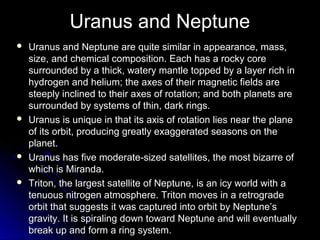
 Uranus and Neptune, ice giants similar to eachUranus and Neptune, ice giants similar to each
other and different from Jupiter and Saturnother and different from Jupiter and Saturn
 Jupiter is the largest planet in the solar system.Jupiter is the largest planet in the solar system.
 It emits more energy than it receives from the Sun.It emits more energy than it receives from the Sun.
 A cloud cover is continually moving and confined to narrowA cloud cover is continually moving and confined to narrow
bands of latitude that move faster at the equator than thebands of latitude that move faster at the equator than the
poles. This causes an effect called differential rotation.poles. This causes an effect called differential rotation.
 The dark reddish bands are called belts, and the light-The dark reddish bands are called belts, and the light-
colored ones are called zones.colored ones are called zones.
 Belts and zones flow eastward or westward, displaying aBelts and zones flow eastward or westward, displaying a
zonal flow much different than winds found on Earth.zonal flow much different than winds found on Earth.
 Jupiter’s belts and zones provide a framework for turbulentJupiter’s belts and zones provide a framework for turbulent
swirling cloud patterns, as well as rotating storms similarswirling cloud patterns, as well as rotating storms similar
to hurricanes.to hurricanes.
Jupiter’s Appearance
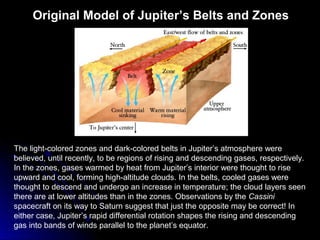
Original Model of Jupiter’s Belts and Zones
The light-colored zones and dark-colored belts in Jupiter’s atmosphere were
believed, until recently, to be regions of rising and descending gases, respectively.
In the zones, gases warmed by heat from Jupiter’s interior were thought to rise
upward and cool, forming high-altitude clouds. In the belts, cooled gases were
thought to descend and undergo an increase in temperature; the cloud layers seen
there are at lower altitudes than in the zones. Observations by the Cassini
spacecraft on its way to Saturn suggest that just the opposite may be correct! In
either case, Jupiter’s rapid differential rotation shapes the rising and descending
gas into bands of winds parallel to the planet’s equator.
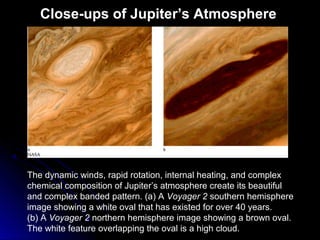
Close-ups of Jupiter’s Atmosphere
The dynamic winds, rapid rotation, internal heating, and complex
chemical composition of Jupiter’s atmosphere create its beautiful
and complex banded pattern. (a) A Voyager 2 southern hemisphere
image showing a white oval that has existed for over 40 years.
(b) A Voyager 2 northern hemisphere image showing a brown oval.
The white feature overlapping the oval is a high cloud.
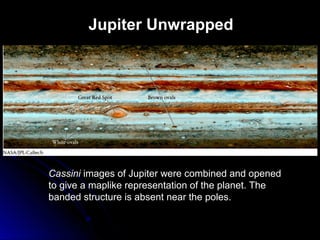
Jupiter Unwrapped
Cassini images of Jupiter were combined and opened
to give a maplike representation of the planet. The
banded structure is absent near the poles.
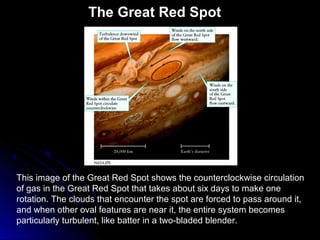
The Great Red Spot
This image of the Great Red Spot shows the counterclockwise circulation
of gas in the Great Red Spot that takes about six days to make one
rotation. The clouds that encounter the spot are forced to pass around it,
and when other oval features are near it, the entire system becomes
particularly turbulent, like batter in a two-bladed blender.
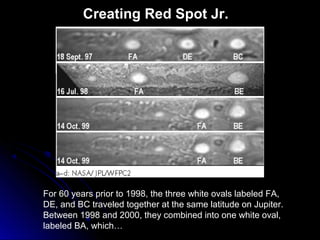
Creating Red Spot Jr.
For 60 years prior to 1998, the three white ovals labeled FA,
DE, and BC traveled together at the same latitude on Jupiter.
Between 1998 and 2000, they combined into one white oval,
labeled BA, which…
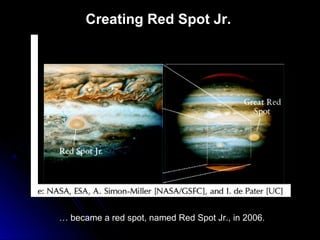
Creating Red Spot Jr.
… became a red spot, named Red Spot Jr., in 2006.
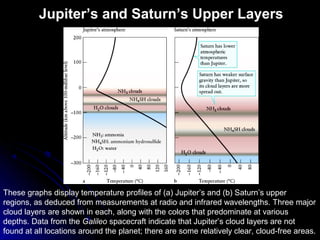
Jupiter’s and Saturn’s Upper Layers
These graphs display temperature profiles of (a) Jupiter’s and (b) Saturn’s upper
regions, as deduced from measurements at radio and infrared wavelengths. Three major
cloud layers are shown in each, along with the colors that predominate at various
depths. Data from the Galileo spacecraft indicate that Jupiter’s cloud layers are not
found at all locations around the planet; there are some relatively clear, cloud-free areas.
 Jupiter’s atmosphere is mostly hydrogen andJupiter’s atmosphere is mostly hydrogen and
helium with traces of methane, ammonia, waterhelium with traces of methane, ammonia, water
vapor, and other gases.vapor, and other gases.
 There are three major cloud layers.There are three major cloud layers.
 The uppermost layer is made of frozen ammoniaThe uppermost layer is made of frozen ammonia
crystals.crystals.
 The middle layer is ammonium hydrosulfide. andThe middle layer is ammonium hydrosulfide. and
the bottom is mostly water vapor.the bottom is mostly water vapor.
 Below its cloud layer, Jupiter’s mantle is entirelyBelow its cloud layer, Jupiter’s mantle is entirely
liquid, with no definite boundary between theliquid, with no definite boundary between the
gaseous atmosphere and its liquid mantle.gaseous atmosphere and its liquid mantle.
Jupiter’s Atmosphere
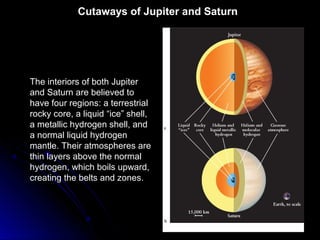
Cutaways of Jupiter and Saturn
The interiors of both Jupiter
and Saturn are believed to
have four regions: a terrestrial
rocky core, a liquid “ice” shell,
a metallic hydrogen shell, and
a normal liquid hydrogen
mantle. Their atmospheres are
thin layers above the normal
hydrogen, which boils upward,
creating the belts and zones.
 Beneath Jupiter’s clouds, we find liquid molecularBeneath Jupiter’s clouds, we find liquid molecular
hydrogen and helium.hydrogen and helium.
 The heat and pressure of the atmosphere transformsThe heat and pressure of the atmosphere transforms
hydrogen into liquid metallic hydrogen, making it behavehydrogen into liquid metallic hydrogen, making it behave
like a metal.like a metal.
 Electric currents running through this rotating metallicElectric currents running through this rotating metallic
region generate a magnetic field.region generate a magnetic field.
 The Nice theory suggests a rock and metal protoplanetThe Nice theory suggests a rock and metal protoplanet
formed out beyond the snowline and is the source offormed out beyond the snowline and is the source of
Jupiter’s core.Jupiter’s core.
 Water, carbon dioxide, methane, and ammonia probablyWater, carbon dioxide, methane, and ammonia probably
existed as ice on the surface of the protoplanet and wereexisted as ice on the surface of the protoplanet and were
likely compressed with it as the atmosphere formed.likely compressed with it as the atmosphere formed.
Jupiter’s Interior and Magnetosphere
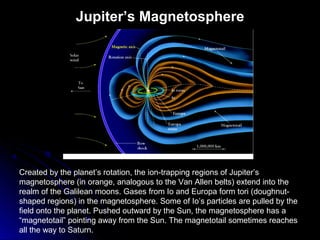
Jupiter’s Magnetosphere
Created by the planet’s rotation, the ion-trapping regions of Jupiter’s
magnetosphere (in orange, analogous to the Van Allen belts) extend into the
realm of the Galilean moons. Gases from Io and Europa form tori (doughnut-
shaped regions) in the magnetosphere. Some of Io’s particles are pulled by the
field onto the planet. Pushed outward by the Sun, the magnetosphere has a
“magnetotail” pointing away from the Sun. The magnetotail sometimes reaches
all the way to Saturn.
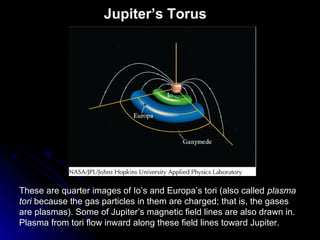
Jupiter’s Torus
These are quarter images of Io’s and Europa’s tori (also called plasma
tori because the gas particles in them are charged; that is, the gases
are plasmas). Some of Jupiter’s magnetic field lines are also drawn in.
Plasma from tori flow inward along these field lines toward Jupiter.
Jupiter’s Magnetosphere
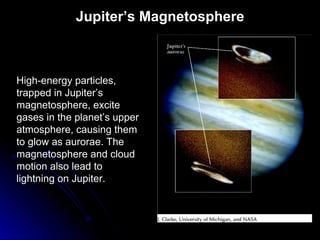
High-energy particles,
trapped in Jupiter’s
magnetosphere, excite
gases in the planet’s upper
atmosphere, causing them
to glow as aurorae. The
magnetosphere and cloud
motion also lead to
lightning on Jupiter.
Comet Shoemaker-Levy 9 and Its Encounter with Jupiter
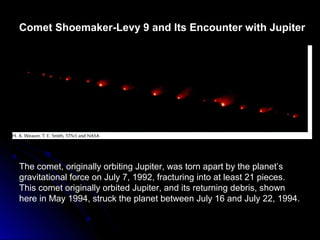
The comet, originally orbiting Jupiter, was torn apart by the planet’s
gravitational force on July 7, 1992, fracturing into at least 21 pieces.
This comet originally orbited Jupiter, and its returning debris, shown
here in May 1994, struck the planet between July 16 and July 22, 1994.
Comet Shoemaker-Levy 9 and Its Encounter with Jupiter
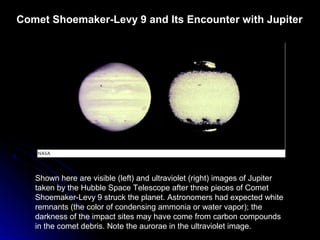
Shown here are visible (left) and ultraviolet (right) images of Jupiter
taken by the Hubble Space Telescope after three pieces of Comet
Shoemaker-Levy 9 struck the planet. Astronomers had expected white
remnants (the color of condensing ammonia or water vapor); the
darkness of the impact sites may have come from carbon compounds
in the comet debris. Note the aurorae in the ultraviolet image.
 Jupiter has about 67 moons, with the fourJupiter has about 67 moons, with the four
largest (Galilean satellites) probably forminglargest (Galilean satellites) probably forming
the same way as the inner planets.the same way as the inner planets.
 The others are either captured planetesimalsThe others are either captured planetesimals
and smaller pieces of space debris.and smaller pieces of space debris.
 The inner and six outer moons orbit in theThe inner and six outer moons orbit in the
same direction Jupiter rotates (prograde).same direction Jupiter rotates (prograde).
The rest display retrograde orbit.The rest display retrograde orbit.
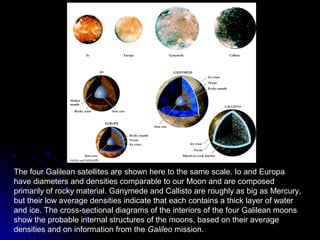
Jupiter’s Moons
The four Galilean satellites are shown here to the same scale. Io and Europa
have diameters and densities comparable to our Moon and are composed
primarily of rocky material. Ganymede and Callisto are roughly as big as Mercury,
but their low average densities indicate that each contains a thick layer of water
and ice. The cross-sectional diagrams of the interiors of the four Galilean moons
show the probable internal structures of the moons, based on their average
densities and on information from the Galileo mission.
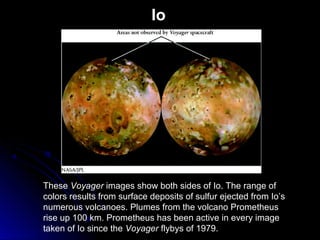
Io
These Voyager images show both sides of Io. The range of
colors results from surface deposits of sulfur ejected from Io’s
numerous volcanoes. Plumes from the volcano Prometheus
rise up 100 km. Prometheus has been active in every image
taken of Io since the Voyager flybys of 1979.
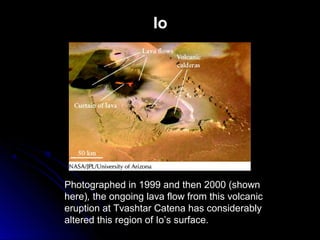
Io
Photographed in 1999 and then 2000 (shown
here), the ongoing lava flow from this volcanic
eruption at Tvashtar Catena has considerably
altered this region of Io’s surface.
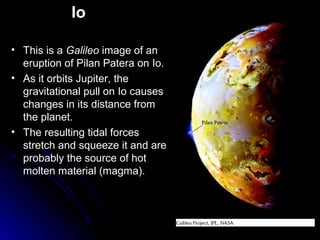
Io
• This is a Galileo image of an
eruption of Pilan Patera on Io.
• As it orbits Jupiter, the
gravitational pull on Io causes
changes in its distance from
the planet.
• The resulting tidal forces
stretch and squeeze it and are
probably the source of hot
molten material (magma).
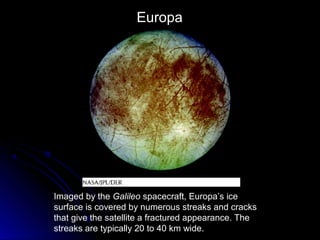
Imaged by the Galileo spacecraft, Europa’s ice
surface is covered by numerous streaks and cracks
that give the satellite a fractured appearance. The
streaks are typically 20 to 40 km wide.
Europa
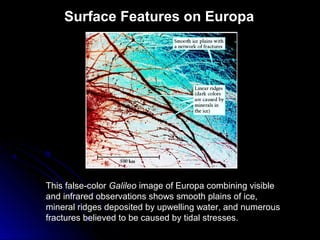
Surface Features on Europa
This false-color Galileo image of Europa combining visible
and infrared observations shows smooth plains of ice,
mineral ridges deposited by upwelling water, and numerous
fractures believed to be caused by tidal stresses.
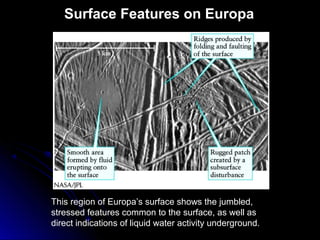
Surface Features on Europa
This region of Europa’s surface shows the jumbled,
stressed features common to the surface, as well as
direct indications of liquid water activity underground.
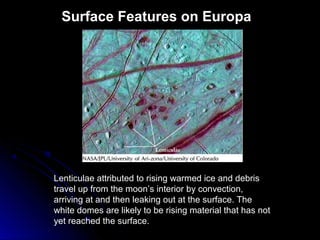
Surface Features on Europa
Lenticulae attributed to rising warmed ice and debris
travel up from the moon’s interior by convection,
arriving at and then leaking out at the surface. The
white domes are likely to be rising material that has not
yet reached the surface.
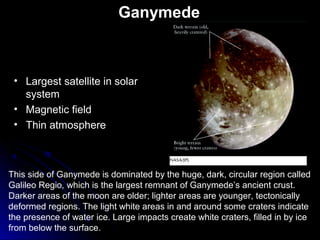
Ganymede
This side of Ganymede is dominated by the huge, dark, circular region called
Galileo Regio, which is the largest remnant of Ganymede’s ancient crust.
Darker areas of the moon are older; lighter areas are younger, tectonically
deformed regions. The light white areas in and around some craters indicate
the presence of water ice. Large impacts create white craters, filled in by ice
from below the surface.
• Largest satellite in solar
system
• Magnetic field
• Thin atmosphere
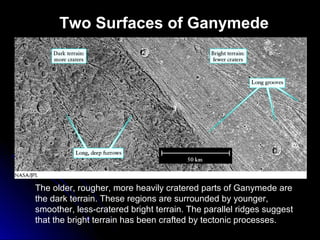
Two Surfaces of Ganymede
The older, rougher, more heavily cratered parts of Ganymede are
the dark terrain. These regions are surrounded by younger,
smoother, less-cratered bright terrain. The parallel ridges suggest
that the bright terrain has been crafted by tectonic processes.
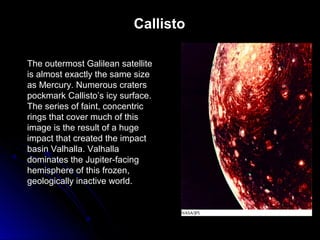
Callisto
The outermost Galilean satellite
is almost exactly the same size
as Mercury. Numerous craters
pockmark Callisto’s icy surface.
The series of faint, concentric
rings that cover much of this
image is the result of a huge
impact that created the impact
basin Valhalla. Valhalla
dominates the Jupiter-facing
hemisphere of this frozen,
geologically inactive world.
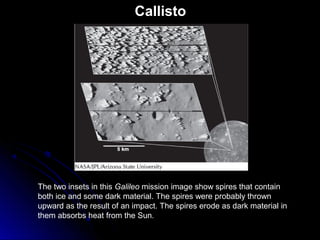
Callisto
The two insets in this Galileo mission image show spires that contain
both ice and some dark material. The spires were probably thrown
upward as the result of an impact. The spires erode as dark material in
them absorbs heat from the Sun.
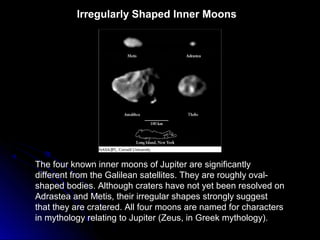
Irregularly Shaped Inner Moons
The four known inner moons of Jupiter are significantly
different from the Galilean satellites. They are roughly oval-
shaped bodies. Although craters have not yet been resolved on
Adrastea and Metis, their irregular shapes strongly suggest
that they are cratered. All four moons are named for characters
in mythology relating to Jupiter (Zeus, in Greek mythology).
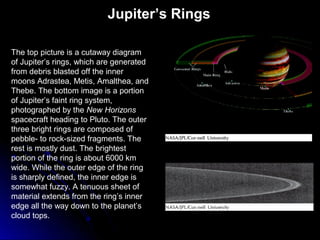
Jupiter’s Rings
The top picture is a cutaway diagram
of Jupiter’s rings, which are generated
from debris blasted off the inner
moons Adrastea, Metis, Amalthea, and
Thebe. The bottom image is a portion
of Jupiter’s faint ring system,
photographed by the New Horizons
spacecraft heading to Pluto. The outer
three bright rings are composed of
pebble- to rock-sized fragments. The
rest is mostly dust. The brightest
portion of the ring is about 6000 km
wide. While the outer edge of the ring
is sharply defined, the inner edge is
somewhat fuzzy. A tenuous sheet of
material extends from the ring’s inner
edge all the way down to the planet’s
cloud tops.
 Saturn’s atmosphere lacks the colorful contrastSaturn’s atmosphere lacks the colorful contrast
visible on Jupiter but still has belts and zones.visible on Jupiter but still has belts and zones.
 Saturn’s atmosphere is not as compressed andSaturn’s atmosphere is not as compressed and
slightly different in composition.slightly different in composition.
 A smaller mass results in less hydrogen beingA smaller mass results in less hydrogen being
converted to liquid metallic hydrogen in Saturn.converted to liquid metallic hydrogen in Saturn.
 Saturn’s rings are composed of fragments of iceSaturn’s rings are composed of fragments of ice
and ice-coated rocks making them appear brighterand ice-coated rocks making them appear brighter
than the other gas giants.than the other gas giants.
 Saturn’s aurorae form spirals instead of rings.Saturn’s aurorae form spirals instead of rings.
 Saturn’s satellites are different from Jupiter’s.Saturn’s satellites are different from Jupiter’s.
Saturn Is Different than Jupiter
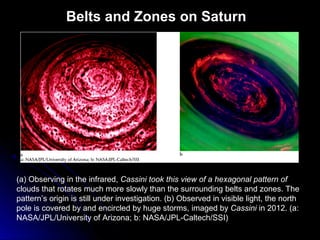
Belts and Zones on Saturn
(a) Observing in the infrared, Cassini took this view of a hexagonal pattern of
clouds that rotates much more slowly than the surrounding belts and zones. The
pattern’s origin is still under investigation. (b) Observed in visible light, the north
pole is covered by and encircled by huge storms, imaged by Cassini in 2012. (a:
NASA/JPL/University of Arizona; b: NASA/JPL-Caltech/SSI)
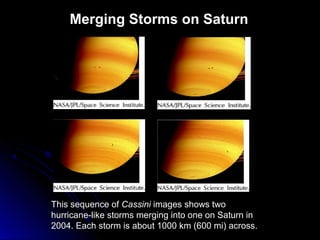
Merging Storms on Saturn
This sequence of Cassini images shows two
hurricane-like storms merging into one on Saturn in
2004. Each storm is about 1000 km (600 mi) across.
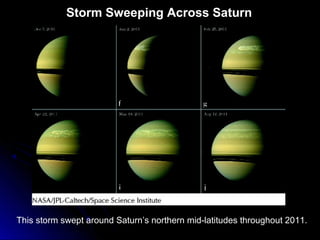
This storm swept around Saturn’s northern mid-latitudes throughout 2011.
Storm Sweeping Across Saturn
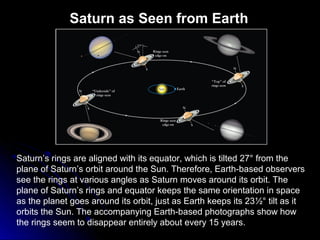
Saturn as Seen from Earth
Saturn’s rings are aligned with its equator, which is tilted 27° from the
plane of Saturn’s orbit around the Sun. Therefore, Earth-based observers
see the rings at various angles as Saturn moves around its orbit. The
plane of Saturn’s rings and equator keeps the same orientation in space
as the planet goes around its orbit, just as Earth keeps its 23½° tilt as it
orbits the Sun. The accompanying Earth-based photographs show how
the rings seem to disappear entirely about every 15 years.
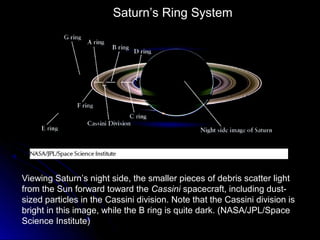
Saturn’s Ring System
Viewing Saturn’s night side, the smaller pieces of debris scatter light
from the Sun forward toward the Cassini spacecraft, including dust-
sized particles in the Cassini division. Note that the Cassini division is
bright in this image, while the B ring is quite dark. (NASA/JPL/Space
Science Institute)
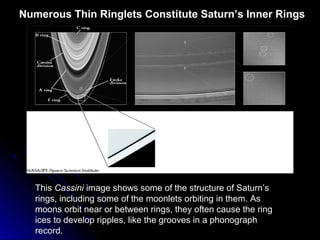
Numerous Thin Ringlets Constitute Saturn’s Inner Rings
This Cassini image shows some of the structure of Saturn’s
rings, including some of the moonlets orbiting in them. As
moons orbit near or between rings, they often cause the ring
ices to develop ripples, like the grooves in a phonograph
record.
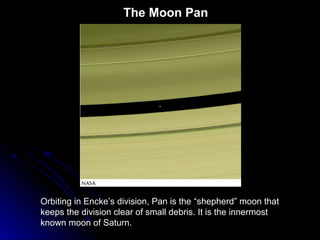
The Moon Pan
Orbiting in Encke’s division, Pan is the “shepherd” moon that
keeps the division clear of small debris. It is the innermost
known moon of Saturn.
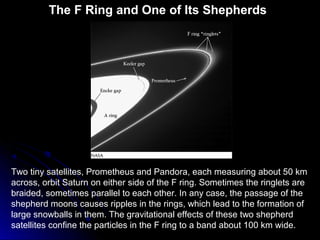
The F Ring and One of Its Shepherds
Two tiny satellites, Prometheus and Pandora, each measuring about 50 km
across, orbit Saturn on either side of the F ring. Sometimes the ringlets are
braided, sometimes parallel to each other. In any case, the passage of the
shepherd moons causes ripples in the rings, which lead to the formation of
large snowballs in them. The gravitational effects of these two shepherd
satellites confine the particles in the F ring to a band about 100 km wide.
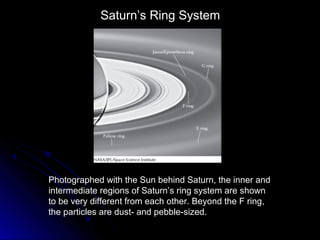
Saturn’s Ring System
Photographed with the Sun behind Saturn, the inner and
intermediate regions of Saturn’s ring system are shown
to be very different from each other. Beyond the F ring,
the particles are dust- and pebble-sized.
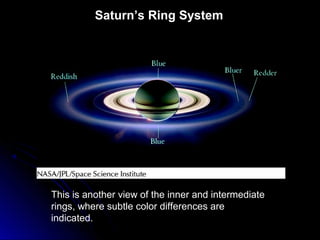
Saturn’s Ring System
This is another view of the inner and intermediate
rings, where subtle color differences are
indicated.
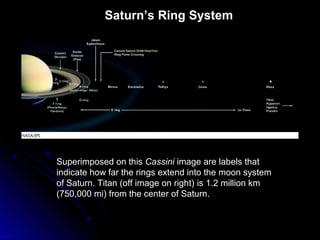
Saturn’s Ring System
Superimposed on this Cassini image are labels that
indicate how far the rings extend into the moon system
of Saturn. Titan (off image on right) is 1.2 million km
(750,000 mi) from the center of Saturn.
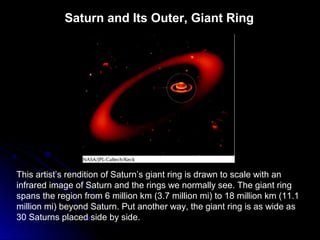
Saturn and Its Outer, Giant Ring
This artist’s rendition of Saturn’s giant ring is drawn to scale with an
infrared image of Saturn and the rings we normally see. The giant ring
spans the region from 6 million km (3.7 million mi) to 18 million km (11.1
million mi) beyond Saturn. Put another way, the giant ring is as wide as
30 Saturns placed side by side.
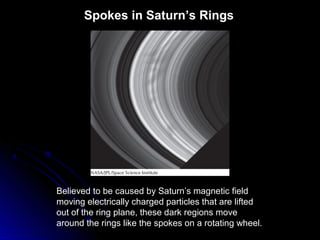
Spokes in Saturn’s Rings
Believed to be caused by Saturn’s magnetic field
moving electrically charged particles that are lifted
out of the ring plane, these dark regions move
around the rings like the spokes on a rotating wheel.
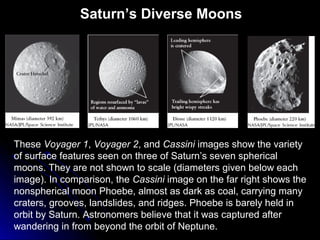
These Voyager 1, Voyager 2, and Cassini images show the variety
of surface features seen on three of Saturn’s seven spherical
moons. They are not shown to scale (diameters given below each
image). In comparison, the Cassini image on the far right shows the
nonspherical moon Phoebe, almost as dark as coal, carrying many
craters, grooves, landslides, and ridges. Phoebe is barely held in
orbit by Saturn. Astronomers believe that it was captured after
wandering in from beyond the orbit of Neptune.
Saturn’s Diverse Moons
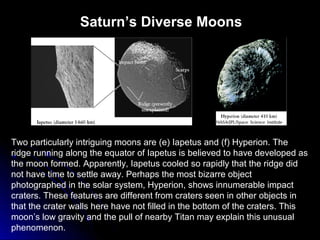
Two particularly intriguing moons are (e) Iapetus and (f) Hyperion. The
ridge running along the equator of Iapetus is believed to have developed as
the moon formed. Apparently, Iapetus cooled so rapidly that the ridge did
not have time to settle away. Perhaps the most bizarre object
photographed in the solar system, Hyperion, shows innumerable impact
craters. These features are different from craters seen in other objects in
that the crater walls here have not filled in the bottom of the craters. This
moon’s low gravity and the pull of nearby Titan may explain this unusual
phenomenon.
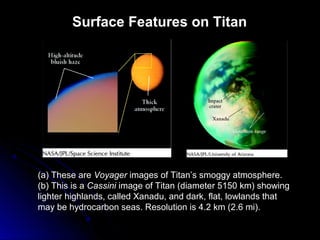
Surface Features on Titan
(a) These are Voyager images of Titan’s smoggy atmosphere.
(b) This is a Cassini image of Titan (diameter 5150 km) showing
lighter highlands, called Xanadu, and dark, flat, lowlands that
may be hydrocarbon seas. Resolution is 4.2 km (2.6 mi).
Surface Features on Titan
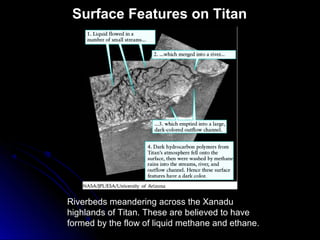
Riverbeds meandering across the Xanadu
highlands of Titan. These are believed to have
formed by the flow of liquid methane and ethane.
Surface Features on Titan
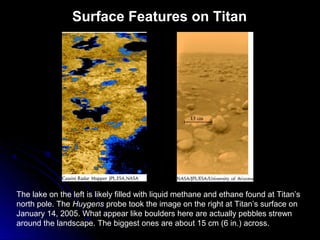
The lake on the left is likely filled with liquid methane and ethane found at Titan’s
north pole. The Huygens probe took the image on the right at Titan’s surface on
January 14, 2005. What appear like boulders here are actually pebbles strewn
around the landscape. The biggest ones are about 15 cm (6 in.) across.
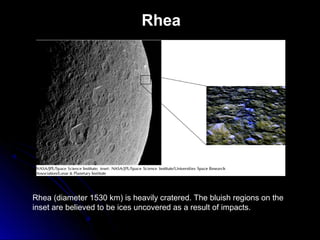
Rhea
Rhea (diameter 1530 km) is heavily cratered. The bluish regions on the
inset are believed to be ices uncovered as a result of impacts.
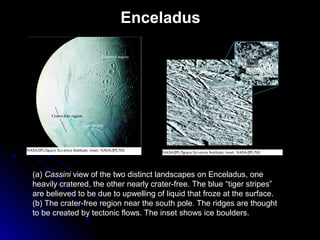
Enceladus
(a) Cassini view of the two distinct landscapes on Enceladus, one
heavily cratered, the other nearly crater-free. The blue “tiger stripes”
are believed to be due to upwelling of liquid that froze at the surface.
(b) The crater-free region near the south pole. The ridges are thought
to be created by tectonic flows. The inset shows ice boulders.
Enceladus
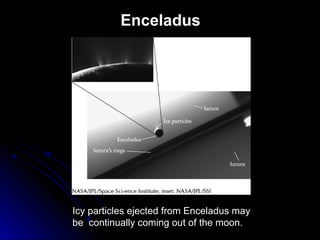
Icy particles ejected from Enceladus may
be continually coming out of the moon.
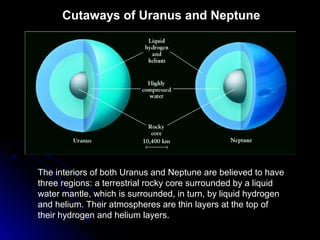
Cutaways of Uranus and Neptune
The interiors of both Uranus and Neptune are believed to have
three regions: a terrestrial rocky core surrounded by a liquid
water mantle, which is surrounded, in turn, by liquid hydrogen
and helium. Their atmospheres are thin layers at the top of
their hydrogen and helium layers.
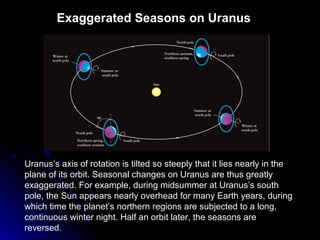
Exaggerated Seasons on Uranus
Uranus’s axis of rotation is tilted so steeply that it lies nearly in the
plane of its orbit. Seasonal changes on Uranus are thus greatly
exaggerated. For example, during midsummer at Uranus’s south
pole, the Sun appears nearly overhead for many Earth years, during
which time the planet’s northern regions are subjected to a long,
continuous winter night. Half an orbit later, the seasons are
reversed.
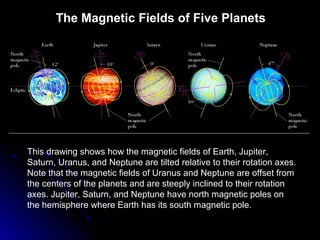
The Magnetic Fields of Five Planets
This drawing shows how the magnetic fields of Earth, Jupiter,
Saturn, Uranus, and Neptune are tilted relative to their rotation axes.
Note that the magnetic fields of Uranus and Neptune are offset from
the centers of the planets and are steeply inclined to their rotation
axes. Jupiter, Saturn, and Neptune have north magnetic poles on
the hemisphere where Earth has its south magnetic pole.
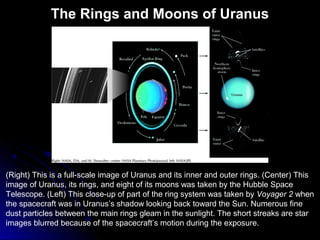
The Rings and Moons of Uranus
(Right) This is a full-scale image of Uranus and its inner and outer rings. (Center) This
image of Uranus, its rings, and eight of its moons was taken by the Hubble Space
Telescope. (Left) This close-up of part of the ring system was taken by Voyager 2 when
the spacecraft was in Uranus’s shadow looking back toward the Sun. Numerous fine
dust particles between the main rings gleam in the sunlight. The short streaks are star
images blurred because of the spacecraft’s motion during the exposure.
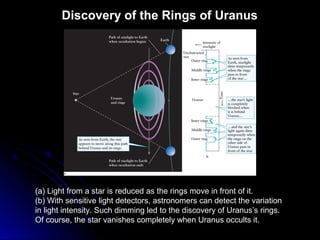
Discovery of the Rings of Uranus
(a) Light from a star is reduced as the rings move in front of it.
(b) With sensitive light detectors, astronomers can detect the variation
in light intensity. Such dimming led to the discovery of Uranus’s rings.
Of course, the star vanishes completely when Uranus occults it.
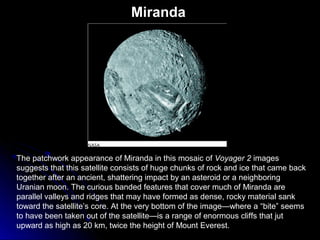
Miranda
The patchwork appearance of Miranda in this mosaic of Voyager 2 images
suggests that this satellite consists of huge chunks of rock and ice that came back
together after an ancient, shattering impact by an asteroid or a neighboring
Uranian moon. The curious banded features that cover much of Miranda are
parallel valleys and ridges that may have formed as dense, rocky material sank
toward the satellite’s core. At the very bottom of the image—where a “bite” seems
to have been taken out of the satellite—is a range of enormous cliffs that jut
upward as high as 20 km, twice the height of Mount Everest.
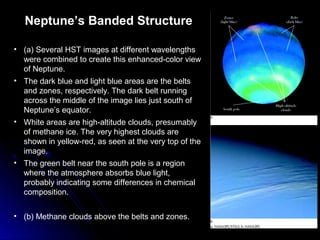
Neptune’s Banded Structure
• (a) Several HST images at different wavelengths
were combined to create this enhanced-color view
of Neptune.
• The dark blue and light blue areas are the belts
and zones, respectively. The dark belt running
across the middle of the image lies just south of
Neptune’s equator.
• White areas are high-altitude clouds, presumably
of methane ice. The very highest clouds are
shown in yellow-red, as seen at the very top of the
image.
• The green belt near the south pole is a region
where the atmosphere absorbs blue light,
probably indicating some differences in chemical
composition.
• (b) Methane clouds above the belts and zones.
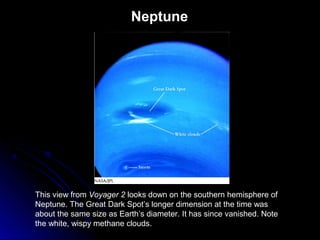
Neptune
This view from Voyager 2 looks down on the southern hemisphere of
Neptune. The Great Dark Spot’s longer dimension at the time was
about the same size as Earth’s diameter. It has since vanished. Note
the white, wispy methane clouds.
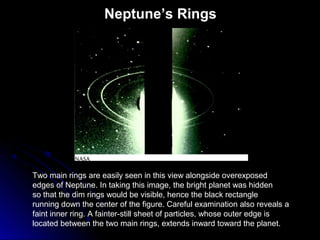
Neptune’s Rings
Two main rings are easily seen in this view alongside overexposed
edges of Neptune. In taking this image, the bright planet was hidden
so that the dim rings would be visible, hence the black rectangle
running down the center of the figure. Careful examination also reveals a
faint inner ring. A fainter-still sheet of particles, whose outer edge is
located between the two main rings, extends inward toward the planet.
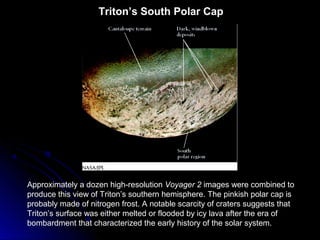
Triton’s South Polar Cap
Approximately a dozen high-resolution Voyager 2 images were combined to
produce this view of Triton’s southern hemisphere. The pinkish polar cap is
probably made of nitrogen frost. A notable scarcity of craters suggests that
Triton’s surface was either melted or flooded by icy lava after the era of
bombardment that characterized the early history of the solar system.
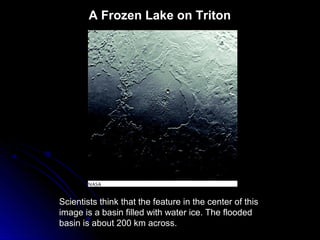
A Frozen Lake on Triton
Scientists think that the feature in the center of this
image is a basin filled with water ice. The flooded
basin is about 200 km across.
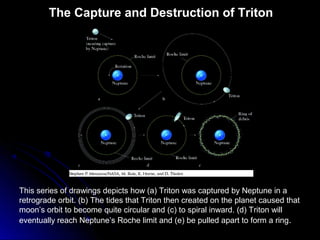
The Capture and Destruction of Triton
This series of drawings depicts how (a) Triton was captured by Neptune in a
retrograde orbit. (b) The tides that Triton then created on the planet caused that
moon’s orbit to become quite circular and (c) to spiral inward. (d) Triton will
eventually reach Neptune’s Roche limit and (e) be pulled apart to form a ring.
Summary of Key IdeasSummary of Key Ideas
Jupiter and Saturn
 Jupiter is by far the largest and most massive planet inJupiter is by far the largest and most massive planet in
the solar system.the solar system.
 Jupiter and Saturn probably have rocky cores surroundedJupiter and Saturn probably have rocky cores surrounded
by a thick layer of liquid metallic hydrogen and an outerby a thick layer of liquid metallic hydrogen and an outer
layer of ordinary liquid hydrogen and helium. Jupiter’slayer of ordinary liquid hydrogen and helium. Jupiter’s
core may be dissolving. Both planets have an overallcore may be dissolving. Both planets have an overall
chemical composition very similar to that of the Sun.chemical composition very similar to that of the Sun.
 The visible features of Jupiter exist in the outermostThe visible features of Jupiter exist in the outermost
100100 km of its atmosphere. Saturn has similar features, butkm of its atmosphere. Saturn has similar features, but
they are much fainter. Three cloud layers exist in thethey are much fainter. Three cloud layers exist in the
upper atmospheres of both Jupiter and Saturn. Becauseupper atmospheres of both Jupiter and Saturn. Because
Saturn’s cloud layers extend through a greater range ofSaturn’s cloud layers extend through a greater range of
altitudes, the colors of the Saturnian atmosphere appearaltitudes, the colors of the Saturnian atmosphere appear
muted.muted.
Jupiter and Saturn
 The colored ovals visible in the JovianThe colored ovals visible in the Jovian
atmospheres are gigantic storms, some of whichatmospheres are gigantic storms, some of which
(such as the Great Red Spot) are stable and(such as the Great Red Spot) are stable and
persist for years or even centuries.persist for years or even centuries.
 Jupiter and Saturn have strong magnetic fieldsJupiter and Saturn have strong magnetic fields
created by electric currents in their metalliccreated by electric currents in their metallic
hydrogen layers.hydrogen layers.
Jupiter and Saturn
 Four large satellites orbit Jupiter. The two inner GalileanFour large satellites orbit Jupiter. The two inner Galilean
moons, Io and Europa, are roughly the same size as ourmoons, Io and Europa, are roughly the same size as our
Moon. The two outer moons, Ganymede and Callisto,Moon. The two outer moons, Ganymede and Callisto,
are approximately the size of Mercury.are approximately the size of Mercury.
 Io is covered with a colorful layer of sulfur compoundsIo is covered with a colorful layer of sulfur compounds
deposited by frequent explosive eruptions from volcanicdeposited by frequent explosive eruptions from volcanic
vents. Europa is covered with a smooth layer of frozenvents. Europa is covered with a smooth layer of frozen
water crisscrossed by an intricate pattern of long cracks.water crisscrossed by an intricate pattern of long cracks.
 The heavily cratered surface of Ganymede is composedThe heavily cratered surface of Ganymede is composed
of frozen water with large polygons of dark, ancient crustof frozen water with large polygons of dark, ancient crust
separated by regions of heavily grooved, lighter-colored,separated by regions of heavily grooved, lighter-colored,
younger terrain. Callisto has a heavily cratered ancientyounger terrain. Callisto has a heavily cratered ancient
crust of frozen water.crust of frozen water.
Jupiter and Saturn
 Both Jupiter and Saturn have rings. Saturn is circled by aBoth Jupiter and Saturn have rings. Saturn is circled by a
system of thin, broad rings lying in the plane of thesystem of thin, broad rings lying in the plane of the
planet’s equator. Each major ring is composed of a greatplanet’s equator. Each major ring is composed of a great
many narrow ringlets that consist of numerous fragmentsmany narrow ringlets that consist of numerous fragments
of ice and ice-coated rock. Jupiter has a much lessof ice and ice-coated rock. Jupiter has a much less
substantial ring system.substantial ring system.
 Saturn’s moon Titan has a thick atmosphere of nitrogen,Saturn’s moon Titan has a thick atmosphere of nitrogen,
methane, and other gases, as well as lakes of methanemethane, and other gases, as well as lakes of methane
and ethane.and ethane.
 Saturn’s moon Enceladus has areas with very differentSaturn’s moon Enceladus has areas with very different
surface features: an older, heavily cratered region and asurface features: an older, heavily cratered region and a
newer, nearly crater-free surface created by tectonicnewer, nearly crater-free surface created by tectonic
activity.activity.
Uranus and Neptune
 Uranus and Neptune are quite similar in appearance, mass,Uranus and Neptune are quite similar in appearance, mass,
size, and chemical composition. Each has a rocky coresize, and chemical composition. Each has a rocky core
surrounded by a thick, watery mantle topped by a layer rich insurrounded by a thick, watery mantle topped by a layer rich in
hydrogen and helium; the axes of their magnetic fields arehydrogen and helium; the axes of their magnetic fields are
steeply inclined to their axes of rotation; and both planets aresteeply inclined to their axes of rotation; and both planets are
surrounded by systems of thin, dark rings.surrounded by systems of thin, dark rings.
 Uranus is unique in that its axis of rotation lies near the planeUranus is unique in that its axis of rotation lies near the plane
of its orbit, producing greatly exaggerated seasons on theof its orbit, producing greatly exaggerated seasons on the
planet.planet.
 Uranus has five moderate-sized satellites, the most bizarre ofUranus has five moderate-sized satellites, the most bizarre of
which is Miranda.which is Miranda.
 Triton, the largest satellite of Neptune, is an icy world with aTriton, the largest satellite of Neptune, is an icy world with a
tenuous nitrogen atmosphere. Triton moves in a retrogradetenuous nitrogen atmosphere. Triton moves in a retrograde
orbit that suggests it was captured into orbit by Neptune’sorbit that suggests it was captured into orbit by Neptune’s
gravity. It is spiraling down toward Neptune and will eventuallygravity. It is spiraling down toward Neptune and will eventually
break up and form a ring system.break up and form a ring system.
Key TermsKey Terms
A ring
B ring
belt
C ring
Cassini division
differential rotation
Encke division
F ring
Galilean moon (satellite)
Great Dark Spot
Great Red Spot
hydrocarbon
liquid metallic hydrogen
occultation
polymer
prograde orbit
resonance
retrograde orbit
ringlet
Roche limit
shepherd satellite (moon)
spoke
zone (atmospheric)

Dtu10e lecture ppt_ch08

  • 1.
    Neil F. Comins• William J. Kaufmann III Discovering the UniverseDiscovering the Universe Tenth EditionTenth Edition CHAPTER 8CHAPTER 8 The Outer PlanetsThe Outer Planets
  • 2.
    In this chapter,you will discover…In this chapter, you will discover…  Jupiter, an active, vibrant, multicolored worldJupiter, an active, vibrant, multicolored world more massive than all of the other planetsmore massive than all of the other planets combinedcombined  Jupiter’s diverse system of moonsJupiter’s diverse system of moons  Saturn, with its spectacular system of thin, flatSaturn, with its spectacular system of thin, flat rings and numerous moons, including bizarrerings and numerous moons, including bizarre Enceladus and TitanEnceladus and Titan  Uranus and Neptune, ice giants similar to eachUranus and Neptune, ice giants similar to each other and different from Jupiter and Saturnother and different from Jupiter and Saturn
  • 4.
     Jupiter isthe largest planet in the solar system.Jupiter is the largest planet in the solar system.  It emits more energy than it receives from the Sun.It emits more energy than it receives from the Sun.  A cloud cover is continually moving and confined to narrowA cloud cover is continually moving and confined to narrow bands of latitude that move faster at the equator than thebands of latitude that move faster at the equator than the poles. This causes an effect called differential rotation.poles. This causes an effect called differential rotation.  The dark reddish bands are called belts, and the light-The dark reddish bands are called belts, and the light- colored ones are called zones.colored ones are called zones.  Belts and zones flow eastward or westward, displaying aBelts and zones flow eastward or westward, displaying a zonal flow much different than winds found on Earth.zonal flow much different than winds found on Earth.  Jupiter’s belts and zones provide a framework for turbulentJupiter’s belts and zones provide a framework for turbulent swirling cloud patterns, as well as rotating storms similarswirling cloud patterns, as well as rotating storms similar to hurricanes.to hurricanes. Jupiter’s Appearance
  • 5.
    Original Model ofJupiter’s Belts and Zones The light-colored zones and dark-colored belts in Jupiter’s atmosphere were believed, until recently, to be regions of rising and descending gases, respectively. In the zones, gases warmed by heat from Jupiter’s interior were thought to rise upward and cool, forming high-altitude clouds. In the belts, cooled gases were thought to descend and undergo an increase in temperature; the cloud layers seen there are at lower altitudes than in the zones. Observations by the Cassini spacecraft on its way to Saturn suggest that just the opposite may be correct! In either case, Jupiter’s rapid differential rotation shapes the rising and descending gas into bands of winds parallel to the planet’s equator.
  • 6.
    Close-ups of Jupiter’sAtmosphere The dynamic winds, rapid rotation, internal heating, and complex chemical composition of Jupiter’s atmosphere create its beautiful and complex banded pattern. (a) A Voyager 2 southern hemisphere image showing a white oval that has existed for over 40 years. (b) A Voyager 2 northern hemisphere image showing a brown oval. The white feature overlapping the oval is a high cloud.
  • 7.
    Jupiter Unwrapped Cassini imagesof Jupiter were combined and opened to give a maplike representation of the planet. The banded structure is absent near the poles.
  • 8.
    The Great RedSpot This image of the Great Red Spot shows the counterclockwise circulation of gas in the Great Red Spot that takes about six days to make one rotation. The clouds that encounter the spot are forced to pass around it, and when other oval features are near it, the entire system becomes particularly turbulent, like batter in a two-bladed blender.
  • 9.
    Creating Red SpotJr. For 60 years prior to 1998, the three white ovals labeled FA, DE, and BC traveled together at the same latitude on Jupiter. Between 1998 and 2000, they combined into one white oval, labeled BA, which…
  • 10.
    Creating Red SpotJr. … became a red spot, named Red Spot Jr., in 2006.
  • 11.
    Jupiter’s and Saturn’sUpper Layers These graphs display temperature profiles of (a) Jupiter’s and (b) Saturn’s upper regions, as deduced from measurements at radio and infrared wavelengths. Three major cloud layers are shown in each, along with the colors that predominate at various depths. Data from the Galileo spacecraft indicate that Jupiter’s cloud layers are not found at all locations around the planet; there are some relatively clear, cloud-free areas.
  • 12.
     Jupiter’s atmosphereis mostly hydrogen andJupiter’s atmosphere is mostly hydrogen and helium with traces of methane, ammonia, waterhelium with traces of methane, ammonia, water vapor, and other gases.vapor, and other gases.  There are three major cloud layers.There are three major cloud layers.  The uppermost layer is made of frozen ammoniaThe uppermost layer is made of frozen ammonia crystals.crystals.  The middle layer is ammonium hydrosulfide. andThe middle layer is ammonium hydrosulfide. and the bottom is mostly water vapor.the bottom is mostly water vapor.  Below its cloud layer, Jupiter’s mantle is entirelyBelow its cloud layer, Jupiter’s mantle is entirely liquid, with no definite boundary between theliquid, with no definite boundary between the gaseous atmosphere and its liquid mantle.gaseous atmosphere and its liquid mantle. Jupiter’s Atmosphere
  • 13.
    Cutaways of Jupiterand Saturn The interiors of both Jupiter and Saturn are believed to have four regions: a terrestrial rocky core, a liquid “ice” shell, a metallic hydrogen shell, and a normal liquid hydrogen mantle. Their atmospheres are thin layers above the normal hydrogen, which boils upward, creating the belts and zones.
  • 14.
     Beneath Jupiter’sclouds, we find liquid molecularBeneath Jupiter’s clouds, we find liquid molecular hydrogen and helium.hydrogen and helium.  The heat and pressure of the atmosphere transformsThe heat and pressure of the atmosphere transforms hydrogen into liquid metallic hydrogen, making it behavehydrogen into liquid metallic hydrogen, making it behave like a metal.like a metal.  Electric currents running through this rotating metallicElectric currents running through this rotating metallic region generate a magnetic field.region generate a magnetic field.  The Nice theory suggests a rock and metal protoplanetThe Nice theory suggests a rock and metal protoplanet formed out beyond the snowline and is the source offormed out beyond the snowline and is the source of Jupiter’s core.Jupiter’s core.  Water, carbon dioxide, methane, and ammonia probablyWater, carbon dioxide, methane, and ammonia probably existed as ice on the surface of the protoplanet and wereexisted as ice on the surface of the protoplanet and were likely compressed with it as the atmosphere formed.likely compressed with it as the atmosphere formed. Jupiter’s Interior and Magnetosphere
  • 15.
    Jupiter’s Magnetosphere Created bythe planet’s rotation, the ion-trapping regions of Jupiter’s magnetosphere (in orange, analogous to the Van Allen belts) extend into the realm of the Galilean moons. Gases from Io and Europa form tori (doughnut- shaped regions) in the magnetosphere. Some of Io’s particles are pulled by the field onto the planet. Pushed outward by the Sun, the magnetosphere has a “magnetotail” pointing away from the Sun. The magnetotail sometimes reaches all the way to Saturn.
  • 16.
    Jupiter’s Torus These arequarter images of Io’s and Europa’s tori (also called plasma tori because the gas particles in them are charged; that is, the gases are plasmas). Some of Jupiter’s magnetic field lines are also drawn in. Plasma from tori flow inward along these field lines toward Jupiter.
  • 17.
    Jupiter’s Magnetosphere High-energy particles, trappedin Jupiter’s magnetosphere, excite gases in the planet’s upper atmosphere, causing them to glow as aurorae. The magnetosphere and cloud motion also lead to lightning on Jupiter.
  • 18.
    Comet Shoemaker-Levy 9and Its Encounter with Jupiter The comet, originally orbiting Jupiter, was torn apart by the planet’s gravitational force on July 7, 1992, fracturing into at least 21 pieces. This comet originally orbited Jupiter, and its returning debris, shown here in May 1994, struck the planet between July 16 and July 22, 1994.
  • 19.
    Comet Shoemaker-Levy 9and Its Encounter with Jupiter Shown here are visible (left) and ultraviolet (right) images of Jupiter taken by the Hubble Space Telescope after three pieces of Comet Shoemaker-Levy 9 struck the planet. Astronomers had expected white remnants (the color of condensing ammonia or water vapor); the darkness of the impact sites may have come from carbon compounds in the comet debris. Note the aurorae in the ultraviolet image.
  • 20.
     Jupiter hasabout 67 moons, with the fourJupiter has about 67 moons, with the four largest (Galilean satellites) probably forminglargest (Galilean satellites) probably forming the same way as the inner planets.the same way as the inner planets.  The others are either captured planetesimalsThe others are either captured planetesimals and smaller pieces of space debris.and smaller pieces of space debris.  The inner and six outer moons orbit in theThe inner and six outer moons orbit in the same direction Jupiter rotates (prograde).same direction Jupiter rotates (prograde). The rest display retrograde orbit.The rest display retrograde orbit. Jupiter’s Moons
  • 21.
    The four Galileansatellites are shown here to the same scale. Io and Europa have diameters and densities comparable to our Moon and are composed primarily of rocky material. Ganymede and Callisto are roughly as big as Mercury, but their low average densities indicate that each contains a thick layer of water and ice. The cross-sectional diagrams of the interiors of the four Galilean moons show the probable internal structures of the moons, based on their average densities and on information from the Galileo mission.
  • 22.
    Io These Voyager imagesshow both sides of Io. The range of colors results from surface deposits of sulfur ejected from Io’s numerous volcanoes. Plumes from the volcano Prometheus rise up 100 km. Prometheus has been active in every image taken of Io since the Voyager flybys of 1979.
  • 23.
    Io Photographed in 1999and then 2000 (shown here), the ongoing lava flow from this volcanic eruption at Tvashtar Catena has considerably altered this region of Io’s surface.
  • 24.
    Io • This isa Galileo image of an eruption of Pilan Patera on Io. • As it orbits Jupiter, the gravitational pull on Io causes changes in its distance from the planet. • The resulting tidal forces stretch and squeeze it and are probably the source of hot molten material (magma).
  • 25.
    Imaged by theGalileo spacecraft, Europa’s ice surface is covered by numerous streaks and cracks that give the satellite a fractured appearance. The streaks are typically 20 to 40 km wide. Europa
  • 26.
    Surface Features onEuropa This false-color Galileo image of Europa combining visible and infrared observations shows smooth plains of ice, mineral ridges deposited by upwelling water, and numerous fractures believed to be caused by tidal stresses.
  • 27.
    Surface Features onEuropa This region of Europa’s surface shows the jumbled, stressed features common to the surface, as well as direct indications of liquid water activity underground.
  • 28.
    Surface Features onEuropa Lenticulae attributed to rising warmed ice and debris travel up from the moon’s interior by convection, arriving at and then leaking out at the surface. The white domes are likely to be rising material that has not yet reached the surface.
  • 29.
    Ganymede This side ofGanymede is dominated by the huge, dark, circular region called Galileo Regio, which is the largest remnant of Ganymede’s ancient crust. Darker areas of the moon are older; lighter areas are younger, tectonically deformed regions. The light white areas in and around some craters indicate the presence of water ice. Large impacts create white craters, filled in by ice from below the surface. • Largest satellite in solar system • Magnetic field • Thin atmosphere
  • 30.
    Two Surfaces ofGanymede The older, rougher, more heavily cratered parts of Ganymede are the dark terrain. These regions are surrounded by younger, smoother, less-cratered bright terrain. The parallel ridges suggest that the bright terrain has been crafted by tectonic processes.
  • 31.
    Callisto The outermost Galileansatellite is almost exactly the same size as Mercury. Numerous craters pockmark Callisto’s icy surface. The series of faint, concentric rings that cover much of this image is the result of a huge impact that created the impact basin Valhalla. Valhalla dominates the Jupiter-facing hemisphere of this frozen, geologically inactive world.
  • 32.
    Callisto The two insetsin this Galileo mission image show spires that contain both ice and some dark material. The spires were probably thrown upward as the result of an impact. The spires erode as dark material in them absorbs heat from the Sun.
  • 33.
    Irregularly Shaped InnerMoons The four known inner moons of Jupiter are significantly different from the Galilean satellites. They are roughly oval- shaped bodies. Although craters have not yet been resolved on Adrastea and Metis, their irregular shapes strongly suggest that they are cratered. All four moons are named for characters in mythology relating to Jupiter (Zeus, in Greek mythology).
  • 34.
    Jupiter’s Rings The toppicture is a cutaway diagram of Jupiter’s rings, which are generated from debris blasted off the inner moons Adrastea, Metis, Amalthea, and Thebe. The bottom image is a portion of Jupiter’s faint ring system, photographed by the New Horizons spacecraft heading to Pluto. The outer three bright rings are composed of pebble- to rock-sized fragments. The rest is mostly dust. The brightest portion of the ring is about 6000 km wide. While the outer edge of the ring is sharply defined, the inner edge is somewhat fuzzy. A tenuous sheet of material extends from the ring’s inner edge all the way down to the planet’s cloud tops.
  • 36.
     Saturn’s atmospherelacks the colorful contrastSaturn’s atmosphere lacks the colorful contrast visible on Jupiter but still has belts and zones.visible on Jupiter but still has belts and zones.  Saturn’s atmosphere is not as compressed andSaturn’s atmosphere is not as compressed and slightly different in composition.slightly different in composition.  A smaller mass results in less hydrogen beingA smaller mass results in less hydrogen being converted to liquid metallic hydrogen in Saturn.converted to liquid metallic hydrogen in Saturn.  Saturn’s rings are composed of fragments of iceSaturn’s rings are composed of fragments of ice and ice-coated rocks making them appear brighterand ice-coated rocks making them appear brighter than the other gas giants.than the other gas giants.  Saturn’s aurorae form spirals instead of rings.Saturn’s aurorae form spirals instead of rings.  Saturn’s satellites are different from Jupiter’s.Saturn’s satellites are different from Jupiter’s. Saturn Is Different than Jupiter
  • 37.
    Belts and Zoneson Saturn (a) Observing in the infrared, Cassini took this view of a hexagonal pattern of clouds that rotates much more slowly than the surrounding belts and zones. The pattern’s origin is still under investigation. (b) Observed in visible light, the north pole is covered by and encircled by huge storms, imaged by Cassini in 2012. (a: NASA/JPL/University of Arizona; b: NASA/JPL-Caltech/SSI)
  • 38.
    Merging Storms onSaturn This sequence of Cassini images shows two hurricane-like storms merging into one on Saturn in 2004. Each storm is about 1000 km (600 mi) across.
  • 39.
    This storm sweptaround Saturn’s northern mid-latitudes throughout 2011. Storm Sweeping Across Saturn
  • 40.
    Saturn as Seenfrom Earth Saturn’s rings are aligned with its equator, which is tilted 27° from the plane of Saturn’s orbit around the Sun. Therefore, Earth-based observers see the rings at various angles as Saturn moves around its orbit. The plane of Saturn’s rings and equator keeps the same orientation in space as the planet goes around its orbit, just as Earth keeps its 23½° tilt as it orbits the Sun. The accompanying Earth-based photographs show how the rings seem to disappear entirely about every 15 years.
  • 41.
    Saturn’s Ring System ViewingSaturn’s night side, the smaller pieces of debris scatter light from the Sun forward toward the Cassini spacecraft, including dust- sized particles in the Cassini division. Note that the Cassini division is bright in this image, while the B ring is quite dark. (NASA/JPL/Space Science Institute)
  • 42.
    Numerous Thin RingletsConstitute Saturn’s Inner Rings This Cassini image shows some of the structure of Saturn’s rings, including some of the moonlets orbiting in them. As moons orbit near or between rings, they often cause the ring ices to develop ripples, like the grooves in a phonograph record.
  • 43.
    The Moon Pan Orbitingin Encke’s division, Pan is the “shepherd” moon that keeps the division clear of small debris. It is the innermost known moon of Saturn.
  • 44.
    The F Ringand One of Its Shepherds Two tiny satellites, Prometheus and Pandora, each measuring about 50 km across, orbit Saturn on either side of the F ring. Sometimes the ringlets are braided, sometimes parallel to each other. In any case, the passage of the shepherd moons causes ripples in the rings, which lead to the formation of large snowballs in them. The gravitational effects of these two shepherd satellites confine the particles in the F ring to a band about 100 km wide.
  • 45.
    Saturn’s Ring System Photographedwith the Sun behind Saturn, the inner and intermediate regions of Saturn’s ring system are shown to be very different from each other. Beyond the F ring, the particles are dust- and pebble-sized.
  • 46.
    Saturn’s Ring System Thisis another view of the inner and intermediate rings, where subtle color differences are indicated.
  • 47.
    Saturn’s Ring System Superimposedon this Cassini image are labels that indicate how far the rings extend into the moon system of Saturn. Titan (off image on right) is 1.2 million km (750,000 mi) from the center of Saturn.
  • 48.
    Saturn and ItsOuter, Giant Ring This artist’s rendition of Saturn’s giant ring is drawn to scale with an infrared image of Saturn and the rings we normally see. The giant ring spans the region from 6 million km (3.7 million mi) to 18 million km (11.1 million mi) beyond Saturn. Put another way, the giant ring is as wide as 30 Saturns placed side by side.
  • 49.
    Spokes in Saturn’sRings Believed to be caused by Saturn’s magnetic field moving electrically charged particles that are lifted out of the ring plane, these dark regions move around the rings like the spokes on a rotating wheel.
  • 50.
    These Voyager 1,Voyager 2, and Cassini images show the variety of surface features seen on three of Saturn’s seven spherical moons. They are not shown to scale (diameters given below each image). In comparison, the Cassini image on the far right shows the nonspherical moon Phoebe, almost as dark as coal, carrying many craters, grooves, landslides, and ridges. Phoebe is barely held in orbit by Saturn. Astronomers believe that it was captured after wandering in from beyond the orbit of Neptune. Saturn’s Diverse Moons
  • 51.
    Saturn’s Diverse Moons Twoparticularly intriguing moons are (e) Iapetus and (f) Hyperion. The ridge running along the equator of Iapetus is believed to have developed as the moon formed. Apparently, Iapetus cooled so rapidly that the ridge did not have time to settle away. Perhaps the most bizarre object photographed in the solar system, Hyperion, shows innumerable impact craters. These features are different from craters seen in other objects in that the crater walls here have not filled in the bottom of the craters. This moon’s low gravity and the pull of nearby Titan may explain this unusual phenomenon.
  • 52.
    Surface Features onTitan (a) These are Voyager images of Titan’s smoggy atmosphere. (b) This is a Cassini image of Titan (diameter 5150 km) showing lighter highlands, called Xanadu, and dark, flat, lowlands that may be hydrocarbon seas. Resolution is 4.2 km (2.6 mi).
  • 53.
    Surface Features onTitan Riverbeds meandering across the Xanadu highlands of Titan. These are believed to have formed by the flow of liquid methane and ethane.
  • 54.
    Surface Features onTitan The lake on the left is likely filled with liquid methane and ethane found at Titan’s north pole. The Huygens probe took the image on the right at Titan’s surface on January 14, 2005. What appear like boulders here are actually pebbles strewn around the landscape. The biggest ones are about 15 cm (6 in.) across.
  • 55.
    Rhea Rhea (diameter 1530km) is heavily cratered. The bluish regions on the inset are believed to be ices uncovered as a result of impacts.
  • 56.
    Enceladus (a) Cassini viewof the two distinct landscapes on Enceladus, one heavily cratered, the other nearly crater-free. The blue “tiger stripes” are believed to be due to upwelling of liquid that froze at the surface. (b) The crater-free region near the south pole. The ridges are thought to be created by tectonic flows. The inset shows ice boulders.
  • 57.
    Enceladus Icy particles ejectedfrom Enceladus may be continually coming out of the moon.
  • 59.
    Cutaways of Uranusand Neptune The interiors of both Uranus and Neptune are believed to have three regions: a terrestrial rocky core surrounded by a liquid water mantle, which is surrounded, in turn, by liquid hydrogen and helium. Their atmospheres are thin layers at the top of their hydrogen and helium layers.
  • 60.
    Exaggerated Seasons onUranus Uranus’s axis of rotation is tilted so steeply that it lies nearly in the plane of its orbit. Seasonal changes on Uranus are thus greatly exaggerated. For example, during midsummer at Uranus’s south pole, the Sun appears nearly overhead for many Earth years, during which time the planet’s northern regions are subjected to a long, continuous winter night. Half an orbit later, the seasons are reversed.
  • 61.
    The Magnetic Fieldsof Five Planets This drawing shows how the magnetic fields of Earth, Jupiter, Saturn, Uranus, and Neptune are tilted relative to their rotation axes. Note that the magnetic fields of Uranus and Neptune are offset from the centers of the planets and are steeply inclined to their rotation axes. Jupiter, Saturn, and Neptune have north magnetic poles on the hemisphere where Earth has its south magnetic pole.
  • 62.
    The Rings andMoons of Uranus (Right) This is a full-scale image of Uranus and its inner and outer rings. (Center) This image of Uranus, its rings, and eight of its moons was taken by the Hubble Space Telescope. (Left) This close-up of part of the ring system was taken by Voyager 2 when the spacecraft was in Uranus’s shadow looking back toward the Sun. Numerous fine dust particles between the main rings gleam in the sunlight. The short streaks are star images blurred because of the spacecraft’s motion during the exposure.
  • 63.
    Discovery of theRings of Uranus (a) Light from a star is reduced as the rings move in front of it. (b) With sensitive light detectors, astronomers can detect the variation in light intensity. Such dimming led to the discovery of Uranus’s rings. Of course, the star vanishes completely when Uranus occults it.
  • 64.
    Miranda The patchwork appearanceof Miranda in this mosaic of Voyager 2 images suggests that this satellite consists of huge chunks of rock and ice that came back together after an ancient, shattering impact by an asteroid or a neighboring Uranian moon. The curious banded features that cover much of Miranda are parallel valleys and ridges that may have formed as dense, rocky material sank toward the satellite’s core. At the very bottom of the image—where a “bite” seems to have been taken out of the satellite—is a range of enormous cliffs that jut upward as high as 20 km, twice the height of Mount Everest.
  • 66.
    Neptune’s Banded Structure •(a) Several HST images at different wavelengths were combined to create this enhanced-color view of Neptune. • The dark blue and light blue areas are the belts and zones, respectively. The dark belt running across the middle of the image lies just south of Neptune’s equator. • White areas are high-altitude clouds, presumably of methane ice. The very highest clouds are shown in yellow-red, as seen at the very top of the image. • The green belt near the south pole is a region where the atmosphere absorbs blue light, probably indicating some differences in chemical composition. • (b) Methane clouds above the belts and zones.
  • 67.
    Neptune This view fromVoyager 2 looks down on the southern hemisphere of Neptune. The Great Dark Spot’s longer dimension at the time was about the same size as Earth’s diameter. It has since vanished. Note the white, wispy methane clouds.
  • 68.
    Neptune’s Rings Two mainrings are easily seen in this view alongside overexposed edges of Neptune. In taking this image, the bright planet was hidden so that the dim rings would be visible, hence the black rectangle running down the center of the figure. Careful examination also reveals a faint inner ring. A fainter-still sheet of particles, whose outer edge is located between the two main rings, extends inward toward the planet.
  • 69.
    Triton’s South PolarCap Approximately a dozen high-resolution Voyager 2 images were combined to produce this view of Triton’s southern hemisphere. The pinkish polar cap is probably made of nitrogen frost. A notable scarcity of craters suggests that Triton’s surface was either melted or flooded by icy lava after the era of bombardment that characterized the early history of the solar system.
  • 70.
    A Frozen Lakeon Triton Scientists think that the feature in the center of this image is a basin filled with water ice. The flooded basin is about 200 km across.
  • 71.
    The Capture andDestruction of Triton This series of drawings depicts how (a) Triton was captured by Neptune in a retrograde orbit. (b) The tides that Triton then created on the planet caused that moon’s orbit to become quite circular and (c) to spiral inward. (d) Triton will eventually reach Neptune’s Roche limit and (e) be pulled apart to form a ring.
  • 73.
    Summary of KeyIdeasSummary of Key Ideas
  • 74.
    Jupiter and Saturn Jupiter is by far the largest and most massive planet inJupiter is by far the largest and most massive planet in the solar system.the solar system.  Jupiter and Saturn probably have rocky cores surroundedJupiter and Saturn probably have rocky cores surrounded by a thick layer of liquid metallic hydrogen and an outerby a thick layer of liquid metallic hydrogen and an outer layer of ordinary liquid hydrogen and helium. Jupiter’slayer of ordinary liquid hydrogen and helium. Jupiter’s core may be dissolving. Both planets have an overallcore may be dissolving. Both planets have an overall chemical composition very similar to that of the Sun.chemical composition very similar to that of the Sun.  The visible features of Jupiter exist in the outermostThe visible features of Jupiter exist in the outermost 100100 km of its atmosphere. Saturn has similar features, butkm of its atmosphere. Saturn has similar features, but they are much fainter. Three cloud layers exist in thethey are much fainter. Three cloud layers exist in the upper atmospheres of both Jupiter and Saturn. Becauseupper atmospheres of both Jupiter and Saturn. Because Saturn’s cloud layers extend through a greater range ofSaturn’s cloud layers extend through a greater range of altitudes, the colors of the Saturnian atmosphere appearaltitudes, the colors of the Saturnian atmosphere appear muted.muted.
  • 75.
    Jupiter and Saturn The colored ovals visible in the JovianThe colored ovals visible in the Jovian atmospheres are gigantic storms, some of whichatmospheres are gigantic storms, some of which (such as the Great Red Spot) are stable and(such as the Great Red Spot) are stable and persist for years or even centuries.persist for years or even centuries.  Jupiter and Saturn have strong magnetic fieldsJupiter and Saturn have strong magnetic fields created by electric currents in their metalliccreated by electric currents in their metallic hydrogen layers.hydrogen layers.
  • 76.
    Jupiter and Saturn Four large satellites orbit Jupiter. The two inner GalileanFour large satellites orbit Jupiter. The two inner Galilean moons, Io and Europa, are roughly the same size as ourmoons, Io and Europa, are roughly the same size as our Moon. The two outer moons, Ganymede and Callisto,Moon. The two outer moons, Ganymede and Callisto, are approximately the size of Mercury.are approximately the size of Mercury.  Io is covered with a colorful layer of sulfur compoundsIo is covered with a colorful layer of sulfur compounds deposited by frequent explosive eruptions from volcanicdeposited by frequent explosive eruptions from volcanic vents. Europa is covered with a smooth layer of frozenvents. Europa is covered with a smooth layer of frozen water crisscrossed by an intricate pattern of long cracks.water crisscrossed by an intricate pattern of long cracks.  The heavily cratered surface of Ganymede is composedThe heavily cratered surface of Ganymede is composed of frozen water with large polygons of dark, ancient crustof frozen water with large polygons of dark, ancient crust separated by regions of heavily grooved, lighter-colored,separated by regions of heavily grooved, lighter-colored, younger terrain. Callisto has a heavily cratered ancientyounger terrain. Callisto has a heavily cratered ancient crust of frozen water.crust of frozen water.
  • 77.
    Jupiter and Saturn Both Jupiter and Saturn have rings. Saturn is circled by aBoth Jupiter and Saturn have rings. Saturn is circled by a system of thin, broad rings lying in the plane of thesystem of thin, broad rings lying in the plane of the planet’s equator. Each major ring is composed of a greatplanet’s equator. Each major ring is composed of a great many narrow ringlets that consist of numerous fragmentsmany narrow ringlets that consist of numerous fragments of ice and ice-coated rock. Jupiter has a much lessof ice and ice-coated rock. Jupiter has a much less substantial ring system.substantial ring system.  Saturn’s moon Titan has a thick atmosphere of nitrogen,Saturn’s moon Titan has a thick atmosphere of nitrogen, methane, and other gases, as well as lakes of methanemethane, and other gases, as well as lakes of methane and ethane.and ethane.  Saturn’s moon Enceladus has areas with very differentSaturn’s moon Enceladus has areas with very different surface features: an older, heavily cratered region and asurface features: an older, heavily cratered region and a newer, nearly crater-free surface created by tectonicnewer, nearly crater-free surface created by tectonic activity.activity.
  • 78.
    Uranus and Neptune Uranus and Neptune are quite similar in appearance, mass,Uranus and Neptune are quite similar in appearance, mass, size, and chemical composition. Each has a rocky coresize, and chemical composition. Each has a rocky core surrounded by a thick, watery mantle topped by a layer rich insurrounded by a thick, watery mantle topped by a layer rich in hydrogen and helium; the axes of their magnetic fields arehydrogen and helium; the axes of their magnetic fields are steeply inclined to their axes of rotation; and both planets aresteeply inclined to their axes of rotation; and both planets are surrounded by systems of thin, dark rings.surrounded by systems of thin, dark rings.  Uranus is unique in that its axis of rotation lies near the planeUranus is unique in that its axis of rotation lies near the plane of its orbit, producing greatly exaggerated seasons on theof its orbit, producing greatly exaggerated seasons on the planet.planet.  Uranus has five moderate-sized satellites, the most bizarre ofUranus has five moderate-sized satellites, the most bizarre of which is Miranda.which is Miranda.  Triton, the largest satellite of Neptune, is an icy world with aTriton, the largest satellite of Neptune, is an icy world with a tenuous nitrogen atmosphere. Triton moves in a retrogradetenuous nitrogen atmosphere. Triton moves in a retrograde orbit that suggests it was captured into orbit by Neptune’sorbit that suggests it was captured into orbit by Neptune’s gravity. It is spiraling down toward Neptune and will eventuallygravity. It is spiraling down toward Neptune and will eventually break up and form a ring system.break up and form a ring system.
  • 79.
    Key TermsKey Terms Aring B ring belt C ring Cassini division differential rotation Encke division F ring Galilean moon (satellite) Great Dark Spot Great Red Spot hydrocarbon liquid metallic hydrogen occultation polymer prograde orbit resonance retrograde orbit ringlet Roche limit shepherd satellite (moon) spoke zone (atmospheric)

Editor's Notes

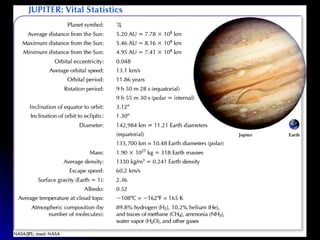
  • #4 FIGURE 8-1 Jupiter and Its Vital Statistics This view was sent back from Voyager 1 in 1979. Features as small as 600 km (370 mi) across can be seen in the turbulent cloud tops of this giant planet. The complex cloud motions that surround the Great Red Spot are clearly visible. Also, clouds at different latitudes have different rotation rates. The inset image of Earth shows its size relative to Jupiter. (NASA/JPL; inset: NASA)
  • #5 Information from chapter introduction and Section 8-1.
  • #6 FIGURE 8-7 Original Model of Jupiter’s Belts and Zones The light-colored zones and dark-colored belts in Jupiter’s atmosphere were believed, until recently, to be regions of rising and descending gases, respectively. In the zones, gases warmed by heat from Jupiter’s interior were thought to rise upward and cool, forming high-altitude clouds. In the belts, cooled gases were thought to descend and undergo an increase in temperature; the cloud layers seen there are at lower altitudes than in the zones. Observations by the Cassini spacecraft on its way to Saturn suggest that just the opposite may be correct (stay tuned)! In either case, Jupiter’s rapid differential rotation shapes the rising and descending gas into bands of winds parallel to the planet’s equator.
  • #7 FIGURE 8-2 Close-ups of Jupiter’s Atmosphere The dynamic winds, rapid rotation, internal heating, and complex chemical composition of Jupiter’s atmosphere create its beautiful and complex banded pattern. (a) A Voyager 2 southern hemisphere image showing a white oval that has existed for over 40 years. (b) A Voyager 2 northern hemisphere image showing a brown oval. The white feature overlapping the oval is a high cloud. (NASA)
  • #8 FIGURE 8-3 Jupiter Unwrapped Cassini images of Jupiter were combined and opened to give a maplike representation of the planet. The banded structure is absent near the poles. (Courtesy of NASA/JPL-Caltech)
  • #9 FIGURE 8-4 The Great Red Spot This image of the Great Red Spot shows the counterclockwise circulation of gas in the Great Red Spot that takes about six days to make one rotation. The clouds that encounter the spot are forced to pass around it, and when other oval features are near it, the entire system becomes particularly turbulent, like batter in a two-bladed blender. (NASA/JPL)
  • #10 FIGURE 8-5 Creating Red Spot Jr. (a–d) For 60 years prior to 1998, the three white ovals labeled FA, DE, and BC traveled together at the same latitude on Jupiter. Between 1998 and 2000, they combined into one white oval, labeled BA, which… (NASA/JPL/WFPC2)
  • #11 FIGURE 8-5 Creating Red Spot Jr. (e) … became a red spot, named Red Spot Jr., in 2006. (NASA, ESA, A. Simon-Miller [NASA/GSFC], and I. de Pater [University of California Berkeley])
  • #12 FIGURE 8-6 Jupiter’s and Saturn’s Upper Layers These graphs display temperature profiles of (a) Jupiter’s and (b) Saturn’s upper regions, as deduced from measurements at radio and infrared wavelengths. Three major cloud layers are shown in each, along with the colors that predominate at various depths. Data from the Galileo spacecraft indicate that Jupiter’s cloud layers are not found at all locations around the planet; there are some relatively clear, cloud-free areas.
  • #13 Information from section 8-1.
  • #14 FIGURE 8-8 Cutaways of Jupiter and Saturn The interiors of both Jupiter and Saturn are believed to have four regions: a terrestrial rocky core, a liquid “ice” shell, a liquid metallic hydrogen shell, and a normal liquid hydrogen mantle. Their atmospheres are thin layers above the normal hydrogen, which boils upward, creating the belts and zones.
  • #15 Information from section 8-2.
  • #16 FIGURE 8-9 Jupiter’s Magnetosphere Created by the planet’s rotation, the ion-trapping regions of Jupiter’s magnetosphere (in orange, analogous to the Van Allen belts) extend into the realm of the Galilean moons. Gases from Io and Europa form tori (doughnut-shaped regions) in the magnetosphere. Some of Io’s particles are pulled by the field onto the planet. Pushed outward by the solar wind, the magnetosphere has a “magnetotail” pointing away from the Sun. The magnetotail is often over 500 million km long and sometimes it reaches all the way to Saturn.
  • #17 FIGURE 8-19 Jupiter’s Ring and Torus (c) Quarter images of Io’s and Europa’s tori (also called plasma tori because the gas particles in them are charged; that is, the gases are plasmas). Some of Jupiter’s magnetic field lines are also drawn in. Plasma from tori flow inward along these field lines toward Jupiter. (NASA/JPL/Johns HopkinsUniversity Applied Physics Laboratory)
  • #18 FIGURE 8-9 Jupiter’s Magnetosphere (b) High-energy particles, trapped in Jupiter’s magnetosphere, excite gases in the planet’s upper atmosphere, causing them to glow as aurorae. The magnetosphere and cloud motion also lead to lightning on Jupiter. (J. Clarke, University of Michigan, and NASA)
  • #19 FIGURE 8-10 Comet Shoemaker-Levy 9 and Its Encounter with Jupiter This comet, originally orbiting Jupiter, was torn apart by the planet’s gravitational force on July 7, 1992, fracturing into at least 21 pieces. Its returning debris, shown here in May 1994, struck the planet between July 16 and July 22, 1994. (H. A. Weaver, T. E. Smith, STScI and NASA)
  • #20 FIGURE 8-10 Comet Shoemaker-Levy 9 and Its Encounter with Jupiter (b) Shown here are visible (left) and ultraviolet (right) images of Jupiter taken by the Hubble Space Telescope after three pieces of Comet Shoemaker-Levy 9 struck the planet. Astronomers had expected white remnants (the color of condensing ammonia or water vapor); the darkness of the impact sites may have come from carbon compounds in the comet debris. Note the aurorae in the ultraviolet image. (NASA)
  • #21 Information from sections 8-3 & 8-8.
  • #22 FIGURE 8-11 The Galilean Satellites The four Galilean satellites are shown here to the same scale. Io and Europa have diameters and densities comparable to our Moon and are composed primarily of rocky material. Ganymede and Callisto are roughly as big as Mercury, but their low average densities indicate that each contains a thick layer of water and ice. The cross-sectional diagrams of the interiors of the four Galilean moons show the probable internal structures of the moons, based on their average densities and on information from the Galileo mission. (NASA and NASA/JPL)
  • #23 FIGURE 8-12 Io These Voyager images show both sides of Io. The range of colors results from surface deposits of sulfur ejected from Io’s numerous volcanoes. Plumes from the volcano Prometheus rise up 100 km. Prometheus has been active in every image taken of Io since the Voyager flybys of 1979. (NASA/JPL)
  • #24 FIGURE 8-12 Io (b) Photographed in 1999 and then 2000 (shown here), the ongoing lava flow from this volcanic eruption at Tvashtar Catena has considerably altered this regionof Io’s surface. (University of Arizona/JPL/NASA)
  • #25 FIGURE 8-12 Io (c) Galileo image of an eruption of Pilan Patera on Io. (Galileo Project, JPL, NASA) Information on volcanism from section 8-4.
  • #26 FIGURE 8-13 Europa Imaged by the Galileo spacecraft, Europa’s ice surface is covered by numerous streaks and cracks that give the satellite a fractured appearance. The streaks are typically 20 to 40 km wide. (NASA/JPL)
  • #27 FIGURE 8-14 Surface Features on Europa This false-color Galileo image of Europa combining visible and infrared observations shows smooth plains of ice, mineral ridges deposited by upwelling water, and numerous fractures believed to be caused by tidal stresses. (NASA/JPL)
  • #28 FIGURE 8-14 Surface Features on Europa (b) This region of Europa’s surface shows the jumbled, stressed features common to the surface, as well as direct indications of liquid water activity underground. (NASA/JPL)
  • #29 FIGURE 8-14 Surface Features on Europa (c) Lenticulae attributed to rising warmed ice and debris travel up from the moon’s interior by convection, arriving at and then leaking out at the surface. The white domes are likely to be rising material that has not yet reached the surface. (NASA/JPL/University of Arizona/University of Colorado)
  • #30 FIGURE 8-15 Ganymede This side of Ganymede is dominated by the huge, dark, circular region called Galileo Regio, which is the largest remnant of Ganymede’s ancient crust. Darker areas of the moon are older; lighter areas are younger, tectonically deformed regions. The light white areas in and around some craters indicate the presence of water ice. Large impacts create white craters, filled in by ice from below the surface. (NASA/JPL)
  • #31 FIGURE 8-16 Two Surfaces of Ganymede The older, rougher, more heavily cratered parts of Ganymede are the dark terrain. These regions are surrounded by younger, smoother, less-cratered bright terrain. The parallel ridges suggest that the bright terrain has been crafted by tectonic processes. (NASA)
  • #32 FIGURE 8-17 Callisto The outermost Galilean satellite is almost exactly the same size as Mercury. Numerous craters pockmark Callisto’s icy surface. (a) The series of faint, concentric rings that cover much of this image is the result of a huge impact that created the impact basin Valhalla. Valhalla dominates the Jupiter-facing hemisphere of this frozen, geologically inactive world. (Courtesy of NASA/JPL)
  • #33 FIGURE 8-17 Callisto (b) The two insets in this Galileo mission image show spires that contain both ice and some dark material. The spires were probably thrown upward as the result of an impact. The spires erode as dark material in them absorbs heat from the Sun. (NASA/JPL/Arizona State University)
  • #34 FIGURE 8-18 Irregularly Shaped Inner Moons The four known inner moons of Jupiter are significantly different from the Galilean satellites. These bodies are roughly oval-shaped. Although craters have not yet been resolved on Adrastea and Metis, their irregular shapes strongly suggest that they are cratered. All four moons are named for characters in mythology relating to Jupiter (Zeus, in Greek mythology). (NASA/JPL, Cornell University)
  • #35 FIGURE 8-19 Jupiter’s Ring and Torus Cutaway diagram of Jupiter’s rings, which are generated from debris blasted off the inner moons Adrastea, Metis, Amalthea, and Thebe. (b) A portion of Jupiter’s faint ring system, photographed by the New Horizons spacecraft heading to Pluto. The outer three bright rings are composed of pebble- to rock-sized fragments. The rest is mostly dust. The brightest portion of the ring is about 6000 km wide. While the outer edge of the ring is sharply defined, the inner edge is somewhat fuzzy. A tenuous sheet of material extends from the ring’s inner edge all the way down to the planet’s cloud tops. (a: NASA/JPL/Cornell University; b: NASA/Johns Hopkins University Applied Physics Laboratory/Southwest Research Institute)
  • #36 FIGURE 8-20 Saturn and Its Vital Statistics Combined visible and ultraviolet images from the Hubble Space Telescope reveal spiral arcs of auroras near Saturn’s south pole. The inset image of Earth shows its size relative to Saturn. Note that there is much less contrast between Saturn’s clouds than those of Jupiter. (NASA, ESA, J. Clarke [Boston University], and Z. Levay [STScI]; inset: NASA)
  • #37 Information from sections 8-2, 8-9, 8-10, 8-11, 8-12, & 8-13. Refer to figures 8-1, 8-7, 8-8, 8-9, & 8-20.
  • #38 FIGURE 8-21 Belts and Zones on Saturn (a) Observing in the infrared, Cassini took this view of a hexagonal pattern of clouds that rotates much more slowly than the surrounding belts and zones. The pattern’s origin is still under investigation. (b) Observed in visible light, the north pole is covered by and encircled by huge storms, imaged by Cassini in 2012. (a: NASA/JPL/University of Arizona; b: NASA/JPL-Caltech/SSI)
  • #39 FIGURE 8-22 Merging Storms on Saturn (a-d) This sequence of Cassini images shows two hurricanelike storms merging into one on Saturn in 2004. Each storm is about 1000 km(600 mi) across. (NASA/JPL/Space Science Institute)
  • #40 FIGURE 8-22 Storm Sweeping Across Saturn (e–j) This storm swept around Saturn’s northern mid-latitudes throughout 2011. (e–j NASA/JPL-Caltech/Space Science Institute)
  • #41 FIGURE 8-23 Saturn as Seen from Earth Saturn’s rings are aligned with its equator, which is tilted 27° from the plane of Saturn’s orbit around the Sun. Therefore, Earth-based observers see the rings at various angles as Saturn orbits the Sun. The plane of Saturn’s rings and equator keeps the same orientation in space as the planet goes around its orbit, just as Earth keeps its 23½° tilt as it orbits the Sun. The accompanying Earth-based photographs show how the rings seem to disappear entirely about every 15 years. (Top left: E. Karkoschka/U. of Arizona Lunar and Planetary Lab and NASA; bottom left: AURA/STScI/NASA; bottom right and top right: A. Bosh/Lowell Obs. and NASA)
  • #42 Figure 8-24 (c) Viewing Saturn’s night side, the smaller pieces of debris scatter light from the Sun forward toward the Cassini spacecraft, including dust-sized particles in the Cassini division. Note that the Cassini division is bright in this image, while the B ring is quite dark. (NASA/JPL/Space Science Institute)
  • #43 FIGURE 8-24 Numerous Thin Ringlets Constitute Saturn’s Inner Rings This Cassini image shows some of the structure of Saturn’s rings, including some of the moonlets orbiting in them. Inset: As moons orbit near or between rings, they often cause the ring ices to develop ripples, like the grooves in a phonograph record. (NASA/JPL/Space Science Institute)
  • #44 Figure 8-25 The Moon Pan Orbiting in Encke’s division, Pan is the “shepherd” moon that keeps the division clear of small debris. It is the innermost known moon of Saturn. (NASA)
  • #45 FIGURE 8-26 The F Ring and One of Its Shepherds Two tiny satellites, Prometheus and Pandora, each measuring about 50 km across, orbit Saturn on either side of the F ring. Sometimes the ringlets are braided, sometimes parallel to each other. In any case, the passage of the shepherd moons causes ripples in the rings, which lead to the formation of large snowballs in them. The gravitational effects of these two shepherd satellites confine the particles in the F ring to a band about 100 km wide. (NASA)
  • #46 FIGURE 8-27 Saturn’s Ring System (a) Photographed with the Sun behind Saturn, the inner and intermediate regions of Saturn’s ring system are shown to be very different from each other. Beyond the F ring, the particles are dust- and pebble-sized. (NASA/JPL/Space Science Institute)
  • #47 FIGURE 8-27 Saturn’s Ring System (b) Another view of the inner and intermediate rings, where subtle color differences are indicated. (NASA/JPL/Space Science Institute)
  • #48 FIGURE 8-27 Saturn’s Ring System (c) Superimposed on this Cassini image are labels that indicate how far the rings extend into the moon system of Saturn. Titan (off image on right) is 1.2 million km (750, 000 mi) from the center of Saturn. (NASA/JPL)
  • #49 FIGURE 8-28 Saturn and Its Outer, Giant Ring This artist’s rendition of Saturn’s giant ring is drawn to scale with an infrared image of Saturn and the rings we normally see. The giant ring spans the region from 6 million km (3.7 million mi) to 18 million km (11.1 million mi) beyond Saturn. Put another way, the giant ring is as wide as 30 Saturns placed side by side. (NASA/JPL-Caltech/Keck)
  • #50 FIGURE 8-29 Spokes in Saturn’s Rings Believed to be caused by Saturn’s magnetic field moving electrically charged particles that are lifted out of the ring plane, these dark regions move around the rings like the spokes on a rotating wheel. (NASA/JPL/Space Science Institute)
  • #51 FIGURE 8-30 Saturn’s Diverse Moons (a–c) These Voyager 1, Voyager 2, and Cassini images show the variety of surface features seen of three of Saturn’s seven spherical moons. They are not shown to scale (refer to the diameters given below each image). (d) In comparison, this Cassini image shows the nonspherical moon Phoebe, almost as dark as coal, carrying many craters, landslides, grooves, and ridges. Phoebe is barely held in orbit by Saturn. Astronomers believe that it was captured after wandering in from beyond the orbit of Neptune. (NASA/JPL/Space Science Institute)
  • #52 FIGURE 8-30 Saturn’s Diverse Moons Two particularly intriguing moons are (e) Iapetus and (f) Hyperion. The ridge running along the equator of Iapetus is believed to have developed as the moon formed. Apparently, Iapetus cooled so rapidly that the ridge did not have time to settle away. Perhaps the most bizarre object photographed in the solar system, Hyperion, shows innumerable impact craters. These features are different from craters seen in other objects in that the crater walls here have not filled in the bottom of the craters. This moon’s low gravity and the pull of nearby Titan may explain this unusual phenomenon. (NASA/JPL/Space Science Institute)
  • #53 FIGURE 8-31 Surface Features on Titan (a) Voyager images of Titan’s smoggy atmosphere. (b) Cassini image of Titan (diameter 5150 km) showing lighter highlands, called Xanadu, and dark, flat, lowlands that may be hydrocarbon seas. Resolution is 4.2km (2.6 mi). (a: NASA/JPL/Space Science Institute; b: NASA/JPL/University of Arizona)
  • #54 FIGURE 8-31 Surface Features on Titan (c) Riverbeds meandering across the Xanadu highlands of Titan. These are believed to have been formed by the flow of liquid methane and ethane. (NASA/JPL/ESA/University of Arizona)
  • #55 FIGURE 8-31 Surface Features on Titan (d) Lakes filled with liquid methane and ethane. (e) The Huygens probe took this image at Titan’s surface on January 14, 2005. What appear like boulders here are actually pebbles strewn around the landscape. The biggest ones are about 15 cm (6 in.) across. (d: Cassini Radar Mapper/JPL/ESA/NASA; e: NASA/JPL/ESA/University of Arizona)
  • #56 FIGURE 8-32 Rhea Rhea (diameter 1530 km) is heavily cratered. The bluish regions on the inset are believed to be ices uncovered as a result of impacts. (NASA/JPL/Space Science Institute; inset: NASA/JPL/Space Science Institute/Universities Space Research Association/Lunar & Planetary Institute)
  • #57 FIGURE 8-33 Enceladus (a) Cassini view of the two distinct landscapes on Enceladus, one heavily cratered, the other nearly crater-free. The blue “tiger stripes” are believed to be due to upwelling of liquid that froze at the surface. (b) The crater-free region near the south pole. The ridges are thought to be created by tectonic flows. The inset shows ice boulders. (NASA/JPL/Space Science Institute; inset: NASA/JPL/SSI)
  • #58 FIGURE 8-33 Enceladus (c) Icy particles ejected from Enceladus may be continually coming out of the moon. (NASA/JPL/Space Science Institute)
  • #59 FIGURE 8-34 Uranus, Earth, and Neptune These images of Uranus, Earth, and Neptune are to the same scale. Uranus and Neptune are quite similar in mass, size, and chemical composition. Both planets are surrounded by thin, dark rings, quite unlike Saturn’s, which are broad and bright. The clouds on the right of Uranus (false-color pink) are each the size of Europe. (NASA)
  • #60 FIGURE 8-36 Cutaways of Uranus and Neptune The interiors of both Uranus and Neptune are believed to have three regions: a terrestrial rocky core surrounded by a liquid water mantle, which is surrounded, in turn, by liquid hydrogen and helium. Their atmospheres are thin layers at the top of their hydrogen and helium layers.
  • #61 FIGURE 8-35 Exaggerated Seasons on Uranus Uranus’s axis of rotation is tilted so steeply that it lies nearly in the plane of its orbit. Seasonal changes on Uranus are thus greatly exaggerated. For example, during midsummer at Uranus’s south pole, the Sun appears nearly overhead for many Earth years, during which time the planet’s northern regions are subjected to a long, continuous winter night. Half an orbit later, the seasons are reversed.
  • #62 FIGURE 8-37 The Magnetic Fields of Five Planets This drawing shows how the magnetic fields of Earth, Jupiter, Saturn, Uranus, and Neptune are tilted relative to their rotation axes. Note that the magnetic fields of Uranus and Neptune are offset from the centers of the planets and are steeply inclined to their rotation axes. Jupiter, Saturn, and Neptune have north magnetic poles on the hemisphere where Earth has its south magnetic pole.
  • #63 FIGURE 8-38 The Rings and Moons of Uranus (Right) Full-scale image of Uranus and its inner and outer rings. (Center) This image of Uranus, its rings, and eight of its moons was taken by the Hubble Space Telescope. (Left) Close-up of part of the ring system taken by Voyager 2 when the spacecraft was in Uranus’s shadow looking back toward the Sun. Numerous fine dust particles between the main rings gleam in the sunlight. The short streaks are star images blurred because of the spacecraft’s motion during the exposure. (NASA; ESA; and M. Showalter,SETI Institute)
  • #64 FIGURE 8-39 Discovery of the Rings of Uranus (a) Light from a star is reduced as the rings move in front of it. (b) With sensitive light detectors, astronomers can detect the variation in light intensity. Such dimming led to the discovery of Uranus’s rings. Of course, the star vanishes completely when Uranus occults it.
  • #65 FIGURE 8-40 Miranda The patchwork appearance of Miranda in this mosaic of Voyager 2 images suggests that this satellite consists of huge chunks of rock and ice that came back together after an ancient, shattering impact by an asteroid or a neighboring Uranian moon. The curious banded features that cover much of Miranda are parallel valleys and ridges that may have formed as dense, rocky material sank toward the satellite’s core. At the very bottom of the image—where a “bite” seems to have been taken out of the satellite—is a range of enormous cliffs that jut upward as high as 20 km, twice the height of Mount Everest. (NASA)
  • #66 FIGURE 8-34 Uranus, Earth, and Neptune These images of Uranus, Earth, and Neptune are to the same scale. Uranus and Neptune are quite similar in mass, size, and chemical composition. Both planets are surrounded by thin, dark rings, quite unlike Saturn’s, which are broad and bright. The clouds on the right of Uranus (false-color pink) are each the size of Europe. (NASA)
  • #67 FIGURE 8-41 Neptune’s Banded Structure Several Hubble Space Telescope images at different wavelengths were combined to create this enhanced-color view of Neptune. The dark blue and light blue areas are the belts and zones, respectively. The slightly darker belt running across the middle of the image lies just south of Neptune’s equator. White areas are high altitude clouds, presumably of methane ice. The very highest clouds are shown in yellow-red, as seen at the very top of the image. The green belt near the south pole is a region where the atmosphere absorbs blue light, probably indicating some differences in chemical composition. [(a) NASA/JPL/STSci, (b) NASA/JPL]
  • #68 FIGURE 8-42 Neptune This view from Voyager 2 looks down on the southern hemisphere of Neptune. The Great Dark Spot’s longer dimension at the time was about the same size as Earth’s diameter. It has since vanished. Note the white, wispy methane clouds. (NASA/JPL)
  • #69 FIGURE 8-43 Neptune’s Rings Two main rings are easily seen in this view alongside overexposed edges of Neptune. In taking this image, the bright planet was hidden so that the dim rings would be visible, hence the black rectangle running down the center of the figure. Careful examination also reveals a faint inner ring. A fainter-still sheet of particles, whose outer edge is located between the two main rings, extends inward toward the planet. (NASA)
  • #70 FIGURE 8-44 Triton’s South Polar Cap Approximately a dozen high-resolution Voyager 2 images were combined to produce this view of Triton’s southern hemisphere. The pinkish polar cap is probably made of nitrogen frost. A notable scarcity of craters suggests that Triton’s surface was either melted or flooded by icy lava after the era of bombardment that characterized the early history of the solar system. (NASA/JPL)
  • #71 FIGURE 8-45 A Frozen Lake on Triton Scientists think that the feature in the center of this image is a basin filled with water ice. The flooded basin is about 200 km across. (NASA)
  • #72 FIGURE 8-46 The Capture and Destruction of Triton This series of drawings depicts how (a) Triton was captured by Neptune in a retrograde orbit. (b) The tides that Triton then created on the planet caused that moon’s orbit to become quite circular and (c) to spiral inward. (d) Triton will eventually reach Neptune’s Roche limit and (e) be pulled apart to form a ring. (Stephen P. Meszaros/NASA, M. Buie, K. Horne, and D. Tholen)
  • #73 Table 8-1 The Outer Planets: A Comparison