
FOR SETTING UP WIND POWER PLANT IN  MADHYA PRADESH   DECISION SUPPORT SYSTEM (DSS )   SUBMITTED BY:   ASHISH BATHRI   R100107021
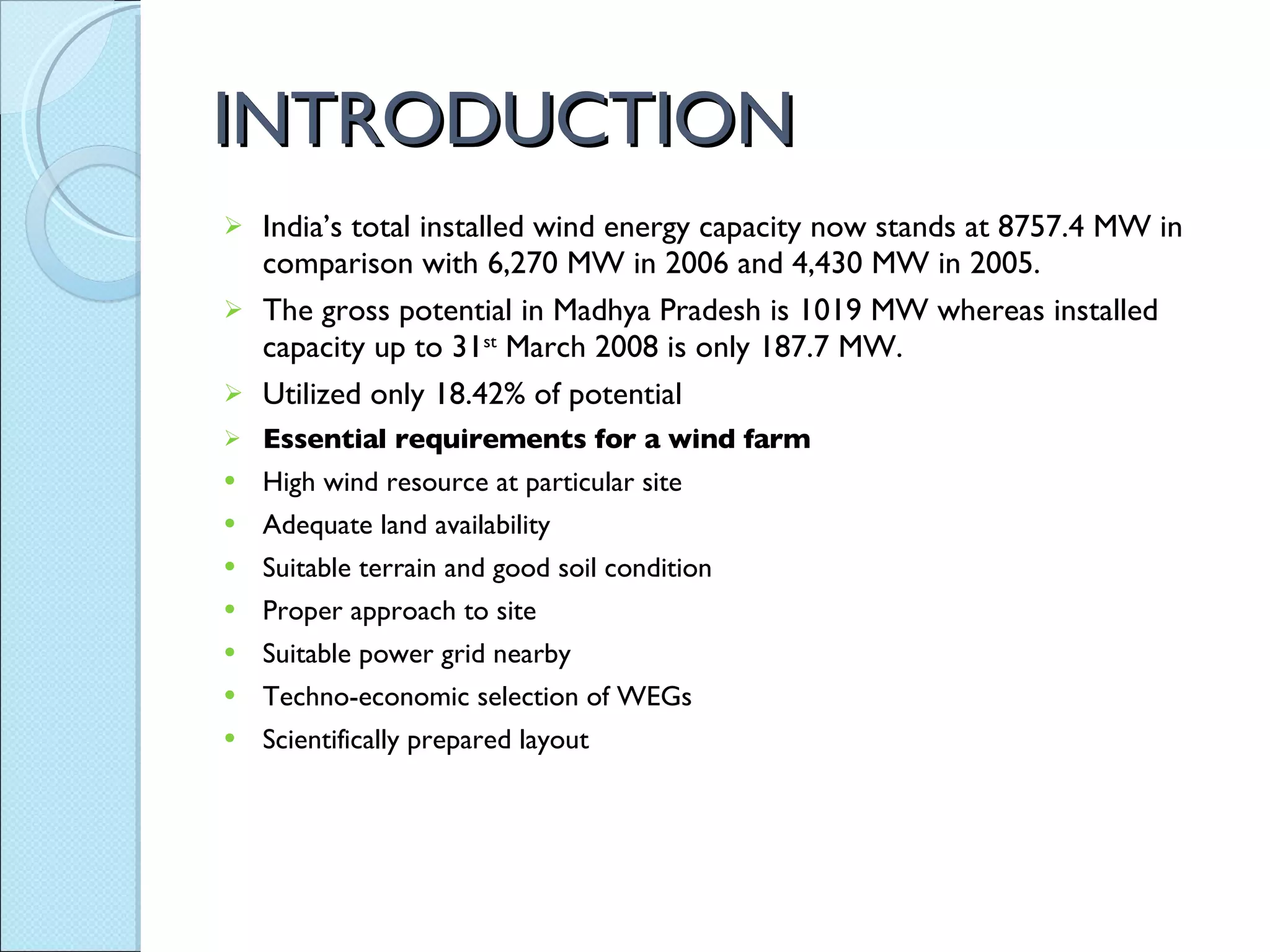
INTRODUCTION India’s total installed wind energy capacity now stands at 8757.4 MW in comparison with 6,270 MW in 2006 and 4,430 MW in 2005.  The gross potential in Madhya Pradesh is 1019 MW whereas installed capacity up to 31 st  March 2008 is only 187.7 MW. Utilized only 18.42% of potential Essential requirements for a wind farm  High wind resource at particular site  Adequate land availability  Suitable terrain and good soil condition  Proper approach to site  Suitable power grid nearby  Techno-economic selection of WEGs  Scientifically prepared layout
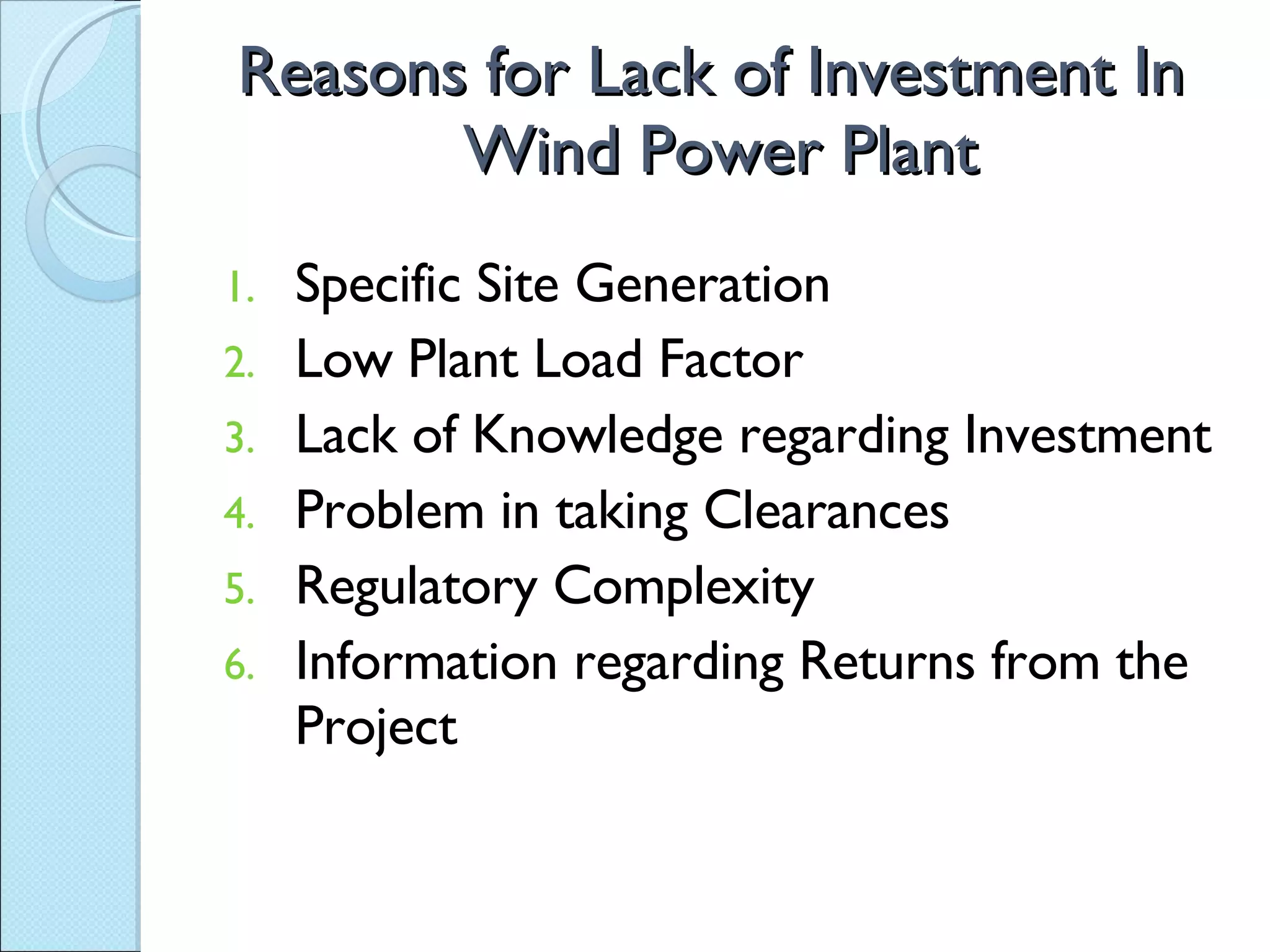
Reasons for Lack of Investment In  Wind Power Plant Specific Site Generation Low Plant Load Factor Lack of Knowledge regarding Investment Problem in taking Clearances Regulatory Complexity Information regarding Returns from the Project
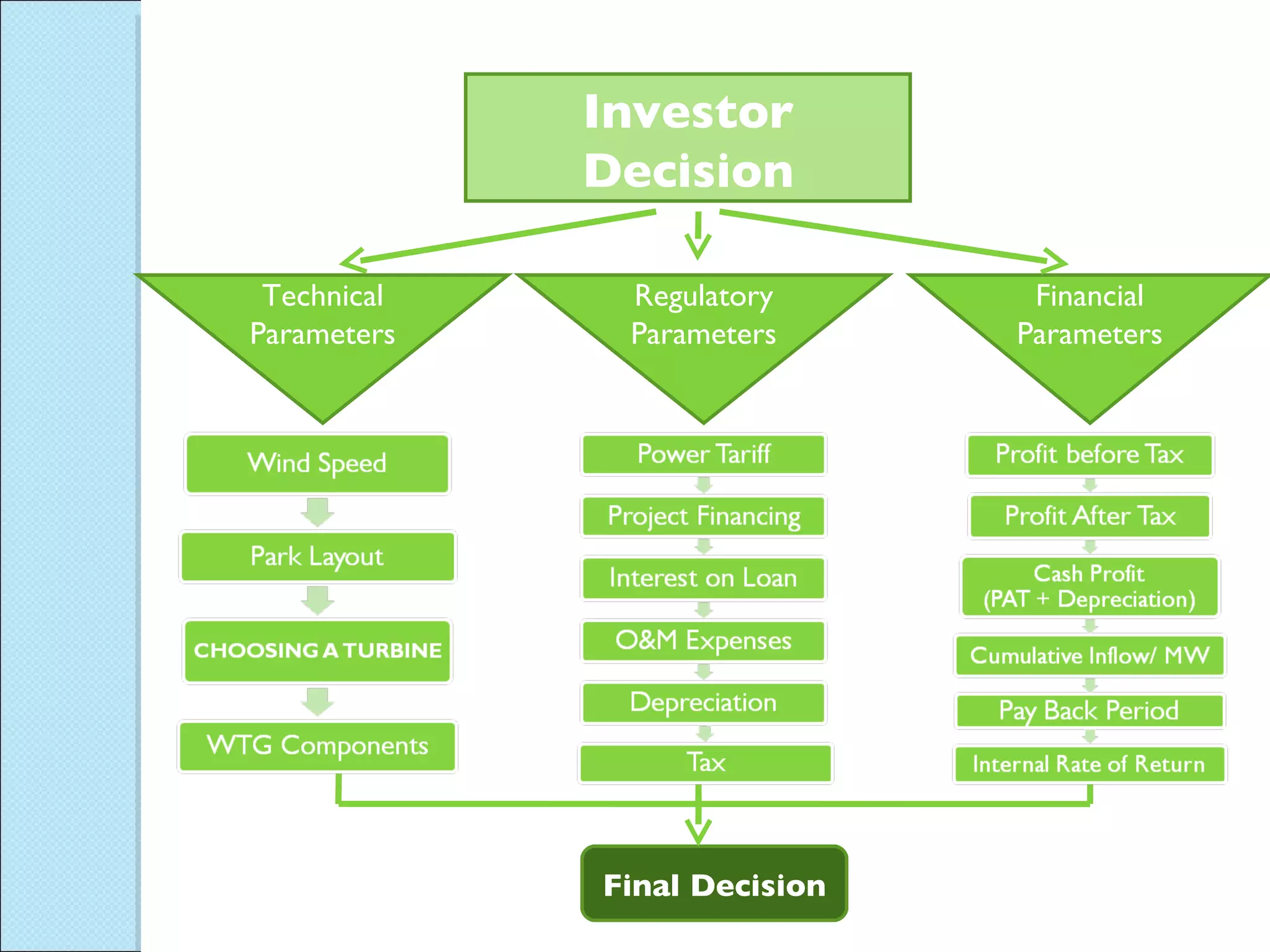
Investor Decision  Technical Parameters Regulatory Parameters Financial Parameters Final Decision
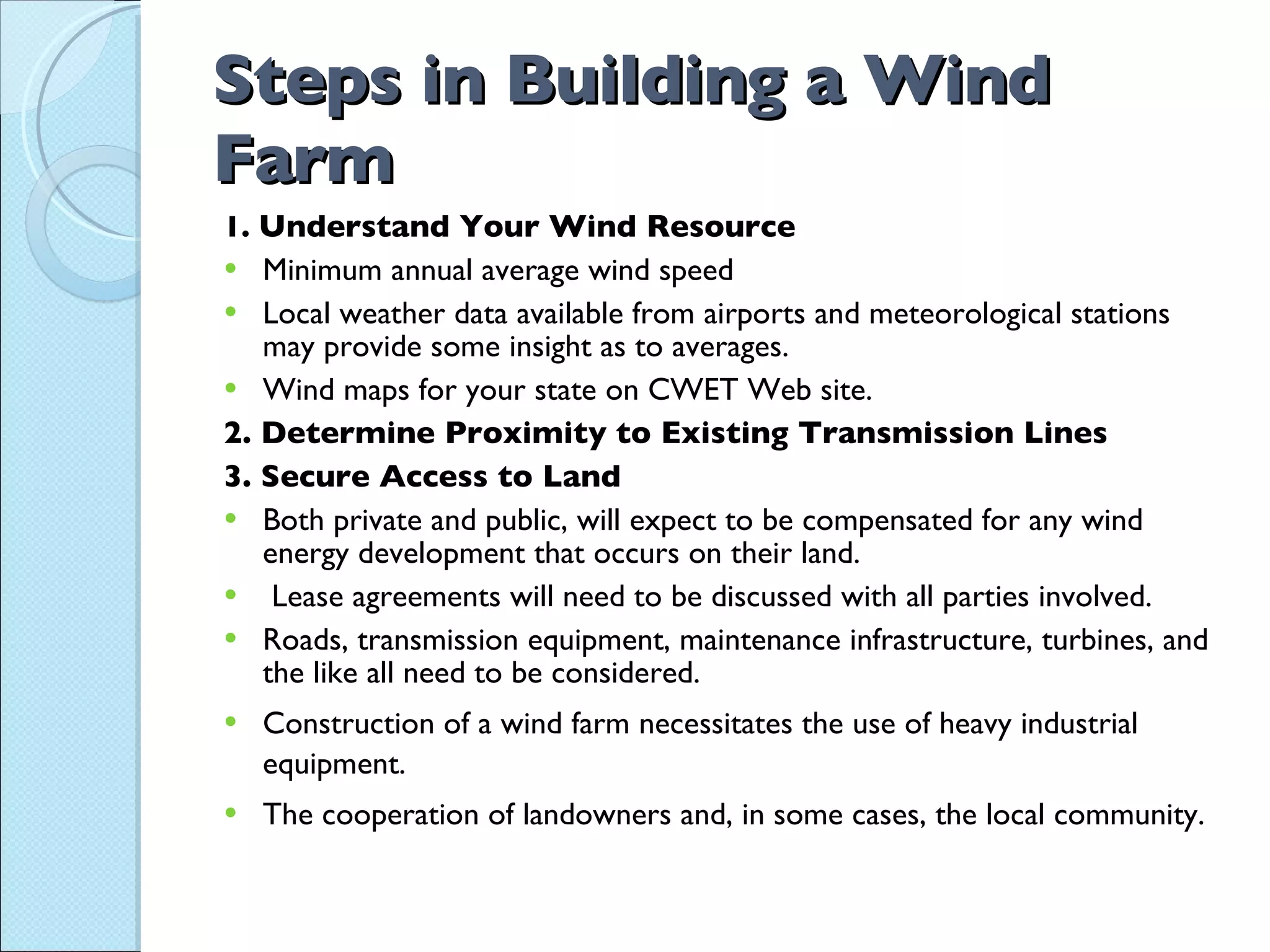
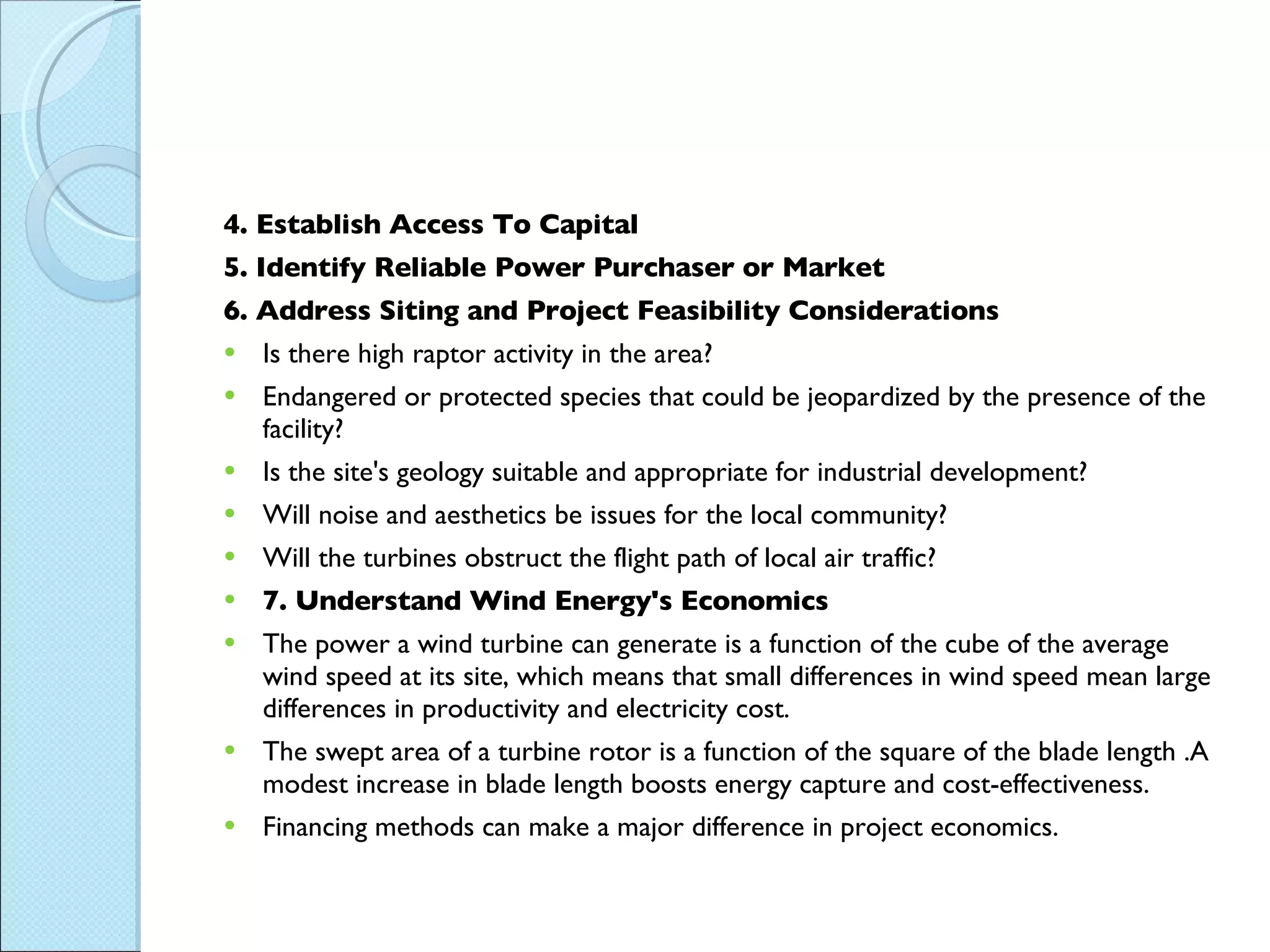
Steps in Building a Wind Farm 1.  Understand Your Wind Resource Minimum annual average wind speed Local weather data available from airports and meteorological stations may provide some insight as to averages. Wind maps for your state on CWET Web site. 2. Determine Proximity to Existing Transmission Lines 3. Secure Access to Land Both private and public, will expect to be compensated for any wind energy development that occurs on their land. Lease agreements will need to be discussed with all parties involved.  Roads, transmission equipment, maintenance infrastructure, turbines, and the like all need to be considered. Construction of a wind farm necessitates the use of heavy industrial equipment. The cooperation of landowners and, in some cases, the local community.
4. Establish Access To Capital 5. Identify Reliable Power Purchaser or Market 6. Address Siting and Project Feasibility Considerations Is there high raptor activity in the area?  Endangered or protected species that could be jeopardized by the presence of the facility?  Is the site's geology suitable and appropriate for industrial development?  Will noise and aesthetics be issues for the local community?  Will the turbines obstruct the flight path of local air traffic?  7. Understand Wind Energy's Economics The power a wind turbine can generate is a function of the cube of the average wind speed at its site, which means that small differences in wind speed mean large differences in productivity and electricity cost. The swept area of a turbine rotor is a function of the square of the blade length .A modest increase in blade length boosts energy capture and cost-effectiveness. Financing methods can make a major difference in project economics.
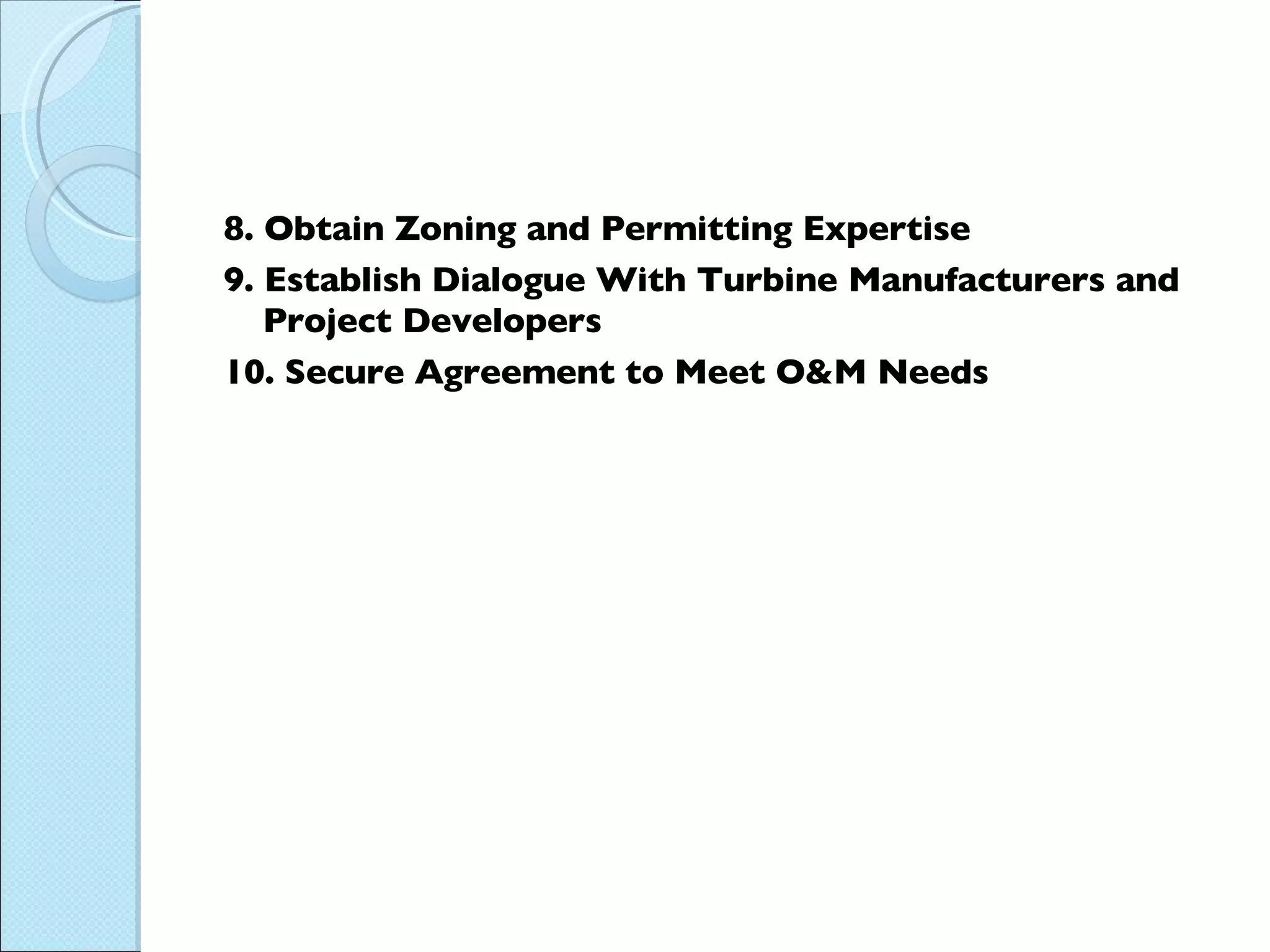
8. Obtain Zoning and Permitting Expertise 9. Establish Dialogue With Turbine Manufacturers and Project Developers 10. Secure Agreement to Meet O&M Needs
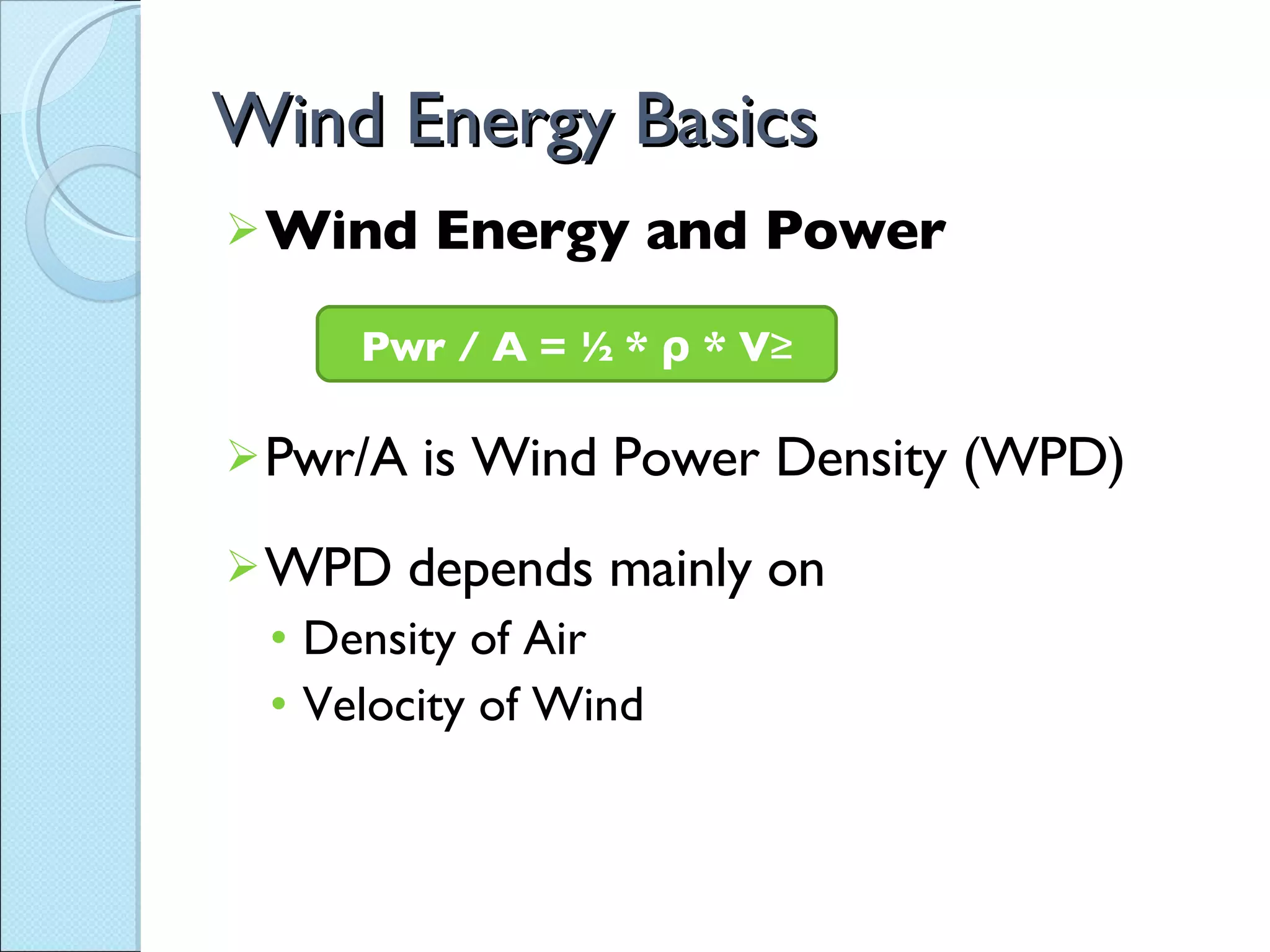
Wind Energy Basics Wind Energy and Power Pwr/A is Wind Power Density (WPD) WPD depends mainly on  Density of Air Velocity of Wind Pwr / A = ½ * ρ * V³
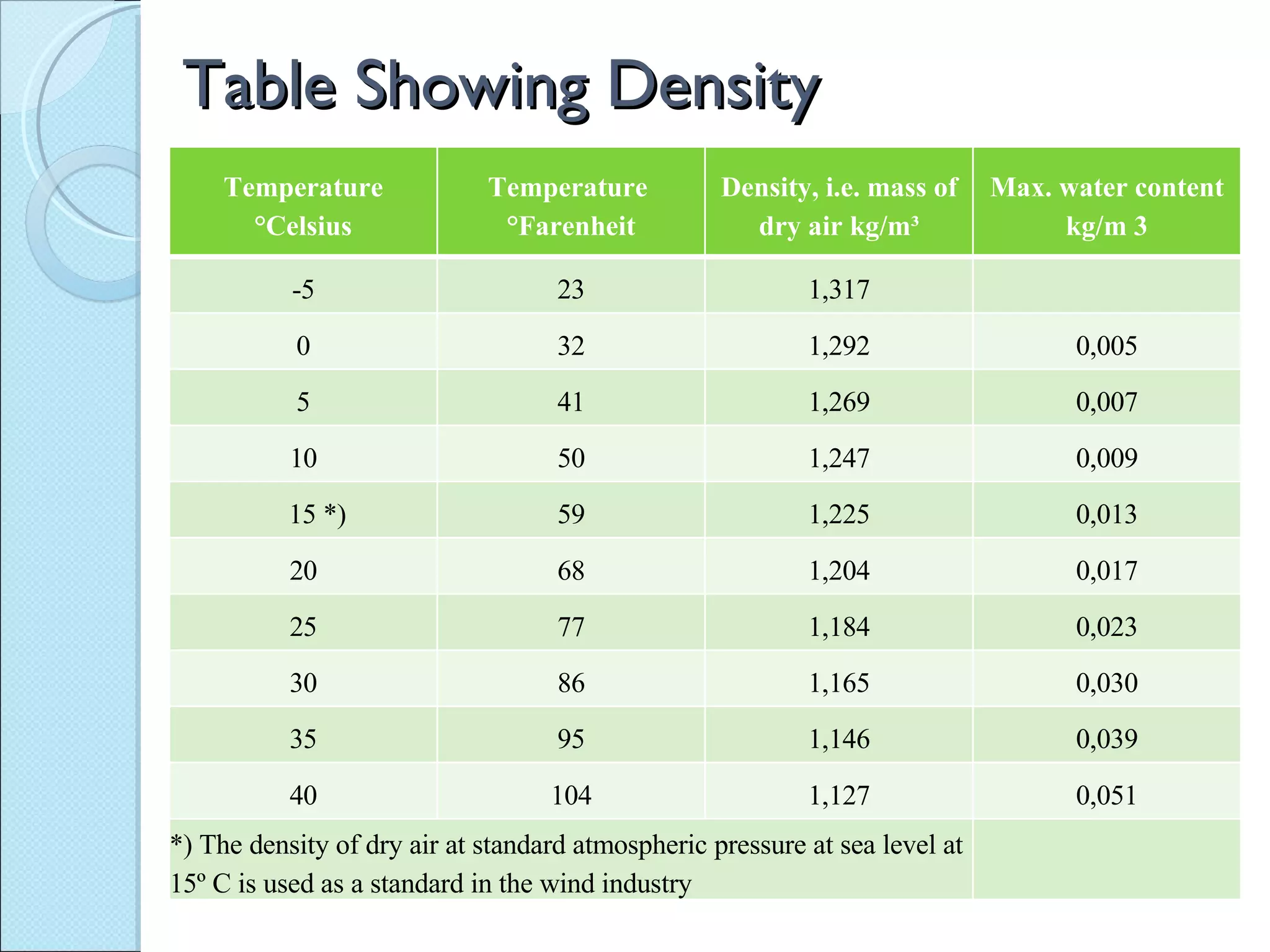
Table Showing Density  Temperature °Celsius Temperature  °Farenheit Density, i.e. mass of dry air kg/m³ Max. water content kg/m 3 -5 23 1,317 0 32 1,292 0,005 5 41 1,269 0,007 10 50 1,247 0,009 15 *) 59 1,225 0,013 20 68 1,204 0,017 25 77 1,184 0,023 30 86 1,165 0,030 35 95 1,146 0,039 40 104 1,127 0,051 *) The density of dry air at standard atmospheric pressure at sea level at 15º C is used as a standard in the wind industry
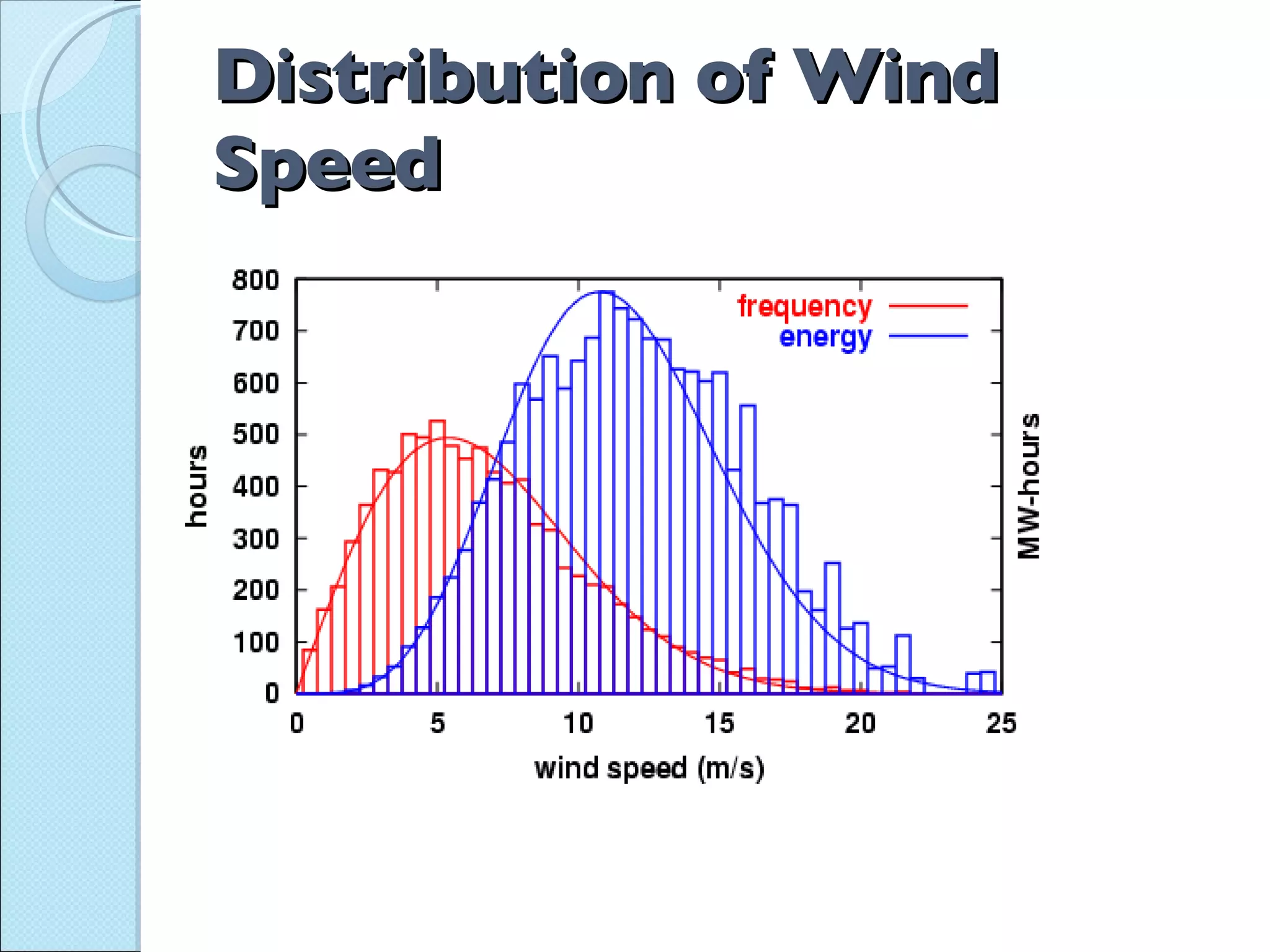
Distribution of Wind Speed
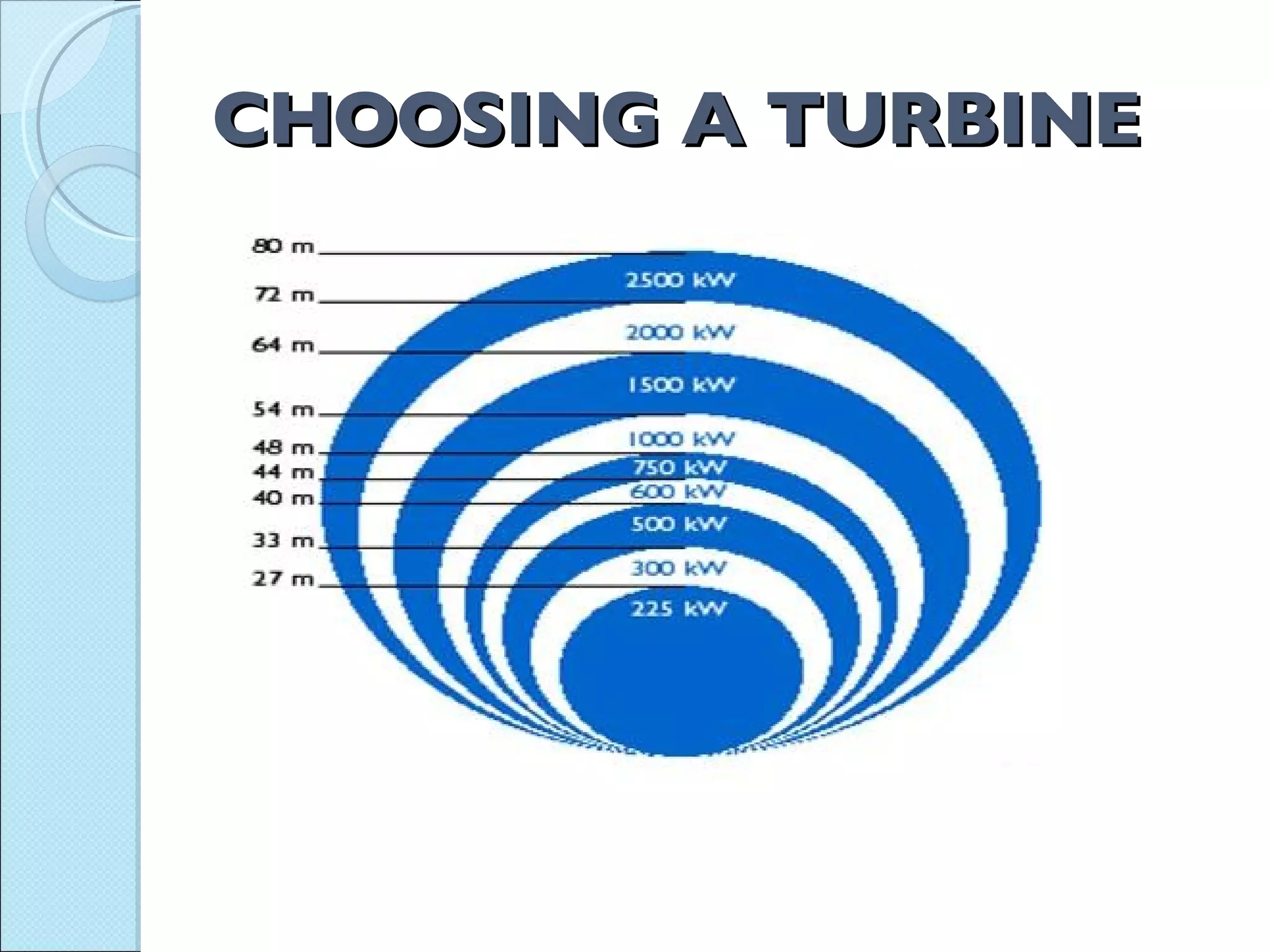
CHOOSING A TURBINE
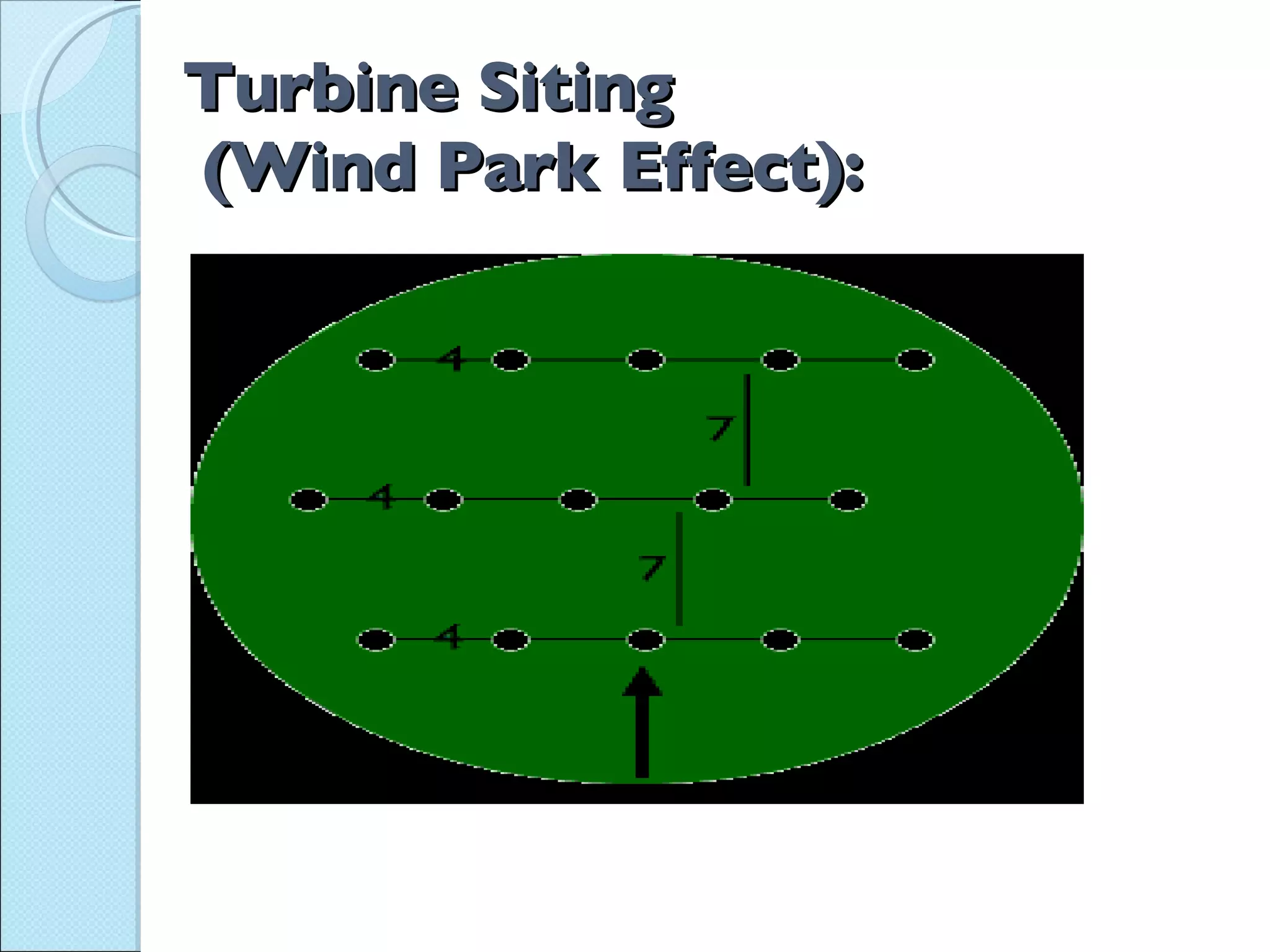
Turbine Siting  (Wind Park Effect):
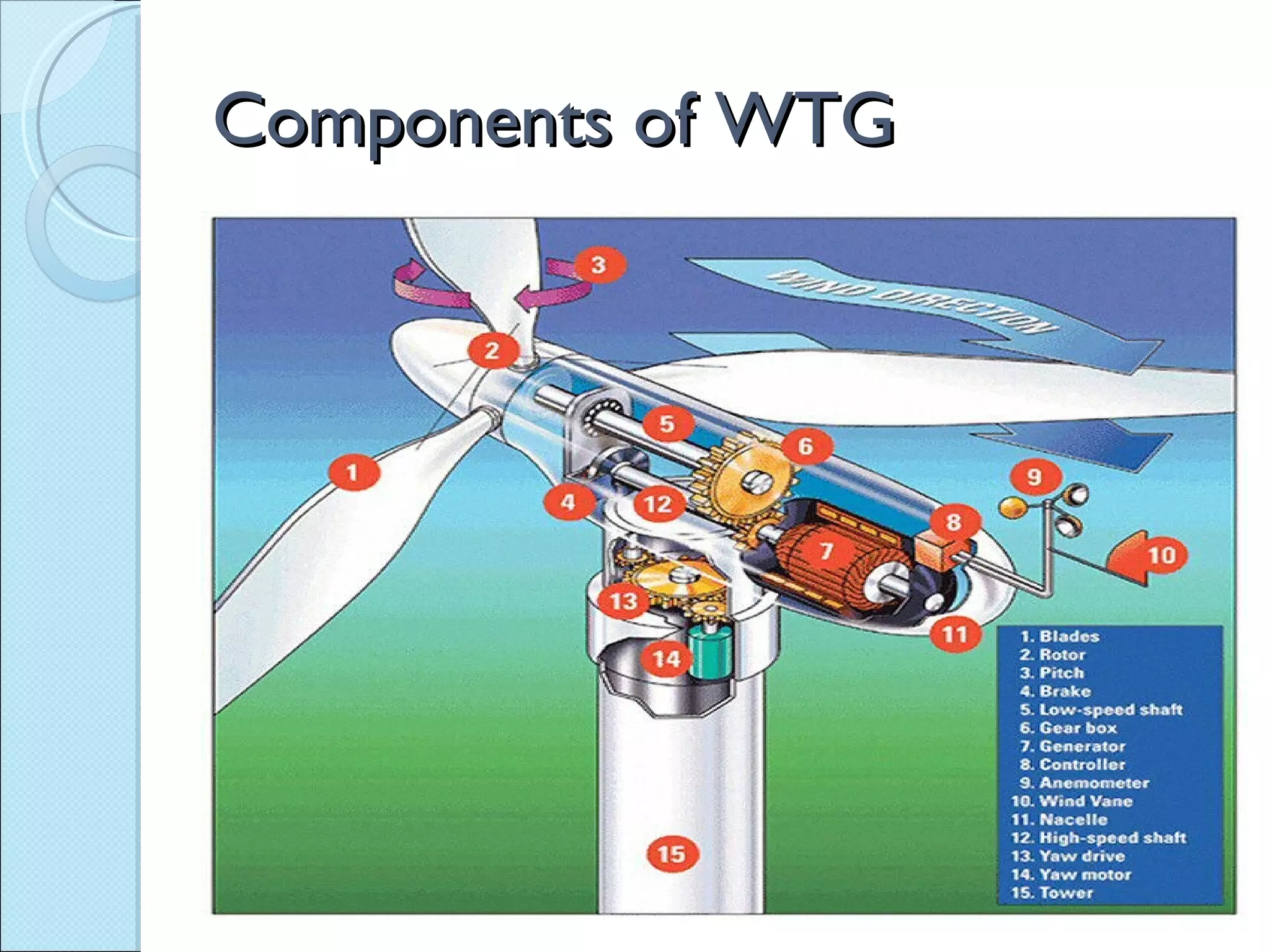
Components of WTG
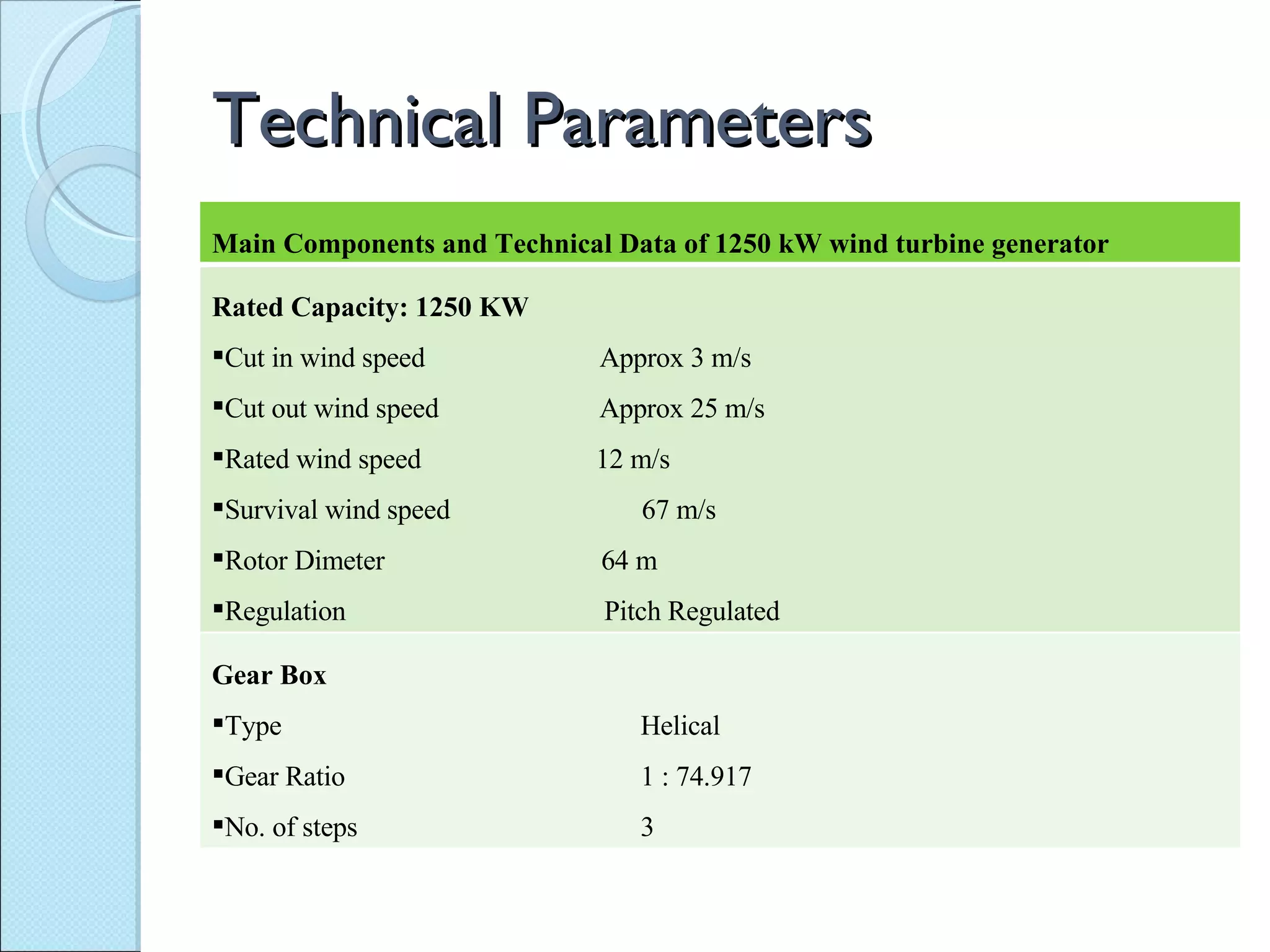
Technical Parameters Main Components and Technical Data of 1250 kW wind turbine generator Rated Capacity: 1250 KW Cut in wind speed  Approx 3 m/s Cut out wind speed  Approx 25 m/s Rated wind speed  12 m/s Survival wind speed    67 m/s  Rotor Dimeter  64 m Regulation  Pitch Regulated  Gear Box Type    Helical Gear Ratio   1 : 74.917 No. of steps   3
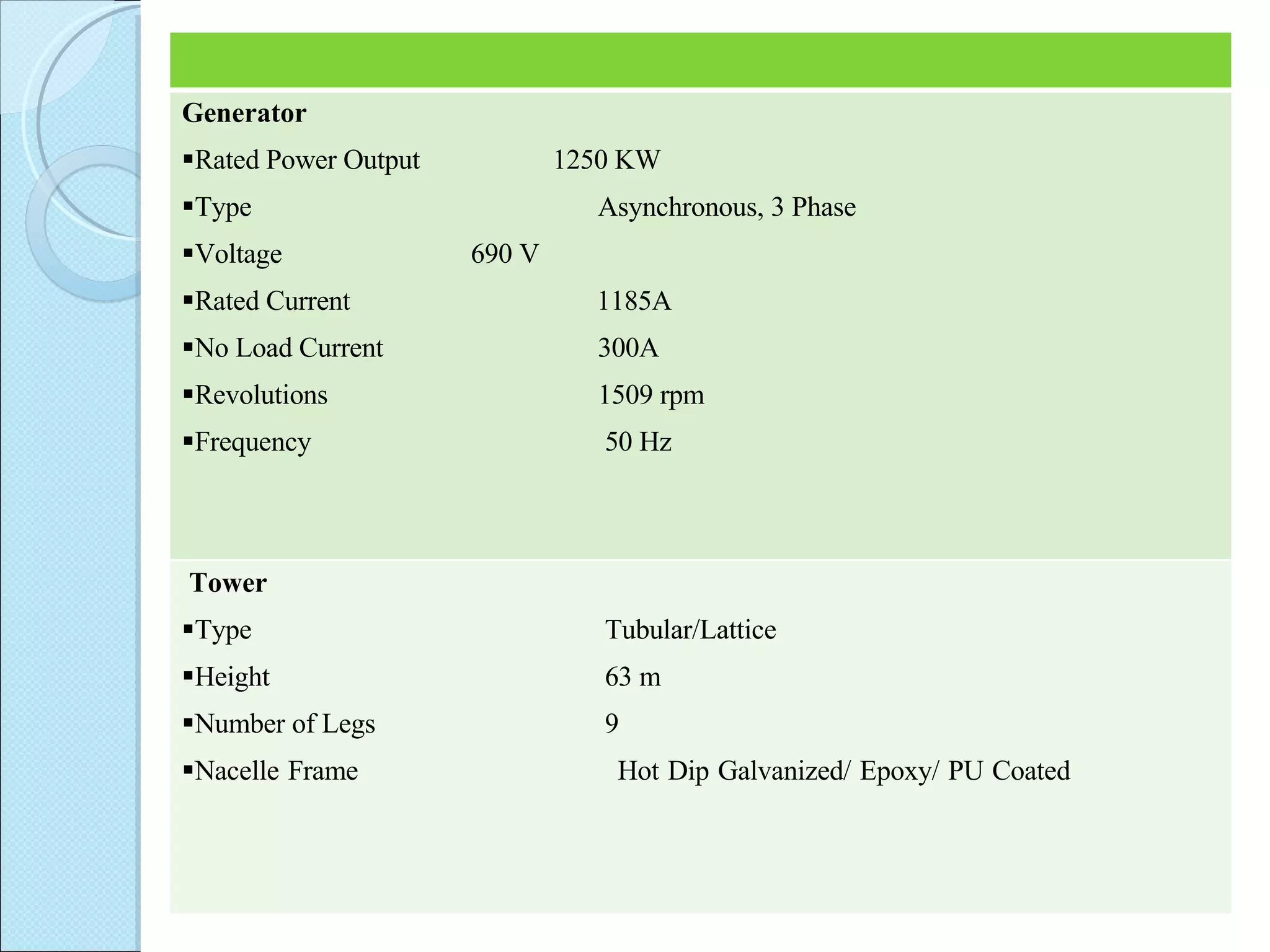
Generator Rated Power Output  1250 KW Type   Asynchronous, 3 Phase Voltage    690 V Rated Current   1185A No Load Current   300A Revolutions    1509 rpm Frequency   50 Hz   Tower Type    Tubular/Lattice Height   63 m   Number of Legs   9 Nacelle Frame   Hot Dip Galvanized/ Epoxy/ PU Coated
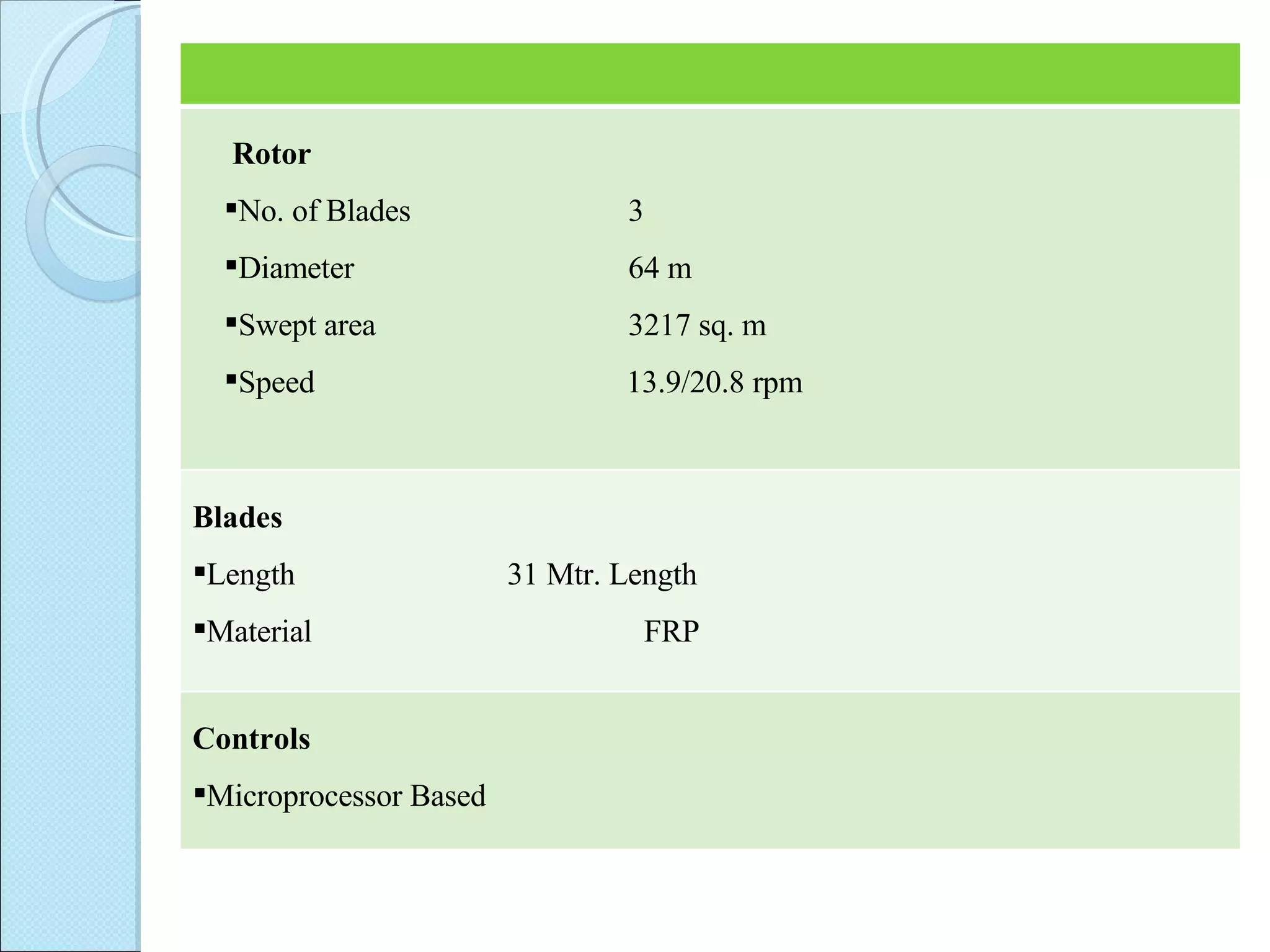
  Rotor No. of Blades   3 Diameter   64 m Swept area   3217 sq. m Speed   13.9/20.8 rpm Blades Length   31 Mtr. Length Material    FRP Controls Microprocessor Based
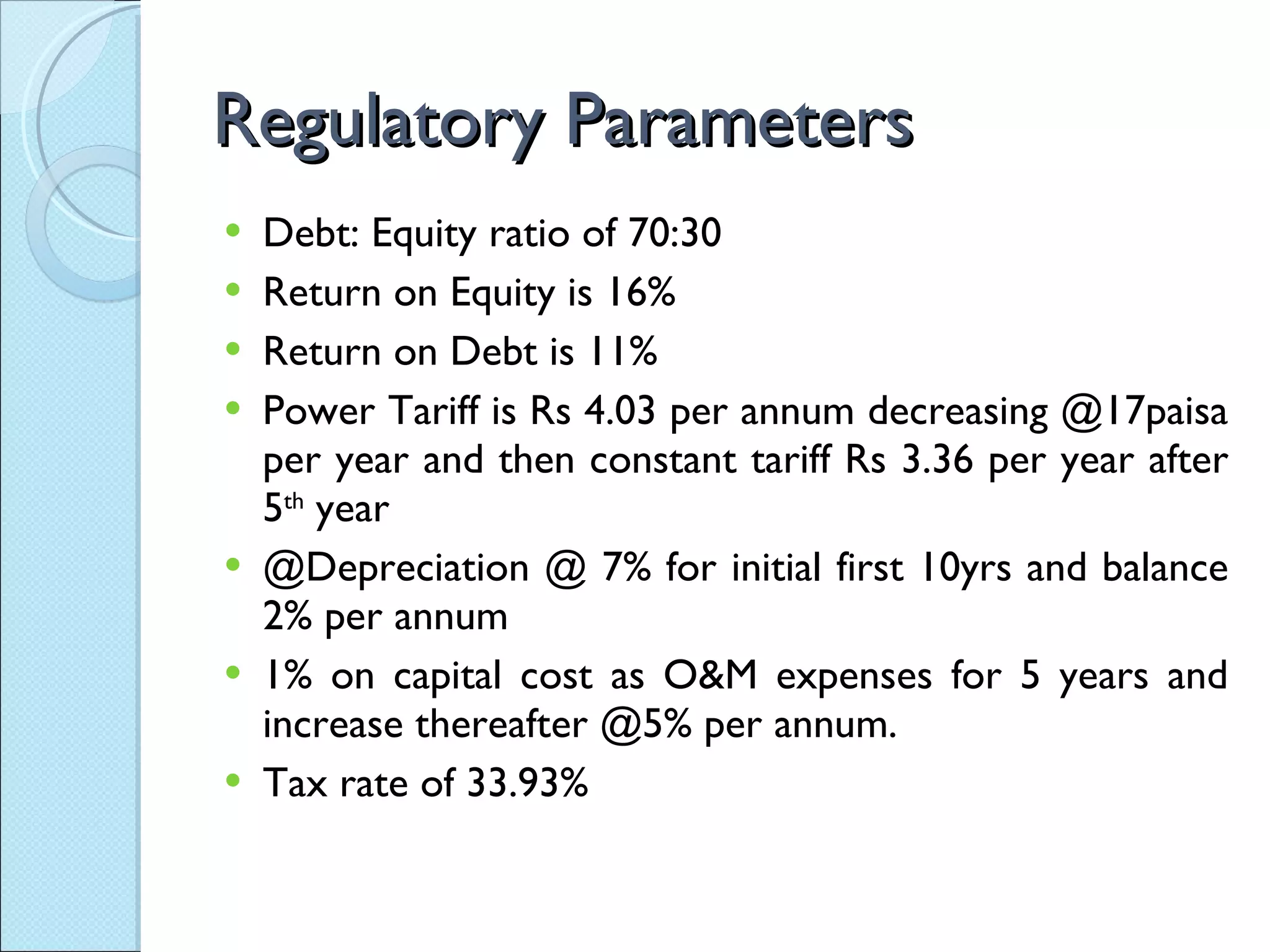
Regulatory Parameters Debt: Equity ratio of 70:30 Return on Equity is 16% Return on Debt is 11% Power Tariff is Rs 4.03 per annum decreasing @17paisa per year and then constant tariff Rs 3.36 per year after 5 th  year @Depreciation @ 7% for initial first 10yrs and balance 2% per annum 1% on capital cost as O&M expenses for 5 years and increase thereafter @5% per annum. Tax rate of 33.93%
MODEL Model Showing the calculation of Financial Parameter
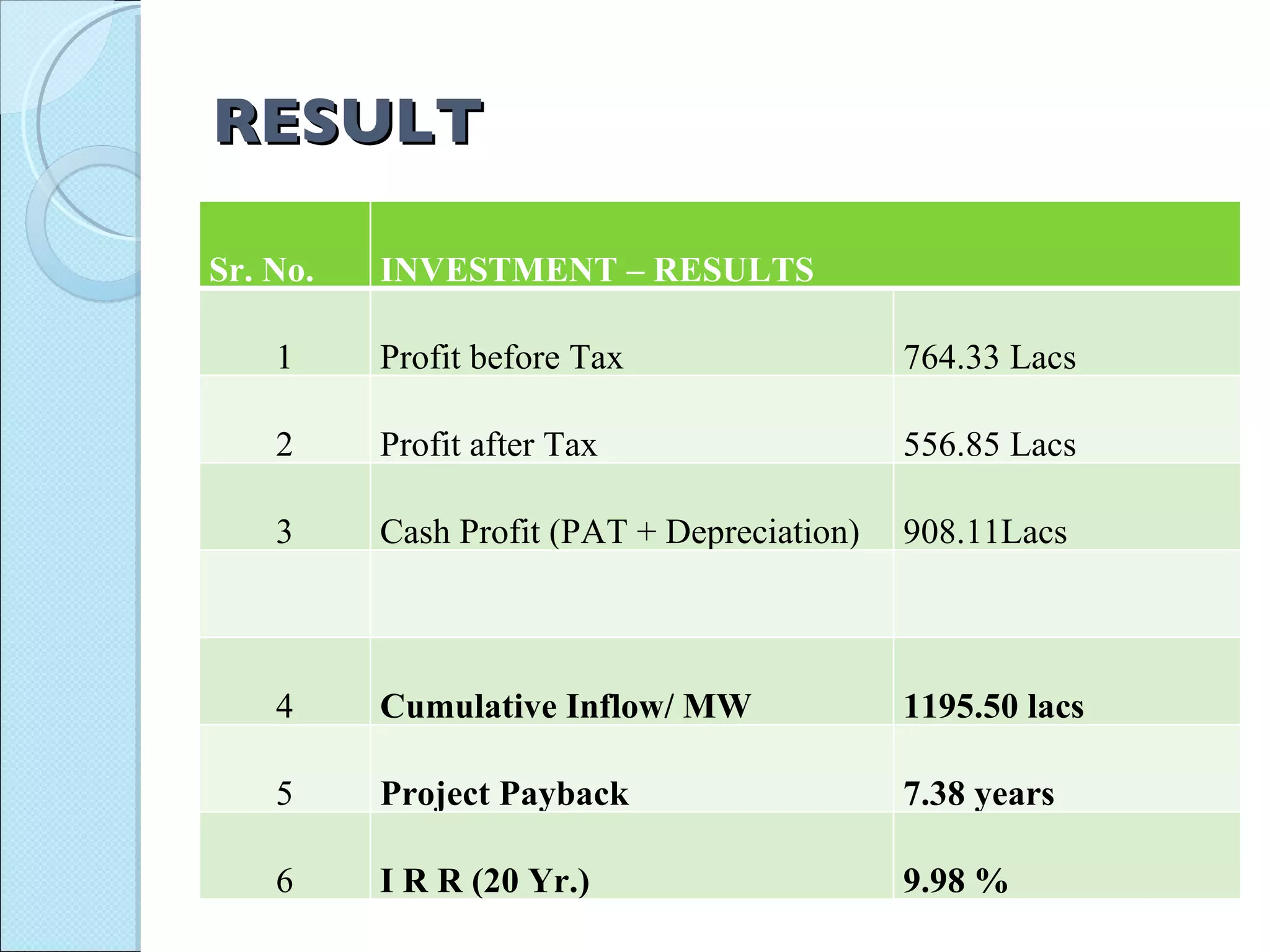
RESULT Sr. No. INVESTMENT – RESULTS 1 Profit before Tax 764.33 Lacs 2 Profit after Tax 556.85 Lacs 3 Cash Profit (PAT + Depreciation) 908.11Lacs 4 Cumulative Inflow/ MW 1195.50 lacs 5 Project Payback 7.38 years 6 I R R (20 Yr.) 9.98 %
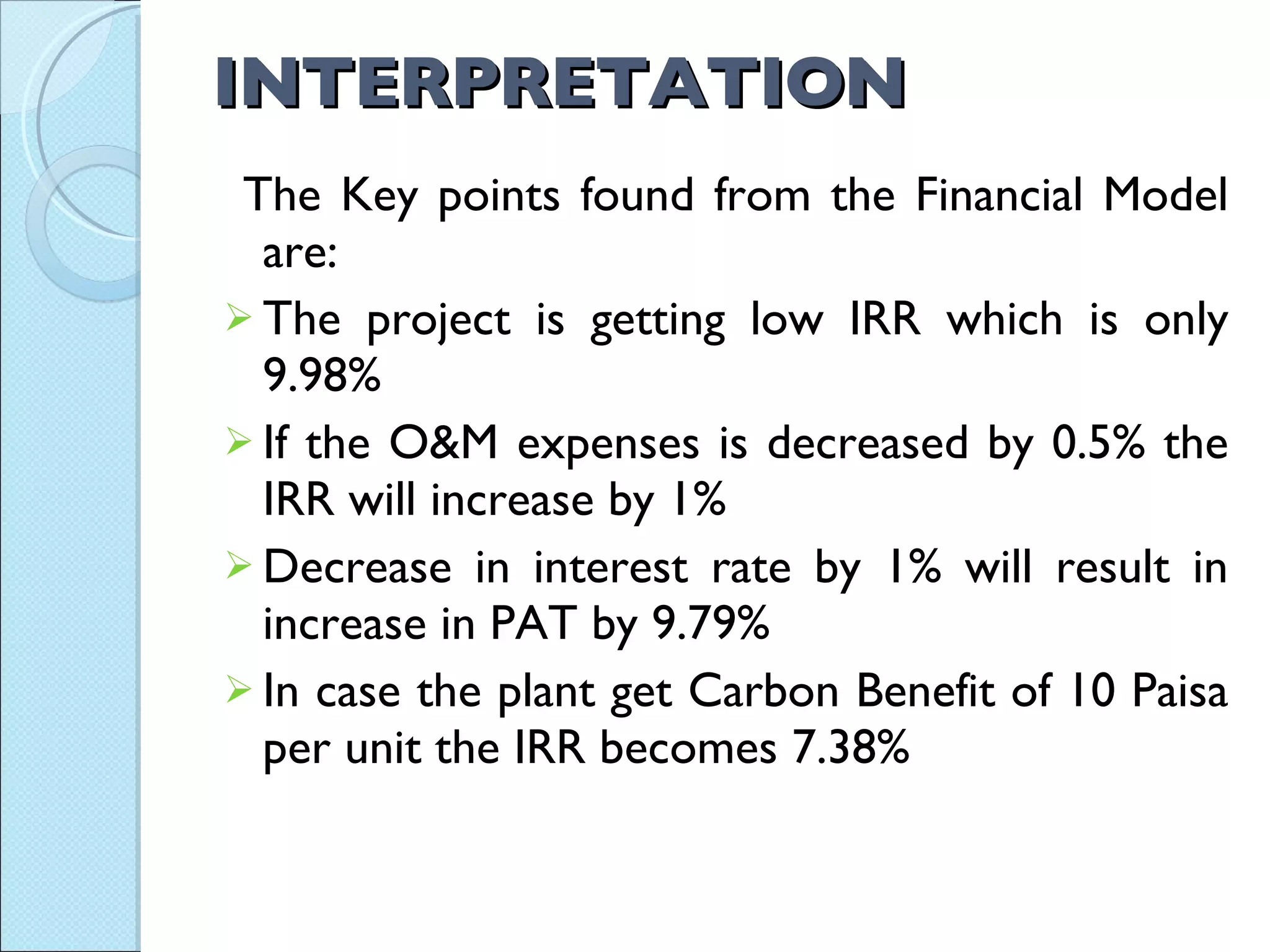
INTERPRETATION  The Key points found from the Financial Model are: The project is getting low IRR which is only 9.98% If the O&M expenses is decreased by 0.5% the IRR will increase by 1% Decrease in interest rate by 1% will result in increase in PAT by 9.79% In case the plant get Carbon Benefit of 10 Paisa per unit the IRR becomes 7.38%
Limitation of Financial Model : The tariff is fixed for the first 5 periods. This model can’t be applied to projects which have different tariff for the initial 5 years. Free O& M is considered for the 1 st  year. It is assumed that the scrap value will be at least 5% Model is designed taking accelerated depreciation @7% per annum for the first 10 years on 80% of the book value and 2% per annum for the remaining period. The value of components considered for calculating project cost like land cost, erection and commissioning cost, substation charges and other components cost can vary.
LIMITATIONS OF THE DISSERTATION PROJECT Uses the Secondary data  for the wind speed, wind density, site location and survey analysis which can’t be fully trusted.  Certain data was taken from various websites which are not fully updated. The reason for outdated data is lack adequate research. The model is made specifically for the Madhya Pradesh  which has its own regulatory provisions which varies with states. So this model can be suggested to apply only for the developers who want to establish wind farm in Madhya Pradesh. The  constraints  like political constraints, climatic constraints, Local People Interventions can affect the project in real situation, Such constraints are not considered in the Project .
SCOPE FOR FUTURE WORK Provides the Technical Knowledge  about Wind Power Plant Provides the  knowledge regarding  Regulatory Aspects  required for setting up Wind Power Plant. Help investor to  take decisions  regarding their investment. Better policies  regarding the promotion of wind can be designed using this model which is beneficial to encourage the investors.  The regulatory body of Madhya Pradesh can design  better tariff model  which attracts more private player in the field of wind power development.
THANK YOU

Dss For Wind Power Plant

  • 1.
    FOR SETTING UPWIND POWER PLANT IN MADHYA PRADESH DECISION SUPPORT SYSTEM (DSS ) SUBMITTED BY: ASHISH BATHRI R100107021
  • 2.
    INTRODUCTION India’s totalinstalled wind energy capacity now stands at 8757.4 MW in comparison with 6,270 MW in 2006 and 4,430 MW in 2005.  The gross potential in Madhya Pradesh is 1019 MW whereas installed capacity up to 31 st March 2008 is only 187.7 MW. Utilized only 18.42% of potential Essential requirements for a wind farm High wind resource at particular site Adequate land availability Suitable terrain and good soil condition Proper approach to site Suitable power grid nearby Techno-economic selection of WEGs Scientifically prepared layout
  • 3.
    Reasons for Lackof Investment In Wind Power Plant Specific Site Generation Low Plant Load Factor Lack of Knowledge regarding Investment Problem in taking Clearances Regulatory Complexity Information regarding Returns from the Project
  • 4.
    Investor Decision Technical Parameters Regulatory Parameters Financial Parameters Final Decision
  • 5.
    Steps in Buildinga Wind Farm 1. Understand Your Wind Resource Minimum annual average wind speed Local weather data available from airports and meteorological stations may provide some insight as to averages. Wind maps for your state on CWET Web site. 2. Determine Proximity to Existing Transmission Lines 3. Secure Access to Land Both private and public, will expect to be compensated for any wind energy development that occurs on their land. Lease agreements will need to be discussed with all parties involved. Roads, transmission equipment, maintenance infrastructure, turbines, and the like all need to be considered. Construction of a wind farm necessitates the use of heavy industrial equipment. The cooperation of landowners and, in some cases, the local community.
  • 6.
    4. Establish AccessTo Capital 5. Identify Reliable Power Purchaser or Market 6. Address Siting and Project Feasibility Considerations Is there high raptor activity in the area? Endangered or protected species that could be jeopardized by the presence of the facility? Is the site's geology suitable and appropriate for industrial development? Will noise and aesthetics be issues for the local community? Will the turbines obstruct the flight path of local air traffic? 7. Understand Wind Energy's Economics The power a wind turbine can generate is a function of the cube of the average wind speed at its site, which means that small differences in wind speed mean large differences in productivity and electricity cost. The swept area of a turbine rotor is a function of the square of the blade length .A modest increase in blade length boosts energy capture and cost-effectiveness. Financing methods can make a major difference in project economics.
  • 7.
    8. Obtain Zoningand Permitting Expertise 9. Establish Dialogue With Turbine Manufacturers and Project Developers 10. Secure Agreement to Meet O&M Needs
  • 8.
    Wind Energy BasicsWind Energy and Power Pwr/A is Wind Power Density (WPD) WPD depends mainly on Density of Air Velocity of Wind Pwr / A = ½ * ρ * V³
  • 9.
    Table Showing Density Temperature °Celsius Temperature °Farenheit Density, i.e. mass of dry air kg/m³ Max. water content kg/m 3 -5 23 1,317 0 32 1,292 0,005 5 41 1,269 0,007 10 50 1,247 0,009 15 *) 59 1,225 0,013 20 68 1,204 0,017 25 77 1,184 0,023 30 86 1,165 0,030 35 95 1,146 0,039 40 104 1,127 0,051 *) The density of dry air at standard atmospheric pressure at sea level at 15º C is used as a standard in the wind industry
  • 10.
  • 11.
  • 12.
    Turbine Siting (Wind Park Effect):
  • 13.
  • 14.
    Technical Parameters MainComponents and Technical Data of 1250 kW wind turbine generator Rated Capacity: 1250 KW Cut in wind speed Approx 3 m/s Cut out wind speed Approx 25 m/s Rated wind speed 12 m/s Survival wind speed 67 m/s Rotor Dimeter 64 m Regulation Pitch Regulated Gear Box Type Helical Gear Ratio 1 : 74.917 No. of steps 3
  • 15.
    Generator Rated PowerOutput 1250 KW Type Asynchronous, 3 Phase Voltage 690 V Rated Current 1185A No Load Current 300A Revolutions 1509 rpm Frequency 50 Hz   Tower Type Tubular/Lattice Height 63 m Number of Legs 9 Nacelle Frame Hot Dip Galvanized/ Epoxy/ PU Coated
  • 16.
      Rotor No.of Blades 3 Diameter 64 m Swept area 3217 sq. m Speed 13.9/20.8 rpm Blades Length 31 Mtr. Length Material FRP Controls Microprocessor Based
  • 17.
    Regulatory Parameters Debt:Equity ratio of 70:30 Return on Equity is 16% Return on Debt is 11% Power Tariff is Rs 4.03 per annum decreasing @17paisa per year and then constant tariff Rs 3.36 per year after 5 th year @Depreciation @ 7% for initial first 10yrs and balance 2% per annum 1% on capital cost as O&M expenses for 5 years and increase thereafter @5% per annum. Tax rate of 33.93%
  • 18.
    MODEL Model Showingthe calculation of Financial Parameter
  • 19.
    RESULT Sr. No.INVESTMENT – RESULTS 1 Profit before Tax 764.33 Lacs 2 Profit after Tax 556.85 Lacs 3 Cash Profit (PAT + Depreciation) 908.11Lacs 4 Cumulative Inflow/ MW 1195.50 lacs 5 Project Payback 7.38 years 6 I R R (20 Yr.) 9.98 %
  • 20.
    INTERPRETATION TheKey points found from the Financial Model are: The project is getting low IRR which is only 9.98% If the O&M expenses is decreased by 0.5% the IRR will increase by 1% Decrease in interest rate by 1% will result in increase in PAT by 9.79% In case the plant get Carbon Benefit of 10 Paisa per unit the IRR becomes 7.38%
  • 21.
    Limitation of FinancialModel : The tariff is fixed for the first 5 periods. This model can’t be applied to projects which have different tariff for the initial 5 years. Free O& M is considered for the 1 st year. It is assumed that the scrap value will be at least 5% Model is designed taking accelerated depreciation @7% per annum for the first 10 years on 80% of the book value and 2% per annum for the remaining period. The value of components considered for calculating project cost like land cost, erection and commissioning cost, substation charges and other components cost can vary.
  • 22.
    LIMITATIONS OF THEDISSERTATION PROJECT Uses the Secondary data for the wind speed, wind density, site location and survey analysis which can’t be fully trusted. Certain data was taken from various websites which are not fully updated. The reason for outdated data is lack adequate research. The model is made specifically for the Madhya Pradesh which has its own regulatory provisions which varies with states. So this model can be suggested to apply only for the developers who want to establish wind farm in Madhya Pradesh. The constraints like political constraints, climatic constraints, Local People Interventions can affect the project in real situation, Such constraints are not considered in the Project .
  • 23.
    SCOPE FOR FUTUREWORK Provides the Technical Knowledge about Wind Power Plant Provides the knowledge regarding Regulatory Aspects required for setting up Wind Power Plant. Help investor to take decisions regarding their investment. Better policies regarding the promotion of wind can be designed using this model which is beneficial to encourage the investors. The regulatory body of Madhya Pradesh can design better tariff model which attracts more private player in the field of wind power development.
  • 24.