THERAPEUTIC DRUG MONITERING
Dr. Sangameshwar B. Kanthale
sbkrscp@gmail.com
Rajarshi Shahu College of Pharmacy, Buldhana
Therapy- Treatment given to
patient
Administration of potent
medication
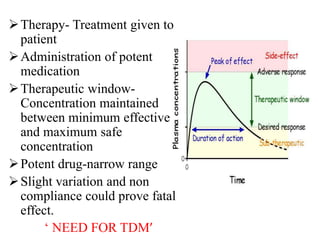
Therapeutic window-
Concentration maintained
between minimum effective
and maximum safe
concentration
Potent drug-narrow range
Slight variation and non
compliance could prove fatal
effect.
‘ NEED FOR TDM’
 Need for TDM
 Treatment are super specialized.
 Patient take more than one medication
 Interactions may happen
 Patients not following prescription
 2 major sources of variability
- pharmacokinetics (dose and plasma concentration)
- pharmacodynamics (drug conc. at the receptor site)
ADME CONSIDERED IN TDM
Categories of drugs require TDM
 Cardiac drug
 Antiepileptic
 Bronchodilators
 Immunosuppressant
 Anti-cancer drugs
 Psychiatric drug
Which drugs requires monitoring?
 Showing marked pharmacokinetic variability
 Concentration related to ADR
 Narrow therapeutic index
 Defined therapeutic concentration range
 In which desired therapeutic effect is difficult to
monitor
When should TDM be requested?
 Drug assay are expensive
 TDM is used to assist the drug therapy
 Appropriate indication for TDM includes-
1. A patient with inadequate clinical response
2. A patient with irreversible sign and symptoms
3. To minimize risk of drug toxicity
4. To individualize dosing for some drugs
5. To help to predict patient dose requirement
6. To assist medication compliance
7. To identify poison and to assess the severity of
poisoning in emergency
 Management of therapy using plasma concentration
Request to laboratory
Analysis Quality Assessment
Report Interpretation clinical action
Record previous report
Factors considered during TDM
 Factors affect serum drug concentration and need to be
considered during interpretation of the assay.
1. Patient demographics
- patient information
- patient age
- address, occupation, reference
- indication for TDM
- etiology
- past treatment, present treatment
- investigation
 Dosage regiment and duration of therapy
 Pathological factors
- patient abnormalities
i.e. vomiting, diarrhea, inflammation
 Alcohol and tobacco use
- non specific microsomal enzyme induction
- result in increased clearance and decrease serum
concentration.
i.e. phenytoin, theophylline
 Medicine or Sampling error
- TDM is incompatible with drug administration
record
 Laboratory errors
- Laboratory error is suspected result should be
repeated or sent to different lab
 Sampling time
- Serum concentration depend on time when the
blood is drawn for assay
- Time and date should be monitored
 Patient compliance
- Concentration is lower than accepted their may
be possibility of non- compliance
 Individual capacity of ADME
- Renal impairment
- Hepatic impairment
 Altered protein binding
Role of Pharmacist
 Multidisciplinary function
 Requires collaborative work
1. Initial optimization of drug, dosage form, interval,
route of administration in view of individual variables
2. Assessment and adjustment of dosage regiment for
patients with hemodialysis or peritoneal dialysis
3. Assessment of possible cause.
- i.e. non compliance, bioavailability problem,
medication error, interaction
4. Management of acute drug intoxication
Scenario of TDM in India
 TDM is available in two ways
1. Clinical Pharmacology department
2. Private medical laboratories
Number of factors influence the use of TDM in
India
 Cost
 Alternative medical service
 Malnutrition
 Ethnic difference
 Variation in bioavailability
TDM.pptx

TDM.pptx

  • 1.
    THERAPEUTIC DRUG MONITERING Dr.Sangameshwar B. Kanthale sbkrscp@gmail.com Rajarshi Shahu College of Pharmacy, Buldhana
  • 2.
    Therapy- Treatment givento patient Administration of potent medication Therapeutic window- Concentration maintained between minimum effective and maximum safe concentration Potent drug-narrow range Slight variation and non compliance could prove fatal effect. ‘ NEED FOR TDM’
  • 3.
     Need forTDM  Treatment are super specialized.  Patient take more than one medication  Interactions may happen  Patients not following prescription  2 major sources of variability - pharmacokinetics (dose and plasma concentration) - pharmacodynamics (drug conc. at the receptor site) ADME CONSIDERED IN TDM
  • 4.
    Categories of drugsrequire TDM  Cardiac drug  Antiepileptic  Bronchodilators  Immunosuppressant  Anti-cancer drugs  Psychiatric drug
  • 5.
    Which drugs requiresmonitoring?  Showing marked pharmacokinetic variability  Concentration related to ADR  Narrow therapeutic index  Defined therapeutic concentration range  In which desired therapeutic effect is difficult to monitor
  • 6.
    When should TDMbe requested?  Drug assay are expensive  TDM is used to assist the drug therapy  Appropriate indication for TDM includes- 1. A patient with inadequate clinical response 2. A patient with irreversible sign and symptoms 3. To minimize risk of drug toxicity 4. To individualize dosing for some drugs 5. To help to predict patient dose requirement 6. To assist medication compliance 7. To identify poison and to assess the severity of poisoning in emergency
  • 7.
     Management oftherapy using plasma concentration Request to laboratory Analysis Quality Assessment Report Interpretation clinical action Record previous report
  • 8.
    Factors considered duringTDM  Factors affect serum drug concentration and need to be considered during interpretation of the assay. 1. Patient demographics - patient information - patient age - address, occupation, reference - indication for TDM - etiology - past treatment, present treatment - investigation
  • 9.
     Dosage regimentand duration of therapy  Pathological factors - patient abnormalities i.e. vomiting, diarrhea, inflammation  Alcohol and tobacco use - non specific microsomal enzyme induction - result in increased clearance and decrease serum concentration. i.e. phenytoin, theophylline
  • 10.
     Medicine orSampling error - TDM is incompatible with drug administration record  Laboratory errors - Laboratory error is suspected result should be repeated or sent to different lab  Sampling time - Serum concentration depend on time when the blood is drawn for assay - Time and date should be monitored
  • 11.
     Patient compliance -Concentration is lower than accepted their may be possibility of non- compliance  Individual capacity of ADME - Renal impairment - Hepatic impairment  Altered protein binding
  • 13.
    Role of Pharmacist Multidisciplinary function  Requires collaborative work 1. Initial optimization of drug, dosage form, interval, route of administration in view of individual variables 2. Assessment and adjustment of dosage regiment for patients with hemodialysis or peritoneal dialysis 3. Assessment of possible cause. - i.e. non compliance, bioavailability problem, medication error, interaction 4. Management of acute drug intoxication
  • 14.
    Scenario of TDMin India  TDM is available in two ways 1. Clinical Pharmacology department 2. Private medical laboratories
  • 15.
    Number of factorsinfluence the use of TDM in India  Cost  Alternative medical service  Malnutrition  Ethnic difference  Variation in bioavailability