DRUG INFORMATION RESOURCES
• Drug information is the process of providing information on the safe and
effective use of therapeutic and diagnostic pharmaceuticals.
• It is the current, relevant, critically examined data about drug and drug use for
given patient or situation.
• Availability of drug information is the key to promote rational use of drug.
• Drug information in an essential element in achieving health goals and
information in an aid to decision making.
August 6, 2022 2
• Drug information is both a body of data and information about
medication and a set of skills and tools that provide pharmacy
professionals with the ability to find, assess, understand interpret,
apply and communicate information and knowledge.
• The body of facts and information pertaining to medications is
generally referred to as “THE DRUG LITERATURE”.
August 6, 2022 3
Aims and Objectives of Drug Information
Services
• The provision of information to health professionals on specific
problems related to the use of drugs in particular patients
• The provision of information to officials in government agencies to
optimize the decision making process
• The preparation and development of guidelines and formularies
• To improve patient compliance and to provide a guide to responsible
self medication
• To develop and participate in continuing education programs
August 6, 2022 4
• To participate in undergraduate and graduate teaching programs
• To develop educational activities regarding the appropriate use of
drugs for patients in the community
• To prepare and distribute material on drugs to health personnel in the
form of a drug Information bulletin and/or other media
• To develop and participate in research programs;
August 6, 2022 5
Drug Information Resources
• The concept of drug information service of drug information center is an
attempt to document drugs by abstracting information about them.
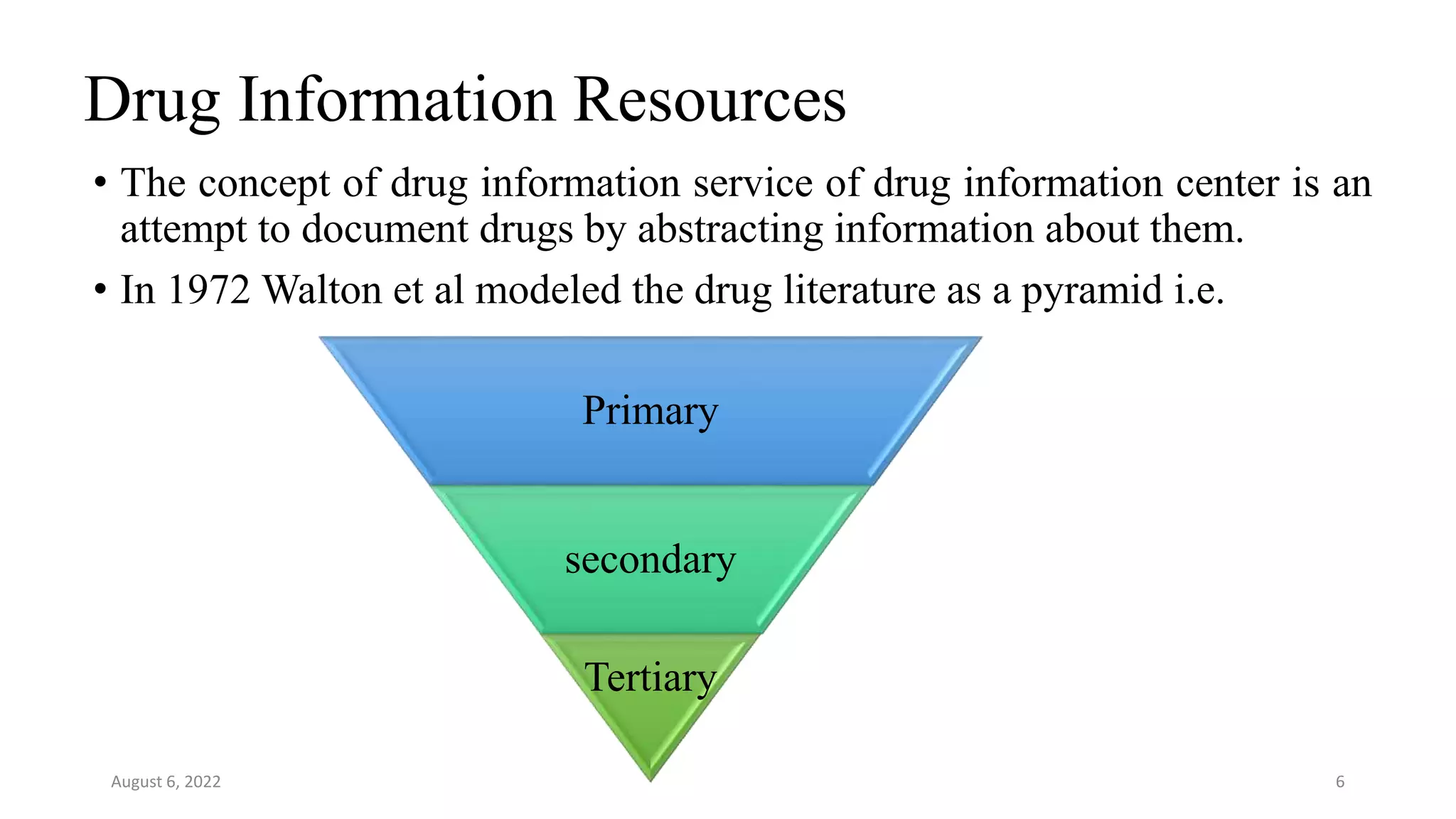
• In 1972 Walton et al modeled the drug literature as a pyramid i.e.
August 6, 2022 6
Primary
secondary
Tertiary
Primary sources of drug information
• It is the source of information for the development of secondary and
tertiary literature resources and is comprised of original research that is
written in the author(s) own words.
• Primary literature consists of clinical research studies and reports, both
published and unpublished.
• Not all literature published in a journal is classified as primary literature,
for example, review articles or editorials are not primary literature.
August 6, 2022 7
• Primary literature often provides the most recent and in-depth information
about a topic, and allows the reader to analyze and critique the study
methodology to determine if the conclusions are valid.
• There are several types of publications considered primary, including
controlled trials, cohort studies, case series, and case reports. Additional
information about study designs commonly found in medical literature.
• Most primary literature contains a detailed description of the study
design, methodology, and scientific results.
August 6, 2022 8
Advantages:
• Primary literature include access to detailed information about a topic and
the ability to personally assess the utility and validity of study results.
• Primary literature tends to be more recent than tertiary or secondary
literature.
Disadvantages:
• Misleading conclusions based on only one trial without the context of
other researches, the need to have good skills in medial literature
evaluation, and the time needed to evaluate the large volume of literature
available.
August 6, 2022 9
Examples:
• Research articles and studies published in the New England Journal of
Medicine, Journal of the American Medical Association and British
Medical Journal.
• These publications are among about 100 others designated as Core
Clinical Journals by the National Library of Medicine. They are
important journals because they contain information that is significant
to medical practice.
August 6, 2022 10
Secondary Literature
• The secondary literature is compiled by indexing and abstracting
services that can be used to systematically locate various types of
published literature.
• Indexing consists of providing bibliographic citation information (e.g.,
title, author, and citation of the article), while abstracting also includes
a brief description (or abstract) of the information provided by the
article or resource cited.
August 6, 2022 11
• There are several challenges in searching secondary database systems.
Systems do not index all terms in the same manner therefore it is
necessary to determine what terms a database is using to conduct a
successful search.
• For example, databases through the National Library of Medicine
index terms by their Medical Subject Heading (MeSH term), while the
Iowa Drug Information Service (IDIS) uses the United States Adopted
Name and the International Classification of Diseases.
August 6, 2022 12
Examples:
• PubMed (Medline), Embase, National Library of Medicine Gateway,
International Pharmacy Abstracts, Scopus, and Toxline.
• Biologic abstract/Biosis Previews
• Anti-infectives today
• Inpharma weekly
• The Cochrane database of systemic reviews
August 6, 2022 13
• International Pharmaceutical Abstract (IPA)
• Iowa Drug Information Service
• Journal Watch
• Padeatrics Today
• Pharmacoeconomics and Outcomes News Weekly
There are many secondary literature databases and each has its own
scope, and features to make it easy for the user to search the database.
August 6, 2022 14
Tertiary resources:
• Tertiary resources are summaries of the primary and secondary
published literatre.
• Printed textbooks are the main example and the search characterised
by a slow rate of revision compared to secondary sources.
• Tertiary resources consist of textbooks, compendia, review articles in
journals, and other general information, such as may be found on the
Internet.
August 6, 2022 15
• These references may often serve as an initial place to identify
information due to the fact that they provide a fairly complete and concise
overview of information available on a specific topic.
• These resources are convenient, easy to use, and familiar to most
practitioners.
• Some resources that may be useful for specific categories of drug
information requests are listed in table below:
August 6, 2022 16
August 6, 2022 17
Some questions that should be considered when evaluating tertiary
literature are listed below:
EVALUATION OF TERTIARY LITERATURE
• Does the author have appropriate experience/expertise to publish in this
area?
• Is the information likely to be timely based on publication date?
• Is the information supported by appropriate citations?
• Does the resource contain relevant information?
• Does the resource appear free from bias or blatant errors?
August 6, 2022 18
Major draw backs
Major draw backs:
• Lag time associated with publication.
• Information may be incomplete.
• Errors in transcription.
• Human bias.
• Incorrect interpretation of information.
• Lack of expertise by authors.
For these reasons readers must judge the quality of tertiary references.
August 6, 2022 19
Consumer Health Information
• As consumers become more active and educated in their health care
and disease management, the need for health information sources
geared at consumers has increased.
• Currently there are a variety of sources where consumers obtain their
health information.
• A recent survey indicated that the most common source of information
about prescription medication, behind physicians and pharmacists, is
the Internet.
August 6, 2022 20
Few sources that may be useful for consumers are listed below:
August 6, 2022 21
Conclusion
• Pharmacists develop a better understanding of where to access
information, provision of drug information will occur more quickly.
• As technological advances continue, which may change the face of
physical pharmacy dispensing and compounding, the need for
information retrieval and interpretation will continue to grow.
• The information in this chapter helps provide guidance as to where
specific types of drug information might be found and how to begin a
search for drug information.
August 6, 2022 22
References
• Gora-harper, M. L. et al. (2006) drug information A GUIDE FOR
PHARMACISTS. third. Edited by J. E. S.-D. I. A. G. for P.-M.-H. M.
(2006). pd. file:///C:/Users/User/Downloads/Patrick M. Malone, Karen
L. Kier. McGraw-Hill Medical Publishing Division New. doi:
10.1036/0071437916.
August 6, 2022 23
August 6, 2022 24

DRUG INFORMATION RESOURCES.pptx

  • 1.
  • 2.
    • Drug informationis the process of providing information on the safe and effective use of therapeutic and diagnostic pharmaceuticals. • It is the current, relevant, critically examined data about drug and drug use for given patient or situation. • Availability of drug information is the key to promote rational use of drug. • Drug information in an essential element in achieving health goals and information in an aid to decision making. August 6, 2022 2
  • 3.
    • Drug informationis both a body of data and information about medication and a set of skills and tools that provide pharmacy professionals with the ability to find, assess, understand interpret, apply and communicate information and knowledge. • The body of facts and information pertaining to medications is generally referred to as “THE DRUG LITERATURE”. August 6, 2022 3
  • 4.
    Aims and Objectivesof Drug Information Services • The provision of information to health professionals on specific problems related to the use of drugs in particular patients • The provision of information to officials in government agencies to optimize the decision making process • The preparation and development of guidelines and formularies • To improve patient compliance and to provide a guide to responsible self medication • To develop and participate in continuing education programs August 6, 2022 4
  • 5.
    • To participatein undergraduate and graduate teaching programs • To develop educational activities regarding the appropriate use of drugs for patients in the community • To prepare and distribute material on drugs to health personnel in the form of a drug Information bulletin and/or other media • To develop and participate in research programs; August 6, 2022 5
  • 6.
    Drug Information Resources •The concept of drug information service of drug information center is an attempt to document drugs by abstracting information about them. • In 1972 Walton et al modeled the drug literature as a pyramid i.e. August 6, 2022 6 Primary secondary Tertiary
  • 7.
    Primary sources ofdrug information • It is the source of information for the development of secondary and tertiary literature resources and is comprised of original research that is written in the author(s) own words. • Primary literature consists of clinical research studies and reports, both published and unpublished. • Not all literature published in a journal is classified as primary literature, for example, review articles or editorials are not primary literature. August 6, 2022 7
  • 8.
    • Primary literatureoften provides the most recent and in-depth information about a topic, and allows the reader to analyze and critique the study methodology to determine if the conclusions are valid. • There are several types of publications considered primary, including controlled trials, cohort studies, case series, and case reports. Additional information about study designs commonly found in medical literature. • Most primary literature contains a detailed description of the study design, methodology, and scientific results. August 6, 2022 8
  • 9.
    Advantages: • Primary literatureinclude access to detailed information about a topic and the ability to personally assess the utility and validity of study results. • Primary literature tends to be more recent than tertiary or secondary literature. Disadvantages: • Misleading conclusions based on only one trial without the context of other researches, the need to have good skills in medial literature evaluation, and the time needed to evaluate the large volume of literature available. August 6, 2022 9
  • 10.
    Examples: • Research articlesand studies published in the New England Journal of Medicine, Journal of the American Medical Association and British Medical Journal. • These publications are among about 100 others designated as Core Clinical Journals by the National Library of Medicine. They are important journals because they contain information that is significant to medical practice. August 6, 2022 10
  • 11.
    Secondary Literature • Thesecondary literature is compiled by indexing and abstracting services that can be used to systematically locate various types of published literature. • Indexing consists of providing bibliographic citation information (e.g., title, author, and citation of the article), while abstracting also includes a brief description (or abstract) of the information provided by the article or resource cited. August 6, 2022 11
  • 12.
    • There areseveral challenges in searching secondary database systems. Systems do not index all terms in the same manner therefore it is necessary to determine what terms a database is using to conduct a successful search. • For example, databases through the National Library of Medicine index terms by their Medical Subject Heading (MeSH term), while the Iowa Drug Information Service (IDIS) uses the United States Adopted Name and the International Classification of Diseases. August 6, 2022 12
  • 13.
    Examples: • PubMed (Medline),Embase, National Library of Medicine Gateway, International Pharmacy Abstracts, Scopus, and Toxline. • Biologic abstract/Biosis Previews • Anti-infectives today • Inpharma weekly • The Cochrane database of systemic reviews August 6, 2022 13
  • 14.
    • International PharmaceuticalAbstract (IPA) • Iowa Drug Information Service • Journal Watch • Padeatrics Today • Pharmacoeconomics and Outcomes News Weekly There are many secondary literature databases and each has its own scope, and features to make it easy for the user to search the database. August 6, 2022 14
  • 15.
    Tertiary resources: • Tertiaryresources are summaries of the primary and secondary published literatre. • Printed textbooks are the main example and the search characterised by a slow rate of revision compared to secondary sources. • Tertiary resources consist of textbooks, compendia, review articles in journals, and other general information, such as may be found on the Internet. August 6, 2022 15
  • 16.
    • These referencesmay often serve as an initial place to identify information due to the fact that they provide a fairly complete and concise overview of information available on a specific topic. • These resources are convenient, easy to use, and familiar to most practitioners. • Some resources that may be useful for specific categories of drug information requests are listed in table below: August 6, 2022 16
  • 17.
  • 18.
    Some questions thatshould be considered when evaluating tertiary literature are listed below: EVALUATION OF TERTIARY LITERATURE • Does the author have appropriate experience/expertise to publish in this area? • Is the information likely to be timely based on publication date? • Is the information supported by appropriate citations? • Does the resource contain relevant information? • Does the resource appear free from bias or blatant errors? August 6, 2022 18
  • 19.
    Major draw backs Majordraw backs: • Lag time associated with publication. • Information may be incomplete. • Errors in transcription. • Human bias. • Incorrect interpretation of information. • Lack of expertise by authors. For these reasons readers must judge the quality of tertiary references. August 6, 2022 19
  • 20.
    Consumer Health Information •As consumers become more active and educated in their health care and disease management, the need for health information sources geared at consumers has increased. • Currently there are a variety of sources where consumers obtain their health information. • A recent survey indicated that the most common source of information about prescription medication, behind physicians and pharmacists, is the Internet. August 6, 2022 20
  • 21.
    Few sources thatmay be useful for consumers are listed below: August 6, 2022 21
  • 22.
    Conclusion • Pharmacists developa better understanding of where to access information, provision of drug information will occur more quickly. • As technological advances continue, which may change the face of physical pharmacy dispensing and compounding, the need for information retrieval and interpretation will continue to grow. • The information in this chapter helps provide guidance as to where specific types of drug information might be found and how to begin a search for drug information. August 6, 2022 22
  • 23.
    References • Gora-harper, M.L. et al. (2006) drug information A GUIDE FOR PHARMACISTS. third. Edited by J. E. S.-D. I. A. G. for P.-M.-H. M. (2006). pd. file:///C:/Users/User/Downloads/Patrick M. Malone, Karen L. Kier. McGraw-Hill Medical Publishing Division New. doi: 10.1036/0071437916. August 6, 2022 23
  • 24.