


DR.UMA KADAM   M.B.B.S. MD ASSOCIATE PROFESSOR PHARMACOLOGY SKNMC
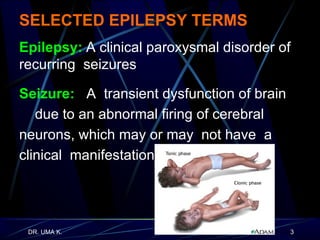
Definition The epilepsies are a group of disorders characterized by  chronic recurrent paroxysmal  changes in neurologic function caused by  abnormalities in the electrical activity of the brain
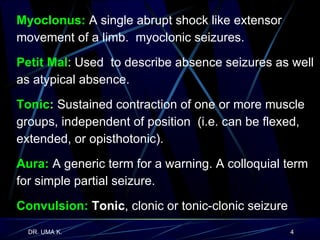
SELECTED EPILEPSY TERMS Epilepsy:   A clinical paroxysmal disorder of recurring  seizures  Seizure:   A  transient dysfunction of brain    due to an abnormal firing of cerebral neurons, which may or may  not have  a clinical  manifestation.
Myoclonus:  A single abrupt shock like extensor movement of a limb.  myoclonic seizures. Petit Mal : Used  to describe absence seizures as well as atypical absence. Tonic :  Sustained contraction of one or more muscle groups, independent of position  (i.e. can be flexed, extended, or opisthotonic). Aura:  A generic term for a warning. A colloquial term for simple partial seizure. Convulsion:  Tonic , clonic or tonic-clonic seizure
Status   A pathological state different from a single seizure  by the  Epilepticus   (a bsence or reduction of  inhibitory processes to terminate the seizure). Applies to any seizure type. The length of time  required to differentiate seizure from status is both  empirical and practical. Convulsive, myoclonic status: 10-30 minutes.
Differential diagnosis of seizures Syncope Drop attacks Narcolepsy-Cataplexy Pseudoseizures Panic attacks Hypoglycemia Migraine
Epidemiology Incidence:   Developed countries: 40-70 per one lakh Developing countries: 100-190 per one lakh Prevalence: Developed countries: 4-10 per 10,000 Developing countries: 57 per 10,000 Partial seizures with or without generalization is most common
Bimodal age distribution :   < 1 and > 60. Less sharp in developing countries Common causes :  Perinatal disorders associated with cerebral palsy & mental retardation, Head trauma, CNS infections, Stroke, Brain tumors, Alcohol and other drugs Men affected 1-2.4 times:  compared    to women
Revised ILAE (International League Against Epilepsy) Seizure Classification I.  PARTIAL (FOCAL, LOCAL) SEIZURES A.   Simple partial seizures B.  Complex partial seizure C.  Partial seizures evolving to generalized  tonic-clonic convulsions (GTC)
II.  GENERALIZED SEIZURES A. 1.   Absence seizures 2.  Atypical absence B.  Myoclonic seizures,  Myoclonic jerks  (simple or multiple) C.  Clonic seizures D.  Tonic seizures E.  Tonic-clonic seizures F.  Atonic seizures (astatic)
III.  UNCLASSIFIED EPILEPTIC SEIZURES Includes all seizures that cannot be classified because of inadequate or incomplete data and some that defy classification in hitherto described categories.  This includes some neonatal seizures, e.g.,  rhythmic eye movements, chewing, and swimming movements .
 
Antiepileptic drug (AED) A drug which decreases the frequency  and /or severity of seizures in people  with epilepsy. Treats the symptom of seizures, not the underlying epileptic condition. Improves quality of life by minimizing seizures.
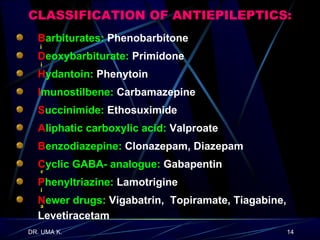
CLASSIFICATION OF ANTIEPILEPTICS: B arbiturates:  Phenobarbitone D eoxybarbiturate:  Primidone H ydantoin:  Phenytoin  I munostilbene:  Carbamazepine  S uccinimide:  Ethosuximide A liphatic carboxylic acid:  Valproate B enzodiazepine:  Clonazepam, Diazepam C yclic GABA- analogue:  Gabapentin P henyltriazine:  Lamotrigine  N ewer drugs:  Vigabatrin,  Topiramate, Tiagabine, Levetiracetam  i i e i a
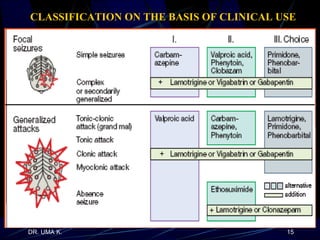
CLASSIFICATION ON THE BASIS OF CLINICAL USE
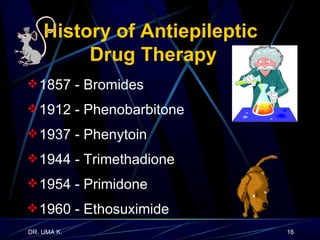
History of Antiepileptic  Drug Therapy 1857 - Bromides 1912 - Phenobarbitone 1937 - Phenytoin 1944 - Trimethadione 1954 - Primidone 1960 - Ethosuximide
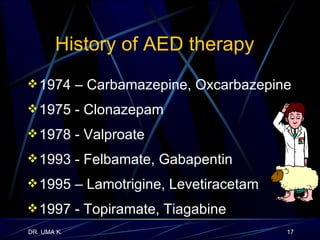
History of AED therapy 1974 – Carbamazepine, Oxcarbazepine 1975 - Clonazepam 1978 - Valproate 1993 - Felbamate, Gabapentin 1995 – Lamotrigine, Levetiracetam 1997 - Topiramate, Tiagabine
Principles of AED Selection Correct diagnosis of  the type of epilepsy   influences treatment, prognosis and genetic counseling. One best drug to fit the fit, fit the patient;   Sequential monotherapy Use the  least expensive  AED (all things being equal, like efficacy). Prefer AEDs which can be taken od  over bid / tid. AEDs almost never need qid dosing
Newer is not better,   and almost certainly   more  expensive Start with one AED and push the dose to clinical toxicity or seizure control. Withdraw AEDs that are not effective. Never have a patient on more than three (3) AEDs. Principles of AED Selection…cont.
Principles of AED Selection…cont. Don't use combination medications  (e.g., phenytoin with phenobarbital). No proof that multiple AEDs are synergistic in the treatment of epilepsy.  Polypharmacy is expensive, increases side effects and increases the complexity of adjusting AEDs in the refractory patient.
  Therapeutic Drug Monitoring Use AED levels to assess: i.  Poor clinical control (compliance,  metabolism) ii.  Dose-related side effect iii. Drug or disease interaction iv.  &quot;Routine&quot; levels on controlled, nontoxic patients are not indicated.
Applied Pharmacokinetics of  Antiepileptic Drugs (AEDs)
Absorption Aqueous solubility - Poor aqueous solubility Impairs absorption from GIT – carbamazepine Erratic absorption from parenteral (SC, IM) sites - phenytoin Poor oral bioavailability – phenytoin Slows time to attain peak plasma levels – carbamazepine May cause physical drug interactions during IV infusions
Absorption Lipid solubility – Good lipid solubility Enhances absorption across membranes Quicker absorption Crosses BBB easily – reaches good levels in CSF Excreted in breast milk, can cross placenta
Mechanism of action of Antiepileptic Drugs
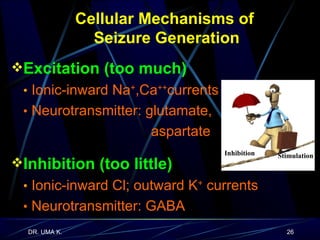
Cellular Mechanisms of  Seizure Generation Excitation (too much) •   Ionic-inward Na + ,Ca ++ currents •   Neurotransmitter: glutamate,    aspartate Inhibition (too little) •   Ionic-inward Cl; outward K +  currents •   Neurotransmitter: GABA Inhibition  Stimulation
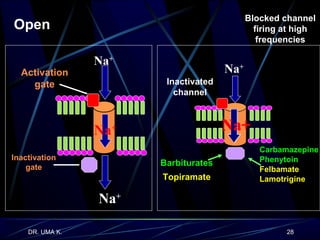
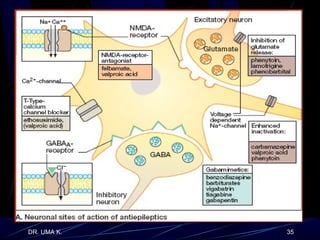
AEDs: Molecular and Cellular Mechanisms Phenytoin, Carbamazepine •   Block voltage-dependent sodium  channels at high firing frequencies
Open Na + Na + Na + Inactivation gate Activation gate Carbamazepine Phenytoin Felbamate Lamotrigine Inactivated channel Blocked channel firing at high frequencies Barbiturates Topiramate Na + Na+ Na+ Na+
AEDs: Molecular and Cellular Mechanisms Barbiturates   •   Prolong GABA-mediated chloride  channel openings  •  Some blockade of voltage- dependent sodium channels Benzodiazepines  •  Increase frequency of GABA-mediated chloride channel openings
 
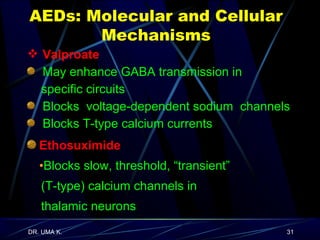
AEDs: Molecular and Cellular Mechanisms Valproate May enhance GABA transmission in specific circuits Blocks  voltage-dependent sodium  channels Blocks T-type calcium currents Ethosuximide • Blocks slow, threshold, “transient”  (T-type) calcium channels in  thalamic neurons
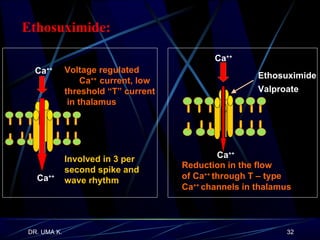
Ca ++ Ca ++ Voltage regulated  Ca ++  current, low  threshold “T” current  in thalamus Involved in 3 per second spike and wave rhythm Ca ++ Ethosuximide Valproate Reduction in the flow of Ca ++  through T – type Ca ++  channels in thalamus Ca ++ Ethosuximide:
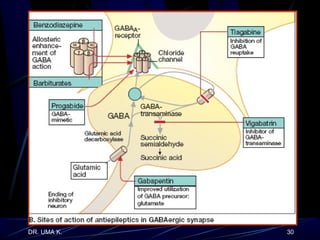
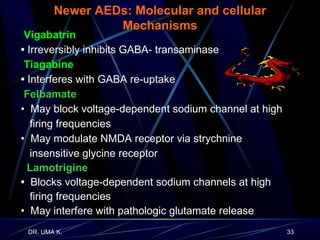
Newer AEDs: Molecular and cellular Mechanisms Vigabatrin   •  Irreversibly inhibits GABA- transaminase Tiagabine   •  Interferes with GABA re-uptake Felbamate  •  May block voltage-dependent sodium channel at high firing frequencies  •  May modulate NMDA receptor via strychnine insensitive glycine receptor Lamotrigine   •  Blocks voltage-dependent sodium channels at high firing frequencies •  May interfere with pathologic glutamate release
Newer AEDs: Molecular and cellular Mechanisms Topiramate Blocks voltage-dependent sodium channels at high firing frequencies Increases frequency at which GABA opens Cl -  channels (different site from benzodiazepines) Antagonizes glutamate actions at receptor subtype Gabapentin  •  May modulate amino acid transport into brain   •  May interfere with GABA re-uptake
 
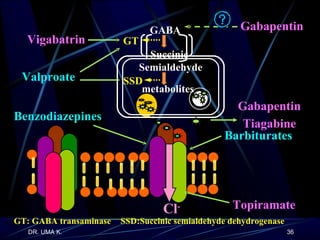
GABA metabolites Succinic  Semialdehyde Gabapentin GT: GABA transaminase SSD:Succinic semialdehyde dehydrogenase GT SSD Vigabatrin Valproate Benzodiazepines Barbiturates Cl - Gabapentin Tiagabine Topiramate
Status Epilepticus-Definition 1.  Major motor (convulsive) status   Three(3) seizures uninterrupted by  consciousness or a single prolonged seizure  greater than 1/2 hour. 2.  Spike wave stupor  (Absence or Petit mal status) and complex partial (psychomotor) status are prolonged alterations of consciousness  verified  by EEG as epileptic.
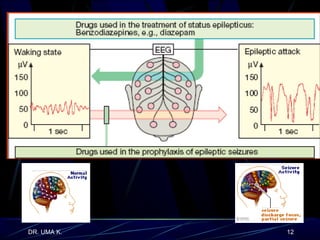
Status epilepticus It is a medical emergency – requires prompt and aggressive treatment Therapy should be aimed at: Rapid termination of status epilepticus Prevention of seizure recurrence Treatment of underlying cause
Immediate treatment   1.  Secure IV line draw blood for analysis (including anticonvulsant levels). 2.  Push  50 cc of 50% Dextrose i.v.,  100mg  thiamine i.v.  3. Monitor vital signs.  4. Examine patient.  5. Protect airway, tongue, head, never leave patient alone  6. Intubate all patients if first line drugs fail.
Non-specific Correct electrolyte imbalance - acidosis lowers seizure threshold, treat with bicarbonate if pH<7.1  Lower fever Antibiotics/ LP if indicated If neurologic exam dictates, treatment of underlying cause may proceed concurrently with drug therapy, e.g., neurosurgical decompression. Hypotension – maintain BP Status Epilepticus - Definite Treatment
Status Epilepticus-Definitive Treatment  Diazepam -  10mg IV push over 30-60 seconds repeat after 10-15mins upto 30mg (5mg/min) Repeat after 2-4hrs. 100mg/day   i.Good results, easy to administer. (fast acting, short lasting)  ii. If two doses fail to stop status, then further doses probably won't work either. iii. Side effects -- hypotension, bradycardia, respiratory depression, cardiac arrest, depresses mental status.
OR Lorazepam -  4 mg IV push (2mg/min) may be repeated. i.  Fast acting, medium lasting.  ii.  Respiratory depression only in the extubated patient.
Status Epilepticus-Definite Treatment  b. Phenytoin -  12-20mg/kg IV (slow IV push)  (50mg/min) fast and long acting. i. Presently used concomitantly with a      benzodiazepine ii. Its pH is 12, all i.v. fluids are pH 4-6. Do not    add to dextrose drip as it precipitates. iii. Monitor BP and ECG
IV Valproate -  25 mg/kg   IV  push, may repeat.  i.  Generally not used because of lack of experience. Good results in both major motor and absence status. ii. fast acting, long acting. iii.  Far less side effects than Diazepam and dilantin especially in unstable cardiac status, hypotension, hepatic failure etc.
Adverse effects of antiepileptics: Phenytoin:  Gum hyperplasia,hirsutism, hypersensitivity, megaloblastic anemia, osteomalacia, hyperglycemia, fetal hydontoin syndrome, dose dependent vestibular & cerebellar toxicity & iv administration causes hypotension & arrhythmias Carbamazepine:  Dose dependent neurotoxicity, hypersensitivity, teratogenic.   Valproate:  Well tolerated, however in children below 3 yrs cause fulminant hepatitis, pancreatitis in patients taking other hepatotoxic drugs & with liver disease. In pregnancy if given cause neural tube defects.
Drug interactions- points to consider Complex – refer to textbooks when possible May enhance toxicity without a corresponding increase in antiepileptic effect. Highly variable and  unpredictable
Drug interactions- points to consider Usually caused by hepatic enzyme induction or hepatic enzyme inhibition  Interactions due to displacement from protein binding sites not significant. TDM advisable with combination therapy
Carbamazepine often lowers plasma concentrations of: Phenytoin (it may also raise phenytoin concentration) Valproate Phenobarbitone/primidone lowers plasma concentrations of: Phenytoin (it may also raise phenytoin concentration) Valproate Carbamazepine Clonazepam  Ethosuximide(sometimes) Phenytoin often lowers plasma concentrations of: valproate carbamazepine clonazepam  Ethosuximide and primidone (sometimes) Often raises plasma concentrations of Phenobarbitone
Valproate often lowers plasma concentrations of: An active metabolite of Carbamazepine Lamotrigine  phenobarbitone, primidone Phenytoin (but may lower it too) Sometimes raises plasma concentrations of Ethosuximide
Thank you

Antiepileptics I & Ii

  • 1.
    DR.UMA KADAM M.B.B.S. MD ASSOCIATE PROFESSOR PHARMACOLOGY SKNMC
  • 2.
    Definition The epilepsiesare a group of disorders characterized by chronic recurrent paroxysmal changes in neurologic function caused by abnormalities in the electrical activity of the brain
  • 3.
    SELECTED EPILEPSY TERMSEpilepsy: A clinical paroxysmal disorder of recurring seizures Seizure: A transient dysfunction of brain due to an abnormal firing of cerebral neurons, which may or may not have a clinical manifestation.
  • 4.
    Myoclonus: Asingle abrupt shock like extensor movement of a limb. myoclonic seizures. Petit Mal : Used to describe absence seizures as well as atypical absence. Tonic : Sustained contraction of one or more muscle groups, independent of position (i.e. can be flexed, extended, or opisthotonic). Aura: A generic term for a warning. A colloquial term for simple partial seizure. Convulsion: Tonic , clonic or tonic-clonic seizure
  • 5.
    Status A pathological state different from a single seizure by the Epilepticus (a bsence or reduction of inhibitory processes to terminate the seizure). Applies to any seizure type. The length of time required to differentiate seizure from status is both empirical and practical. Convulsive, myoclonic status: 10-30 minutes.
  • 6.
    Differential diagnosis ofseizures Syncope Drop attacks Narcolepsy-Cataplexy Pseudoseizures Panic attacks Hypoglycemia Migraine
  • 7.
    Epidemiology Incidence: Developed countries: 40-70 per one lakh Developing countries: 100-190 per one lakh Prevalence: Developed countries: 4-10 per 10,000 Developing countries: 57 per 10,000 Partial seizures with or without generalization is most common
  • 8.
    Bimodal age distribution: < 1 and > 60. Less sharp in developing countries Common causes : Perinatal disorders associated with cerebral palsy & mental retardation, Head trauma, CNS infections, Stroke, Brain tumors, Alcohol and other drugs Men affected 1-2.4 times: compared to women
  • 9.
    Revised ILAE (InternationalLeague Against Epilepsy) Seizure Classification I. PARTIAL (FOCAL, LOCAL) SEIZURES A. Simple partial seizures B. Complex partial seizure C. Partial seizures evolving to generalized tonic-clonic convulsions (GTC)
  • 10.
    II. GENERALIZEDSEIZURES A. 1. Absence seizures 2. Atypical absence B. Myoclonic seizures, Myoclonic jerks (simple or multiple) C. Clonic seizures D. Tonic seizures E. Tonic-clonic seizures F. Atonic seizures (astatic)
  • 11.
    III. UNCLASSIFIEDEPILEPTIC SEIZURES Includes all seizures that cannot be classified because of inadequate or incomplete data and some that defy classification in hitherto described categories. This includes some neonatal seizures, e.g., rhythmic eye movements, chewing, and swimming movements .
  • 12.
  • 13.
    Antiepileptic drug (AED)A drug which decreases the frequency and /or severity of seizures in people with epilepsy. Treats the symptom of seizures, not the underlying epileptic condition. Improves quality of life by minimizing seizures.
  • 14.
    CLASSIFICATION OF ANTIEPILEPTICS:B arbiturates: Phenobarbitone D eoxybarbiturate: Primidone H ydantoin: Phenytoin I munostilbene: Carbamazepine S uccinimide: Ethosuximide A liphatic carboxylic acid: Valproate B enzodiazepine: Clonazepam, Diazepam C yclic GABA- analogue: Gabapentin P henyltriazine: Lamotrigine N ewer drugs: Vigabatrin, Topiramate, Tiagabine, Levetiracetam i i e i a
  • 15.
    CLASSIFICATION ON THEBASIS OF CLINICAL USE
  • 16.
    History of Antiepileptic Drug Therapy 1857 - Bromides 1912 - Phenobarbitone 1937 - Phenytoin 1944 - Trimethadione 1954 - Primidone 1960 - Ethosuximide
  • 17.
    History of AEDtherapy 1974 – Carbamazepine, Oxcarbazepine 1975 - Clonazepam 1978 - Valproate 1993 - Felbamate, Gabapentin 1995 – Lamotrigine, Levetiracetam 1997 - Topiramate, Tiagabine
  • 18.
    Principles of AEDSelection Correct diagnosis of the type of epilepsy influences treatment, prognosis and genetic counseling. One best drug to fit the fit, fit the patient; Sequential monotherapy Use the least expensive AED (all things being equal, like efficacy). Prefer AEDs which can be taken od over bid / tid. AEDs almost never need qid dosing
  • 19.
    Newer is notbetter, and almost certainly more expensive Start with one AED and push the dose to clinical toxicity or seizure control. Withdraw AEDs that are not effective. Never have a patient on more than three (3) AEDs. Principles of AED Selection…cont.
  • 20.
    Principles of AEDSelection…cont. Don't use combination medications (e.g., phenytoin with phenobarbital). No proof that multiple AEDs are synergistic in the treatment of epilepsy. Polypharmacy is expensive, increases side effects and increases the complexity of adjusting AEDs in the refractory patient.
  • 21.
    TherapeuticDrug Monitoring Use AED levels to assess: i. Poor clinical control (compliance, metabolism) ii. Dose-related side effect iii. Drug or disease interaction iv. &quot;Routine&quot; levels on controlled, nontoxic patients are not indicated.
  • 22.
    Applied Pharmacokinetics of Antiepileptic Drugs (AEDs)
  • 23.
    Absorption Aqueous solubility- Poor aqueous solubility Impairs absorption from GIT – carbamazepine Erratic absorption from parenteral (SC, IM) sites - phenytoin Poor oral bioavailability – phenytoin Slows time to attain peak plasma levels – carbamazepine May cause physical drug interactions during IV infusions
  • 24.
    Absorption Lipid solubility– Good lipid solubility Enhances absorption across membranes Quicker absorption Crosses BBB easily – reaches good levels in CSF Excreted in breast milk, can cross placenta
  • 25.
    Mechanism of actionof Antiepileptic Drugs
  • 26.
    Cellular Mechanisms of Seizure Generation Excitation (too much) • Ionic-inward Na + ,Ca ++ currents • Neurotransmitter: glutamate, aspartate Inhibition (too little) • Ionic-inward Cl; outward K + currents • Neurotransmitter: GABA Inhibition Stimulation
  • 27.
    AEDs: Molecular andCellular Mechanisms Phenytoin, Carbamazepine • Block voltage-dependent sodium channels at high firing frequencies
  • 28.
    Open Na +Na + Na + Inactivation gate Activation gate Carbamazepine Phenytoin Felbamate Lamotrigine Inactivated channel Blocked channel firing at high frequencies Barbiturates Topiramate Na + Na+ Na+ Na+
  • 29.
    AEDs: Molecular andCellular Mechanisms Barbiturates • Prolong GABA-mediated chloride channel openings • Some blockade of voltage- dependent sodium channels Benzodiazepines • Increase frequency of GABA-mediated chloride channel openings
  • 30.
  • 31.
    AEDs: Molecular andCellular Mechanisms Valproate May enhance GABA transmission in specific circuits Blocks voltage-dependent sodium channels Blocks T-type calcium currents Ethosuximide • Blocks slow, threshold, “transient” (T-type) calcium channels in thalamic neurons
  • 32.
    Ca ++ Ca++ Voltage regulated Ca ++ current, low threshold “T” current in thalamus Involved in 3 per second spike and wave rhythm Ca ++ Ethosuximide Valproate Reduction in the flow of Ca ++ through T – type Ca ++ channels in thalamus Ca ++ Ethosuximide:
  • 33.
    Newer AEDs: Molecularand cellular Mechanisms Vigabatrin • Irreversibly inhibits GABA- transaminase Tiagabine • Interferes with GABA re-uptake Felbamate • May block voltage-dependent sodium channel at high firing frequencies • May modulate NMDA receptor via strychnine insensitive glycine receptor Lamotrigine • Blocks voltage-dependent sodium channels at high firing frequencies • May interfere with pathologic glutamate release
  • 34.
    Newer AEDs: Molecularand cellular Mechanisms Topiramate Blocks voltage-dependent sodium channels at high firing frequencies Increases frequency at which GABA opens Cl - channels (different site from benzodiazepines) Antagonizes glutamate actions at receptor subtype Gabapentin • May modulate amino acid transport into brain • May interfere with GABA re-uptake
  • 35.
  • 36.
    GABA metabolites Succinic Semialdehyde Gabapentin GT: GABA transaminase SSD:Succinic semialdehyde dehydrogenase GT SSD Vigabatrin Valproate Benzodiazepines Barbiturates Cl - Gabapentin Tiagabine Topiramate
  • 37.
    Status Epilepticus-Definition 1. Major motor (convulsive) status Three(3) seizures uninterrupted by consciousness or a single prolonged seizure greater than 1/2 hour. 2. Spike wave stupor (Absence or Petit mal status) and complex partial (psychomotor) status are prolonged alterations of consciousness verified by EEG as epileptic.
  • 38.
    Status epilepticus Itis a medical emergency – requires prompt and aggressive treatment Therapy should be aimed at: Rapid termination of status epilepticus Prevention of seizure recurrence Treatment of underlying cause
  • 39.
    Immediate treatment 1. Secure IV line draw blood for analysis (including anticonvulsant levels). 2. Push 50 cc of 50% Dextrose i.v., 100mg thiamine i.v. 3. Monitor vital signs. 4. Examine patient. 5. Protect airway, tongue, head, never leave patient alone 6. Intubate all patients if first line drugs fail.
  • 40.
    Non-specific Correct electrolyteimbalance - acidosis lowers seizure threshold, treat with bicarbonate if pH<7.1 Lower fever Antibiotics/ LP if indicated If neurologic exam dictates, treatment of underlying cause may proceed concurrently with drug therapy, e.g., neurosurgical decompression. Hypotension – maintain BP Status Epilepticus - Definite Treatment
  • 41.
    Status Epilepticus-Definitive Treatment Diazepam - 10mg IV push over 30-60 seconds repeat after 10-15mins upto 30mg (5mg/min) Repeat after 2-4hrs. 100mg/day i.Good results, easy to administer. (fast acting, short lasting) ii. If two doses fail to stop status, then further doses probably won't work either. iii. Side effects -- hypotension, bradycardia, respiratory depression, cardiac arrest, depresses mental status.
  • 42.
    OR Lorazepam - 4 mg IV push (2mg/min) may be repeated. i. Fast acting, medium lasting. ii. Respiratory depression only in the extubated patient.
  • 43.
    Status Epilepticus-Definite Treatment b. Phenytoin - 12-20mg/kg IV (slow IV push) (50mg/min) fast and long acting. i. Presently used concomitantly with a benzodiazepine ii. Its pH is 12, all i.v. fluids are pH 4-6. Do not add to dextrose drip as it precipitates. iii. Monitor BP and ECG
  • 44.
    IV Valproate - 25 mg/kg IV push, may repeat. i. Generally not used because of lack of experience. Good results in both major motor and absence status. ii. fast acting, long acting. iii. Far less side effects than Diazepam and dilantin especially in unstable cardiac status, hypotension, hepatic failure etc.
  • 45.
    Adverse effects ofantiepileptics: Phenytoin: Gum hyperplasia,hirsutism, hypersensitivity, megaloblastic anemia, osteomalacia, hyperglycemia, fetal hydontoin syndrome, dose dependent vestibular & cerebellar toxicity & iv administration causes hypotension & arrhythmias Carbamazepine: Dose dependent neurotoxicity, hypersensitivity, teratogenic. Valproate: Well tolerated, however in children below 3 yrs cause fulminant hepatitis, pancreatitis in patients taking other hepatotoxic drugs & with liver disease. In pregnancy if given cause neural tube defects.
  • 46.
    Drug interactions- pointsto consider Complex – refer to textbooks when possible May enhance toxicity without a corresponding increase in antiepileptic effect. Highly variable and unpredictable
  • 47.
    Drug interactions- pointsto consider Usually caused by hepatic enzyme induction or hepatic enzyme inhibition Interactions due to displacement from protein binding sites not significant. TDM advisable with combination therapy
  • 48.
    Carbamazepine often lowersplasma concentrations of: Phenytoin (it may also raise phenytoin concentration) Valproate Phenobarbitone/primidone lowers plasma concentrations of: Phenytoin (it may also raise phenytoin concentration) Valproate Carbamazepine Clonazepam Ethosuximide(sometimes) Phenytoin often lowers plasma concentrations of: valproate carbamazepine clonazepam Ethosuximide and primidone (sometimes) Often raises plasma concentrations of Phenobarbitone
  • 49.
    Valproate often lowersplasma concentrations of: An active metabolite of Carbamazepine Lamotrigine phenobarbitone, primidone Phenytoin (but may lower it too) Sometimes raises plasma concentrations of Ethosuximide
  • 50.