ABSORPTION
Dr chintan Doshi
1
PHARMACOKINETICS
• Simply means, the science which deals with
 “ What the Body does to the drug ”
• Includes 4 stages –
2
PHARMACOKINETICS
ABSORPTION DISTRIBUTION METABOLISM EXCRETION
3
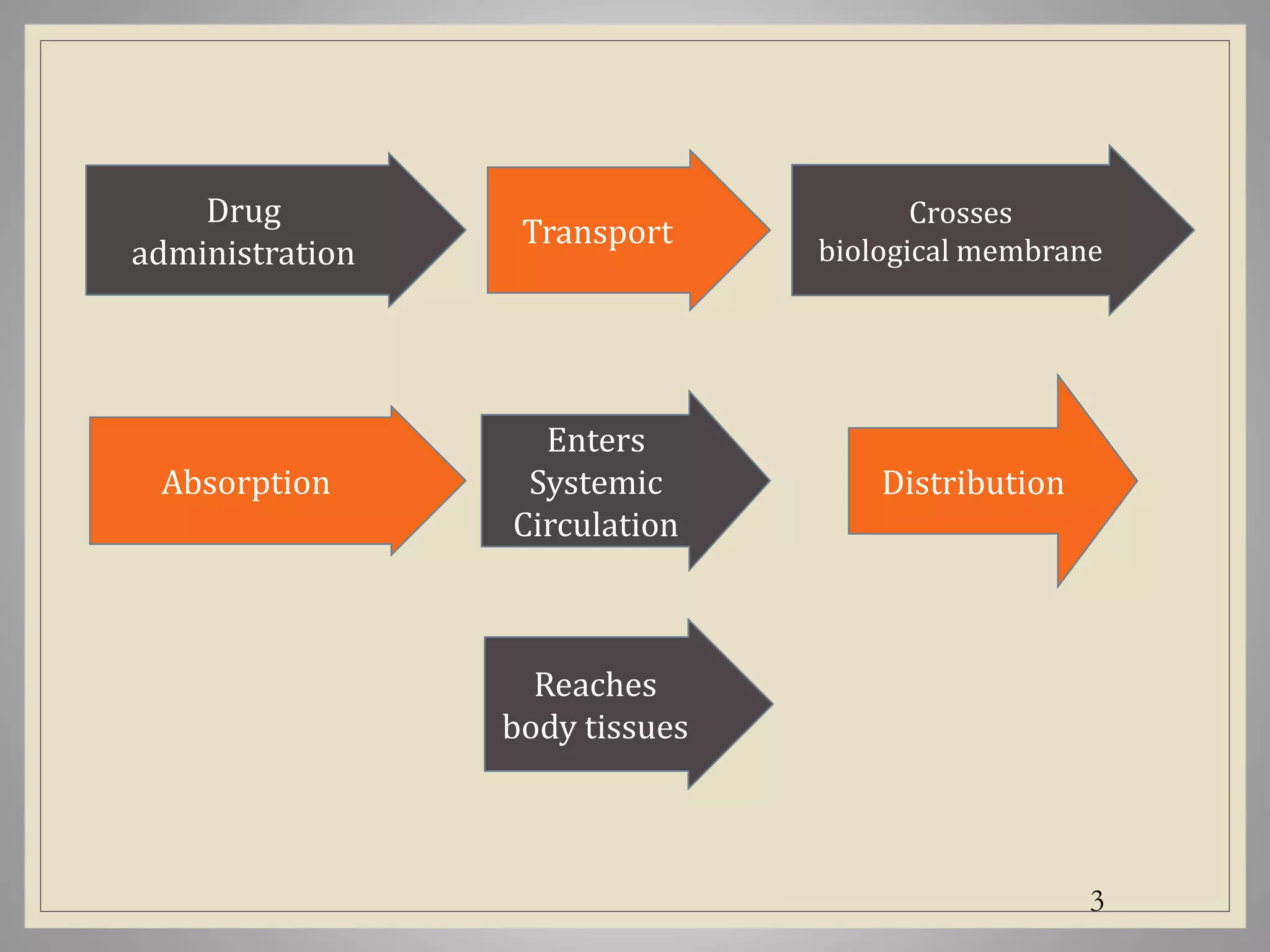
Drug
administration
Crosses
biological membrane
Transport
Absorption
Enters
Systemic
Circulation
Reaches
body tissues
Distribution
ABSORPTION
30-Dec-13
4
BIOAVAILABILITY
• DEFINITION :-
“ The Rate at which & the Extent to which the
Active Concentration of drug is available at the desired
site of action. ”
• Concept came into existence when an unusual incidence
occurred in Australia in 1968.
• Phenytoin toxicity in Epileptic patients.
5
BIOEQUIVALENCE
 Definition :
• If two or more dosage forms of the same drug reach the
blood circulation at the same relative rate & same
relative extent, they are called Bioequivalent
preparations of the generic drug.
• Clinically important for the drugs having steep dose-
response relationship,
• e.g.
 Zero order kinetics ( phenytoin, warfarin )
 Narrow margin of safety ( Theophylline, Tetracycline )
6
Measurement of Bioavailability
• Oral administration of 2 brand products of same drug
⇓
Plasma concentration – Time curve is obtained
⇓
3 characteristics noted & compared :
1) Cmax
2) Tmax
3) AUC
7
Rate of Absorption
Extent of Absorption
8
Quantitative Evaluation of Bioavailability
Drug Bioavailability ( % ) = AUC ( Oral ) x 100
AUC ( I.V. )
AUC (oral) = AUC obtained after oral administration of
single dose
AUC (IV) = AUC obtained after IV administration of same
drug in the same dose.
9
Drug transport process
DRUGS ARE TRANSPORTED ACROSS
THE MENBRANE
PASSIVE DIFFUSION
AND FILTRATION
SPECIALIZED
TRANSPORT
CARRIER
MEDIATED
FACILITATED
DIFFUSION
ACTIVE
TRANSPORT
PRIMARY SECONDORY
PINOCYTOSIS
10
Diffusion
Higher
conc.
Lower
conc.
M
E
M
B
R
A
N
E
Lipid soluble
Lipid
insoluble
DIFFUSION
FILTRATION
11
Carrier mediated transport
• Facilitated
M
E
M
B
R
A
N
E
12
• Active transport
AA
M
E
M
B
R
A
N
E
ATP ADP
e.g.- levodopa
30-Dec-13 13
Active transport
PRIMARY
◦ Energy obtained directly
from ATP
◦ Eg. P glycoprotein
SECONDARY
◦ Energy obtained from
movment of other solute
(Na+)
◦ Eg- Na/K/2CL symporter
14
• Primary Active transport
AA
M
E
M
B
R
A
N
E
ATP ADP
15
• Secondary Active Transport
AA
M
E
M
B
R
A
N
E
Na+ K +
ATPase
ATP ADP
Na+ K +
ATPase
H+ H+
GLUCOSE
Na+
K+
16
Pinocytosis / Cell Drinking
17
• Uptake of fluid solutes
18
FACTORS AFFECTING
DRUG ABSORPTION
&
BIOAVAILABILITY
A) Pharmacological Factors:
(1) Route of Administration :
19
Absorption via G.I.T.
20
Absorption
Site
pH
Drugs
absorbed
Example
Stomach Acidic
Lipid soluble
Non-ionized
Acidic/Neutral
Aspirin
Mouth
Lipid soluble
Non-ionized
Basic/Neutral
Isosorbide
Small
intestine Morphine
Colon Diazepam
Rectal Ergotamine
Absorption via Parenteral Sites :
21
Intravenous injection
⇓
Direct in bloodstream
⇓
Completely absorbed,
Rapidly distributed
Intramuscular
&
Subcutaneous injection
⇓
Passive diffusion
Absorption : i.m. > s.c.
Absorption via Lungs :
• Rapid absorption of Lipid-soluble drugs
• From pulmonary epithelium & mucous
membrane of trachea & lungs
• Ex. - General anaesthetics ( vapourized form )
- Salbutamol ( aqueous spray )
- Disodium cromoglycate ( suspended
microfined particles)
22
Absorption via Topical sites :
• Dermis – permeable for lipid-soluble drugs
◦ Transdermal patches for – GTN, Scopolamine.
◦ Applied on mucous membranes – Oxytocin,
Vasopressin
23
(2) Age :
 Infants :
◦ High gastric pH
◦ Less intestinal surface & blood flow
 Elderly :
◦ Achlorhydria
◦ Less intestinal blood flow
◦ Altered gastric emptying
24
◦ Any factor which ↑: ↑ absorption of drug
◦ Permits drug to reach large intestinal surface
25
(3) Gastric Emptying Time
• Volume of Ingested Material • Bulky material tends to empty
more slowly than liquids
• Type of Meal • carbohydrates > proteins > fats
• Body Position • Lying on the left side decreases
emptying rate,
• Right side promotes it
• Drugs
• Anticholinergics
• Narcotic analgesics
• Ethanol
• Reduction in rate of emptying
• Emotional state • Anxiety promotes,
• depression retards it
• Disease states • Hypothyroidism retards it,
• Hyperthyroidism promotes it.
26
(4) Presence of food
FOOD INCREASES THE
ABSORPTION OF ..
Chloroquine
Griseofulvin
FOOD DECREASES THE
ABSORPTION OF ..
Ampicillin
Aspirin
Tetracycline
To be
taken
before
meals
To be
taken
after
meals
27
Contd.
◦ Tetracycline absorption ↓ with milk
◦ Vit. C ↑absorption of iron
28
5)Gastrointestinial diseases
◦ Coeliac disease: Malabsorption of fat
◦ Amoxicillin show decrease absorption
◦ Gastroenteritis: oral absorption ↓
29
6)Drug intractions
◦ Enzyme inducer: phenobarbitone ↓ bioavalibility of other
drug
◦ Liquid paraffin: ↓ bioavaibility of VIT. A, D,E,K
30
7)First pass metabolism
◦ When given orally reaches direct liver for
metabolism before reaching systemic circulation
◦ Decrease bioavaibility
◦ Ex.:
◦ Levodopa
◦ Propranolol
◦ Niroglycerin
31
8)Pharmacogenetic factor
Slow acetalators:
◦ ↑ bioavaibility of isoniazid→ toxicity of isoniazid
◦ Seen in Americans
Fast acetalators:
o↓ bioavaibility
oSeen in Chinese, Eskimos
32
9)Miscelleneous factors
◦ Routes of administration
◦ Area of absorbing surface
◦ State of circulation
◦ In shock tissue perfusion ↓ and ↓ bioavalibility
33
Pharmaceutical factors
34
35
Oral Administration of Drug
To fine particles
Tab or Cap
Drug in solution
Powders &
Suspensions
Solutions
Available for absorption in GIT
Disintegration time :
Rapid disintegration
⇓
Less disintegration time
⇓
Rapid absorption
◦ Ex.-
• Coated tablets – more disintegration time
slow absorption
• Fine dispersible tablets – less disintegration time
fast absorption
36
1)Particle size
◦ Microfine tablet: ↑bioavaibility
Ex:
◦ Aspirin
◦ Sprinolactone
37
2)Salt form
◦ Acidic drug precipitated from salt
◦ Faster dissolution and ↑bioavailability
◦ Ex.: phenytoin salts
38
3)Degree of ionization
◦ Non ionized lipid soluble drugs better absorbed
◦ Highly ionized drug reduce bioavailability
◦ Streptomycin
◦ Acetylcholine
◦ Neostigmine
39
4)Crystal form
◦ Amorphous chloramphenicol has faster dissolution and
increase bioavalibility
40
5)Water of hydration
◦ Anhydrous form of ampicillin has faster dissolution and
increase bioavailability
41
Methods to Delay Absorption
1. Using Appropriate Dosage Form :
• Slow & Sustained absorption of drugs –
- Retard tablets ( pot. Chloride retard tablets )
- Depot injections ( Fluphenazine depot injectons )
- Subcutaneous implants ( testosterone pellets )
2. Changing Physical characteristics of drug :
• e.g. Procaine PnG
- Slightly water soluble
- When given i.v. ⇨ slowly absorbed & action is
prolonged
42
43
44
45
Contd…
3. Adding a Vasoconstrictor Drug :
- Noradrenaline + Local Anaesthetic ( Xylocaine )
⇓
- Prolongs effect of local anaesthetic effect
- Reduces absorption into Systemic circulation &
systemic toxicity
4. Applying a Tourniquet :
- Tourniquet application ⇨ injection of L.A. below it
⇓
Delays systemic absorption
Prolongs action of L.A.
46
Methods to Facilitate Absorption
• Addition of enzyme Hyaluronidase (breaks down
intercellular matrix)
⇓
Speeds absorption
• Increasing the local blood flow to the tissue
⇓
Increased absorption
47
T h a n k
y o u…
48
All of the following statements
regarding bioavailability
of a drug are true except:
◦ (a) It is a fraction of administered drug that reaches the
systemic circulation in unchanged form
◦ (b) Bioavailability of an orally administered drug can be
calculated by comparing the Area Under Curve after oral and
intravenous administration
◦ (c) Low oral availability always and necessarily means poor
absorption
◦ (d) Bioavailability can be determined from plasma
concentration or urinary excretion data.
49
◦ Drug transport mechanisms include:
◦ (a) Active transport
◦ (b) Passive transport
◦ (c) Diffusion
◦ (d) All
50
All of the following are advantages of transdermal drug
delivery systems EXCEPT:
◦ (a) They produce high peak plasma concentration of the drug
◦ (b) They produce smooth and nonfluctuating plasma
concentration of the drug
◦ (c) They minimize interindividual variations in the achieved
plasma drug concentration
◦ (d) They avoid hepatic first pass metabolism of the drug
51
◦ Major mechanism of transport of drugs across
biological membranes is by:
◦ (a) Passive diffusion
◦ (b) Facilitated diffusion
◦ (c) Active transport
◦ (d) Endocytosis
52
◦ Pharmacodynamics includes:
◦ (a) Drug elimination
◦ (b) Drug excretion
◦ (c) Drug absorption
◦ (d) Mechanism of action
53

Drug absorption

  • 1.
  • 2.
    PHARMACOKINETICS • Simply means,the science which deals with  “ What the Body does to the drug ” • Includes 4 stages – 2 PHARMACOKINETICS ABSORPTION DISTRIBUTION METABOLISM EXCRETION
  • 3.
  • 4.
  • 5.
    BIOAVAILABILITY • DEFINITION :- “The Rate at which & the Extent to which the Active Concentration of drug is available at the desired site of action. ” • Concept came into existence when an unusual incidence occurred in Australia in 1968. • Phenytoin toxicity in Epileptic patients. 5
  • 6.
    BIOEQUIVALENCE  Definition : •If two or more dosage forms of the same drug reach the blood circulation at the same relative rate & same relative extent, they are called Bioequivalent preparations of the generic drug. • Clinically important for the drugs having steep dose- response relationship, • e.g.  Zero order kinetics ( phenytoin, warfarin )  Narrow margin of safety ( Theophylline, Tetracycline ) 6
  • 7.
    Measurement of Bioavailability •Oral administration of 2 brand products of same drug ⇓ Plasma concentration – Time curve is obtained ⇓ 3 characteristics noted & compared : 1) Cmax 2) Tmax 3) AUC 7 Rate of Absorption Extent of Absorption
  • 8.
  • 9.
    Quantitative Evaluation ofBioavailability Drug Bioavailability ( % ) = AUC ( Oral ) x 100 AUC ( I.V. ) AUC (oral) = AUC obtained after oral administration of single dose AUC (IV) = AUC obtained after IV administration of same drug in the same dose. 9
  • 10.
    Drug transport process DRUGSARE TRANSPORTED ACROSS THE MENBRANE PASSIVE DIFFUSION AND FILTRATION SPECIALIZED TRANSPORT CARRIER MEDIATED FACILITATED DIFFUSION ACTIVE TRANSPORT PRIMARY SECONDORY PINOCYTOSIS 10
  • 11.
  • 12.
    Carrier mediated transport •Facilitated M E M B R A N E 12
  • 13.
    • Active transport AA M E M B R A N E ATPADP e.g.- levodopa 30-Dec-13 13
  • 14.
    Active transport PRIMARY ◦ Energyobtained directly from ATP ◦ Eg. P glycoprotein SECONDARY ◦ Energy obtained from movment of other solute (Na+) ◦ Eg- Na/K/2CL symporter 14
  • 15.
    • Primary Activetransport AA M E M B R A N E ATP ADP 15
  • 16.
    • Secondary ActiveTransport AA M E M B R A N E Na+ K + ATPase ATP ADP Na+ K + ATPase H+ H+ GLUCOSE Na+ K+ 16
  • 17.
    Pinocytosis / CellDrinking 17 • Uptake of fluid solutes
  • 18.
  • 19.
    A) Pharmacological Factors: (1)Route of Administration : 19
  • 20.
    Absorption via G.I.T. 20 Absorption Site pH Drugs absorbed Example StomachAcidic Lipid soluble Non-ionized Acidic/Neutral Aspirin Mouth Lipid soluble Non-ionized Basic/Neutral Isosorbide Small intestine Morphine Colon Diazepam Rectal Ergotamine
  • 21.
    Absorption via ParenteralSites : 21 Intravenous injection ⇓ Direct in bloodstream ⇓ Completely absorbed, Rapidly distributed Intramuscular & Subcutaneous injection ⇓ Passive diffusion Absorption : i.m. > s.c.
  • 22.
    Absorption via Lungs: • Rapid absorption of Lipid-soluble drugs • From pulmonary epithelium & mucous membrane of trachea & lungs • Ex. - General anaesthetics ( vapourized form ) - Salbutamol ( aqueous spray ) - Disodium cromoglycate ( suspended microfined particles) 22
  • 23.
    Absorption via Topicalsites : • Dermis – permeable for lipid-soluble drugs ◦ Transdermal patches for – GTN, Scopolamine. ◦ Applied on mucous membranes – Oxytocin, Vasopressin 23
  • 24.
    (2) Age : Infants : ◦ High gastric pH ◦ Less intestinal surface & blood flow  Elderly : ◦ Achlorhydria ◦ Less intestinal blood flow ◦ Altered gastric emptying 24
  • 25.
    ◦ Any factorwhich ↑: ↑ absorption of drug ◦ Permits drug to reach large intestinal surface 25 (3) Gastric Emptying Time
  • 26.
    (3) Gastric EmptyingTime • Volume of Ingested Material • Bulky material tends to empty more slowly than liquids • Type of Meal • carbohydrates > proteins > fats • Body Position • Lying on the left side decreases emptying rate, • Right side promotes it • Drugs • Anticholinergics • Narcotic analgesics • Ethanol • Reduction in rate of emptying • Emotional state • Anxiety promotes, • depression retards it • Disease states • Hypothyroidism retards it, • Hyperthyroidism promotes it. 26
  • 27.
    (4) Presence offood FOOD INCREASES THE ABSORPTION OF .. Chloroquine Griseofulvin FOOD DECREASES THE ABSORPTION OF .. Ampicillin Aspirin Tetracycline To be taken before meals To be taken after meals 27
  • 28.
    Contd. ◦ Tetracycline absorption↓ with milk ◦ Vit. C ↑absorption of iron 28
  • 29.
    5)Gastrointestinial diseases ◦ Coeliacdisease: Malabsorption of fat ◦ Amoxicillin show decrease absorption ◦ Gastroenteritis: oral absorption ↓ 29
  • 30.
    6)Drug intractions ◦ Enzymeinducer: phenobarbitone ↓ bioavalibility of other drug ◦ Liquid paraffin: ↓ bioavaibility of VIT. A, D,E,K 30
  • 31.
    7)First pass metabolism ◦When given orally reaches direct liver for metabolism before reaching systemic circulation ◦ Decrease bioavaibility ◦ Ex.: ◦ Levodopa ◦ Propranolol ◦ Niroglycerin 31
  • 32.
    8)Pharmacogenetic factor Slow acetalators: ◦↑ bioavaibility of isoniazid→ toxicity of isoniazid ◦ Seen in Americans Fast acetalators: o↓ bioavaibility oSeen in Chinese, Eskimos 32
  • 33.
    9)Miscelleneous factors ◦ Routesof administration ◦ Area of absorbing surface ◦ State of circulation ◦ In shock tissue perfusion ↓ and ↓ bioavalibility 33
  • 34.
  • 35.
    35 Oral Administration ofDrug To fine particles Tab or Cap Drug in solution Powders & Suspensions Solutions Available for absorption in GIT
  • 36.
    Disintegration time : Rapiddisintegration ⇓ Less disintegration time ⇓ Rapid absorption ◦ Ex.- • Coated tablets – more disintegration time slow absorption • Fine dispersible tablets – less disintegration time fast absorption 36
  • 37.
    1)Particle size ◦ Microfinetablet: ↑bioavaibility Ex: ◦ Aspirin ◦ Sprinolactone 37
  • 38.
    2)Salt form ◦ Acidicdrug precipitated from salt ◦ Faster dissolution and ↑bioavailability ◦ Ex.: phenytoin salts 38
  • 39.
    3)Degree of ionization ◦Non ionized lipid soluble drugs better absorbed ◦ Highly ionized drug reduce bioavailability ◦ Streptomycin ◦ Acetylcholine ◦ Neostigmine 39
  • 40.
    4)Crystal form ◦ Amorphouschloramphenicol has faster dissolution and increase bioavalibility 40
  • 41.
    5)Water of hydration ◦Anhydrous form of ampicillin has faster dissolution and increase bioavailability 41
  • 42.
    Methods to DelayAbsorption 1. Using Appropriate Dosage Form : • Slow & Sustained absorption of drugs – - Retard tablets ( pot. Chloride retard tablets ) - Depot injections ( Fluphenazine depot injectons ) - Subcutaneous implants ( testosterone pellets ) 2. Changing Physical characteristics of drug : • e.g. Procaine PnG - Slightly water soluble - When given i.v. ⇨ slowly absorbed & action is prolonged 42
  • 43.
  • 44.
  • 45.
  • 46.
    Contd… 3. Adding aVasoconstrictor Drug : - Noradrenaline + Local Anaesthetic ( Xylocaine ) ⇓ - Prolongs effect of local anaesthetic effect - Reduces absorption into Systemic circulation & systemic toxicity 4. Applying a Tourniquet : - Tourniquet application ⇨ injection of L.A. below it ⇓ Delays systemic absorption Prolongs action of L.A. 46
  • 47.
    Methods to FacilitateAbsorption • Addition of enzyme Hyaluronidase (breaks down intercellular matrix) ⇓ Speeds absorption • Increasing the local blood flow to the tissue ⇓ Increased absorption 47
  • 48.
    T h an k y o u… 48
  • 49.
    All of thefollowing statements regarding bioavailability of a drug are true except: ◦ (a) It is a fraction of administered drug that reaches the systemic circulation in unchanged form ◦ (b) Bioavailability of an orally administered drug can be calculated by comparing the Area Under Curve after oral and intravenous administration ◦ (c) Low oral availability always and necessarily means poor absorption ◦ (d) Bioavailability can be determined from plasma concentration or urinary excretion data. 49
  • 50.
    ◦ Drug transportmechanisms include: ◦ (a) Active transport ◦ (b) Passive transport ◦ (c) Diffusion ◦ (d) All 50
  • 51.
    All of thefollowing are advantages of transdermal drug delivery systems EXCEPT: ◦ (a) They produce high peak plasma concentration of the drug ◦ (b) They produce smooth and nonfluctuating plasma concentration of the drug ◦ (c) They minimize interindividual variations in the achieved plasma drug concentration ◦ (d) They avoid hepatic first pass metabolism of the drug 51
  • 52.
    ◦ Major mechanismof transport of drugs across biological membranes is by: ◦ (a) Passive diffusion ◦ (b) Facilitated diffusion ◦ (c) Active transport ◦ (d) Endocytosis 52
  • 53.
    ◦ Pharmacodynamics includes: ◦(a) Drug elimination ◦ (b) Drug excretion ◦ (c) Drug absorption ◦ (d) Mechanism of action 53

Editor's Notes

  • #6 Dilantin sodium capsules, Calcium sulphate → lactose
  • #24  Cornea – ophthalmic drugs eye drops Ex. – Ciprofloxacin eye drops