Pharmacokinetic principles-2
Dr. M. Ahsan (MBBS, MD)
Biotransformation/ Drug metabolism
Biotransformation means chemical transformation of the drug in the body
Primary site: LIVER
Other sites: kidney, intestine, lungs and plasma
Importance:
converts non-polar (lipid soluble) compounds to polar (lipid-insoluble)
…….so that they are not reabsorbed in the renal tubules and are excreted
Biotransformation/ Drug metabolism
Biotransformation of drugs may lead to:
Inactivation of active drug
Active metabolite from an active drug
Activation of inactive drug
Few drugs are inactive and need conversion in the body
to one or more active metabolites.
Such a drug is called PRODRUG
Biotransformation
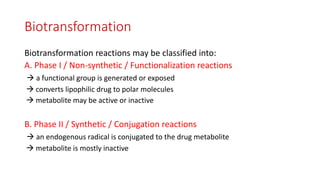
Biotransformation reactions may be classified into:
A. Phase I / Non-synthetic / Functionalization reactions
 a functional group is generated or exposed
 converts lipophilic drug to polar molecules
 metabolite may be active or inactive
B. Phase II / Synthetic / Conjugation reactions
 an endogenous radical is conjugated to the drug metabolite
 metabolite is mostly inactive
Drug
(lipophilic)
Oxidation,
Reduction,
And/or
Hydrolysis
(polar)
Conjugation products
(water soluble)
Phase I Phase II
Following phase I, the drug may be activated,
unchanged, or most often, inactivated
Conjugated drug is usually
inactive
Some drugs directly enter
phase II metabolism
Phase I
• Oxidation
• Reduction
• Hydrolysis
• Cyclization
• Decyclization
• Oxidation reactions are the most
common
• Mostly carried out by
monooxygenases in the liver:
cytochrome P450
• Different cytochrome P450
isoenzymes have affinity for
different substrates
CYP3A4
36%
CYP2D6
19%
CYP2C8/9
16%
CYP1A2
11%
CYP2C19
8%
CYP2E1
4%
CYP2B6
3%
CYP2A6
3%
Relative contribution of cytochrome 450 (CYP) isoforms to
drug biotransformation
CYP3A4 CYP2D6 CYP2C8/9 CYP1A2 CYP2C19 CYP2E1 CYP2B6 CYP2A6
Four isoenzymes
(CYPA3A4, CYP2D6,
CYP2C8/9, and
CYP1A2) are
responsible for the
majority of P450-
catalyzed reactions
CYP3A4 carries out
metabolism of largest
number of drugs
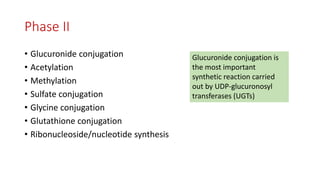
Phase II
• Glucuronide conjugation
• Acetylation
• Methylation
• Sulfate conjugation
• Glycine conjugation
• Glutathione conjugation
• Ribonucleoside/nucleotide synthesis
Glucuronide conjugation is
the most important
synthetic reaction carried
out by UDP-glucuronosyl
transferases (UGTs)
Microsomal enzymes
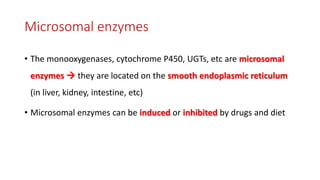
• The monooxygenases, cytochrome P450, UGTs, etc are microsomal
enzymes  they are located on the smooth endoplasmic reticulum
(in liver, kidney, intestine, etc)
• Microsomal enzymes can be induced or inhibited by drugs and diet
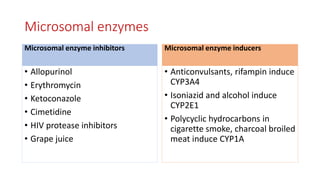
Microsomal enzymes
Microsomal enzyme inhibitors
• Allopurinol
• Erythromycin
• Ketoconazole
• Cimetidine
• HIV protease inhibitors
• Grape juice
Microsomal enzyme inducers
• Anticonvulsants, rifampin induce
CYP3A4
• Isoniazid and alcohol induce
CYP2E1
• Polycyclic hydrocarbons in
cigarette smoke, charcoal broiled
meat induce CYP1A
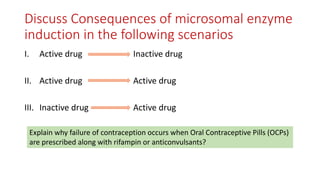
Discuss Consequences of microsomal enzyme
induction in the following scenarios
I. Active drug Inactive drug
II. Active drug Active drug
III. Inactive drug Active drug
Explain why failure of contraception occurs when Oral Contraceptive Pills (OCPs)
are prescribed along with rifampin or anticonvulsants?
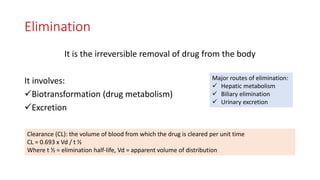
Elimination
It is the irreversible removal of drug from the body
It involves:
Biotransformation (drug metabolism)
Excretion
Major routes of elimination:
 Hepatic metabolism
 Biliary elimination
 Urinary excretion
Clearance (CL): the volume of blood from which the drug is cleared per unit time
CL = 0.693 x Vd / t ½
Where t ½ = elimination half-life, Vd = apparent volume of distribution
Renal elimination of a drug
• Most important channel of excretion for majority of drugs
• The kidney is responsible for excreting all
water soluble substances
Net renal excretion = (Glomerular filtration
+ tubular secretion) – tubular
reabsorption
Excretion by other routes
Drugs and their metabolites can also be excreted in:
Faeces
Most of the drug in faeces is derived from bile
Exhaled air
Gases and volatile liquids
Saliva and sweat
Milk
Kinetics of metabolism
• First-order kinetics
• Zero-order kinetics
First order kinetics
• The rate of elimination is directly
proportional to drug
concentration
• Constant fraction of drug is
eliminated per unit time
• Increase in dose, increases
elimination
• With increase in dose, t1/2
remains unaltered
• Most common
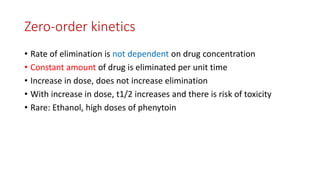
Zero-order kinetics
• Rate of elimination is not dependent on drug concentration
• Constant amount of drug is eliminated per unit time
• Increase in dose, does not increase elimination
• With increase in dose, t1/2 increases and there is risk of toxicity
• Rare: Ethanol, high doses of phenytoin
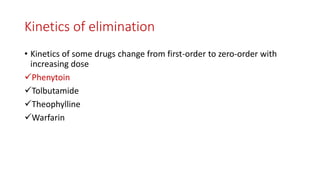
Kinetics of elimination
• Kinetics of some drugs change from first-order to zero-order with
increasing dose
Phenytoin
Tolbutamide
Theophylline
Warfarin
Kinetics of elimination
• First order kinetics:
V = rate of reaction = Vmax [C] / Km
Km = Michaelis constant
• Zero order kinetics:
V = rate of reaction = Vmax [C] /[C]
= Vmax
Plasma half-life (t ½)
Time in which plasma concentration of drug is reduced by half
T ½ = ln2/k = 0.693/k
k= CL/V
T ½ = 0.693x V/CL
T ½ is directly proportional to volume of distribution and inversely
proportional to clearance
Plasma half-life (t ½)
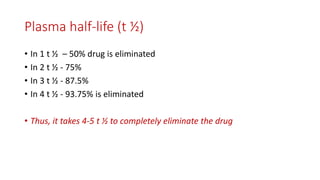
• In 1 t ½ – 50% drug is eliminated
• In 2 t ½ - 75%
• In 3 t ½ - 87.5%
• In 4 t ½ - 93.75% is eliminated
• Thus, it takes 4-5 t ½ to completely eliminate the drug
Therapeutic drug monitoring (TDM)
• It is the measurement of plasma concentration of drugs
• It is required in special situations
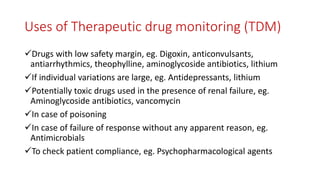
Uses of Therapeutic drug monitoring (TDM)
Drugs with low safety margin, eg. Digoxin, anticonvulsants,
antiarrhythmics, theophylline, aminoglycoside antibiotics, lithium
If individual variations are large, eg. Antidepressants, lithium
Potentially toxic drugs used in the presence of renal failure, eg.
Aminoglycoside antibiotics, vancomycin
In case of poisoning
In case of failure of response without any apparent reason, eg.
Antimicrobials
To check patient compliance, eg. Psychopharmacological agents
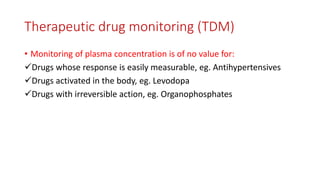
Therapeutic drug monitoring (TDM)
• Monitoring of plasma concentration is of no value for:
Drugs whose response is easily measurable, eg. Antihypertensives
Drugs activated in the body, eg. Levodopa
Drugs with irreversible action, eg. Organophosphates
Thank you
References
• Goodman & Gillman’s: The Pharmacological Basis of Therapeutics,
13th edition. New York: McGraw-Hill, 2018
• Lippincott Illustrated Reviews: Pharmacology(6th ed.). Philadelphia,
PA: Wolters Kluwer.

Pharmacokinetic principles 2

  • 1.
  • 2.
    Biotransformation/ Drug metabolism Biotransformationmeans chemical transformation of the drug in the body Primary site: LIVER Other sites: kidney, intestine, lungs and plasma Importance: converts non-polar (lipid soluble) compounds to polar (lipid-insoluble) …….so that they are not reabsorbed in the renal tubules and are excreted
  • 3.
    Biotransformation/ Drug metabolism Biotransformationof drugs may lead to: Inactivation of active drug Active metabolite from an active drug Activation of inactive drug Few drugs are inactive and need conversion in the body to one or more active metabolites. Such a drug is called PRODRUG
  • 4.
    Biotransformation Biotransformation reactions maybe classified into: A. Phase I / Non-synthetic / Functionalization reactions  a functional group is generated or exposed  converts lipophilic drug to polar molecules  metabolite may be active or inactive B. Phase II / Synthetic / Conjugation reactions  an endogenous radical is conjugated to the drug metabolite  metabolite is mostly inactive
  • 5.
    Drug (lipophilic) Oxidation, Reduction, And/or Hydrolysis (polar) Conjugation products (water soluble) PhaseI Phase II Following phase I, the drug may be activated, unchanged, or most often, inactivated Conjugated drug is usually inactive Some drugs directly enter phase II metabolism
  • 6.
    Phase I • Oxidation •Reduction • Hydrolysis • Cyclization • Decyclization • Oxidation reactions are the most common • Mostly carried out by monooxygenases in the liver: cytochrome P450 • Different cytochrome P450 isoenzymes have affinity for different substrates
  • 7.
    CYP3A4 36% CYP2D6 19% CYP2C8/9 16% CYP1A2 11% CYP2C19 8% CYP2E1 4% CYP2B6 3% CYP2A6 3% Relative contribution ofcytochrome 450 (CYP) isoforms to drug biotransformation CYP3A4 CYP2D6 CYP2C8/9 CYP1A2 CYP2C19 CYP2E1 CYP2B6 CYP2A6 Four isoenzymes (CYPA3A4, CYP2D6, CYP2C8/9, and CYP1A2) are responsible for the majority of P450- catalyzed reactions CYP3A4 carries out metabolism of largest number of drugs
  • 8.
    Phase II • Glucuronideconjugation • Acetylation • Methylation • Sulfate conjugation • Glycine conjugation • Glutathione conjugation • Ribonucleoside/nucleotide synthesis Glucuronide conjugation is the most important synthetic reaction carried out by UDP-glucuronosyl transferases (UGTs)
  • 9.
    Microsomal enzymes • Themonooxygenases, cytochrome P450, UGTs, etc are microsomal enzymes  they are located on the smooth endoplasmic reticulum (in liver, kidney, intestine, etc) • Microsomal enzymes can be induced or inhibited by drugs and diet
  • 10.
    Microsomal enzymes Microsomal enzymeinhibitors • Allopurinol • Erythromycin • Ketoconazole • Cimetidine • HIV protease inhibitors • Grape juice Microsomal enzyme inducers • Anticonvulsants, rifampin induce CYP3A4 • Isoniazid and alcohol induce CYP2E1 • Polycyclic hydrocarbons in cigarette smoke, charcoal broiled meat induce CYP1A
  • 11.
    Discuss Consequences ofmicrosomal enzyme induction in the following scenarios I. Active drug Inactive drug II. Active drug Active drug III. Inactive drug Active drug Explain why failure of contraception occurs when Oral Contraceptive Pills (OCPs) are prescribed along with rifampin or anticonvulsants?
  • 12.
    Elimination It is theirreversible removal of drug from the body It involves: Biotransformation (drug metabolism) Excretion Major routes of elimination:  Hepatic metabolism  Biliary elimination  Urinary excretion Clearance (CL): the volume of blood from which the drug is cleared per unit time CL = 0.693 x Vd / t ½ Where t ½ = elimination half-life, Vd = apparent volume of distribution
  • 13.
    Renal elimination ofa drug • Most important channel of excretion for majority of drugs • The kidney is responsible for excreting all water soluble substances Net renal excretion = (Glomerular filtration + tubular secretion) – tubular reabsorption
  • 14.
    Excretion by otherroutes Drugs and their metabolites can also be excreted in: Faeces Most of the drug in faeces is derived from bile Exhaled air Gases and volatile liquids Saliva and sweat Milk
  • 15.
    Kinetics of metabolism •First-order kinetics • Zero-order kinetics
  • 16.
    First order kinetics •The rate of elimination is directly proportional to drug concentration • Constant fraction of drug is eliminated per unit time • Increase in dose, increases elimination • With increase in dose, t1/2 remains unaltered • Most common
  • 17.
    Zero-order kinetics • Rateof elimination is not dependent on drug concentration • Constant amount of drug is eliminated per unit time • Increase in dose, does not increase elimination • With increase in dose, t1/2 increases and there is risk of toxicity • Rare: Ethanol, high doses of phenytoin
  • 18.
    Kinetics of elimination •Kinetics of some drugs change from first-order to zero-order with increasing dose Phenytoin Tolbutamide Theophylline Warfarin
  • 19.
    Kinetics of elimination •First order kinetics: V = rate of reaction = Vmax [C] / Km Km = Michaelis constant • Zero order kinetics: V = rate of reaction = Vmax [C] /[C] = Vmax
  • 20.
    Plasma half-life (t½) Time in which plasma concentration of drug is reduced by half T ½ = ln2/k = 0.693/k k= CL/V T ½ = 0.693x V/CL T ½ is directly proportional to volume of distribution and inversely proportional to clearance
  • 21.
    Plasma half-life (t½) • In 1 t ½ – 50% drug is eliminated • In 2 t ½ - 75% • In 3 t ½ - 87.5% • In 4 t ½ - 93.75% is eliminated • Thus, it takes 4-5 t ½ to completely eliminate the drug
  • 22.
    Therapeutic drug monitoring(TDM) • It is the measurement of plasma concentration of drugs • It is required in special situations
  • 23.
    Uses of Therapeuticdrug monitoring (TDM) Drugs with low safety margin, eg. Digoxin, anticonvulsants, antiarrhythmics, theophylline, aminoglycoside antibiotics, lithium If individual variations are large, eg. Antidepressants, lithium Potentially toxic drugs used in the presence of renal failure, eg. Aminoglycoside antibiotics, vancomycin In case of poisoning In case of failure of response without any apparent reason, eg. Antimicrobials To check patient compliance, eg. Psychopharmacological agents
  • 24.
    Therapeutic drug monitoring(TDM) • Monitoring of plasma concentration is of no value for: Drugs whose response is easily measurable, eg. Antihypertensives Drugs activated in the body, eg. Levodopa Drugs with irreversible action, eg. Organophosphates
  • 25.
  • 26.
    References • Goodman &Gillman’s: The Pharmacological Basis of Therapeutics, 13th edition. New York: McGraw-Hill, 2018 • Lippincott Illustrated Reviews: Pharmacology(6th ed.). Philadelphia, PA: Wolters Kluwer.

Editor's Notes

  • #8 The isoenzymes are grouped into families designated by numerals (1, 2, 3,….), each having sub-families designated by capital letters (A, B, C….), while individual isoenzymes are allotted numerals (1, 2, 3…)
  • #13 Drug half-life is often used as a measure of drug clearance, because, for many drugs, Vd is a constant