Global Campaigns Masterclass:
    Digital & Social Media
               Oxfam, St Hugh’s
                  14.3.2013


             Prof. Charlie Beckett
 Director, Polis, Head of Dept of Media and
Communications, London School of Economics
                @CharlieBeckett
           E: c.h.beckett@lse.ac.uk
Finding frames
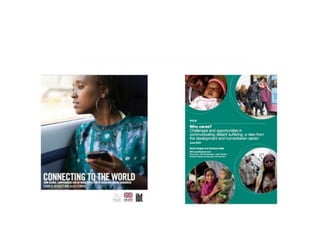
• ‘There is an irony at the heart of much
  campaigning on global challenges – including
  campaigning on humanitarian and
  environmental crises: as our awareness of the
  profound scale of these challenges and the
  difficulty of addressing them grows, we tend
  to rely ever more heavily upon a set of issue-
  specific tactics which may actually militate
  against the emergence of the systemic and
  durable solutions that are needed.’
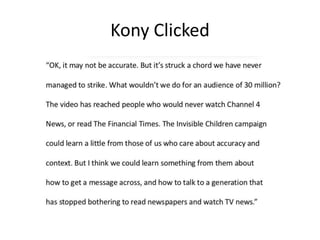
Kony Clicked
Particular points for NGOs
• Oxfam is a thought-leader on this within
  sector
• Increasing public(s) scepticism
• ‘Post-humanitarian’ communications
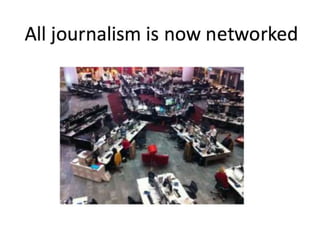
• Development is being disintermediated and
  networked
Strategy considerations
• Skills – who works for you?
• Segmentation – what is your relevance?
• Collaboration – who do you work with?
• Control – where is the power?
• Business model – does your theory of change
  match your practice?
• Are you agents of change or an institution?

Oxfam pres14.3.2013

  • 1.
    Global Campaigns Masterclass: Digital & Social Media Oxfam, St Hugh’s 14.3.2013 Prof. Charlie Beckett Director, Polis, Head of Dept of Media and Communications, London School of Economics @CharlieBeckett E: c.h.beckett@lse.ac.uk
  • 4.
    Finding frames • ‘Thereis an irony at the heart of much campaigning on global challenges – including campaigning on humanitarian and environmental crises: as our awareness of the profound scale of these challenges and the difficulty of addressing them grows, we tend to rely ever more heavily upon a set of issue- specific tactics which may actually militate against the emergence of the systemic and durable solutions that are needed.’
  • 5.
  • 10.
    Particular points forNGOs • Oxfam is a thought-leader on this within sector • Increasing public(s) scepticism • ‘Post-humanitarian’ communications • Development is being disintermediated and networked
  • 11.
    Strategy considerations • Skills– who works for you? • Segmentation – what is your relevance? • Collaboration – who do you work with? • Control – where is the power? • Business model – does your theory of change match your practice? • Are you agents of change or an institution?