Road Accidents Prevention &
Protection
Presented by
B. Rajitha
TAM/ 2013- 028
Definition of Accident
 WHO Definition:
- unpremeditated event resulting in
recognizable damage.
 An unexpected occurrence which may
involve injury due to collision of
vehicle.
 Occurrence in a sequence of events
which usually produces unintended
injury, death or property damage.
ROAD ACCIDENTS
 50 million people worldwide are believed
to be injured in road crashes each year,
15 million seriously injured .
 Developing countries account for more
than 85 per cent of global deaths from
road traffic crashes.
History
The world’s first road traffic death involving a motor
vehicle is alleged to have occurred on 31 August 1869.
Irish scientist Mary Ward died when she fell out of her
steam car and was run over by it.
 Ministry of road transports G.O.I (GOVERNMENT
OF INDIA) on road safety states that in india,
annual economic losses are as high as 3% of gross
domestic product – caused due to road accidents.
 It has also released stats about the economic losses
caused by road accidents in other nations.
STATISTICS OF ROAD ACCIDENT MORTALITY RATES IN INDIA
THE INCIDENCE OF ACCIDENTAL DEATHS HAS SHOWN AN
INCREASING TREND DURING THESE DECADES
Year Average accidental
deaths per year
Average Rate of
accidental deaths per
year
1971-80 113952 18.8
1981-90 145740 19.2
1991-2000 222840 24.0
2001-2010 310168 27.9
2011 390884 32.3
Most disasturous accidents in our state
 As many as 2,640 people lost their lives in 8,400
road accidents reported in the State up to July 21 in
2014.
 The 2013 Mahabubnagar bus accident occurred
on 30 October when a private Volvo bus on the
way from Bangalore to Hyderabad caught fire after
hitting a culvert while overtaking a car, killing 45
people and injuring another 7.
 As many as 2,640 people lost their lives in 8,400 road
accidents reported in the State up to July 21 in 2014.
 According to official figures for 2012, road accidents
accounted for 51.9 per cent deaths in Andhra Pradesh
against the all-India figure of 37.4 per cent.
 In March last year, eight children were killed when a
school bus lost control and plunged into a canal in
Khammam district.
FACTORS BEHIND ROAD ACCIDENTS
A study by K. Rumar, using crash reports as data,
There are commonly 3 factors behind road
accidents.
A. MAN FACTORS 69 % of total accidents
B. MACHINE FACTORS 27 % of total accidents
C. MEDIUM (ROADWAY) FACTORS 4 % of total
accidents
Fault of driver -
71.5%
Defect in road
condition – 4%
Defective vehicle
causes 24.5 %
[A]. HUMAN FACTORS
 Human factors in vehicle collisions include all
factors related to drivers which cause a
collision.
 Examples of human factors include driver
behavior, visual and auditory ability, decision-
making ability, and reaction speed during
driving.
Driver impairment
Drivers caused collission factors include:
i. Alcohol consumption
ii. Physical impairment
iii. Youth & Old age
iv. Drugs use
v. Distraction
ALCOHOL CONSUMPTION
I. Traffic department’s statistics found that in almost
40% of fatally injured drivers, some quantity of
alcohol was consumed prior to the collision.
I. It is the most devastating factor which causes fatal
damage to public.
Vellore on 25th october
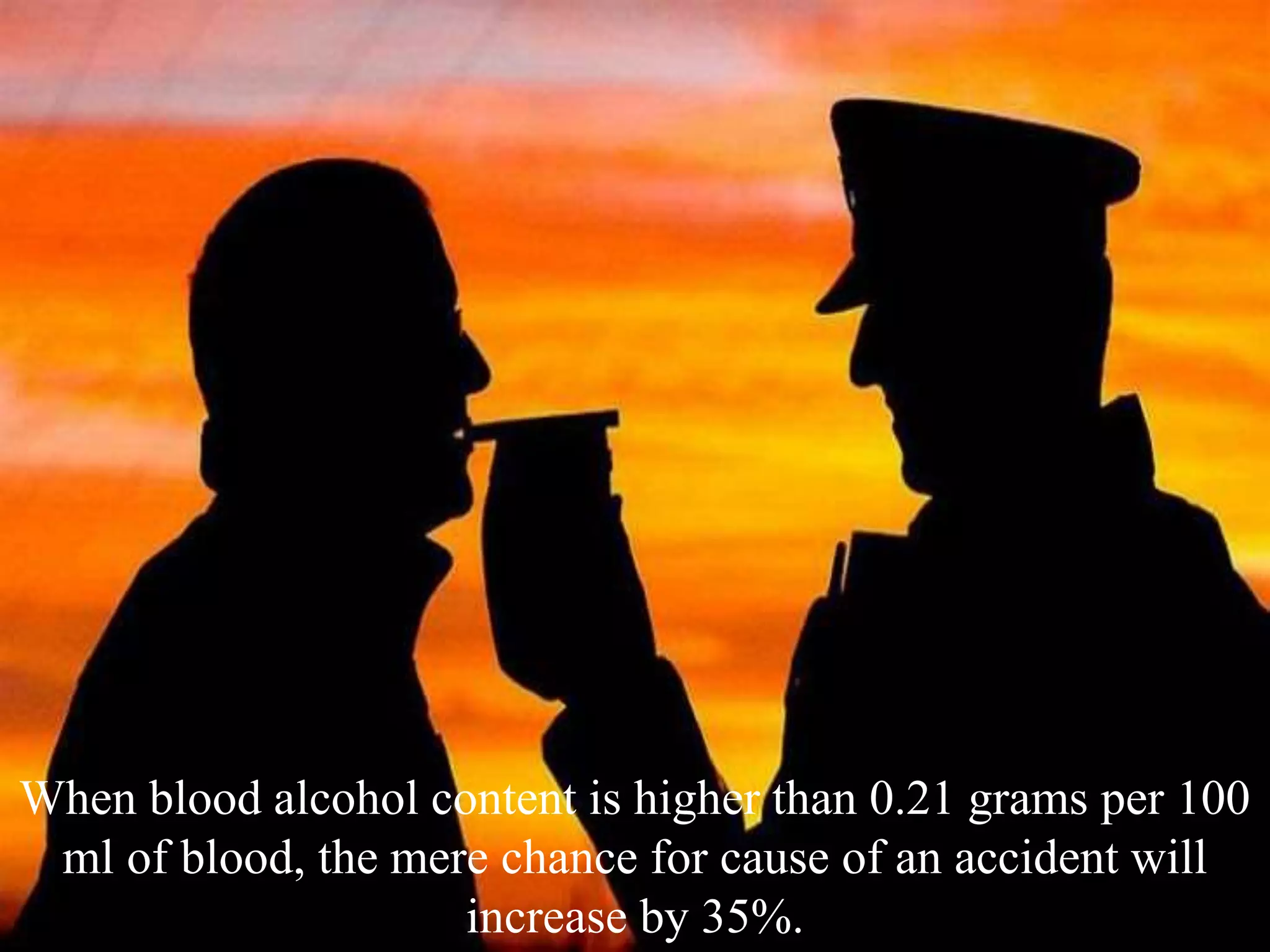
When blood alcohol content is higher than 0.21 grams per 100
ml of blood, the mere chance for cause of an accident will
increase by 35%.
PHYSICAL IMPAIREMENT
 Poor eyesight causes accidents.
 physical impairment may also be a person’s
physical limb inability (handicap), or poor
vision, poor ear audibility, etc..,
YOUTH & OLD AGE
 Teens and early twenty-aged drivers have the
highest incidence of both accidents and fatalities
among all driving age groups.
 This is merely due to their natural aggressive
nature and inexperience in driving.
 Females in this age group suffer a lower accident
and fatality rate than males. Also within this
group, the highest accident incidence rate occurs
within the first year after they procure a license.
 Old age of people also causes road collisions.
 This is due to their slower reaction ability and also
poor eye-sight, low audibility, and physical
weakness.
DRUGS USAGE DURING DRIVING
Illegal or medical narcotic drugs will cause
fatigue (weakness) to the drivers.
Illegal drugs like kokkaine, heroin, brown
sugar etc.., will cause severe sedativeness.
When drivers are addicts to such drugs,
there is every chance for the accident.
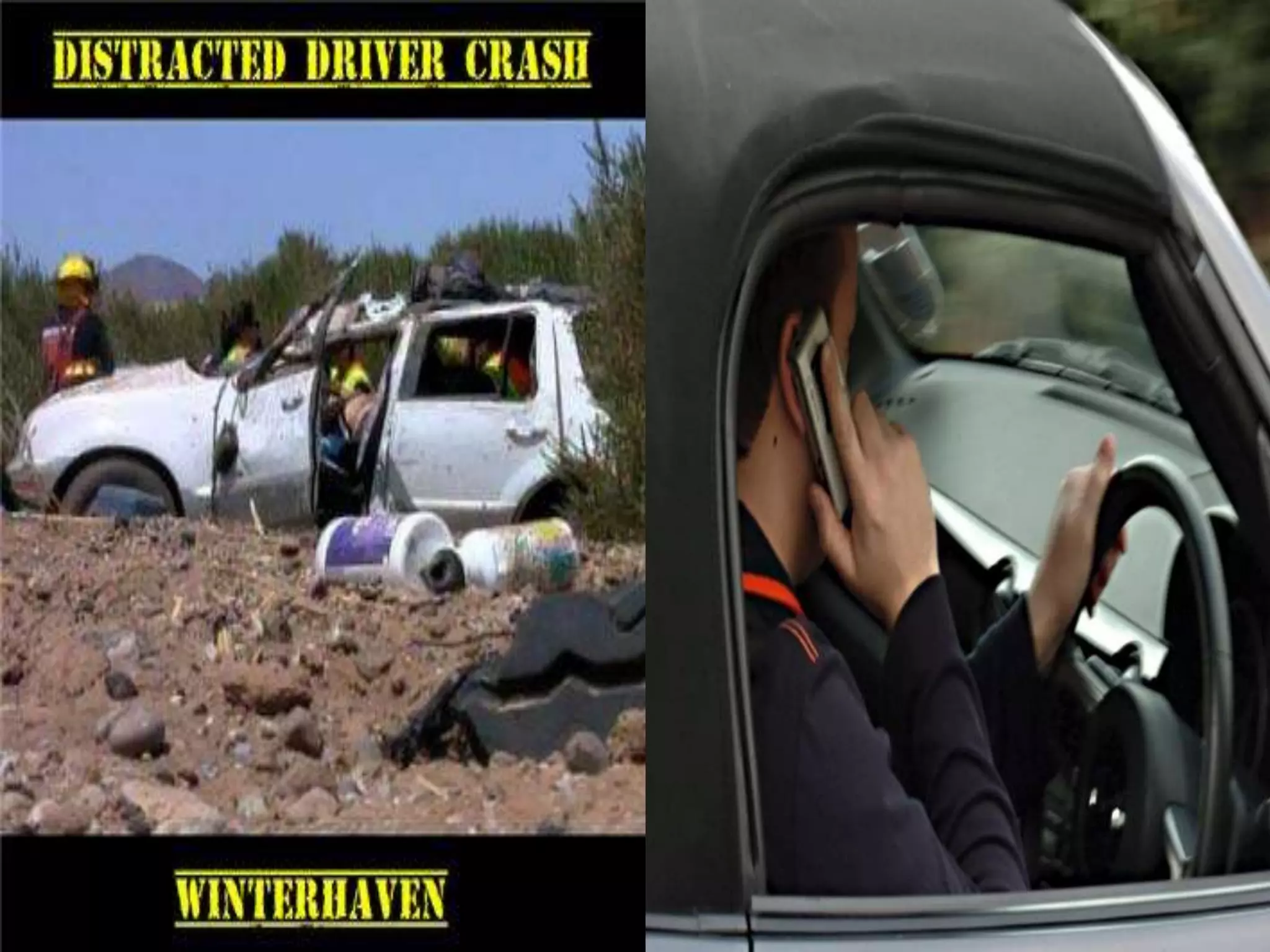
Distractions
 Research suggests that the driver's attention is
affected by distracting sounds such as
conversations and operating a mobile phone
while driving.
 Many jurisdictions now restrict or outlaw the
use of some types of phone within the car.
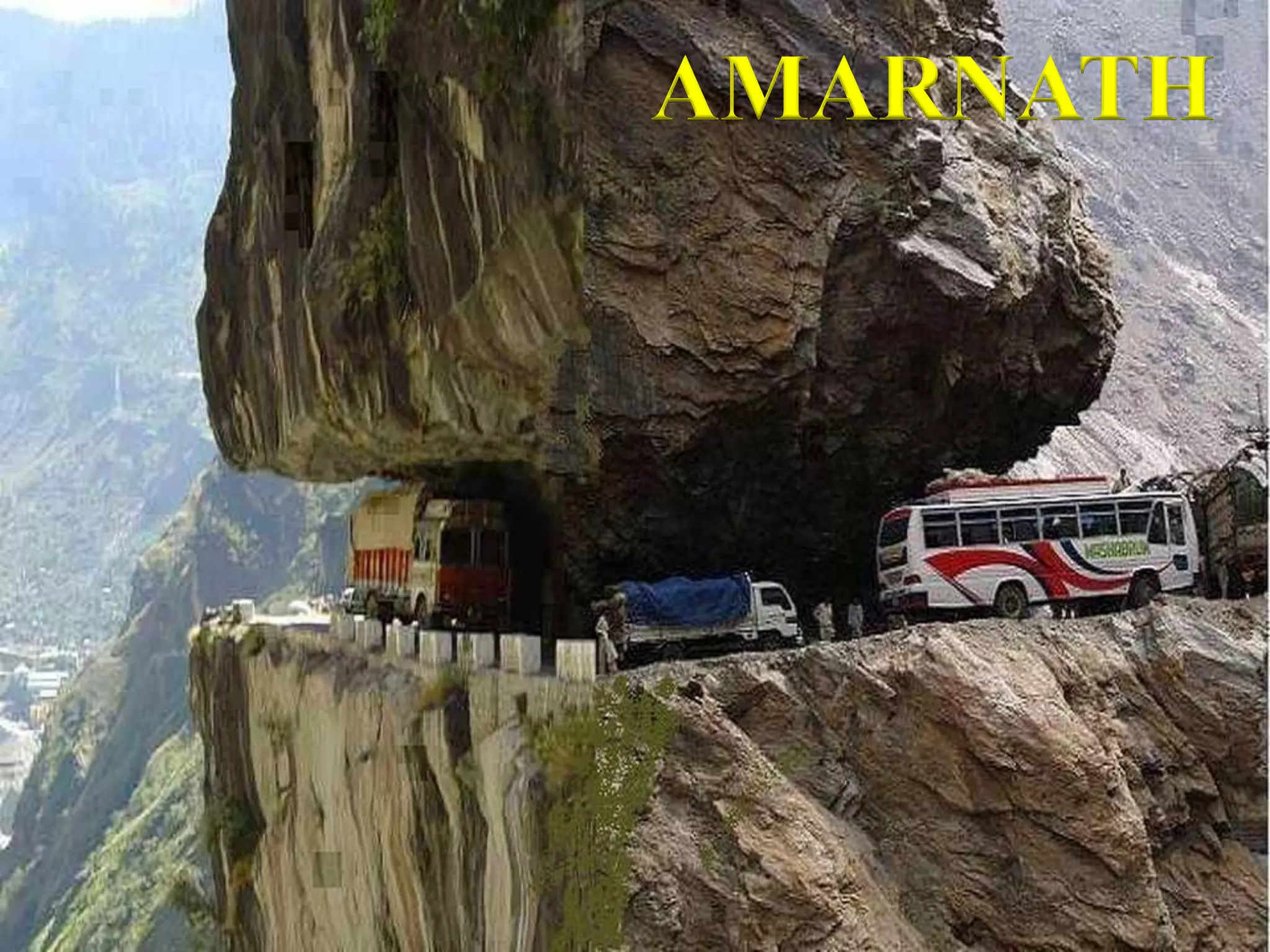
[B]. ROADWAY FACTORS
 About 4% of serious crashes are due to the
roadway or its environment.
 Poor quality roads laid due to corrupt
contractors, not erupting signal boards at
dangerous turnings, hilly and avalanche like
terrains as seen in north indian states like
Darjeeling causes road collisions.
AMARNATH
[C]. VEHICLE FACTORS
 Some crash types involving vehicular design and
maintenance tend to have more serious
consequences.
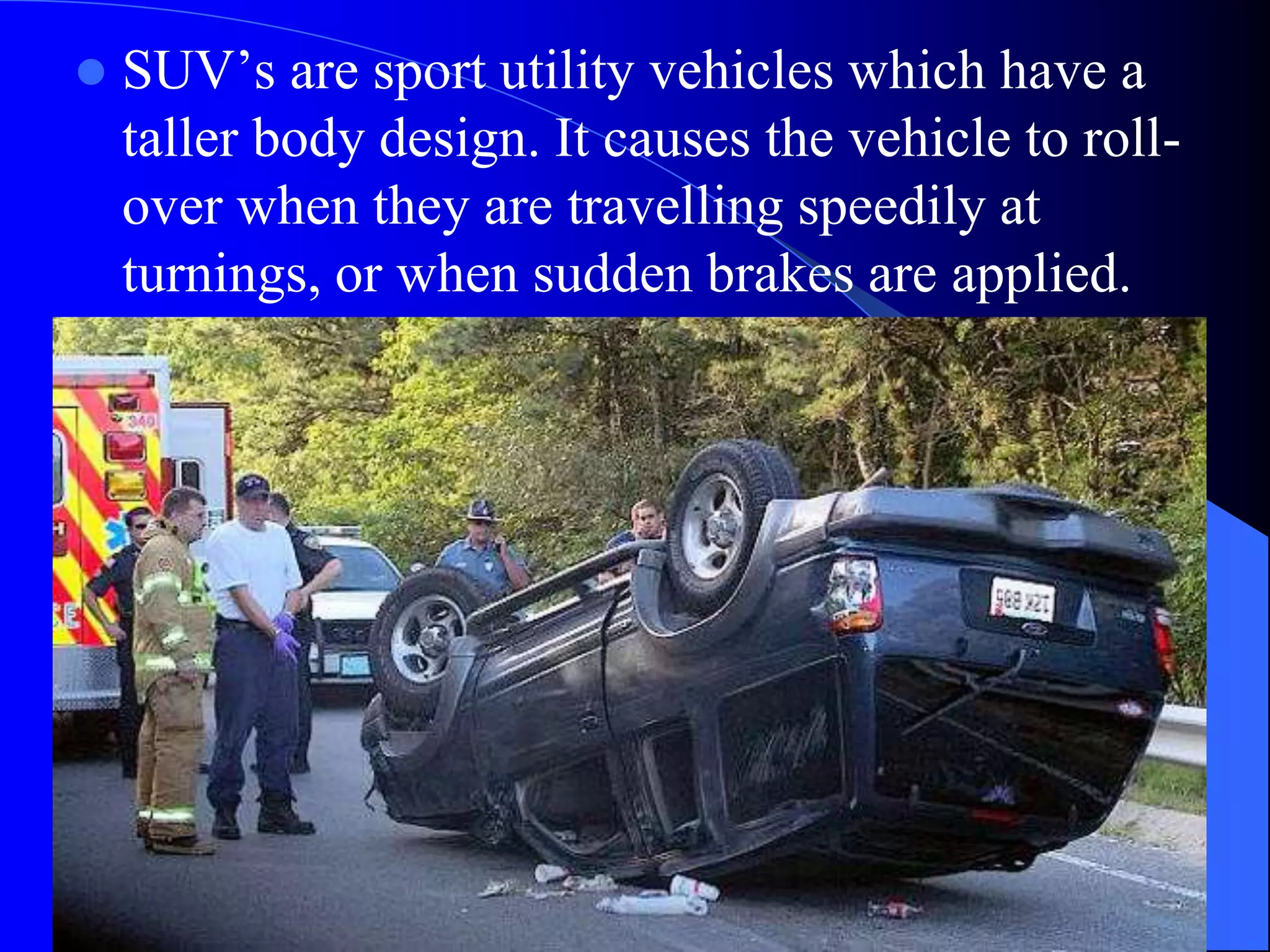
 Rollovers have become more common in recent
years, perhaps due to increased popularity of
taller SUVs and minivans.
 Rollovers can be fatal, especially if the occupants
are ejected because they were not wearing seat belts
 SUV’s are sport utility vehicles which have a
taller body design. It causes the vehicle to roll-
over when they are travelling speedily at
turnings, or when sudden brakes are applied.
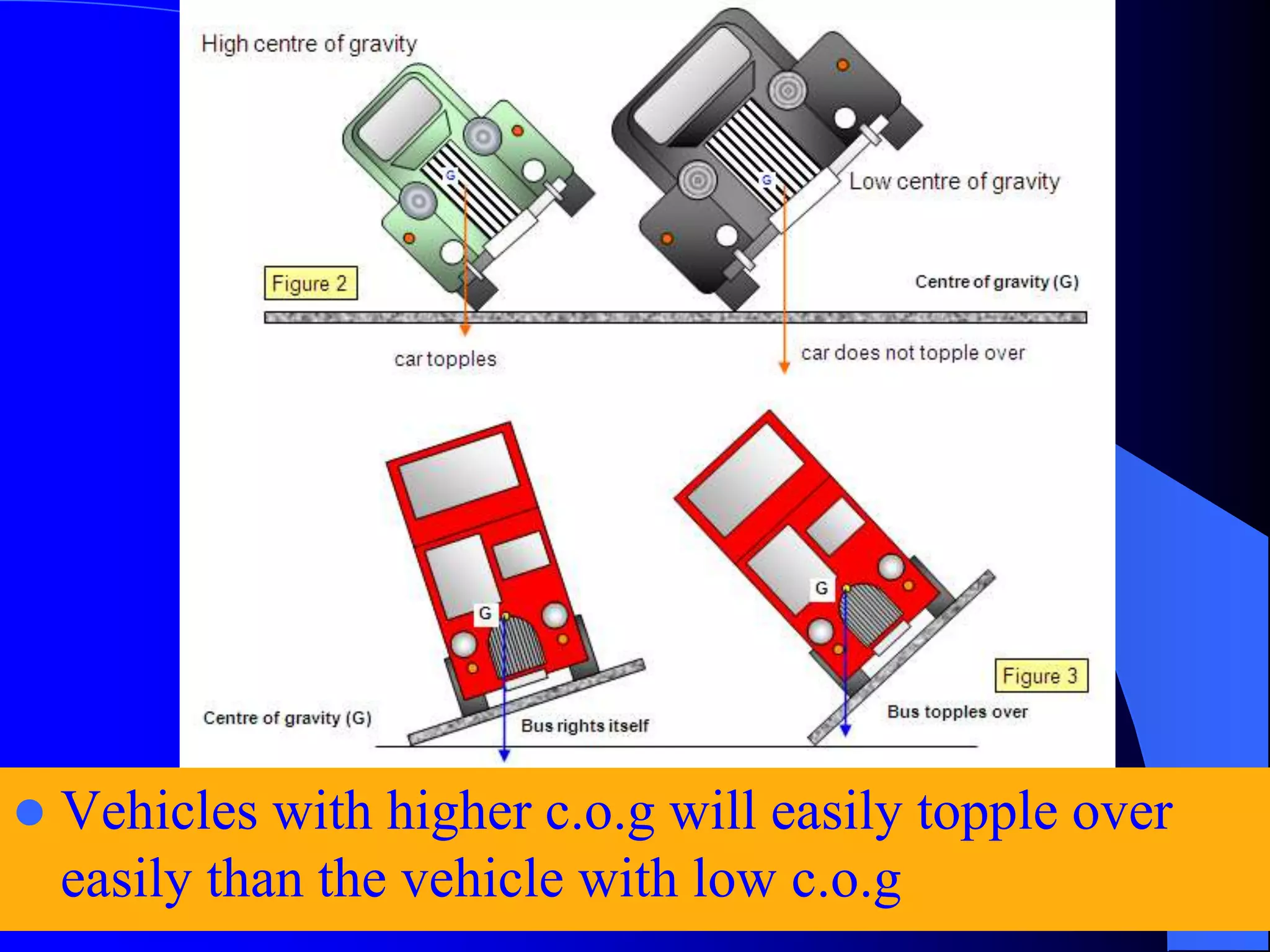
 Vehicles with higher c.o.g will easily topple over
easily than the vehicle with low c.o.g
PREVENTIVE & PROTECTIVE
MEASURES TO BE TAKEN TO
AVOID ROAD ACCIDENTS
A. It is sure that thousands of lives can
be saved, every year, if the
suggestions are implemented
worldwide, especially in developing
and under developed countries.
 Most important method to bring down accidents
is strict enforcement of speed limits. 90 % of
accidents can be avoided by strict enforcement of
speed limits.
 Heavy Penalty should be imposed on ALL those
who cross speed limits. If this is strictly
implemented, nobody will dare to go at high
speed.
 Diving tests for issue of Driving license is to be
made more stringent and foolproof.
 License of drunkard drivers and riders should be
cancelled immediately.
 One way traffic should be implemented in all
roads as far as possible.
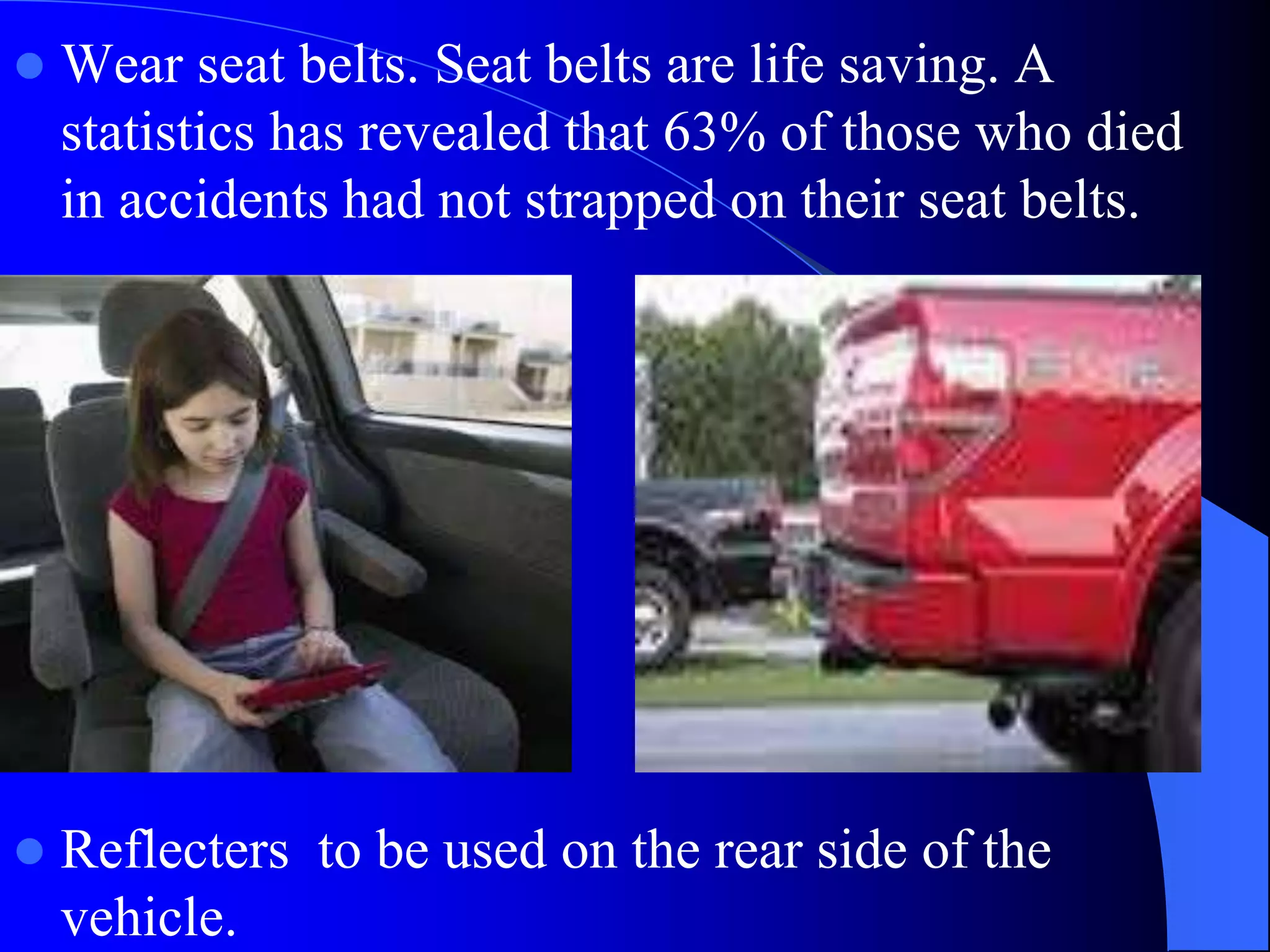
 Wear seat belts. Seat belts are life saving. A
statistics has revealed that 63% of those who died
in accidents had not strapped on their seat belts.
 Reflecters to be used on the rear side of the
vehicle.
 Lower age limit for two wheeler and Heavy
Vehicle license should be raised to 21.
 License of those who make serious accidents
should be cancelled immediately.
 Roads should be properly marked. Sign posts
should be provided wherever required.
 Helmet should be made compulsory by law in all
countries, OR impose a lower speed limit for
those who do not use helmet.
 Issue of Helmet should be made mandatory with
the sale of each two wheeler.
 All sorts of Motor sports, especially racing should
be banned by government.
 All the roads should be maintained properly.
Permanent contracts or arrangements should be
in place for maintaining all roads in good
condition. Because, if a gutter is repaired in time
it can save a life !!!
 Health of vehicles should be strictly checked and
enforced.
 • Eyes of old aged driving license holders should
be checked at regular intervals.
 Foot paths and medians should be made
mandatory for all important roads and
for all new roads.
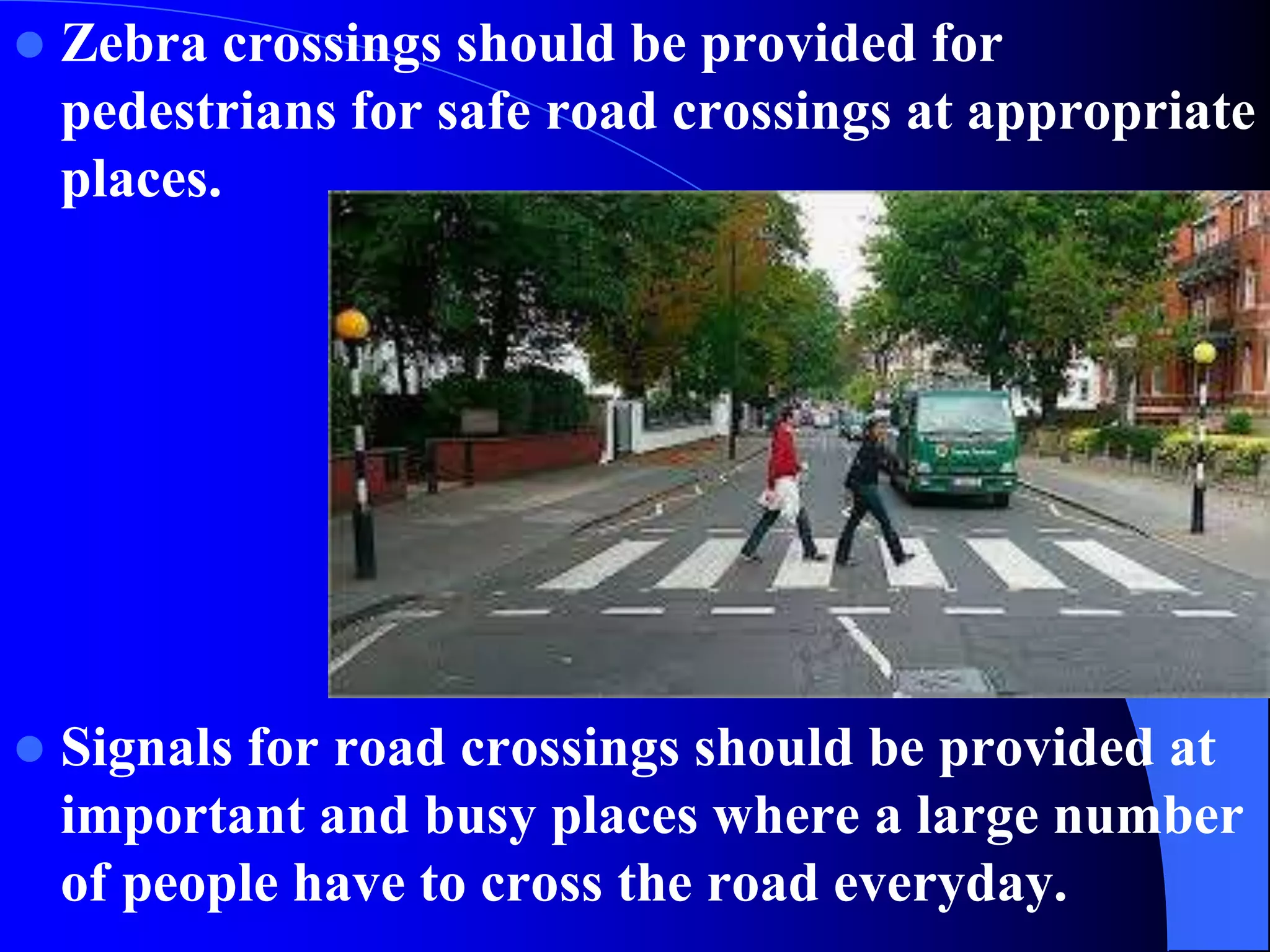
 Zebra crossings should be provided for
pedestrians for safe road crossings at appropriate
places.
 Signals for road crossings should be provided at
important and busy places where a large number
of people have to cross the road everyday.
 Humps & speed breakers should be provided at
all important places like Educational institutions,
temples, hospitals and accident prone areas.
 Humps should be clearly marked, to avoid
accidents.
 Methods of permanent nature should be
followed in Hump marking. For example white /
fluorescent pigmented metal blocks must be used.
Avoid over load and
follow rules as per RTA
Prevention of RTA / RTI
What Can We Do?
Summary Outline
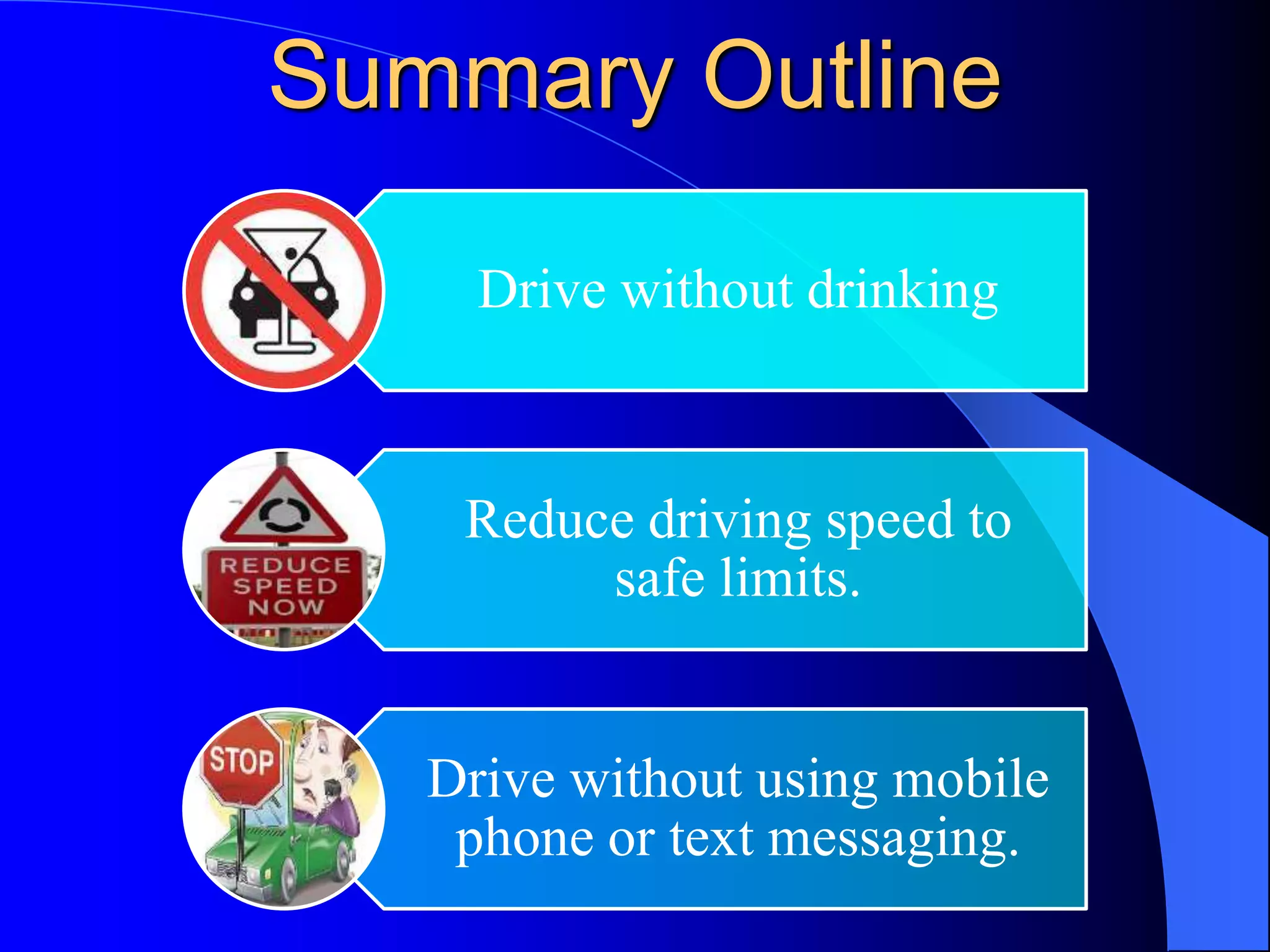
Drive without drinking
Reduce driving speed to
safe limits.
Drive without using mobile
phone or text messaging.

Road accidents tam 2013-28

  • 1.
    Road Accidents Prevention& Protection Presented by B. Rajitha TAM/ 2013- 028
  • 2.
    Definition of Accident WHO Definition: - unpremeditated event resulting in recognizable damage.  An unexpected occurrence which may involve injury due to collision of vehicle.  Occurrence in a sequence of events which usually produces unintended injury, death or property damage.
  • 3.
  • 4.
     50 millionpeople worldwide are believed to be injured in road crashes each year, 15 million seriously injured .  Developing countries account for more than 85 per cent of global deaths from road traffic crashes.
  • 5.
    History The world’s firstroad traffic death involving a motor vehicle is alleged to have occurred on 31 August 1869. Irish scientist Mary Ward died when she fell out of her steam car and was run over by it.
  • 6.
     Ministry ofroad transports G.O.I (GOVERNMENT OF INDIA) on road safety states that in india, annual economic losses are as high as 3% of gross domestic product – caused due to road accidents.  It has also released stats about the economic losses caused by road accidents in other nations.
  • 7.
    STATISTICS OF ROADACCIDENT MORTALITY RATES IN INDIA THE INCIDENCE OF ACCIDENTAL DEATHS HAS SHOWN AN INCREASING TREND DURING THESE DECADES Year Average accidental deaths per year Average Rate of accidental deaths per year 1971-80 113952 18.8 1981-90 145740 19.2 1991-2000 222840 24.0 2001-2010 310168 27.9 2011 390884 32.3
  • 8.
    Most disasturous accidentsin our state  As many as 2,640 people lost their lives in 8,400 road accidents reported in the State up to July 21 in 2014.  The 2013 Mahabubnagar bus accident occurred on 30 October when a private Volvo bus on the way from Bangalore to Hyderabad caught fire after hitting a culvert while overtaking a car, killing 45 people and injuring another 7.
  • 10.
     As manyas 2,640 people lost their lives in 8,400 road accidents reported in the State up to July 21 in 2014.  According to official figures for 2012, road accidents accounted for 51.9 per cent deaths in Andhra Pradesh against the all-India figure of 37.4 per cent.  In March last year, eight children were killed when a school bus lost control and plunged into a canal in Khammam district.
  • 12.
    FACTORS BEHIND ROADACCIDENTS A study by K. Rumar, using crash reports as data, There are commonly 3 factors behind road accidents. A. MAN FACTORS 69 % of total accidents B. MACHINE FACTORS 27 % of total accidents C. MEDIUM (ROADWAY) FACTORS 4 % of total accidents
  • 13.
    Fault of driver- 71.5% Defect in road condition – 4% Defective vehicle causes 24.5 %
  • 14.
    [A]. HUMAN FACTORS Human factors in vehicle collisions include all factors related to drivers which cause a collision.  Examples of human factors include driver behavior, visual and auditory ability, decision- making ability, and reaction speed during driving.
  • 15.
    Driver impairment Drivers causedcollission factors include: i. Alcohol consumption ii. Physical impairment iii. Youth & Old age iv. Drugs use v. Distraction
  • 17.
    ALCOHOL CONSUMPTION I. Trafficdepartment’s statistics found that in almost 40% of fatally injured drivers, some quantity of alcohol was consumed prior to the collision. I. It is the most devastating factor which causes fatal damage to public.
  • 18.
  • 19.
    When blood alcoholcontent is higher than 0.21 grams per 100 ml of blood, the mere chance for cause of an accident will increase by 35%.
  • 20.
    PHYSICAL IMPAIREMENT  Pooreyesight causes accidents.  physical impairment may also be a person’s physical limb inability (handicap), or poor vision, poor ear audibility, etc..,
  • 21.
    YOUTH & OLDAGE  Teens and early twenty-aged drivers have the highest incidence of both accidents and fatalities among all driving age groups.  This is merely due to their natural aggressive nature and inexperience in driving.  Females in this age group suffer a lower accident and fatality rate than males. Also within this group, the highest accident incidence rate occurs within the first year after they procure a license.
  • 22.
     Old ageof people also causes road collisions.  This is due to their slower reaction ability and also poor eye-sight, low audibility, and physical weakness.
  • 23.
    DRUGS USAGE DURINGDRIVING Illegal or medical narcotic drugs will cause fatigue (weakness) to the drivers. Illegal drugs like kokkaine, heroin, brown sugar etc.., will cause severe sedativeness. When drivers are addicts to such drugs, there is every chance for the accident.
  • 24.
    Distractions  Research suggeststhat the driver's attention is affected by distracting sounds such as conversations and operating a mobile phone while driving.  Many jurisdictions now restrict or outlaw the use of some types of phone within the car.
  • 26.
    [B]. ROADWAY FACTORS About 4% of serious crashes are due to the roadway or its environment.  Poor quality roads laid due to corrupt contractors, not erupting signal boards at dangerous turnings, hilly and avalanche like terrains as seen in north indian states like Darjeeling causes road collisions.
  • 27.
  • 30.
    [C]. VEHICLE FACTORS Some crash types involving vehicular design and maintenance tend to have more serious consequences.  Rollovers have become more common in recent years, perhaps due to increased popularity of taller SUVs and minivans.  Rollovers can be fatal, especially if the occupants are ejected because they were not wearing seat belts
  • 31.
     SUV’s aresport utility vehicles which have a taller body design. It causes the vehicle to roll- over when they are travelling speedily at turnings, or when sudden brakes are applied.
  • 32.
     Vehicles withhigher c.o.g will easily topple over easily than the vehicle with low c.o.g
  • 33.
    PREVENTIVE & PROTECTIVE MEASURESTO BE TAKEN TO AVOID ROAD ACCIDENTS A. It is sure that thousands of lives can be saved, every year, if the suggestions are implemented worldwide, especially in developing and under developed countries.
  • 34.
     Most importantmethod to bring down accidents is strict enforcement of speed limits. 90 % of accidents can be avoided by strict enforcement of speed limits.  Heavy Penalty should be imposed on ALL those who cross speed limits. If this is strictly implemented, nobody will dare to go at high speed.
  • 35.
     Diving testsfor issue of Driving license is to be made more stringent and foolproof.  License of drunkard drivers and riders should be cancelled immediately.  One way traffic should be implemented in all roads as far as possible.
  • 36.
     Wear seatbelts. Seat belts are life saving. A statistics has revealed that 63% of those who died in accidents had not strapped on their seat belts.  Reflecters to be used on the rear side of the vehicle.
  • 37.
     Lower agelimit for two wheeler and Heavy Vehicle license should be raised to 21.  License of those who make serious accidents should be cancelled immediately.  Roads should be properly marked. Sign posts should be provided wherever required.
  • 38.
     Helmet shouldbe made compulsory by law in all countries, OR impose a lower speed limit for those who do not use helmet.  Issue of Helmet should be made mandatory with the sale of each two wheeler.  All sorts of Motor sports, especially racing should be banned by government.
  • 39.
     All theroads should be maintained properly. Permanent contracts or arrangements should be in place for maintaining all roads in good condition. Because, if a gutter is repaired in time it can save a life !!!  Health of vehicles should be strictly checked and enforced.  • Eyes of old aged driving license holders should be checked at regular intervals.
  • 40.
     Foot pathsand medians should be made mandatory for all important roads and for all new roads.
  • 41.
     Zebra crossingsshould be provided for pedestrians for safe road crossings at appropriate places.  Signals for road crossings should be provided at important and busy places where a large number of people have to cross the road everyday.
  • 42.
     Humps &speed breakers should be provided at all important places like Educational institutions, temples, hospitals and accident prone areas.  Humps should be clearly marked, to avoid accidents.  Methods of permanent nature should be followed in Hump marking. For example white / fluorescent pigmented metal blocks must be used.
  • 43.
    Avoid over loadand follow rules as per RTA
  • 44.
    Prevention of RTA/ RTI What Can We Do?
  • 45.
    Summary Outline Drive withoutdrinking Reduce driving speed to safe limits. Drive without using mobile phone or text messaging.