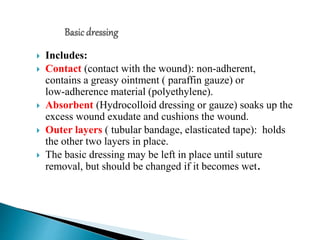
Dr. Faiza Inam
FCPS-II TRAINEE
DERMATOLOGY JPMC
 Dressing is a sterile pad applied to a wound to promote
healing, and prevent further harm..
 Good wound care will minimize
the inflammatory response, speed healing and minimize
scarring.
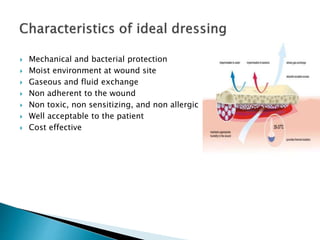
 Mechanical and bacterial protection
 Moist environment at wound site
 Gaseous and fluid exchange
 Non adherent to the wound
 Non toxic, non sensitizing, and non allergic
 Well acceptable to the patient
 Cost effective
 Highly absorbable
 Absorb wound odor
 Sterile
 Easy to use
 Require infrequent changing
 Available in a suitable range of forms and sizes
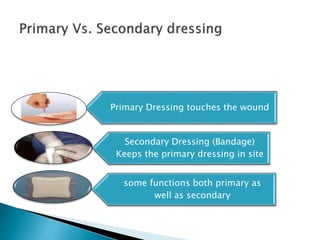
Primary Dressing touches the wound
Secondary Dressing (Bandage)
Keeps the primary dressing in site
some functions both primary as
well as secondary
 Includes:
 Contact (contact with the wound): non‐adherent,
contains a greasy ointment ( paraffin gauze) or
low‐adherence material (polyethylene).
 Absorbent (Hydrocolloid dressing or gauze) soaks up the
excess wound exudate and cushions the wound.
 Outer layers ( tubular bandage, elasticated tape): holds
the other two layers in place.
 The basic dressing may be left in place until suture
removal, but should be changed if it becomes wet.
 If discharging wound: dressing should be changed daily to
minimize bacterial growth.
 Ointments : applied to limit surface bacterial growth and
prevent the dressing from sticking to the wound.
 Topical antibiotics: useful in a contaminated wound but should
be avoided in clean wounds because there is an increasing rate
of bacterial resistance to these agents.
 Wounds may be cleansed with water, normal saline or hydrogen
peroxide, several times daily before the reapplication
of ointment.
 Use of topical silicone gel sheeting or polyurethane self-
adhesive patches after routine dermatologic surgery minimizes
the risk of hypertrophic scars and keloids..
 Gauze
 Tulle
 Hydrogels
 Hydrocolloid
 Synthetic Foams
 Films
 Alginates
 Hydrofibres
 Collagens
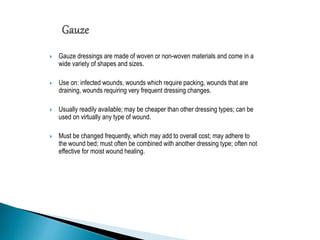
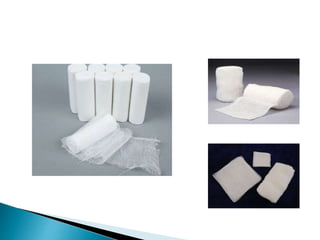
 Gauze dressings are made of woven or non-woven materials and come in a
wide variety of shapes and sizes.
 Use on: infected wounds, wounds which require packing, wounds that are
draining, wounds requiring very frequent dressing changes.
 Usually readily available; may be cheaper than other dressing types; can be
used on virtually any type of wound.
 Must be changed frequently, which may add to overall cost; may adhere to
the wound bed; must often be combined with another dressing type; often not
effective for moist wound healing.
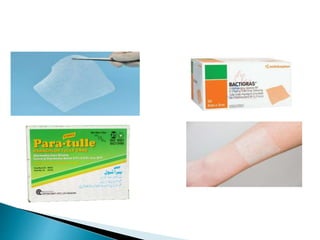
 A light, thin type of cloth that is like a net.
 Dressing does not stick to wound surface.
 Suitable for flat, shallow wound.
 Useful in patient with sensitive skin.
 Require a secondary dressing.
 Bactigras* is an antiseptic, soft paraffin dressing
which soothes and protects the wound whilst helping
to reduce wound infection and inflammation.
 It has low adherence and allows the wound to drain
freely into an absorbent secondary dressing.
 Bactigras is suitable for covering wounds such as
minor burns, lacerations, abrasions, and graft sites.
 Contains chlorhexidine…..an ANTISEPTIC
 Base composed of white soft paraffin,
anhydrous lanolin, and 1.0%
Framycetin Sulphate.
 Framycetin ……. aminoglycoside
group.
 Used for Infected wounds, combining
low adherence with antimicrobial
activity
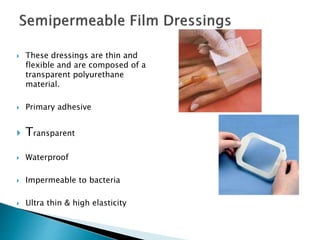
 These dressings are thin and
flexible and are composed of a
transparent polyurethane
material.
 Primary adhesive
 Transparent
 Waterproof
 Impermeable to bacteria
 Ultra thin & high elasticity
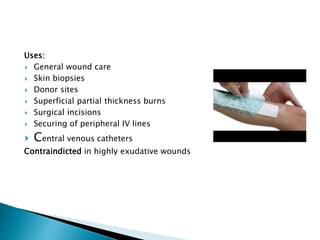
Uses:
 General wound care
 Skin biopsies
 Donor sites
 Superficial partial thickness burns
 Surgical incisions
 Securing of peripheral IV lines
 Central venous catheters
Contraindicted in highly exudative wounds
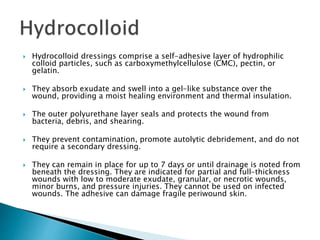
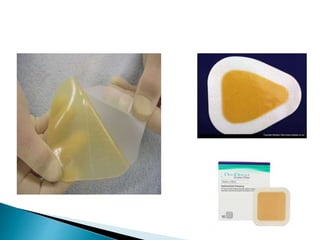
 Hydrocolloid dressings comprise a self-adhesive layer of hydrophilic
colloid particles, such as carboxymethylcellulose (CMC), pectin, or
gelatin.
 They absorb exudate and swell into a gel-like substance over the
wound, providing a moist healing environment and thermal insulation.
 The outer polyurethane layer seals and protects the wound from
bacteria, debris, and shearing.
 They prevent contamination, promote autolytic debridement, and do not
require a secondary dressing.
 They can remain in place for up to 7 days or until drainage is noted from
beneath the dressing. They are indicated for partial and full-thickness
wounds with low to moderate exudate, granular, or necrotic wounds,
minor burns, and pressure injuries. They cannot be used on infected
wounds. The adhesive can damage fragile periwound skin.
 Hydrophilic polysaccharide ( 50%-70%
water)
 Cooling & soothing effect
 Facilitates autolytic debridement
 Available in Amorphous gel, Sheets
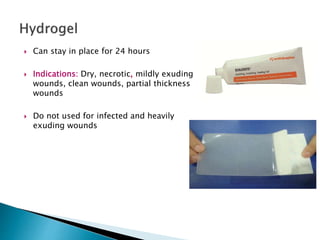
 Can stay in place for 24 hours
 Indications: Dry, necrotic, mildly exuding
wounds, clean wounds, partial thickness
wounds
 Do not used for infected and heavily
exuding wounds
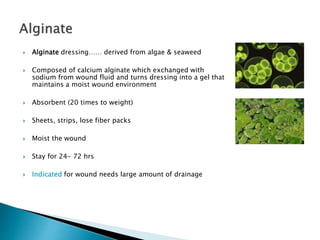
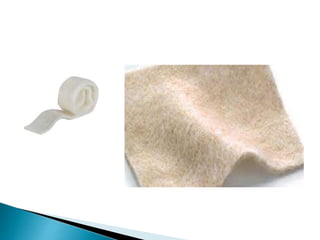
 Alginate dressing…… derived from algae & seaweed
 Composed of calcium alginate which exchanged with
sodium from wound fluid and turns dressing into a gel that
maintains a moist wound environment
 Absorbent (20 times to weight)
 Sheets, strips, lose fiber packs
 Moist the wound
 Stay for 24- 72 hrs
 Indicated for wound needs large amount of drainage
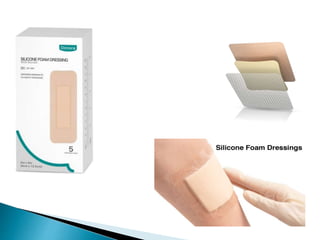
 Adherent silicone layer that provides
excellent bonding to the skin.
 Hydrophilic polyurethane foam with high
absorption capacity.
 Transparent polyurethane film that acts as a
bacterial and viral barrier
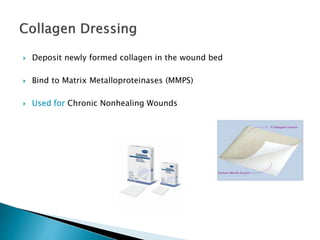
 Deposit newly formed collagen in the wound bed
 Bind to Matrix Metalloproteinases (MMPS)
 Used for Chronic Nonhealing Wounds
WOUND TYPE DRESSING TYPE
Clean medium-to
high exudate
(epithelialising)
•Paraffin gauze
•Knitted
viscose primary dressing.
Clean, dry,
low exudate (epithelialis
ing)
•Absorbent perforated
plastic film-faced dressing
•Vapour-permeable
adhesive film dressing
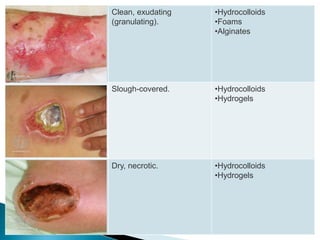
Clean, exudating
(granulating).
•Hydrocolloids
•Foams
•Alginates
Slough-covered. •Hydrocolloids
•Hydrogels
Dry, necrotic. •Hydrocolloids
•Hydrogels
 Maceration (sogginess) of surrounding skin (change
dressing frequently and use a more absorbent dressing).
 Irritant contact dermatitis (protect skin
with emollient or barrier film).
 Allergic contact dermatitis (uncommon: change dressing
type, apply topical steroids).
 Wet wrap therapy is a treatment where you
put wet dressings to your skin to rehydrate
and soothe it.
 Wet wrap therapy is best for people that have
moderate to severe atopic dermatitis, chronic
eczema, erythroderma
 Wet wraps work via three different ways:
 Cooling – as water gradually evaporates from the bandages this cools the skin and
helps relieve inflammation, itching and soreness.
 Moisturizing – emollients covered over with wet bandages are deeply absorbed into the
skin to provide a longer lasting moisturizing effect.
 Steroid absorption – enhanced absorption of topical steroid molecules into both the
superficial and deeper layers of skin where inflammation is present.
 In addition, the bandages provide protection from the itching and scratching cycle so
that skin gets a chance to heal properly.
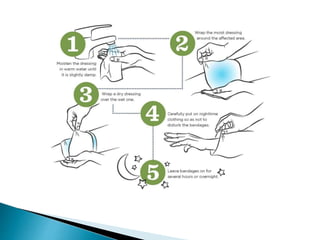
 There are different methods and bandages used for wet wrapping but the basic technique is as
follows.
 Depending on the area being treated the patient may first soak in a bath with bath oil
or emollient solution
 An emollient and/or steroid cream (as prescribed by the doctor) is liberally applied to the area
 Bandages (often a tubular bandage is used) soaked in warm water are wrapped or applied over
the top of the creams
 Dry bandages are placed over the top of the wet bandages to protect clothing
 Later on, the dry bandage may be removed and water sprayed on the underneath layer to keep it
damp, before reapplying the dry outer bandage.
 The benefits of wet wrapping include:
 Reduced itching and scratching
 Reduced redness and inflammation
 Skin rehydration
 Better skin healing process
 Reduced steroid usage once the condition is controlled
 Improved sleep
 As skin improves, taper off wet wrap frequency rather than stopping
abruptly.
 Moisturizers should be applied 3-4 times a day otherwise the skin will
become dry and itchy again.
 Wet dressings will dry after a few hours.
 Do not leave the dressings on dry (unless your child is sleeping) as dry
dressings can irritate the skin by causing it to become hot, dry and itchy.
 Use a spray bottle of warm water to moisten bandages.
 Crepe bandages used for wet dressings may be washed in the washing
machine
 Do not wash or reuse the disposable towels.
 Do not use antiseptic bath oils in the wet dressings as these may irritate
and burn your child’s skin.
 Cool compressing is a wet dressing for the face.
 Wet disposable towels in a bowl of cool water and
bath oil.
 Hold the towels on to the face for 5–10 minutes.
 Apply moisturizer immediately after
compressing.
 Cool compressing should be applied as often as
needed until the itch is relieved
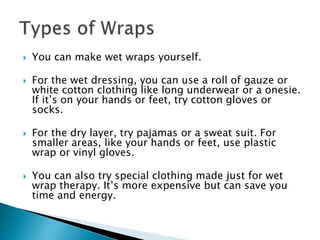
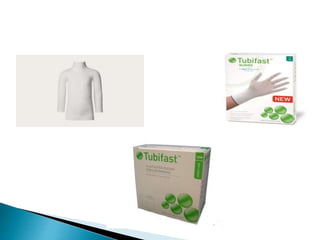
 You can make wet wraps yourself.
 For the wet dressing, you can use a roll of gauze or
white cotton clothing like long underwear or a onesie.
If it’s on your hands or feet, try cotton gloves or
socks.
 For the dry layer, try pajamas or a sweat suit. For
smaller areas, like your hands or feet, use plastic
wrap or vinyl gloves.
 You can also try special clothing made just for wet
wrap therapy. It’s more expensive but can save you
time and energy.
dressing.pptx
dressing.pptx

dressing.pptx

  • 1.
    Dr. Faiza Inam FCPS-IITRAINEE DERMATOLOGY JPMC
  • 2.
     Dressing isa sterile pad applied to a wound to promote healing, and prevent further harm..  Good wound care will minimize the inflammatory response, speed healing and minimize scarring.
  • 3.
     Mechanical andbacterial protection  Moist environment at wound site  Gaseous and fluid exchange  Non adherent to the wound  Non toxic, non sensitizing, and non allergic  Well acceptable to the patient  Cost effective
  • 4.
     Highly absorbable Absorb wound odor  Sterile  Easy to use  Require infrequent changing  Available in a suitable range of forms and sizes
  • 5.
    Primary Dressing touchesthe wound Secondary Dressing (Bandage) Keeps the primary dressing in site some functions both primary as well as secondary
  • 6.
     Includes:  Contact(contact with the wound): non‐adherent, contains a greasy ointment ( paraffin gauze) or low‐adherence material (polyethylene).  Absorbent (Hydrocolloid dressing or gauze) soaks up the excess wound exudate and cushions the wound.  Outer layers ( tubular bandage, elasticated tape): holds the other two layers in place.  The basic dressing may be left in place until suture removal, but should be changed if it becomes wet.
  • 7.
     If dischargingwound: dressing should be changed daily to minimize bacterial growth.  Ointments : applied to limit surface bacterial growth and prevent the dressing from sticking to the wound.  Topical antibiotics: useful in a contaminated wound but should be avoided in clean wounds because there is an increasing rate of bacterial resistance to these agents.  Wounds may be cleansed with water, normal saline or hydrogen peroxide, several times daily before the reapplication of ointment.  Use of topical silicone gel sheeting or polyurethane self- adhesive patches after routine dermatologic surgery minimizes the risk of hypertrophic scars and keloids..
  • 8.
     Gauze  Tulle Hydrogels  Hydrocolloid  Synthetic Foams  Films  Alginates  Hydrofibres  Collagens
  • 9.
     Gauze dressingsare made of woven or non-woven materials and come in a wide variety of shapes and sizes.  Use on: infected wounds, wounds which require packing, wounds that are draining, wounds requiring very frequent dressing changes.  Usually readily available; may be cheaper than other dressing types; can be used on virtually any type of wound.  Must be changed frequently, which may add to overall cost; may adhere to the wound bed; must often be combined with another dressing type; often not effective for moist wound healing.
  • 11.
     A light,thin type of cloth that is like a net.  Dressing does not stick to wound surface.  Suitable for flat, shallow wound.  Useful in patient with sensitive skin.  Require a secondary dressing.
  • 12.
     Bactigras* isan antiseptic, soft paraffin dressing which soothes and protects the wound whilst helping to reduce wound infection and inflammation.  It has low adherence and allows the wound to drain freely into an absorbent secondary dressing.  Bactigras is suitable for covering wounds such as minor burns, lacerations, abrasions, and graft sites.  Contains chlorhexidine…..an ANTISEPTIC
  • 14.
     Base composedof white soft paraffin, anhydrous lanolin, and 1.0% Framycetin Sulphate.  Framycetin ……. aminoglycoside group.  Used for Infected wounds, combining low adherence with antimicrobial activity
  • 15.
     These dressingsare thin and flexible and are composed of a transparent polyurethane material.  Primary adhesive  Transparent  Waterproof  Impermeable to bacteria  Ultra thin & high elasticity
  • 16.
    Uses:  General woundcare  Skin biopsies  Donor sites  Superficial partial thickness burns  Surgical incisions  Securing of peripheral IV lines  Central venous catheters Contraindicted in highly exudative wounds
  • 17.
     Hydrocolloid dressingscomprise a self-adhesive layer of hydrophilic colloid particles, such as carboxymethylcellulose (CMC), pectin, or gelatin.  They absorb exudate and swell into a gel-like substance over the wound, providing a moist healing environment and thermal insulation.  The outer polyurethane layer seals and protects the wound from bacteria, debris, and shearing.  They prevent contamination, promote autolytic debridement, and do not require a secondary dressing.  They can remain in place for up to 7 days or until drainage is noted from beneath the dressing. They are indicated for partial and full-thickness wounds with low to moderate exudate, granular, or necrotic wounds, minor burns, and pressure injuries. They cannot be used on infected wounds. The adhesive can damage fragile periwound skin.
  • 19.
     Hydrophilic polysaccharide( 50%-70% water)  Cooling & soothing effect  Facilitates autolytic debridement  Available in Amorphous gel, Sheets
  • 20.
     Can stayin place for 24 hours  Indications: Dry, necrotic, mildly exuding wounds, clean wounds, partial thickness wounds  Do not used for infected and heavily exuding wounds
  • 21.
     Alginate dressing……derived from algae & seaweed  Composed of calcium alginate which exchanged with sodium from wound fluid and turns dressing into a gel that maintains a moist wound environment  Absorbent (20 times to weight)  Sheets, strips, lose fiber packs  Moist the wound  Stay for 24- 72 hrs  Indicated for wound needs large amount of drainage
  • 23.
     Adherent siliconelayer that provides excellent bonding to the skin.  Hydrophilic polyurethane foam with high absorption capacity.  Transparent polyurethane film that acts as a bacterial and viral barrier
  • 25.
     Deposit newlyformed collagen in the wound bed  Bind to Matrix Metalloproteinases (MMPS)  Used for Chronic Nonhealing Wounds
  • 26.
    WOUND TYPE DRESSINGTYPE Clean medium-to high exudate (epithelialising) •Paraffin gauze •Knitted viscose primary dressing. Clean, dry, low exudate (epithelialis ing) •Absorbent perforated plastic film-faced dressing •Vapour-permeable adhesive film dressing
  • 27.
  • 28.
     Maceration (sogginess)of surrounding skin (change dressing frequently and use a more absorbent dressing).  Irritant contact dermatitis (protect skin with emollient or barrier film).  Allergic contact dermatitis (uncommon: change dressing type, apply topical steroids).
  • 30.
     Wet wraptherapy is a treatment where you put wet dressings to your skin to rehydrate and soothe it.  Wet wrap therapy is best for people that have moderate to severe atopic dermatitis, chronic eczema, erythroderma
  • 31.
     Wet wrapswork via three different ways:  Cooling – as water gradually evaporates from the bandages this cools the skin and helps relieve inflammation, itching and soreness.  Moisturizing – emollients covered over with wet bandages are deeply absorbed into the skin to provide a longer lasting moisturizing effect.  Steroid absorption – enhanced absorption of topical steroid molecules into both the superficial and deeper layers of skin where inflammation is present.  In addition, the bandages provide protection from the itching and scratching cycle so that skin gets a chance to heal properly.
  • 32.
     There aredifferent methods and bandages used for wet wrapping but the basic technique is as follows.  Depending on the area being treated the patient may first soak in a bath with bath oil or emollient solution  An emollient and/or steroid cream (as prescribed by the doctor) is liberally applied to the area  Bandages (often a tubular bandage is used) soaked in warm water are wrapped or applied over the top of the creams  Dry bandages are placed over the top of the wet bandages to protect clothing  Later on, the dry bandage may be removed and water sprayed on the underneath layer to keep it damp, before reapplying the dry outer bandage.
  • 35.
     The benefitsof wet wrapping include:  Reduced itching and scratching  Reduced redness and inflammation  Skin rehydration  Better skin healing process  Reduced steroid usage once the condition is controlled  Improved sleep
  • 36.
     As skinimproves, taper off wet wrap frequency rather than stopping abruptly.  Moisturizers should be applied 3-4 times a day otherwise the skin will become dry and itchy again.  Wet dressings will dry after a few hours.  Do not leave the dressings on dry (unless your child is sleeping) as dry dressings can irritate the skin by causing it to become hot, dry and itchy.  Use a spray bottle of warm water to moisten bandages.  Crepe bandages used for wet dressings may be washed in the washing machine  Do not wash or reuse the disposable towels.  Do not use antiseptic bath oils in the wet dressings as these may irritate and burn your child’s skin.
  • 37.
     Cool compressingis a wet dressing for the face.  Wet disposable towels in a bowl of cool water and bath oil.  Hold the towels on to the face for 5–10 minutes.  Apply moisturizer immediately after compressing.  Cool compressing should be applied as often as needed until the itch is relieved
  • 38.
     You canmake wet wraps yourself.  For the wet dressing, you can use a roll of gauze or white cotton clothing like long underwear or a onesie. If it’s on your hands or feet, try cotton gloves or socks.  For the dry layer, try pajamas or a sweat suit. For smaller areas, like your hands or feet, use plastic wrap or vinyl gloves.  You can also try special clothing made just for wet wrap therapy. It’s more expensive but can save you time and energy.

Editor's Notes

  • #3 Ent further harm