SUTURES & NEEDLES
Prof. Dr. Ram Sharan Mehta
SUTURES MATERIAL USE IN
THREATRE AND ITS CARE:
• Suture: Stitch used in surgery to hold living
tissues or structure until normal process of
healing complete.
• Ligature: It is also suturing used to encircle
blood vessels to control bleeding.
• Suture may simply be defined as a length of
material used to maintain approximation of
body tissues until healing process has
occurred.
SUTURES
Sutures bind tissues together
Ligatures or Ties obliterate the lumen of ductular
tissues
• Sutures are used to hold skin, internal organs,
blood vessels and all other tissues together,
after they have been severed by injury or
surgery.
• Sutures are designed to help the healing of
the body by closely opposing the two sides of
a wound to minimize scar formation or to
prevent leaking blood, like in vessels.
• They have to comply with several
requirements to be effective. They must be
strong (so they do not break), non-toxic and
hypoallergenic (to avoid adverse reactions in
the body), and flexible (so they can be tied
and knotted easily).
• In addition, they must lack the so called
"wick effect", which means that sutures
must not allow fluids to penetrate the body
through them from outside, which could
easily cause infections
Tissue adhesives
In recent years, topical cyanoacrylate adhesives ("liquid
stitches") have been used in combination with, or as an
alternative to, sutures in wound closure. The adhesive remains
liquid until exposed to water or water-containing
substances/tissue, after which it cures (polymerizes) and forms
a flexible film that bonds to the underlying surface. The tissue
adhesive has been shown to act as a barrier to microbial
penetration as long as the adhesive film remains intact.
Antimicrobial sutures
Another recent development in wound closure involves the
use of sutures coated with antimicrobial substances to reduce
the chances of wound infection. While long-term studies are
not yet available, preliminary results indicate that these
sutures are effective at keeping bacteria out of wounds.
Function of sutures
• To hold together tissues, or structure which
have been divided as a part of the surgical
intervention.
• To approximate (hold) a body tissue or
structures with an implant in order to keep
the implant in the correct position.
• To ligate ( tie off) blood vessels in order to the
prevent bleeding , the correct term for this is
ligature, ( although material used is the same)
• To clearly identify and separate specific structures
during surgery in order to assist with the surgical
procedure by acting as a marker.
• To allow gentle retraction of a specific structure
during the surgery in order to improve visions
and access for the surgeon.
• To identify the exact nature and specimen of
body tissue removed during surgery in order to
assist the exact histology in the laboratory.
Function of sutures
• To hold together tissues, or structure which have been divided as a
part of the surgical intervention.
• To approximate (hold) a body tissue or structures with an implant in
order to keep the implant in the correct position.
• To ligate ( tie off) blood vessels in order to the prevent bleeding , the
correct term for this is ligature, ( although material used is the same)
• To clearly identify and separate specific structures during surgery in
order to assist with the surgical procedure by acting as a marker.
• To allow gentle retraction of a specific structure during the surgery in
order to improve visions and access for the surgeon.
• To identify the exact nature and specimen of body tissue removed
during surgery in order to assist the exact histology in the laboratory.
Classification of sutures
Absorbable
Non Absorbable
• Absorbable: These types of sutures material is
absorbed by the body at varying duration following
surgery ranging from 7 days to 6 months. For eg:- Plain
catgut, Chronic catgut. Vicryl.
• Non Absorbable: These types of suture remain within
the body unless removed intentionally. They are
therefore used in areas that have poor healing, or
where natural healing can’t occur such as Prolene, silk.
Sutures material is also classified according to their
origin.
• Natural
• Synthetic
• Natural: – Natural sutures are made that are
originate from an animal or plant source, which
produce less tissue reaction such as catgut.
• Synthetic:- These types of sutures are made from
a wide variety of polymers (complex molecules).
They give a more uniform predictable
performance than natural material and cause less
reactions in surrounding tissues. e. g Prolene,
Maxon.
• Mono filament: These suture are made from
single strand or filament or material.
• Multifilament or polyfilament: These suture are
made up of several strand or filament of materials
either braided or twisted together to from one
threat – It is flexible and easy to handle and use (
Dexon)
• Characteristic of sutures materials:
- Absorbable and Nonabsorbable
• Natural and Synthetic
• Monofilament and Multifilament.
TYPES
A Based on origin
– animal- catgut, silk
– vegetable- cotton, linen
– synthetic - nylon,
– metal- stainless steel
B Whether the material is absorbable or not
Absorbable or Nonabsorbabl
Selection criteria of suture materials
• Comfortable and natural healing.
• Minimal tissues reaction.
• Not creating a suitable environment for bacterial growth.
• Secure knot holding.
• Easy to use.
• Safety for the surgical team as well as patient.
• Absorbable and Non absorbable
• Natural and Synthetic.
• Monofilament and Multifilament.
• Absorption rate.
• Needle point and type
• Function of suture and each stage.
• Healing abilities.
• Healing rate.
• Strength of tissue to be approximately.
Care and storage of sutures materials
• Keep dry and dust free area of the theatre.
• Easily visible.
• Easily transferable to other operating theatre.
• Stored efficiently in each operative theatre.
• Expiry date/ time
• Manufacture company.
• Types of materials.
Absorbable materials:
(Natural organic)
• Catgut: - Prepared from submucosa of the small
intestine that government inspected of sheep and
bovine intestine. (Sterilized by gamma irradiation)
• Chronic Catgut: The terms chronic indicate that
the ribbons have been treated with chromic salt,
which increased material strength and reduce
tissue irritation. This type of catgut is use in
Peritoneum cavity, Muscles, facia, uterine tube.
• Collagen: - Like catgut these are prepared as plain
or chromic catgut.
Non Absorbable suture materials
• Linen- used in GI Surgery.
• Silk: - Silk can be used for skin suture, Opthalmic
and oral surgery.
• Polyester: Use vascular, orthropaedic Surgery.
• Stainless steel: These materials used for tendon
and for suturing of chest, ortho.
• Other non absorbable materials
Adhesive stripe metal clips wire, nail and plates.
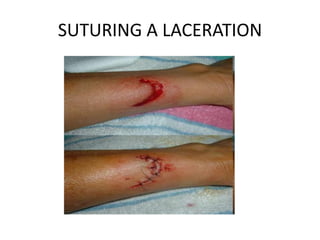
SUTURING A LACERATION
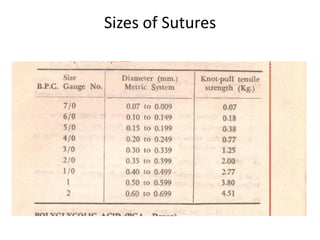
Sizes of Sutures
Needles
Common needles used in theatre and
its types
• Round – bodies needles
• Cutting needles
• Reverse cutting needles.
• Blunt needles.
Needle shape
• Quarter – circle
• Three- eight circle
• Half- circle.
• Five – eight – circle
• J- shaped
• Straight.
NEEDLES
Traumatic and atraumatic needles with sutures
Traumatic needles with sutures are those which are supplied to the
hospital plain, i.e., the manufacturer supplies the suture thread and the
eyed needle to use the suture as separate items. The suture must be
threaded as it is done when sewing at home.
Atraumatic needles with sutures include an eyeless needle attached to a
specific length of suture thread. The suture manufacturer swages the
suture thread to the eyeless atraumatic needle at the factory. There are
several advantages to having the needle pre-mounted on the sutre. The
doctor or the nurse do not have to spend time threading the suture on the
needle. More importantly, the suture thread which is swaged using a hole
at the end of the needle is smaller in size than the needle body. In
traumatic needle with suture, the thread comes out of the needle's hole
or eye on both sides. When passing through the tissues, this type of suture
rips the tissue to a certain extent. With the atraumatic needle with suture
this does not happen. They produce no trauma to the tissue, hence the
name "atraumatic". Because of these advantages, nearly all modern
sutures feature swaged atraumatic needles.
There are several shapes of atraumatic needles,
including straight, half circle, five-eighths and one-
quarter. Needles may also be classified by their point
geometry; examples include taper (needle body is
round and tapers smoothly to a point), cutting
(needle body is triangular and has a sharpened
cutting edge on the inside), reverse cutting (cutting
edge on the outside), and "trocar point" or "tapercut"
(needle body is round and tapered, but ends in a
small triangular cutting point)..
Finally, atraumatic needles may be permanently
swaged to the suture or may be designed to come off
the suture with a sharp straight tug. These "pop-offs"
are commonly used for interrupted sutures, where
each suture is only passed once and then tied.

2.2. sutures & needles

  • 1.
    SUTURES & NEEDLES Prof.Dr. Ram Sharan Mehta
  • 2.
    SUTURES MATERIAL USEIN THREATRE AND ITS CARE:
  • 3.
    • Suture: Stitchused in surgery to hold living tissues or structure until normal process of healing complete. • Ligature: It is also suturing used to encircle blood vessels to control bleeding. • Suture may simply be defined as a length of material used to maintain approximation of body tissues until healing process has occurred.
  • 4.
    SUTURES Sutures bind tissuestogether Ligatures or Ties obliterate the lumen of ductular tissues • Sutures are used to hold skin, internal organs, blood vessels and all other tissues together, after they have been severed by injury or surgery. • Sutures are designed to help the healing of the body by closely opposing the two sides of a wound to minimize scar formation or to prevent leaking blood, like in vessels.
  • 5.
    • They haveto comply with several requirements to be effective. They must be strong (so they do not break), non-toxic and hypoallergenic (to avoid adverse reactions in the body), and flexible (so they can be tied and knotted easily). • In addition, they must lack the so called "wick effect", which means that sutures must not allow fluids to penetrate the body through them from outside, which could easily cause infections
  • 6.
    Tissue adhesives In recentyears, topical cyanoacrylate adhesives ("liquid stitches") have been used in combination with, or as an alternative to, sutures in wound closure. The adhesive remains liquid until exposed to water or water-containing substances/tissue, after which it cures (polymerizes) and forms a flexible film that bonds to the underlying surface. The tissue adhesive has been shown to act as a barrier to microbial penetration as long as the adhesive film remains intact. Antimicrobial sutures Another recent development in wound closure involves the use of sutures coated with antimicrobial substances to reduce the chances of wound infection. While long-term studies are not yet available, preliminary results indicate that these sutures are effective at keeping bacteria out of wounds.
  • 7.
    Function of sutures •To hold together tissues, or structure which have been divided as a part of the surgical intervention. • To approximate (hold) a body tissue or structures with an implant in order to keep the implant in the correct position. • To ligate ( tie off) blood vessels in order to the prevent bleeding , the correct term for this is ligature, ( although material used is the same)
  • 8.
    • To clearlyidentify and separate specific structures during surgery in order to assist with the surgical procedure by acting as a marker. • To allow gentle retraction of a specific structure during the surgery in order to improve visions and access for the surgeon. • To identify the exact nature and specimen of body tissue removed during surgery in order to assist the exact histology in the laboratory.
  • 9.
    Function of sutures •To hold together tissues, or structure which have been divided as a part of the surgical intervention. • To approximate (hold) a body tissue or structures with an implant in order to keep the implant in the correct position. • To ligate ( tie off) blood vessels in order to the prevent bleeding , the correct term for this is ligature, ( although material used is the same) • To clearly identify and separate specific structures during surgery in order to assist with the surgical procedure by acting as a marker. • To allow gentle retraction of a specific structure during the surgery in order to improve visions and access for the surgeon. • To identify the exact nature and specimen of body tissue removed during surgery in order to assist the exact histology in the laboratory.
  • 10.
    Classification of sutures Absorbable NonAbsorbable • Absorbable: These types of sutures material is absorbed by the body at varying duration following surgery ranging from 7 days to 6 months. For eg:- Plain catgut, Chronic catgut. Vicryl. • Non Absorbable: These types of suture remain within the body unless removed intentionally. They are therefore used in areas that have poor healing, or where natural healing can’t occur such as Prolene, silk.
  • 11.
    Sutures material isalso classified according to their origin. • Natural • Synthetic • Natural: – Natural sutures are made that are originate from an animal or plant source, which produce less tissue reaction such as catgut. • Synthetic:- These types of sutures are made from a wide variety of polymers (complex molecules). They give a more uniform predictable performance than natural material and cause less reactions in surrounding tissues. e. g Prolene, Maxon.
  • 12.
    • Mono filament:These suture are made from single strand or filament or material. • Multifilament or polyfilament: These suture are made up of several strand or filament of materials either braided or twisted together to from one threat – It is flexible and easy to handle and use ( Dexon) • Characteristic of sutures materials: - Absorbable and Nonabsorbable • Natural and Synthetic • Monofilament and Multifilament.
  • 13.
    TYPES A Based onorigin – animal- catgut, silk – vegetable- cotton, linen – synthetic - nylon, – metal- stainless steel B Whether the material is absorbable or not Absorbable or Nonabsorbabl
  • 14.
    Selection criteria ofsuture materials • Comfortable and natural healing. • Minimal tissues reaction. • Not creating a suitable environment for bacterial growth. • Secure knot holding. • Easy to use. • Safety for the surgical team as well as patient. • Absorbable and Non absorbable • Natural and Synthetic. • Monofilament and Multifilament. • Absorption rate. • Needle point and type • Function of suture and each stage. • Healing abilities. • Healing rate. • Strength of tissue to be approximately.
  • 15.
    Care and storageof sutures materials • Keep dry and dust free area of the theatre. • Easily visible. • Easily transferable to other operating theatre. • Stored efficiently in each operative theatre. • Expiry date/ time • Manufacture company. • Types of materials.
  • 16.
    Absorbable materials: (Natural organic) •Catgut: - Prepared from submucosa of the small intestine that government inspected of sheep and bovine intestine. (Sterilized by gamma irradiation) • Chronic Catgut: The terms chronic indicate that the ribbons have been treated with chromic salt, which increased material strength and reduce tissue irritation. This type of catgut is use in Peritoneum cavity, Muscles, facia, uterine tube. • Collagen: - Like catgut these are prepared as plain or chromic catgut.
  • 17.
    Non Absorbable suturematerials • Linen- used in GI Surgery. • Silk: - Silk can be used for skin suture, Opthalmic and oral surgery. • Polyester: Use vascular, orthropaedic Surgery. • Stainless steel: These materials used for tendon and for suturing of chest, ortho. • Other non absorbable materials Adhesive stripe metal clips wire, nail and plates.
  • 18.
  • 19.
  • 20.
  • 21.
    Common needles usedin theatre and its types • Round – bodies needles • Cutting needles • Reverse cutting needles. • Blunt needles.
  • 22.
    Needle shape • Quarter– circle • Three- eight circle • Half- circle. • Five – eight – circle • J- shaped • Straight.
  • 23.
    NEEDLES Traumatic and atraumaticneedles with sutures Traumatic needles with sutures are those which are supplied to the hospital plain, i.e., the manufacturer supplies the suture thread and the eyed needle to use the suture as separate items. The suture must be threaded as it is done when sewing at home. Atraumatic needles with sutures include an eyeless needle attached to a specific length of suture thread. The suture manufacturer swages the suture thread to the eyeless atraumatic needle at the factory. There are several advantages to having the needle pre-mounted on the sutre. The doctor or the nurse do not have to spend time threading the suture on the needle. More importantly, the suture thread which is swaged using a hole at the end of the needle is smaller in size than the needle body. In traumatic needle with suture, the thread comes out of the needle's hole or eye on both sides. When passing through the tissues, this type of suture rips the tissue to a certain extent. With the atraumatic needle with suture this does not happen. They produce no trauma to the tissue, hence the name "atraumatic". Because of these advantages, nearly all modern sutures feature swaged atraumatic needles.
  • 24.
    There are severalshapes of atraumatic needles, including straight, half circle, five-eighths and one- quarter. Needles may also be classified by their point geometry; examples include taper (needle body is round and tapers smoothly to a point), cutting (needle body is triangular and has a sharpened cutting edge on the inside), reverse cutting (cutting edge on the outside), and "trocar point" or "tapercut" (needle body is round and tapered, but ends in a small triangular cutting point).. Finally, atraumatic needles may be permanently swaged to the suture or may be designed to come off the suture with a sharp straight tug. These "pop-offs" are commonly used for interrupted sutures, where each suture is only passed once and then tied.