


Introduction to Ethnography Paul Lynch Department of Management University of Strathclyde
Definition The study of people  in cultures; also the text that is written based on that study  ( Sunstein and Chiseri-Strater, 2007)
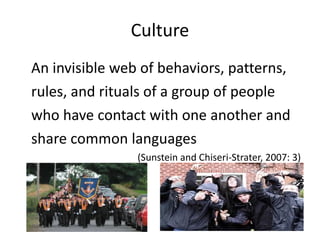
Culture An invisible web of behaviors, patterns,  rules, and rituals of a group of people  who have contact with one another and  share common languages  (Sunstein and Chiseri-Strater, 2007: 3)
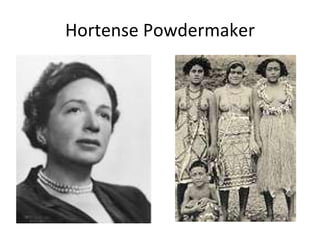
Hortense Powdermaker
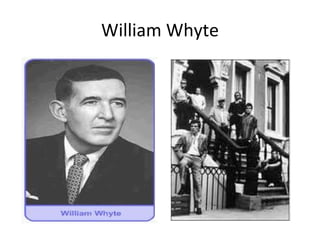
William Whyte
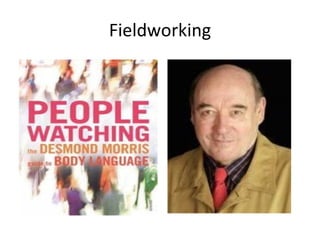
Fieldworking
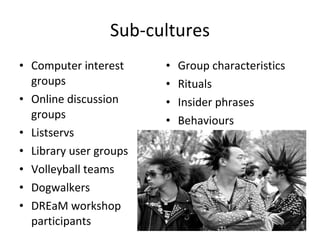
Sub-cultures Computer interest groups Online discussion groups Listservs Library user groups Volleyball teams Dogwalkers DREaM workshop participants Group characteristics Rituals Insider phrases Behaviours
Research Methods Participant observation Observation Library and archival research Cultural artefacts  Fieldnotes Interviews and transcripts Reflective memos Freewriting Photographs
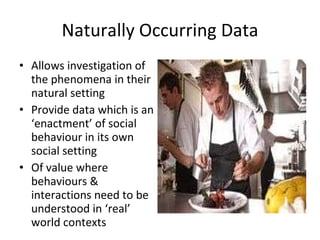
Naturally Occurring Data Allows investigation of the phenomena in their natural setting Provide data which is an ‘enactment’ of social behaviour in its own social setting Of value where behaviours & interactions need to be understood in ‘real’ world contexts
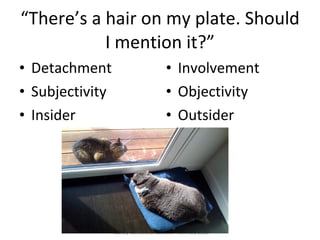
“ There’s a hair on my plate. Should I mention it?” Detachment Subjectivity Insider Involvement Objectivity Outsider DREaM project launch conference   British Library Conference Centre 19th July 2011
Naturally Occurring Data Issues and Challenges Access to the natural setting & ‘fitting in’ Avoid contamination of the social setting Researcher’s bias in interpretation Need to surface social politics of the research  Example: A 45 year old male teetotal academic observing the alcohol drinking habits and social behaviours of 18-21 year old females in a night club
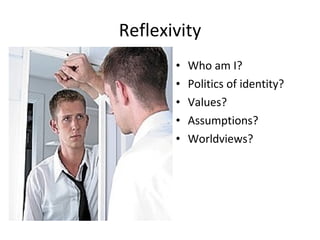
Reflexivity Who am I? Politics of identity? Values? Assumptions? Worldviews?
Generated Data Involves reconstruction  Requires re-processing & retelling of attitudes, beliefs, behaviour or other phenomena The experience, thought, event, behaviour etc. is mentally re-processed & verbally recounted by study participants Gives insight into people’s own perspectives Example: What are your alcohol drinking habits and social behaviours when you are out with your friends at a night club
Generated Data Issues and Challenges Accessibility to research participants that meet sample criteria Is the recounting of the research phenomenon likely to be sufficiently detailed, accurate or complete? What version of the ‘story’ does the research participant want to make public? Ethics Example: A focus group of 18-21 year olds talking in front of a researcher of similar socio-demographic profile to their mothers about their alcohol drinking habits and social behaviours when out with friends at a night club
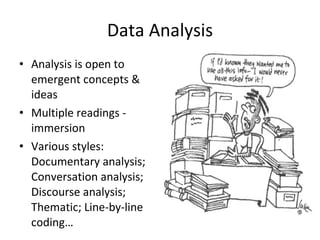
Data Analysis Analysis is open to emergent concepts & ideas Multiple readings - immersion Various styles: Documentary analysis; Conversation analysis; Discourse analysis; Thematic; Line-by-line coding…
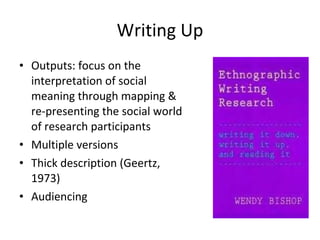
Writing Up Outputs: focus on the interpretation of social meaning through mapping & re-presenting the social world of research participants Multiple versions Thick description (Geertz, 1973) Audiencing
Key Elements Purposive selection How do you know what is important to study? Aims to provide an in-depth & interpreted understanding of the social world Data collection methods usually involve close interaction researcher/research participants Data is detailed, information rich & extensive
References Bishop, W. (2011) Ethnographic Writing Research: Writing it Down, Writing it Up, and Reading it, Heinemann Bryant, J. (2009) What are students doing in our library? Ethnography as a method of exploring library user behaviour, Library and Information Research, 33(102): 3-9. Clark, D. The Raw and the Rotten: Punk Cuisine. In C. Counihan and P. Van Esterik, Food and Culture: A Reader, Routledge, London, pp. 411-422. Davies, B. (2003) Reflexive Ethnography: A Guide to Researching Selves and Others, Routledge, London. Ethnography.com, http://www.ethnography.com/ Fetterman, D. (1998) Ethnography: Step by Step, Sage, London.
Geertz, C. (1973) The Interpretation of  Cultures  ,  Basic Books, New York. Hammersley, M. and Atkinson, P. (1995) Ethnography: Principles in Practice, Routledge, London. Laurier, E., Whyte, A. and Buckner, K. (2001) An Ethnography of Neighbourhood Café: Informality, Table Arrangements and Background Noise.  Journal of Mundane Behavior , 2, 1-30 Available at:  http://www.mundanebehavior.org/issues/v2n2/laurier.html Lynch, P.A.   (2005) Sociological Impressionism In A Hospitality Context, Annals of Tourism Research, 32(3): 527-548. Miles, M., Huberman, A. (1994) Qualitative Data Analysis, Sage, London.
Sunstein, B. and Chiseri-Strater, E. (2007) FieldWorking: Reading and Writing Research, Bedford/St Martin’s, Boston.  Whyte, W. F. (1943) Street Corner Society: The Social Structure of an Italian Slum, Chicago University Press, Chicago.
 

DREaM Event 2: Paul Lynch

  • 1.
    Introduction to EthnographyPaul Lynch Department of Management University of Strathclyde
  • 2.
    Definition The studyof people in cultures; also the text that is written based on that study ( Sunstein and Chiseri-Strater, 2007)
  • 3.
    Culture An invisibleweb of behaviors, patterns, rules, and rituals of a group of people who have contact with one another and share common languages (Sunstein and Chiseri-Strater, 2007: 3)
  • 4.
  • 5.
  • 6.
  • 7.
    Sub-cultures Computer interestgroups Online discussion groups Listservs Library user groups Volleyball teams Dogwalkers DREaM workshop participants Group characteristics Rituals Insider phrases Behaviours
  • 8.
    Research Methods Participantobservation Observation Library and archival research Cultural artefacts Fieldnotes Interviews and transcripts Reflective memos Freewriting Photographs
  • 9.
    Naturally Occurring DataAllows investigation of the phenomena in their natural setting Provide data which is an ‘enactment’ of social behaviour in its own social setting Of value where behaviours & interactions need to be understood in ‘real’ world contexts
  • 10.
    “ There’s ahair on my plate. Should I mention it?” Detachment Subjectivity Insider Involvement Objectivity Outsider DREaM project launch conference  British Library Conference Centre 19th July 2011
  • 11.
    Naturally Occurring DataIssues and Challenges Access to the natural setting & ‘fitting in’ Avoid contamination of the social setting Researcher’s bias in interpretation Need to surface social politics of the research Example: A 45 year old male teetotal academic observing the alcohol drinking habits and social behaviours of 18-21 year old females in a night club
  • 12.
    Reflexivity Who amI? Politics of identity? Values? Assumptions? Worldviews?
  • 13.
    Generated Data Involvesreconstruction Requires re-processing & retelling of attitudes, beliefs, behaviour or other phenomena The experience, thought, event, behaviour etc. is mentally re-processed & verbally recounted by study participants Gives insight into people’s own perspectives Example: What are your alcohol drinking habits and social behaviours when you are out with your friends at a night club
  • 14.
    Generated Data Issuesand Challenges Accessibility to research participants that meet sample criteria Is the recounting of the research phenomenon likely to be sufficiently detailed, accurate or complete? What version of the ‘story’ does the research participant want to make public? Ethics Example: A focus group of 18-21 year olds talking in front of a researcher of similar socio-demographic profile to their mothers about their alcohol drinking habits and social behaviours when out with friends at a night club
  • 15.
    Data Analysis Analysisis open to emergent concepts & ideas Multiple readings - immersion Various styles: Documentary analysis; Conversation analysis; Discourse analysis; Thematic; Line-by-line coding…
  • 16.
    Writing Up Outputs:focus on the interpretation of social meaning through mapping & re-presenting the social world of research participants Multiple versions Thick description (Geertz, 1973) Audiencing
  • 17.
    Key Elements Purposiveselection How do you know what is important to study? Aims to provide an in-depth & interpreted understanding of the social world Data collection methods usually involve close interaction researcher/research participants Data is detailed, information rich & extensive
  • 18.
    References Bishop, W.(2011) Ethnographic Writing Research: Writing it Down, Writing it Up, and Reading it, Heinemann Bryant, J. (2009) What are students doing in our library? Ethnography as a method of exploring library user behaviour, Library and Information Research, 33(102): 3-9. Clark, D. The Raw and the Rotten: Punk Cuisine. In C. Counihan and P. Van Esterik, Food and Culture: A Reader, Routledge, London, pp. 411-422. Davies, B. (2003) Reflexive Ethnography: A Guide to Researching Selves and Others, Routledge, London. Ethnography.com, http://www.ethnography.com/ Fetterman, D. (1998) Ethnography: Step by Step, Sage, London.
  • 19.
    Geertz, C. (1973)The Interpretation of Cultures  , Basic Books, New York. Hammersley, M. and Atkinson, P. (1995) Ethnography: Principles in Practice, Routledge, London. Laurier, E., Whyte, A. and Buckner, K. (2001) An Ethnography of Neighbourhood Café: Informality, Table Arrangements and Background Noise. Journal of Mundane Behavior , 2, 1-30 Available at: http://www.mundanebehavior.org/issues/v2n2/laurier.html Lynch, P.A. (2005) Sociological Impressionism In A Hospitality Context, Annals of Tourism Research, 32(3): 527-548. Miles, M., Huberman, A. (1994) Qualitative Data Analysis, Sage, London.
  • 20.
    Sunstein, B. andChiseri-Strater, E. (2007) FieldWorking: Reading and Writing Research, Bedford/St Martin’s, Boston. Whyte, W. F. (1943) Street Corner Society: The Social Structure of an Italian Slum, Chicago University Press, Chicago.
  • 21.

Editor's Notes

  • #2 Introductory overview with interdisciplinary examples/perspective
  • #3 Problem of various types: 1. Contested term as picked up by a range of disciplines who adapt for their own purposes: anthropologists, folklorists, linguists, sociologists, oral historians, those who study popular culture… 2. My own perspective is broadly sociological with an emphasis/application upon working environments Types : Online - , Virtual -, Netnography, Auto- , Narrative -, Glocal –, Critical -
  • #5 1930s/40s: ‘Colonisation’ – Melanesian culture less sophisticated or develop than her own – raises issue of ethnocentrism, of need for personal reflexivity, importance of Fieldworking skills. One has to unpack cultural baggage and embark on a collaborative journey with those studied.
  • #6 Street corner society: study of an Italian slum – member of a gang, Chicago 1930s/40s, Chicago school of sociology
  • #7 Field – site for doing research; fieldworking – process of doing it. Involves close looking and listening skills – ‘peoplewatching’ Desmond Morris zoologist and anthropologist captured the sense of what we all do (but beware his interpretations!) Ethnography concern with studying people and their customs etc in their context, the spaces they inhabit.
  • #9 Participant observation: researcher joins the study population to record actions, interactions or events as they occur Observation: stands outside the study population allowing actions etc. to be seen through the eyes of the researcher Not exhaustive – indicative Cultural artefacts – maps, sketches, poems, songs, newsletters, advertisements, brochures…
  • #10 John Cooper – Part of PhD 3 x 6 weeks working in michelin star kitchens doing whatever: interviews 60 top chefs GB, fieldnotes, reflective memos, living their life, scars, burns, exhaustion, eczema…
  • #11 Detached language, careful detailing of routine Interpretive kills may create parody PhD study – staying in small commercial accommodation as covert participant observer i.e. a guest-researcher, or just a day-to-day guest? Subjective response of the involved individual ‘… there’s a hair on my plate. Should I mention it?’ Importance of inner feelings and belief systems to uncover aspects of culture Internal dialogue between objective and subjective selves Making familiar strange, the strange familiar – seeing beyond the wallpaper Insider = emic , Outsider = etic
  • #12 Avoid contamination of the social setting that would impact on the authenticity of ‘enactment’ Need to surface social politics of the research & ways in which it may impact on the validity of findings
  • #13 Acknowledge bias/way of seeing in order to achieve a higher level of ‘objectivity’ or ‘trustworthiness’ Immersion - Getting in/getting out Diary and supersvior/co-researcher
  • #16 Manual!!!
  • #18 Highly selective – finding focus – what’s noteworthy?