IOSR Journal of Mechanical and Civil Engineering (IOSR-JMCE)
e-ISSN: 2278-1684,p-ISSN: 2320-334X, Volume 6, Issue 3 (May. - Jun. 2013), PP 63-70
www.iosrjournals.org
www.iosrjournals.org 63 | Page
Experimental Investigation and Analysis of Extrusion of Lead
from Round Section through Triangular Section Converging
Dies: As Applied To Forward Metal Extrusion
Debabrata Rath1
, Dr. Sushanta Tripathy2
1
(Mechanical Engineering Department, CMJ University, India)
2
(School of Mechanical Engineering, KIIT University, India)
Abstract : An experimental investigation has been done on the changes of die angle, area reduction in dies,
loading rate on the final extruded products, extrusion pressures of lead of circular cross sections of different
length. The proposed method is successfully adapted to the extrusion of the equilateral triangular section from
round billet through converging dies of different area reductions. Computation of extrusion pressure at various
area reductions and finite element analysis of different parameters (stress, strain, velocity) both in dry and wet
condition.
Keywords - Converging dies, Extrusion of the equilateral triangular section, Extrusion Pressure
I. Introduction
The extrusion process has been analyzed by various experimental, analytical and numerical methods.
The majority of these techniques have been utilized for determining the extrusion pressure. For many metal
working processes, exact solutions are not available and many attempts have been taken for approximate
methods which could be adopted for estimating the loads necessary to cause plastic deformation. Now it is
becoming essential to pay greater attention to the extrusion of section rod from round stock, as this operation
offers the promise of an economic production route. Despite the advantage of converging dies, only a few
theoretical approaches to the extrusion or drawing processes for 3D shapes have been published. Nagpal and
Altan [1] introduced the concept of dual stream functions to express 3D flow in the die and analyzed the force of
extrusion from round billet to elliptical bars. Basily and Sansome [2] made an upper-bound analysis of drawing
of square sections from round billets by using triangular elements at entry and exit of the die. Yang and Lee [3]
proposed kinematically admissible velocity fields for the extrusion of billets having generalized cross-sections,
where the similarity in the profile of cross-section was assumed to be maintained throughout deformation. They
analyzed the extrusion of polynomial billet with rectilinear and curvilinear sides. Johnson and Kudo [4] have
proposed upper bound for plain strain axis-symmetry extrusion, for extrusion through smooth square dies. in this
case materials was assumed to be rigid, perfectly plastic and work hardening effect being neglected. Hill et al.
[5] proposed the first genuine attempt to develop a general method of analysis of three dimensional metal
deformation problem choosing a class of velocity field that nearly satisfies the statistically requirements, by
using the virtual work principle for the continuum. Prakash and Khan [6] made an upper-bound analysis of
extrusion and drawing through dies of polygonal cross-sections with straight stream lines, where the similarity
in shape was maintained. The upper-bound technique appears to be a useful tool for analyzing 3D metal forming
problems when the objective of such an analysis is limited to prediction of the deformation load and study of
metal flow during the process. P.K. Kar and N.S Das [7] modified this technique of discretizing the deformation
zone into elementary rigid regions to solve problems with dissimilar billet and product sections. However, their
formulation was also limited to problems with flat boundaries and as such; the analysis of extrusion from round
billets is excluded from their formulation. However P.K. Kar and S.K. Sahoo [8] used the reformulated spatial
elementary rigid region (SERR) technique for the analysis of round-to-square extrusion by approximating the
circle into a polygon and successively increasing the number of sides of this approximating polygon until the
extrusion pressure converged by using tapper dies. Narayanasamy et al. [9] proposed an analytical method for
designing the streamlined extrusion have the cosine profile and an upper bound analysis is proposed for the
extrusion of circular section from circular billets.
Hosino and Gunasekara [10] made an upper bound solution for extrusion and drawing of square section
from round billets through converging dies formed by an envelope of straight lines. Boer et al. [11] applied the
upper bound approach to drawing of square rods from round stock, by employing a method of co-ordinate
transformation.
Knoerr et al. [12] have investigated the die fill, defect analysis and prevention, as well as for the
prediction of part properties by using DEFORM FEM software. Kang et al. [13] have performed finite element
simulation of hot extrusion for copper-clad aluminium rod to predict the distributions of temperature, effective
Experimental investigation and Analysis of Extrusion of Lead from Round section through Triangular
www.iosrjournals.org 64 | Page
stress, and effective strain rate and mean stress for various sheath thickness, die exit diameter and die
temperature and validated with experiments. A.K. Rout and K.P.Maity [14] investigated the optimum pressure
during extrusion of square sections from square billet by using curved dies. In addition to this the principle laid
by Johnson and Mellor[15], the strain in the present case was calculated from the empirical relation.
II. Experimental Investigation
Before applying the theoretically result to any practical situation, their adequacy needs experimental
verification. The objective of present work is to compare theoretically predicted extrusion load with
experimental value. Experiments are performed for TRIANGULAR section using converging die.
Commercially available Lead was chosen as the working material for the experiments (extrusion). Different
shape of same circular entry face and various reduction of triangular exit face were made (60%, 70%, and 90%).
2.1.Determination of Material Behavoiur A serious limitation of the tensile test even for cold working is
that fracture occurs at a moderate strain; so that it is not possible to use this test for determination of yield stress,
after very heavy deformation. The fracture is most easily avoided by adopting some compressive form of test.
The average stress state during testing is similar to that in much bulk deformation process, without introducing
the problems of necking or material orientation. Therefore, in compression test, a large amount of deformation
can be achieved before fracture. By controlling the barreling of the specimen ends and the anvils with lubricants
the strain can be varied under limits.
2.1.1. Experimental procedure of Compression Test
Cylinders with a 50.20mm × 31.77 mm (H/D = 1.5 to 2) were used to obtain the stress-strain curve by a
compression test using UTM (INSTRON 400 KN) at room temperature. The compression rate is maintained
same as that adapted for the experiments. The specimen has oil grooves on both the ends to entrap lubricant
during the compression test. The compression load is recorded at every 0.5 mm of punch travel. After
compressing the specimen to about 10 mm it is taken out of the press, re-machined to cylindrical shape with
original diameter, and tested in compression till the specimen is reduced to about 10mm. The stress-strain
diagram is drawn and the curve is extrapolated beyond a natural strain 0.5. To simulate a rigid plastic material,
the wavy portion is approximated by smooth line (Fig. 2.1). The average flow stress of the used lead is found to
be 25460 KN/m2
.
Fig 2.1.variation of true stress with true strain
2.2.Measurement of Friction Factor The local value of the friction cannot be easily determined.
The coefficient of friction may actually vary through a working pass, as the lubrication deteriorates due to
thinning of the film and extension of their surface. Experimental studies suggests, however that this is negligible
for all well lubricated operations. There is at present no generally accepted method of measuring the value of the
coefficient of friction for given surface and lubricant. Various factors can influence the result, chemical
condition, lubricant film thickness; temperature, speed, environment and degree of deformation should match as
closely as possible the actual conditions of the operation. The friction factor can be measured by the following
methods.
• Direct measurement of friction in metal working.
• Coefficients obtained from correlation of theory.
• Measurements depending upon shape change.
Experimental investigation and Analysis of Extrusion of Lead from Round section through Triangular
www.iosrjournals.org 65 | Page
2.2.1. Ring Compression Test
If the coefficient of friction can be deduced from a change in shape, the yield stress will not enter the
derivation, provided the material is homogeneous and there are no serious temperature gradients. Such methods
are generally suitable for rapidly strain hardening materials. Ring compression test suggested by Kudo and
Kungio and developed by Cockcroft utilizes axial compression of a ring between flat platens. When a flat, ring
shaped specimen is upset in the axial direction, the resulting shape change depends only on the amount of
compression in the thickness direction and the frictional conditions at the die ring interfaces. If the interfacial
friction were zero, the ring would deform in the same manner as a solid disk, with each element flowing
outward radially from the center. In case of small but finite interfacial friction, the outside diameter is smaller
than in the zero friction case. If the friction exceeds a critical value, frictional resistance to outward flow
becomes so high that some of the ring material flows inward to the center. Measurements of the inside diameters
of compressed rings provide a particularly sensitive means of studying interfacial friction, because the inside
diameter increases if the friction is low and decreases if the friction is higher.The ring thickness is usually
expressed in relation to the inside and outside diameters. Under the condition of maximum friction, the largest
usable specimen height is obtained with rings of dimensions in the ratio of 6:3:2 i.e, Outer Diameter: Inner
Diameter: Height. The ring compression test can be used to measure the flow stress under high strain practical
forming conditions. Thus, by measuring the ratio of internal, external diameters after axial compression of a ring
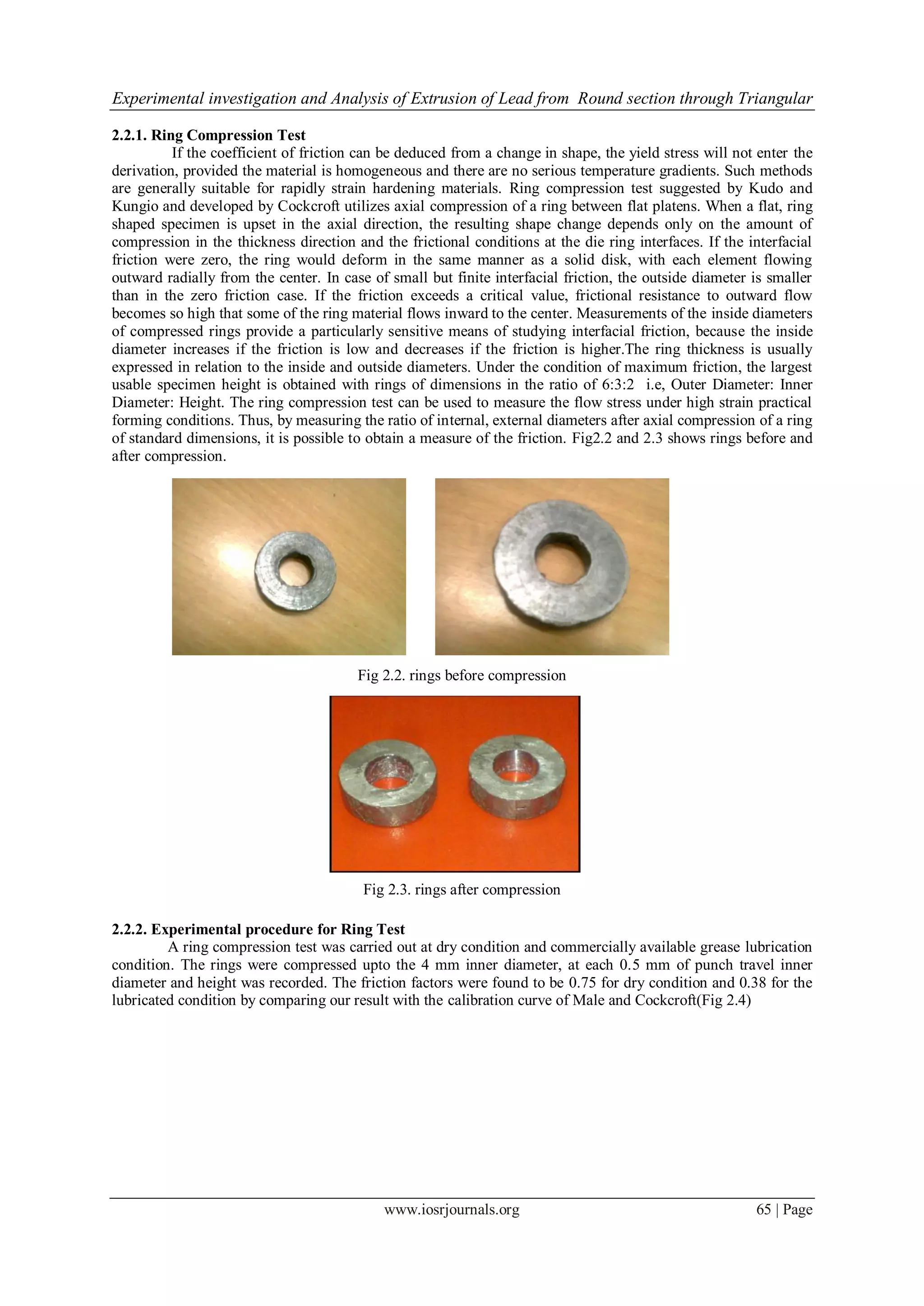
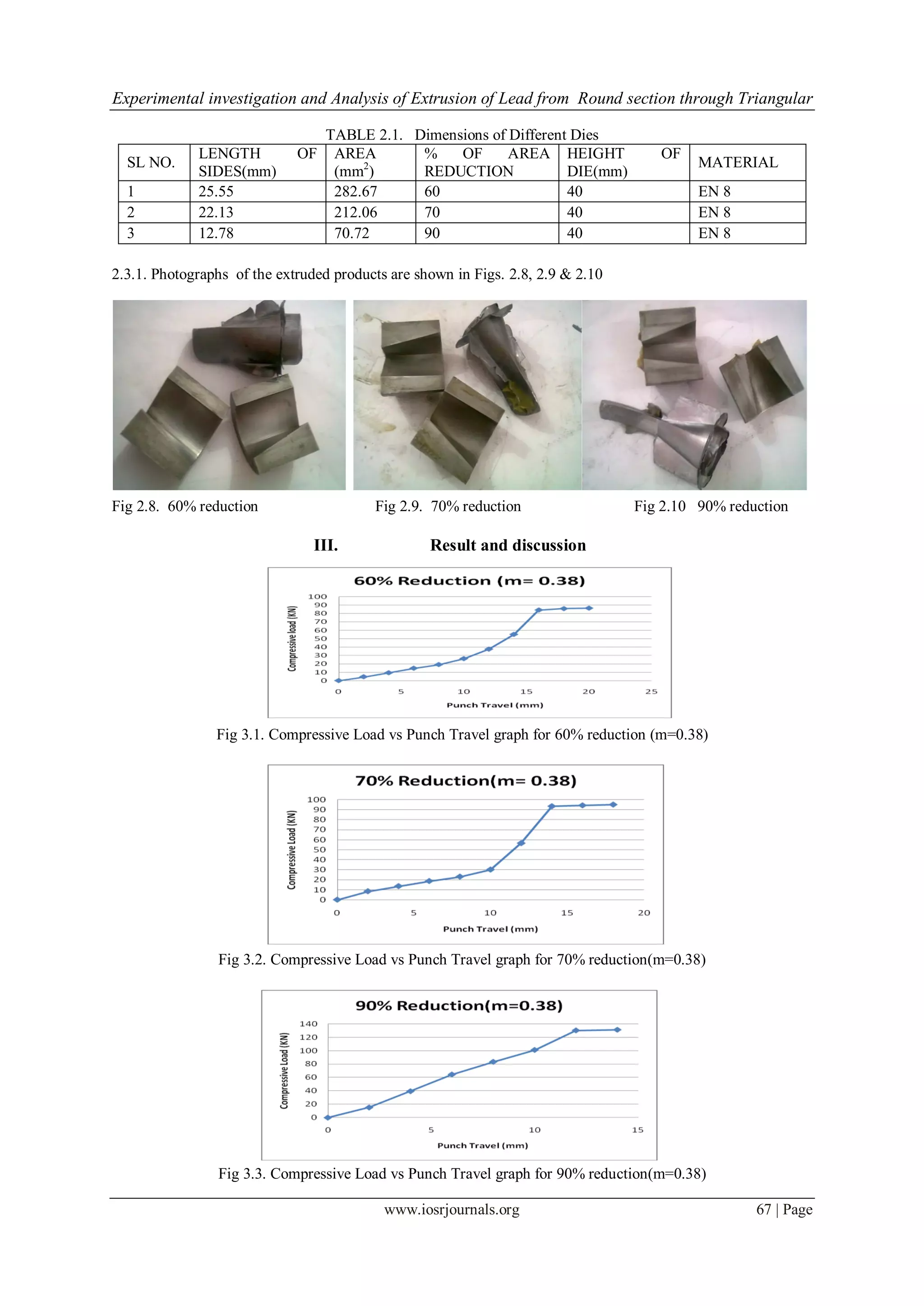
of standard dimensions, it is possible to obtain a measure of the friction. Fig2.2 and 2.3 shows rings before and
after compression.
Fig 2.2. rings before compression
Fig 2.3. rings after compression
2.2.2. Experimental procedure for Ring Test
A ring compression test was carried out at dry condition and commercially available grease lubrication
condition. The rings were compressed upto the 4 mm inner diameter, at each 0.5 mm of punch travel inner
diameter and height was recorded. The friction factors were found to be 0.75 for dry condition and 0.38 for the
lubricated condition by comparing our result with the calibration curve of Male and Cockcroft(Fig 2.4)
Experimental investigation and Analysis of Extrusion of Lead from Round section through Triangular
www.iosrjournals.org 66 | Page
Fig 2.4. theoretical calibration curve for standard ring 6:3:2 [21]
2.3.Design and Manufacturing of Extrusion Die
Fig 2.5. Converging die with 60% reduction
Fig 2.6. Converging die with 70% reduction
Fig 2.7. Converging die with 90% reduction
Experimental investigation and Analysis of Extrusion of Lead from Round section through Triangular
www.iosrjournals.org 67 | Page
TABLE 2.1. Dimensions of Different Dies
SL NO.
LENGTH OF
SIDES(mm)
AREA
(mm2
)
% OF AREA
REDUCTION
HEIGHT OF
DIE(mm)
MATERIAL
1 25.55 282.67 60 40 EN 8
2 22.13 212.06 70 40 EN 8
3 12.78 70.72 90 40 EN 8
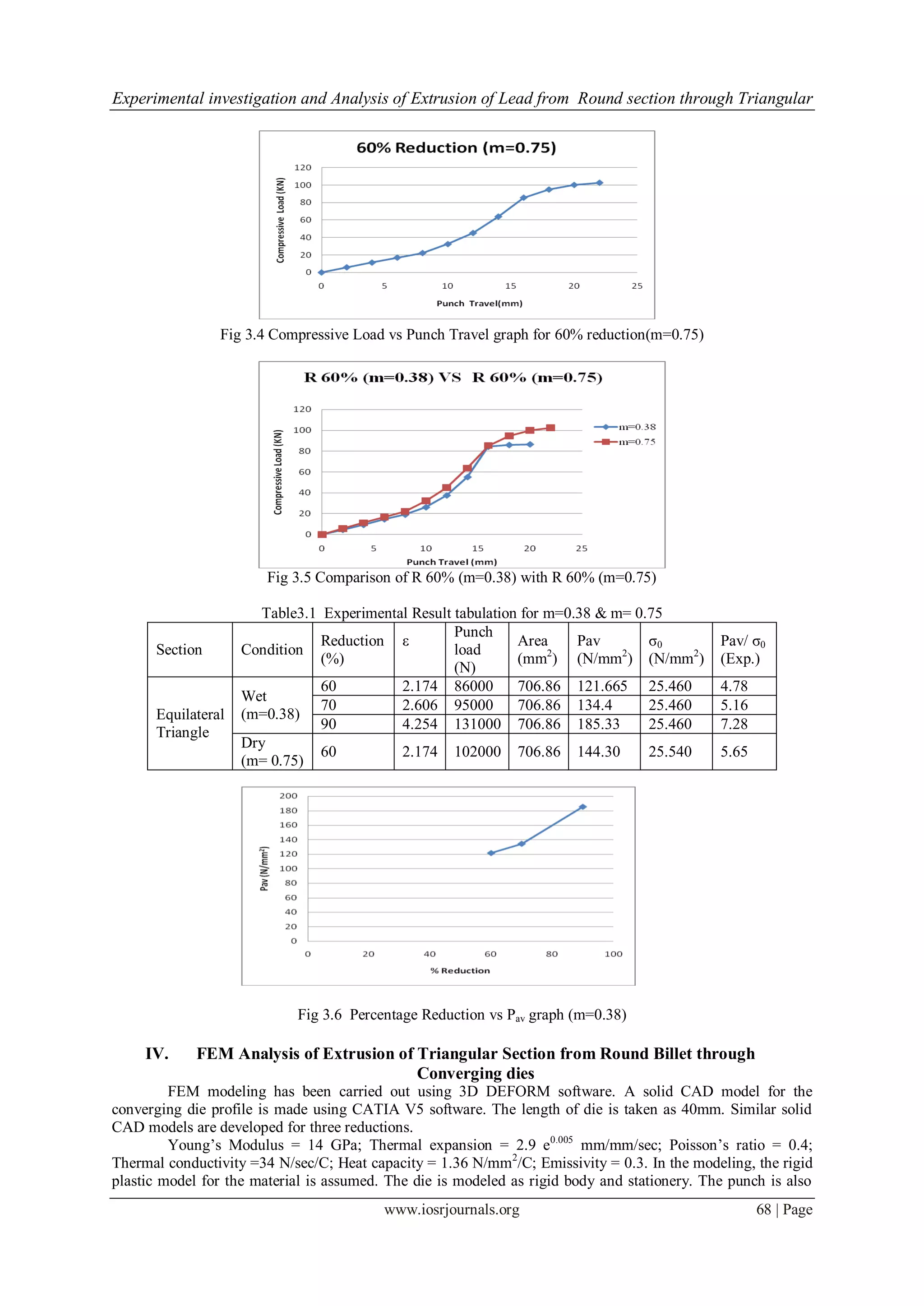
2.3.1. Photographs of the extruded products are shown in Figs. 2.8, 2.9 & 2.10
Fig 2.8. 60% reduction Fig 2.9. 70% reduction Fig 2.10 90% reduction
III. Result and discussion
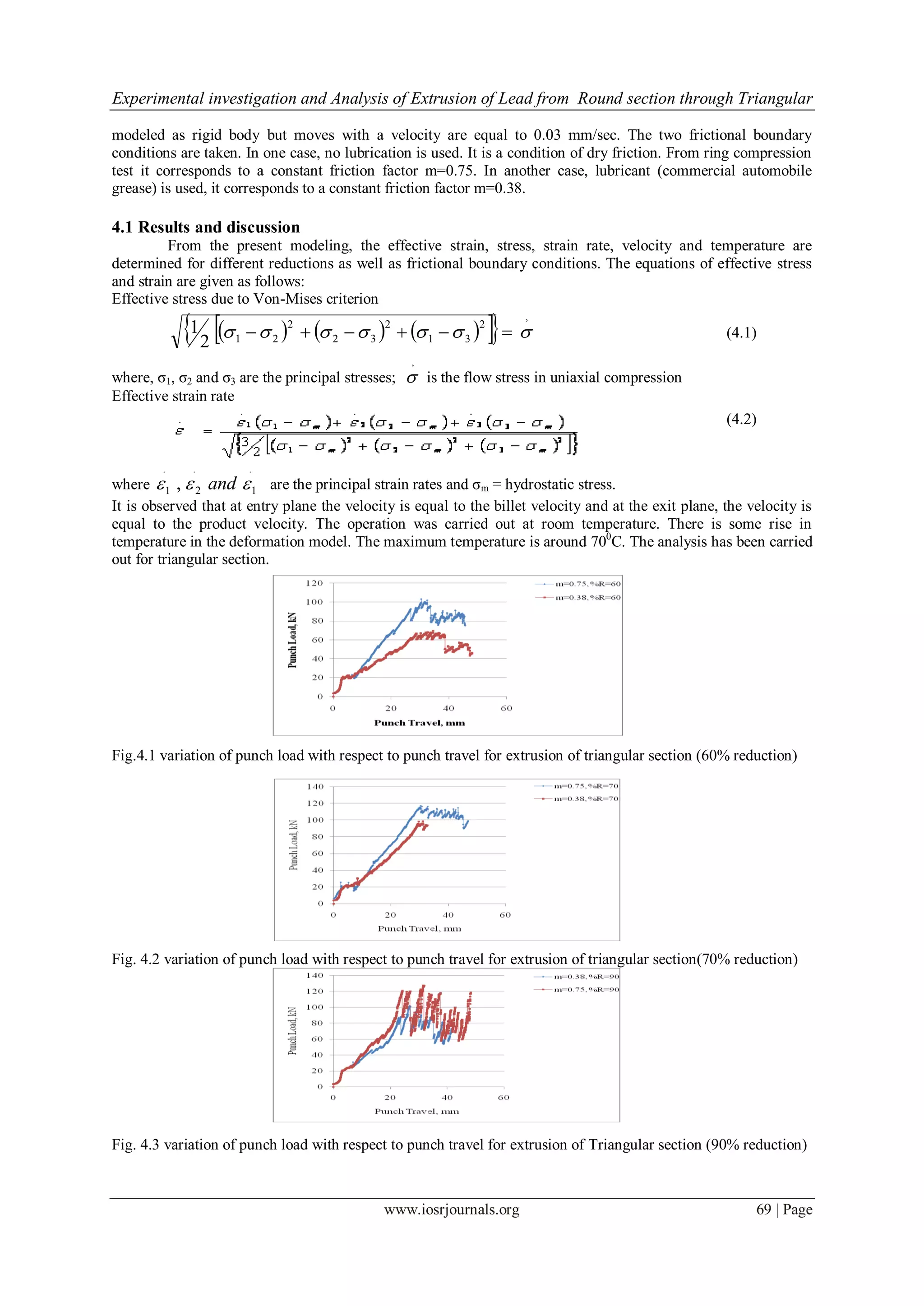
Fig 3.1. Compressive Load vs Punch Travel graph for 60% reduction (m=0.38)
Fig 3.2. Compressive Load vs Punch Travel graph for 70% reduction(m=0.38)
Fig 3.3. Compressive Load vs Punch Travel graph for 90% reduction(m=0.38)
Experimental investigation and Analysis of Extrusion of Lead from Round section through Triangular
www.iosrjournals.org 68 | Page
Fig 3.4 Compressive Load vs Punch Travel graph for 60% reduction(m=0.75)
Fig 3.5 Comparison of R 60% (m=0.38) with R 60% (m=0.75)
Table3.1 Experimental Result tabulation for m=0.38 & m= 0.75
Section Condition
Reduction
(%)
ε
Punch
load
(N)
Area
(mm2
)
Pav
(N/mm2
)
σ0
(N/mm2
)
Pav/ σ0
(Exp.)
Equilateral
Triangle
Wet
(m=0.38)
60 2.174 86000 706.86 121.665 25.460 4.78
70 2.606 95000 706.86 134.4 25.460 5.16
90 4.254 131000 706.86 185.33 25.460 7.28
Dry
(m= 0.75)
60 2.174 102000 706.86 144.30 25.540 5.65
Fig 3.6 Percentage Reduction vs Pav graph (m=0.38)
IV. FEM Analysis of Extrusion of Triangular Section from Round Billet through
Converging dies
FEM modeling has been carried out using 3D DEFORM software. A solid CAD model for the
converging die profile is made using CATIA V5 software. The length of die is taken as 40mm. Similar solid
CAD models are developed for three reductions.
Young’s Modulus = 14 GPa; Thermal expansion = 2.9 e0.005
mm/mm/sec; Poisson’s ratio = 0.4;
Thermal conductivity =34 N/sec/C; Heat capacity = 1.36 N/mm2
/C; Emissivity = 0.3. In the modeling, the rigid
plastic model for the material is assumed. The die is modeled as rigid body and stationery. The punch is also
Experimental investigation and Analysis of Extrusion of Lead from Round section through Triangular
www.iosrjournals.org 69 | Page
modeled as rigid body but moves with a velocity are equal to 0.03 mm/sec. The two frictional boundary
conditions are taken. In one case, no lubrication is used. It is a condition of dry friction. From ring compression
test it corresponds to a constant friction factor m=0.75. In another case, lubricant (commercial automobile
grease) is used, it corresponds to a constant friction factor m=0.38.
4.1 Results and discussion
From the present modeling, the effective strain, stress, strain rate, velocity and temperature are
determined for different reductions as well as frictional boundary conditions. The equations of effective stress
and strain are given as follows:
Effective stress due to Von-Mises criterion
        ,
2
31
2
32
2
212
1   (4.1)
where, σ1, σ2 and σ3 are the principal stresses;
,
 is the flow stress in uniaxial compression
Effective strain rate
(4.2)
where
.
1
.
2
.
1 ,  and are the principal strain rates and σm = hydrostatic stress.
It is observed that at entry plane the velocity is equal to the billet velocity and at the exit plane, the velocity is
equal to the product velocity. The operation was carried out at room temperature. There is some rise in
temperature in the deformation model. The maximum temperature is around 700
C. The analysis has been carried
out for triangular section.
Fig.4.1 variation of punch load with respect to punch travel for extrusion of triangular section (60% reduction)
Fig. 4.2 variation of punch load with respect to punch travel for extrusion of triangular section(70% reduction)
Fig. 4.3 variation of punch load with respect to punch travel for extrusion of Triangular section (90% reduction)
Experimental investigation and Analysis of Extrusion of Lead from Round section through Triangular
www.iosrjournals.org 70 | Page
Fig. 4.4 comparison of wet and dry extrusion pressure for extrusion of triangular sections
It is indicated that the extrusion pressure increases with increase in reduction and friction factor. It is observed
that the extrusion pressure is higher for dry friction.
V. Conclusion
In this study, a die profile function have been developed for extrusion of triangular section from round
billet using a mathematically converging die profile. Solid CAD models of converging die profiles have been
developed for extrusion of triangular section. FEM modeling have been carried out by using DEFORM-3D
software using tellurium lead as rigid plastic material for extrusion of triangular section from round billet.
Various extrusion parameters have been investigated to determine their effects on extrusion product. It was
found that extrusion pressure increases with increase in reduction and friction factor. Analysis of extrusion at
other different reductions may be carried out to compare the results.
References
[1] V. Nagpal, T. Altan, Analysis of the three-dimensional metal flow in extrusion of shapes. With the use of dual stream function, in:
Proceedings of the Third North American Metal Research Conference, Pittsburgh, PA, 1975, pp. 26–40.
[2] B.B. Basily, D.H. Sansome, Some theoretical considerations for the direct drawing of section rod from round bar, Int. J. Mech. Sci.
18 (1979) 201–209.
[3] D.Y. Yang, C.H. Lee, Analysis of three-dimensional extrusion of sections through curved dies by conformal transformations, Int. J.
Mech. Sci. 20 (1978) 541–552.
[4] W. Johnson, H. Kudo, The Mechanics of Metal Extrusion.(1963)
[5] Hill, Analysis metal working process, mechanics of physical solids flow rule(1963)
[6] R. Prakash, O.H. Khan, An analysis of plastic flow through polygonal converging dies with generalized boundaries of the zone of
plastic deformation, Int. J. Mach.Tool Des. Res. 19(1979)1-9
[7] P.K. Kar, N.S. Das, Upper bound analysis of extrusion of I-section bars from Square, rectangular billets through square dies, Int. J.
Mech. Sci. 39 (8) (1997) 925–934.
[8] S.K. Sahoo, P.K. Kar , K.C. Singh a. A numerical application of the upper-bound technique for round-to-hexagon extrusion through
linearly converging dies, Int. J. Mat. Pro. Tec. 91 (1999) 105–110
[9] Narayanasamy R, Ponalagusamy R, Venkatesan R, Srinivasan P (2006) An upper bound solution to extrusion of circular billet to
circular shape through cosine die. Mater Des 27(5):411– 415. doi:10.1016/j.matdes.2004.11.026
[10] J.S. Gunasekera, S. Hosino, Analysis of extrusion or drawing of polygonal sections through straightly conversing dies, J. Engng.
Ind.Trans. ASME 104 (1982) 38–43.
[11] C.B. Boer, W.R. Schneider, B. Avitzur, An upper bound approach for the direct drawing of square section rod from round bar, in:
Proceedings of the 20th International Machine Tool Design and Research Conference, Birmingham, 1980, pp. 149–155
[12] Knoerr, M. Lee,T.Altan, application of the 2D finite element method to simulation of various forming process, International
Journal of Materials Processing Technology,33(1-2), 1992,pp 31-55
[13] Kang, B-Soo, Min-Kim,B. and Choi, J.C., perform design in extrusion by the FEM and its experimental confirmation, International
Journal of Materials Processing Technology,41(2),1994,pp 237-248.
[14] A. K. Rout and K. P. Maity, Numerical and Experimental study on the three-dimensional extrusion of square section from square
billet through a polynomial shaped curved die, published in an Int. J. of Advanced Manufacturing Technology, Vol-54, Issue 5,
(2011), pp. 495-506.
[15] Johnson W, Experiments in the cold extrusion of rods of non-circular sections, Journals of Mechanics and Physics
Solids,5,1957,pp.267-281.
[16] D.Y. Yang, M.U. Kim, C.H. Lee, A new approach for generalized three-dimensional extrusion of sections from round billets by
conformal transformation, IUTAM Symp. Metal Forming Plasticity, Germany, 1979, pp. 204–221.
[17] Geoffrey W. Rowe, Introduction to the principle of metal working, Chapter-8
[18] V. Gopinathan, Plasticity Theory and its Application in Metal Forming, Chapter 7
[19] Dieter,G.E., Mechanical Metallurgy (Tata McGraw-Hill Publishing company ltd., New Delhi)
[20] DEFORM TM
3D Version 6.1(sp2),User’s manual, Scientific Forming Technologies Corporation,2545 Farmers Drive, Suite 200,
Columbus, Ohio,2008,43235.
[21] Shabaik. A. and Kobayashi. S., Computer application to the viscoplasticity method, Transactions of the ASME, Journal of
Engineering for Industry,89,1967, pp.339-352.

Experimental Investigation and Analysis of Extrusion of Lead from Round Section through Triangular Section Converging Dies: As Applied To Forward Metal Extrusion

  • 1.
    IOSR Journal ofMechanical and Civil Engineering (IOSR-JMCE) e-ISSN: 2278-1684,p-ISSN: 2320-334X, Volume 6, Issue 3 (May. - Jun. 2013), PP 63-70 www.iosrjournals.org www.iosrjournals.org 63 | Page Experimental Investigation and Analysis of Extrusion of Lead from Round Section through Triangular Section Converging Dies: As Applied To Forward Metal Extrusion Debabrata Rath1 , Dr. Sushanta Tripathy2 1 (Mechanical Engineering Department, CMJ University, India) 2 (School of Mechanical Engineering, KIIT University, India) Abstract : An experimental investigation has been done on the changes of die angle, area reduction in dies, loading rate on the final extruded products, extrusion pressures of lead of circular cross sections of different length. The proposed method is successfully adapted to the extrusion of the equilateral triangular section from round billet through converging dies of different area reductions. Computation of extrusion pressure at various area reductions and finite element analysis of different parameters (stress, strain, velocity) both in dry and wet condition. Keywords - Converging dies, Extrusion of the equilateral triangular section, Extrusion Pressure I. Introduction The extrusion process has been analyzed by various experimental, analytical and numerical methods. The majority of these techniques have been utilized for determining the extrusion pressure. For many metal working processes, exact solutions are not available and many attempts have been taken for approximate methods which could be adopted for estimating the loads necessary to cause plastic deformation. Now it is becoming essential to pay greater attention to the extrusion of section rod from round stock, as this operation offers the promise of an economic production route. Despite the advantage of converging dies, only a few theoretical approaches to the extrusion or drawing processes for 3D shapes have been published. Nagpal and Altan [1] introduced the concept of dual stream functions to express 3D flow in the die and analyzed the force of extrusion from round billet to elliptical bars. Basily and Sansome [2] made an upper-bound analysis of drawing of square sections from round billets by using triangular elements at entry and exit of the die. Yang and Lee [3] proposed kinematically admissible velocity fields for the extrusion of billets having generalized cross-sections, where the similarity in the profile of cross-section was assumed to be maintained throughout deformation. They analyzed the extrusion of polynomial billet with rectilinear and curvilinear sides. Johnson and Kudo [4] have proposed upper bound for plain strain axis-symmetry extrusion, for extrusion through smooth square dies. in this case materials was assumed to be rigid, perfectly plastic and work hardening effect being neglected. Hill et al. [5] proposed the first genuine attempt to develop a general method of analysis of three dimensional metal deformation problem choosing a class of velocity field that nearly satisfies the statistically requirements, by using the virtual work principle for the continuum. Prakash and Khan [6] made an upper-bound analysis of extrusion and drawing through dies of polygonal cross-sections with straight stream lines, where the similarity in shape was maintained. The upper-bound technique appears to be a useful tool for analyzing 3D metal forming problems when the objective of such an analysis is limited to prediction of the deformation load and study of metal flow during the process. P.K. Kar and N.S Das [7] modified this technique of discretizing the deformation zone into elementary rigid regions to solve problems with dissimilar billet and product sections. However, their formulation was also limited to problems with flat boundaries and as such; the analysis of extrusion from round billets is excluded from their formulation. However P.K. Kar and S.K. Sahoo [8] used the reformulated spatial elementary rigid region (SERR) technique for the analysis of round-to-square extrusion by approximating the circle into a polygon and successively increasing the number of sides of this approximating polygon until the extrusion pressure converged by using tapper dies. Narayanasamy et al. [9] proposed an analytical method for designing the streamlined extrusion have the cosine profile and an upper bound analysis is proposed for the extrusion of circular section from circular billets. Hosino and Gunasekara [10] made an upper bound solution for extrusion and drawing of square section from round billets through converging dies formed by an envelope of straight lines. Boer et al. [11] applied the upper bound approach to drawing of square rods from round stock, by employing a method of co-ordinate transformation. Knoerr et al. [12] have investigated the die fill, defect analysis and prevention, as well as for the prediction of part properties by using DEFORM FEM software. Kang et al. [13] have performed finite element simulation of hot extrusion for copper-clad aluminium rod to predict the distributions of temperature, effective
  • 2.
    Experimental investigation andAnalysis of Extrusion of Lead from Round section through Triangular www.iosrjournals.org 64 | Page stress, and effective strain rate and mean stress for various sheath thickness, die exit diameter and die temperature and validated with experiments. A.K. Rout and K.P.Maity [14] investigated the optimum pressure during extrusion of square sections from square billet by using curved dies. In addition to this the principle laid by Johnson and Mellor[15], the strain in the present case was calculated from the empirical relation. II. Experimental Investigation Before applying the theoretically result to any practical situation, their adequacy needs experimental verification. The objective of present work is to compare theoretically predicted extrusion load with experimental value. Experiments are performed for TRIANGULAR section using converging die. Commercially available Lead was chosen as the working material for the experiments (extrusion). Different shape of same circular entry face and various reduction of triangular exit face were made (60%, 70%, and 90%). 2.1.Determination of Material Behavoiur A serious limitation of the tensile test even for cold working is that fracture occurs at a moderate strain; so that it is not possible to use this test for determination of yield stress, after very heavy deformation. The fracture is most easily avoided by adopting some compressive form of test. The average stress state during testing is similar to that in much bulk deformation process, without introducing the problems of necking or material orientation. Therefore, in compression test, a large amount of deformation can be achieved before fracture. By controlling the barreling of the specimen ends and the anvils with lubricants the strain can be varied under limits. 2.1.1. Experimental procedure of Compression Test Cylinders with a 50.20mm × 31.77 mm (H/D = 1.5 to 2) were used to obtain the stress-strain curve by a compression test using UTM (INSTRON 400 KN) at room temperature. The compression rate is maintained same as that adapted for the experiments. The specimen has oil grooves on both the ends to entrap lubricant during the compression test. The compression load is recorded at every 0.5 mm of punch travel. After compressing the specimen to about 10 mm it is taken out of the press, re-machined to cylindrical shape with original diameter, and tested in compression till the specimen is reduced to about 10mm. The stress-strain diagram is drawn and the curve is extrapolated beyond a natural strain 0.5. To simulate a rigid plastic material, the wavy portion is approximated by smooth line (Fig. 2.1). The average flow stress of the used lead is found to be 25460 KN/m2 . Fig 2.1.variation of true stress with true strain 2.2.Measurement of Friction Factor The local value of the friction cannot be easily determined. The coefficient of friction may actually vary through a working pass, as the lubrication deteriorates due to thinning of the film and extension of their surface. Experimental studies suggests, however that this is negligible for all well lubricated operations. There is at present no generally accepted method of measuring the value of the coefficient of friction for given surface and lubricant. Various factors can influence the result, chemical condition, lubricant film thickness; temperature, speed, environment and degree of deformation should match as closely as possible the actual conditions of the operation. The friction factor can be measured by the following methods. • Direct measurement of friction in metal working. • Coefficients obtained from correlation of theory. • Measurements depending upon shape change.
  • 3.
    Experimental investigation andAnalysis of Extrusion of Lead from Round section through Triangular www.iosrjournals.org 65 | Page 2.2.1. Ring Compression Test If the coefficient of friction can be deduced from a change in shape, the yield stress will not enter the derivation, provided the material is homogeneous and there are no serious temperature gradients. Such methods are generally suitable for rapidly strain hardening materials. Ring compression test suggested by Kudo and Kungio and developed by Cockcroft utilizes axial compression of a ring between flat platens. When a flat, ring shaped specimen is upset in the axial direction, the resulting shape change depends only on the amount of compression in the thickness direction and the frictional conditions at the die ring interfaces. If the interfacial friction were zero, the ring would deform in the same manner as a solid disk, with each element flowing outward radially from the center. In case of small but finite interfacial friction, the outside diameter is smaller than in the zero friction case. If the friction exceeds a critical value, frictional resistance to outward flow becomes so high that some of the ring material flows inward to the center. Measurements of the inside diameters of compressed rings provide a particularly sensitive means of studying interfacial friction, because the inside diameter increases if the friction is low and decreases if the friction is higher.The ring thickness is usually expressed in relation to the inside and outside diameters. Under the condition of maximum friction, the largest usable specimen height is obtained with rings of dimensions in the ratio of 6:3:2 i.e, Outer Diameter: Inner Diameter: Height. The ring compression test can be used to measure the flow stress under high strain practical forming conditions. Thus, by measuring the ratio of internal, external diameters after axial compression of a ring of standard dimensions, it is possible to obtain a measure of the friction. Fig2.2 and 2.3 shows rings before and after compression. Fig 2.2. rings before compression Fig 2.3. rings after compression 2.2.2. Experimental procedure for Ring Test A ring compression test was carried out at dry condition and commercially available grease lubrication condition. The rings were compressed upto the 4 mm inner diameter, at each 0.5 mm of punch travel inner diameter and height was recorded. The friction factors were found to be 0.75 for dry condition and 0.38 for the lubricated condition by comparing our result with the calibration curve of Male and Cockcroft(Fig 2.4)
  • 4.
    Experimental investigation andAnalysis of Extrusion of Lead from Round section through Triangular www.iosrjournals.org 66 | Page Fig 2.4. theoretical calibration curve for standard ring 6:3:2 [21] 2.3.Design and Manufacturing of Extrusion Die Fig 2.5. Converging die with 60% reduction Fig 2.6. Converging die with 70% reduction Fig 2.7. Converging die with 90% reduction
  • 5.
    Experimental investigation andAnalysis of Extrusion of Lead from Round section through Triangular www.iosrjournals.org 67 | Page TABLE 2.1. Dimensions of Different Dies SL NO. LENGTH OF SIDES(mm) AREA (mm2 ) % OF AREA REDUCTION HEIGHT OF DIE(mm) MATERIAL 1 25.55 282.67 60 40 EN 8 2 22.13 212.06 70 40 EN 8 3 12.78 70.72 90 40 EN 8 2.3.1. Photographs of the extruded products are shown in Figs. 2.8, 2.9 & 2.10 Fig 2.8. 60% reduction Fig 2.9. 70% reduction Fig 2.10 90% reduction III. Result and discussion Fig 3.1. Compressive Load vs Punch Travel graph for 60% reduction (m=0.38) Fig 3.2. Compressive Load vs Punch Travel graph for 70% reduction(m=0.38) Fig 3.3. Compressive Load vs Punch Travel graph for 90% reduction(m=0.38)
  • 6.
    Experimental investigation andAnalysis of Extrusion of Lead from Round section through Triangular www.iosrjournals.org 68 | Page Fig 3.4 Compressive Load vs Punch Travel graph for 60% reduction(m=0.75) Fig 3.5 Comparison of R 60% (m=0.38) with R 60% (m=0.75) Table3.1 Experimental Result tabulation for m=0.38 & m= 0.75 Section Condition Reduction (%) ε Punch load (N) Area (mm2 ) Pav (N/mm2 ) σ0 (N/mm2 ) Pav/ σ0 (Exp.) Equilateral Triangle Wet (m=0.38) 60 2.174 86000 706.86 121.665 25.460 4.78 70 2.606 95000 706.86 134.4 25.460 5.16 90 4.254 131000 706.86 185.33 25.460 7.28 Dry (m= 0.75) 60 2.174 102000 706.86 144.30 25.540 5.65 Fig 3.6 Percentage Reduction vs Pav graph (m=0.38) IV. FEM Analysis of Extrusion of Triangular Section from Round Billet through Converging dies FEM modeling has been carried out using 3D DEFORM software. A solid CAD model for the converging die profile is made using CATIA V5 software. The length of die is taken as 40mm. Similar solid CAD models are developed for three reductions. Young’s Modulus = 14 GPa; Thermal expansion = 2.9 e0.005 mm/mm/sec; Poisson’s ratio = 0.4; Thermal conductivity =34 N/sec/C; Heat capacity = 1.36 N/mm2 /C; Emissivity = 0.3. In the modeling, the rigid plastic model for the material is assumed. The die is modeled as rigid body and stationery. The punch is also
  • 7.
    Experimental investigation andAnalysis of Extrusion of Lead from Round section through Triangular www.iosrjournals.org 69 | Page modeled as rigid body but moves with a velocity are equal to 0.03 mm/sec. The two frictional boundary conditions are taken. In one case, no lubrication is used. It is a condition of dry friction. From ring compression test it corresponds to a constant friction factor m=0.75. In another case, lubricant (commercial automobile grease) is used, it corresponds to a constant friction factor m=0.38. 4.1 Results and discussion From the present modeling, the effective strain, stress, strain rate, velocity and temperature are determined for different reductions as well as frictional boundary conditions. The equations of effective stress and strain are given as follows: Effective stress due to Von-Mises criterion         , 2 31 2 32 2 212 1   (4.1) where, σ1, σ2 and σ3 are the principal stresses; ,  is the flow stress in uniaxial compression Effective strain rate (4.2) where . 1 . 2 . 1 ,  and are the principal strain rates and σm = hydrostatic stress. It is observed that at entry plane the velocity is equal to the billet velocity and at the exit plane, the velocity is equal to the product velocity. The operation was carried out at room temperature. There is some rise in temperature in the deformation model. The maximum temperature is around 700 C. The analysis has been carried out for triangular section. Fig.4.1 variation of punch load with respect to punch travel for extrusion of triangular section (60% reduction) Fig. 4.2 variation of punch load with respect to punch travel for extrusion of triangular section(70% reduction) Fig. 4.3 variation of punch load with respect to punch travel for extrusion of Triangular section (90% reduction)
  • 8.
    Experimental investigation andAnalysis of Extrusion of Lead from Round section through Triangular www.iosrjournals.org 70 | Page Fig. 4.4 comparison of wet and dry extrusion pressure for extrusion of triangular sections It is indicated that the extrusion pressure increases with increase in reduction and friction factor. It is observed that the extrusion pressure is higher for dry friction. V. Conclusion In this study, a die profile function have been developed for extrusion of triangular section from round billet using a mathematically converging die profile. Solid CAD models of converging die profiles have been developed for extrusion of triangular section. FEM modeling have been carried out by using DEFORM-3D software using tellurium lead as rigid plastic material for extrusion of triangular section from round billet. Various extrusion parameters have been investigated to determine their effects on extrusion product. It was found that extrusion pressure increases with increase in reduction and friction factor. Analysis of extrusion at other different reductions may be carried out to compare the results. References [1] V. Nagpal, T. Altan, Analysis of the three-dimensional metal flow in extrusion of shapes. With the use of dual stream function, in: Proceedings of the Third North American Metal Research Conference, Pittsburgh, PA, 1975, pp. 26–40. [2] B.B. Basily, D.H. Sansome, Some theoretical considerations for the direct drawing of section rod from round bar, Int. J. Mech. Sci. 18 (1979) 201–209. [3] D.Y. Yang, C.H. Lee, Analysis of three-dimensional extrusion of sections through curved dies by conformal transformations, Int. J. Mech. Sci. 20 (1978) 541–552. [4] W. Johnson, H. Kudo, The Mechanics of Metal Extrusion.(1963) [5] Hill, Analysis metal working process, mechanics of physical solids flow rule(1963) [6] R. Prakash, O.H. Khan, An analysis of plastic flow through polygonal converging dies with generalized boundaries of the zone of plastic deformation, Int. J. Mach.Tool Des. Res. 19(1979)1-9 [7] P.K. Kar, N.S. Das, Upper bound analysis of extrusion of I-section bars from Square, rectangular billets through square dies, Int. J. Mech. Sci. 39 (8) (1997) 925–934. [8] S.K. Sahoo, P.K. Kar , K.C. Singh a. A numerical application of the upper-bound technique for round-to-hexagon extrusion through linearly converging dies, Int. J. Mat. Pro. Tec. 91 (1999) 105–110 [9] Narayanasamy R, Ponalagusamy R, Venkatesan R, Srinivasan P (2006) An upper bound solution to extrusion of circular billet to circular shape through cosine die. Mater Des 27(5):411– 415. doi:10.1016/j.matdes.2004.11.026 [10] J.S. Gunasekera, S. Hosino, Analysis of extrusion or drawing of polygonal sections through straightly conversing dies, J. Engng. Ind.Trans. ASME 104 (1982) 38–43. [11] C.B. Boer, W.R. Schneider, B. Avitzur, An upper bound approach for the direct drawing of square section rod from round bar, in: Proceedings of the 20th International Machine Tool Design and Research Conference, Birmingham, 1980, pp. 149–155 [12] Knoerr, M. Lee,T.Altan, application of the 2D finite element method to simulation of various forming process, International Journal of Materials Processing Technology,33(1-2), 1992,pp 31-55 [13] Kang, B-Soo, Min-Kim,B. and Choi, J.C., perform design in extrusion by the FEM and its experimental confirmation, International Journal of Materials Processing Technology,41(2),1994,pp 237-248. [14] A. K. Rout and K. P. Maity, Numerical and Experimental study on the three-dimensional extrusion of square section from square billet through a polynomial shaped curved die, published in an Int. J. of Advanced Manufacturing Technology, Vol-54, Issue 5, (2011), pp. 495-506. [15] Johnson W, Experiments in the cold extrusion of rods of non-circular sections, Journals of Mechanics and Physics Solids,5,1957,pp.267-281. [16] D.Y. Yang, M.U. Kim, C.H. Lee, A new approach for generalized three-dimensional extrusion of sections from round billets by conformal transformation, IUTAM Symp. Metal Forming Plasticity, Germany, 1979, pp. 204–221. [17] Geoffrey W. Rowe, Introduction to the principle of metal working, Chapter-8 [18] V. Gopinathan, Plasticity Theory and its Application in Metal Forming, Chapter 7 [19] Dieter,G.E., Mechanical Metallurgy (Tata McGraw-Hill Publishing company ltd., New Delhi) [20] DEFORM TM 3D Version 6.1(sp2),User’s manual, Scientific Forming Technologies Corporation,2545 Farmers Drive, Suite 200, Columbus, Ohio,2008,43235. [21] Shabaik. A. and Kobayashi. S., Computer application to the viscoplasticity method, Transactions of the ASME, Journal of Engineering for Industry,89,1967, pp.339-352.