Unit II: Drainage in
excavation
• Dewatering of excavations is required at
construction sites generally for foundation
works. Various methods for dewatering of
excavations are described in this article. Firm
and sound working conditions are
indispensable when construction of buildings,
powerhouse, dams, and other structures has
to be executed.
These structures not only require a dry base for
their foundations but also good water-table stability
in the girth. Dewatering of any excavated area is
done in order to keep the excavation bottom dry, to
prevent the leakage of water or sand and to avoid
upheaval failure. Dewatering could turn out to be a
herculean task if one doesn’t adopt the right
method. The different methods available for
dewatering of excavations at constructions sites are
not necessarily interchangeable as each one has a
narrow range of applications, therefore, adopting
the right method of dewatering for a particular
ground condition is always a critical and a difficult
decision to make.
Methods of Dewatering Excavations at
Construction Site:
• There are four important dewatering methods
one should be aware of:Wellpoint method of
dewatering,
• Eductor wells,
• Open sump pumping and
• Deep wellpoint method
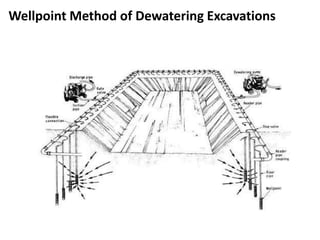
Wellpoint Method of Dewatering Excavations
A series of wells of required depth are created in the
vicinity of the excavated area from where the water has to
be pumped out. The wells are arranged either in a line or a
rectangular form where the wellpoints are created at a
distance of at least 2m from each other. 2) Riser pipes or
dewatering pipes are then installed into those closely
spaced wells which on the surface are connected to a
flexible swing pipe which is ultimately appended to a
common header pipe that is responsible for discharging
the water away from the site. The purpose of using a
flexible swing pipe is just to provide a clear view of what is
being pumped and the purpose of header pipe is to create
suction as well as discharge the water off the working area.
3) One end of the header pipe is connected to a
vacuum pump which draws water through notches
in the well-point. The water then travels from the
well-points through the flexible swing pipe into the
header pipe to the pump. It is then discharged away
from the site or to other processes to remove
unwanted properties such as contaminants. 4) The
drawdown using this method is restricted to around
five to six meters below the well-point pump level.
If a deeper drawdown is required, multiple stages of
well-points must be used.
Eductor Wells Method of
Dewatering Excavations
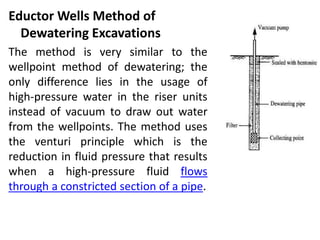
The method is very similar to the
wellpoint method of dewatering; the
only difference lies in the usage of
high-pressure water in the riser units
instead of vacuum to draw out water
from the wellpoints. The method uses
the venturi principle which is the
reduction in fluid pressure that results
when a high-pressure fluid flows
through a constricted section of a pipe.
Open Sump Pumping
Method of Dewatering
Excavations
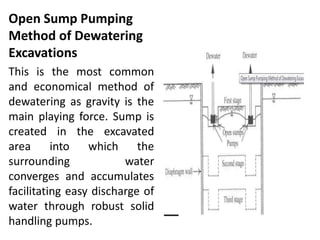
This is the most common
and economical method of
dewatering as gravity is the
main playing force. Sump is
created in the excavated
area into which the
surrounding water
converges and accumulates
facilitating easy discharge of
water through robust solid
handling pumps.
Thank you

Drainage in Excavation.ppt

  • 1.
    Unit II: Drainagein excavation
  • 2.
    • Dewatering ofexcavations is required at construction sites generally for foundation works. Various methods for dewatering of excavations are described in this article. Firm and sound working conditions are indispensable when construction of buildings, powerhouse, dams, and other structures has to be executed.
  • 3.
    These structures notonly require a dry base for their foundations but also good water-table stability in the girth. Dewatering of any excavated area is done in order to keep the excavation bottom dry, to prevent the leakage of water or sand and to avoid upheaval failure. Dewatering could turn out to be a herculean task if one doesn’t adopt the right method. The different methods available for dewatering of excavations at constructions sites are not necessarily interchangeable as each one has a narrow range of applications, therefore, adopting the right method of dewatering for a particular ground condition is always a critical and a difficult decision to make.
  • 4.
    Methods of DewateringExcavations at Construction Site: • There are four important dewatering methods one should be aware of:Wellpoint method of dewatering, • Eductor wells, • Open sump pumping and • Deep wellpoint method
  • 5.
    Wellpoint Method ofDewatering Excavations
  • 6.
    A series ofwells of required depth are created in the vicinity of the excavated area from where the water has to be pumped out. The wells are arranged either in a line or a rectangular form where the wellpoints are created at a distance of at least 2m from each other. 2) Riser pipes or dewatering pipes are then installed into those closely spaced wells which on the surface are connected to a flexible swing pipe which is ultimately appended to a common header pipe that is responsible for discharging the water away from the site. The purpose of using a flexible swing pipe is just to provide a clear view of what is being pumped and the purpose of header pipe is to create suction as well as discharge the water off the working area.
  • 7.
    3) One endof the header pipe is connected to a vacuum pump which draws water through notches in the well-point. The water then travels from the well-points through the flexible swing pipe into the header pipe to the pump. It is then discharged away from the site or to other processes to remove unwanted properties such as contaminants. 4) The drawdown using this method is restricted to around five to six meters below the well-point pump level. If a deeper drawdown is required, multiple stages of well-points must be used.
  • 8.
    Eductor Wells Methodof Dewatering Excavations The method is very similar to the wellpoint method of dewatering; the only difference lies in the usage of high-pressure water in the riser units instead of vacuum to draw out water from the wellpoints. The method uses the venturi principle which is the reduction in fluid pressure that results when a high-pressure fluid flows through a constricted section of a pipe.
  • 9.
    Open Sump Pumping Methodof Dewatering Excavations This is the most common and economical method of dewatering as gravity is the main playing force. Sump is created in the excavated area into which the surrounding water converges and accumulates facilitating easy discharge of water through robust solid handling pumps.
  • 10.