DREDGING
Definition:
• Dredging is an excavation activity or
operation usually carried out at least partly
underwater, in shallow seas or fresh
water areas with the purpose of gathering up
bottom sediments and disposing of them at a
different location.
• In all situations the operation is undertaken
by special floating plant, known as a dredger.
Dredger:
• A dredgers is a piece of equipment which
can dig, transport and dump a certain
amount of under water laying soil in a certain
time.
• The quantity of soil moved per unit of time is
called Production.
•

4 phases are:
- Excavation
- Lifting
- Transportation
-Disposal
Why dredging?
•

Capital works:Creation of new facilities, such as harbour
basins,deeper navigation channels etc



Infrastructure



coastal engineering



mining industry



•

Navigation

offshore industry

Maintenance works : Maintain design depth of navigation
channel and ports.

•

Remedial works: Careful removal of contaminated
material ,reuse or relocation of the material
Types Of Dredgers:
`
•

Mechanical Dredger

•

Hydraulic Dredger
Hydraulically

continuously
Discontinuously

Transport Via pipeline

Mechanically
Transport via conveyor
belt
Transport via
grab,ship,truck
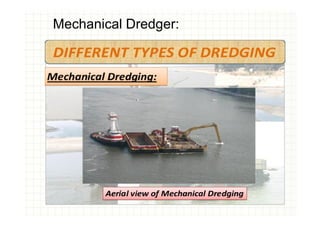
Mechanical Dredger:
Mechanical Dredger:
In Mechanical dredgers materials conveyed by
mechanical contravenes.
• Bucket Ladder Dredger
• Grab Dredger
• Dipper/Back Hoe Dredger
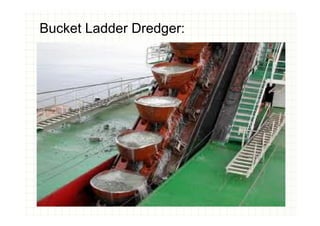
Bucket Ladder Dredger:
Working method :
• The bucket ladder dredge is positioned on 6 wires. Under
working conditions the dredge swings around the bow
anchor.
• The bow anchor line or headline can have length longer
than 1000 m.
• In order to avoid dragging of the wire over the soil, which
results in a smaller radius, the wire is supported by a
headline pontoon.
• As a result of this long headline the cut width can be large
as well (200 m or more).
• The side-line winches take care of the swinging of the
dredge as well as the power necessary for the cutting
process.
• The swing speed depends on the soil condition, the layer
thickness cut.
• This type of dredge is suitable for excavating soft ground,
sand or gravel.
Specification:
• The size of these vessel is about 60m in length
and 15m in width, having a draft of about
2.5 to 3m.
• The capacity of bucket is about 1cubic meter.
• The digging depth commonly extend to 1 cubic
metre
• The output is the range of 250cubic meter/hr
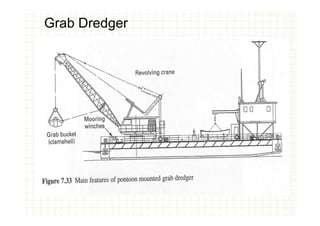
Grab Dredger
Working method:
•

The dredgers can be moored by anchors or by poles
(spuds) .

•

The capacity of a grab dredger is expressed in the volume
of the grab.

•

Grab sizes varies between less than 1 m3 up to 200 m3.

•

The opening of the grab is controlled by the closing and
hoisting wire or by hydraulic cylinders.

•

For grab dredgers the method of anchoring and the
positioning system plays an important role for the
effectiveness of the dredger.
•

At every pontoon position an area as wide as
possible will be dredged.

•

The positioning is important to localize the bit of the
grab.
Specification:
• The Hull is generally 30m to 60m long and
15m cross, the boom is being 15m long.
• The capacity of a grab dredger is expressed in the
volume of the grab.
• Grab sizes varies between less than 1 m3 up to
200 m3.
• The opening of the grab is controlled by the
closing and hoisting wire or by hydraulic cylinders.
Dipper or Black Hoe Dredger:
Dipper or Back Hoe Dredger:
• This is similar to the land operator crawler shovel.
• It mounted on a Barge.
• It carries a lever outer end of which, a steel
bucket is attached.
• The lever can rotate both about the vertical and
horizontal axis.
•The bottom of bucket can be opened by operating
wire rope from the barge.
• The bucket scoops out the material and after
slewing, the contents of the bucket are dropped
on to the barge by opening bottom plate of the
bucket.
Specification:
• This type of dredge can dig in depths up to
15m of water.
• Dipper capacity varies from 1 to 4 cubic meter
and heavy capacities of about 12m3 are used
in panama canal.
Hydraulic Dredger:
Hydraulic dredgers use hydraulic pumps to
produce a slurry of the dredged material.
•

Profile or plain suction dredger

•

Cutter suction dredger

•

Trailing suction hopper dredger
Profile or plain suction dredger:
Plain Suction Dredger:
• Dredgers are equipped with a centrifugal pump
for raising mixture of soil and water to deliver the
material into the transport system.
• There is a plain end suction pipe, the suction
head buried to material to be excavated.
• These type of dredgers are well suited for free
running granular material.
Working method:
• These operate by sucking through a long
tube, like some vaccum cleaners but on a
larger scale.
• A plain suction dredger has no tool at the end
of the suction pipe to disturb the material.
This is often the most commonly used form of
dredging
Specification:
• The Dredging depth is about 15m.
• Bucket capacity is about 6cubic meter, then its used
for soft material.
• If a smaller capacity bucket of about 4 cubic meter,
then its used for dredging hard material.
Cutter Suction Dredger:
Cutter suction Dredger:
•

•

•

A cutter-suction dredger's (CSD) suction
tube has a cutting mechanism at the
.
suction inlet.
The cutting mechanism loosens the bed
material and transports it to the suction
mouth.
The dredged material is usually sucked up
by a wear-resistant centrifugal pump and
discharged either through a pipe line or to
a barge.
Cutter suction Dredger (cont…)
•

•

Cutter-suction dredgers are most often
used in geological areas consisting of hard
.
surface materials (for example gravel
deposits or surface bedrock) where a
standard suction dredger would be
ineffective.
In recent years, dredgers with more
powerful cutters have been built in order to
excavate harder rock without the need for
blasting.
Trailing suction Hopper Dredger:
• A trailing suction hopper dredger (TSHD) trails its
suction pipe when working, and loads the dredge
spoil into one or more hoppers in the vessel.
•

When the hoppers are full, the TSHD sails to a
disposal area and either dumps the material through
doors in the hull or pumps the material out of the
hoppers.

• Some dredges also self-offload using drag buckets
and conveyors
Specification:
•The normal dredging vary from 10 to 30m
•The hopper capacities vary from 300-11000cubic
meter.
•Majority of these dredgers are in the range of 5003500cubic meter.
IMPACTS OF DREDGING:
• Dredging can create disturbance to aquatic
ecosystem.
• This activities have the potential to change the
environment.
• Depending upon the nature of the dredged material,
its disturbance from the sea bed may lead to changes
in the chemical composition of the water.
• As well as toxicants, the nutrient elements,
particularly nitrogen and phosphorus, which control the
rate of marine plant growth can also be released from
sediments during dredging.
Thank You.

Dredging equipment

  • 1.
  • 2.
    Definition: • Dredging isan excavation activity or operation usually carried out at least partly underwater, in shallow seas or fresh water areas with the purpose of gathering up bottom sediments and disposing of them at a different location. • In all situations the operation is undertaken by special floating plant, known as a dredger.
  • 3.
    Dredger: • A dredgersis a piece of equipment which can dig, transport and dump a certain amount of under water laying soil in a certain time. • The quantity of soil moved per unit of time is called Production.
  • 4.
    • 4 phases are: -Excavation - Lifting - Transportation -Disposal
  • 5.
    Why dredging? • Capital works:Creationof new facilities, such as harbour basins,deeper navigation channels etc   Infrastructure  coastal engineering  mining industry  • Navigation offshore industry Maintenance works : Maintain design depth of navigation channel and ports. • Remedial works: Careful removal of contaminated material ,reuse or relocation of the material
  • 6.
    Types Of Dredgers: ` • MechanicalDredger • Hydraulic Dredger Hydraulically continuously Discontinuously Transport Via pipeline Mechanically Transport via conveyor belt Transport via grab,ship,truck
  • 7.
  • 10.
    Mechanical Dredger: In Mechanicaldredgers materials conveyed by mechanical contravenes. • Bucket Ladder Dredger • Grab Dredger • Dipper/Back Hoe Dredger
  • 11.
  • 13.
  • 14.
    Working method : •The bucket ladder dredge is positioned on 6 wires. Under working conditions the dredge swings around the bow anchor. • The bow anchor line or headline can have length longer than 1000 m. • In order to avoid dragging of the wire over the soil, which results in a smaller radius, the wire is supported by a headline pontoon. • As a result of this long headline the cut width can be large as well (200 m or more).
  • 15.
    • The side-linewinches take care of the swinging of the dredge as well as the power necessary for the cutting process. • The swing speed depends on the soil condition, the layer thickness cut. • This type of dredge is suitable for excavating soft ground, sand or gravel.
  • 16.
    Specification: • The sizeof these vessel is about 60m in length and 15m in width, having a draft of about 2.5 to 3m. • The capacity of bucket is about 1cubic meter. • The digging depth commonly extend to 1 cubic metre • The output is the range of 250cubic meter/hr
  • 17.
  • 18.
    Working method: • The dredgerscan be moored by anchors or by poles (spuds) . • The capacity of a grab dredger is expressed in the volume of the grab. • Grab sizes varies between less than 1 m3 up to 200 m3. • The opening of the grab is controlled by the closing and hoisting wire or by hydraulic cylinders. • For grab dredgers the method of anchoring and the positioning system plays an important role for the effectiveness of the dredger.
  • 19.
    • At every pontoonposition an area as wide as possible will be dredged. • The positioning is important to localize the bit of the grab.
  • 20.
    Specification: • The Hullis generally 30m to 60m long and 15m cross, the boom is being 15m long. • The capacity of a grab dredger is expressed in the volume of the grab. • Grab sizes varies between less than 1 m3 up to 200 m3. • The opening of the grab is controlled by the closing and hoisting wire or by hydraulic cylinders.
  • 21.
    Dipper or BlackHoe Dredger:
  • 23.
    Dipper or BackHoe Dredger: • This is similar to the land operator crawler shovel. • It mounted on a Barge. • It carries a lever outer end of which, a steel bucket is attached. • The lever can rotate both about the vertical and horizontal axis. •The bottom of bucket can be opened by operating wire rope from the barge.
  • 24.
    • The bucketscoops out the material and after slewing, the contents of the bucket are dropped on to the barge by opening bottom plate of the bucket. Specification: • This type of dredge can dig in depths up to 15m of water. • Dipper capacity varies from 1 to 4 cubic meter and heavy capacities of about 12m3 are used in panama canal.
  • 25.
    Hydraulic Dredger: Hydraulic dredgersuse hydraulic pumps to produce a slurry of the dredged material. • Profile or plain suction dredger • Cutter suction dredger • Trailing suction hopper dredger
  • 26.
    Profile or plainsuction dredger:
  • 27.
    Plain Suction Dredger: •Dredgers are equipped with a centrifugal pump for raising mixture of soil and water to deliver the material into the transport system. • There is a plain end suction pipe, the suction head buried to material to be excavated. • These type of dredgers are well suited for free running granular material.
  • 28.
    Working method: • Theseoperate by sucking through a long tube, like some vaccum cleaners but on a larger scale. • A plain suction dredger has no tool at the end of the suction pipe to disturb the material. This is often the most commonly used form of dredging
  • 29.
    Specification: • The Dredgingdepth is about 15m. • Bucket capacity is about 6cubic meter, then its used for soft material. • If a smaller capacity bucket of about 4 cubic meter, then its used for dredging hard material.
  • 30.
  • 31.
    Cutter suction Dredger: • • • Acutter-suction dredger's (CSD) suction tube has a cutting mechanism at the . suction inlet. The cutting mechanism loosens the bed material and transports it to the suction mouth. The dredged material is usually sucked up by a wear-resistant centrifugal pump and discharged either through a pipe line or to a barge.
  • 32.
    Cutter suction Dredger(cont…) • • Cutter-suction dredgers are most often used in geological areas consisting of hard . surface materials (for example gravel deposits or surface bedrock) where a standard suction dredger would be ineffective. In recent years, dredgers with more powerful cutters have been built in order to excavate harder rock without the need for blasting.
  • 33.
    Trailing suction HopperDredger: • A trailing suction hopper dredger (TSHD) trails its suction pipe when working, and loads the dredge spoil into one or more hoppers in the vessel. • When the hoppers are full, the TSHD sails to a disposal area and either dumps the material through doors in the hull or pumps the material out of the hoppers. • Some dredges also self-offload using drag buckets and conveyors
  • 34.
    Specification: •The normal dredgingvary from 10 to 30m •The hopper capacities vary from 300-11000cubic meter. •Majority of these dredgers are in the range of 5003500cubic meter.
  • 35.
    IMPACTS OF DREDGING: •Dredging can create disturbance to aquatic ecosystem. • This activities have the potential to change the environment. • Depending upon the nature of the dredged material, its disturbance from the sea bed may lead to changes in the chemical composition of the water. • As well as toxicants, the nutrient elements, particularly nitrogen and phosphorus, which control the rate of marine plant growth can also be released from sediments during dredging.
  • 36.