Department of Agricultural and Biosystems Engineering
Reducing Nitrate-N: Scale of
Implementation Needed
Matthew Helmers
Dean’s Professor, College of Ag. & Life Sciences
Professor, Dept. of Ag. and Biosystems Eng.
Iowa State University
Department of Agricultural and Biosystems Engineering
Situation
• Increasing concern for local and regional waters
• Substantial demand for agricultural products
• Hypoxia Action Plan in 2008 called for
development and implementation of
comprehensive N and P reduction strategies for
states in the Mississippi/Atchafalaya River
Basin
• Des Moines Waterworks has filed a lawsuit over
high nitrate-N levels
Fertilizer Management
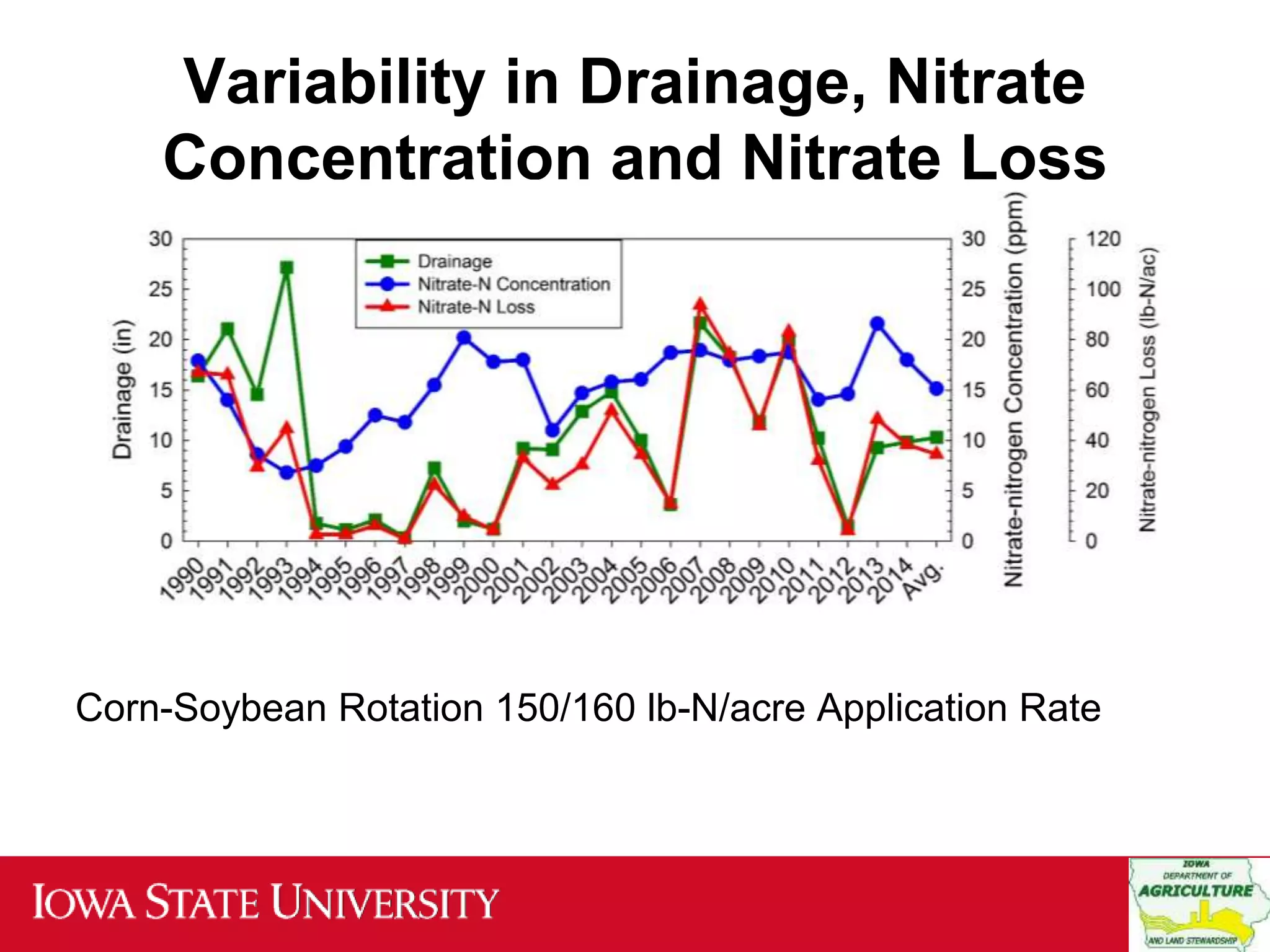
1990
1991
1992
1993
1994
1995
1996
1997
1998
1999
2000
2001
2002
2003
2004
Average
Drainage(in)
0
5
10
15
20
25
30
Nitrate-nitrogenConcentration(ppm)
0
5
10
15
20
25
30
Nitrate-nitrogenLoss(lb-N/ac)
0
20
40
60
80Drainage
Nitrate-N Concentration
Nitrate-N Loss
Corn-Soybean Rotation 150/160 lb-N/acre Application Rate
Variability in Drainage, Nitrate
Concentration and Nitrate Loss
Nitrate
Response to
Nitrogen
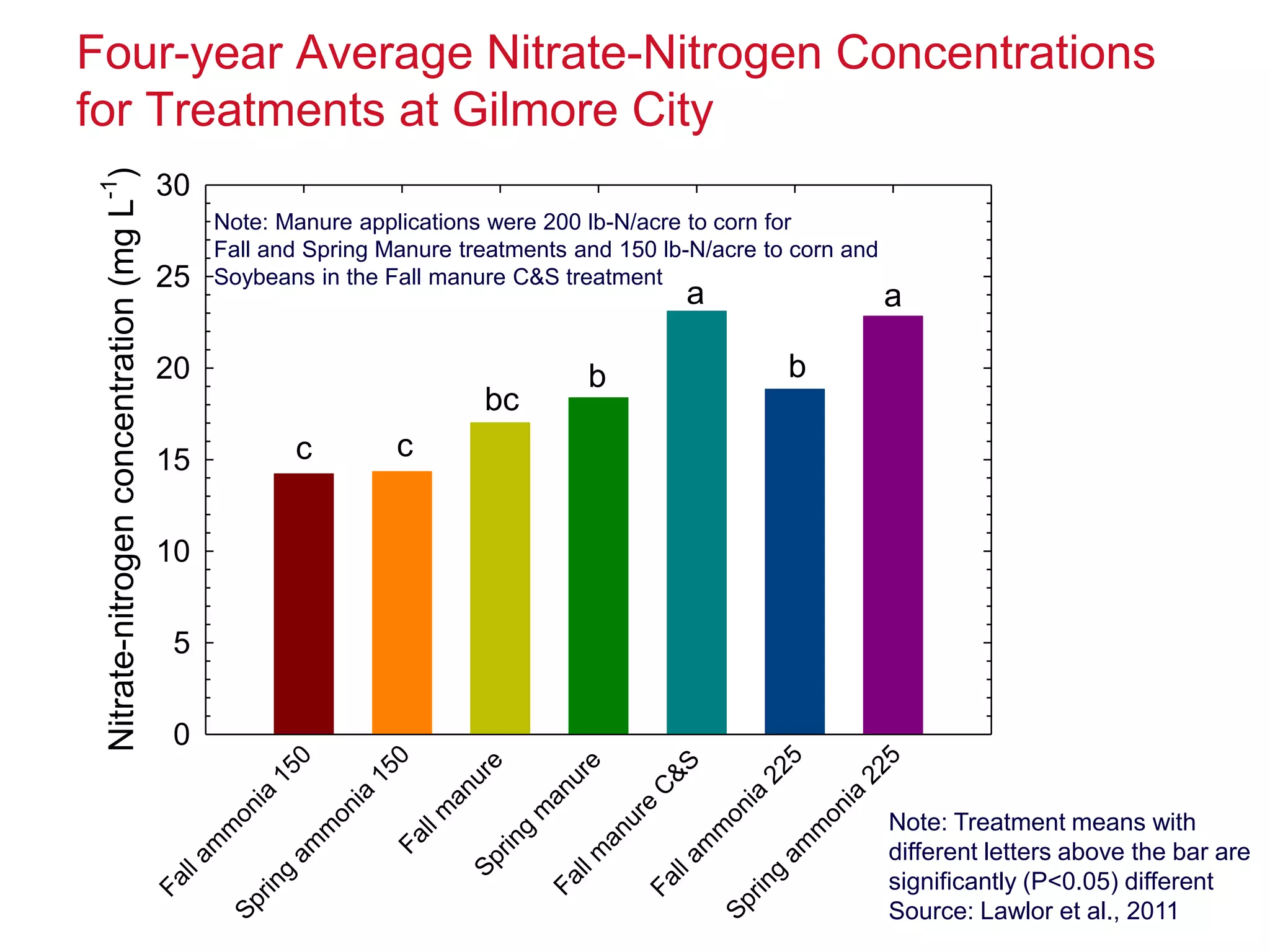
Four-year Average Nitrate-Nitrogen Concentrations
for Treatments at Gilmore City
Fallam
m
onia
150
Spring
am
m
onia
150Fallm
anureSpring
m
anure
Fallm
anure
C
&S
Fallam
m
onia
225
Spring
am
m
onia
225
Nitrate-nitrogenconcentration(mgL-1
)
0
5
10
15
20
25
30
c c
bc
b
a
b
a
Note: Treatment means with
different letters above the bar are
significantly (P<0.05) different
Source: Lawlor et al., 2011
Note: Manure applications were 200 lb-N/acre to corn for
Fall and Spring Manure treatments and 150 lb-N/acre to corn and
Soybeans in the Fall manure C&S treatment
Underlying Processes?
Soil Nitrate Production vs. Crop Nitrate Uptake
In the shaded areas, the soil produces nitrate, but there is no crop to use it. As a result,
some nitrate is lost to waterways.
March February
Rate of soil nitrate
production from
native soil organic
matter
Rate of corn or
soybean nitrate uptake
The majority of nitrate used
by corn and soybean comes
from soil nitrate production.
Corn gets the difference from
fertilizer while soybean gets
the difference from legume
fixation of atmospheric
nitrogen.
Winter Cereal Rye Cover Crops
Ames Gilmore City
Soil Nitrate Production vs. Crop Nitrate Uptake
Addition of a Cover Crop
March February
Rate of soil nitrate
production from
native soil organic
matter
Rate of corn or
soybean nitrate uptake
Cover crops can use nitrate
when corn and beans are not
growing, thus reducing the
asynchrony between soil
nitrate production and crop
nitrate uptake.
Cover crop
nitrate use
Cover crop
nitrate use
In the shaded areas, the soil produces nitrate, but there is no crop to use it. As a result,
some nitrate is lost to waterways.
Impacts of Cover Crops on Nitrate-N Concentration in
Drainage Water – Gilmore City – System with Tillage
~25% Reduction in Nitrate-N Concentration
With Winter Cereal Rye Cover Crop
Subsurface Drainage and
Nitrate-N Leaching 2010-2013
Subsurface
D
rainage
N
itrate-N
C
oncentration
N
itrate-N
Load
SubsurfaceDrainage(in)
0
5
10
15
20
Flow-weightedNitrate-N
Concentration(ppm)
0
5
10
15
20
AnnualNitrate-NLoad(lb/acre)
0
5
10
15
20
CORN-soybean
SOYBEAN-corn
Continuous Corn
Continuous Corn with Cover Crop
Prairie
Fertilized Prairie
What Can We Do?
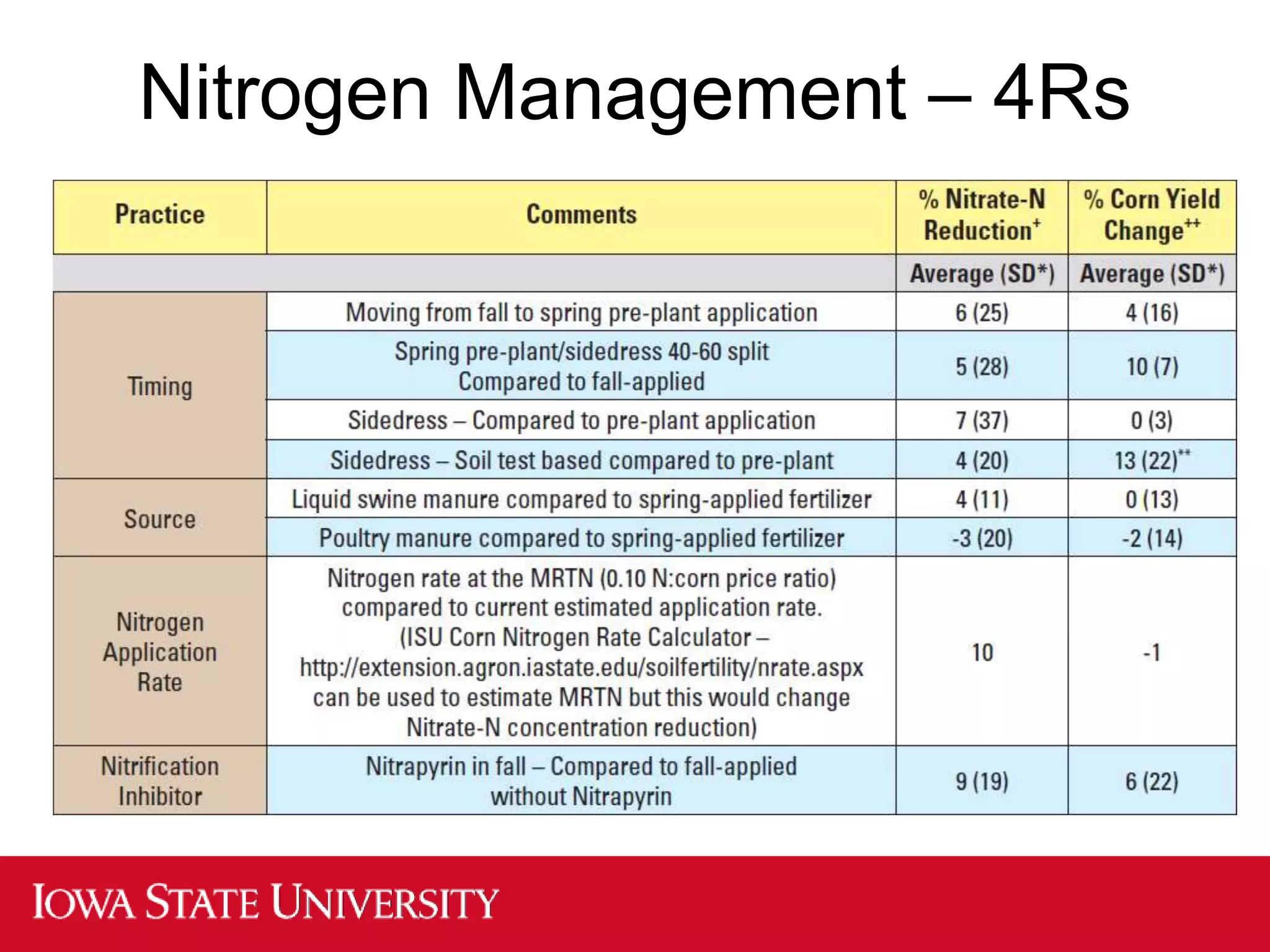
Nitrogen Management – 4Rs
In-field/Land-use Practices
Edge-of-Field Practices
From Christianson and Helmers, 2011
Illustration by John Petersen
(www.petersenart.com)
Subsurface Drainage Bioreactor
Nitrate Removal Wetland
Corn
Soybean
1 km
Targeted Wetland Restoration
DD Tile
W.G. Crumpton, Iowa State University
Iowa Conservation Reserve Enhancement Program (CREP)
What Might it Take to Reach our
Goals?
Nitrate-N
Reduction
Total Equal
Annualized
Cost
Practice/Scenario
% (from
baseline)
Million $/yr
N management - Maximum Return to
Nitrogen Application Rate and 60% of all
Corn-Bean and Continuous Corn Acres
with Cover Crop
Edge-of-Field - 27% of all ag land
treated with wetland and 60% of all
subsurface drained land with bioreactor
42 756
Example: Combination Scenarios that Achieves N Goal
From Non-Point Sources for Nutrient Reduction Strategy
Treated Acres
Treated Acres
~7600wetlands
Treated Acres
~7600wetlands
~120000bioreactors
Wrapup
• Iowa Nutrient Reduction Strategy calls for
a 41% reduction in nitrate-N from nonpoint
sources
• In-field nitrogen management has some
potential to reduce nitrate-N loss however
other in-field and edge-of-field practices
will be needed to reach the goals
• Level of implementation to reach the goals
is very large
Contact
• mhelmers@iastate.edu
• Twitter: @ISUAgWaterMgmt
• Website: http://agwatermgmt.ae.iastate.edu/
Dr. Matt Helmers - Reducing Nitrate-N: Scale of Implementation Needed

Dr. Matt Helmers - Reducing Nitrate-N: Scale of Implementation Needed

  • 1.
    Department of Agriculturaland Biosystems Engineering Reducing Nitrate-N: Scale of Implementation Needed Matthew Helmers Dean’s Professor, College of Ag. & Life Sciences Professor, Dept. of Ag. and Biosystems Eng. Iowa State University Department of Agricultural and Biosystems Engineering
  • 2.
    Situation • Increasing concernfor local and regional waters • Substantial demand for agricultural products • Hypoxia Action Plan in 2008 called for development and implementation of comprehensive N and P reduction strategies for states in the Mississippi/Atchafalaya River Basin • Des Moines Waterworks has filed a lawsuit over high nitrate-N levels
  • 3.
  • 4.
  • 5.
  • 6.
    Four-year Average Nitrate-NitrogenConcentrations for Treatments at Gilmore City Fallam m onia 150 Spring am m onia 150Fallm anureSpring m anure Fallm anure C &S Fallam m onia 225 Spring am m onia 225 Nitrate-nitrogenconcentration(mgL-1 ) 0 5 10 15 20 25 30 c c bc b a b a Note: Treatment means with different letters above the bar are significantly (P<0.05) different Source: Lawlor et al., 2011 Note: Manure applications were 200 lb-N/acre to corn for Fall and Spring Manure treatments and 150 lb-N/acre to corn and Soybeans in the Fall manure C&S treatment
  • 7.
  • 8.
    Soil Nitrate Productionvs. Crop Nitrate Uptake In the shaded areas, the soil produces nitrate, but there is no crop to use it. As a result, some nitrate is lost to waterways. March February Rate of soil nitrate production from native soil organic matter Rate of corn or soybean nitrate uptake The majority of nitrate used by corn and soybean comes from soil nitrate production. Corn gets the difference from fertilizer while soybean gets the difference from legume fixation of atmospheric nitrogen.
  • 9.
    Winter Cereal RyeCover Crops Ames Gilmore City
  • 10.
    Soil Nitrate Productionvs. Crop Nitrate Uptake Addition of a Cover Crop March February Rate of soil nitrate production from native soil organic matter Rate of corn or soybean nitrate uptake Cover crops can use nitrate when corn and beans are not growing, thus reducing the asynchrony between soil nitrate production and crop nitrate uptake. Cover crop nitrate use Cover crop nitrate use In the shaded areas, the soil produces nitrate, but there is no crop to use it. As a result, some nitrate is lost to waterways.
  • 11.
    Impacts of CoverCrops on Nitrate-N Concentration in Drainage Water – Gilmore City – System with Tillage ~25% Reduction in Nitrate-N Concentration With Winter Cereal Rye Cover Crop
  • 12.
    Subsurface Drainage and Nitrate-NLeaching 2010-2013 Subsurface D rainage N itrate-N C oncentration N itrate-N Load SubsurfaceDrainage(in) 0 5 10 15 20 Flow-weightedNitrate-N Concentration(ppm) 0 5 10 15 20 AnnualNitrate-NLoad(lb/acre) 0 5 10 15 20 CORN-soybean SOYBEAN-corn Continuous Corn Continuous Corn with Cover Crop Prairie Fertilized Prairie
  • 13.
  • 14.
  • 15.
  • 16.
  • 17.
    From Christianson andHelmers, 2011 Illustration by John Petersen (www.petersenart.com) Subsurface Drainage Bioreactor
  • 19.
  • 20.
    Corn Soybean 1 km Targeted WetlandRestoration DD Tile W.G. Crumpton, Iowa State University Iowa Conservation Reserve Enhancement Program (CREP)
  • 21.
    What Might itTake to Reach our Goals? Nitrate-N Reduction Total Equal Annualized Cost Practice/Scenario % (from baseline) Million $/yr N management - Maximum Return to Nitrogen Application Rate and 60% of all Corn-Bean and Continuous Corn Acres with Cover Crop Edge-of-Field - 27% of all ag land treated with wetland and 60% of all subsurface drained land with bioreactor 42 756 Example: Combination Scenarios that Achieves N Goal From Non-Point Sources for Nutrient Reduction Strategy
  • 22.
  • 23.
  • 24.
  • 25.
    Wrapup • Iowa NutrientReduction Strategy calls for a 41% reduction in nitrate-N from nonpoint sources • In-field nitrogen management has some potential to reduce nitrate-N loss however other in-field and edge-of-field practices will be needed to reach the goals • Level of implementation to reach the goals is very large
  • 26.
    Contact • mhelmers@iastate.edu • Twitter:@ISUAgWaterMgmt • Website: http://agwatermgmt.ae.iastate.edu/

Editor's Notes

  • #9 Fall application.
  • #22 Examples for illustration only, not for recommendation. It shows that to achieve the 41% N and 29% P targets for nonpoint source, it will require a high adoption rate of several practices. Remember that Equal Annualized Costs (EAC) includes the annualized initial investment, so you cannot add initial investment and EAC.