Land-Grant University Nutrient Management
Guidelines: Can We Meet Crop Production
And Environmental Quality Goals?
Fabián G. Fernández
Nutrient Management & Water Quality Specialist
Department of Soil, Water, and Climate
fabiangf@umn.edu
73rd Soil and Water Conservation Society Annual Conference
1-3 August 2018, Albuquerque NM
Nutrient Management
Outline
• University guidelines for crops, soils
AND the environment?
• Rate
• Source
• Time of application
• Summary and thoughts
Nutrient Management
Guidelines
Nutrient Management
Nutrient guidelines
• Need to based on science.
• Need to be transparent.
• Need to be local.
• Need to be “alive.”
– There is nothing static about crop
production and the environment.
Guidelines should reflect this fact and be
updated as needed.
Nutrient Management
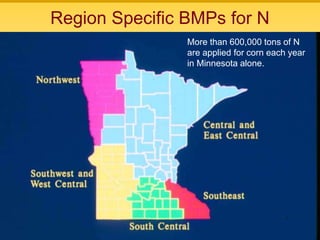
Region Specific BMPs for N
More than 600,000 tons of N
are applied for corn each year
in Minnesota alone.
Nutrient Management
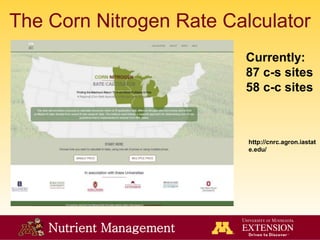
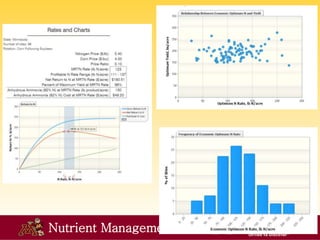
The Corn Nitrogen Rate Calculator
http://cnrc.agron.iastat
e.edu/
Currently:
87 c-s sites
58 c-c sites
Nutrient Management
MRTN Rate
108 (120) 133
Nutrient Management
Rate
Nutrient Management
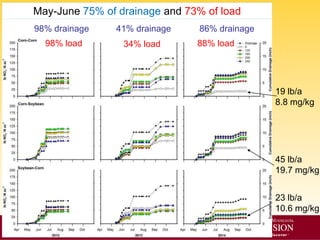
May-June 75% of drainage and 73% of load
98% load 34% load 88% load
98% drainage 41% drainage 86% drainage
45 lb/a
19.7 mg/kg
19 lb/a
8.8 mg/kg
23 lb/a
10.6 mg/kg
Nutrient Management
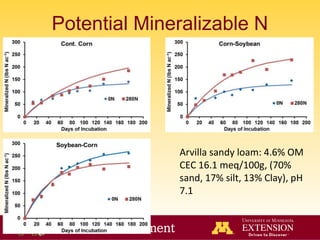
Potential Mineralizable N
Arvilla sandy loam: 4.6% OM
CEC 16.1 meq/100g, (70%
sand, 17% silt, 13% Clay), pH
7.1
Nutrient Management
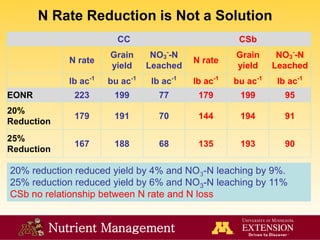
20% reduction reduced yield by 4% and NO3-N leaching by 9%.
25% reduction reduced yield by 6% and NO3-N leaching by 11%
CSb no relationship between N rate and N loss
CC CSb
N rate
Grain
yield
NO3
-
-N
Leached
N rate
Grain
yield
NO3
-
-N
Leached
lb ac-1
bu ac-1
lb ac-1
lb ac-1
bu ac-1
lb ac-1
EONR 223 199 77 179 199 95
20%
Reduction
179 191 70 144 194 91
25%
Reduction
167 188 68 135 193 90
N Rate Reduction is Not a Solution
Nutrient Management
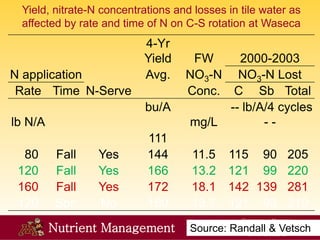
Yield, nitrate-N concentrations and losses in tile water as
affected by rate and time of N on C-S rotation at Waseca
4-Yr
Yield FW 2000-2003
N application Avg. NO3-N NO3-N Lost
Rate Time N-Serve Conc. C Sb Total
lb N/A
bu/A
mg/L
-- lb/A/4 cycles
- -
111
80 Fall Yes 144 11.5 115 90 205
120 Fall Yes 166 13.2 121 99 220
160 Fall Yes 172 18.1 142 139 281
120 Spr. No 180 13.7 121 98 219
Source: Randall & Vetsch
Nutrient Management
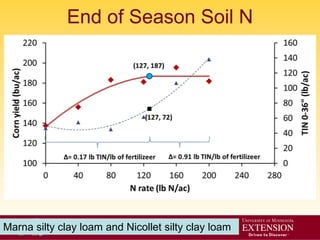
End of Season Soil N
Marna silty clay loam and Nicollet silty clay loam
Nutrient Management
Time of N Application
Nutrient Management
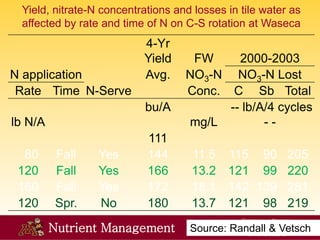
Yield, nitrate-N concentrations and losses in tile water as
affected by rate and time of N on C-S rotation at Waseca
4-Yr
Yield FW 2000-2003
N application Avg. NO3-N NO3-N Lost
Rate Time N-Serve Conc. C Sb Total
lb N/A
bu/A
mg/L
-- lb/A/4 cycles
- -
111
80 Fall Yes 144 11.5 115 90 205
120 Fall Yes 166 13.2 121 99 220
160 Fall Yes 172 18.1 142 139 281
120 Spr. No 180 13.7 121 98 219
Source: Randall & Vetsch
Nutrient Management
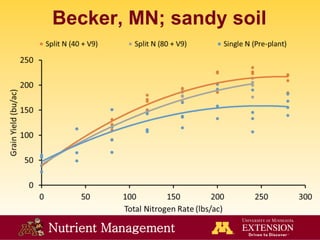
Becker, MN; sandy soil
Nutrient Management
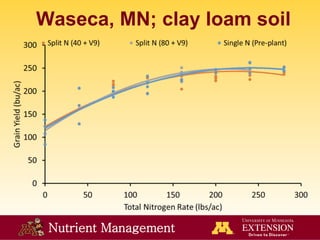
Waseca, MN; clay loam soil
Nutrient Management
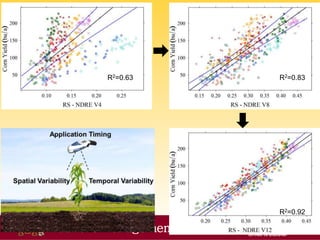
R2=0.92
R2=0.83R2=0.63
Nutrient Management
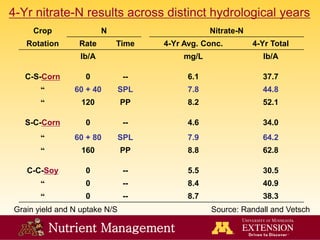
4-Yr nitrate-N results across distinct hydrological years
Crop N Nitrate-N
Rotation Rate Time 4-Yr Avg. Conc. 4-Yr Total
lb/A mg/L lb/A
C-S-Corn 0 -- 6.1 37.7
“ 60 + 40 SPL 7.8 44.8
“ 120 PP 8.2 52.1
S-C-Corn 0 -- 4.6 34.0
“ 60 + 80 SPL 7.9 64.2
“ 160 PP 8.8 62.8
C-C-Soy 0 -- 5.5 30.5
“ 0 -- 8.4 40.9
“ 0 -- 8.7 38.3
Source: Randall and VetschGrain yield and N uptake N/S
Nutrient Management
Source
Nutrient Management
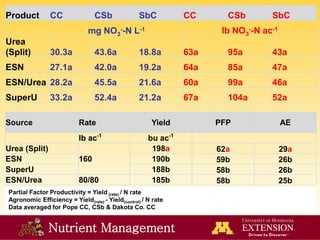
Product CC CSb SbC CC CSb SbC
mg NO3
--N L-1 lb NO3
--N ac-1
Urea
(Split) 30.3a 43.6a 18.8a 63a 95a 43a
ESN 27.1a 42.0a 19.2a 64a 85a 47a
ESN/Urea 28.2a 45.5a 21.6a 60a 99a 46a
SuperU 33.2a 52.4a 21.2a 67a 104a 52a
Source Rate Yield PFP AE
lb ac-1
bu ac-1
Urea (Split)
160
198a 62a 29a
ESN 190b 59b 26b
SuperU 188b 58b 26b
ESN/Urea 80/80 185b 58b 25b
Partial Factor Productivity = Yield (rate) / N rate
Agronomic Efficiency = Yield(rate) - Yield(control) / N rate
Data averaged for Pope CC, CSb & Dakota Co. CC
Nutrient Management
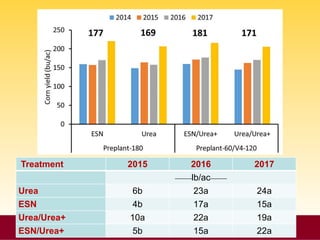
Treatment 2015 2016 2017
_____lb/ac_____
Urea 6b 23a 24a
ESN 4b 17a 15a
Urea/Urea+ 10a 22a 19a
ESN/Urea+ 5b 15a 22a
Nutrient Management
Other Options
Nutrient Management
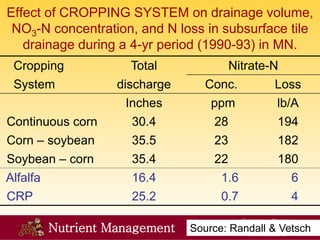
Effect of CROPPING SYSTEM on drainage volume,
NO3-N concentration, and N loss in subsurface tile
drainage during a 4-yr period (1990-93) in MN.
Cropping Total Nitrate-N
System discharge Conc. Loss
Inches ppm lb/A
Continuous corn 30.4 28 194
Corn – soybean 35.5 23 182
Soybean – corn 35.4 22 180
Alfalfa 16.4 1.6 6
CRP 25.2 0.7 4
Source: Randall & Vetsch
Nutrient Management
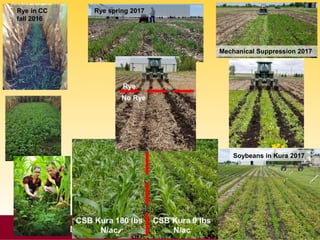
Rye in CC
fall 2016
Soybeans in Kura 2017
Mechanical Suppression 2017
Rye spring 2017
Nutrient Management
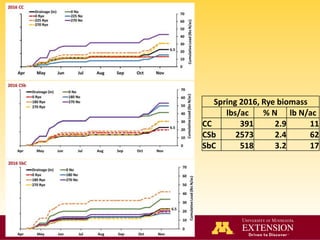
Spring 2016, Rye biomass
lbs/ac % N lb N/ac
CC 391 2.9 11
CSb 2573 2.4 62
SbC 518 3.2 17
Nutrient Management
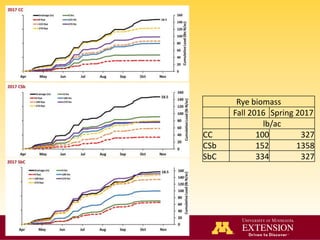
Rye biomass
Fall 2016 Spring 2017
lb/ac
CC 100 327
CSb 152 1358
SbC 334 327
Nutrient Management
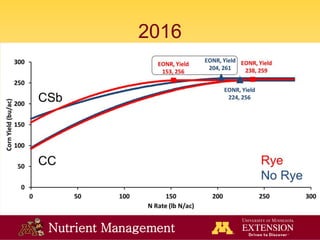
2016
Nutrient Management
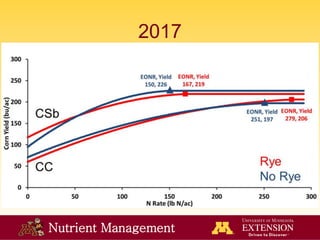
2017
Nutrient Management
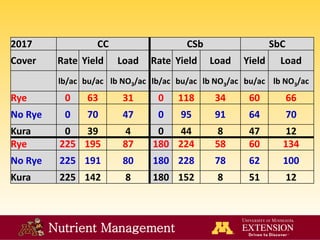
2017 CC CSb SbC
Cover Rate Yield Load Rate Yield Load Yield Load
lb/ac bu/ac lb NO3/ac lb/ac bu/ac lb NO3/ac bu/ac lb NO3/ac
Rye 0 63 31 0 118 34 60 66
No Rye 0 70 47 0 95 91 64 70
Kura 0 39 4 0 44 8 47 12
Rye 225 195 87 180 224 58 60 134
No Rye 225 191 80 180 228 78 62 100
Kura 225 142 8 180 152 8 51 12
Nutrient Management
Conclusions
• Fertilizer guidelines are research based and
include environmental as well as agronomic
benefits.
• Optimizing N rate is key and will continue to
receive major research and regulatory focus.
• N application timing and source are
important, but the results are inconsistent
with the current emphasis placed on them as
an strategy to improve water quality.
Nutrient Management
Final Thoughts
Will the 4R approach to N management be successful in
reducing nitrate-N losses to surface and ground water to
meet the goals of Nitrogen Loss Reduction Strategies being
established?
•They are directionally correct but insufficient to fully
accomplish the goals.
•Engineering options can be helpful but dependent on
landscape and other geographic considerations.
•Shifting ag land away from annual cropping systems
with high N requirements can help, but need to balance
the need for sustainable food production and
environmental protection and profitability
Nutrient Management
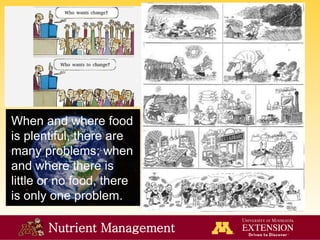
When and where food
is plentiful, there are
many problems; when
and where there is
little or no food, there
is only one problem.
Nutrient Management
Thank
You

Land grant university nutrient management guidelines

  • 1.
    Land-Grant University NutrientManagement Guidelines: Can We Meet Crop Production And Environmental Quality Goals? Fabián G. Fernández Nutrient Management & Water Quality Specialist Department of Soil, Water, and Climate fabiangf@umn.edu 73rd Soil and Water Conservation Society Annual Conference 1-3 August 2018, Albuquerque NM
  • 2.
    Nutrient Management Outline • Universityguidelines for crops, soils AND the environment? • Rate • Source • Time of application • Summary and thoughts
  • 3.
  • 4.
    Nutrient Management Nutrient guidelines •Need to based on science. • Need to be transparent. • Need to be local. • Need to be “alive.” – There is nothing static about crop production and the environment. Guidelines should reflect this fact and be updated as needed.
  • 5.
    Nutrient Management Region SpecificBMPs for N More than 600,000 tons of N are applied for corn each year in Minnesota alone.
  • 6.
    Nutrient Management The CornNitrogen Rate Calculator http://cnrc.agron.iastat e.edu/ Currently: 87 c-s sites 58 c-c sites
  • 7.
  • 8.
  • 9.
    Nutrient Management May-June 75%of drainage and 73% of load 98% load 34% load 88% load 98% drainage 41% drainage 86% drainage 45 lb/a 19.7 mg/kg 19 lb/a 8.8 mg/kg 23 lb/a 10.6 mg/kg
  • 10.
    Nutrient Management Potential MineralizableN Arvilla sandy loam: 4.6% OM CEC 16.1 meq/100g, (70% sand, 17% silt, 13% Clay), pH 7.1
  • 11.
    Nutrient Management 20% reductionreduced yield by 4% and NO3-N leaching by 9%. 25% reduction reduced yield by 6% and NO3-N leaching by 11% CSb no relationship between N rate and N loss CC CSb N rate Grain yield NO3 - -N Leached N rate Grain yield NO3 - -N Leached lb ac-1 bu ac-1 lb ac-1 lb ac-1 bu ac-1 lb ac-1 EONR 223 199 77 179 199 95 20% Reduction 179 191 70 144 194 91 25% Reduction 167 188 68 135 193 90 N Rate Reduction is Not a Solution
  • 12.
    Nutrient Management Yield, nitrate-Nconcentrations and losses in tile water as affected by rate and time of N on C-S rotation at Waseca 4-Yr Yield FW 2000-2003 N application Avg. NO3-N NO3-N Lost Rate Time N-Serve Conc. C Sb Total lb N/A bu/A mg/L -- lb/A/4 cycles - - 111 80 Fall Yes 144 11.5 115 90 205 120 Fall Yes 166 13.2 121 99 220 160 Fall Yes 172 18.1 142 139 281 120 Spr. No 180 13.7 121 98 219 Source: Randall & Vetsch
  • 13.
    Nutrient Management End ofSeason Soil N Marna silty clay loam and Nicollet silty clay loam
  • 14.
  • 15.
    Nutrient Management Yield, nitrate-Nconcentrations and losses in tile water as affected by rate and time of N on C-S rotation at Waseca 4-Yr Yield FW 2000-2003 N application Avg. NO3-N NO3-N Lost Rate Time N-Serve Conc. C Sb Total lb N/A bu/A mg/L -- lb/A/4 cycles - - 111 80 Fall Yes 144 11.5 115 90 205 120 Fall Yes 166 13.2 121 99 220 160 Fall Yes 172 18.1 142 139 281 120 Spr. No 180 13.7 121 98 219 Source: Randall & Vetsch
  • 16.
  • 17.
  • 18.
  • 19.
    Nutrient Management 4-Yr nitrate-Nresults across distinct hydrological years Crop N Nitrate-N Rotation Rate Time 4-Yr Avg. Conc. 4-Yr Total lb/A mg/L lb/A C-S-Corn 0 -- 6.1 37.7 “ 60 + 40 SPL 7.8 44.8 “ 120 PP 8.2 52.1 S-C-Corn 0 -- 4.6 34.0 “ 60 + 80 SPL 7.9 64.2 “ 160 PP 8.8 62.8 C-C-Soy 0 -- 5.5 30.5 “ 0 -- 8.4 40.9 “ 0 -- 8.7 38.3 Source: Randall and VetschGrain yield and N uptake N/S
  • 20.
  • 21.
    Nutrient Management Product CCCSb SbC CC CSb SbC mg NO3 --N L-1 lb NO3 --N ac-1 Urea (Split) 30.3a 43.6a 18.8a 63a 95a 43a ESN 27.1a 42.0a 19.2a 64a 85a 47a ESN/Urea 28.2a 45.5a 21.6a 60a 99a 46a SuperU 33.2a 52.4a 21.2a 67a 104a 52a Source Rate Yield PFP AE lb ac-1 bu ac-1 Urea (Split) 160 198a 62a 29a ESN 190b 59b 26b SuperU 188b 58b 26b ESN/Urea 80/80 185b 58b 25b Partial Factor Productivity = Yield (rate) / N rate Agronomic Efficiency = Yield(rate) - Yield(control) / N rate Data averaged for Pope CC, CSb & Dakota Co. CC
  • 22.
    Nutrient Management Treatment 20152016 2017 _____lb/ac_____ Urea 6b 23a 24a ESN 4b 17a 15a Urea/Urea+ 10a 22a 19a ESN/Urea+ 5b 15a 22a
  • 23.
  • 24.
    Nutrient Management Effect ofCROPPING SYSTEM on drainage volume, NO3-N concentration, and N loss in subsurface tile drainage during a 4-yr period (1990-93) in MN. Cropping Total Nitrate-N System discharge Conc. Loss Inches ppm lb/A Continuous corn 30.4 28 194 Corn – soybean 35.5 23 182 Soybean – corn 35.4 22 180 Alfalfa 16.4 1.6 6 CRP 25.2 0.7 4 Source: Randall & Vetsch
  • 25.
    Nutrient Management Rye inCC fall 2016 Soybeans in Kura 2017 Mechanical Suppression 2017 Rye spring 2017
  • 26.
    Nutrient Management Spring 2016,Rye biomass lbs/ac % N lb N/ac CC 391 2.9 11 CSb 2573 2.4 62 SbC 518 3.2 17
  • 27.
    Nutrient Management Rye biomass Fall2016 Spring 2017 lb/ac CC 100 327 CSb 152 1358 SbC 334 327
  • 28.
  • 29.
  • 30.
    Nutrient Management 2017 CCCSb SbC Cover Rate Yield Load Rate Yield Load Yield Load lb/ac bu/ac lb NO3/ac lb/ac bu/ac lb NO3/ac bu/ac lb NO3/ac Rye 0 63 31 0 118 34 60 66 No Rye 0 70 47 0 95 91 64 70 Kura 0 39 4 0 44 8 47 12 Rye 225 195 87 180 224 58 60 134 No Rye 225 191 80 180 228 78 62 100 Kura 225 142 8 180 152 8 51 12
  • 31.
    Nutrient Management Conclusions • Fertilizerguidelines are research based and include environmental as well as agronomic benefits. • Optimizing N rate is key and will continue to receive major research and regulatory focus. • N application timing and source are important, but the results are inconsistent with the current emphasis placed on them as an strategy to improve water quality.
  • 32.
    Nutrient Management Final Thoughts Willthe 4R approach to N management be successful in reducing nitrate-N losses to surface and ground water to meet the goals of Nitrogen Loss Reduction Strategies being established? •They are directionally correct but insufficient to fully accomplish the goals. •Engineering options can be helpful but dependent on landscape and other geographic considerations. •Shifting ag land away from annual cropping systems with high N requirements can help, but need to balance the need for sustainable food production and environmental protection and profitability
  • 33.
    Nutrient Management When andwhere food is plentiful, there are many problems; when and where there is little or no food, there is only one problem.
  • 34.