


Yoga in Stress Management 
Dr. S. Krishnan, MD, DPM, DIP.NB, MNAMS, CYMP 
Associate Professor of Psychiatry 
Department of Psychiatry 
Government Medical College, Thiruvananthapuram
Stress Common cause of ill 
health in our society 
Underlies as many as 
70% of all visits to 
family doctors. 
Most important cause of 
Work inefficiency 
Substance use disorder 
Suicide attempts 
Pre marital and 
extramarital relationship
Stress ¨Inseparable part of 
human existence. 
¨Responsible for a 
large number of 
health related 
problems. 
¨Affects the biological 
psychological, 
biological and social 
functioning of a 
person.
Do we Need A Definition 
¨Stress: 
– The body’s non specific response to any demand 
made on it. 
¨Better: 
– Stress is what happens when the perceived 
demands of a situation are greater than the 
perceived coping skills we believe we have to deal 
with the situation. 
A simpler one!!!
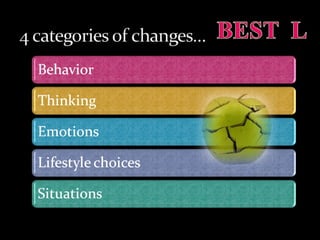
BEST Life … 
¨STRESS FREE LIFE
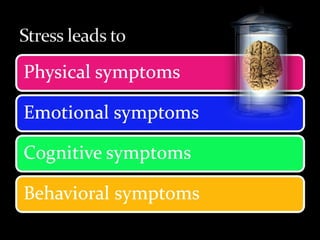
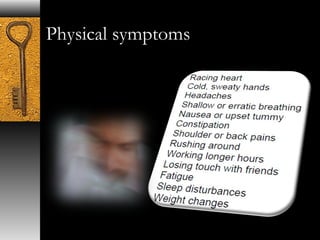
Physical symptoms
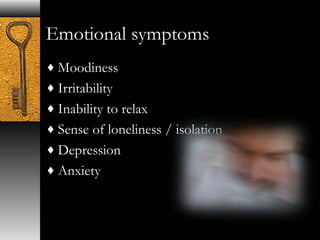
Emotional symptoms 
¨Moodiness 
¨Irritability 
¨Inability to relax 
¨Sense of loneliness / isolation 
¨Depression 
¨Anxiety
Cognitive symptoms 
¨Memory disturbance 
¨Concentration disturbance 
¨Poor judgment / decision making 
¨Seeing only negative 
¨Worrying, constant
Behavioral symptoms 
¨Eating more or less 
¨Sleeping too much / too little 
¨Isolating self from others 
¨Neglecting responsibilities 
¨Using alcohol, cigarettes, drugs to relax 
¨Nervous habits – nail biting, pacing
There is a Method…
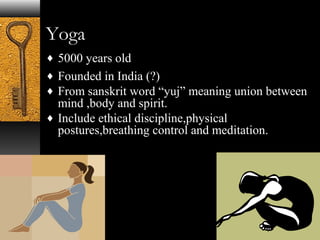
Yoga 
¨ 5000 years old 
¨ Founded in India (?) 
¨ From sanskrit word “yuj” meaning union between 
mind ,body and spirit. 
¨ Include ethical discipline,physical 
postures,breathing control and meditation.
Yoga 
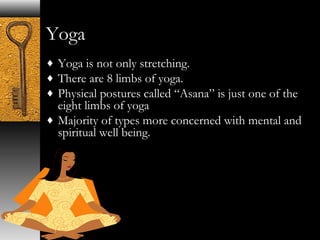
¨ Yoga is not only stretching. 
¨ There are 8 limbs of yoga. 
¨ Physical postures called “Asana” is just one of the 
eight limbs of yoga 
¨ Majority of types more concerned with mental and 
spiritual well being.
Yoga 
¨Yoga requires you 
to make an effort 
to unify your body 
and mind. 
¨You do this by 
concentrating your 
awareness on your 
physical body 
through breathing 
and postures.
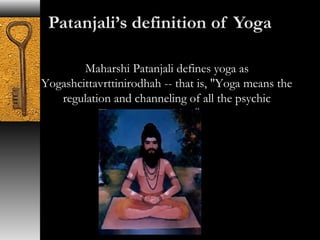
Maharshi Patanjali defines yoga as 
Yogashcittavrttinirodhah -- that is, "Yoga means the 
regulation and channeling of all the psychic 
propensities."
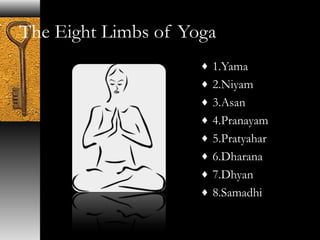
The Eight Limbs of Yoga 
¨ 1.Yama 
¨ 2.Niyam 
¨ 3.Asan 
¨ 4.Pranayam 
¨ 5.Pratyahar 
¨ 6.Dharana 
¨ 7.Dhyan 
¨ 8.Samadhi
Yama 
¨Five ethical guidelines regarding moral 
behavior towards others 
1. Ahimsa-Nonviolence 
2. Satya-Truthfulness 
3. Asteya-Nonstealing 
4. Brahmacharya-No lust or sexual activity 
within marriage. 
5. Aparigraha-don’t collect things that are not 
necessary.
Niyam 
Five rules regarding personal behavior 
1. Sauch-Clealiness 
2. Santosh-Contentment 
3. Tapas-Sustained Practice 
4. Svadyay-Self Study 
5. Ishvara Pranidhan-Surrender to God
The Eight Limbs Cont. 
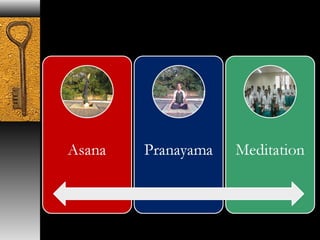
¨Asana - Practice of yoga postures 
¨Pranayama - Practice of breathing exercises 
¨Pratyahara - Withdrawal of the senses, 
meaning that the exterior world is not a 
distraction from the interior world within 
oneself.
The Eight Limbs Cont. 
¨Dharana-Concentration,The ability to focus 
on something uninterrupted by external or 
internal distraction 
¨Dhyana-Meditation 
¨Samadhi-Bliss. Building upon Breathe! 
Dhyana,the 
transcendence of the self through meditation. 
The merging of self with the universe.
 Abdominal breathing 
 Sends a fax to the brain to relax 
 Close your eyes 
 Put your hand on your belly 
 Imagine …..
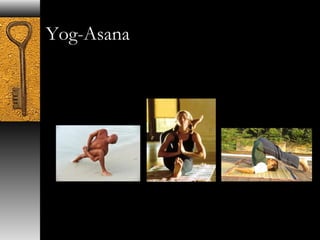
Yog-Asana
Asana 
Does not mean EXERCISE 
ASANA means POSTURE 
Asana means EXISTENCE 
EXSITENCE – without doing anything! 
No movement. A steady posture 
“STHIR SUKHAM ASANAM” 
2:46 
“Steady & comfortable posture is Asana”
Asana 
Asana is a posture without movements. But to attain 
this posture movements are essential. 
1. Performing the Asana Pre-Position – Basal posture 
2. Attaining the Asana posture with movements 
3. Asana Posture – Maintaining with no movement 
4. Releasing the Asana posture with movements 
Note: 
Step No. 3 is Asana. Step No. 2 & 4 are not Asana
Asana - Movements 
Slow 
Under control 
Accompanied with a correct breathing method
Asana 
“STHIR SUKHAM ASANAM” 
2:46 
Steady & comfortable posture is Asana 
¨ Steadiness & comfort must be in 
Physical body (mainly muscle) 
Mental Condition 
¨ Steadiness & comfort are also interdependent
Asana 
Asanas can be practiced on the following Levels 
0) With fast movements & without steadiness – Non yogic 
level, Exercise 
1) With slow movements but without steadiness – for people 
with physical weakness (arthritis, frozen restriction) 
2) With slow movements & with steadiness for a certain 
period 
3) With slow movements with steadiness for a certain period 
& a relaxation of the muscles (improves organ function) 
4) With slow movements & with steadiness for a certain 
period, relaxation of the muscles & concentrating the 
mind on any organ of the self-body 
5) With slow movements & with steadiness for a certain 
period, relaxation of all the muscles & concentrating the 
mind on infinity
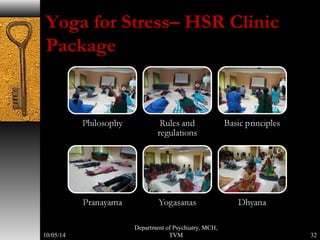
Yoga for Stress– HSR Clinic 
Package 
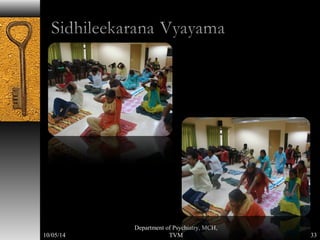
Department of Psychiatry, MCH, 
10/05/14 TVM 32
10/05/14 
Department of Psychiatry, MCH, 
TVM 33
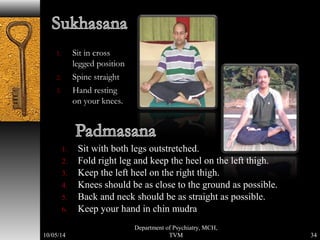
1. Sit in cross 
legged position 
2. Spine straight 
3. Hand resting 
on your knees. 
1. Sit with both legs outstretched. 
2. Fold right leg and keep the heel on the left thigh. 
3. Keep the left heel on the right thigh. 
4. Knees should be as close to the ground as possible. 
5. Back and neck should be as straight as possible. 
6. Keep your hand in chin mudra 
34 
Department of Psychiatry, MCH, 
10/05/14 TVM
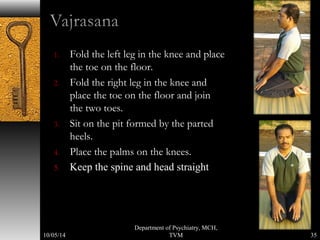
1. Fold the left leg in the knee and place 
the toe on the floor. 
2. Fold the right leg in the knee and 
place the toe on the floor and join 
the two toes. 
3. Sit on the pit formed by the parted 
heels. 
4. Place the palms on the knees. 
5. Keep the spine and head straight 
35 
Department of Psychiatry, MCH, 
10/05/14 TVM
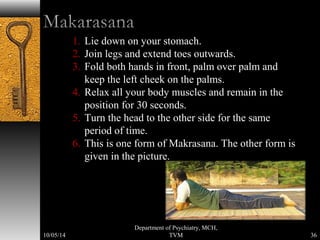
1. Lie down on your stomach. 
2. Join legs and extend toes outwards. 
3. Fold both hands in front, palm over palm and 
keep the left cheek on the palms. 
4. Relax all your body muscles and remain in the 
position for 30 seconds. 
5. Turn the head to the other side for the same 
period of time. 
6. This is one form of Makrasana. The other form is 
given in the picture. 
36 
Department of Psychiatry, MCH, 
10/05/14 TVM
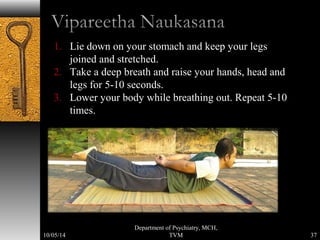
1. Lie down on your stomach and keep your legs 
joined and stretched. 
2. Take a deep breath and raise your hands, head and 
legs for 5-10 seconds. 
3. Lower your body while breathing out. Repeat 5-10 
times. 
37 
Department of Psychiatry, MCH, 
10/05/14 TVM
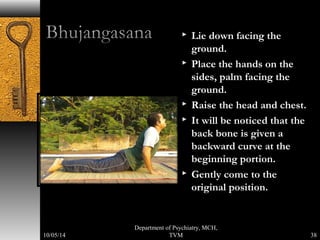
 Lie down facing the 
ground. 
 Place the hands on the 
sides, palm facing the 
ground. 
 Raise the head and chest. 
 It will be noticed that the 
back bone is given a 
backward curve at the 
beginning portion. 
 Gently come to the 
original position. 
38 
Department of Psychiatry, MCH, 
10/05/14 TVM
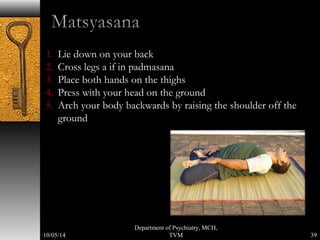
1. Lie down on your back 
2. Cross legs a if in padmasana 
3. Place both hands on the thighs 
4. Press with your head on the ground 
5. Arch your body backwards by raising the shoulder off the 
ground 
39 
Department of Psychiatry, MCH, 
10/05/14 TVM
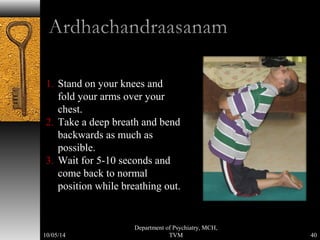
1. Stand on your knees and 
fold your arms over your 
chest. 
2. Take a deep breath and bend 
backwards as much as 
possible. 
3. Wait for 5-10 seconds and 
come back to normal 
position while breathing out. 
40 
Department of Psychiatry, MCH, 
10/05/14 TVM
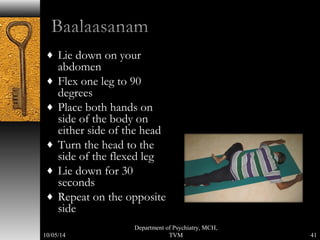
¨ Lie down on your 
abdomen 
¨ Flex one leg to 90 
degrees 
¨ Place both hands on 
side of the body on 
either side of the head 
¨ Turn the head to the 
side of the flexed leg 
¨ Lie down for 30 
seconds 
¨ Repeat on the opposite 
side 
41 
Department of Psychiatry, MCH, 
10/05/14 TVM
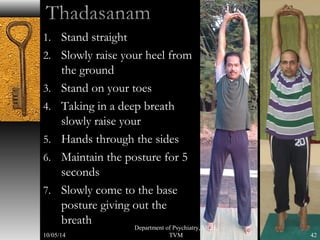
1. Stand straight 
2. Slowly raise your heel from 
the ground 
3. Stand on your toes 
4. Taking in a deep breath 
slowly raise your 
5. Hands through the sides 
6. Maintain the posture for 5 
seconds 
7. Slowly come to the base 
posture giving out the 
breath 
42 
Department of Psychiatry, MCH, 
10/05/14 TVM
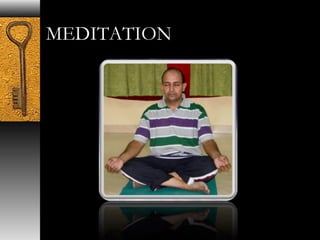
MEDITATION
Dr. S. Krishnan 
Associate Professor of Psychiatry 
Medical College, Thiruvananthapuram 
Ph: 9447 123 789
15 minute Schedule 
1. Bhujangasana – 5 times 
2. Bhastrika in Vajrasana – 3 minutes 
3. Viparitha naukasana – 5 times 
4. Salabhaasana – 5 times 
5. Ardha chandrasana – 5 times 
6. Tadasana – 3 times 
45 
Department of Psychiatry, MCH, 
10/05/14 TVM
Stress and Healthcare Providers 
¨Providing care to others is a rich and 
rewarding experience 
¨Often feel improved self esteem and 
confidence 
¨But….They have the responsibility of another 
human being’s life. 
¨No wonder they live under tremendous 
stress!
Stress and Healthcare providers 
¨Continuous exposure to suffering 
¨Psychological effects of death and dying 
patients 
¨Decreased sleep and food 
¨Long hours of work 
¨Constant worry about law suits 
¨CME – study ,study , study!
How Yoga Can help 
¨ Practicing yoga can be a best thing a provider can 
do for himself/herself 
¨ Doing simple “Pranayam” (breathing technique) in 
breaks can calm their mind. 
¨ Practicing yoga for ½ hr. a day can make their body 
fit to take care of others. 
¨ Yogic thought process- will teach not to work only 
for money.
Future Directions for Research 
¨ Attractive treatment – Is it enough? 
¨ Few studies exist – Only in its infancy 
¨ Questions to be answered 
– Is yoga effective (superior to minimal or no interventions) 
– Heterogeneity of practices – various methods of same named 
asanas, 
– What are the essential elements of yoga – asana / pranayama / 
others 
– What is the best balance of pranayama vs asanas / physical 
movements vs meditation 
– Which asana to try for which patient? 
– How important is it that practice should be physically vigorous 
– What is the ideal amount of practice which has an antidepressant 
effect 
– What could be the mechanisms by which yoga reduces depression 
• Is it merely the exercise component 
Department of Psychiatry, MCH, 
TVM 49 
10/05/14
To think about… 
¨Can yoga be used as a prophylactic treatment 
for PSYCHIATRIC DISORDERS? 
Department of Psychiatry, MCH, 
TVM 50 
10/05/14
DDoonn’’tt TTrryy IITT!! 
10/05/14 
JJuusstt DDoo IITT!!!!!! 
Department of Psychiatry, MCH, 
TVM 51
manaskrishnan2003@gmail.com 
9447 123 789 
52 
Department of Psychiatry, MCH, 
10/05/14 TVM
Department of Psychiatry, MCH, 
10/05/14 TVM 53

Dr. krishnan's yoga for stress management

  • 1.
    Yoga in StressManagement Dr. S. Krishnan, MD, DPM, DIP.NB, MNAMS, CYMP Associate Professor of Psychiatry Department of Psychiatry Government Medical College, Thiruvananthapuram
  • 2.
    Stress Common causeof ill health in our society Underlies as many as 70% of all visits to family doctors. Most important cause of Work inefficiency Substance use disorder Suicide attempts Pre marital and extramarital relationship
  • 3.
    Stress ¨Inseparable partof human existence. ¨Responsible for a large number of health related problems. ¨Affects the biological psychological, biological and social functioning of a person.
  • 5.
    Do we NeedA Definition ¨Stress: – The body’s non specific response to any demand made on it. ¨Better: – Stress is what happens when the perceived demands of a situation are greater than the perceived coping skills we believe we have to deal with the situation. A simpler one!!!
  • 7.
    BEST Life … ¨STRESS FREE LIFE
  • 10.
  • 11.
    Emotional symptoms ¨Moodiness ¨Irritability ¨Inability to relax ¨Sense of loneliness / isolation ¨Depression ¨Anxiety
  • 12.
    Cognitive symptoms ¨Memorydisturbance ¨Concentration disturbance ¨Poor judgment / decision making ¨Seeing only negative ¨Worrying, constant
  • 13.
    Behavioral symptoms ¨Eatingmore or less ¨Sleeping too much / too little ¨Isolating self from others ¨Neglecting responsibilities ¨Using alcohol, cigarettes, drugs to relax ¨Nervous habits – nail biting, pacing
  • 14.
    There is aMethod…
  • 15.
    Yoga ¨ 5000years old ¨ Founded in India (?) ¨ From sanskrit word “yuj” meaning union between mind ,body and spirit. ¨ Include ethical discipline,physical postures,breathing control and meditation.
  • 16.
    Yoga ¨ Yogais not only stretching. ¨ There are 8 limbs of yoga. ¨ Physical postures called “Asana” is just one of the eight limbs of yoga ¨ Majority of types more concerned with mental and spiritual well being.
  • 17.
    Yoga ¨Yoga requiresyou to make an effort to unify your body and mind. ¨You do this by concentrating your awareness on your physical body through breathing and postures.
  • 18.
    Maharshi Patanjali definesyoga as Yogashcittavrttinirodhah -- that is, "Yoga means the regulation and channeling of all the psychic propensities."
  • 19.
    The Eight Limbsof Yoga ¨ 1.Yama ¨ 2.Niyam ¨ 3.Asan ¨ 4.Pranayam ¨ 5.Pratyahar ¨ 6.Dharana ¨ 7.Dhyan ¨ 8.Samadhi
  • 20.
    Yama ¨Five ethicalguidelines regarding moral behavior towards others 1. Ahimsa-Nonviolence 2. Satya-Truthfulness 3. Asteya-Nonstealing 4. Brahmacharya-No lust or sexual activity within marriage. 5. Aparigraha-don’t collect things that are not necessary.
  • 21.
    Niyam Five rulesregarding personal behavior 1. Sauch-Clealiness 2. Santosh-Contentment 3. Tapas-Sustained Practice 4. Svadyay-Self Study 5. Ishvara Pranidhan-Surrender to God
  • 22.
    The Eight LimbsCont. ¨Asana - Practice of yoga postures ¨Pranayama - Practice of breathing exercises ¨Pratyahara - Withdrawal of the senses, meaning that the exterior world is not a distraction from the interior world within oneself.
  • 24.
    The Eight LimbsCont. ¨Dharana-Concentration,The ability to focus on something uninterrupted by external or internal distraction ¨Dhyana-Meditation ¨Samadhi-Bliss. Building upon Breathe! Dhyana,the transcendence of the self through meditation. The merging of self with the universe.
  • 25.
     Abdominal breathing  Sends a fax to the brain to relax  Close your eyes  Put your hand on your belly  Imagine …..
  • 26.
  • 27.
    Asana Does notmean EXERCISE ASANA means POSTURE Asana means EXISTENCE EXSITENCE – without doing anything! No movement. A steady posture “STHIR SUKHAM ASANAM” 2:46 “Steady & comfortable posture is Asana”
  • 28.
    Asana Asana isa posture without movements. But to attain this posture movements are essential. 1. Performing the Asana Pre-Position – Basal posture 2. Attaining the Asana posture with movements 3. Asana Posture – Maintaining with no movement 4. Releasing the Asana posture with movements Note: Step No. 3 is Asana. Step No. 2 & 4 are not Asana
  • 29.
    Asana - Movements Slow Under control Accompanied with a correct breathing method
  • 30.
    Asana “STHIR SUKHAMASANAM” 2:46 Steady & comfortable posture is Asana ¨ Steadiness & comfort must be in Physical body (mainly muscle) Mental Condition ¨ Steadiness & comfort are also interdependent
  • 31.
    Asana Asanas canbe practiced on the following Levels 0) With fast movements & without steadiness – Non yogic level, Exercise 1) With slow movements but without steadiness – for people with physical weakness (arthritis, frozen restriction) 2) With slow movements & with steadiness for a certain period 3) With slow movements with steadiness for a certain period & a relaxation of the muscles (improves organ function) 4) With slow movements & with steadiness for a certain period, relaxation of the muscles & concentrating the mind on any organ of the self-body 5) With slow movements & with steadiness for a certain period, relaxation of all the muscles & concentrating the mind on infinity
  • 32.
    Yoga for Stress–HSR Clinic Package Department of Psychiatry, MCH, 10/05/14 TVM 32
  • 33.
    10/05/14 Department ofPsychiatry, MCH, TVM 33
  • 34.
    1. Sit incross legged position 2. Spine straight 3. Hand resting on your knees. 1. Sit with both legs outstretched. 2. Fold right leg and keep the heel on the left thigh. 3. Keep the left heel on the right thigh. 4. Knees should be as close to the ground as possible. 5. Back and neck should be as straight as possible. 6. Keep your hand in chin mudra 34 Department of Psychiatry, MCH, 10/05/14 TVM
  • 35.
    1. Fold theleft leg in the knee and place the toe on the floor. 2. Fold the right leg in the knee and place the toe on the floor and join the two toes. 3. Sit on the pit formed by the parted heels. 4. Place the palms on the knees. 5. Keep the spine and head straight 35 Department of Psychiatry, MCH, 10/05/14 TVM
  • 36.
    1. Lie downon your stomach. 2. Join legs and extend toes outwards. 3. Fold both hands in front, palm over palm and keep the left cheek on the palms. 4. Relax all your body muscles and remain in the position for 30 seconds. 5. Turn the head to the other side for the same period of time. 6. This is one form of Makrasana. The other form is given in the picture. 36 Department of Psychiatry, MCH, 10/05/14 TVM
  • 37.
    1. Lie downon your stomach and keep your legs joined and stretched. 2. Take a deep breath and raise your hands, head and legs for 5-10 seconds. 3. Lower your body while breathing out. Repeat 5-10 times. 37 Department of Psychiatry, MCH, 10/05/14 TVM
  • 38.
     Lie downfacing the ground.  Place the hands on the sides, palm facing the ground.  Raise the head and chest.  It will be noticed that the back bone is given a backward curve at the beginning portion.  Gently come to the original position. 38 Department of Psychiatry, MCH, 10/05/14 TVM
  • 39.
    1. Lie downon your back 2. Cross legs a if in padmasana 3. Place both hands on the thighs 4. Press with your head on the ground 5. Arch your body backwards by raising the shoulder off the ground 39 Department of Psychiatry, MCH, 10/05/14 TVM
  • 40.
    1. Stand onyour knees and fold your arms over your chest. 2. Take a deep breath and bend backwards as much as possible. 3. Wait for 5-10 seconds and come back to normal position while breathing out. 40 Department of Psychiatry, MCH, 10/05/14 TVM
  • 41.
    ¨ Lie downon your abdomen ¨ Flex one leg to 90 degrees ¨ Place both hands on side of the body on either side of the head ¨ Turn the head to the side of the flexed leg ¨ Lie down for 30 seconds ¨ Repeat on the opposite side 41 Department of Psychiatry, MCH, 10/05/14 TVM
  • 42.
    1. Stand straight 2. Slowly raise your heel from the ground 3. Stand on your toes 4. Taking in a deep breath slowly raise your 5. Hands through the sides 6. Maintain the posture for 5 seconds 7. Slowly come to the base posture giving out the breath 42 Department of Psychiatry, MCH, 10/05/14 TVM
  • 43.
  • 44.
    Dr. S. Krishnan Associate Professor of Psychiatry Medical College, Thiruvananthapuram Ph: 9447 123 789
  • 45.
    15 minute Schedule 1. Bhujangasana – 5 times 2. Bhastrika in Vajrasana – 3 minutes 3. Viparitha naukasana – 5 times 4. Salabhaasana – 5 times 5. Ardha chandrasana – 5 times 6. Tadasana – 3 times 45 Department of Psychiatry, MCH, 10/05/14 TVM
  • 46.
    Stress and HealthcareProviders ¨Providing care to others is a rich and rewarding experience ¨Often feel improved self esteem and confidence ¨But….They have the responsibility of another human being’s life. ¨No wonder they live under tremendous stress!
  • 47.
    Stress and Healthcareproviders ¨Continuous exposure to suffering ¨Psychological effects of death and dying patients ¨Decreased sleep and food ¨Long hours of work ¨Constant worry about law suits ¨CME – study ,study , study!
  • 48.
    How Yoga Canhelp ¨ Practicing yoga can be a best thing a provider can do for himself/herself ¨ Doing simple “Pranayam” (breathing technique) in breaks can calm their mind. ¨ Practicing yoga for ½ hr. a day can make their body fit to take care of others. ¨ Yogic thought process- will teach not to work only for money.
  • 49.
    Future Directions forResearch ¨ Attractive treatment – Is it enough? ¨ Few studies exist – Only in its infancy ¨ Questions to be answered – Is yoga effective (superior to minimal or no interventions) – Heterogeneity of practices – various methods of same named asanas, – What are the essential elements of yoga – asana / pranayama / others – What is the best balance of pranayama vs asanas / physical movements vs meditation – Which asana to try for which patient? – How important is it that practice should be physically vigorous – What is the ideal amount of practice which has an antidepressant effect – What could be the mechanisms by which yoga reduces depression • Is it merely the exercise component Department of Psychiatry, MCH, TVM 49 10/05/14
  • 50.
    To think about… ¨Can yoga be used as a prophylactic treatment for PSYCHIATRIC DISORDERS? Department of Psychiatry, MCH, TVM 50 10/05/14
  • 51.
    DDoonn’’tt TTrryy IITT!! 10/05/14 JJuusstt DDoo IITT!!!!!! Department of Psychiatry, MCH, TVM 51
  • 52.
    manaskrishnan2003@gmail.com 9447 123789 52 Department of Psychiatry, MCH, 10/05/14 TVM
  • 53.
    Department of Psychiatry,MCH, 10/05/14 TVM 53

Editor's Notes

  • #20 http://www.yogawiz.com