Library Networks in the New Millennium: Emerging Trends   Dr. H. K. Kaul Director, DELNET
Digital Resources  Growth of Information is Random Some Global Estimates of Growth The amount of new technical information is doubling every two years The world’s total store of information is doubling every four years Business information is doubling every eighteen months Digitized information is doubling every 18 months Human knowledge is doubling every year. Medical knowledge is doubling every five years.
Growing Dimensions Growth is inevitable  From tangible to intangible media Sources of information and representations of knowledge  on the INTERNET  From Books and Journals to services and databases  The knowledge packages are published and distributed on the INTERNET. From buying to leasing From ascertaining to using New purposes of the catalogue. To help others to use knowledge packages on the INTERNET.
Development of  Digital Collection   Digital collections  that are  created. e.g. newspapers, e-journals,  documents in offices, MSS,  publications etc  Digital documents converted from print to digital versions  Born Digital Publications “ Digital materials which are not intended to have an analogue equivalent, either as  the originating source or as a result of conversion to analogue form.”  Digital Preservation Coalition, U. K. Born Digital Publications include: Video Recordings; Sound Recordings; Podcasts; Mixed Media; Geographic  Information; Software programs; Blogs, Wikis;
Direct Access or Access Through Consortiums Consortium approach has been tested. Helps to get access to commercially available content at a low price.  The issues : Archiving licensed  content  for which one has paid. Archiving content for which the permissions are not available. Access should be possible to content for which payment has been  made even after the expiry of subscription. Pricing should be affordable.
E-books About 78,500,000 search results on Google. December 12,  2008.  Institutional Repositories Institutions  such as universities, research organizations, Government  departments are now creating MSS in digital form  E-Journals  A bout 3,080,000 search results on the Google. December 12,  2008
Accessing Digital Collections Single search should give access to  several related databases  Accessing Digital Collections in Other Languages Access should be possible to  non-English digital collections  With mechanical  translations  as far as possible.
Digitisation Metadata Metadata with a digitized document. Terminology which is globally comprehensible and standard Access to content becomes possible through a variety of search engines. Metadata would generally include  author, file name, creation software and version, creation date, modification date, subject, size, and any additional pertinent information.  Once the preservation process is done the addition of metadata becomes necessary.  Dublin Core Metadata Initiative  gives guidelines for creating  interoperable online metadata standards.  http://dublincore.org/documents/dcmi-terms/
 
 
Software Issues The issues that are important to be looked into the software applications include technical sustainability of the software,  adoption of risk assessment procedure, eligible for long term  archiving; etc.  Types of Content to be Digitised   Printed Documents Manuscripts Video-recordings Sound-recordings, such as oral history collections and music Traditional heritage, cultural objects, medicines etc. The catalogues act as metadata if they are in conformity with international  standards.
Digital Library Technologies Digital library technologies are also useful for knowledge networks. Specialised tools like SKOS (Specialised Knowledge Organisation Systems) work in the area of  developing specifications and standards to support the use of knowledge organisation such as thesauri, classification schemes and  subject heading systems  within the framework of the Semantic Web are  becoming available for  application in knowledge networks.
 
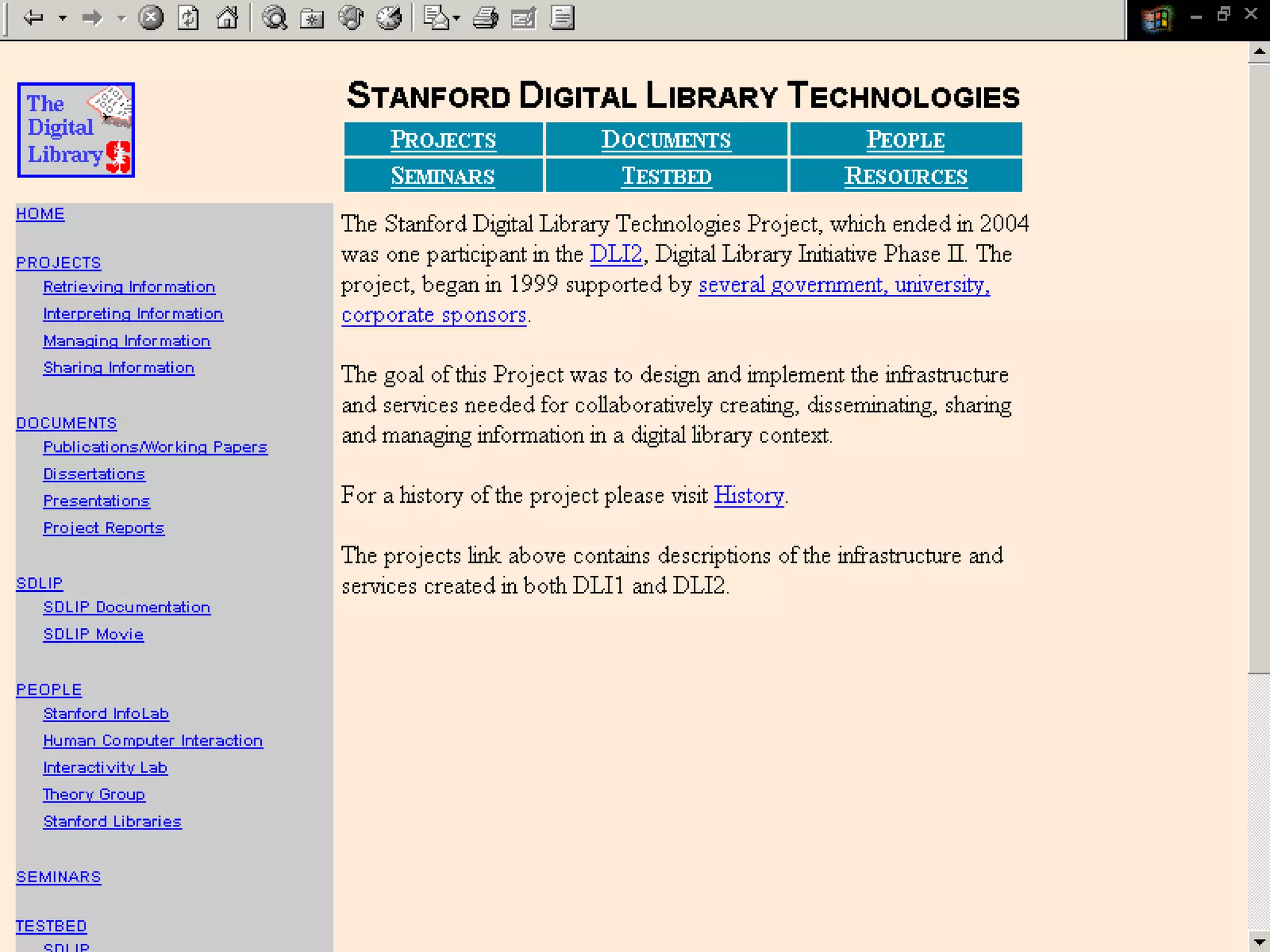
Digital Library Technologies  Stanford Digital Libraries  Technologies Stanford University and Sun Microsystems developed several technologies for  developing digital library such as Digital Library Tool Kit, etc.comprise:  I nterBib : - a tool for maintaining bibliographic information.  Capable of reading from and writing to many different    formats, it acts as a unified, searchable repository of      bibliographic records.  Archival Repositories : a Digital Library Repository (DLR) is  formed by a collection of independent but    collaborating sites. Each site manages a    collection of digital objects  Digital Wallets : -  Focuses on bringing  interoperability to the  electronic payments arena.”
 
Networking  of Digital Resources A Vision  Access  any  document In any Language In any  format Anywhere in the world Any time as required At a very low cost Networked Digital Resources  A Vision Linked  to any institution in the world Offer digital documents globally
Technology Issues Hardware  High-speed high-specification computer with  multimedia and  telecommunication connectivity would be essential. Over the past twenty years: The processor speeds have increased from 10 MHz to 10,000 MHz.  The capacities of transistors per chip have increased from 275,000  to 250 million.  Basic disc capacity has increased from 20 MB to  250 GB. Memory of chips has increased from 64 Kbits to 16 Gbits.
Technology Issues (contd.) Wireless communication   Wireless connectivity, through radio waves has emerged as the fastest mode of communication /  Mobile Phones High Speed Fibre Optics Fibre optic cables can carry data at a far higher speed of 1Gb/s ( while as 100 Mb/s to 10Gb/s are also in use as backbone.  New Satellite System Large streams of data can be  processed through the  new satellite system. This multipurpose facility will use video, sound, data for weather, intelligence etc. It is the best tool which is emerging for networking  of digital resources. The  new satellite system  uses the Global Positioning System (GPS).
Technology Issues (contd.) High Bandwidth   The speed of the network which is the rate of data transfer is known as bandwidth.  In the early 1990s the speed of the modems was generally 56 Kbps. In 2008 the speed of modems has increased  to  up-speed of 15-16 mbps and down-speed of 16-24 mbps. With the transfer of images, sound and video recordings  through digital networks higher bandwidth speeds of upto 5 GB are available now. Content Based Networking A new concept has emerged in which a special  communication infrastructure  which makes the messages to move by the content of the messages. It is not driven by the addresses which are attached to the mails. In this network the characteristics of the receivers of messages attract the types of messages it is interested in. The interests of receivers is noted by means of a description of interests called predicates.  In contrast to the previous method it is somewhat semantic in nature.
Technology Issues (contd.) Online-Catalogues   The catalogues have remained  important tools for searching documents. Even today cataloging and authority control have gained more  significance in the online environment  Sharing Technologies Cooperation with  libraries and networks. Use of knowledge tools. SalesForce.com,  BMC Software, DCASoft, and Atlassian are some of the software used for sharing knowledge.
Library Networks  National Overview Global Issues Future  of Networked Digital Resources   Interactive Interactive network covers digital LAN signals,  video,  television signals,  local video,  personal computers, television receivers, video cassette recorders, printers, and video cameras. A television interface enables any television in the network to receive and display local video output by a personal computer or other device in the network and enables the television to be used as a remote monitor for the computer.  Intuitive Intuitive computing facilitates answers for all types of questions in a given environment.
Future  of Networked Digital Resources (contd.)   Provisional paths In complex computing,  mixed topologies will be used :e.g. a mix of  Bus topology; Ring topology; Star topology; Tree topology. Each time a topology change is detected,  the systems will create automatically new subset topologies. Time taken for this job and the effectiveness of the topologies  will  vary from system to system. It will be done without affecting the users. Multimedia 99% of the digital explosion on the Internet would be in Multimedia format by 2012. Web 2.0 Multimedia Search: will provide  new opportunities for online advertising and applications.  It is changing and is not ever lasting. From fixed, permanent, formatted text collections  we are going to have fluid and transient multimedia resources 
Future  of Networked Digital Resources (contd.)   Relationships Complex relationships are going to be  handled by computing models which will revolutionize the networking requirements  Resources We are going to have increasingly access to digital resources rather than to collections  as the scope of physical collections will gradually decrease. Free, flexible, and virtual information Spaces In place of static library facilities with fixed stacks we are going to have access to free, flexible, and virtual information spaces.
Future  of Networked Digital Resources (contd.)   Hypertext Every document will get linked, for further explanation or reference,  to every other necessary documents through the hypertext.  Very large hypertexts and shared information spaces are going to emerge.  The authoring tools  which are  software and services that are used to produce Web pages and Web  content   are  going to advance the use of hypertext in multiple applications. Flexibility More and more flexibility is getting developed for use in high power computing services. New algorithms avoid large enumeration in programming  Contingency Contingency computing plans  are going to cover major security systems against attacks, thefts etc
Future  of Networked Digital Resources (contd.)   Multiple online identities   A person can develop multiple identities, where each identity will identify the person with a characteristics or a purpose. A person can have  multiple profiles and control access to them.  Blogs are the examples.  For instance  MySpace and Facebook allow  people to create a social network helping others to develop different identities/ profiles  Adaptability and ambiguity   Because of the turbulent and dynamic internal and external environment, inherent flexibility of web based materials,  item-wise  attention for hypermedia systems, etc adaptability in software solutions would be a must. Also,  it should be able to resolve ambiguities arising because of  speech, language, data etc.
Future  of Networked Digital Resources (contd.)   Global Global vision of the world’s computational infrastructure is becoming day by day necessary  Informal Informal knowledge exchange and  social relationships among  like-minded individuals/ experts on the increase. Simulation Imitation of  real phenomenon with a set of mathematical formulas/ advanced computer programs  is going to be on the increase
fluid and transient multimedia resources   free, flexible, and virtual information    customized annotations/transient works   tailored services to collaborative teams  personalized consulting and analysis   integrated service provision   holistic, integrated networked systems   distributed, decentralized global access   participative and collegial relationships   inter-, multi- and cross-disciplinary studies  user-/use-specific relevant services policies  integration of informal with formal     fixed, permanent, formatted text collections  static library facilities with fixed stacks  uniform sources, citations, references  services provided to individual readers  standard reference services   professionally provided services  locally owned permanent collections  centralized collections and services  hierarchical organizational structures  discipline specialization  generic user service   formal acquisitions   To   From
Networking for LMS Some libraries come together to acquire and use a library management  system (LMS). Sometimes national: e.g. COBISS network and software used for many libraries in Slovenia, Macedonia, Serbia , Montenegro etc. http://www.cobiss.net/cobiss_platform.htm Physical network issues  Wi-Fi – wireless fidelity – for sending info. to/from wireless local area networks that might be in a physical library.
Resources Networking knowledge - An essential activity Developing a case-based reasoning knowledge repository to support  learning  Community  would help library and knowledge networks. Electronic Resources Provide shared electronic resources to users Network of ‘e-offerings’  Value Added Resources For creating value added products,  knowledge servers, with  great features should be preferred. Package the content. Refinements to be made to the content have to be on a  regular basis. User-created content
Social  Networking   Social networking services and libraries – Web 2.0   The tools and techniques of social computing providing new opportunities for the design and delivery of library resources and services. http://www.acrl.org/ala/acrl/acrlpubs/whitepapers/Environmental_Scan_2.pdf Social networking has flourished due to the ease of connecting on the Web.
Blogs Sample blog entry:  Lorcan Dempsey – VP OCLC  http://orweblog.oclc.org/archives/001379.html   
 
Wikis  A  wiki  is a page or collection of Web pages designed to enable anyone who accesses it to contribute or modify content, using a simplified markup language
 
RSS  RSS  is a family of Web feed formats used to publish frequently updated works— such as blog entries, news headlines, audio, and video—in a standardized format
 
Podcasts A  podcast  is a series of audio or video digital-media files which is distributed over the Internet by syndicated download, through Web feeds
 
Facebook Facebook  is a social utility that connects people with friends and others who work, study and live around them. People use  Facebook  to keep up with friends
 
MySpace  An international site that offers email, a forum, communities, videos and weblog  space
 
Flickr Flickr is almost certainly the best online photo management and sharing application in the world. Show off your favorite photos and videos to the world,  ...
Flickr
Libraries “ Libraries can now easily collaborate and create online communities, as well as explore new ways in which to communicate with, educate and attract new users - and also to market themselves ”   Phil Bradley
Knowledge Discovery To facilitate the process of knowledge discovery in databases, a wide variety of methodologies including machine learning, pattern recognition, artificial intelligence, knowledge acquisition for expert systems, etc are getting developed.  The Knowledge Discovery in Databases contains not only the automated processes but also the non-automated processes in order to cull out the knowledge from the databases.
Retrieval Retrieval and delivery of knowledge is becoming a specialised art. The types of experts who get involved with the work include domain experts, computer experts, training specialists and users who look into all types of documents  including  text documents, images, graphics, maps, animations, video and audio recordings, and combinations of them.
Retrieval (contd.) Semantic retrieval comprise techniques that use semantic information  and  the understanding of the language for retrieval of subjects technically. The retrieval of relational concepts from massive text databases by using search engines helps in collecting correlations for research and reference. It improve performance in retrieving more information from complex documents.
Retrieval (contd.) The retrieval of images either from the Web or from databases  by using image and text recognition software  is beginning to be used. Actual contents of the image are analyzed.  Research is continuing in this field where artificial intelligence approaches are being tested.
Retrieval (contd.) Partaking of knowledge for  creation and sharing is emerging as a useful tool for knowledge networks. Knowledge sharing technologies  are used in organizations, and between individuals and experts SalesForce.com,  BMC Software, DCASoft, and Atlassian are some examples.
Retrieval (contd.) The Knowledge Delivery Service (KDS) is an infrastructure which every Library Network should have. It  facilitates the transmission of selected knowledge to each and every node (a library) connected with the library network and interested in a specific knowledge.
Trends in Subject Gateways:  The example from “Law” Business & Regulation   Constitutional Law   Copyright and Intellectual Property   Courts & Tribunals   Criminal Law   Family Law   Gazettes   Gender and the Law   Health Law   Human Rights   Indigenous Law   Justices   Law reform   Legal Topics   Tax Law   Treaties   Business & Regulation
Trends in Subject Gateways:  The example from “Law” (contd.) Australian Competition & Consumer Commission   Australian Securities and Investments Commission   Australian Taxation Office - ATO Legal Database   Business Law  (Parliamentary library link)  Consumers.online.gov.au   Commonwealth Department of Treasury   Constitutional Law A-Z Constitutions   Australian Constitution   Constitution Finder   Constitutional Law  ( Charles Darwin University)  U.S. Constitution  (Bill of Rights, Historical information)    Copyright and Intellectual Property Australian Copyright Council   Copyright  (National Library Guide)  Copyright Law  Attorney-General's Department  Copyright Information  (through Australian Library & Information Association)  Copyright & Intellectual Property  (Parliamentary Library links)  Communications, Information Technology & the Arts  (Commonwealth)
Trends in Subject Gateways:  The example from “Law” (contd.) Intellectual Property Law  (Copyright (International resources)  Intellectual Property Rights and Developing Countries   IP Australia  (Commonwealth)  U.K. Copyright  (Patent Office)  U.S. Copyright Office  (Library of Congress)  WIPO  - World Intellectual Property Organization  World Trade Organization  - World Trade Organization  TRIPS  (Trade-related Aspects of Intellectual Property Rights)  Courts & Tribunals:
Trends in Subject Gateways:  The example from “Law” (contd.) Commonwealth High Court of Australia   ( Latest High Court cases )  Family Court of Australia   Federal Court of Australia   Industrial Relations Court of Australia   Australian Industrial Relations Commission   Administrative Appeals Tribunal   Migration Review Tribunal   National Native Trial Tribunal   Refugee Review Tribunal   Social Security Tribunal   Superannuation Complaints Tribunal
Trends in Subject Gateways:  The example from “Law” (contd.) Australian States & Territories A.C.T. Law Courts & Tribunals    A.C.T. Magistrates Court & Tribunals ,  A.C.T. Supreme Court   N.S.W. Courts   Northern Territory. Department of Justice   Queensland Courts   S.A.Courts Administration   Tasmania Courts   Victoria. Department of Justice   W.A. Department of the Attorney General
Trends in Subject Gateways:  The example from “Law” (contd.) International Courts International Court of Justice   European Court of Human Rights   Permanent Court of International Justice     International Courts & Tribunals   Project on International Courts and Tribunals   World Courts.com   Criminal Law Australasian Centre for Policing Research   Australian Bureau of Statistics Crime Statistics   Australian Crime Commission    Australian Institute of Criminology   Crime & Criminal Justice Statistics  (AIC)  Crimenet    Criminal Justice  (U.K. University of Kent)  Criminology Research Council   U.K. Judicial System  (U.K. Government)  U.K. Metropolitan Police Service   U.S. Department of Justice - Office of Justice  -  Statistics
Trends in Subject Gateways:  The example from “Law” (contd.) Family Law Australian Institute of Family Studies   Family Court of Australia   Family Law Online  (Commonwealth Attorney General's Department)  Family Law Council   Islamic Family Law   Gazettes Government Notices Gazettes  (Cth Atorney-General's Department)  ACT Government Gazettes   ASIC Gazettes   Business Gazettes  (ASIC)  Periodic Notices Gazettes   Public Service Gazettes   Special Notices Gazettes   Government Gazettes Online   
Trends in Subject Gateways:  The example from “Law” (contd.) Gender and the Law Australian Institute of Criminology: Women and the Law: Conference proceedings   Office for Women  (Australia)  National Women's Justice Coalition    Health Law Austlii  Guide to Medicine & Health   Health Law  (Weblaw)  Health Law  (Parliamentary Library Guide)
Trends in Subject Gateways:  The example from “Law” (contd.) Human Rights A.C.T. Human Rights Office   Australian Human Rights and Equal Opportunity Commission   Australian Human Rights Centre  (University of New South Wales, Faculty of Law)   Columbia Law School - Human and Constitutional Rights   Commonwealth Department of Foreign Affairs & Trade Human Rights resources    Human Rights Council of Australia   Human Rights Library  (University of Minnesota)  Human Rights Online   Interights  (Commonwealth Human Rights Case Law Database)  Office of the High Commissioner for Human Rights  (United Nations)  Parliamentary Library - Civil & Human Rights Guide   United Nations Human Rights information   Universal Declaration of Human Rights   U.S. Department of State. Human Rights reports
Trends in Subject Gateways:  The example from “Law” (contd.) Indigenous Law Indigenous Law Centre   Indigenous Peoples & the Law  (Parliamentary Library)  Indigenous Law Resources  (Austlii)   National Native Title Tribunal   Timeline for Indigenous Legal Issues  (Austlii)  WebLaw guide   Justices High Court of Australia Justices  (High Court of Australia)  Judges of A.C.T. Supreme Court
Trends in Subject Gateways:  The example from “Law” (contd.) Law reform A.C.T. Law Reform Commission Reports   Australian Law Reform Commission   Law Reform Commission of Western Australia   N.S.W. Law Reform Commission   Queensland Law Reform Commission   Tasmanian Law Reform Institute   Victorian Law Reform Commission   Law Reform  (World)  Legal topics Austlii  Hot Topics  -online topics 1998-2004-Search within each issue.  APEC Competition Policy and Law Database  (Asia-Pacific Economic Forum)  Australia's counter terrorism laws  (Proposals...from Parliamentary Library)    European Law - Jean Monnet Project:  European integration in Law, Economics, Political Science & History (NYU School of Law)  JURIST - Current Awareness  (University of Pittsburgh School of Law)   Law & Justice Foundation of New South Wales   Law Council of Australia   OECD Topics   Parliamentary Library - E-Briefs, & other Publications    Pandora Archive  - National Library & Partners (select Law & Criminology or related topics)  Proceedings from the Old Bailey, London (1674-1834)   United Nations
Trends in Subject Gateways:  The example from “Law” (contd.) Tax Law ACT Revenue Office   Australian Taxation Office   ATO Legal Database  Collection of legal and policy information that is used by the Australian Tax Office when making decisions. Find a Public Ruling, Public Determination or a Bulletin.  Reference Manual   Board of Taxation   Tax Law guide  (Parliamentary Library)  Tax law guide  (WebLaw Guide)  Treaties Australian Treaties Library  (Austlii & DFAT)  European Treaties  (Council of Europe-Legal Affairs)  Hague Conference on Private International Law    Multilateral Conventions  (Fletcher-Ginn Multilateral Projects - Tufts University)  United Nations Treaty Collection
Trends in Subject Gateways:  The example from “Law” (contd.) Subject Gateways Australian Law Online  Entry point to Australian Government legal resources  Australian Law on the Internet  National Library Guide  Australian Public Law  (Charles Darwin University Law School)  BUBL Link   Findlaw   JURIST  (University of Pittsburgh, School of Law)  Lawlinks  (U.K. University of Kent)  Legal Information Institute  (Cornell University Law School)  LLRX.com  -  Researching Australian Law   Parliamentary Library  Guide to Law  SOSIG  Social Science Information Gateway for Law - U.K.  WashLAW Web  (Washburn University, School of Law Legal Information)  WebLaw  Subject gateway to Internet resources for Australian legal researchers
The Human Network Characteristics  Personal information strategies  Good communication  Enliven your network  Manage technology effectively  Be part of a high performance team Make teams use technology  Develop a creative knowledge environment
The Human Network (contd.) Characteristics Inbuilt human traits are needed in networking of digital resources  Initiative taking Network  with any individual or institution that  yield useful information Self-management –  manage  time for fulfilling commitments Effective team-workers   Demonstrate leadership Supportive followers  Broad perspective-  while initiating or executing jobs Show and tell –  ideas are presented persuasively Organisation savvy –  work keeping in view the interests and policies  of the organisation
The Human Network (contd.) Good Communication Planning Conducive Environment Introduce Yourself First Method of Conveying Information Method of Receiving Information Summarise Action Points Follow Through
The Human Network (contd.) Enliven Your Network Mapping the Network New Inputs Network Associates  Activating the Network Can Network Function Without You? . Reciprocity and Trust
Training Library networks should introduce online learning courses. Training to library staff and citizens in using information resources.
Archiving Develop digital archive of historical and government documents, photographs, maps, etc.
 
Services Interlibrary loan and document delivery system to members. Providing services to communities, including children  in  less developed and rural communities. Equitable access to information resources and library services
Thank You

Dr H K Kaul

  • 1.
    Library Networks inthe New Millennium: Emerging Trends Dr. H. K. Kaul Director, DELNET
  • 2.
    Digital Resources Growth of Information is Random Some Global Estimates of Growth The amount of new technical information is doubling every two years The world’s total store of information is doubling every four years Business information is doubling every eighteen months Digitized information is doubling every 18 months Human knowledge is doubling every year. Medical knowledge is doubling every five years.
  • 3.
    Growing Dimensions Growthis inevitable From tangible to intangible media Sources of information and representations of knowledge on the INTERNET From Books and Journals to services and databases The knowledge packages are published and distributed on the INTERNET. From buying to leasing From ascertaining to using New purposes of the catalogue. To help others to use knowledge packages on the INTERNET.
  • 4.
    Development of Digital Collection Digital collections that are created. e.g. newspapers, e-journals, documents in offices, MSS, publications etc Digital documents converted from print to digital versions Born Digital Publications “ Digital materials which are not intended to have an analogue equivalent, either as the originating source or as a result of conversion to analogue form.” Digital Preservation Coalition, U. K. Born Digital Publications include: Video Recordings; Sound Recordings; Podcasts; Mixed Media; Geographic Information; Software programs; Blogs, Wikis;
  • 5.
    Direct Access orAccess Through Consortiums Consortium approach has been tested. Helps to get access to commercially available content at a low price. The issues : Archiving licensed content for which one has paid. Archiving content for which the permissions are not available. Access should be possible to content for which payment has been made even after the expiry of subscription. Pricing should be affordable.
  • 6.
    E-books About 78,500,000search results on Google. December 12, 2008. Institutional Repositories Institutions such as universities, research organizations, Government departments are now creating MSS in digital form E-Journals A bout 3,080,000 search results on the Google. December 12, 2008
  • 7.
    Accessing Digital CollectionsSingle search should give access to several related databases Accessing Digital Collections in Other Languages Access should be possible to non-English digital collections With mechanical translations as far as possible.
  • 8.
    Digitisation Metadata Metadatawith a digitized document. Terminology which is globally comprehensible and standard Access to content becomes possible through a variety of search engines. Metadata would generally include author, file name, creation software and version, creation date, modification date, subject, size, and any additional pertinent information. Once the preservation process is done the addition of metadata becomes necessary. Dublin Core Metadata Initiative gives guidelines for creating interoperable online metadata standards. http://dublincore.org/documents/dcmi-terms/
  • 9.
  • 10.
  • 11.
    Software Issues Theissues that are important to be looked into the software applications include technical sustainability of the software, adoption of risk assessment procedure, eligible for long term archiving; etc. Types of Content to be Digitised Printed Documents Manuscripts Video-recordings Sound-recordings, such as oral history collections and music Traditional heritage, cultural objects, medicines etc. The catalogues act as metadata if they are in conformity with international standards.
  • 12.
    Digital Library TechnologiesDigital library technologies are also useful for knowledge networks. Specialised tools like SKOS (Specialised Knowledge Organisation Systems) work in the area of developing specifications and standards to support the use of knowledge organisation such as thesauri, classification schemes and subject heading systems within the framework of the Semantic Web are becoming available for application in knowledge networks.
  • 13.
  • 14.
    Digital Library Technologies Stanford Digital Libraries Technologies Stanford University and Sun Microsystems developed several technologies for developing digital library such as Digital Library Tool Kit, etc.comprise: I nterBib : - a tool for maintaining bibliographic information. Capable of reading from and writing to many different formats, it acts as a unified, searchable repository of bibliographic records. Archival Repositories : a Digital Library Repository (DLR) is formed by a collection of independent but collaborating sites. Each site manages a collection of digital objects Digital Wallets : - Focuses on bringing interoperability to the electronic payments arena.”
  • 15.
  • 16.
    Networking ofDigital Resources A Vision Access any document In any Language In any format Anywhere in the world Any time as required At a very low cost Networked Digital Resources A Vision Linked to any institution in the world Offer digital documents globally
  • 17.
    Technology Issues Hardware High-speed high-specification computer with multimedia and telecommunication connectivity would be essential. Over the past twenty years: The processor speeds have increased from 10 MHz to 10,000 MHz. The capacities of transistors per chip have increased from 275,000 to 250 million. Basic disc capacity has increased from 20 MB to 250 GB. Memory of chips has increased from 64 Kbits to 16 Gbits.
  • 18.
    Technology Issues (contd.)Wireless communication Wireless connectivity, through radio waves has emerged as the fastest mode of communication / Mobile Phones High Speed Fibre Optics Fibre optic cables can carry data at a far higher speed of 1Gb/s ( while as 100 Mb/s to 10Gb/s are also in use as backbone. New Satellite System Large streams of data can be processed through the new satellite system. This multipurpose facility will use video, sound, data for weather, intelligence etc. It is the best tool which is emerging for networking of digital resources. The new satellite system uses the Global Positioning System (GPS).
  • 19.
    Technology Issues (contd.)High Bandwidth The speed of the network which is the rate of data transfer is known as bandwidth. In the early 1990s the speed of the modems was generally 56 Kbps. In 2008 the speed of modems has increased to up-speed of 15-16 mbps and down-speed of 16-24 mbps. With the transfer of images, sound and video recordings through digital networks higher bandwidth speeds of upto 5 GB are available now. Content Based Networking A new concept has emerged in which a special communication infrastructure which makes the messages to move by the content of the messages. It is not driven by the addresses which are attached to the mails. In this network the characteristics of the receivers of messages attract the types of messages it is interested in. The interests of receivers is noted by means of a description of interests called predicates. In contrast to the previous method it is somewhat semantic in nature.
  • 20.
    Technology Issues (contd.)Online-Catalogues The catalogues have remained important tools for searching documents. Even today cataloging and authority control have gained more significance in the online environment Sharing Technologies Cooperation with libraries and networks. Use of knowledge tools. SalesForce.com, BMC Software, DCASoft, and Atlassian are some of the software used for sharing knowledge.
  • 21.
    Library Networks National Overview Global Issues Future of Networked Digital Resources Interactive Interactive network covers digital LAN signals, video, television signals, local video, personal computers, television receivers, video cassette recorders, printers, and video cameras. A television interface enables any television in the network to receive and display local video output by a personal computer or other device in the network and enables the television to be used as a remote monitor for the computer. Intuitive Intuitive computing facilitates answers for all types of questions in a given environment.
  • 22.
    Future ofNetworked Digital Resources (contd.) Provisional paths In complex computing, mixed topologies will be used :e.g. a mix of Bus topology; Ring topology; Star topology; Tree topology. Each time a topology change is detected, the systems will create automatically new subset topologies. Time taken for this job and the effectiveness of the topologies will vary from system to system. It will be done without affecting the users. Multimedia 99% of the digital explosion on the Internet would be in Multimedia format by 2012. Web 2.0 Multimedia Search: will provide new opportunities for online advertising and applications. It is changing and is not ever lasting. From fixed, permanent, formatted text collections we are going to have fluid and transient multimedia resources 
  • 23.
    Future ofNetworked Digital Resources (contd.) Relationships Complex relationships are going to be handled by computing models which will revolutionize the networking requirements Resources We are going to have increasingly access to digital resources rather than to collections as the scope of physical collections will gradually decrease. Free, flexible, and virtual information Spaces In place of static library facilities with fixed stacks we are going to have access to free, flexible, and virtual information spaces.
  • 24.
    Future ofNetworked Digital Resources (contd.) Hypertext Every document will get linked, for further explanation or reference, to every other necessary documents through the hypertext. Very large hypertexts and shared information spaces are going to emerge. The authoring tools which are software and services that are used to produce Web pages and Web content are going to advance the use of hypertext in multiple applications. Flexibility More and more flexibility is getting developed for use in high power computing services. New algorithms avoid large enumeration in programming Contingency Contingency computing plans are going to cover major security systems against attacks, thefts etc
  • 25.
    Future ofNetworked Digital Resources (contd.) Multiple online identities A person can develop multiple identities, where each identity will identify the person with a characteristics or a purpose. A person can have multiple profiles and control access to them. Blogs are the examples. For instance MySpace and Facebook allow people to create a social network helping others to develop different identities/ profiles Adaptability and ambiguity Because of the turbulent and dynamic internal and external environment, inherent flexibility of web based materials, item-wise attention for hypermedia systems, etc adaptability in software solutions would be a must. Also, it should be able to resolve ambiguities arising because of speech, language, data etc.
  • 26.
    Future ofNetworked Digital Resources (contd.) Global Global vision of the world’s computational infrastructure is becoming day by day necessary Informal Informal knowledge exchange and social relationships among like-minded individuals/ experts on the increase. Simulation Imitation of real phenomenon with a set of mathematical formulas/ advanced computer programs is going to be on the increase
  • 27.
    fluid and transientmultimedia resources  free, flexible, and virtual information   customized annotations/transient works  tailored services to collaborative teams personalized consulting and analysis  integrated service provision  holistic, integrated networked systems  distributed, decentralized global access  participative and collegial relationships  inter-, multi- and cross-disciplinary studies user-/use-specific relevant services policies integration of informal with formal   fixed, permanent, formatted text collections static library facilities with fixed stacks uniform sources, citations, references services provided to individual readers standard reference services  professionally provided services locally owned permanent collections centralized collections and services hierarchical organizational structures discipline specialization generic user service  formal acquisitions To From
  • 28.
    Networking for LMSSome libraries come together to acquire and use a library management  system (LMS). Sometimes national: e.g. COBISS network and software used for many libraries in Slovenia, Macedonia, Serbia , Montenegro etc. http://www.cobiss.net/cobiss_platform.htm Physical network issues  Wi-Fi – wireless fidelity – for sending info. to/from wireless local area networks that might be in a physical library.
  • 29.
    Resources Networking knowledge- An essential activity Developing a case-based reasoning knowledge repository to support learning Community would help library and knowledge networks. Electronic Resources Provide shared electronic resources to users Network of ‘e-offerings’ Value Added Resources For creating value added products, knowledge servers, with great features should be preferred. Package the content. Refinements to be made to the content have to be on a regular basis. User-created content
  • 30.
    Social Networking  Social networking services and libraries – Web 2.0   The tools and techniques of social computing providing new opportunities for the design and delivery of library resources and services. http://www.acrl.org/ala/acrl/acrlpubs/whitepapers/Environmental_Scan_2.pdf Social networking has flourished due to the ease of connecting on the Web.
  • 31.
    Blogs Sample blogentry:  Lorcan Dempsey – VP OCLC http://orweblog.oclc.org/archives/001379.html  
  • 32.
  • 33.
    Wikis A wiki is a page or collection of Web pages designed to enable anyone who accesses it to contribute or modify content, using a simplified markup language
  • 34.
  • 35.
    RSS RSS is a family of Web feed formats used to publish frequently updated works— such as blog entries, news headlines, audio, and video—in a standardized format
  • 36.
  • 37.
    Podcasts A podcast is a series of audio or video digital-media files which is distributed over the Internet by syndicated download, through Web feeds
  • 38.
  • 39.
    Facebook Facebook is a social utility that connects people with friends and others who work, study and live around them. People use Facebook to keep up with friends
  • 40.
  • 41.
    MySpace Aninternational site that offers email, a forum, communities, videos and weblog space
  • 42.
  • 43.
    Flickr Flickr isalmost certainly the best online photo management and sharing application in the world. Show off your favorite photos and videos to the world, ...
  • 44.
  • 45.
    Libraries “ Librariescan now easily collaborate and create online communities, as well as explore new ways in which to communicate with, educate and attract new users - and also to market themselves ” Phil Bradley
  • 46.
    Knowledge Discovery Tofacilitate the process of knowledge discovery in databases, a wide variety of methodologies including machine learning, pattern recognition, artificial intelligence, knowledge acquisition for expert systems, etc are getting developed. The Knowledge Discovery in Databases contains not only the automated processes but also the non-automated processes in order to cull out the knowledge from the databases.
  • 47.
    Retrieval Retrieval anddelivery of knowledge is becoming a specialised art. The types of experts who get involved with the work include domain experts, computer experts, training specialists and users who look into all types of documents including text documents, images, graphics, maps, animations, video and audio recordings, and combinations of them.
  • 48.
    Retrieval (contd.) Semanticretrieval comprise techniques that use semantic information and the understanding of the language for retrieval of subjects technically. The retrieval of relational concepts from massive text databases by using search engines helps in collecting correlations for research and reference. It improve performance in retrieving more information from complex documents.
  • 49.
    Retrieval (contd.) Theretrieval of images either from the Web or from databases by using image and text recognition software is beginning to be used. Actual contents of the image are analyzed. Research is continuing in this field where artificial intelligence approaches are being tested.
  • 50.
    Retrieval (contd.) Partakingof knowledge for creation and sharing is emerging as a useful tool for knowledge networks. Knowledge sharing technologies are used in organizations, and between individuals and experts SalesForce.com, BMC Software, DCASoft, and Atlassian are some examples.
  • 51.
    Retrieval (contd.) TheKnowledge Delivery Service (KDS) is an infrastructure which every Library Network should have. It facilitates the transmission of selected knowledge to each and every node (a library) connected with the library network and interested in a specific knowledge.
  • 52.
    Trends in SubjectGateways: The example from “Law” Business & Regulation Constitutional Law Copyright and Intellectual Property Courts & Tribunals Criminal Law Family Law Gazettes Gender and the Law Health Law Human Rights Indigenous Law Justices Law reform Legal Topics Tax Law Treaties Business & Regulation
  • 53.
    Trends in SubjectGateways: The example from “Law” (contd.) Australian Competition & Consumer Commission Australian Securities and Investments Commission Australian Taxation Office - ATO Legal Database Business Law (Parliamentary library link) Consumers.online.gov.au Commonwealth Department of Treasury Constitutional Law A-Z Constitutions Australian Constitution Constitution Finder Constitutional Law ( Charles Darwin University) U.S. Constitution (Bill of Rights, Historical information)   Copyright and Intellectual Property Australian Copyright Council Copyright (National Library Guide) Copyright Law Attorney-General's Department Copyright Information (through Australian Library & Information Association) Copyright & Intellectual Property (Parliamentary Library links) Communications, Information Technology & the Arts (Commonwealth)
  • 54.
    Trends in SubjectGateways: The example from “Law” (contd.) Intellectual Property Law (Copyright (International resources) Intellectual Property Rights and Developing Countries IP Australia (Commonwealth) U.K. Copyright (Patent Office) U.S. Copyright Office (Library of Congress) WIPO  - World Intellectual Property Organization World Trade Organization  - World Trade Organization TRIPS  (Trade-related Aspects of Intellectual Property Rights) Courts & Tribunals:
  • 55.
    Trends in SubjectGateways: The example from “Law” (contd.) Commonwealth High Court of Australia   ( Latest High Court cases ) Family Court of Australia Federal Court of Australia Industrial Relations Court of Australia Australian Industrial Relations Commission Administrative Appeals Tribunal Migration Review Tribunal National Native Trial Tribunal Refugee Review Tribunal Social Security Tribunal Superannuation Complaints Tribunal
  • 56.
    Trends in SubjectGateways: The example from “Law” (contd.) Australian States & Territories A.C.T. Law Courts & Tribunals   A.C.T. Magistrates Court & Tribunals , A.C.T. Supreme Court N.S.W. Courts Northern Territory. Department of Justice Queensland Courts S.A.Courts Administration Tasmania Courts Victoria. Department of Justice W.A. Department of the Attorney General
  • 57.
    Trends in SubjectGateways: The example from “Law” (contd.) International Courts International Court of Justice European Court of Human Rights Permanent Court of International Justice    International Courts & Tribunals Project on International Courts and Tribunals World Courts.com Criminal Law Australasian Centre for Policing Research Australian Bureau of Statistics Crime Statistics Australian Crime Commission   Australian Institute of Criminology Crime & Criminal Justice Statistics (AIC) Crimenet   Criminal Justice (U.K. University of Kent) Criminology Research Council U.K. Judicial System (U.K. Government) U.K. Metropolitan Police Service U.S. Department of Justice - Office of Justice - Statistics
  • 58.
    Trends in SubjectGateways: The example from “Law” (contd.) Family Law Australian Institute of Family Studies Family Court of Australia Family Law Online (Commonwealth Attorney General's Department) Family Law Council Islamic Family Law Gazettes Government Notices Gazettes (Cth Atorney-General's Department) ACT Government Gazettes ASIC Gazettes Business Gazettes (ASIC) Periodic Notices Gazettes Public Service Gazettes Special Notices Gazettes Government Gazettes Online   
  • 59.
    Trends in SubjectGateways: The example from “Law” (contd.) Gender and the Law Australian Institute of Criminology: Women and the Law: Conference proceedings Office for Women (Australia) National Women's Justice Coalition   Health Law Austlii Guide to Medicine & Health Health Law (Weblaw) Health Law (Parliamentary Library Guide)
  • 60.
    Trends in SubjectGateways: The example from “Law” (contd.) Human Rights A.C.T. Human Rights Office Australian Human Rights and Equal Opportunity Commission Australian Human Rights Centre (University of New South Wales, Faculty of Law)  Columbia Law School - Human and Constitutional Rights Commonwealth Department of Foreign Affairs & Trade Human Rights resources  Human Rights Council of Australia Human Rights Library  (University of Minnesota) Human Rights Online Interights (Commonwealth Human Rights Case Law Database) Office of the High Commissioner for Human Rights (United Nations) Parliamentary Library - Civil & Human Rights Guide United Nations Human Rights information Universal Declaration of Human Rights U.S. Department of State. Human Rights reports
  • 61.
    Trends in SubjectGateways: The example from “Law” (contd.) Indigenous Law Indigenous Law Centre Indigenous Peoples & the Law (Parliamentary Library) Indigenous Law Resources (Austlii)  National Native Title Tribunal Timeline for Indigenous Legal Issues (Austlii) WebLaw guide Justices High Court of Australia Justices (High Court of Australia) Judges of A.C.T. Supreme Court
  • 62.
    Trends in SubjectGateways: The example from “Law” (contd.) Law reform A.C.T. Law Reform Commission Reports Australian Law Reform Commission Law Reform Commission of Western Australia N.S.W. Law Reform Commission Queensland Law Reform Commission Tasmanian Law Reform Institute Victorian Law Reform Commission Law Reform (World) Legal topics Austlii  Hot Topics -online topics 1998-2004-Search within each issue. APEC Competition Policy and Law Database (Asia-Pacific Economic Forum) Australia's counter terrorism laws (Proposals...from Parliamentary Library)   European Law - Jean Monnet Project: European integration in Law, Economics, Political Science & History (NYU School of Law) JURIST - Current Awareness  (University of Pittsburgh School of Law)  Law & Justice Foundation of New South Wales Law Council of Australia OECD Topics Parliamentary Library - E-Briefs, & other Publications   Pandora Archive - National Library & Partners (select Law & Criminology or related topics) Proceedings from the Old Bailey, London (1674-1834) United Nations
  • 63.
    Trends in SubjectGateways: The example from “Law” (contd.) Tax Law ACT Revenue Office Australian Taxation Office ATO Legal Database Collection of legal and policy information that is used by the Australian Tax Office when making decisions. Find a Public Ruling, Public Determination or a Bulletin.  Reference Manual Board of Taxation Tax Law guide (Parliamentary Library) Tax law guide (WebLaw Guide) Treaties Australian Treaties Library (Austlii & DFAT) European Treaties (Council of Europe-Legal Affairs) Hague Conference on Private International Law   Multilateral Conventions (Fletcher-Ginn Multilateral Projects - Tufts University) United Nations Treaty Collection
  • 64.
    Trends in SubjectGateways: The example from “Law” (contd.) Subject Gateways Australian Law Online Entry point to Australian Government legal resources Australian Law on the Internet National Library Guide Australian Public Law (Charles Darwin University Law School) BUBL Link Findlaw JURIST (University of Pittsburgh, School of Law) Lawlinks (U.K. University of Kent) Legal Information Institute  (Cornell University Law School) LLRX.com - Researching Australian Law Parliamentary Library Guide to Law SOSIG Social Science Information Gateway for Law - U.K. WashLAW Web (Washburn University, School of Law Legal Information) WebLaw Subject gateway to Internet resources for Australian legal researchers
  • 65.
    The Human NetworkCharacteristics Personal information strategies Good communication Enliven your network Manage technology effectively Be part of a high performance team Make teams use technology Develop a creative knowledge environment
  • 66.
    The Human Network(contd.) Characteristics Inbuilt human traits are needed in networking of digital resources Initiative taking Network with any individual or institution that yield useful information Self-management – manage time for fulfilling commitments Effective team-workers Demonstrate leadership Supportive followers Broad perspective- while initiating or executing jobs Show and tell – ideas are presented persuasively Organisation savvy – work keeping in view the interests and policies of the organisation
  • 67.
    The Human Network(contd.) Good Communication Planning Conducive Environment Introduce Yourself First Method of Conveying Information Method of Receiving Information Summarise Action Points Follow Through
  • 68.
    The Human Network(contd.) Enliven Your Network Mapping the Network New Inputs Network Associates Activating the Network Can Network Function Without You? . Reciprocity and Trust
  • 69.
    Training Library networksshould introduce online learning courses. Training to library staff and citizens in using information resources.
  • 70.
    Archiving Develop digitalarchive of historical and government documents, photographs, maps, etc.
  • 71.
  • 72.
    Services Interlibrary loanand document delivery system to members. Providing services to communities, including children in less developed and rural communities. Equitable access to information resources and library services
  • 73.