Emerging Trends in Library and
Information Science
Dr. S. Srinivasaragavan
Professor & Head
Dept. of Library & Information Science
Bharathidasan University, Tiruchirappalli-24
Virtual Reality
• Virtual reality (VR) technology provides the user with a
headset.
• Users can look up, down, and around simply by moving
their heads
• Libraries may have the opportunity to offer users their
first interactions with virtual reality
• With this new technology, library can be viewed sitting
in one place. Nowadays, Many museums started using
this technology.
• Ex: In California, Oculus launched an initiative that
made 100 Oculus Rift headsets and VR-ready
computers available in 90 libraries.
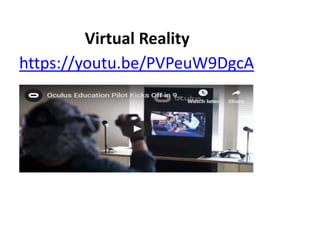
Virtual Reality
https://youtu.be/PVPeuW9DgcA
Social Media
• Establishing, maintaining, and growing a social
media presence is important for libraries
• Social media links make library events,
activities, and offerings easily sharable.
• By responding to social media tags,
comments, or mentions, libraries gain a
valuable opportunity to engage with their
audience and strengthen social connections
Bleeding-Edge Tech (Automatic
Translation)
•Google Pixel Buds are wireless earbuds that translate in
near real time from 40 languages. The Google Pixel Buds
cost $159 and provide 5 hours of battery life.
•Mymanu CLIK out of the U.K. are wireless earbuds that
translate from 37 languages. They currently cost just
under $300.
•Pilot Translating Earpiece from Waverly Labs will launch
soon. This wireless earbud device will offer French,
Italian, Portuguese, and Spanish translations to start with
and will add more languages. It will cost $249 and will do
group translations.
Media Labs
• Multimedia labs are already a trend in many
libraries across the country
• They offer library users the chance to learn and
use design software and equipment for photo
editing, video production, website design, and
page layout.
• They offer library users the chance to learn and
use design software and equipment for photo
editing, video production, website design, and
page layout.
Media Labs
https://youtu.be/6BFDgH7n410
Video Streaming
• Some libraries started circulating GoChip Beams for patrons to take
home. They are essentially storage devices with their own hotspot
network.
• Each GoChip can hold five feature-length movies or an entire
season of a TV series.
• Patrons connect a mobile device, computer, or TV streaming device
to the GoChip's network and watch the movies or TV shows
through the GoChip app.
• Patrons find them really easy to use. These are great for patrons
who don't have home Internet, a TV, or a Netflix subscription.
Artificial
Intelligence
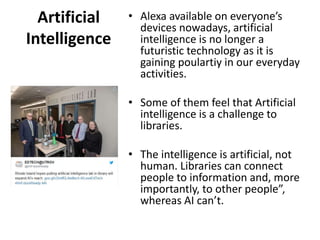
• Alexa available on everyone’s
devices nowadays, artificial
intelligence is no longer a
futuristic technology as it is
gaining poulartiy in our everyday
activities.
• Some of them feel that Artificial
intelligence is a challenge to
libraries.
• The intelligence is artificial, not
human. Libraries can connect
people to information and, more
importantly, to other people”,
whereas AI can’t.
Digital interfaces for printed books
• It is a combination of physical book with e-book
features.
• FingerLink is a prototype developed by Fujitsu that
provides all the digital functionalities on a printed book
Example: https://youtu.be/I2l0qklSzks
• It detects the users’ fingers and what it is touching and
creates an interactive touchscreen where they can
select the part they want to and transpose it in a digital
form, where it can be processed.
Blockchain technology
• Blockchain technology is the most discussed technologies becsuee
of the poularity of the Bitcoin power.
• Blockchain technology represents a decentralized database that
keeps records of pseudonymized digital transactions that are visible
to anyone within the network. Therefore, it is a new way to collect
and store data.
• Sue Alman, a teacher on emerging technologies highlights in an
article for EdSurge that blockchain technology “could be used to
build an enhanced metadata system for libraries, to keep track of
digital-first sale rights and ownership, to connect networks of
libraries and universities, or even to support community-based
borrowing and skill sharing programs.”
Internet of
Things
• IOT refers to the possibility of
connecting everyday devices and
transferring data between them
and the data is transfered over
internet.
• There are many “opportunities for
library applications, from tracking
room usage and program
attendance to monitoring humidity
levels for special collections and
more”.
• Therefore, the library can offer a
better user experience by enriching
its services and collections
https://youtu.be/v-NPTNHOWo0
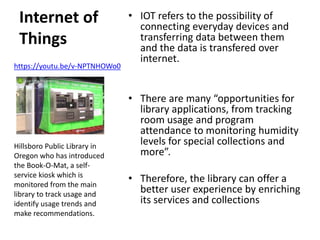
Hillsboro Public Library in
Oregon who has introduced
the Book-O-Mat, a self-
service kiosk which is
monitored from the main
library to track usage and
identify usage trends and
make recommendations.
Drones
• The small flying devices remotely controlled are another
trendsetter in library.
• Drones can be used for creating content for the library,
collecting data.
• Users who don’t have the possibility to go to the library; be
it because of a disability, or because of the long distance to
the library
• Ex: Book Rental Services Zookal uses this service (
https://vimeo.com/76606906 )
Cloud Computing
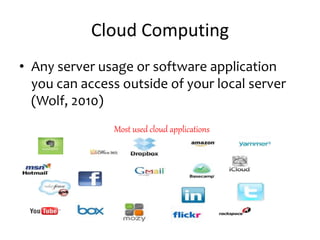
• Any server usage or software application
you can access outside of your local server
(Wolf, 2010)
Most used cloud applications
Cloud Computing - Types
• Three types of cloud computing
• Software as a Service (SaaS) or Applicaion as
service (AaaS)
• Platform as as Service ( PaaS) or Hardware as a
Service (HaaS)
• Infrastructure as a Service (IaaS)
• Software as a servi
Use of Cloud Computing in Library
• With the help of cloud computing technology
libraries can host their website. The district of
Columbia Public Library is using Amazon’s EC2
(Elastic computing cloud) service to host their
website.
• Libraries can use cloud technology like Google
docs to collect response to web forms, Google
Calendar on and meeting rooms, and Google
Analytics to collect statistics about their website,
catalogue and blogs.
Use of Cloud Computing in Library
• Libraries can build digital library, content
management system, institutional repository.
Inter Library Loan system and Integrated Library
System (ILS) from locally managed to vendor-
hosted environment, on their own with the help
of cloud service.
• Cloud computing can be applied for backing up of
media collections and storing and accessing of
bibliographic data. Libraries can also and
maintain much of the same data hundreds and
thousands of times

Emerging Trends Library Science.ppt

  • 1.
    Emerging Trends inLibrary and Information Science Dr. S. Srinivasaragavan Professor & Head Dept. of Library & Information Science Bharathidasan University, Tiruchirappalli-24
  • 2.
    Virtual Reality • Virtualreality (VR) technology provides the user with a headset. • Users can look up, down, and around simply by moving their heads • Libraries may have the opportunity to offer users their first interactions with virtual reality • With this new technology, library can be viewed sitting in one place. Nowadays, Many museums started using this technology. • Ex: In California, Oculus launched an initiative that made 100 Oculus Rift headsets and VR-ready computers available in 90 libraries.
  • 3.
  • 4.
    Social Media • Establishing,maintaining, and growing a social media presence is important for libraries • Social media links make library events, activities, and offerings easily sharable. • By responding to social media tags, comments, or mentions, libraries gain a valuable opportunity to engage with their audience and strengthen social connections
  • 5.
    Bleeding-Edge Tech (Automatic Translation) •GooglePixel Buds are wireless earbuds that translate in near real time from 40 languages. The Google Pixel Buds cost $159 and provide 5 hours of battery life. •Mymanu CLIK out of the U.K. are wireless earbuds that translate from 37 languages. They currently cost just under $300. •Pilot Translating Earpiece from Waverly Labs will launch soon. This wireless earbud device will offer French, Italian, Portuguese, and Spanish translations to start with and will add more languages. It will cost $249 and will do group translations.
  • 6.
    Media Labs • Multimedialabs are already a trend in many libraries across the country • They offer library users the chance to learn and use design software and equipment for photo editing, video production, website design, and page layout. • They offer library users the chance to learn and use design software and equipment for photo editing, video production, website design, and page layout.
  • 7.
  • 8.
    Video Streaming • Somelibraries started circulating GoChip Beams for patrons to take home. They are essentially storage devices with their own hotspot network. • Each GoChip can hold five feature-length movies or an entire season of a TV series. • Patrons connect a mobile device, computer, or TV streaming device to the GoChip's network and watch the movies or TV shows through the GoChip app. • Patrons find them really easy to use. These are great for patrons who don't have home Internet, a TV, or a Netflix subscription.
  • 9.
    Artificial Intelligence • Alexa availableon everyone’s devices nowadays, artificial intelligence is no longer a futuristic technology as it is gaining poulartiy in our everyday activities. • Some of them feel that Artificial intelligence is a challenge to libraries. • The intelligence is artificial, not human. Libraries can connect people to information and, more importantly, to other people”, whereas AI can’t.
  • 10.
    Digital interfaces forprinted books • It is a combination of physical book with e-book features. • FingerLink is a prototype developed by Fujitsu that provides all the digital functionalities on a printed book Example: https://youtu.be/I2l0qklSzks • It detects the users’ fingers and what it is touching and creates an interactive touchscreen where they can select the part they want to and transpose it in a digital form, where it can be processed.
  • 11.
    Blockchain technology • Blockchaintechnology is the most discussed technologies becsuee of the poularity of the Bitcoin power. • Blockchain technology represents a decentralized database that keeps records of pseudonymized digital transactions that are visible to anyone within the network. Therefore, it is a new way to collect and store data. • Sue Alman, a teacher on emerging technologies highlights in an article for EdSurge that blockchain technology “could be used to build an enhanced metadata system for libraries, to keep track of digital-first sale rights and ownership, to connect networks of libraries and universities, or even to support community-based borrowing and skill sharing programs.”
  • 12.
    Internet of Things • IOTrefers to the possibility of connecting everyday devices and transferring data between them and the data is transfered over internet. • There are many “opportunities for library applications, from tracking room usage and program attendance to monitoring humidity levels for special collections and more”. • Therefore, the library can offer a better user experience by enriching its services and collections https://youtu.be/v-NPTNHOWo0 Hillsboro Public Library in Oregon who has introduced the Book-O-Mat, a self- service kiosk which is monitored from the main library to track usage and identify usage trends and make recommendations.
  • 13.
    Drones • The smallflying devices remotely controlled are another trendsetter in library. • Drones can be used for creating content for the library, collecting data. • Users who don’t have the possibility to go to the library; be it because of a disability, or because of the long distance to the library • Ex: Book Rental Services Zookal uses this service ( https://vimeo.com/76606906 )
  • 14.
    Cloud Computing • Anyserver usage or software application you can access outside of your local server (Wolf, 2010) Most used cloud applications
  • 15.
    Cloud Computing -Types • Three types of cloud computing • Software as a Service (SaaS) or Applicaion as service (AaaS) • Platform as as Service ( PaaS) or Hardware as a Service (HaaS) • Infrastructure as a Service (IaaS) • Software as a servi
  • 16.
    Use of CloudComputing in Library • With the help of cloud computing technology libraries can host their website. The district of Columbia Public Library is using Amazon’s EC2 (Elastic computing cloud) service to host their website. • Libraries can use cloud technology like Google docs to collect response to web forms, Google Calendar on and meeting rooms, and Google Analytics to collect statistics about their website, catalogue and blogs.
  • 17.
    Use of CloudComputing in Library • Libraries can build digital library, content management system, institutional repository. Inter Library Loan system and Integrated Library System (ILS) from locally managed to vendor- hosted environment, on their own with the help of cloud service. • Cloud computing can be applied for backing up of media collections and storing and accessing of bibliographic data. Libraries can also and maintain much of the same data hundreds and thousands of times