Advanced Construction & Equipments (2160601)
Submitted to :-
Proff. Purvesh Raval
Submitted by :-
Parth Maheta (141210106020)
1
CONTENT :-
 Introduction
 Working
 Applications
 Factors Affecting
 Some Types
 Advantages & Disadvantages
2
INTRODUCTION
 Dragline falls in heavy equipment’s category.
 Dragline excavator is used for civil engineering projects
and surface mining.
 Dragline is the largest equipment ever built on this planet.
It has the ability to excavate very deep down the earth.
 Word drag is used because it has the ability to drag
material at far distance from the machine.
3
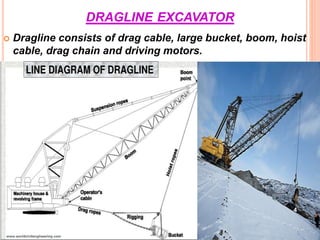
 Dragline consists of drag cable, large bucket, boom, hoist
cable, drag chain and driving motors.
DRAGLINE EXCAVATOR
4
WORKING OF DRAGLINE
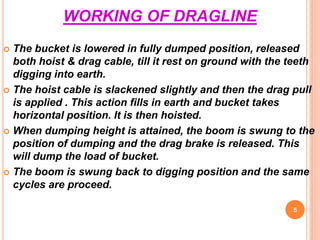
 The bucket is lowered in fully dumped position, released
both hoist & drag cable, till it rest on ground with the teeth
digging into earth.
 The hoist cable is slackened slightly and then the drag pull
is applied . This action fills in earth and bucket takes
horizontal position. It is then hoisted.
 When dumping height is attained, the boom is swung to the
position of dumping and the drag brake is released. This
will dump the load of bucket.
 The boom is swung back to digging position and the same
cycles are proceed.
5
WORKING OF DRAGLINE
6
APPLICATIONS
 Most suitable for digging softer material.
 Useful for excavating trenches.
 Mostly used in excavating canals & embankments.
 Suitable for loose soils, marshy land and areas containing
water.
7
FACTORS AFFECTING ON DRAGLINE
 Size & Type of Bucket :-
Light Bucket : for loose, dry soils, sand & gravel.
Medium: for clays & compacted gravel.
Heavy : for hard & broken rocks.
 Length of Boom :-
 Longer boom with smaller bucket increased
digging rate.
It is possible of dispose off the earth in one operation so
cost and time is saved.
 Type of material :-
 loose, dry & soft soil => Output More.
 Hard & Tough soil => Output Less.
8
FACTORS AFFECTING ON DRAGLINE
 Angle of Swing :- The time cycle is directly proportional to
angle of swing. If Angle of swing increases, output
decreases.
 Depth of cut :- If work at optimum depth and A.O.S=90,
output will be max.
 optimum depth depends on type of soil &
size of bucket, if bucket size is increase, optimum depth of
cut also increases.
 Size of Hauling unit :- The hauling units (trucks) of desired
sizes should be made available, to avoid delay, to get more
output.
 Skill of Operator
9
TYPES OF DRAGLINES
 Crawler mounted draglines :-
 low travel speed.
 suitable for soft ground.
 Wheel mounted draglines :-
 high travel speed.
 suitable for firm ground.
 Truck mounted draglines :-
 same as wheel mounted.
10
ADVANTAGES & DISADVANTAGES OF DRAGLINE
 ADVANTAGES it can work on natural ground while
power shovel take a pit or trench.
 hauling units do not have to go into trench
while using dragline.
 range of working is more than power
shovel.
 excavated material disposed off in one
operation.
 DISADVANTAGES  it has less digging force than P.S
 output is less than as compared to
shovel.
11
Thank You
12

Dragline ppt

  • 1.
    Advanced Construction &Equipments (2160601) Submitted to :- Proff. Purvesh Raval Submitted by :- Parth Maheta (141210106020) 1
  • 2.
    CONTENT :-  Introduction Working  Applications  Factors Affecting  Some Types  Advantages & Disadvantages 2
  • 3.
    INTRODUCTION  Dragline fallsin heavy equipment’s category.  Dragline excavator is used for civil engineering projects and surface mining.  Dragline is the largest equipment ever built on this planet. It has the ability to excavate very deep down the earth.  Word drag is used because it has the ability to drag material at far distance from the machine. 3
  • 4.
     Dragline consistsof drag cable, large bucket, boom, hoist cable, drag chain and driving motors. DRAGLINE EXCAVATOR 4
  • 5.
    WORKING OF DRAGLINE The bucket is lowered in fully dumped position, released both hoist & drag cable, till it rest on ground with the teeth digging into earth.  The hoist cable is slackened slightly and then the drag pull is applied . This action fills in earth and bucket takes horizontal position. It is then hoisted.  When dumping height is attained, the boom is swung to the position of dumping and the drag brake is released. This will dump the load of bucket.  The boom is swung back to digging position and the same cycles are proceed. 5
  • 6.
  • 7.
    APPLICATIONS  Most suitablefor digging softer material.  Useful for excavating trenches.  Mostly used in excavating canals & embankments.  Suitable for loose soils, marshy land and areas containing water. 7
  • 8.
    FACTORS AFFECTING ONDRAGLINE  Size & Type of Bucket :- Light Bucket : for loose, dry soils, sand & gravel. Medium: for clays & compacted gravel. Heavy : for hard & broken rocks.  Length of Boom :-  Longer boom with smaller bucket increased digging rate. It is possible of dispose off the earth in one operation so cost and time is saved.  Type of material :-  loose, dry & soft soil => Output More.  Hard & Tough soil => Output Less. 8
  • 9.
    FACTORS AFFECTING ONDRAGLINE  Angle of Swing :- The time cycle is directly proportional to angle of swing. If Angle of swing increases, output decreases.  Depth of cut :- If work at optimum depth and A.O.S=90, output will be max.  optimum depth depends on type of soil & size of bucket, if bucket size is increase, optimum depth of cut also increases.  Size of Hauling unit :- The hauling units (trucks) of desired sizes should be made available, to avoid delay, to get more output.  Skill of Operator 9
  • 10.
    TYPES OF DRAGLINES Crawler mounted draglines :-  low travel speed.  suitable for soft ground.  Wheel mounted draglines :-  high travel speed.  suitable for firm ground.  Truck mounted draglines :-  same as wheel mounted. 10
  • 11.
    ADVANTAGES & DISADVANTAGESOF DRAGLINE  ADVANTAGES it can work on natural ground while power shovel take a pit or trench.  hauling units do not have to go into trench while using dragline.  range of working is more than power shovel.  excavated material disposed off in one operation.  DISADVANTAGES  it has less digging force than P.S  output is less than as compared to shovel. 11
  • 12.