Bangalore University
B.com online
Financial Accounting
B.com online (SEMESTER SCHEME) 2024 –2025
Sem: 1St Sem B.com
Subject: Financial Accounting
MODUL-1 CONCEPTUAL FRAME WORK OF FINANCIAL
ACCOUNTING-CLASS-2
Dr. Gurumurthy K H
Associate Prof. in Commerce &
In-charge Principal, GFGC Kudur,
Magadi,(Tq) Ramanagar (dt)
561101
2
Module 1. CONCEPTUAL FRAME WORK OF FINANCIALACCOUNTING
1. Accounting Cycle/process/ Steps
2. Examples—Realization vs Accrual concept
3. Accounting Equation – explain with illustration
4. Financial Statement-Income statement and Balance Sheet-
Assignment and Quiz questions
3
Accounting cycle/process
4
Identifying
Transactions
Journal
entry
Post to
Ledger
preparing
Trail balance
Adjusting
entries
Adjust
Journal
entries
preparing
Financial
statement
Closing
Accounts
books
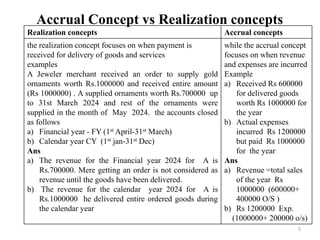
Accrual Concept vs Realization concepts
5
Realization concepts Accrual concepts
the realization concept focuses on when payment is
received for delivery of goods and services
examples
A Jeweler merchant received an order to supply gold
ornaments worth Rs.1000000 and received entire amount
(Rs 1000000) . A supplied ornaments worth Rs.700000 up
to 31st March 2024 and rest of the ornaments were
supplied in the month of May 2024. the accounts closed
as follows
a) Financial year - FY (1st April-31st March)
b) Calendar year CY (1st jan-31st Dec)
Ans
a) The revenue for the Financial year 2024 for A is
Rs.700000. Mere getting an order is not considered as
revenue until the goods have been delivered.
b) The revenue for the calendar year 2024 for A is
Rs.1000000 he delivered entire ordered goods during
the calendar year
while the accrual concept
focuses on when revenue
and expenses are incurred
Example
a) Received Rs 600000
for delivered goods
worth Rs 1000000 for
the year
b) Actual expenses
incurred Rs 1200000
but paid Rs 1000000
for the year
Ans
a) Revenue =total sales
of the year Rs
1000000 (600000+
400000 O/S )
b) Rs 1200000 Exp.
(1000000+ 200000 o/s)
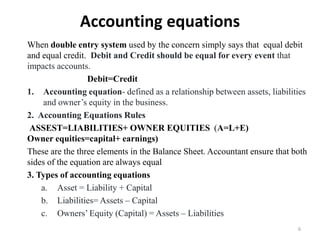
Accounting equations
When double entry system used by the concern simply says that equal debit
and equal credit. Debit and Credit should be equal for every event that
impacts accounts.
Debit=Credit
1. Accounting equation- defined as a relationship between assets, liabilities
and owner’s equity in the business.
2. Accounting Equations Rules
ASSEST=LIABILITIES+ OWNER EQUITIES (A=L+E)
Owner equities=capital+ earnings)
These are the three elements in the Balance Sheet. Accountant ensure that both
sides of the equation are always equal
3. Types of accounting equations
a. Asset = Liability + Capital
b. Liabilities= Assets – Capital
c. Owners’ Equity (Capital) = Assets – Liabilities
6
Example
• Jan 1 Invested Capital Rs 200000
• Jan 2 Purchased goods on credit from KK Co. for Rs 20000
• Jan 4 Bought plant and machinery for Rs 80000 for cash
• Jan 8 Purchased goods for Rs 4,000 on cash basis
• Jan 12 Sold goods for RS 60000 on cash (stock 40000+ profit
20000)
• Jan 18 Paid to KK Co. cash Rs 10000
• Jan 22 Received Rs 3000 from Mr. Y (being a debtor)
• Jan 25 Paid salary of Rs 60000
• Jan 30 Received interest of Rs 5,000
The effect of above transactions on Assets, liabilities and owner’s
equity considering the accounting equation
7
Date Transaction Journal entries Assets = Liability + Owners equity
(capital + Earnings
Jan
1st
Invested Capital
200000
Bank a/c Dr.
To Capital Cr
200000 - 200000
Jan
2nd
Purchased goods
on credit from KK
Co Rs 20000
Purchase a/c Dr
To KK Co. Cr.
(purchase=stock
KK=creditor)
20000 20000 -
As on Jan 2nd the assets = liabilities +capital 220000= 20000 + 200000
Jan
4th
Bought P &M Rs
80000 for cash
P & M a/c Dr.
To Bank Cr.
+ 80000
- 80000
- -
As on Jan 4th the revised equation 220000= 20000 + 200000
Jan
8th
Purchased goods Rs
4,000 on cash
Purchase Dr.
To cash Cr.
+ 4000
- 4000
- -
As on Jan 8th the revised equation 220000= 20000 + 200000
Jan
12th
Sold goods for cash
60000 (40000 stock
+20000 profit)
Bank a/c Dr.
To Sales Cr
(sales=stock)
+60000
-40000
+ 20000
-
+ 20000
As on Jan 12th the revised equation 240000 20000 + 220000
8
Date Transaction Journal entries Assets = Liability + Owners equity
(capital + Earnings)
Jan
18th
Paid to KK Co. cash
Rs 10000
KK a/c Dr.
To Bank Cr
-10000 -10000 -
As on Jan 18nd the Revised equation 230000= 10000 + 220000
Jan
22nd
Received Rs 3000
from Y (being debtor
Bank a/c Dr.
To Y Cr.
+ 3000
- 3000
- -
As on Jan 22nd the revised equation 230000= 10000 + 220000
Jan
25th
Paid wages & salary
of Rs 60000
Salary Dr.
To Bank Cr.
- 60000 - - 60000
As on Jan 25th the revised equation 170000= 10000 + 160000
Jan
30th
Received interest of
Rs 5,000
Bank a/c Dr.
To Interest Cr
+5000 - +5000
As on Jan 30th the revised equation 175000= 10000 + 165000
9

Basic Accounting frame work frame - 2.pdf

  • 1.
  • 2.
    B.com online (SEMESTERSCHEME) 2024 –2025 Sem: 1St Sem B.com Subject: Financial Accounting MODUL-1 CONCEPTUAL FRAME WORK OF FINANCIAL ACCOUNTING-CLASS-2 Dr. Gurumurthy K H Associate Prof. in Commerce & In-charge Principal, GFGC Kudur, Magadi,(Tq) Ramanagar (dt) 561101 2
  • 3.
    Module 1. CONCEPTUALFRAME WORK OF FINANCIALACCOUNTING 1. Accounting Cycle/process/ Steps 2. Examples—Realization vs Accrual concept 3. Accounting Equation – explain with illustration 4. Financial Statement-Income statement and Balance Sheet- Assignment and Quiz questions 3
  • 4.
    Accounting cycle/process 4 Identifying Transactions Journal entry Post to Ledger preparing Trailbalance Adjusting entries Adjust Journal entries preparing Financial statement Closing Accounts books
  • 5.
    Accrual Concept vsRealization concepts 5 Realization concepts Accrual concepts the realization concept focuses on when payment is received for delivery of goods and services examples A Jeweler merchant received an order to supply gold ornaments worth Rs.1000000 and received entire amount (Rs 1000000) . A supplied ornaments worth Rs.700000 up to 31st March 2024 and rest of the ornaments were supplied in the month of May 2024. the accounts closed as follows a) Financial year - FY (1st April-31st March) b) Calendar year CY (1st jan-31st Dec) Ans a) The revenue for the Financial year 2024 for A is Rs.700000. Mere getting an order is not considered as revenue until the goods have been delivered. b) The revenue for the calendar year 2024 for A is Rs.1000000 he delivered entire ordered goods during the calendar year while the accrual concept focuses on when revenue and expenses are incurred Example a) Received Rs 600000 for delivered goods worth Rs 1000000 for the year b) Actual expenses incurred Rs 1200000 but paid Rs 1000000 for the year Ans a) Revenue =total sales of the year Rs 1000000 (600000+ 400000 O/S ) b) Rs 1200000 Exp. (1000000+ 200000 o/s)
  • 6.
    Accounting equations When doubleentry system used by the concern simply says that equal debit and equal credit. Debit and Credit should be equal for every event that impacts accounts. Debit=Credit 1. Accounting equation- defined as a relationship between assets, liabilities and owner’s equity in the business. 2. Accounting Equations Rules ASSEST=LIABILITIES+ OWNER EQUITIES (A=L+E) Owner equities=capital+ earnings) These are the three elements in the Balance Sheet. Accountant ensure that both sides of the equation are always equal 3. Types of accounting equations a. Asset = Liability + Capital b. Liabilities= Assets – Capital c. Owners’ Equity (Capital) = Assets – Liabilities 6
  • 7.
    Example • Jan 1Invested Capital Rs 200000 • Jan 2 Purchased goods on credit from KK Co. for Rs 20000 • Jan 4 Bought plant and machinery for Rs 80000 for cash • Jan 8 Purchased goods for Rs 4,000 on cash basis • Jan 12 Sold goods for RS 60000 on cash (stock 40000+ profit 20000) • Jan 18 Paid to KK Co. cash Rs 10000 • Jan 22 Received Rs 3000 from Mr. Y (being a debtor) • Jan 25 Paid salary of Rs 60000 • Jan 30 Received interest of Rs 5,000 The effect of above transactions on Assets, liabilities and owner’s equity considering the accounting equation 7
  • 8.
    Date Transaction Journalentries Assets = Liability + Owners equity (capital + Earnings Jan 1st Invested Capital 200000 Bank a/c Dr. To Capital Cr 200000 - 200000 Jan 2nd Purchased goods on credit from KK Co Rs 20000 Purchase a/c Dr To KK Co. Cr. (purchase=stock KK=creditor) 20000 20000 - As on Jan 2nd the assets = liabilities +capital 220000= 20000 + 200000 Jan 4th Bought P &M Rs 80000 for cash P & M a/c Dr. To Bank Cr. + 80000 - 80000 - - As on Jan 4th the revised equation 220000= 20000 + 200000 Jan 8th Purchased goods Rs 4,000 on cash Purchase Dr. To cash Cr. + 4000 - 4000 - - As on Jan 8th the revised equation 220000= 20000 + 200000 Jan 12th Sold goods for cash 60000 (40000 stock +20000 profit) Bank a/c Dr. To Sales Cr (sales=stock) +60000 -40000 + 20000 - + 20000 As on Jan 12th the revised equation 240000 20000 + 220000 8
  • 9.
    Date Transaction Journalentries Assets = Liability + Owners equity (capital + Earnings) Jan 18th Paid to KK Co. cash Rs 10000 KK a/c Dr. To Bank Cr -10000 -10000 - As on Jan 18nd the Revised equation 230000= 10000 + 220000 Jan 22nd Received Rs 3000 from Y (being debtor Bank a/c Dr. To Y Cr. + 3000 - 3000 - - As on Jan 22nd the revised equation 230000= 10000 + 220000 Jan 25th Paid wages & salary of Rs 60000 Salary Dr. To Bank Cr. - 60000 - - 60000 As on Jan 25th the revised equation 170000= 10000 + 160000 Jan 30th Received interest of Rs 5,000 Bank a/c Dr. To Interest Cr +5000 - +5000 As on Jan 30th the revised equation 175000= 10000 + 165000 9