 An Accounting Equation is a mathematical
expression which shows that the assets are
equal to liabilities plus Capital.
 An Accounting Equation is based on the dual
aspect concept of accounting i.e., every
transaction has two effects
 Total Funds or Claims (i.e. Capital and Liabilities)
are always equal to the total Assets and is known
as Accounting Equation.
 The funds are of two types:
1. Owner's equity or capital, and
2. Outsiders Equity (Liabilities or amounts due to
outsiders).
 We can expressAccounting Equation as follows:
a) Assets = Liabilities + Capital or
b) Liabilities = Assets – Capital or
c) Capital = Assets - Liabilities
 An Accounting Equation always holds true
with every change that occurs due to a
transaction entered into. It is because of this
reason that it is based on the dual aspect
concept of accounting.
 A transaction may affect either both sides of
the equation by the same amount or one side
of the equation only. by both increasing or
decreasing it by equal amounts.
The procedure to workout an Accounting Equation
is:
1. Analyse the transaction in terms of such variables
as assets, liabilities, capital. revenues and
expenses.
2. Decide the effect of the transactions in terms of
increase or decrease on variables mentioned in 1.
3. Record the effect on the relevant side of the
equation.
 Let us take a few transactions to understand the
accounting equation.
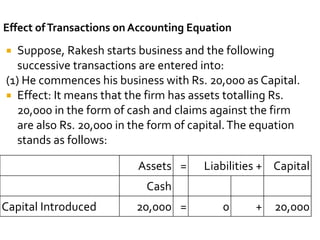
 Suppose, Rakesh starts business and the following
successive transactions are entered into:
(1) He commences his business with Rs. 20,000 as Capital.
 Effect: It means that the firm has assets totalling Rs.
20,000 in the form of cash and claims against the firm
are also Rs. 20,000 in the form of capital.The equation
stands as follows:
Assets = Liabilities + Capital
Cash
Capital Introduced 20,000 = 0 + 20,000
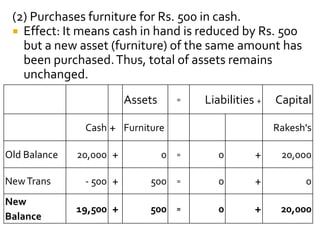
(2) Purchases furniture for Rs. 500 in cash.
 Effect: It means cash in hand is reduced by Rs. 500
but a new asset (furniture) of the same amount has
been purchased.Thus, total of assets remains
unchanged.
Assets = Liabilities + Capital
Cash + Furniture Rakesh's
Old Balance 20,000 + 0 = 0 + 20,000
NewTrans - 500 + 500 = 0 + 0
New
Balance
19,500 + 500 = 0 + 20,000
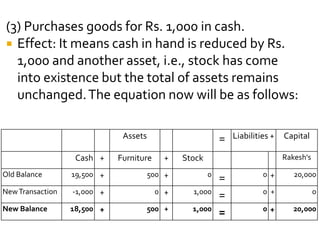
(3) Purchases goods for Rs. 1,000 in cash.
 Effect: It means cash in hand is reduced by Rs.
1,000 and another asset, i.e., stock has come
into existence but the total of assets remains
unchanged.The equation now will be as follows:
Assets = Liabilities + Capital
Cash + Furniture + Stock Rakesh's
Old Balance 19,500 + 500 + 0
= 0 + 20,000
NewTransaction -1,000 + 0 + 1,000
= 0 + 0
New Balance 18,500 + 500 + 1,000
= 0 + 20,000
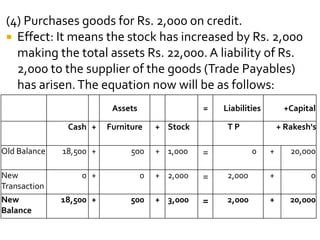
(4) Purchases goods for Rs. 2,000 on credit.
 Effect: It means the stock has increased by Rs. 2,000
making the total assets Rs. 22,000. A liability of Rs.
2,000 to the supplier of the goods (Trade Payables)
has arisen.The equation now will be as follows:
Assets = Liabilities +Capital
Cash + Furniture + Stock T P + Rakesh's
Old Balance 18,500 + 500 + 1,000 = 0 + 20,000
New
Transaction
0 + 0 + 2,000 = 2,000 + 0
New
Balance
18,500 + 500 + 3,000 = 2,000 + 20,000
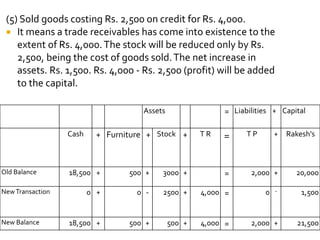
(5) Sold goods costing Rs. 2,500 on credit for Rs. 4,000.
 It means a trade receivables has come into existence to the
extent of Rs. 4,000.The stock will be reduced only by Rs.
2,500, being the cost of goods sold.The net increase in
assets. Rs. 1,500. Rs. 4,000 - Rs. 2,500 (profit) will be added
to the capital.
Assets = Liabilities + Capital
Cash + Furniture + Stock + T R = T P + Rakesh's
Old Balance 18,500 + 500 + 3000 + = 2,000 + 20,000
NewTransaction 0 + 0 - 2500 + 4,000 = 0 - 1,500
New Balance 18,500 + 500 + 500 + 4,000 = 2,000 + 21,500
Assets = Liabilities + Capital+ [(Revenue-
Expenses)- dividends]
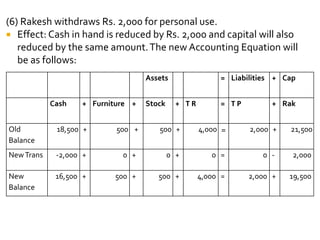
(6) Rakesh withdraws Rs. 2,000 for personal use.
 Effect: Cash in hand is reduced by Rs. 2,000 and capital will also
reduced by the same amount.The new Accounting Equation will
be as follows:
Assets = Liabilities + Cap
Cash + Furniture + Stock + T R = T P + Rak
Old
Balance
18,500 + 500 + 500 + 4,000 = 2,000 + 21,500
NewTrans -2,000 + 0 + 0 + 0 = 0 - 2,000
New
Balance
16,500 + 500 + 500 + 4,000 = 2,000 + 19,500

PPTs on Accounting Equation for beginners.pptx

  • 2.
     An AccountingEquation is a mathematical expression which shows that the assets are equal to liabilities plus Capital.  An Accounting Equation is based on the dual aspect concept of accounting i.e., every transaction has two effects
  • 3.
     Total Fundsor Claims (i.e. Capital and Liabilities) are always equal to the total Assets and is known as Accounting Equation.  The funds are of two types: 1. Owner's equity or capital, and 2. Outsiders Equity (Liabilities or amounts due to outsiders).  We can expressAccounting Equation as follows: a) Assets = Liabilities + Capital or b) Liabilities = Assets – Capital or c) Capital = Assets - Liabilities
  • 4.
     An AccountingEquation always holds true with every change that occurs due to a transaction entered into. It is because of this reason that it is based on the dual aspect concept of accounting.  A transaction may affect either both sides of the equation by the same amount or one side of the equation only. by both increasing or decreasing it by equal amounts.
  • 5.
    The procedure toworkout an Accounting Equation is: 1. Analyse the transaction in terms of such variables as assets, liabilities, capital. revenues and expenses. 2. Decide the effect of the transactions in terms of increase or decrease on variables mentioned in 1. 3. Record the effect on the relevant side of the equation.  Let us take a few transactions to understand the accounting equation.
  • 6.
     Suppose, Rakeshstarts business and the following successive transactions are entered into: (1) He commences his business with Rs. 20,000 as Capital.  Effect: It means that the firm has assets totalling Rs. 20,000 in the form of cash and claims against the firm are also Rs. 20,000 in the form of capital.The equation stands as follows: Assets = Liabilities + Capital Cash Capital Introduced 20,000 = 0 + 20,000
  • 7.
    (2) Purchases furniturefor Rs. 500 in cash.  Effect: It means cash in hand is reduced by Rs. 500 but a new asset (furniture) of the same amount has been purchased.Thus, total of assets remains unchanged. Assets = Liabilities + Capital Cash + Furniture Rakesh's Old Balance 20,000 + 0 = 0 + 20,000 NewTrans - 500 + 500 = 0 + 0 New Balance 19,500 + 500 = 0 + 20,000
  • 8.
    (3) Purchases goodsfor Rs. 1,000 in cash.  Effect: It means cash in hand is reduced by Rs. 1,000 and another asset, i.e., stock has come into existence but the total of assets remains unchanged.The equation now will be as follows: Assets = Liabilities + Capital Cash + Furniture + Stock Rakesh's Old Balance 19,500 + 500 + 0 = 0 + 20,000 NewTransaction -1,000 + 0 + 1,000 = 0 + 0 New Balance 18,500 + 500 + 1,000 = 0 + 20,000
  • 9.
    (4) Purchases goodsfor Rs. 2,000 on credit.  Effect: It means the stock has increased by Rs. 2,000 making the total assets Rs. 22,000. A liability of Rs. 2,000 to the supplier of the goods (Trade Payables) has arisen.The equation now will be as follows: Assets = Liabilities +Capital Cash + Furniture + Stock T P + Rakesh's Old Balance 18,500 + 500 + 1,000 = 0 + 20,000 New Transaction 0 + 0 + 2,000 = 2,000 + 0 New Balance 18,500 + 500 + 3,000 = 2,000 + 20,000
  • 10.
    (5) Sold goodscosting Rs. 2,500 on credit for Rs. 4,000.  It means a trade receivables has come into existence to the extent of Rs. 4,000.The stock will be reduced only by Rs. 2,500, being the cost of goods sold.The net increase in assets. Rs. 1,500. Rs. 4,000 - Rs. 2,500 (profit) will be added to the capital. Assets = Liabilities + Capital Cash + Furniture + Stock + T R = T P + Rakesh's Old Balance 18,500 + 500 + 3000 + = 2,000 + 20,000 NewTransaction 0 + 0 - 2500 + 4,000 = 0 - 1,500 New Balance 18,500 + 500 + 500 + 4,000 = 2,000 + 21,500
  • 11.
    Assets = Liabilities+ Capital+ [(Revenue- Expenses)- dividends]
  • 12.
    (6) Rakesh withdrawsRs. 2,000 for personal use.  Effect: Cash in hand is reduced by Rs. 2,000 and capital will also reduced by the same amount.The new Accounting Equation will be as follows: Assets = Liabilities + Cap Cash + Furniture + Stock + T R = T P + Rak Old Balance 18,500 + 500 + 500 + 4,000 = 2,000 + 21,500 NewTrans -2,000 + 0 + 0 + 0 = 0 - 2,000 New Balance 16,500 + 500 + 500 + 4,000 = 2,000 + 19,500